
Aircraft Hose Fittings Market Trends, Size & Growth by 2034
Coverage: By Material (PTFE, Rubber, Metal, Others); Flexibility (Flexible, Non-flexible); Aircraft Type (Commercial Aircraft, Military Aircraft, Industrial Aircraft, Others); Application (Hydraulic, Fuel, Lubrication, Air, Others) , and Geography (North America, Europe, Asia Pacific, and South and Central America)
- Status : Data Released
- Report Code : TIPRE00017890
- Category : Aerospace and Defense
- No. of Pages : 150
- Available Report Formats :


- Last update date : November 02, 2026


2025 Market Size
US$ 1.48 Bn
Base year value
2034 Forecast
US$ 2.35 Bn
Projected by 2034
CAGR 2026-2034
5.28 %
Growth rate
Addressable Market
US$ 17.38 Bn
(2026-2034)
The aircraft hose fittings market is valued at US$ 1.48 Billion in 2025 and is projected to reach US$ 2.35 Billion by 2034, registering a CAGR of 5.28% during 2026–2034. The market covers fittings used with aircraft fluid conveyance systems across hydraulic, fuel, lubrication, and air applications, with demand shaped by commercial fleet expansion, military platform procurement, aircraft maintenance, and replacement requirements.
North America remains a structurally important demand center for Aircraft Hose Fittings Market share, supported by established aircraft manufacturing, extensive military fleets, mature MRO infrastructure, and a large installed base requiring recurring component replacement. The regional market is estimated to expand at a ~5% CAGR through 2034, with demand reinforced by commercial aircraft production, defense modernization, and continued specification of certified fluid-connectivity components across airframe and engine systems.
Aircraft Hose Fittings Market Assessment and Insights
Regional Outlook
- North America: ~39% of the global market in 2025 | ~5% CAGR through 2034. Market position: North America holds the largest regional position, supported by major commercial and defense aerospace programs, extensive MRO capacity, established component qualification infrastructure, and strong demand for hydraulic, fuel, and air conveyance systems.
- US: ~85% of North American market revenue in 2025 | ~5% CAGR through 2034. Market position: The US represents the principal demand center within North America, combining aircraft production, military procurement, general aviation activity, and a broad installed fleet requiring certified fittings for hydraulic, fuel, lubrication, and air systems.
- Europe: ~28% of the global market in 2025 | ~4% CAGR through 2034. Market position: Europe is a mature aerospace manufacturing and MRO base, with Germany leading the regional market and France, the UK, Italy, and Spain providing significant aircraft production, maintenance, and component demand.
- Asia Pacific: ~22% of the global market in 2025 | ~7% CAGR through 2034. Market position: Asia Pacific is the fastest-growing region, supported by fleet expansion, expanding MRO networks, aerospace manufacturing localization, and rising defense aviation expenditure across China, India, Japan, South Korea, and Australia.
Segment Outlook
- Commercial Aircraft: ~58% Share in 2025 | ~5% CAGR through 2034. Market position: Commercial aircraft represents the largest main segment because of its broad installed fleet, high utilization rates, recurring maintenance requirements, and extensive use of fluid conveyance systems across flight-critical and auxiliary applications.
- Military Aircraft: ~30% Share in 2025 | ~7% CAGR through 2034. Market position: Military aircraft provides the higher-growth main segment as defense modernization, fleet sustainment, new platform procurement, and upgrades to hydraulic and fuel systems increase demand for qualified, durable hose-fitting assemblies.
Competitive Coverage
Chief Aircraft Inc., Delafield Corporation, Eaton Corporation, Flexfab LLC, Hy-Lok USA, Inc., Parker Hannifin Corporation, Precision Hose Technology, Inc., Specialty Hose Corporation, TECALEMIT AEROSPACE, Titeflex
Methodology
The Insight Partners follows Data Collection & Secondary Research, Primary Research, Data Analysis, and Data Triangulation & Final Review to validate market estimates and insights.
Source: The Insight Partners' analysis based on proprietary research, government publications, company annual reports, investor presentations, industry databases, and expert interviews.
The aircraft hose fittings market has evolved alongside aircraft fluid-system requirements, shifting from standardized metallic connection components toward application-specific assemblies optimized for pressure, temperature, vibration, corrosion resistance, weight, and maintainability. PTFE-containing hoses have become more relevant in situations when chemical resistance and thermal resistance are needed, while rubber or metallic products keep being used where flexibility, strength, and durability are essential. Hose assembly suppliers now tend to use fittings together with specially designed hose assemblies, quick couplers, swivel joints, and special sealing arrangements that help deal with installation limitations on platforms.
The production processes are also determined by qualification procedures in the aerospace industry. Suppliers need to keep stable dimensional tolerances, material traceability, process control, and qualification for an extended period of time, which is favorable for well-established suppliers with qualified production systems but allows other specialists to compete. The aircraft hose fittings market therefore, combines recurring replacement demand with new-build requirements, creating a supply environment in which reliability and qualification history are central procurement considerations.
Through 2034, the Aircraft Hose Fittings Market forecast is expected to benefit from emerging aerospace manufacturing centers as aircraft fleets expand and local MRO capabilities mature. Asia Pacific is particularly relevant because commercial aviation growth is being accompanied by indigenous aerospace programs, defense procurement, and investment in maintenance infrastructure. North American and European suppliers are also likely to deepen regional support networks to serve operators closer to aircraft maintenance bases.
Aircraft Hose Fittings Market trends are influenced by regulatory and procurement requirements, favoring products capable of operating under demanding pressure, temperature, vibration, and fire-resistance conditions. Investment is consequently expected to concentrate on material engineering, precision machining, testing capability, flexible manufacturing, and configuration management. These priorities should support gradual market expansion while preserving relatively high entry barriers for suppliers without aerospace qualification experience.
Aircraft Hose Fittings Market Report Scope
| Report Attribute | Details |
|---|---|
| Market size in 2025 | US$ 1.48 Billion |
| Market Size by 2034 | US$ 2.35 Billion |
| Global CAGR (2026 - 2034) | 5.28% |
| Historical Data | 2021-2024 |
| Forecast period | 2026-2034 |
Aircraft Hose Fittings Market Analysis
The Aircraft Hose Fittings Market growth is driven by the interaction of aircraft production, fleet utilization, MRO activity, and replacement cycles. Hydraulic, fuel, lubrication, and air systems all require reliable connections between flexible hoses, rigid tubing, valves, pumps, actuators, and other equipment. Greater utilization of aircraft will lead to increased need for inspections and replacements, and the introduction of new airframes will generate additional demand for quality components. Such a demand pool is diverse and spread between original equipment and aftermarket channels as compared to a single procurement cycle.
The value chain comprises suppliers of materials, machining and forming activities, hose producers, fittings manufacturers, hose assembly, distributors, MRO services, and aircraft, engine and system OEMs. Supply conditions benefit those organizations able to coordinate material sourcing, fittings design, hose assembly, testing and certification. For instance, TECALEMIT AEROSPACE offers a range of services including hose, pipe, hybrid pipe, and fittings while Eaton is an aerospace hose, fitting and coupling, as well as fluid conveyance systems provider.
Competitive positioning in the Aircraft Hose Fittings Market is shaped by qualification records, engineering support, product breadth, manufacturing consistency, and aftermarket availability. Parker Hannifin Corporation and Eaton Corporation cover broad fluid conveyance product lines for aerospace, while companies such as Titeflex, Flexfab LLC, Specialty Hose Corporation, Precision Hose Technology, and TECALEMIT AEROSPACE offer more focused products. Companies such as Hy-Lok USA, Inc., Delafield Corporation, and Chief Aircraft Inc. further increase competition in the area of fittings, distribution, and application-specific components.
Aerospace business growth will become increasingly dependent on manufacturing capability, quality system management, product engineering, and regional presence. Parker Hannifin Corporation has had solid aerospace orders in fiscal year 2026, whereas the company's aerospace product line covers both commercial and defense areas. In the case of aerospace suppliers, business growth will thus be increasingly dependent on the ability to balance OEM projects of long duration with replacement/MRO projects.
● REPORT CUSTOMIZATION
Tailor This Report To Align With Your Specific Business Requirements
This report can be customized to align precisely with your business objectives, scope, and target markets. Customization options include tailored segmentation, geography, competitive analysis, and strategic insights to support informed decision-making.
Customize This Report →WHAT YOU CAN ADJUST
- ● Segmentations
- ● Geography
- ● Competitive Analysis
- ● Language Preferences
Aircraft Hose Fittings Market: Strategic Insights
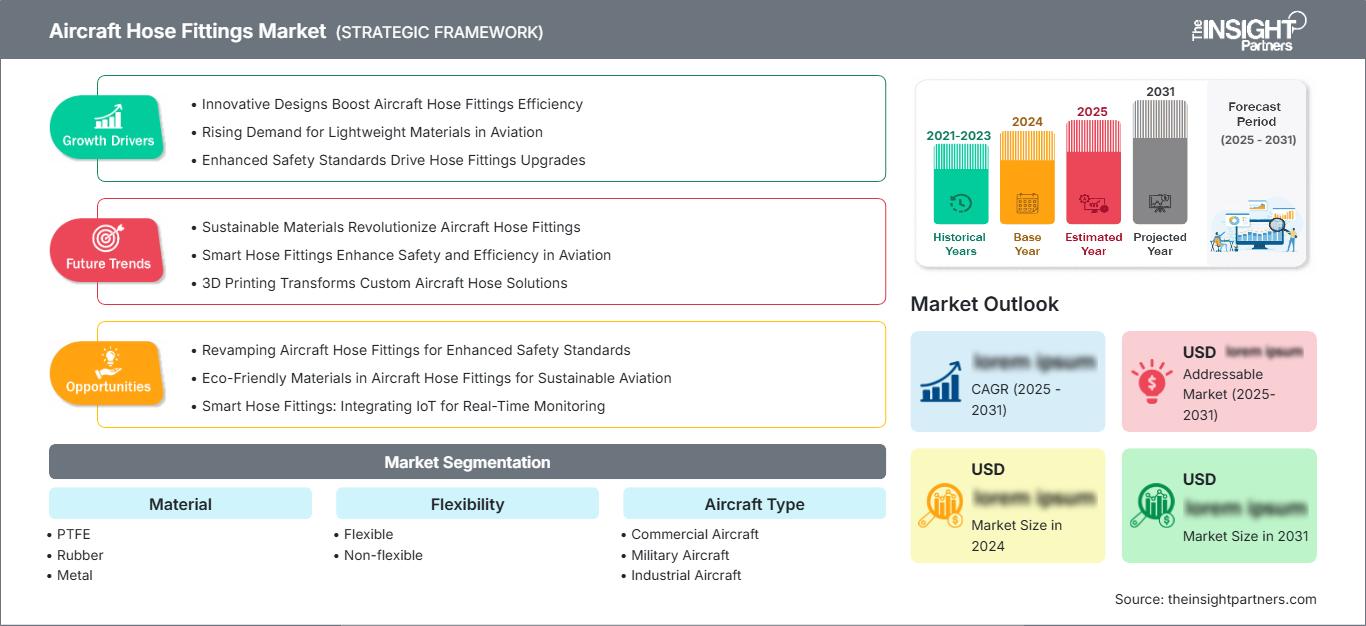
Regional Insights
North America aircraft hose fittings market
North America accounts for ~39% of the global aircraft hose fittings market in 2025 and is expected to expand at a ~5% CAGR through 2034. The region benefits from a large commercial aircraft fleet, substantial military aviation activity, established aircraft production, and extensive MRO infrastructure. The US is considered to be the main demand source on the regional market since the producers of aircraft, defense equipment, airlines, independent MRO firms, as well as distributors of parts generate a wide consumer base. Canadian demand appears from commercial aviation, business aviation, and aerospace manufacturing.
The regional market also profits from advanced qualification and replacement processes. Airplane operators and MRO companies need fittings that guarantee compatibility and integrity during each subsequent repair cycle. Hydraulics and fuels appear to be major demand sectors because of numerous fluid circuitries under pressure and vibration. The needs of this market are met by such suppliers as Eaton Corporation, Parker Hannifin Corporation, Titeflex, Flexfab LLC and others in terms of their aerospace products. Thus, the North American demand should stay balanced between new airplane equipment and replacement aftermarket.
U.S. aircraft hose fittings market
The US represents ~85% of North American aircraft hose fittings market revenue in 2025 and is projected to record a ~5% CAGR through 2034. Its position reflects the concentration of aircraft manufacturers, military platforms, airline fleets, MRO facilities, and aerospace component suppliers. The country's large installed fleet creates recurring demand for replacement fittings, hose assemblies, and related fluid-connectivity components.
Requirements cover hydraulic actuation, fuel delivery systems, lubrication lines, pneumatic systems, cooling, and other auxiliary aircraft applications. The commercial aviation industry provides high volume repeat orders, whereas the military program calls for components that can withstand challenging environmental and performance conditions. Companies such as Parker Hannifin Corporation, Eaton Corporation, Titeflex, Chief Aircraft Inc., and Specialty Hose Corporation are part of the larger US aerospace fluid conveyance market. Growth in aircraft production and defense fleets will drive demand throughout the forecast period.
Europe aircraft hose fittings market
Europe represents ~28% of the global aircraft hose fittings market in 2025 and is expected to expand at a ~4% CAGR through 2034. Germany is the leader in Europe due to its aerospace manufacturing capability, industry capability, MRO activities, and involvement in large aircraft programs. France is also significant due to its airframe, engine, and aerospace system ecosystem. The UK contributes through aircraft manufacturing, defense aviation, and aerospace engineering, whereas Italy and Spain contribute through aircraft manufacturing, component manufacturing, and MRO operations.
The developed aerospace industry in the region ensures that there is an existing aircraft fleet of commercial, military, and industrial aircraft in the region. The existence of an existing fleet ensures the existence of recurring replacement even when the cycles of aircraft deliveries vary. Buyers in Europe are also known for their concern with material traceability, technical documentation, quality management, and compliance with aerospace standards. TECALEMIT AEROSPACE has a wide presence in the aerospace industry in Europe in terms of hose, pipe, fitting, and assembly.
The demand is becoming more reliant on aircraft usage, new aircraft fleets, defense upgrades, and regional maintenance capabilities. Germany has the advantage of a strong industrial capability, giving it the strongest demand potential of any nation. Both France and the UK still have relevance in aerospace engineering and procurement. There is also potential in Italy and Spain in terms of aircraft manufacture and maintenance.
APAC aircraft hose fittings market
Asia Pacific accounts for ~22% of the global aircraft hose fittings market in 2025 and is forecast to grow at a ~7% CAGR through 2034, making it the fastest-growing region. The leader of this region is China, which has aircraft manufacturing, commercial fleet growth, defense aviation, and MRO capabilities. In addition, India is developing its aerospace environment due to fleet growth, defense spending, manufacturing localization, and the development of MRO capability.
The presence of other countries like Japan and South Korea can be attributed to their aerospace manufacturing and defense programs, while Australia contributes to the demand through military aviation, commercial fleet, and maintenance activities. The future growth in this region will depend on the increase in operating bases of aircraft and MRO capability. Fittings related to hydraulic systems, fuel systems, lubrication systems, and air systems require suppliers with certification skills and logistics capabilities.
Middle East & Africa aircraft hose fittings market
The Middle East and Africa aircraft hose fittings market demand is supported by airline fleet expansion, aircraft utilization, defense aviation, and investments in aviation infrastructure. Saudi Arabia and the UAE represent major regional demand centers, with fleet development and MRO investment creating opportunities for fluid-system component suppliers. South Africa provides an established aerospace and maintenance base serving commercial, defense, and specialized aviation applications.
The regional market is expected to expand at a ~5% CAGR through 2034. Gulf aviation hubs generate recurring requirements for replacement components because high aircraft utilization increases maintenance activity. Saudi Arabia's expanding aviation infrastructure and the UAE's established airline and MRO ecosystem provide important procurement channels. Across Africa, demand is more fragmented and closely linked to fleet modernization, maintenance accessibility, and defense requirements.
Segmentation Analysis
Material
Material selection is governed by pressure, temperature, chemical compatibility, weight, corrosion resistance, and required service life. PTFE is positioned strongly in applications requiring chemical resistance and stable performance across demanding operating conditions, while rubber remains important where flexibility and cost-effective fluid conveyance are required. Metal continues to support applications requiring structural robustness and resistance to mechanical loading. The Material segment is estimated to expand at a ~5% CAGR through 2026–2034.
- PTFE: PTFE fittings and hose interfaces are important for applications requiring chemical compatibility, temperature resistance, and low-friction fluid conveyance. Their use is particularly relevant to hydraulic, fuel, and specialized aircraft systems where stable performance and material durability are required.
- Rubber: Rubber-based solutions remain relevant where flexibility, vibration accommodation, and practical installation characteristics are important. Their established use across aircraft fluid systems supports recurring replacement demand, particularly where flexible assemblies are exposed to movement and service-related handling.
- Metal: Metal fittings provide mechanical strength, dimensional stability, and resistance to demanding environmental conditions. Aluminum, stainless steel, titanium, and other aerospace-grade materials serve different combinations of weight, corrosion resistance, pressure capability, and structural requirements.
Flexibility
Flexibility determines how effectively a hose-fitting assembly accommodates movement, vibration, routing constraints, and installation access. Flexible solutions address aircraft areas where components experience dynamic motion or where compact routing is required, while non-flexible configurations remain suitable for stable connection points. The Flexibility segment is expected to register a ~5% CAGR through 2026–2034.
- Flexible: Flexible fittings and assemblies support aircraft systems where vibration, movement, thermal expansion, or constrained routing must be accommodated. Their importance is reinforced by maintainability requirements because flexible assemblies can simplify installation and replacement around crowded aircraft-system layouts.
- Non-flexible: Non-flexible configurations are used where connection geometry and system movement are relatively controlled. They remain strategically important in structured fluid-routing architectures where dimensional stability, secure installation, and predictable long-term positioning are prioritized.
Aircraft Type
Aircraft Type demand is led by commercial aviation because of its large installed fleet, high utilization, and extensive network of hydraulic, fuel, lubrication, and air systems. The segment is estimated to grow at a ~5% CAGR through 2026–2034, while military demand expands more rapidly as modernization programs increase.
- Commercial Aircraft: Commercial aircraft represent the largest aircraft-type category because airlines operate extensive fleets requiring scheduled maintenance, component replacement, and new-build installations. High utilization and recurring MRO activity create a durable consumption base for certified hose fittings.
- Military Aircraft: Military aircraft generate demand through new platform procurement, fleet sustainment, upgrades, and harsh operating environments. Qualification requirements and mission-critical fluid systems increase the importance of reliable fittings capable of maintaining performance under vibration, pressure, temperature, and repeated maintenance conditions.
- Industrial Aircraft: Industrial aircraft include specialized platforms used for surveying, firefighting, utility missions, and other operational roles. Their diverse operating profiles create application-specific demand for fittings selected according to fluid type, routing requirements, environmental exposure, and maintenance practices.
Application
Application requirements vary according to fluid characteristics, pressure conditions, temperature, system architecture, and aircraft mission. Hydraulic systems represent a substantial demand base because of the number of pressurized circuits and actuators used across aircraft. The Application segment is projected to expand at a ~5% CAGR through 2026–2034.
- Hydraulic: Hydraulic applications require secure, pressure-capable connections for flight controls, landing gear, braking, actuation, and other systems. Reliability requirements are particularly stringent because fluid leakage or connection failure can affect aircraft availability and maintenance schedules.
- Fuel: Fuel applications require fittings compatible with aviation fuels and operating conditions across tanks, transfer systems, engines, and auxiliary equipment. Material compatibility, sealing integrity, fire considerations, and vibration resistance shape product selection.
- Lubrication: Lubrication applications use fittings to support oil and related fluid circulation around engines and mechanical systems. Demand is tied to reliable routing, temperature exposure, maintainability, and the need to prevent leakage around critical components.
- Air: Air applications include pneumatic, environmental-control, cooling, and related circuits. Fittings must maintain connection integrity under pressure changes, temperature variation, vibration, and restricted routing conditions while supporting efficient installation and maintenance.
Opportunity Snapshot
| Application | Revenue Contribution | Trend Tag | Adoption Stage |
| Hydraulic | High | Pressure Systems | Mature |
| Fuel | High | Fuel Integrity | Mature |
| Lubrication | Medium | Engine Reliability | Mature |
| Air | Medium | Pneumatic Systems | Scaling |
Aircraft Hose Fittings Market Growth Drivers and Impact Analysis
Expansion of Commercial Aircraft Fleets and Utilization
Commercial aviation expansion directly increases the installed base of aircraft fluid systems requiring qualified hose fittings. New aircraft require fittings during initial assembly, while active fleets create recurring replacement demand through scheduled inspections, maintenance events, and component life limits. Higher utilization can shorten maintenance intervals for components exposed to vibration, thermal cycling, and pressure fluctuations. This creates a dual demand mechanism in which production supports original-equipment volumes while fleet operations sustain aftermarket consumption. For suppliers, the effect is greater visibility across the aircraft lifecycle because fittings are required not only when aircraft are delivered but also when systems are repaired or reconfigured. Companies capable of supplying standardized products alongside application-specific assemblies can therefore address both production-line and MRO purchasing requirements.
Defense Modernization and Fleet Sustainment
Defense aviation provides an important growth mechanism because military fleets require continued sustainment even when new platform deliveries fluctuate. Modernization programs can involve upgrades to hydraulic, fuel, cooling, pneumatic, and lubrication systems, creating opportunities for replacement fittings and newly qualified configurations. Military aircraft also operate across demanding environments where vibration, temperature variation, pressure cycling, and maintenance accessibility influence component selection. Procurement programs generally emphasize reliability, documentation, qualification, and long-term availability, favoring suppliers with established aerospace manufacturing and quality systems. The impact extends beyond new fighter or transport aircraft because existing fleets require replacement components throughout extended service lives. This lifecycle characteristic creates a relatively stable demand foundation and encourages suppliers to maintain technical support, spare-parts availability, and configuration control.
Rising MRO Requirements Across Global Aircraft Fleets
Aircraft maintenance activity supports demand independently of new-aircraft production because fittings are exposed to inspection, removal, reinstallation, and replacement requirements during scheduled and unscheduled maintenance. Aging aircraft can require more frequent component replacement, while high-utilization commercial fleets increase the number of maintenance events over an aircraft's operating life. MRO providers also need products that can be sourced quickly and matched accurately to approved configurations, creating opportunities for distributors and manufacturers with broad inventories. The market impact is particularly relevant in regions where MRO infrastructure is expanding alongside fleet growth. Suppliers that combine certified products with documentation, technical assistance, and responsive logistics can strengthen aftermarket access without depending exclusively on long-cycle OEM contracts.
Aircraft Hose Fittings Market Future Trends
Material Optimization for Lighter and More Durable Assemblies
Future aircraft hose fitting development is expected to place greater emphasis on balancing weight reduction with pressure capability, corrosion resistance, temperature stability, and service life. PTFE-based solutions can remain important where chemical compatibility and thermal performance are prioritized, while advanced metallic materials can address high-load and high-temperature environments. The trend is not simply toward replacing metal with lighter materials; instead, designers are likely to optimize material selection according to each fluid circuit and aircraft installation. Greater use of lightweight reinforcement, compact connection geometry, and application-specific fitting designs can reduce installation constraints while maintaining reliability. Suppliers that can demonstrate weight savings without compromising qualification requirements may gain opportunities in new aircraft programs and retrofit applications where system efficiency and maintainability are important.
Greater Integration of Fittings With Engineered Hose Assemblies
Aircraft fluid-connectivity procurement is expected to move gradually toward more integrated assemblies that combine hoses, fittings, couplings, sealing elements, and application-specific configurations. Integration can reduce interface risk and simplify installation because customers receive a validated assembly rather than independently sourced components requiring additional configuration. This approach also supports traceability and maintenance documentation, which are important for aerospace programs with long operating lifecycles. Suppliers with capabilities across hose manufacturing, fitting production, assembly, testing, and certification are positioned to support this trend. The shift can also encourage closer collaboration between component manufacturers and aircraft or system designers during early development stages, allowing routing, bend radius, connection geometry, and serviceability requirements to be addressed before production volumes begin.
Aircraft Hose Fittings Market Opportunities
Regional Manufacturing and MRO Supply Networks in Asia Pacific
Asia Pacific offers commercial opportunities through the combination of fleet growth, expanding MRO capacity, defense aviation investment, and aerospace manufacturing localization. Suppliers can pursue regional opportunities by establishing distribution arrangements, technical support centers, approved repair channels, or localized assembly capabilities near major aviation clusters. China and India are particularly relevant because their expanding aviation ecosystems create demand beyond aircraft procurement alone, including maintenance, component replacement, and supply-chain development. Japan, South Korea, and Australia provide additional opportunities through established aerospace and defense capabilities. A regional strategy should prioritize certification support and reliable availability because local buyers increasingly require components that can be incorporated into approved maintenance workflows. Companies able to combine global qualification with responsive regional service can address this supply-chain requirement.
Aftermarket Solutions for Aging and High-Utilization Fleets
The aftermarket provides opportunities to suppliers that can deliver replacement fittings for established aircraft platforms while maintaining accurate specifications and traceability. As aircraft remain in service for longer periods, operators and MRO providers need dependable access to components compatible with legacy and current configurations. Opportunity exists in inventory optimization, repairable assemblies, alternative approved configurations, and rapid-response distribution. Suppliers can also strengthen aftermarket positions by developing digital catalogs, cross-reference tools, configuration records, and technical documentation that reduce procurement time. The commercial opportunity extends across commercial, military, and specialized aircraft because each fleet generates lifecycle requirements independent of new production. A strong aftermarket proposition therefore combines product availability with engineering support, certification knowledge, and dependable logistics.
Frequently Asked Questions

- Comprehensive Market Sizing and Forecast Analysis
- Detailed Segmentation Analysis
- In-Depth Market Dynamics Assessment
- Regional and Country-Level Insights
- Competitive Landscape and Company Benchmarking
- Strategic Business Intelligence
Recent Reports
Testimonials

The Insight Partners provided valuable market intelligence that supported our global go-to-market strategy. Their team was professional, responsive, and attentive to our feedback, providing thoughtful analysis and helpful methodological clarifications throughout the project.
Junmo Kim Chief Financial Officer (CFO), Enertech Co., Ltd.
The Insight Partners' SCADA System Market report is comprehensive, with valuable insights on current trends and future forecasts. The team was highly professional, responsive, and supportive throughout. We are very satisfied and highly recommend their services.
RAN KEDEM Partner, Reali Technologies LTDs
I requested a report on a very specific software market and the team produced the report in a few days. The information was very relevant and well presented. I then requested some changes and additions to the report. The team was again very responsive and I got the final report in less than a week.
JEAN-HERVE JENN Chairman, Future Analytica
We worked with The Insight Partners for an important market study and forecast. They gave us clear insights into opportunities and risks, which helped shape our plans. Their research was easy to use and based on solid data. It helped us make smart, confident decisions. We highly recommend them.
PIYUSH NAGPAL Sr. Vice President, High Beam Global
The Insight Partners delivered insightful, well-structured market research with strong domain expertise. Their team was professional and responsive throughout. The user-friendly website made accessing industry reports seamless. We highly recommend them for reliable, high-quality research services
YUKIHIKO ADACHI CEO, Deep Blue, LLC.
This is the first time I have purchased a market report from The Insight Partners.While I was unsure at first, I visited their web site and felt more comfortable to take the risk and purchase a market report.I am completely satisfied with the quality of the report and customer service. I had several questions and comments with the initial report, but after a couple of dialogs over email with their analyst I believe I have a report that I can use as input to our strategic planning process.Thank you so much for taking the extra time and making this a positive experience.I will definitely recommend your service to others and you will be my first call when we need further market data.
JOHN SUZUKI President and Chief Executive Officer, Board Director, BK Technologies
I wish to appreciate your support and the professionalism you displayed in the course of attending to my request for information regarding to infectious disease IVD market in Nigeria. I appreciate your patience, your guidance, and the fact that you were willing to offer a discount, which eventually made it possible for us to close a deal. I look forward to engaging The Insight Partners in the future, all thanks to the impression you have created in me as a result of this first encounter.
DR CHIJIOKE ONYIA MANAGING DIRECTOR, PineCrest Healthcare Ltd.Reason to Buy
- Informed Decision-Making
- Understanding Market Dynamics
- Competitive Analysis
- Identifying Emerging Markets
- Customer Insights
- Market Forecasts
- Risk Mitigation
- Boosting Operational Efficiency
- Strategic Planning
- Investment Justification
- Tracking Industry Innovations
- Aligning with Regulatory Trends





 Get Free Sample for