Aircraft Lightning Protection Market Size & Overview
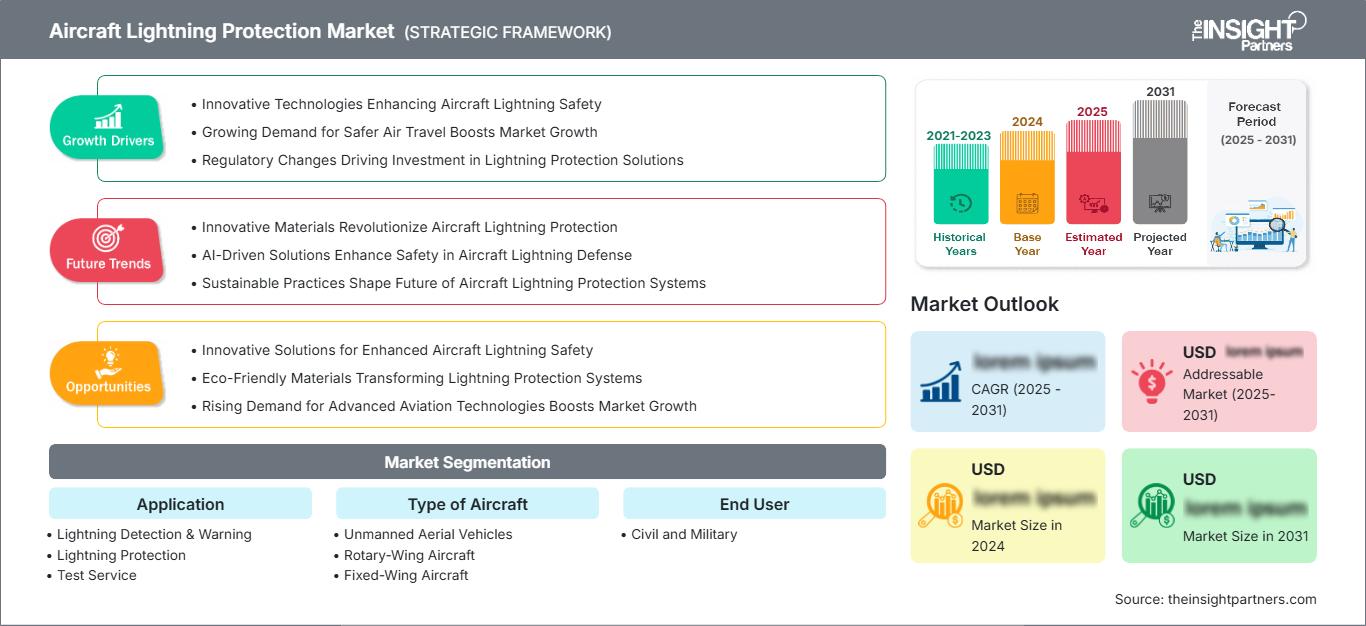
The aircraft lightning protection market was valued at US$ 4.30 Billion in 2025 and is projected to reach US$ 5.67 Billion by 2034, expanding at a CAGR of 3.11% from 2026 to 2034. The market covers technologies and services used to protect aircraft structures and electrical and electronic systems from direct and indirect lightning effects. Demand spans lightning detection and warning, lightning protection, and test services across unmanned aerial vehicles, rotary-wing aircraft, and fixed-wing aircraft serving civil and military users.
North America remains a major technology and procurement center for the aircraft lightning protection market, supported by established aircraft manufacturing, defense programs, avionics development, and certification infrastructure. The region is expected to register a ~3% CAGR through 2034. Increasing use of composite structures and increasingly electrified aircraft systems are reinforcing the need for conductive pathways, bonding, shielding, transient protection, and qualified lightning testing.
The aircraft lightning protection market growth is linked to aircraft production, fleet modernization, increasing composite content, and the expansion of onboard electrical and electronic functions. The demand is driven by aircraft and system integrator manufacturers and flows from material providers, component manufacturers, avionics suppliers, engineering firms, and laboratories providing certification. The architecture of protection systems often consists of the management of structural strike currents as well as the protection of electrical and electronic systems against indirect effects. The demand may also be created via the replacement and modification process due to the aging of aircraft that need protection from the aforementioned aspects. The supply factors are influenced by qualification, material properties, manufacturability, and integration capability without a significant weight increase. Conductive foils, meshes, tapes, coatings, bonding materials, transient suppressors, and static dischargers must comply with strict aerospace standards. The Aircraft Lightning Protection Market forecast is also influenced by testing requirements because protection performance must be demonstrated against representative lightning environments and aircraft-specific configurations. Suppliers with established aerospace qualifications can therefore participate across multiple aircraft programs, while specialized companies can compete through material or testing expertise.
Competition in the aircraft lightning protection market combines diversified aerospace suppliers with specialist material, electrical protection, and testing companies. L3Harris Technologies and Saab AB bring aerospace and defense-system capabilities, while TE Connectivity Ltd. and Microchip Technology Inc. address electrical protection and transient-management requirements. Parker Hannifin Corporation contributes aerospace components and protection expertise, and Cobham maintains capabilities associated with electromagnetic and lightning testing. The Gill Corporation and Dexmet Corporation focus on materials and structural protection applications, while Dayton-Granger, Inc. serves specialized electrostatic and lightning-related requirements. Aircraft Lightning Protection Market trends increasingly center on lightweight conductive materials, composite-compatible protection, electrical transient suppression, and engineering services that reduce certification risk. Strategic positioning is therefore influenced not only by component performance but also by qualification history, production scalability, program participation, and the ability to support aircraft manufacturers from design through testing and aftermarket requirements. Companies with complementary material, electrical, and testing capabilities can address a broader portion of the aircraft protection architecture.
Aircraft Lightning Protection Market Assessment and Insights
Regional Outlook
- North America: ~38% of the global market in 2025 | ~3% CAGR through 2034. Market position: North America holds the largest regional position, supported by a concentrated aerospace manufacturing base, military aviation procurement, mature certification capabilities, and strong demand for advanced avionics and composite-airframe protection.
- US: ~84% of North American market revenue in 2025 | ~3% CAGR through 2034. Market position: The US represents the leading country in North America, with extensive commercial and defense aircraft activity, established certification infrastructure, and broad adoption of lightning protection across fixed-wing, rotary-wing, and unmanned platforms.
- Europe: ~30% of the global market in 2025 | ~3% CAGR through 2034. Market position: Europe has a mature aerospace ecosystem spanning aircraft manufacturing, defense aviation, and specialist testing. Germany, France, the UK, Italy, and Spain support demand, with France representing the leading country in Europe through its strong aerospace industrial base.
- Asia Pacific: ~25% of the global market in 2025 | ~4% CAGR through 2034. Market position: Asia Pacific is the fastest-growing region, supported by expanding aircraft production, indigenous aerospace programs, fleet modernization, and defense investment. China is the leading country in the Asia Pacific, while India and South Korea are strengthening their domestic aerospace capabilities.
Segment Outlook
- Fixed-Wing Aircraft: ~58% Share in 2025 | ~3% CAGR through 2034. Market position: Fixed-wing aircraft lead because commercial transports, cargo aircraft, business aircraft, and military platforms represent the largest installed and production base, requiring integrated structural, electrical, and avionics lightning protection.
- Unmanned Aerial Vehicles: ~10% Share in 2025 | ~5% CAGR through 2034. Market position: UAVs represent the high-growth platform segment as defense surveillance, logistics, mapping, and autonomous operations expand. Protection requirements increasingly extend to lightweight composite structures, power electronics, communications, and mission-critical control systems.
Competitive Coverage
L3Harris Technologies, Cobham, TE Connectivity Ltd., Exel Composites Plc, The Gill Corporation, Saab AB, Dexmet Corporation, Microchip Technology Inc., Parker Hannifin Corporation, Dayton-Granger, Inc.
Methodology
The Insight Partners follows Data Collection & Secondary Research, Primary Research, Data Analysis, and Data Triangulation & Final Review to validate market estimates and insights.
Source: The Insight Partners' analysis based on proprietary research, government publications, company annual reports, investor presentations, industry databases, and expert interviews.
Aircraft Lightning Protection Market Trends
Integration of Lightweight Conductive Materials Into Composite Structures
Future aircraft designs are expected to place greater emphasis on integrating lightning protection directly into composite structures rather than treating it solely as an external add-on. Expanded metal foils, conductive meshes, tapes, hybrid materials, and conductive coatings can be engineered around structural requirements to reduce weight and simplify manufacturing. The direction of development is toward materials that deliver adequate conductivity, damage tolerance, corrosion resistance, and manufacturability while remaining compatible with automated composite production. Material suppliers are therefore likely to compete on both electrical performance and production efficiency. Over time, the distinction between structural material and lightning protection material may become less pronounced as multifunctional laminates provide mechanical reinforcement, electromagnetic shielding, and lightning-current management within a coordinated architecture.
System-Level Protection for Highly Electrified and Autonomous Aircraft
As aircraft become more electrified and autonomous, future lightning protection architectures are likely to move toward coordinated system-level designs. Protection will increasingly need to account for power electronics, communication networks, sensors, autonomous flight systems, batteries, and distributed electrical equipment rather than isolated components. UAVs and emerging advanced-air-mobility platforms can accelerate this trend because their architectures often combine lightweight composite structures with high electrical content. Engineering teams will therefore require improved modeling of current paths and induced transients before physical testing. This trend can increase demand for digital simulation, integrated test programs, compact transient suppression, and protection technologies designed around specific electrical architectures rather than generic component-level requirements.
Aircraft Lightning Protection Market Growth Factors
Growing Composite-Airframe Adoption Increases Protection Requirements
The growing use of carbon-fiber-reinforced composite structures is a major demand driver because composite materials require engineered conductive pathways to manage lightning currents effectively. Traditional metallic airframes can provide inherent electrical conductivity, whereas composite structures generally require additional meshes, foils, coatings, bonding arrangements, or other conductive solutions. As aircraft manufacturers seek lower structural weight and improved aerodynamic performance, the need to integrate lightning protection into composite manufacturing processes becomes more important. This creates opportunities for suppliers able to provide lightweight materials that maintain conductivity while remaining compatible with automated lay-up, bonding, curing, and inspection processes. The impact extends beyond new aircraft because structural modifications and repairs can also require compatible protection materials and validated installation procedures.
Increasing Aircraft Electrification Raises Indirect-Effects Protection Demand
Aircraft electrification is expanding the number and complexity of electrical interfaces exposed to lightning-induced transients. More-electric aircraft architectures, digital avionics, electric actuation, connected systems, and high-density power electronics increase the consequences of voltage disturbances even when a lightning strike does not directly attach to sensitive equipment. This drives demand for transient voltage suppressors, shielding, grounding, bonding, and carefully engineered cable and equipment protection. The market impact is strongest in aircraft programs where electrical systems are becoming more integrated and where weight and packaging constraints limit the use of conventional protection approaches. Suppliers that can combine compact electrical protection with aerospace qualification can address a broader set of applications across avionics, power management, communications, and flight-control systems.
Certification and Testing Requirements Sustain Specialized Service Demand
Certification requirements create a recurring need for lightning simulation, direct-effects testing, indirect-effects evaluation, modeling, documentation, and engineering support. Aircraft manufacturers must demonstrate that relevant structures and systems can tolerate defined lightning environments without unacceptable effects on aircraft safety or functionality. This makes test services an important part of the value chain rather than a one-time engineering activity. Revisions to aerospace recommended practices can also create demand for updated test plans and engineering assessments. The resulting market impact includes opportunities for specialized laboratories, simulation providers, and engineering companies with lightning expertise. Suppliers that can support testing from early design through certification can participate in longer aircraft development cycles and modification programs.
Aircraft Lightning Protection Market Opportunities
Localized Aerospace Supply Chains in Asia Pacific
Expansion of aerospace manufacturing in Asia Pacific creates opportunities for suppliers to establish regional production, qualification, engineering, and distribution capabilities. China, India, Japan, and South Korea are strengthening aerospace manufacturing and defense ecosystems, increasing the potential customer base for conductive materials, transient suppression devices, bonding products, static-discharge components, and testing services. Localized supply can shorten lead times and support aircraft programs that require long-term component availability. Companies seeking regional growth can also develop partnerships with aerospace manufacturers, MRO providers, research institutions, and defense organizations. The opportunity is strongest for suppliers that can meet aerospace quality and qualification requirements while adapting products to local production processes and procurement structures.
Integrated Protection Solutions for UAV and Advanced Aircraft Programs
UAV and emerging aircraft programs provide an opportunity to develop integrated protection packages that combine structural protection, electrical transient suppression, bonding, grounding, and testing support. These platforms often impose tighter weight, space, and power constraints than conventional aircraft, increasing the value of multifunctional solutions. Suppliers can pursue opportunities through early collaboration with airframe designers, avionics developers, and propulsion-system manufacturers so protection requirements are embedded before production designs are finalized. Engineering services can provide an additional revenue stream by supporting electromagnetic modeling, lightning-zone assessment, qualification testing, and certification documentation. The opportunity therefore extends beyond individual components toward integrated engineering and lifecycle support.
Segmentation Analysis
Application
The Application segment encompasses Lightning Detection & Warning, Lightning Protection, and Test Service. The application segment is expected to expand at a ~3% CAGR from 2026 to 2034. Lightning protection remains central to aircraft safety architecture because it addresses both direct strike effects and current conduction through aircraft structures. Detection and warning solutions support situational awareness and system response, while test services remain essential for qualification and certification. Increasing aircraft electrification strengthens demand for integrated protection across structural and electronic systems.
- Lightning Detection & Warning: These solutions support identification, monitoring, and communication of lightning-related hazards. Demand is shaped by aircraft mission requirements, avionics integration, and the need to provide actionable information without adding excessive system complexity.
- Lightning Protection: This is the core application area, covering conductive pathways, shielding, bonding, static discharge, transient suppression, and structural protection. Composite-airframe adoption increases the need for engineered solutions that safely manage lightning currents.
- Test Service: Testing supports design verification, qualification, certification, and troubleshooting. Demand is linked to new aircraft programs, modifications, composite structures, and changing certification requirements that require evidence of resistance to direct and indirect lightning effects.
Type of Aircraft
The Type of Aircraft segment includes Unmanned Aerial Vehicles, Rotary-Wing Aircraft, and Fixed-Wing Aircraft and is expected to expand at a ~3% CAGR from 2026 to 2034. Fixed-wing aircraft generate the largest revenue contribution because commercial, cargo, business, and military aircraft constitute a broad installed base. Rotary-wing platforms require specialized rotor, blade, and electrical protection. UAV adoption introduces new requirements for lightweight protection and reliable electronics.
- Unmanned Aerial Vehicles: UAV demand is expanding through defense, surveillance, logistics, mapping, and autonomous applications. Lightweight composite structures and compact electronics increase the importance of protection solutions that combine low mass with reliable current management.
- Rotary-Wing Aircraft: Helicopters require protection for rotor systems, airframe structures, electrical equipment, and mission electronics. Military and utility applications can require robust solutions suited to demanding operating environments and frequent aircraft configuration changes.
- Fixed-Wing Aircraft: Fixed-wing platforms account for the largest demand because of extensive commercial and defense fleets. Protection is integrated across airframes, avionics, electrical systems, fuel-related structures, and external surfaces during new production and modernization.
End User
The End User segment comprises Civil and Military users and is expected to register a ~3% CAGR from 2026 to 2034. Civil aviation provides recurring demand through commercial aircraft production, fleet modernization, business aviation, and MRO activity. Military users require highly reliable protection for mission electronics and airframes operating across varied environments. The balance between these users varies by platform, geography, procurement cycle, and aircraft mission.
- Civil: Civil users generate demand through commercial aviation, business aircraft, general aviation, and associated MRO programs. Certification requirements and fleet reliability objectives support continued adoption of qualified lightning protection technologies.
- Military: Military users require protection across fixed-wing aircraft, rotorcraft, and UAVs. Mission electronics, communications, sensors, and power systems increase the importance of protection against direct strikes and induced electrical transients.
Opportunity Snapshot
| End User | Revenue Contribution | Trend Tag | Adoption Stage |
|---|---|---|---|
| Civil | High | Fleet Modernization | Mature |
| Military | Medium | Mission Electronics | Scaling |
Regional Insights
North America Aircraft Lightning Protection Market
North America accounted for ~38% of the global aircraft lightning protection market in 2025 and is expected to expand at a ~3% CAGR through 2034. The area is characterized by an abundance of aerospace manufacturing infrastructure, commercial aircraft fleet, defense spending, and an existing network of engineering and certification organizations. The United States is a significant contributor to regional demand, driven by major aircraft development and continued investment in avionics, composite airframes, and enhanced electrical-system capabilities.
The regional demand is further driven by regulatory clarity and established testing procedures. Lightning protection guidelines of the FAA for aircraft electrical and electronic systems serve as a standard procedure for certification and modification of aircraft. Composite airframes are also generating demand for conductive meshes, foils, bonding and other forms of lightning protection. Defense programs and UAVs create additional demand for protection of electrical components against transient phenomena and electromagnetic environment, especially in cases of miniature electrical systems.
U.S. Aircraft Lightning Protection Market
The US represented ~84% of North American aircraft lightning protection market revenue in 2025 and is expected to grow at a ~3% CAGR through 2034. Its position reflects the scale of commercial and military aviation activity, domestic aircraft manufacturing, and the presence of major avionics, aerospace components, and defense suppliers. Protection needs cover fixed-wing aircraft, rotorcraft, and UAVs, and demands for protection are increasingly becoming part of the electrical architecture of aircraft.
Certification and testing also contribute to growth in the market. Guidance from the FAA includes the need to protect aircraft electrical and electronic systems from lightning, and aerospace suppliers offer transient protection, structural protection material, bonding, and static discharge solutions. New aircraft builds as well as upgrading current aircraft contribute to the recurring demand. Specialized protection may be required for military aircraft and UAVs due to the need to have reliable mission electronics and power systems in harsh environments.
Europe Aircraft Lightning Protection Market
Europe represented ~30% of the global aircraft lightning protection market in 2025 and is expected to register a ~3% CAGR through 2034. France is the leading country in Europe, supported by its aircraft manufacturing, engine, defense, and aerospace systems industries. Germany also contributes substantially through aircraft manufacturing and advanced component production, while the UK maintains capabilities in aerospace engineering, testing, and defense. Italy and Spain add demand through aircraft structures, rotorcraft, military programs, and aerospace supply chains.
The regional ecosystem centers on the topics of certification, electromagnetic compatibility, lightweight structures, and system-level protection. European aerospace companies continue developing technical guidelines related to electromagnetic hazards, lightning protection, and testing. An increased use of composites leads to the need for conductive protection coatings and bonding solutions, while higher electrical integration contributes to the need for indirect effects protection. The demands of retrofit and test service remain relevant as well because European airlines operate various fleets of commercial, business, military, and rotary-wing aircraft.
As a result, investments in Europe are made in structural materials, electrical protection, engineering simulation, testing, and aircraft development. French companies have the most diversified base of suppliers and OEMs, while German, British, Italian, and Spanish ones offer supplementary manufacturing and engineering solutions. This makes it possible a highly developed market structure where aerospace major players and specialized companies can compete.
APAC Aircraft Lightning Protection Market
Asia Pacific represented ~25% of the global aircraft lightning protection market in 2025 and is expected to expand at a ~4% CAGR, making it the fastest-growing region. In the region, China leads in all three aspects of commercial aircraft development, military aircraft, and production capability in aerospace manufacture in the region. Both Japan and South Korea play their part through established aerospace manufacturing and defense capability, and India through indigenous development of aircraft and defense capability.
Australia plays its part through civil aviation, defense, and special aerospace. Fleet growth and localization of the aerospace chain bring possibilities in protection materials, electrical parts, test and engineering service. Aerospace programs and increased electrification of aircraft, in turn, reinforce the need for integrated lightning protection systems.
Middle East & Africa Aircraft Lightning Protection Market
The Middle East and Africa represent a smaller portion of global demand, but the aircraft lightning protection market in the region is supported by fleet expansion, military aviation procurement, and investment in aviation infrastructure. Aerospace and defense developments make Saudi Arabia one of the major players in the Middle East and Africa region, with the UAE being a key maintenance and aerospace player in the region. South Africa has a presence with its existing capabilities in the aviation and defense segments.
Demand from the region is driven by usage, fleet modernization, maintenance, and infrastructure. Electrical and structural protection requirements for the digitalization of airline fleets will drive demand further. Opportunities will be generated in the form of testing, inspections, replacements, and retrofits from MRO activities. Investments in aviation manufacturing and defense localization have the potential to expand the regional supply base.
Aircraft Lightning Protection Market Report Scope
| Report Attribute | Details |
|---|---|
| Market size in 2025 | US$ 4.30 Billion |
| Market Size by 2034 | US$ 5.67 Billion |
| Global CAGR (2026 - 2034) | 3.11% |
| Historical Data | 2021-2024 |
| Forecast period | 2026-2034 |
| Segments Covered | Application, Type of Aircraft, End User |
| Region scope | North America, Europe, Asia-Pacific, South and Central America, Middle East and Africa |
Frequently Asked Questions

Recent Reports






