Aircraft Refurbishment Market Size & Overview
The aircraft refurbishment market was valued at US$ 6.27 Billion in 2025 and is projected to reach US$ 10.50 Billion by 2034, registering a CAGR of 5.90% during 2026–2034. Expansion is supported by aging aircraft fleets, delayed fleet renewal, increasing cabin modernization requirements, aircraft lifecycle extension, and continued investment in maintenance, repair, and overhaul capabilities. Refurbishment programs increasingly combine structural restoration with passenger-experience upgrades, operational modifications, and selective replacement of aging components.
The aircraft refurbishment market size in North America is supported by a mature installed fleet, extensive MRO infrastructure, high utilization of commercial aircraft, and sustained demand for cabin and structural upgrades. North America is modeled to expand at approximately ~6% CAGR through 2034, supported by delayed aircraft replacement, airline fleet optimization, and established engineering and certification capabilities that enable operators to execute refurbishment during scheduled maintenance events.
The market for aircraft refurbishment depends on the interplay between age of the aircraft, utilization of the aircraft, passenger expectations, fleet availability, and economics of maintenance. Refurbishment of aircraft may allow airlines to maintain aircraft value and improve selected elements. The industry comprises aircraft owners and lessors, airlines, original equipment manufacturers, maintenance organizations, engineering organizations, component suppliers, cabin suppliers, certification agencies, and specialist installers. Supply of goods and services continues to depend upon available skilled labor, component certifications, engineering approval, materials, and hangar space. Older aircraft will present regular needs for interior, structure, window, surface, and equipment refurbishment, while fleet modernization will generate a need for upgrade projects which can be executed without the complete replacement of the aircraft. The extended life of older aircraft from delayed deliveries adds to the importance of efficient scheduling of refurbishment activities. Therefore, the aircraft refurbishment market combines maintenance spend with asset management, with a project scope depending on age of the aircraft, utilization, ownership structure, environmental conditions, and remaining life.
Competition is evident from integrated MRO service providers, specialist manufacturers for components, cabin interior specialists, engineering firms, and aerospace technology providers. Lufthansa Technik offers both cabin modifications and cabin certification, while FACC is involved with refurbishment solutions for the interiors of commercial and executive aircraft. RTX Corporation’s Collins Aerospace business unit is working on concepts of seat modification solutions in the aftermarket segment, while The NORDAM Group LLC offers interior structures and customized cabin solutions made of composites. Ascent Aviation Services offers combined heavy maintenance, aircraft and cargo conversion services, while GKN Aerospace Services Limited offers structural and transparency aftermarket solutions. There is increasing investment in integrated aftermarket platforms, engineering services, specialized repair services, and cabin retrofit solutions. There are cabin specialists like Jamco America, Inc. that are investing in aftermarket solutions, and Honeywell International Inc., Thales Group, and Crane Aerospace & Electronics that operate in equipment and system segments which can form a part of modernization packages. Differentiation in competition therefore depends on certification capability, turnaround time, coverage of installed base, engineering capability, supply capability, and execution of multidisciplinary refurbishment projects.
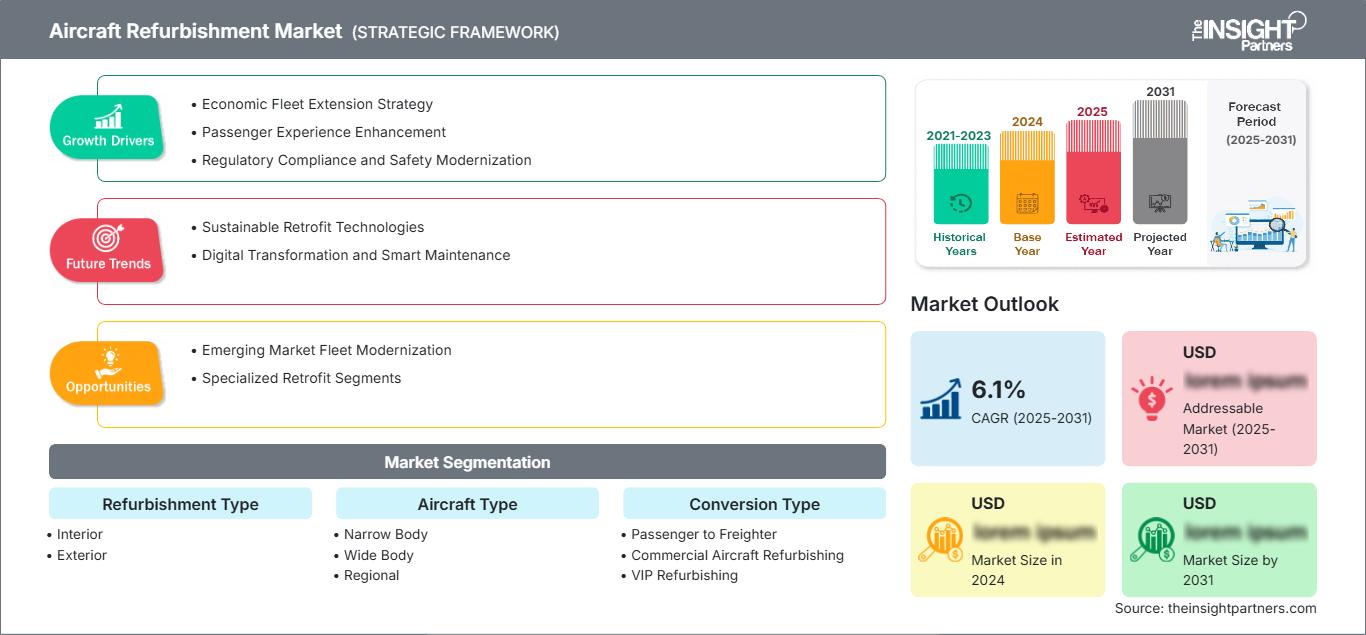
Aircraft Refurbishment Market Assessment and Insights
Regional Outlook
- North America: ~35% of the global aircraft refurbishment market share in 2025 | ~6% CAGR through 2034. Market position: North America holds the largest regional position, supported by a substantial installed fleet, established MRO networks, extensive airline operations, and recurring refurbishment demand for aging narrow-body and wide-body aircraft.
- US: ~86% of North American market revenue in 2025 | ~6% CAGR through 2034. Market position: The US represents the principal demand center within North America, reflecting its large airline fleet, business aviation activity, extensive maintenance infrastructure, and strong concentration of aircraft modification, component, and interior specialists.
- Europe: ~27% of the global market in 2025 | ~5% CAGR through 2034. Market position: Europe has a mature refurbishment ecosystem supported by established MRO capacity. Germany is the leading country in Europe, while the UK, France, Italy, and Spain contribute through airline fleets, MRO clusters, and aircraft completion activity.
- Asia Pacific: ~25% of the global market in 2025 | ~7% CAGR through 2034. Market position: Asia Pacific is the fastest-growing region, supported by fleet expansion, rising aircraft utilization, expanding MRO infrastructure, and increasing cabin modernization. China is the leading country in Asia Pacific, with Japan, South Korea, India, and Australia adding demand.
Segment Outlook
- Interior: ~68% Share in 2025 | ~6% CAGR through 2034. Market position: Interior refurbishment leads because airlines routinely upgrade seating, galleys, lavatories, lighting, monuments, and passenger-facing surfaces to extend cabin usability, meet changing service expectations, and improve aircraft asset value without replacing the complete airframe.
- Passenger to Freighter: ~8% Share in 2025 | ~8% CAGR through 2034. Market position: Passenger to Freighter is the high-growth segment as aircraft owners seek lifecycle extensions and cargo capacity amid sustained air-freight demand. Conversion activity also creates refurbishment requirements across structures, interiors, systems, and aircraft configurations.
Competitive Coverage
Ascent Aviation Services, RTX Corporation, Crane Aerospace & Electronics, FACC AG, Honeywell International Inc., GKN Aerospace Services Limited, Jamco America, Inc., Lufthansa Technik AG, Thales Group, The NORDAM Group LLC
Methodology
The Insight Partners follows Data Collection & Secondary Research, Primary Research, Data Analysis, and Data Triangulation & Final Review to validate market estimates and insights.
Source: The Insight Partners' analysis based on proprietary research, government publications, company annual reports, investor presentations, industry databases, and expert interviews.
Aircraft Refurbishment Market Trends
Modular Cabin Refurbishment and Faster Installation Cycles
The aircraft refurbishment market trends show that future aircraft refurbishment programs are expected to place greater emphasis on modular cabin architecture and standardized modification packages that reduce engineering repetition. Airlines increasingly need refurbishment solutions that can be introduced across multiple aircraft within the same fleet while retaining room for branding and configuration differences. Modular components can simplify installation, logistics, certification, and future replacement. Suppliers that develop pre-engineered solutions for seating, monuments, galleys, lavatories, lighting, and storage can potentially reduce aircraft ground time and improve project predictability. The aircraft refurbishment market is therefore likely to move toward greater standardization at the component and engineering levels, even as operators continue to seek differentiated passenger environments. Digital design tools and improved configuration management can further support repeatable installation across geographically distributed MRO facilities.
Data-Enabled Lifecycle Planning and Refurbishment Decisions
Data integration is expected to become more influential in determining when and how aircraft refurbishment should occur. Fleet-management systems can combine aircraft age, utilization, maintenance history, component condition, passenger feedback, and planned downtime to identify suitable refurbishment windows. This can shift refurbishment planning from reactive replacement toward coordinated lifecycle management. Digital records can also improve traceability of modified components, engineering configurations, certification documentation, and maintenance requirements. As operators manage larger fleets and more complex cabin configurations, the ability to synchronize refurbishment with scheduled maintenance can become a differentiating capability. The aircraft refurbishment market may consequently see closer integration among airlines, lessors, MRO organizations, engineering providers, and component suppliers, with data serving as an operational layer connecting design, procurement, installation, and subsequent maintenance.
Aircraft Refurbishment Market Growth Factors
Delayed Fleet Renewal Extends the Refurbishment Window
Aircraft delivery constraints and longer replacement cycles increase the commercial importance of keeping existing aircraft operational and competitive. When operators cannot replace aircraft as quickly as planned, refurbishment can become a practical mechanism for improving passenger-facing features, restoring cabin condition, and addressing selected structural or systems requirements. The aircraft refurbishment market benefits because lifecycle decisions are increasingly influenced by aircraft availability as well as capital expenditure. Refurbishment also allows airlines to prioritize specific improvements rather than commit to complete aircraft replacement. This creates demand for modular projects that can be executed during scheduled maintenance windows, reducing incremental downtime. For MRO providers, the effect is a larger pipeline of work associated with aging aircraft, lease transitions, interior refreshes, and modifications required to maintain operational relevance.
Passenger Experience Investment Raises Cabin Modernization Demand
Airlines increasingly use cabin products as a means of differentiating service classes and maintaining consistency across fleets. Seating, lighting, galleys, lavatories, monuments, finishes, and connectivity-related equipment can be upgraded independently or as part of broader cabin programs. This supports refurbishment spending because passenger-facing components can become outdated before the underlying aircraft reaches the end of its economic life. The aircraft refurbishment market consequently gains from programs that combine aesthetic renewal with functional improvements, including easier maintenance, improved storage, updated passenger interfaces, and weight-conscious component selection. The commercial impact extends beyond airlines because cabin suppliers, engineering organizations, MRO providers, and certification specialists can participate in the same project. Integrated execution can shorten turnaround times and reduce coordination requirements for operators.
Aircraft Lifecycle Economics Support Conversion and Reconfiguration
Aircraft owners and lessors increasingly evaluate refurbishment through the remaining economic life and intended operational role of an asset. A suitable aircraft can be reconfigured for a new operator, cabin class, route network, or cargo application rather than immediately retired. Passenger-to-freighter conversion is particularly relevant because the modification can reposition aircraft toward cargo demand while preserving residual asset value. Commercial refurbishment similarly supports lease transitions by bringing interiors and equipment closer to incoming operator specifications. The aircraft refurbishment market therefore benefits from lifecycle strategies that connect engineering work with asset utilization. Suppliers able to combine certification, component availability, installation, and project management can capture a larger share of this spending because operators increasingly seek coordinated solutions rather than fragmented refurbishment activities.
Aircraft Refurbishment Market Opportunities
Integrated Refurbishment Platforms for Emerging MRO Hubs
Investment opportunities are emerging around integrated refurbishment centers in high-growth aviation markets where fleet expansion is creating additional demand for local maintenance capacity. Asia Pacific is particularly relevant because increasing aircraft utilization and growing MRO infrastructure can reduce the need to send selected refurbishment projects to distant facilities. An integrated platform can combine engineering, component sourcing, interior production, installation, certification support, and maintenance planning. Such facilities can also support airlines seeking shorter aircraft turnaround times and regional supply-chain resilience. The market offers scope for providers that establish capabilities close to expanding airline fleets while maintaining internationally recognized certification and quality systems. Partnerships with aircraft manufacturers, cabin suppliers, lessors, and established MRO organizations can provide a route to technical expertise and broader customer access.
Lifecycle Conversion and Premium Cabin Specialization
Specialization in high-value refurbishment niches provides another commercial opportunity. Passenger-to-freighter conversion can create demand for coordinated engineering and structural modification services, while VIP refurbishment can support specialized design, craftsmanship, connectivity, and premium cabin integration. Commercial aircraft operators also require repeatable cabin refresh programs that can be deployed across multiple aircraft with limited downtime. Providers can differentiate through specialized engineering approvals, component availability, installation productivity, and project management rather than relying solely on workshop capacity. The aircraft refurbishment market can therefore support investment in capabilities that address distinct lifecycle stages, from routine cabin refreshes to major aircraft reconfiguration. Companies that combine refurbishment expertise with complementary MRO or conversion capabilities may be positioned to serve multiple requirements within the same aircraft lifecycle.
Segmentation Analysis
Refurbishment Type
The Refurbishment Type segment establishes the physical scope of aircraft restoration and modernization and remains central to operator decisions concerning asset life, passenger experience, and maintenance economics. Interior work represents the larger portion of refurbishment activity because cabin elements experience continuous passenger and crew use. Interior refurbishment is modeled at ~6% CAGR through 2034, supported by recurring replacement cycles, cabin refresh programs, and the integration of new passenger-facing equipment.
- Interior: Interior refurbishment addresses passenger-facing and cabin-support elements whose condition, appearance, functionality, or configuration affects aircraft usability. Demand is linked to scheduled maintenance, airline branding, passenger experience programs, and cabin lifecycle requirements.
- Exterior: Exterior refurbishment covers aircraft surfaces and externally visible elements requiring restoration, repair, coating, or replacement. Its demand is influenced by corrosion exposure, operating environment, appearance requirements, structural condition, and maintenance schedules.
Aircraft Type
The Aircraft Type segment reflects differences in refurbishment scope, utilization, cabin configuration, aircraft age, and operator economics. Narrow-body fleets generate substantial recurring work because of their high global installed base and intensive utilization, while wide-body programs can involve larger project values because of extensive cabin areas and complex configuration changes. Regional aircraft add specialized refurbishment requirements for smaller cabins and diverse operating environments.
- Narrow Body: Narrow-body aircraft generate recurring refurbishment demand because of intensive utilization and large installed fleets. Operators commonly integrate refurbishment with heavy maintenance, lease transitions, cabin standardization, and scheduled interior replacement programs.
- Wide Body: Wide-body refurbishment typically involves more complex cabin architecture and larger installation scopes. Premium seating, monuments, galleys, lavatories, connectivity, and configuration changes can create substantial engineering and installation requirements.
- Regional: Regional aircraft operate across shorter routes and varied airport environments, creating refurbishment needs focused on durability, efficient maintenance, cabin condition, and cost-effective lifecycle extension.
Conversion Type
The Conversion Type segment captures refurbishment activity associated with changes in aircraft purpose or configuration. Commercial Aircraft Refurbishing represents the broadest recurring application because airlines regularly update in-service fleets, while VIP Refurbishing supports high-value customization. Passenger to Freighter programs have a higher growth profile, modeled at ~8% CAGR through 2034, as operators seek additional cargo capacity and lifecycle opportunities for suitable aircraft.
- Passenger to Freighter: Passenger to freighter conversion transforms aircraft for cargo operations and requires coordinated structural, systems, interior, and configuration modifications. Demand is supported by air-freight requirements and the economic value of extending aircraft service lives.
- Commercial Aircraft Refurbishing: Commercial aircraft refurbishing includes upgrades and restoration performed to preserve aircraft usability, improve passenger environments, and align cabin configurations with airline operating strategies and fleet standards.
- VIP Refurbishing: VIP refurbishing emphasizes customized interiors, premium materials, specialized layouts, advanced connectivity, and individual owner requirements. Programs generally require detailed design coordination and high levels of certification and craftsmanship.
Opportunity Snapshot
| Conversion Type | Revenue Contribution | Trend Tag | Adoption Stage |
| Passenger to Freighter | Medium | Cargo Conversion | Scaling |
| Commercial Aircraft Refurbishing | High | Cabin Modernization | Mature |
| VIP Refurbishing | Low | Premium Customization | Scaling |
Regional Insights
North America aircraft refurbishment market
North America represents ~35% of the global aircraft refurbishment market in 2025 and is modeled to expand at ~6% CAGR through 2034. The region benefits from a large installed commercial fleet, extensive airline networks, mature MRO infrastructure, and strong availability of certified engineering and component-repair providers. Fleet age and delayed aircraft deliveries encourage operators to retain existing aircraft longer, creating recurring demand for interior modernization and structural restoration.
The US accounts for ~86% of North American revenue and provides the region's deepest concentration of refurbishment capability. Major commercial airlines, aircraft leasing companies, freight carriers, business aviation companies, and MROs create demands through their maintenance and modification programs. Ascent Aviation Services specializes in the maintenance of narrow body and wide body aircraft, whereas RTX Corporation, Honeywell International Inc., Crane Aerospace & Electronics, and The NORDAM Group LLC provide technologies or parts that can be incorporated in refurbishment programs. The region is also blessed with the advantage of FAA certification process and legacy fleet of aircraft to be serviced.
U.S. aircraft refurbishment market
The US represents ~86% of North American aircraft refurbishment market revenue in 2025 and is modeled to grow at ~6% CAGR through 2034. This is informed by the size and variety of the nation’s aircraft fleet which ranges from major passenger airlines to cargo operations, business aircraft operators, leasing, and specialized aviation. Refurbishment needs range from interior work, structural work, component replacement, aircraft conversions, and lifecycle extension of aircraft.
Service providers based in the US are involved at different levels of the value chain of the refurbishment industry. The Ascent Aviation Services company engages in aircraft conversions and heavy maintenance. The NORDAM Group LLC is involved in providing composite and interior capabilities. RTX Corporation and Honeywell International Inc. companies participate through aircraft systems and aftermarket products respectively. Crane Aerospace & Electronics is a service provider involved in supplying aerospace equipment which can be utilized in the maintenance and modifications of aircraft.
Europe aircraft refurbishment market
Europe accounts for ~27% of global aircraft refurbishment market revenue in 2025 and is modeled to grow at ~5% CAGR through 2034. Germany is the leading country in Europe, supported by a deep aviation engineering base, major MRO activity, and extensive aircraft modification expertise. The UK maintains an important position through aerospace engineering, maintenance, and aircraft support activities, while France benefits from its large aerospace industrial base and airline ecosystem.
Germany's refurbishment activity is supported by organizations such as Lufthansa Technik AG, which provides engineering, certification, installation, and cabin modification capabilities. France combines OEM and MRO infrastructure with a large commercial aviation ecosystem, while the UK benefits from established aftermarket and engineering services. Italy and Spain contribute through airline fleets, maintenance providers, completion activities, and aircraft services. Across the region, refurbishment is increasingly linked with cabin modernization, lease transitions, configuration changes, and lifecycle extension rather than isolated cosmetic repairs.
European demand is also shaped by certification requirements and the need to manage modifications within controlled engineering processes. The region's mature aircraft base creates recurring work, while environmental and operating-cost considerations encourage airlines to improve existing aircraft rather than rely solely on accelerated fleet replacement. Competitive activity therefore centers on certified engineering, project integration, turnaround performance, and the ability to combine cabin, structural, and systems modifications.
APAC aircraft refurbishment market
The aircraft refurbishment market forecast shows that Asia Pacific represents ~25% of the market in 2025 and is modeled to expand at ~7% CAGR through 2034, making it the fastest-growing region. China is the leading country in Asia Pacific, while Japan, South Korea, India, and Australia provide additional demand through expanding airline fleets, established carriers, business aviation, and growing MRO networks.
China and India are important sources of fleet and traffic expansion, while Japan and South Korea contribute through mature airline and aerospace ecosystems. Australia supports refurbishment through its geographically dispersed aviation network and maintenance requirements. Increasing regional MRO investment, rising aircraft utilization, and passenger-experience upgrades support demand for cabin modifications. Regional airlines are also increasingly using refurbishment to standardize cabins and introduce premium products as fleets expand.
Middle East & Africa aircraft refurbishment market
Middle East and Africa demand is supported by airline fleet expansion, aircraft utilization, long-haul connectivity, and investment in aviation infrastructure. The region is modeled to grow at ~6% CAGR through 2034. Saudi Arabia and the UAE are important refurbishment centers in the Middle East because of aviation investment, large airline fleets, airport development, and the growth of specialized aviation services.
South Africa remains a significant aerospace and MRO center for the wider African market, while the Rest of MEA reflects demand from airlines, business aviation, cargo operators, and government fleets. Middle Eastern operators place particular emphasis on premium cabin environments and aircraft configuration changes, while African operators often require refurbishment programs that balance lifecycle economics, reliability, and aircraft availability. Infrastructure investment and expanding aviation connectivity provide additional support for specialist refurbishment capabilities.
Aircraft Refurbishment Market Report Scope
| Report Attribute | Details |
|---|---|
| Market size in 2025 | US$ 6.27 Billion |
| Market Size by 2034 | US$ 10.50 Billion |
| Global CAGR (2026 - 2034) | 5.90% |
| Historical Data | 2021-2024 |
| Forecast period | 2026-2034 |
| Segments Covered | Refurbishment Type, Aircraft Type, Conversion Type, Geography |
| Region scope | North America, Europe, Asia-Pacific, South and Central America, Middle East and Africa |
Recent Developments
- April 2026: Lufthansa Technik AG — EASA granted Lufthansa Technik the Certain STC Privilege, allowing the company within an approved scope to authorize recurring major changes for aircraft, including recurring A320ceo cabin conversions such as seat reconfigurations, galley or lavatory relocations, and class-divider repositioning. The development can simplify repeat modification programs by reducing the need for separate approval processes for each recurring configuration change.
- April 2026: Jamco Corporation — Jamco announced the appointment of Proponent as its exclusive aftermarket spare-parts distributor, strengthening its aftermarket support model for aircraft cabin products. The move follows broader expansion of Jamco's global cabin-interiors platform and supports availability of aftermarket components for operators requiring replacement and refurbishment-related support.
- April 2025: RTX Corporation — Collins Aerospace demonstrated aftermarket seating modification concepts designed to transform existing Pinnacle main-cabin seats into upgraded solutions. The approach provides multiple pathways for refreshing aging cabin interiors, extending seat service life, and reducing replacement requirements, illustrating the increasing role of modification-based refurbishment in airline cabin programs.
Frequently Asked Questions

Recent Reports






