
Aircraft Relays Market Trends, Size & Forecast by 2034
Coverage: By Ampere (0-5 Amp, 5-25 Amp, More than 25 Amp); Aircraft Type (Rotary, Fixed Wing); Application (Military, Commercial) , and Geography (North America, Europe, Asia Pacific, and South and Central America)
- Status : Data Released
- Report Code : TIPRE00024657
- Category : Aerospace and Defense
- No. of Pages : 150
- Available Report Formats :


- Last update date : October 30, 2026


2025 Market Size
US$ 1.32 Bn
Base year value
2034 Forecast
US$ 2.55 Bn
Projected by 2034
CAGR 2026-2034
7.59 %
Growth rate
Addressable Market
US$ 17.43 Bn
(2026-2034)
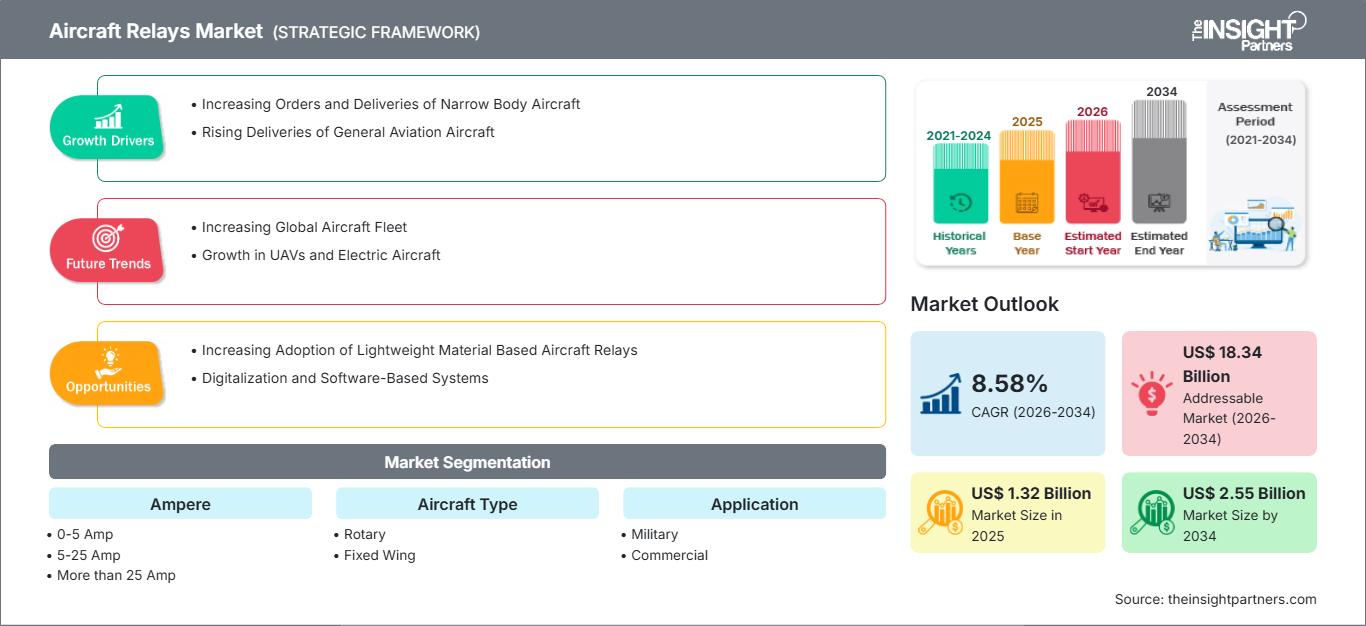
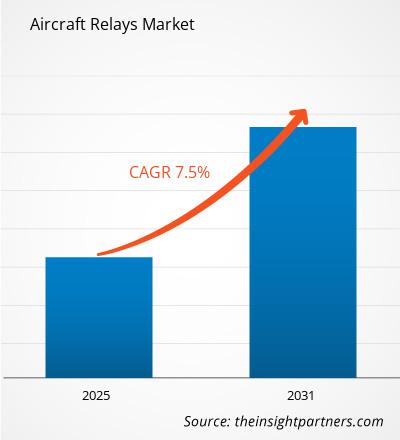
The aircraft relays market size reached US$ 1.32 Billion in 2025 and is projected to reach US$ 2.55 Billion by 2034, with a CAGR of 7.59% from 2026 to 2034. Growth is supported by increasing electrical content in aircraft, modernization of power distribution architectures, replacement of legacy switching components, and demand for compact, reliable relays across commercial and military platforms. Higher electrical loads and tighter size, weight, and power requirements are also encouraging suppliers to improve switching efficiency, thermal performance, environmental sealing, and integration with monitored electrical systems.
North America remains an important production and consumption base for the aircraft relays market, supported by established aircraft manufacturing, defense procurement, aftermarket maintenance, and a dense supplier ecosystem. The region is expected to expand at a ~7% CAGR through 2034. Demand is reinforced by fleet modernization and continued investment in electrically intensive aircraft systems, while replacement programs create recurring requirements for qualified switching components.
Aircraft Relays Market Assessment and Insights
Regional Outlook
- North America: ~38% of the global aircraft relays market share in 2025 | ~7% CAGR through 2034. Market position: North America holds the largest regional position, supported by extensive aircraft production, defense platforms, MRO activity, and established electrical-component suppliers. Fleet modernization and replacement of qualified legacy relays sustain recurring demand.
- US: ~82% of North American market revenue in 2025 | ~7% CAGR through 2034. Market position: The US represents the principal market within North America because of its large commercial and military aircraft base, extensive aerospace manufacturing capacity, and concentration of avionics, power-management, and component suppliers serving OEM and aftermarket programs.
- Europe: ~26% of the global market in 2025 | ~7% CAGR through 2034. Market position: Europe maintains a mature aerospace electrical ecosystem, with France representing the leading country in Europe. Germany, the UK, Italy, and Spain contribute through aircraft manufacturing, defense programs, component production, and MRO networks.
- Asia Pacific: ~24% of the global market in 2025 | ~10% CAGR through 2034. Market position: Asia Pacific is the fastest-growing region, supported by expanding commercial fleets, indigenous aircraft programs, defense modernization, and localization of aerospace manufacturing. China represents the leading country in Asia Pacific, with Japan, South Korea, India, and Australia adding demand.
Segment Outlook
- Commercial: ~72% Share in 2025 | ~8% CAGR through 2034. Market position: Commercial applications lead because passenger aircraft deploy extensive electrical distribution, avionics, lighting, actuation, and utility systems. High aircraft utilization and fleet renewal sustain demand for qualified relays across production and aftermarket channels.
- Rotary: ~18% Share in 2025 | ~10% CAGR through 2034. Market position: Rotary aircraft represent the high-growth segment as helicopter modernization, defense rotorcraft programs, and electrification of onboard systems increase demand for compact switching components able to operate under vibration, temperature, and altitude constraints.
Competitive Coverage
Leach International Corporation, Safran, AMETEK, Inc., FIRST SWITCHTECH, Teledyne Defense Electronics, TE Connectivity, KELCO Industries, Woodward, Inc., Jupiter Avionics Corporation, Applied Avionics, Inc.
Methodology
The Insight Partners follows Data Collection & Secondary Research, Primary Research, Data Analysis, and Data Triangulation & Final Review to validate market estimates and insights.
Source: The Insight Partners' analysis based on proprietary research, government publications, company annual reports, investor presentations, industry databases, and expert interviews.
Aircraft relays market has been developed within the general trend of migration from the mechanical concentration of aircraft systems to more electrical distribution. Relays are now focused on being lighter, smaller, well-sealed, more reliable in switching, and adaptable to power management requirements of the aircraft. Production trends are also affected by tough qualification criteria, long-term aircraft program cycles, and requirements of interchangeable or specialized components. As electrical loads increase, relay manufacturers have to solve the issues related to higher current switching, heat removal, interface of monitoring system and high reliability in terms of vibration, shock, temperature, and altitude.
The future development of the market will be driven by aircraft deliveries, modernization of military fleets, MRO needs, and investments in more electric and hybrid electric aircraft architectures. The new aerospace production hubs of Asia Pacific are expanding the potential supplier base as well as creating local qualification requirements. Certification requirements are still in favor of tested families of products provided by traditional suppliers while new aircraft architectures create a chance for lighter and smarter switchgears. All this creates conditions for steady demand up to 2034 without excluding replacement demand of mature aircrafts.
Aircraft Relays Market Report Scope
| Report Attribute | Details |
|---|---|
| Market size in 2025 | US$ 1.32 Billion |
| Market Size by 2034 | US$ 2.55 Billion |
| Global CAGR (2026 - 2034) | 7.59% |
| Historical Data | 2021-2024 |
| Forecast period | 2026-2034 |
Aircraft Relays Market Analysis
The aircraft relay market is characterized by the need to manage and distribute power safely throughout an aircraft while being reliable and lightweight. The market demands range from power distribution to avionics, lighting, fuel systems, environment control systems, landing systems, and mission equipment. The value chain consists of relay manufacturers, specific electrical components producers, distributors, aircraft OEMs, system integrators, MRO companies, and defense procurement agencies. The requirement to qualify suppliers is critical since replacement parts need to fulfill certain electrical, mechanical, environmental and certification requirements.
Market dynamics depend on the long qualification process and production capabilities of suppliers. Hermetically sealed cases, contacts, coil assemblies, insulation system, and specific materials should be reliably manufactured through the whole cycle of an aircraft program. Manufacturers, therefore, compete on the basis of engineering expertise, qualification depth, customization, reliability of production, and service in the after-market. Growing electronic content of aircraft results in the growing demand for high current switching and better heat management properties.
Competitive positioning is based on the breadth of the product offering, aerospace qualifications, manufacturing volumes, and market channels such as OEM and after-market sales. Safran, TE Connectivity, Leach International Corporation, FIRST SWITCHTECH, Teledyne Defense Electronics, and AMETEK, Inc. satisfy different combinations of power distribution, switching in harsh environments, and aerospace electronics needs. Woodward, Inc. brings the expertise in aerospace controls, and Jupiter Avionics Corporation and Applied Avionics, Inc. contribute into specific aircraft applications in the areas of electrical systems and avionics. KELCO Industries and other specialized companies provide switching solutions for certain configurations.
Investment is focused on technologies reducing size and weight but increasing electrical power and efficiency of aircraft architectures. Competitive positioning in such case will be based on maintaining qualified products and on development of products for new aircraft platforms. Suppliers with broad engineering capability can cover several aircraft types, and specialists can compete with their customized relay configurations, quick application support, and qualification expertise. Aircraft life cycle adds more weight to lifecycle support and documentation as well as replacement.
● REPORT CUSTOMIZATION
Tailor This Report To Align With Your Specific Business Requirements
This report can be customized to align precisely with your business objectives, scope, and target markets. Customization options include tailored segmentation, geography, competitive analysis, and strategic insights to support informed decision-making.
Customize This Report →WHAT YOU CAN ADJUST
- ● Segmentations
- ● Geography
- ● Competitive Analysis
- ● Language Preferences
Aircraft Relays Market: Strategic Insights
Regional Insights
North America Aircraft Relays Market
North America accounted for ~38% of the aircraft relays market in 2025 and is expected to expand at a ~7% CAGR through 2034. This is because of the well-established base of manufacture of aircraft, including military aircraft, commercial aircraft, rotorcraft, business aviation, and special purpose aircraft. Demand will be driven both by development of new aircraft and the need for replacement of existing components which have reached their maintenance schedules. North America forms the demand center, because of the presence of companies involved in design and manufacture of aircraft, defense contracts, avionics, and MRO services spread throughout the US. The relay applications range from signal switching to power distribution. Canada forms another demand source in the form of regional air travel, business aircraft, rotorcraft, and aerospace component manufacture. There are also barriers in the form of certification facilities and the requirement of qualification of suppliers, which make it necessary to stick to proven product designs.
U.S. Aircraft Relays Market
The aircraft relays market forecast shows that the US represented ~82% of North American market in 2025 and is expected to grow at a ~7% CAGR through 2034. It is due to the level of commercial and military aviation, aircraft manufacturing, and installed fleet with periodic maintenance and component replacement. The need also arises due to corporate aviation, rotary-wing aircrafts, and special purpose government aircrafts.
The supplier environment consists of Leach International Corporation, TE Connectivity, AMETEK, Inc., Teledyne Defense Electronics, Woodward, Inc., KELCO Industries, and Applied Avionics, Inc., besides many systems integrators and distributors. There are high recurring demands arising from commercial aviation whereas the military systems need extremely reliable and robust parts that can withstand tough environmental conditions. There are multiple channels of demands arising due to increased electrical load, enhanced power management, avionics updates, and maintenance of aircrafts.
Europe Aircraft Relays Market
Europe represented ~26% of the aircraft relays market in 2025 and is projected to register a ~7% CAGR through 2034. France is the leading country in Europe, supported by its aerospace manufacturing and electrical-system capabilities. Germany contributes through aircraft systems, industrial aerospace suppliers, and defense programs, while the UK remains important for aerospace engineering, military aviation, and component manufacturing. Italy and Spain add demand through aircraft assembly, rotorcraft, defense programs, and MRO activities.
European demand is closely linked to aircraft production, fleet modernization, and the transition toward more-electric architectures. France benefits from a strong aerospace ecosystem and established power-distribution capabilities. Germany's industrial base supports specialized electrical and avionics applications, while the UK combines aircraft systems expertise with a significant defense and aftermarket presence. Italy has opportunities in rotorcraft and defense aviation, whereas Spain benefits from aircraft manufacturing and maintenance networks.
The regional market also reflects stringent qualification expectations and long aircraft development cycles. Suppliers must maintain documentation, traceability, environmental performance, and consistent production quality. Investment in next-generation aircraft programs is creating demand for lighter and more efficient switching components. The European market therefore combines stable replacement demand from mature fleets with incremental opportunities created by new aircraft electrical architectures. Collaboration between component manufacturers, aircraft OEMs, and system integrators remains important for securing long-duration programs.
APAC Aircraft Relays Market
Asia Pacific represented ~24% of the aircraft relays market in 2025 and is expected to expand at a ~10% CAGR through 2034, making it the fastest-growing region. China is the leading country in Asia Pacific, supported by commercial aircraft development, expanding fleet requirements, and defense modernization. Japan and South Korea provide established aerospace manufacturing capabilities, while India is expanding aircraft production and MRO infrastructure.
Australia contributes through defense aviation, regional aircraft, and maintenance requirements. Across the region, increasing passenger traffic, indigenous aerospace programs, localization initiatives, and military procurement are broadening the demand base. Relay suppliers that can support local production, certification, engineering customization, and aftermarket logistics are positioned to participate in the region's expanding aircraft ecosystem.
Middle East & Africa Aircraft Relays Market
The Middle East and Africa aircraft relays market is expected to grow at a ~8% CAGR through 2034. Saudi Arabia and the UAE provide important demand centers because of aviation infrastructure investment, fleet expansion, defense modernization, and development of domestic aerospace capabilities. South Africa contributes through established aerospace engineering and defense activities.
The UAE represents the leading country in the Middle East & Africa based on its combination of commercial aviation activity, MRO infrastructure, airport investment, and defense aerospace requirements. Saudi Arabia is strengthening its aerospace industrial ecosystem, while South Africa supports regional demand through maintenance and defense capabilities. Across the wider region, relay consumption is tied to fleet maintenance, aircraft modernization, and expansion of aviation infrastructure. Suppliers able to provide reliable aftermarket availability and certified components can address both mature operator requirements and emerging aerospace programs.
Segmentation Analysis
Ampere
The Ampere segment reflects the electrical-load diversity of aircraft systems and determines the relay architecture, contact configuration, thermal requirements, and application suitability. Demand spans low-power signal switching through higher-load distribution functions, with buyers balancing current capacity against weight, size, reliability, and lifecycle requirements. The 0-5 Amp sub-segment is expected to record a ~7% CAGR through 2034 as avionics, control, monitoring, and low-power electronic functions continue expanding.
- 0-5 Amp: Low-current relays serve signal, control, monitoring, and avionics functions where compact packaging, low coil consumption, and reliable switching are important. Their broad application base supports recurring OEM and replacement demand.
- 5-25 Amp: Mid-range switching supports secondary electrical distribution, equipment control, and utility functions. Adoption is influenced by the need to handle moderate loads while retaining compact form factors and environmental robustness.
- More than 25 Amp: Higher-current relays address power-intensive aircraft functions requiring stronger contacts, improved thermal management, and dependable switching under demanding electrical loads. Their importance increases as aircraft electrical architectures become more capable.
Aircraft Type
The Aircraft Type segment captures differences in electrical architecture, operating environment, platform utilization, and procurement requirements between rotary and fixed-wing aircraft. Fixed-wing platforms generate broad demand because commercial, military, and business aircraft deploy numerous electrical systems across propulsion support, avionics, cabin functions, and power distribution. The Rotary sub-segment is expected to achieve a ~10% CAGR through 2034, supported by helicopter modernization and increasing onboard electrical functionality.
- Rotary: Rotorcraft require components capable of tolerating vibration, shock, temperature variation, and demanding mission conditions. Modernization of military and commercial helicopters supports relay replacement and new-platform requirements.
- Fixed Wing: Fixed-wing aircraft represent the broadest application environment, spanning passenger, cargo, business, training, and military platforms. Their extensive electrical networks create sustained requirements for both new-build and aftermarket relays.
Application
The Application segment reflects the differing procurement cycles, aircraft utilization patterns, certification requirements, and electrical-system configurations of military and commercial aviation. Commercial aircraft generate the larger requirement because of the size of the global fleet and extensive electrical content in passenger and cargo platforms. The Commercial sub-segment is expected to expand at a ~8% CAGR through 2034 as deliveries, fleet upgrades, and MRO activity sustain component demand.
- Military: Military aircraft require ruggedized switching components for mission systems, avionics, communications, weapons support, power distribution, and other critical functions. Procurement cycles can be lengthy, but platform modernization provides durable demand.
- Commercial: Commercial aviation creates demand across new aircraft production, airline fleet upgrades, business aviation, and MRO. High aircraft utilization increases the importance of reliable replacement components and lifecycle support.
Opportunity Snapshot
| Application | Revenue Contribution | Trend Tag | Adoption Stage |
| Military | Medium | Defense Modernization | Scaling |
| Commercial | High | Fleet Electrification | Mature |
Aircraft Relays Market Growth Drivers and Impact Analysis
Increasing Electrical Content in Aircraft Platforms
Modern aircraft are incorporating more electrically powered and electronically controlled functions, increasing the number and diversity of switching points required across the electrical architecture. Higher electrical content creates demand for relays that can manage power distribution, signal routing, equipment control, and protection functions while maintaining low mass and high reliability. The market impact extends beyond new aircraft because installed fleets also require component upgrades and replacements as electrical systems are modernized. More-electric architectures additionally increase the importance of current handling, thermal management, contact durability, and compact packaging. Suppliers capable of supporting multiple load classes can therefore address a wider portion of aircraft electrical-system requirements. The shift also encourages closer coordination between relay manufacturers and aircraft-system integrators during platform development.
Commercial Fleet Expansion and MRO Requirements
Growing aircraft utilization creates two complementary demand channels for aircraft relays: installation on new platforms and replacement within aircraft already in service. Commercial operators require reliable components because relay failures can affect electrical distribution, avionics, cabin equipment, or other aircraft functions. MRO providers consequently value established part numbers, traceability, qualification documentation, and dependable availability. High aircraft utilization can shorten maintenance intervals for certain components and increase the importance of replacement supply chains. New deliveries further expand the installed base that will eventually require maintenance. This combination creates a recurring demand mechanism that is less dependent on a single aircraft program. Relay manufacturers with established aftermarket channels can therefore participate throughout the aircraft lifecycle rather than relying exclusively on original equipment production.
Military Aircraft Modernization and Mission-System Upgrades
Defense aviation modernization supports relay demand through upgrades to avionics, communications, mission computers, electronic warfare systems, power distribution, and other onboard equipment. Military platforms often remain in service for long periods, making component obsolescence management and replacement availability important. Upgrades can require switching components with revised electrical ratings, environmental performance, packaging, or qualification characteristics. New rotorcraft and fixed-wing defense platforms similarly require ruggedized relays capable of operating under vibration, shock, temperature, and altitude stresses. The market impact is therefore distributed between new procurement and modernization of existing aircraft. Suppliers that maintain qualified legacy products while developing updated switching technologies can address both requirements, particularly where defense customers prioritize lifecycle support and configuration stability.
Aircraft Relays Market Future Trends
Intelligent and Sensor-Integrated Switching Architectures
The aircraft relays market trends indicate that future aircraft electrical systems are likely to place greater emphasis on monitoring, diagnostics, and intelligent power management. Conventional relay functions can increasingly be combined with sensing and control capabilities to provide information about electrical states, load conditions, switching activity, or abnormal behavior. This development can support predictive maintenance and improve visibility across distributed aircraft electrical networks. The opportunity for relay suppliers is to integrate monitoring functions without creating excessive weight, power consumption, heat generation, or certification complexity. As aircraft become more connected, switching components may increasingly form part of a broader digital electrical-management architecture rather than operating as isolated devices. Adoption will depend on reliability, cybersecurity considerations where applicable, compatibility with aircraft communication architectures, and the ability to demonstrate certification compliance.
High-Voltage Switching for More-Electric Aircraft
More-electric and hybrid-electric aircraft concepts are increasing attention on higher-voltage electrical distribution and power conversion. Higher-voltage architectures can reduce current requirements for a given power level, but they also introduce stricter requirements for insulation, arcing control, contact design, thermal performance, and safety. Relay and contactor suppliers are therefore expected to develop compact switching technologies capable of managing higher electrical loads within constrained aircraft spaces. The trend will initially be strongest in new aircraft development and specialized platforms where electrical propulsion or high-power subsystems are being evaluated. Over time, lessons from these programs can influence conventional aircraft electrical systems. Suppliers with experience in high-voltage switching, environmental qualification, and aerospace certification can benefit from this transition.
Aircraft Relays Market Opportunities
Localized Aerospace Supply Chains in Asia Pacific
Asia Pacific provides an opportunity for relay suppliers to establish stronger manufacturing, engineering, distribution, and MRO relationships as regional aerospace capabilities expand. China, India, Japan, South Korea, and Australia have different aircraft-production and defense requirements, creating opportunities for suppliers that can tailor commercial models to local certification and procurement structures. Localization can reduce lead times and strengthen support for aircraft manufacturers and MRO providers, particularly where replacement availability is strategically important. Partnerships with local aerospace companies, distributors, and maintenance organizations can provide market access without requiring immediate full-scale manufacturing investment. Suppliers can also use regional engineering centers to support customization and qualification work. The opportunity is therefore broader than sales growth and includes development of long-term regional aerospace supply-chain positions.
Lifecycle Support for Legacy and Modern Aircraft Fleets
The coexistence of legacy aircraft and newer electrically intensive platforms creates opportunities for suppliers that can provide long-term relay availability, engineering support, documentation, and replacement solutions. Mature aircraft fleets may require continued access to qualified legacy configurations even as original production volumes decline. At the same time, new aircraft programs create demand for next-generation switching components with different electrical and packaging requirements. Companies can address this transition through product-line rationalization, form-fit-function replacements, application engineering, and digital parts support. MRO relationships are particularly valuable because operators prioritize predictable supply and certification documentation when aircraft remain in service for extended periods. A lifecycle-oriented strategy can therefore create recurring revenue opportunities across both mature and emerging aircraft platforms.
Frequently Asked Questions

- Comprehensive Market Sizing and Forecast Analysis
- Detailed Segmentation Analysis
- In-Depth Market Dynamics Assessment
- Regional and Country-Level Insights
- Competitive Landscape and Company Benchmarking
- Strategic Business Intelligence
Recent Reports
Testimonials

The Insight Partners provided valuable market intelligence that supported our global go-to-market strategy. Their team was professional, responsive, and attentive to our feedback, providing thoughtful analysis and helpful methodological clarifications throughout the project.
Junmo Kim Chief Financial Officer (CFO), Enertech Co., Ltd.
The Insight Partners' SCADA System Market report is comprehensive, with valuable insights on current trends and future forecasts. The team was highly professional, responsive, and supportive throughout. We are very satisfied and highly recommend their services.
RAN KEDEM Partner, Reali Technologies LTDs
I requested a report on a very specific software market and the team produced the report in a few days. The information was very relevant and well presented. I then requested some changes and additions to the report. The team was again very responsive and I got the final report in less than a week.
JEAN-HERVE JENN Chairman, Future Analytica
We worked with The Insight Partners for an important market study and forecast. They gave us clear insights into opportunities and risks, which helped shape our plans. Their research was easy to use and based on solid data. It helped us make smart, confident decisions. We highly recommend them.
PIYUSH NAGPAL Sr. Vice President, High Beam Global
The Insight Partners delivered insightful, well-structured market research with strong domain expertise. Their team was professional and responsive throughout. The user-friendly website made accessing industry reports seamless. We highly recommend them for reliable, high-quality research services
YUKIHIKO ADACHI CEO, Deep Blue, LLC.
This is the first time I have purchased a market report from The Insight Partners.While I was unsure at first, I visited their web site and felt more comfortable to take the risk and purchase a market report.I am completely satisfied with the quality of the report and customer service. I had several questions and comments with the initial report, but after a couple of dialogs over email with their analyst I believe I have a report that I can use as input to our strategic planning process.Thank you so much for taking the extra time and making this a positive experience.I will definitely recommend your service to others and you will be my first call when we need further market data.
JOHN SUZUKI President and Chief Executive Officer, Board Director, BK Technologies
I wish to appreciate your support and the professionalism you displayed in the course of attending to my request for information regarding to infectious disease IVD market in Nigeria. I appreciate your patience, your guidance, and the fact that you were willing to offer a discount, which eventually made it possible for us to close a deal. I look forward to engaging The Insight Partners in the future, all thanks to the impression you have created in me as a result of this first encounter.
DR CHIJIOKE ONYIA MANAGING DIRECTOR, PineCrest Healthcare Ltd.Reason to Buy
- Informed Decision-Making
- Understanding Market Dynamics
- Competitive Analysis
- Identifying Emerging Markets
- Customer Insights
- Market Forecasts
- Risk Mitigation
- Boosting Operational Efficiency
- Strategic Planning
- Investment Justification
- Tracking Industry Innovations
- Aligning with Regulatory Trends





 Get Free Sample for