Aircraft Remote Electronic Unit Market Size & Overview
The aircraft remote electronic unit market size was valued at US$ 5.53 Billion in 2025 and is projected to reach US$ 12.33 Billion by 2034, registering a CAGR of 9.33% during 2026–2034. Growth is supported by increasing use of distributed aircraft control architectures, electrification of actuation systems, demand for lightweight electronics, and the integration of monitoring and control functions closer to aircraft equipment.
North America remains an important production and deployment center for aircraft control electronics, supported by major aircraft manufacturers, defense programs, established avionics suppliers, and a large installed aircraft base. The aircraft remote electronic unit market in the region is estimated to expand at a CAGR of ~8% through 2034 as replacement demand combines with new aircraft deliveries and upgrades to electronically controlled systems.
There is a direct link between increased localization of aircraft control functionalities and demand. The remote unit may be used to close the actuator loop, handle sensors' input, check the status of equipment, and communicate via aircraft data bus without having all functionalities localized in one central computer. The flight control application creates especially high demand due to the need for redundancy, fault monitoring, and deterministic execution. There is a value chain running from semiconductor and electronics suppliers to board level electronics, software, enclosure, thermal management solutions, system integration, aircraft production, and MRO companies. The suppliers have to deal with long qualification processes and demanding environmental conditions while providing stable components availability during the entire life cycle of the aircraft. Hence, the market dynamics benefit suppliers that possess engineering skills, certification, manufacturing competencies, and lifecycle support rather than just electronic components.
Competitive efforts encompass system providers for integrated aerospace systems and actuation electronics providers. The Collins Aerospace provides aerospace electronics, power management and after-market services while BAE Systems specializes in flight control electronics and remote electronics units. Parker supplies REUs in its range of electronic controls and Liebherr has designed universal architecture for multiple applications of REUs in aerospace systems. Other providers like Moog, Curtiss-Wright, Thales, Siemens, Becker Avionics, AAC Microtec and GE Aerospace contribute to control electronics, avionics, embedded systems and aircraft systems. Increasingly, investments go into electronics engineering, qualifying infrastructure, automated manufacturing and local presence. An engineering development and testing facility by Collins Aerospace in Bengaluru was established in 2025. Additionally, the more extensive Indian manufacturing presence at Collins helps in aerospace manufacturing and localization of supply chains. Investments like these may reduce development and qualification timeframes and increase access to engineering skills in the region. For suppliers, competitive positioning involves combining hardware, embedded software, diagnostics, certification capabilities and aftermarket services in long life cycles of aircraft programs.
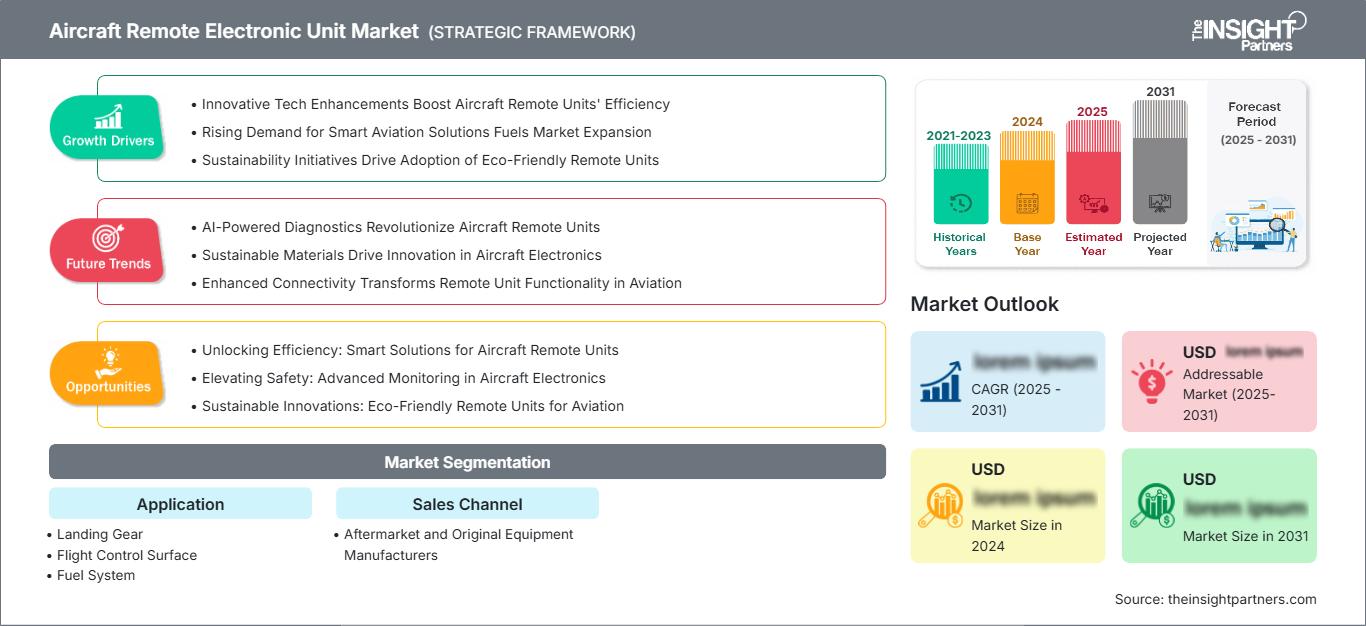
Aircraft Remote Electronic Unit Market Assessment and Insights
Regional Outlook
- North America: ~38% of the global aircraft remote electronic unit market share in 2025 | ~8% CAGR through 2034. Market position: North America holds the largest regional position, supported by extensive commercial and military aircraft programs, mature avionics supply chains, established certification capabilities, and demand for electronically controlled flight-critical systems.
- US: ~76% of North American market revenue in 2025 | ~8% CAGR through 2034. Market position: The US accounts for most North American demand because of its large aircraft manufacturing and defense ecosystem. Broad deployment of distributed flight-control, landing-gear, fuel-management, and monitoring electronics reinforces domestic demand.
- Europe: ~27% of the global market in 2025 | ~8% CAGR through 2034. Market position: Europe has a mature aerospace manufacturing base centered on the UK, Germany, France, Italy, and Spain. Germany is the leading country in Europe, supported by aircraft systems manufacturing, component engineering, and established aerospace certification capabilities.
- Asia Pacific: ~25% of the global market in 2025 | ~12% CAGR through 2034. Market position: Asia Pacific is the fastest-growing region as aircraft fleets expand, aerospace manufacturing capacity develops, and localized engineering increases. China is the leading country in Asia Pacific, while India, Japan, South Korea, and Australia support wider adoption.
Segment Outlook
- Flight Control Surface: ~34% Share in 2025 | ~10% CAGR through 2034. Market position: Flight-control applications represent the largest application position because REUs provide localized closed-loop control, monitoring, signal conversion, and redundancy functions for safety-critical actuation architectures.
- Original Equipment Manufacturers: ~61% Share in 2025 | ~10% CAGR through 2034. Market position: OEM demand remains structurally strong because REUs are integrated during aircraft development and production. Certification, architecture integration, software qualification, and platform-specific hardware requirements favor early supplier involvement.
Competitive Coverage
Collins Aerospace, Siemens AG, Thales Group, Parker Hannifin Corporation, BAE Systems plc, Liebherr Group, Curtiss-Wright Corporation, Moog Inc., Becker Avionics Inc., AAC Microtec, GE Aerospace
Methodology
The Insight Partners follows Data Collection & Secondary Research, Primary Research, Data Analysis, and Data Triangulation & Final Review to validate market estimates and insights.
Source: The Insight Partners' analysis based on proprietary research, government publications, company annual reports, investor presentations, industry databases, and expert interviews.
Aircraft Remote Electronic Unit Market Trends
Higher Functional Integration in Compact Electronics
The aircraft remote electronic unit market trends indicate that future REUs are likely to combine more control, monitoring, communication, and diagnostic functions within compact hardware. Instead of serving only as a local loop-closure device, an REU can increasingly act as a data concentrator and interface between sensors, actuators, and aircraft networks. This development can reduce the number of separate electronic modules and support more flexible system architectures. Qualification requirements will remain a constraint because increased integration also raises the consequences of component or software failures. Suppliers are therefore likely to focus on redundant computing lanes, configurable interfaces, embedded diagnostics, and software architectures that can support multiple aircraft configurations without extensive hardware redesign.
Integration of Predictive Health Monitoring
Remote electronic units are positioned close to equipment that generates useful operational data, creating an opportunity to integrate condition-monitoring functions directly into distributed control architectures. Future systems can increasingly use local measurements such as actuator position, temperature, current, pressure, or fault status to identify abnormal operating conditions before a component reaches an unscheduled removal threshold. This direction aligns with wider aerospace investment in predictive maintenance and connected aircraft operations. For REU suppliers, the trend can shift product differentiation from basic control functionality toward embedded diagnostics, data quality, secure communications, and compatibility with aircraft maintenance systems.
Aircraft Remote Electronic Unit Market Growth Factors
Expansion of Distributed Aircraft Control Architectures
Aircraft manufacturers are increasingly distributing control and monitoring functions across the airframe rather than concentrating every processing task in a small number of centralized computers. REUs fit this architecture by positioning processing capability close to actuators, sensors, valves, and other controlled equipment. The resulting architecture can simplify wiring, shorten signal paths, and support localized fault monitoring. Liebherr's REU technology demonstrates the broader application of system control, position control, monitoring, data concentration, and signal conversion within a single unit. As aircraft programs adopt more integrated electrical and electronic systems, suppliers able to provide configurable units with multiple interfaces and high-integrity operation can address a broader range of applications.
Growth in More-Electric Flight Control and Actuation
Aircraft electrification creates additional requirements for electronic control hardware because electric, electrohydraulic, and electro-mechanical actuators require sophisticated command, feedback, monitoring, and power-management functions. Parker's aerospace portfolio includes remote electronics units, actuation control electronics, and motor-control electronics designed for more-electric systems. This architecture creates demand not only for new REUs but also for electronics capable of operating in demanding temperature, vibration, electromagnetic, and reliability environments. As manufacturers seek lower system weight and greater functional integration, electronic control units can replace or consolidate discrete control elements. The resulting increase in electronics content per aircraft creates a structural demand pathway for qualified REU suppliers.
Increasing Aircraft Production and Fleet Modernization
New commercial aircraft deliveries and military platform modernization increase the addressable installed base for flight-control and aircraft utility electronics. At the same time, older aircraft require replacement components, system upgrades, and maintenance support over long operating lifecycles. These two demand streams reduce dependence on a single procurement cycle. OEM installations generally create higher integration requirements, while aftermarket channels require interchangeable or repairable equipment supported by documentation and certification. Suppliers with established relationships across aircraft manufacturers and MRO organizations can address both channels. The combination of new-build production and installed-fleet maintenance therefore provides a diversified demand base for remote electronic units through 2034.
Aircraft Remote Electronic Unit Market Opportunities
Regional Aerospace Electronics Localization
The expansion of aerospace manufacturing and engineering capabilities in Asia Pacific creates opportunities for suppliers to establish local design, testing, manufacturing, and support capabilities. India is developing particular importance as an aerospace engineering and manufacturing location, while China, Japan, and South Korea maintain substantial industrial and aviation ecosystems. Local qualification and test infrastructure can reduce development-cycle friction and support closer collaboration with aircraft manufacturers and MRO organizations. Suppliers entering these markets can focus on certified production, repair capability, engineering support, and supply-chain resilience rather than only final assembly. Partnerships with established aerospace organizations can also provide access to long-duration aircraft programs where qualification barriers make direct market entry more difficult.
Lifecycle Services for Installed REU Fleets
The installed base of aircraft creates commercial opportunities beyond initial equipment sales. Operators require repair, replacement, testing, documentation, configuration management, and obsolescence support throughout aircraft service lives. As electronic components become obsolete, suppliers can offer redesigned units that preserve interfaces while improving availability or functionality, subject to aircraft certification requirements. Lifecycle programs can also combine spare-unit pools, repair services, technical support, and upgrade packages. This approach is particularly relevant for older aircraft where original electronics may have limited production availability. Companies with established certification records and repair networks can use lifecycle support to extend customer relationships beyond the original equipment procurement cycle.
Segmentation Analysis
Application
Application is the principal demand dimension for the aircraft remote electronic unit market because REU architecture is determined by the control, monitoring, sensing, and actuation requirements of aircraft equipment. Adoption increases as manufacturers distribute processing functions closer to flight-critical hardware and seek modular electronics. Flight Control Surface applications are estimated to record a CAGR of ~10% through 2034, supported by continued electronic actuation and localized closed-loop control requirements.
- Landing Gear: REUs support localized control, monitoring, and communication for landing-gear equipment, where reliable status feedback and deterministic operation are important for steering, extension, retraction, and braking-related functions.
- Flight Control Surface: Demand is linked to fly-by-wire architectures and electronically controlled actuators. Localized electronics can support control-loop closure, position feedback, fault monitoring, and communication for aircraft maneuvering functions.
- Fuel System: Remote electronics can process sensor information and control fuel-system equipment while communicating with higher-level aircraft management systems. Adoption is influenced by distributed sensing, monitoring requirements, and increasing aircraft systems integration.
- Ice Protection System: Electronics support sensing, monitoring, and control functions associated with aircraft protection from icing conditions. Demand is connected to automation, environmental sensing, reliability requirements, and integration with aircraft control architectures.
Sales Channel
Sales Channel determines how REUs reach aircraft operators and reflects the distinction between platform-integrated equipment and lifecycle replacement demand. Original Equipment Manufacturers remain central because certification and architecture integration generally occur during aircraft development and production. Original Equipment Manufacturers are estimated to expand at a CAGR of ~10% through 2034 as new aircraft programs and increasing electronics content support initial installation requirements.
- Aftermarket: Aftermarket demand arises from scheduled replacement, repair, reliability improvements, fleet upgrades, and component availability requirements. Long aircraft service lives create recurring opportunities for qualified replacement units and repairable electronic assemblies.
- Original Equipment Manufacturers: OEM procurement is closely connected to aircraft design programs and qualification activity. Suppliers participate early to integrate hardware, software, communications interfaces, environmental protection, and safety requirements into production aircraft architectures.
Opportunity Snapshot
| Application | Revenue Contribution | Trend Tag | Adoption Stage |
|---|---|---|---|
| Landing Gear | Medium | Steering Electronics | Mature |
| Flight Control Surface | High | Fly-by-Wire | Mature |
| Fuel System | Medium | Distributed Control | Scaling |
| Ice Protection System | Low | Automated Protection | Scaling |
Regional Insights
North America aircraft remote electronic unit market
The aircraft remote electronic unit market forecast indicates that North America is estimated to account for ~38% of the market in 2025 and is projected to grow at ~8% through 2034. The region benefits from a dense aerospace ecosystem encompassing commercial aircraft production, military aircraft programs, business aviation, component manufacturing, and MRO. The US represents the largest demand center because major aircraft and defense programs require high-reliability electronics for flight control, steering, actuation, and aircraft utility systems.
Demand is also supported by modernization of installed aircraft. Distributed control electronics can be incorporated into new production aircraft and used in selected upgrades where architecture, certification, and equipment compatibility permit. Companies such as Collins Aerospace, BAE Systems, Parker, Moog, Curtiss-Wright, and GE Aerospace participate in related electronics and control-system activities. The combination of defense procurement, commercial fleet renewal, and mature aftermarket infrastructure supports recurring demand for qualified electronic units.
U.S. aircraft remote electronic unit market
The US is estimated to represent ~76% of North American aircraft remote electronic unit market revenue in 2025, with a CAGR of ~8% through 2034. Its position reflects the scale of domestic aircraft manufacturing, military procurement, aerospace electronics development, and airline fleet operations. Demand extends across primary and secondary flight controls, landing-gear functions, fuel management, steering, and aircraft monitoring.
The application base is reinforced by suppliers with established qualification and certification capabilities. BAE Systems identifies remote electronics units among its flight-control electronics offerings, while GE Aerospace maintains REU technology supporting aircraft actuation control. Parker also supplies remote electronics units within its aerospace electronic-control portfolio. This ecosystem enables the US market to combine new-aircraft installation with lifecycle support, repair, replacement, and technology-refresh requirements.
Europe aircraft remote electronic unit market
Europe accounts for an estimated ~27% of global aircraft remote electronic unit market revenue in 2025 and is projected to expand at ~8% through 2034. Germany is the leading country in Europe, supported by aerospace systems engineering, aircraft component manufacturing, and a broad industrial electronics base. France also represents a major aerospace center, while the UK contributes through aircraft systems, defense electronics, and avionics engineering.
Germany's position is strengthened by Liebherr's aerospace electronics and flight-control activities. The company develops electronics for flight-critical systems and has demonstrated REU applications involving aircraft actuation and steering. France benefits from the presence of major aerospace and electronics organizations and from aircraft production and MRO activity. The UK maintains significant capabilities in defense electronics and aircraft controls, while Italy and Spain contribute through aircraft manufacturing, systems integration, and supplier networks.
European demand is shaped by both original equipment and long-term fleet support. Certification and environmental qualification requirements raise the importance of established engineering processes, while efforts to reduce aircraft weight and increase electrification support greater use of distributed electronics. The region's mature aerospace base therefore provides a stable platform for REU deployment while new aircraft architectures create opportunities for more compact, configurable, and multifunctional units.
APAC aircraft remote electronic unit market
Asia Pacific is estimated to hold ~25% of the aircraft remote electronic unit market in 2025 and is expected to grow at ~12% through 2034, making it the fastest-growing regional market. China is the leading country in Asia Pacific, supported by expanding aerospace manufacturing and a large commercial aviation requirement. Japan and South Korea add advanced electronics and aerospace manufacturing capabilities.
India is gaining importance through aircraft fleet expansion, MRO development, and aerospace localization, while Australia contributes through defense aviation and specialist aerospace activities. Regional investment in manufacturing, engineering, testing, and supply-chain capabilities can increase local participation in electronic aircraft systems. These factors support demand for qualified REUs across flight control, landing gear, fuel systems, and other distributed aircraft functions.
Middle East & Africa aircraft remote electronic unit market
The Middle East & Africa market is expected to expand at ~9% through 2034. Saudi Arabia and the UAE represent important demand centers in the Middle East because of fleet expansion, aviation infrastructure investment, defense procurement, and the development of domestic aerospace capabilities. South Africa provides an additional aerospace engineering and maintenance base.
The region's aircraft electronics requirement is connected to fleet modernization, MRO activity, and increasing emphasis on local technical capabilities. Gulf aviation markets support demand through large commercial fleets and expanding aviation infrastructure, while defense programs provide another application base. As aircraft operators prioritize reliability and lifecycle support, suppliers with established certification, repair, replacement, and technical-support capabilities can participate across both new equipment and aftermarket channels.
Aircraft Remote Electronic Unit Market Report Scope
| Report Attribute | Details |
|---|---|
| Market size in 2025 | US$ 5.53 Billion |
| Market Size by 2034 | US$ 12.33 Billion |
| Global CAGR (2026 - 2034) | 9.33% |
| Historical Data | 2021-2024 |
| Forecast period | 2026-2034 |
| Segments Covered | Application, Sales Channel |
| Region scope | North America, Europe, Asia-Pacific, South and Central America, Middle East and Africa |
Frequently Asked Questions

Recent Reports






