Aircraft Tire Market Size & Overview
The aircraft tire market was valued at US$ 2.09 Billion in 2025 and is projected to reach US$ 2.66 Billion by 2034, registering a CAGR of 2.72% during 2026–2034. Growth is supported by commercial fleet expansion, rising aircraft utilization, replacement demand from aging fleets, and continued deployment of tires engineered for higher load capacity, durability, and operating efficiency. Increasing emphasis on aircraft weight reduction and lifecycle economics is also encouraging tire manufacturers to improve casing construction, materials, retreading compatibility, and service performance.
The aircraft tire market size is being shaped by sustained fleet utilization and replacement cycles across mature aviation systems, while North America remains supported by a large installed aircraft base and extensive maintenance infrastructure. The region is expected to record a ~2% CAGR through 2034, with demand benefiting from commercial aviation activity, military fleet maintenance, business aviation, and established MRO networks.
The aircraft tire market is highly driven by the dynamics of the use of the aircraft, the size of the aircraft fleet, replacement frequencies, and the manufacture of the aircraft. Each aircraft needs tires that are able to handle high landing loads, speed changes, heat generation, and frequent braking. The demand goes beyond the delivery of new aircraft as tires are consumable parts that need inspection and replacement among other maintenance works. The aircraft fleet provides an after sales market while the deliveries provide line fit opportunities. Supply is dependent on the special rubber compounds used, reinforcement materials, casings, certifications, and distribution networks of the tires. The tire value chain includes the raw materials suppliers, the tire manufacturers, aircraft original equipment manufacturers, airlines, military operators, the distributors, MROs, and aviation services providers. Competitions within the supply side are determined by the qualification requirements and technical impacts of the tire failure. Radial technology is of utmost importance for the commercial aircraft as it can handle high load and efficiency. Michelin, Goodyear, Bridgestone, and Dunlop Aircraft Tyres are significant players within the aviation tires whereas Desser Tire and Rubber, Specialty Tires of America are specialists within the replacements and aviation markets.
Competition in the aircraft tire segment depends on technical qualification, reliability, fleet qualification, distribution, and after sales rather than price competition. MICHELIN caters to commercial, regional, general, and military segments of aircraft tires, and offers a variety of tires in radial and bias construction, focusing on durability, lightness, and performance. Goodyear also restructured its aviation division into a single worldwide organization to serve commercial, military, and private aviation. The trend among suppliers is to focus on engineering, light construction, manufacturing precision, and longer tire life. Opportunities in new programs exist for those who get involved early in the process of qualification and line fitment, but aftermarket opportunities will be more favorable to those who have wide product lines, distribution, retreading capacity, and operator relationships.
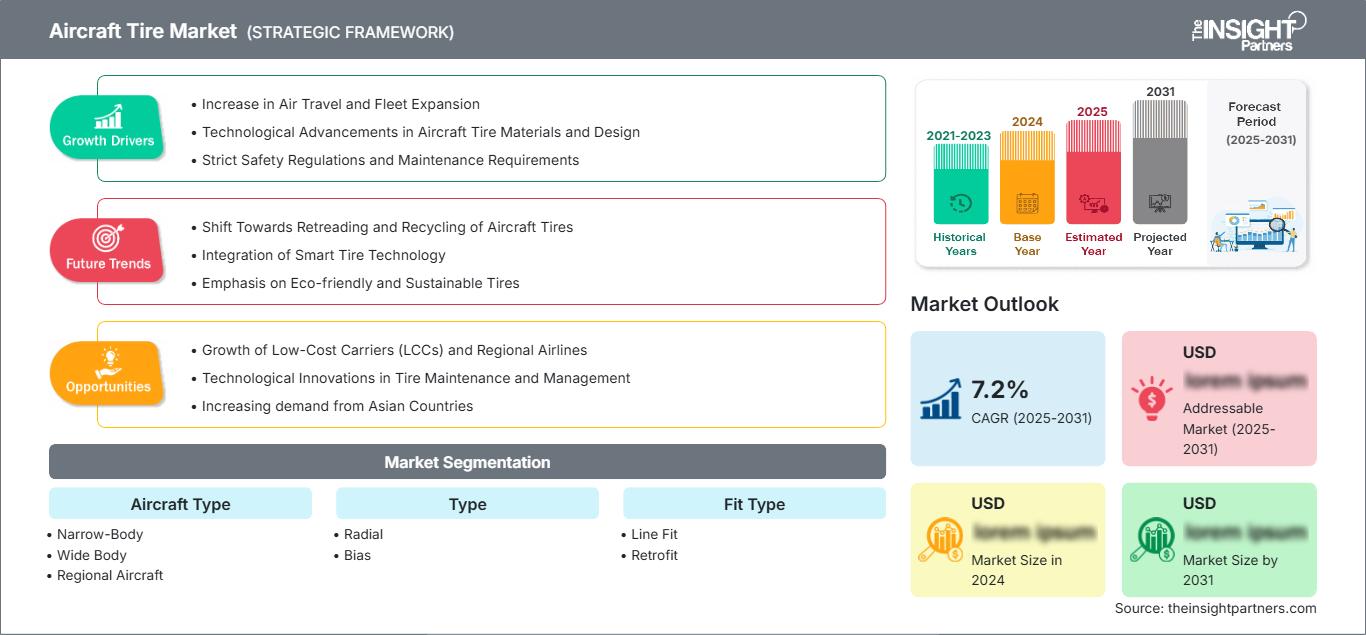
Aircraft Tire Market Assessment and Insights
Regional Outlook
- North America: ~35% of the global aircraft tire market share in 2025 | ~2% CAGR through 2034. Market position: North America maintains the largest regional position because of its substantial commercial and military aircraft base, established MRO ecosystem, replacement demand, and concentration of aircraft operators and aviation service providers.
- US: ~88% of North American market revenue in 2025 | ~2% CAGR through 2034. Market position: The US represents the principal North American demand center, supported by commercial airline fleets, general aviation activity, military aircraft operations, and a mature replacement market serving both OEM and aftermarket requirements.
- Europe: ~27% of the global market in 2025 | ~2% CAGR through 2034. Market position: Europe represents a mature aviation market, with France leading regional demand through aerospace manufacturing and airline activity, while Germany, the UK, Italy, and Spain contribute substantial commercial and MRO requirements.
- Asia Pacific: ~24% of the global market in 2025 | ~4% CAGR through 2034. Market position: Asia Pacific is the fastest-growing region as fleet expansion, increasing passenger traffic, new aircraft deliveries, and rising aviation activity in China and India increase both line-fit and replacement tire requirements.
Segment Outlook
- Narrow-Body: ~42% Share in 2025 | ~3% CAGR through 2034. Market position: Narrow-body aircraft constitute the largest demand base because high-frequency short- and medium-haul operations generate substantial landing cycles and recurring tire replacement requirements across major airline fleets.
- Radial: ~61% Share in 2025 | ~3% CAGR through 2034. Market position: Radial construction leads because commercial aircraft increasingly require higher load capability, improved durability, and efficient operating characteristics. Adoption is reinforced by newer aircraft platforms and airline focus on lifecycle operating costs.
Competitive Coverage
Bridgestone Corporation, Desser Tire and Rubber Co., LLC, Dunlop Aircraft Tyres Limited, Kadex Aero Supply Ltd, MICHELIN, Petlas Tire Corporation, Qingdao Sentury Tire Co., Ltd, Specialty Tires of America, Inc., The Goodyear Tire and Rubber Company, Wilkerson Company, Inc.
Methodology
The Insight Partners follows Data Collection & Secondary Research, Primary Research, Data Analysis, and Data Triangulation & Final Review to validate market estimates and insights.
Source: The Insight Partners' analysis based on proprietary research, government publications, company annual reports, investor presentations, industry databases, and expert interviews.
Aircraft Tire Market Trends
Longer-Life and Lower-Weight Aircraft Tire Architectures
The aircraft tire market trends show that aircraft tire development is moving toward designs that improve durability while reducing unnecessary weight. Tire manufacturers are testing combinations of advanced architecture, materials, casing design, and manufacturing processes to address airline priorities around fuel efficiency and maintenance economics. Michelin's Air X Sky Light, developed for the Dassault Falcon 10X, illustrates this direction by combining a redesigned architecture with lighter construction and longer service objectives. The broader implication is a shift from evaluating tires only on purchase price toward lifecycle performance. Suppliers that demonstrate longer usable life, lower aircraft weight, consistent handling, and reliable retreading or servicing characteristics can strengthen their relevance in future aircraft programs.
Data-Enabled Maintenance and Tire Lifecycle Management
Aircraft operators are likely to place greater emphasis on tire lifecycle visibility as fleets become more connected and maintenance processes become increasingly data-driven. Tire selection can be linked with aircraft utilization, landing cycles, inspection records, pressure management, wear characteristics, and replacement planning. Better lifecycle information can help operators reduce unscheduled maintenance and improve inventory planning, particularly across large fleets with geographically dispersed aircraft. For manufacturers and distributors, this creates opportunities to integrate technical support with digital maintenance workflows. The trend also favors suppliers capable of providing consistent product identification, service documentation, and actionable lifecycle information across OEM and aftermarket channels.
Aircraft Tire Market Growth Factors
Expansion of Commercial Aircraft Utilization
Higher aircraft utilization directly increases the number of takeoff and landing cycles experienced by tires, accelerating replacement requirements across airline fleets. IATA reported that global passenger demand increased 5.3% in 2025, while passenger load factor reached a record 83.6%, indicating sustained aircraft utilization across the global network. The effect on tire demand extends beyond fleet growth because an existing aircraft can require multiple replacement events during its operating life. High-frequency narrow-body aircraft are particularly exposed because repeated short- and medium-haul cycles increase tire wear. For manufacturers, the mechanism supports recurring aftermarket demand and increases the value of products that combine durability, predictable wear, and reduced maintenance downtime.
Aging Fleets and Extended Aircraft Operating Lives
Aircraft supply constraints are extending the operational relevance of existing fleets and supporting replacement demand. IATA reported that the average global aircraft fleet age reached 15.1 years in 2025, while delivery shortfalls and a backlog exceeding 17,000 aircraft continued to constrain fleet renewal. Older aircraft generally require continued maintenance and replacement of consumable components, including tires. This creates an important aftermarket mechanism even when new-aircraft deliveries fluctuate. Tire manufacturers can benefit from operators seeking dependable replacement products that maintain aircraft availability. MRO organizations and distributors also gain importance because older fleets require consistent access to approved replacement tires and associated technical support.
Aircraft Fleet Expansion and New Aircraft Deliveries
New aircraft deliveries create direct line-fit opportunities while also expanding the future replacement base. Airbus delivered 793 commercial aircraft in 2025 and recorded a year-end backlog of 8,754 aircraft, demonstrating substantial long-term demand for commercial aircraft production. Every incremental aircraft entering service requires an initial tire set and subsequently generates aftermarket replacement requirements. Narrow-body aircraft are especially important because their extensive use in domestic and regional networks produces recurring landing cycles. Manufacturers that secure qualification on new aircraft programs can therefore establish a multi-year revenue pathway extending from original equipment into replacement markets.
Aircraft Tire Market Opportunities
Expansion of Aircraft Tire Aftermarket Networks in Asia Pacific
Asia Pacific offers an opportunity for manufacturers and distributors to expand replacement coverage alongside fleet growth and increasing aircraft utilization. China, India, Japan, South Korea, and Australia collectively provide diverse commercial, regional, general aviation, and military applications. The region's strong traffic growth increases the utilization of existing aircraft while new aircraft deliveries expand the installed base. IATA reported that Asia Pacific international traffic grew 10.9% in 2025, supporting the underlying demand environment. Suppliers can pursue opportunity through localized inventory, distributor partnerships, MRO relationships, technical support, and faster replacement availability rather than relying exclusively on direct OEM channels.
Premium Products Focused on Lifecycle Economics
Manufacturers can create commercial opportunities by developing tires that address airline priorities beyond basic replacement. Products offering longer service life, lower weight, predictable wear, improved heat resistance, or simplified maintenance can support a lifecycle-cost proposition for operators. Michelin's recent aircraft tire development demonstrates how weight reduction and durability can be integrated into next-generation aviation tire architecture. Similar product strategies can target commercial fleets, business aviation, military operators, and specialized aircraft. The opportunity is particularly relevant where operators evaluate total operating costs across tire purchase, replacement frequency, aircraft downtime, maintenance labor, and inventory requirements.
Segmentation Analysis
Aircraft Type
Aircraft Type is a central determinant of aircraft tire demand because aircraft operating weight, landing speed, wheel configuration, utilization, and mission profile determine tire specifications. Commercial aviation creates a substantial recurring replacement base, while military and specialized aircraft require application-specific performance. Narrow-body demand is particularly important because high-frequency operations generate repeated landing cycles. Radial tire demand within narrow-body fleets is expected to expand at a ~3% CAGR through 2034 as newer aircraft platforms emphasize operating efficiency and load performance.
- Narrow-Body: High-frequency short- and medium-haul operations create substantial tire replacement requirements, with large global fleets generating consistent demand across both line-fit and aftermarket channels.
- Wide Body: Wide-body aircraft require tires capable of handling high aircraft loads and demanding operating conditions, supporting specialized products across international passenger and cargo fleets.
- Regional Aircraft: Regional aircraft serve shorter routes and secondary markets, creating recurring tire demand where high utilization and frequent cycles influence replacement requirements.
- General Aviation: General aviation encompasses a broad fleet of smaller aircraft, producing fragmented demand across aircraft owners, operators, maintenance organizations, and specialized distributors.
- Combat Aircraft: Combat aircraft require highly engineered tires capable of supporting demanding acceleration, landing, braking, and operational environments associated with military missions.
- Military Transport/Refueling Aircraft: Transport and refueling aircraft require robust tire systems suited to heavy loads, repeated operations, and varied runway conditions across military networks.
- Helicopters: Helicopter tire requirements are linked to landing configuration, aircraft weight, mission profile, and operating environment, with demand spanning commercial, utility, military, and specialized operations.
Type
Type determines the construction technology and operating characteristics of aircraft tires. Radial construction has become particularly important in commercial aviation because of its load, durability, and efficiency characteristics, while bias construction remains relevant in general aviation and selected aircraft applications. The radial sub-segment is expected to expand at a ~3% CAGR through 2034 as newer aircraft platforms and airline lifecycle objectives support continued adoption.
- Radial: Radial aircraft tires use advanced casing construction to provide high load capability, durability, and operating performance, making them important for modern commercial aircraft.
- Bias: Bias tires remain relevant for selected aircraft where construction characteristics, aircraft design, operating requirements, and established replacement practices support continued use.
Fit Type
Fit Type distinguishes demand associated with aircraft delivered with qualified tires from replacement requirements generated during aircraft operation. Retrofit demand is strategically important because the installed fleet creates recurring replacement opportunities independent of new aircraft production. Airlines and operators evaluate replacement products according to certification, aircraft compatibility, service life, availability, and total operating cost, while line-fit programs provide suppliers with longer-term OEM relationships.
- Line Fit: Line-fit tires are installed on new aircraft during production, making supplier qualification and OEM relationships important determinants of market access and recurring program demand.
- Retrofit: Retrofit demand originates from operating aircraft and replacement cycles, creating an extensive aftermarket supported by airlines, MRO organizations, distributors, and specialized aviation service providers.
Opportunity Snapshot
| Segment Name | Revenue Contribution | Trend Tag | Adoption Stage |
| Narrow-Body | High | Fleet Utilization | Mature |
| Wide Body | Medium | Long-Haul Fleet | Mature |
| Regional Aircraft | Medium | Regional Connectivity | Scaling |
| General Aviation | Medium | Fleet Renewal | Mature |
| Combat Aircraft | Low | Defense Modernization | Scaling |
| Military Transport/Refueling Aircraft | Low | Mission Readiness | Mature |
| Helicopters | Low | Utility Aviation | Mature |
Regional Insights
North America Aircraft Tire Market
North America accounted for ~35% of the global aircraft tire market in 2025 and is expected to expand at a ~2% CAGR through 2034. The advantage that this region holds is its large pool of commercial aviation fleet, huge military aviation fleet, presence of business aviation and well-established maintenance facilities. Aircraft usage drives frequent need for replacements, while existing MRO facilities make tire inspection, service and replacement convenient. The U.S. constitutes the key demand center in this region, thanks to substantial airliners' fleet and active general aviation operations.
Age of fleets and aircraft availability also impact the regional market. The supply chain issues have driven users to keep their aircraft for longer duration, driving up maintenance-oriented demand. On the other hand, introduction of narrow-body aircraft in the region offers line-fit prospects for the manufacturers. Operators in North America pay close attention to tire economics (casing life, turnaround times, and scheduled replacement), which helps maintain healthy aftermarket segment despite any yearly variation in aircraft production volume.
U.S. Aircraft Tire Market
The aircraft tire market forecast shows that the U.S. represented ~88% of North American revenue in 2025 and is expected to record a ~2% CAGR through 2034. The placement of this segment within the country is determined by the magnitude of the aviation industry there, including passenger and cargo airlines, the military, business aircraft, regional aviation, and general aviation. The variety of use cases of aircraft results in the necessity for a wide range of tire types.
Recurring needs arise from passenger and military airlines, while additional fragmentation arises due to the aftermarket needs of the general aviation segment. There are both large international and niche tire providers active in the US market directly, via distributors and MROs. Also, the strong local infrastructure in aerospace manufacturing and servicing allows for introducing advanced tire technology into the market.
Europe Aircraft Tire Market
Europe represented ~27% of the global aircraft tire market in 2025 and is projected to grow at a ~2% CAGR through 2034. France is the leading country in Europe, supported by its major aerospace manufacturing base and extensive commercial and business aviation ecosystem. Germany contributes through airline operations, aerospace manufacturing, and MRO activity, while the UK remains important because of its large aviation services and airline base. Italy and Spain add demand through commercial aviation, tourism-related traffic, military fleets, and regional aircraft operations.
European demand is influenced by aircraft utilization, replacement requirements, and the gradual introduction of newer aircraft platforms. The region also has strong technical and environmental expectations surrounding aircraft equipment, encouraging manufacturers to improve tire durability and material efficiency. Passenger demand remains an important underlying mechanism, with European carriers recording 6.0% growth in international traffic during 2025. This supports continued utilization of commercial aircraft and associated consumable components.
Airlines and MRO providers increasingly consider lifecycle cost when selecting replacement tires. Products capable of extending service intervals, reducing downtime, or supporting aircraft weight-efficiency objectives can therefore gain attention. The mature European fleet also creates a stable replacement base, limiting dependence on new-aircraft deliveries alone.
APAC Aircraft Tire Market
APAC represented ~24% of the global aircraft tire market in 2025 and is expected to expand at a ~4% CAGR through 2034, making it the fastest-growing region. China is the leading country in Asia Pacific, supported by its large aviation market and substantial aircraft demand. India is another important growth center, while Japan, South Korea, and Australia provide established commercial, regional, and general aviation demand.
The regional market is supported by fleet expansion, passenger traffic, airport development, and increasing aircraft utilization. IATA reported that Asia Pacific international traffic increased 10.9% in 2025, the strongest regional increase among international markets. Increasing airline capacity and the introduction of newer aircraft therefore support both line-fit and replacement requirements. Local aerospace development and expanding MRO capabilities are also improving the regional service ecosystem.
Middle East & Africa Aircraft Tire Market
The Middle East and Africa aircraft tire market is expected to expand at a ~3% CAGR through 2034. Saudi Arabia and the UAE are important demand centers in the Middle East because of airline fleet expansion, airport investment, and aviation hub development. South Africa provides a major aviation base in Africa, while Rest of MEA demand is supported by commercial, military, regional, and utility aviation.
The Middle East benefits from major international airline networks and large aircraft fleets, while African markets are characterized by diverse operating environments and significant replacement requirements. IATA recorded 7.8% annual growth in African airline traffic during 2025, alongside continued expansion in capacity. Tire durability and availability are especially relevant where aircraft operate across demanding climatic conditions or where maintenance infrastructure is less concentrated.
Aircraft Tire Market Report Scope
| Report Attribute | Details |
|---|---|
| Market size in 2025 | US$ 2.09 Billion |
| Market Size by 2034 | US$ 2.66 Billion |
| Global CAGR (2026 - 2034) | 2.72% |
| Historical Data | 2021-2024 |
| Forecast period | 2026-2034 |
| Segments Covered | Aircraft Type, Type, Fit Type, Geography |
| Region scope | North America, Europe, Asia-Pacific, South and Central America, Middle East and Africa |
Frequently Asked Questions

Recent Reports






