
Airport Catering Trucks Market Size, Share & Demand by 2034
Coverage: By Height (Below 4m, 4-6 m, Above 6m); Refrigeration (With Refrigeration, Without Refrigeration); Capacity (Less Than 1500 Kg, 1500-4000 Kg, Above 4000 Kg), and Geography (North America, Europe, Asia Pacific, and South and Central America)
- Status : Data Released
- Report Code : TIPRE00017891
- Category : Automotive and Transportation
- No. of Pages : 150
- Available Report Formats :


- Last update date : August 10, 2026


2025 Market Size
US$ 12.33 Bn
Base year value
2034 Forecast
US$ 20.64 Bn
Projected by 2034
CAGR 2026-2034
5.89 %
Growth rate
Addressable Market
US$ 149.35 Bn
(2026-2034)
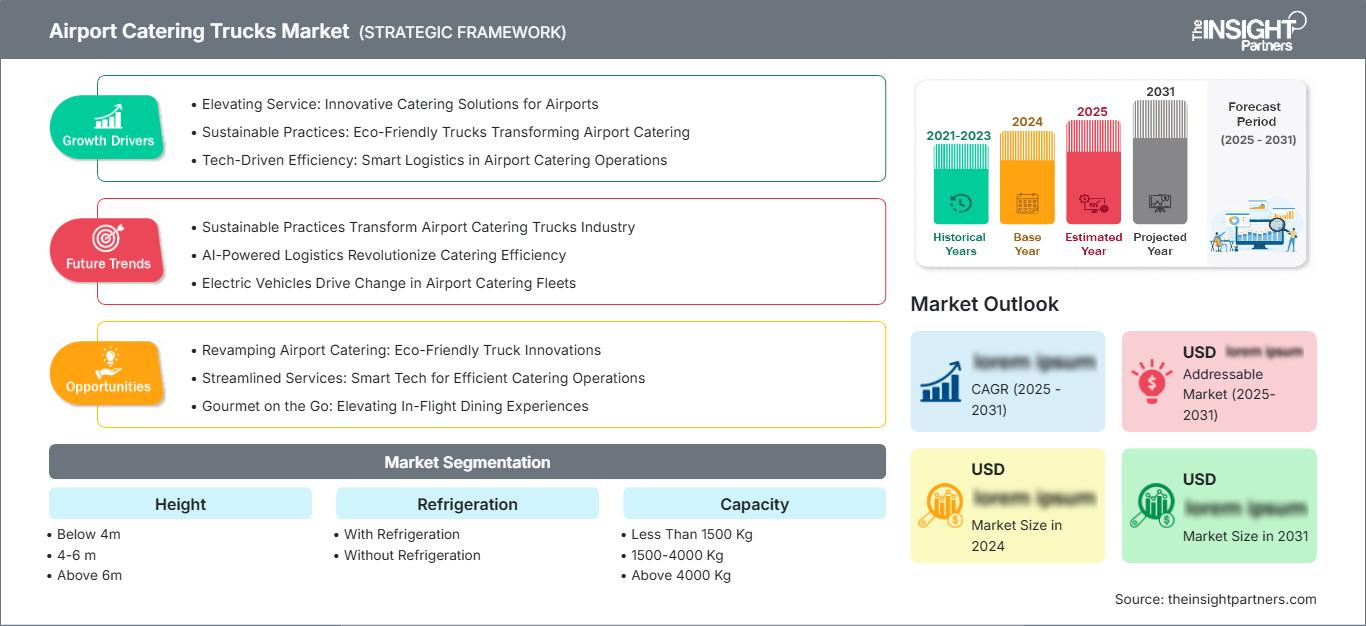
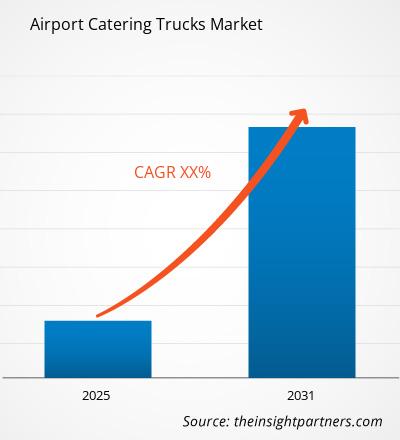
The airport catering trucks market is projected to grow from US$ 12.33 Billion in 2025 to US$ 20.64 Billion by 2034, registering a CAGR of 5.89% during 2026–2034. Demand is being shaped by higher aircraft movements, fleet renewal at major hubs, and the need for reliable food logistics vehicles that can support narrow-body, wide-body, and regional aircraft operations without disrupting turnaround schedules.
North America remains a structurally important region as airlines, caterers, and airport ground handlers renew aging diesel fleets and adopt safer, lower-emission vehicles. The airport catering trucks market size in the region is supported by high international route density, major hub modernization, and early deployment of electric refrigerated catering trucks at selected airports.
Airport Catering Trucks Market Assessment and Insights
- North America: The region accounted for an estimated 31–34% share in 2025 and is expected to grow at a CAGR of 5.6–6.2% during 2026–2034, led by fleet replacement and electrification programs.
- US: The country represented 73–77% of North America in 2025 and is expected to grow at a CAGR of 5.8–6.4%, supported by major hub upgrades.
- Europe: Europe held an estimated 24–27% share in 2025 and is forecast to expand at a CAGR of 5.1–5.7%, with Germany, the UK, France, Italy, and Spain leading procurement.
- Asia Pacific: Asia Pacific held 27–30% share in 2025 and is projected to grow at a CAGR of 6.4–7.1%, driven by China, India, Japan, South Korea, and Australia.
- Largest Segment: With refrigeration held 56–60% market share in 2025 and is expected to grow at a CAGR of 5.9–6.5% as airlines prioritize temperature-controlled catering logistics.
- High Growth Segment: Above 6m trucks held 18–21% share in 2025 and are expected to grow at a CAGR of 6.6–7.2% with wide-body fleet deployment.
- Key companies analyzed in detail: Daewon A.E., DOLL Fahrzeugbau GmbH, Global Ground Support, LLC, Jiangsu Tianyi Airport Equipment Corp. Ltd., LAS-1 Company, Mallaghan Engineering Ltd, Nandan GSE Pvt. Ltd., Smith Transportation Equipment, SOVAM, and Weihai Guangtai Airport Equipment Co. Ltd.
Source: The Insight Partners' analysis based on proprietary research, government publications, company annual reports, investor presentations, industry databases, and expert interviews.
These operational needs are evolving from pure lift-and-load capabilities to more advanced catering logistics systems. The factors driving growth in the market for airport catering trucks include hydraulic stability, refrigerated compartments, telematics, collision-avoidance technologies, and service door standardization. In addition, manufacturers are enhancing box insulation, lifting accuracy, and energy management to enable more compact ramp schedules and airside emissions reductions.
Future demand will likely be driven by the intersection of airport expansion, airline network expansion, and ground support upgrades. The growing aviation routes in the Asia Pacific and the Middle East are leading to increased fleet demands, whereas established markets are looking at replacing aging fleets. Decisions on procurement are based increasingly on lifecycle costs, charging capability, maintenance availability, and airport sustainability goals.
Airport Catering Trucks Market Report Scope
| Report Attribute | Details |
|---|---|
| Market size in 2025 | US$ 12.33 Billion |
| Market Size by 2034 | US$ 20.64 Billion |
| Global CAGR (2026 - 2034) | 5.89% |
| Historical Data | 2021-2024 |
| Forecast period | 2026-2034 |
Airport Catering Trucks Market Analysis
Demand is closely linked to passenger traffic recovery, long-haul meal service restoration, and pressure on airlines to maintain punctual turnarounds. The airport catering trucks market growth is strongest where aircraft utilization is high and flight kitchens need precise, temperature-controlled dispatch. Refrigerated bodies, high-lift systems, and telematics help caterers reduce spoilage risk while improving coordination between kitchens, ramps, and aircraft gates.
Supply dynamics are shaped by chassis availability, hydraulic component costs, and customization needs across aircraft types. Suppliers that can offer diesel, hybrid, and electric configurations have a stronger position because airports differ widely in charging infrastructure and emissions rules. Lead times remain sensitive to specialized body fabrication, refrigeration integration, and safety certification.
The airport catering trucks market analysis demonstrates that this market is highly competitive and includes specialized GSE manufacturers and regional fabricators. These are Mallaghan Engineering Ltd, DOLL Fahrzeugbau GmbH, Weihai Guangtai Airport Equipment Co. Ltd., Jiangsu Tianyi Airport Equipment Corp. Ltd., SOVAM, and Global Ground Support, LLC.
Increasing investment goes into modular designs, battery-electric chassis, and monitoring systems. Big caterers want companies with maintenance facilities, whereas small airports focus on cost-effective solutions. Thus, strategic positioning should be based on an effective balance between advanced technologies and easy operation in regions with limited access to charging facilities and engineering expertise.
● REPORT CUSTOMIZATION
Tailor This Report To Align With Your Specific Business Requirements
This report can be customized to align precisely with your business objectives, scope, and target markets. Customization options include tailored segmentation, geography, competitive analysis, and strategic insights to support informed decision-making.
Customize This Report →WHAT YOU CAN ADJUST
- ● Segmentations
- ● Geography
- ● Competitive Analysis
- ● Language Preferences
Airport Catering Trucks Market: Strategic Insights
Regional Insights
North America airport catering trucks market
North America is expected to maintain 31–34% airport catering trucks market share in 2025, supported by large hub airports, high aircraft utilization, and fleet renewal across airline catering operations. The region is forecast to grow at a CAGR of 5.6–6.2% during 2026–2034 as operators replace diesel units with safer, connected, and lower-emission alternatives.
Procurement has become increasingly associated with electrification pilots as well as the sustainability requirements of airports. Examples include electric refrigerated catering trucks piloted at Boston Logan Airport and trials carried out in cooperation with major catering companies. The greatest need for electrification solutions will arise near international hubs and airline hubs.
U.S. airport catering trucks Market
The U.S. represented 73–77% of North America in 2025 and is expected to grow at a CAGR of 5.8–6.4% during 2026–2034. Its size is enabled by the density of domestic network connections, sizable international gateways, and existing airline catering infrastructure that needs dependable high-lift machines to serve airplanes quickly.
Trends in applications range from refrigerated electric trucks, improved cameras, aircraft approach control, and telemetry for fleet management. Examples of use cases with Mallaghan, Delta Air Lines, and catering companies reveal increasing adoption of battery-electric technology, where short ramps and predictable duty cycles make electric power feasible.
Europe airport catering trucks Market
Europe held an estimated 24–27% share in 2025 and is forecast to expand at a CAGR of 5.1–5.7%. Countries such as Germany and the United Kingdom are among the leading nations due to effective GSE manufacturing operations, extensive international network, and airport decarbonization trends that have been established at major airports.
The UK takes advantage of specialized manufacturers and export-focused GSE engineering. On the other hand, Germany encourages high-quality equipment demand by its industrial standards and operations at big airports. Countries such as France, Italy and Spain maintain consistent replacement demand as they upgrade their ramp fleets and safety systems amid airport congestion.
APAC airport catering trucks Market
Asia Pacific accounted for 27–30% share in 2025 and is expected to record a CAGR of 6.4–7.1%. China is the leading country due to airport expansion, domestic passenger growth, and local manufacturing depth, while India and Southeast Asia add demand through new terminals and wider airline networks.
Japan, South Korea, and Australia are more replacement-led markets, emphasizing safety, reliability, and operating efficiency. Airport infrastructure programs across Asia Pacific increase the market scope for refrigerated high-lift trucks, especially as international meal service volumes recover and premium cabin traffic rises, according to the Airport Catering Trucks Market report.
Middle East & Africa airport catering trucks Market
The Middle East and Africa region is expected to grow at a CAGR of 5.9–6.6% during 2026–2034. The UAE and Saudi Arabia dominate demand, since the big operators require high volume international connecting traffic, top-class catering facilities, and constant replacement of airside aircraft fleet.
The South African and the rest of the MEA region exhibit selective buying, usually associated with the modernization of airports and airline services. In addition, the Gulf countries, which are energy-rich, are conducting trial runs of low-emission products.
Segmentation Analysis
Height
The Height segmentation is expected to grow at a CAGR of 5.7–6.3% during 2026–2034. The airport catering trucks market scope across height classes depends on aircraft mix, door height, and service format. Smaller airports use lower-lift models, while international hubs require taller platforms for wide-body aircraft and long-haul catering loads.
- Below 4m: Used mainly for regional aircraft and smaller airport operations where lower service-door access, moderate catering volumes, and simpler ramp layouts define equipment needs.
- 4–6 m: Represents a balanced category for narrow-body and mid-size aircraft, offering broad compatibility for commercial carriers and cost-efficient operations at busy domestic terminals.
- Above 6m: Supports wide-body aircraft and premium long-haul services, making it strategically important for hub airports with higher galley volumes and international route density.
Refrigeration
The Refrigeration segment is expected to grow at a CAGR of 5.9–6.5% during 2026–2034. Temperature control is a decisive requirement for long-haul catering, premium cabin meals, and food safety compliance. Refrigerated models command higher adoption at major hubs, while non-refrigerated variants remain relevant for short-haul routes and lower-cost operations.
- With Refrigeration: Dominates high-value demand because it protects meal quality, supports longer ramp dwell times, and aligns with stricter food safety expectations for international catering operations.
- Without Refrigeration: Serves cost-sensitive and short-duration operations where catering dispatch times are predictable, ambient conditions are manageable, and simpler maintenance remains a priority.
Capacity
The Capacity segment is forecast to grow at a CAGR of 5.6–6.2% during 2026–2034. Capacity selection depends on airline service level, aircraft size, galley cart volume, and flight duration. Larger-capacity units are gaining relevance as premium long-haul service and wide-body operations recover across major international corridors.
- Less Than 15 Kg: Suits light-duty operations, private aviation, and limited catering requirements where compact vehicle size, lower operating cost, and maneuverability are more important than payload scale.
- 15-4 Kg: Serves mid-range fleet needs with moderate payload flexibility, supporting mixed aircraft operations and airports, balancing equipment utilization with acquisition cost.
- Above 4 Kg: Addresses heavier catering loads for long-haul and wide-body aircraft, making it important for hub airports and full-service carriers with larger meal cart requirements.
Opportunity Snapshot
| Segments | Revenue Contribution | Trend Tag | Adoption Stage |
| Below 4m | Medium | Regional Jets | Mature |
| 4-6 m | High | Narrow Body | Mature |
| Above 6m | Medium | Wide Body | Scaling |
| With Refrigeration | High | Cold Chain | Scaling |
| Without Refrigeration | Medium | Short Haul | Mature |
| Less Than 15 Kg | Low | Light Duty | Emerging |
| 15-4 Kg | Medium | Mixed Fleet | Mature |
| Above 4 Kg | High | Heavy Load | Scaling |
Airport Catering Trucks Market Growth Drivers and Impact Analysis
Airport Fleet Renewal and Turnaround Efficiency
Airport operators and catering service providers are replacing older trucks because downtime directly affects departure punctuality. Newer models offer more stable lifting systems, better refrigeration reliability, and improved operator visibility. These upgrades reduce aircraft damage risk and allow catering teams to complete loading within tighter time windows. As airlines restore full in-flight meal services and increase aircraft utilization, the airport catering trucks market benefits from procurement cycles focused on reliability, safety, and predictable maintenance.
Electrification of Ground Support Equipment
The decarbonization goals of airport authorities are driving the need for electric and hybrid catering trucks, especially in North America, Europe, and key Gulf countries. Batteries are ideal technology for airports owing to the fact that distances traveled by these trucks are small, speed requirements are low, and the battery charging will be carried out in the same location as the service areas. The benefits include improved environmental performance and quieter work on the ramp.
Growth in International Catering Complexity
Recovery for long hauls, increased demand for premium cabin, and the differentiation in airline food service have made the operation of aircraft catering more complex. Wide-body aircraft necessitate greater lift height, large insulated boxes, and accurate control of galley carts. As such, airlines will need equipment that is capable of lifting heavier loads without sacrificing safety and quality of the food being served. This makes a strong case for refrigerated and above 6m trucks.
Airport Catering Trucks Market Future Trends
Connected Electric Catering Fleets
Airport catering trucks market trends point toward connected electric fleets that combine battery monitoring, refrigeration control, route scheduling, and maintenance alerts. Telemetry will be used by fleet managers to monitor energy consumption, temperature inside the box, lift cycles, and idling. This information will help in minimizing downtimes and setting up charging schedules. With the development of charging infrastructure in airports, electric trucks will be deployed in large numbers instead of being used in pilot projects.
Advanced Safety and Aircraft Approach Systems
Future catering trucks will come with enhanced safety equipment such as 360-degree cameras, proximity detectors, a safe approach for the aircraft, and automatic stability analysis. This equipment is meant to deal with one of the biggest risks associated with ramp handling, which is damage from aircraft contact. With the rising cost of insurance and the need for increased safety measures, the future buyer will definitely look for safety equipment.
Airport Catering Trucks Market Opportunities
Electric Retrofit and Replacement Programs
The strongest airport catering trucks market forecast opportunity lies in structured replacement programs that convert aging diesel fleets to electric or hybrid platforms. Caterers can phase procurement by airport readiness, beginning with high-utilization hubs where charging access and maintenance support are strongest. Suppliers that provide vehicles, chargers, service contracts, and performance monitoring will capture a larger wallet share. This model reduces buyer risk and helps airports meet sustainability commitments without compromising daily catering reliability.
Premium Hub Catering Infrastructure Expansion
The premium hubs of the Middle East, Asia Pacific, and North America present a great potential for large capacity refrigerated trucks. The need here is fast turnaround of wide-body planes, premium class carts and complicated galleys. With a modular body, greater lift and cold chain certification options, this could be achieved by manufacturing companies. Collaboration with airlines’ flight kitchens and caterers would help in improving the specifications and revenue from service.
Frequently Asked Questions

- Comprehensive Market Sizing and Forecast Analysis
- Detailed Segmentation Analysis
- In-Depth Market Dynamics Assessment
- Regional and Country-Level Insights
- Competitive Landscape and Company Benchmarking
- Strategic Business Intelligence
Recent Reports
Testimonials

The Insight Partners provided valuable market intelligence that supported our global go-to-market strategy. Their team was professional, responsive, and attentive to our feedback, providing thoughtful analysis and helpful methodological clarifications throughout the project.
Junmo Kim Chief Financial Officer (CFO), Enertech Co., Ltd.
The Insight Partners' SCADA System Market report is comprehensive, with valuable insights on current trends and future forecasts. The team was highly professional, responsive, and supportive throughout. We are very satisfied and highly recommend their services.
RAN KEDEM Partner, Reali Technologies LTDs
I requested a report on a very specific software market and the team produced the report in a few days. The information was very relevant and well presented. I then requested some changes and additions to the report. The team was again very responsive and I got the final report in less than a week.
JEAN-HERVE JENN Chairman, Future Analytica
We worked with The Insight Partners for an important market study and forecast. They gave us clear insights into opportunities and risks, which helped shape our plans. Their research was easy to use and based on solid data. It helped us make smart, confident decisions. We highly recommend them.
PIYUSH NAGPAL Sr. Vice President, High Beam Global
The Insight Partners delivered insightful, well-structured market research with strong domain expertise. Their team was professional and responsive throughout. The user-friendly website made accessing industry reports seamless. We highly recommend them for reliable, high-quality research services
YUKIHIKO ADACHI CEO, Deep Blue, LLC.
This is the first time I have purchased a market report from The Insight Partners.While I was unsure at first, I visited their web site and felt more comfortable to take the risk and purchase a market report.I am completely satisfied with the quality of the report and customer service. I had several questions and comments with the initial report, but after a couple of dialogs over email with their analyst I believe I have a report that I can use as input to our strategic planning process.Thank you so much for taking the extra time and making this a positive experience.I will definitely recommend your service to others and you will be my first call when we need further market data.
JOHN SUZUKI President and Chief Executive Officer, Board Director, BK Technologies
I wish to appreciate your support and the professionalism you displayed in the course of attending to my request for information regarding to infectious disease IVD market in Nigeria. I appreciate your patience, your guidance, and the fact that you were willing to offer a discount, which eventually made it possible for us to close a deal. I look forward to engaging The Insight Partners in the future, all thanks to the impression you have created in me as a result of this first encounter.
DR CHIJIOKE ONYIA MANAGING DIRECTOR, PineCrest Healthcare Ltd.Reason to Buy
- Informed Decision-Making
- Understanding Market Dynamics
- Competitive Analysis
- Identifying Emerging Markets
- Customer Insights
- Market Forecasts
- Risk Mitigation
- Boosting Operational Efficiency
- Strategic Planning
- Investment Justification
- Tracking Industry Innovations
- Aligning with Regulatory Trends





 Get Free Sample for