
Airway Management Tube Market Drivers, Strategies, Upcoming Trends, and Forecast by 2034
Coverage: By Product (Supraglottic Devices, Infraglottic Devices, Resuscitators, Laryngoscopes, Others); Application (Anesthesia, Emergency Medicine, Others, Hospitals); End-User (Homecare, Others, Others) , and Geography (North America, Europe, Asia Pacific, and South and Central America)
- Status : Data Released
- Report Code : TIPRE00004724
- Category : Life Sciences
- No. of Pages : 150
- Available Report Formats :


- Last update date : July 15, 2026


2025 Market Size
US$ 2.00 Bn
Base year value
2034 Forecast
US$ 3.18 Bn
Projected by 2034
CAGR 2026-2034
5.3 %
Growth rate
Addressable Market
US$ 23.51 Bn
(2026-2034)
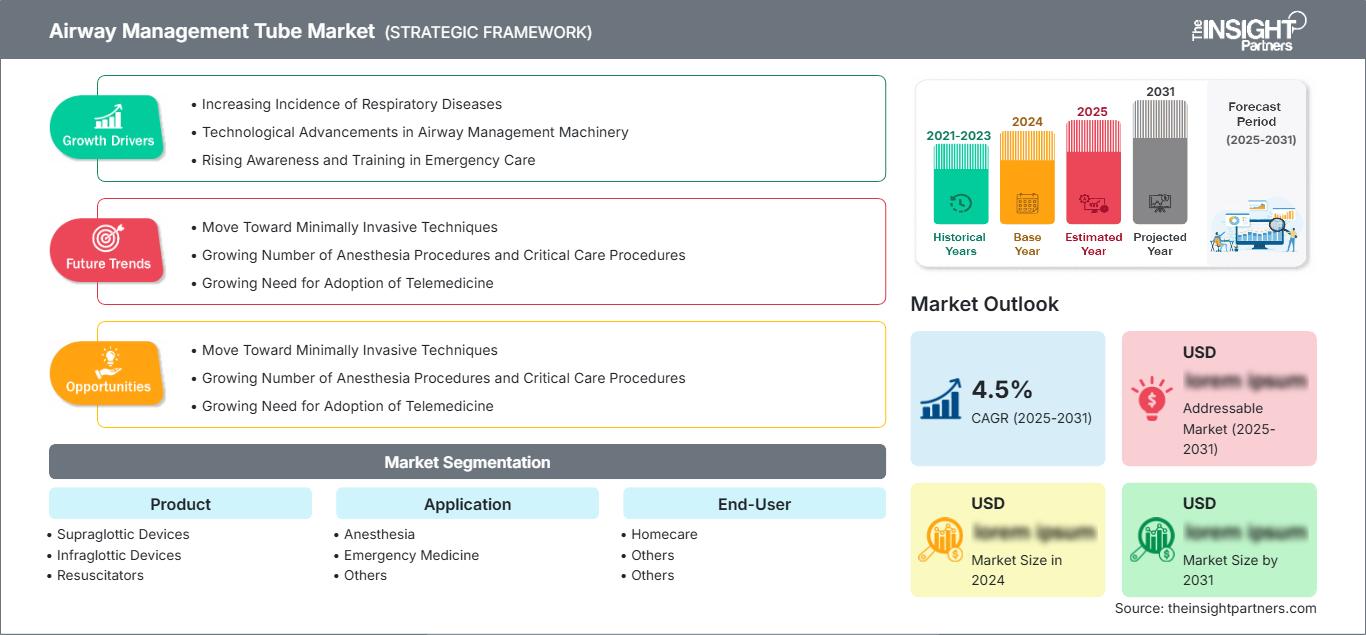
The airway management tube market size was valued at US$ 2.00 Billion in 2025 and is projected to reach US$ 3.18 Billion by 2034, expanding at a CAGR of 5.3% during 2026–2034. The market growth is driven by rising surgical procedures, increasing prevalence of respiratory disorders, and expanding emergency care infrastructure across both developed and emerging economies. Growing reliance on secure airway access in anesthesia and critical care continues to reinforce the importance of the market solutions globally.
North America is expected to grow at a CAGR of 5.2–5.6%, supported by high surgical volumes and strong intensive care infrastructure. Growing incidences of traumas, older age population, and growing use of superior intubation devices are boosting demand. Hospitals are focusing on implementing standard airway protocols whereas ambulatory surgical facilities are speeding up towards adoption of disposables airway tubes.
Airway Management Tube Market Assessment and Insights
- North America: North America accounts for 40–44% share in 2025, supported by advanced ICU systems, high surgical throughput, and strong emergency care infrastructure. The region is projected to grow at a CAGR of 5.2–5.6% (2026–2034), driven by rising respiratory disease burden, trauma admissions, and adoption of advanced intubation technologies across hospitals and emergency departments.
- US: The United States holds approximately 65–70% of North America’s airway management tube market share in 2025, with growth supported by increasing ICU admissions and surgical procedures. The market is expanding at a CAGR of 5.2–5.6%, driven by strong hospital procurement systems and rising preference for disposable airway tube solutions.
- Europe: Europe represents 25–28% share in 2025, growing at a CAGR of 5.0–5.4%, led by Germany, the UK, France, Italy, and Spain. Demand is driven by structured anesthesia protocols, aging population, and increasing surgical safety regulations across public healthcare systems.
- Asia Pacific: Asia Pacific holds 22–26% share in 2025, expanding at a CAGR of 5.5–6.0%, led by China, India, Japan, South Korea, and Australia. Growth is supported by expanding hospital infrastructure, rising surgical volumes, and improving emergency medical access.
- Largest Segment (Infraglottic Devices): Infraglottic devices account for 32–36% share in 2025, growing at a CAGR of 5.3–5.7%, driven by widespread use in anesthesia and emergency airway access procedures requiring secure tracheal intubation.
- High Growth Segment (Supraglottic Devices): Supraglottic devices represent 28–32% share in 2025, growing at a CAGR of 5.6–6.2%, supported by ease of use, reduced airway trauma, and growing adoption in ambulatory surgical and emergency care settings.
- Key companies analyzed in detail: Medtronic, Smiths Medical, Teleflex Incorporated, Flexicare (Group) Limited, Olympus Corporation, Verathon Inc., Intersurgical Ltd, Medis Medical, Medline Industries, SunMed
Source: The Insight Partners' analysis based on proprietary research, government publications, company annual reports, investor presentations, industry databases, and expert interviews.
There has been progression from a simple reusability intubation system to highly specific airway devices that are made for safety in terms of precise placement and low complications. The reliance on traditional endotracheal tubes has now progressed to advanced cuffed tubes, reinforced tubes, and disposables. There is more emphasis on controlling infections, biocompatibility of materials, and sealing of the airway.
The market is closely aligned with global growth in surgical volumes and critical care admissions. Standardization of airway protocols by hospitals is being done to avoid any ventilator complication. The regulators always prioritize patient safety and infection control. There is growing capacity of ICUs in emerging markets, whereas developing countries emphasize more on development of advanced airway safety technology.
Airway Management Tube Market Report Scope
| Report Attribute | Details |
|---|---|
| Market size in 2025 | US$ 2.00 Billion |
| Market Size by 2034 | US$ 3.18 Billion |
| Global CAGR (2026 - 2034) | 5.3% |
| Historical Data | 2021-2024 |
| Forecast period | 2026-2034 |
Airway Management Tube Market Analysis
The market demand for airway management tubes is highly dependent on the increase in surgical procedures, the increase in the rate of respiratory diseases, and the increase in emergencies. Hospitals will continue to be the largest demand source due to high rates of ICU admissions and high-level surgical procedures. The value chain consists of raw material providers, medical device producers, distributors, and hospital procurement systems. There is an increase in emphasis on patient safety and effectiveness of procedures leading to constant replacement demand in both reusable and disposable airway tube systems.
Supply dynamics are driven by innovations in materials used in making products, cost efficiency, and compliance with regulations. Medtronic and Teleflex Incorporated are investing in developing cuff technology and reinforced airway tubes in order to minimize ventilation problems. Flexicare and Intersurgical Ltd are developing their portfolios of disposable airway tubing in order to fulfill the infection prevention needs.
Based on the Airway Management Tube Market Forecast, there will be moderate to high levels of competition in the industry, as companies will focus on expanding their portfolios and increasing their geographical diversification. Companies like Smiths Medical and Verathon Inc. will continue to expand their footprint in advanced visualization techniques for airways and tubes, while Olympus Corporation will improve the process of airway management with the help of visualization technology. In the coming years, the market participants will focus more on disposable airway systems as well as hybrid products.
● REPORT CUSTOMIZATION
Tailor This Report To Align With Your Specific Business Requirements
This report can be customized to align precisely with your business objectives, scope, and target markets. Customization options include tailored segmentation, geography, competitive analysis, and strategic insights to support informed decision-making.
Customize This Report →WHAT YOU CAN ADJUST
- ● Segmentations
- ● Geography
- ● Competitive Analysis
- ● Language Preferences
Airway Management Tube Market: Strategic Insights
Regional Insights
North America Airway Management Tube Market
North America maintained an estimated share of 35–39% in 2025 and is projected to register a CAGR of 5.0–5.8% between 2026–2034. The region benefits from advanced hospital infrastructure, high surgical procedure volumes, and strong adoption of technologically developed airway devices across critical care departments. The United States remains the leading contributor due to extensive healthcare expenditure and established emergency response networks.
Canada also supports regional development through healthcare modernization initiatives and increasing demand for advanced medical equipment. The presence of major manufacturers, including Medtronic, Teleflex Incorporated, and Smiths Medical, strengthens product availability and innovation. Rising investments in intensive care units and respiratory care capabilities continue to influence adoption patterns across hospitals and specialized medical facilities.
U.S. Airway Management Tube Market Market
The U.S. accounted for approximately 75–80% of North America share in 2025 and is expected to expand at a CAGR of 5.1–5.9% during 2026–2034. The country benefits from a large network of hospitals, ambulatory surgical centers, and emergency care providers requiring dependable airway management products.
Clinical applications across anesthesia, trauma care, and intensive care continue driving demand for advanced tube technologies. Companies including Medtronic, Teleflex Incorporated, Smiths Medical, and Verathon Inc. maintain significant market presence through established product portfolios. Increasing focus on patient safety, procedural efficiency, and healthcare quality standards supports adoption across various medical facilities throughout the country.
Europe Airway Management Tube Market
Europe represented an estimated share of 27–31% in 2025, with growth expected at a CAGR of 4.7–5.5% through 2026–2034. The region benefits from developed healthcare systems, strong regulatory frameworks, and consistent demand from surgical and emergency care applications. Germany remains a leading country due to its advanced medical infrastructure and high healthcare investment levels.
The UK market is supported by established public healthcare systems and increasing demand for efficient airway management solutions. Germany demonstrates strong adoption through hospitals and specialty care facilities. France, Italy, and Spain contribute through expanding surgical procedures, healthcare modernization, and increasing availability of advanced medical technologies. Regional manufacturers and global companies continue strengthening their presence through product innovation and distribution networks.
APAC Airway Management Tube Market
APAC Airway Management Tube Market accounted for approximately 21–25% share in 2025 and is estimated to grow at a CAGR of 6.0–6.8% during 2026–2034. China leads regional demand due to healthcare infrastructure expansion, increasing surgical procedures, and government-supported medical investments.
Japan, South Korea, India, and Australia are contributing through improved hospital capacity and rising adoption of advanced airway technologies. Growing healthcare access, increasing awareness of patient safety practices, and expansion of emergency medical services are supporting regional growth. Industrial development and healthcare policy initiatives continue improving production capabilities and distribution efficiency across the region.
Middle East & Africa Airway Management Tube Market
Middle East & Africa Airway Management Tube Market held an estimated share of 7–10% in 2025 and is projected to grow at a CAGR of 5.4–6.2% between 2026–2034. Saudi Arabia leads regional adoption through healthcare infrastructure development and investments in advanced medical facilities.
The UAE and South Africa are also important contributors due to expanding hospital networks and improving critical care capabilities. Growth across the Rest of MEA region is supported by healthcare accessibility programs and modernization initiatives. Energy-driven economies are allocating resources toward healthcare diversification, while infrastructure development continues improving access to specialized respiratory and emergency care equipment.
Segmentation Analysis
Product
The Product segment in the market plays a central role in ensuring secure ventilation across anesthesia, emergency medicine, and intensive care settings. It includes infraglottic devices, supraglottic devices, resuscitators, laryngoscopes, and other adjunct airway tools. Increasing surgical complexity and rising ICU admissions are reinforcing demand for reliable airway access systems. The segment is projected to grow at a CAGR of 5.2–5.6% (2026–2034), supported by material innovation, improved cuff sealing technologies, and growing preference for single-use devices that reduce infection risks in high-acuity clinical environments.
- Supraglottic Devices: These devices are increasingly adopted due to ease of insertion and reduced need for advanced airway expertise. They are widely used in ambulatory surgery and emergency settings where rapid airway stabilization is critical.
- Infraglottic Devices: These remain essential for definitive airway management in critical care and trauma cases. Demand is driven by their ability to provide secure ventilation in high-risk surgical and ICU environments.
- Resuscitators: Widely used in emergency response and pre-hospital care, resuscitators support immediate ventilation in cardiac arrest and respiratory failure scenarios. Adoption is expanding with emergency infrastructure development.
- Laryngoscopes: This sub-segment is evolving rapidly with video-assisted technologies improving visualization accuracy. Hospitals are increasingly adopting advanced laryngoscopes to reduce intubation failure rates and procedural complications.
- Others: This includes ancillary airway accessories that support ventilation management and procedural efficiency in operating rooms and critical care units.
Application
The Application segment is a key demand driver in the market, spanning anesthesia, emergency medicine, and hospital-based procedural care. Rising surgical volumes and increasing prevalence of respiratory disorders are reinforcing consistent utilization across these applications. The segment is projected to grow at a CAGR of 5.3–5.7% (2026–2034), supported by expanding surgical infrastructure and increasing emphasis on airway safety protocols in high-risk clinical environments.
- Anesthesia: This remains the largest application area due to widespread use of airway tubes during surgical procedures. Demand is driven by increasing elective surgeries and growing adoption of advanced airway safety protocols in operating rooms.
- Emergency Medicine: Rapid airway stabilization is critical in trauma and acute respiratory failure cases. Rising emergency admissions and improved pre-hospital care systems are driving adoption of airway management tubes in this segment.
- Hospitals: Hospitals represent the core utilization environment, integrating airway tubes across ICUs, operating rooms, and emergency departments. Standardization of airway management practices is strengthening consistent demand.
End User
The End User segment reflects structured adoption patterns across hospitals, homecare, ambulatory surgical care centers, and other healthcare settings. Hospitals dominate due to high procedural intensity and ICU dependence. The segment is projected to expand at a CAGR of 5.2–5.6% (2026–2034), supported by rising inpatient admissions and increasing investment in critical care infrastructure.
- Hospitals: Hospitals remain the primary end-user due to high surgical volumes, emergency admissions, and ICU-based ventilation requirements. Adoption is reinforced by standardized airway management protocols and advanced critical care infrastructure.
- Homecare: Growing prevalence of chronic respiratory diseases is driving home-based ventilation demand. Patients requiring long-term respiratory support are increasingly using airway tube systems in domiciliary care environments.
- Ambulatory Surgical Care Centers: These centers are expanding adoption of disposable airway tubes due to efficiency, cost-effectiveness, and reduced infection risks in outpatient surgical procedures.
- Others: This includes emergency response units and specialty clinics that require airway management support in specific procedural or acute care scenarios.
Opportunity Snapshot
| Application | Revenue Contribution | Trend Tag | Adoption Stage |
| Anesthesia | High | Video Intubation | Mature |
| Emergency Medicine | Medium | Rescue Airway | Scaling |
| Others | Low | Specialty Use | Emerging |
| Hospitals | High | ICU Standardization | Mature |
Airway Management Tube Market Growth Drivers and Impact Analysis
Rising Prevalence of Respiratory and Chronic Diseases
Increasing incidence of chronic respiratory conditions such as COPD, asthma, and sleep-disordered breathing is a major structural driver for the airway management tube market. The aging demographics, along with environmental pollution, are resulting in an increase in respiratory complications around the world. This has resulted in an increased admission of patients into the intensive care units and an increased use of the mechanical ventilation systems that require secure airway access. The hospitals have been seeing continuous demand for the endotracheal and tracheal tubes in emergency as well as elective surgeries. The rising burden in the healthcare system is also leading to increased needs for post-operative respiratory assistance.
Expansion of Surgical and Critical Care Infrastructure
Global expansion of surgical infrastructure and intensive care capacity is significantly driving the airway management tube market growth. Increased number of surgeries of the heart, cancer, and trauma patients will necessitate more anesthesia usage in various hospitals. The emergence of new operating rooms and ICUs, especially in developing nations, has increased the number of surgeries. Another source of demand creation is ambulatory surgery centers performing frequent but brief procedures that need single use airway system. Providers of healthcare services are placing emphasis on airway safety and procedure efficiency, hence adoption of advanced and cuffed airway tubes.
Technological Advancements in Airway Tube Design
Advancements in the technology related to the airway tube material and design have been helping in achieving better safety levels and results from procedures. Some of these innovations include high-volume, low-pressure cuffs, reinforced designs, and antimicrobial coatings that reduce the risk of complications from intubation and mechanical ventilation. There are also advances, such as single-use airway tubes, being introduced by manufacturers to reduce the risk of infection in acute care settings. Compatibility with video laryngoscopes and airway visualization equipment is another innovation in the field.
Airway Management Tube Market Future Trends
Shift Toward Single-Use and Infection-Control Airway Systems
A major airway management tube market trend is the increasing shift toward single-use devices. Hospitals are prioritizing infection prevention due to rising concerns about hospital-acquired infections and cross-contamination risks. Disposible airway tubes help to remove the need for sterilization and decrease the level of complexity involved in procedures. This is more evident in cases involving emergency medicine and ambulatory surgery centers, where time is of the essence. The trend among the manufacturers is to produce disposible products in a manner that ensures their performance without increasing costs. Patient safety considerations by regulators are also hastening this process.
Integration of Advanced Materials and Smart Airway Systems
The adoption of advanced materials and emerging smart airway technologies is transforming product development in the airway management tube market. The development of new polymer blends is enhancing the flexibility, durability, and patient comfort without causing any kind of injury upon insertion. The research on airway tubes with sensors has been catching up as well, which allows for monitoring the flow of air and proper positioning of the tube. All these developments will definitely help in improving the decision-making process for clinicians in a critical care environment. Modern hospitals are embracing the use of digital airway management systems incorporating tubes and imaging.
Airway Management Tube Market Opportunities
Expansion in Emerging Healthcare Systems
Emerging markets are among the key growth areas due to rapid development in healthcare infrastructure and greater access to surgical treatment. Hospitals in Asia Pacific, Latin American countries, and some Middle Eastern regions are developing hospital and ICU services. There is increased demand for low-cost airway tubes that can be used at high volume. Governments’ healthcare campaigns and PPPs are helping to expedite the purchase of necessary airway tools. Companies that focus on producing cost-effective products in bulk will benefit from this situation.
Growth of Ambulatory Surgical and Outpatient Care
Growth in ambulatory surgical facilities presents new business prospects for airway tube vendors. Increased patient preference for day surgery procedures is boosting demand for convenient, single-use airway devices. Such applications demand efficient designs that reduce sterilization time and lower infection risk. The introduction of small-sized airway packs designed specifically for outpatient facilities is becoming common. In addition, the trend towards value-based medicine is increasing the need for products that reduce hospital length of stay and lower treatment costs.
Recent Developments
- December 2025: Teleflex Incorporated — Teleflex introduced updated endotracheal tube designs featuring improved material flexibility and enhanced patient safety features aimed at reducing airway trauma during prolonged intubation procedures. The development targets both hospital and emergency care applications globally.
- August 2025: Intersurgical Ltd — Intersurgical launched an expanded range of disposable airway tubing solutions focusing on infection prevention and operational efficiency in high-volume surgical environments. The portfolio expansion supports growing demand from ambulatory surgical centers and critical care units.
Frequently Asked Questions

- Comprehensive Market Sizing and Forecast Analysis
- Detailed Segmentation Analysis
- In-Depth Market Dynamics Assessment
- Regional and Country-Level Insights
- Competitive Landscape and Company Benchmarking
- Strategic Business Intelligence
Recent Reports
Testimonials

The Insight Partners provided valuable market intelligence that supported our global go-to-market strategy. Their team was professional, responsive, and attentive to our feedback, providing thoughtful analysis and helpful methodological clarifications throughout the project.
Junmo Kim Chief Financial Officer (CFO), Enertech Co., Ltd.
The Insight Partners' SCADA System Market report is comprehensive, with valuable insights on current trends and future forecasts. The team was highly professional, responsive, and supportive throughout. We are very satisfied and highly recommend their services.
RAN KEDEM Partner, Reali Technologies LTDs
I requested a report on a very specific software market and the team produced the report in a few days. The information was very relevant and well presented. I then requested some changes and additions to the report. The team was again very responsive and I got the final report in less than a week.
JEAN-HERVE JENN Chairman, Future Analytica
We worked with The Insight Partners for an important market study and forecast. They gave us clear insights into opportunities and risks, which helped shape our plans. Their research was easy to use and based on solid data. It helped us make smart, confident decisions. We highly recommend them.
PIYUSH NAGPAL Sr. Vice President, High Beam Global
The Insight Partners delivered insightful, well-structured market research with strong domain expertise. Their team was professional and responsive throughout. The user-friendly website made accessing industry reports seamless. We highly recommend them for reliable, high-quality research services
YUKIHIKO ADACHI CEO, Deep Blue, LLC.
This is the first time I have purchased a market report from The Insight Partners.While I was unsure at first, I visited their web site and felt more comfortable to take the risk and purchase a market report.I am completely satisfied with the quality of the report and customer service. I had several questions and comments with the initial report, but after a couple of dialogs over email with their analyst I believe I have a report that I can use as input to our strategic planning process.Thank you so much for taking the extra time and making this a positive experience.I will definitely recommend your service to others and you will be my first call when we need further market data.
JOHN SUZUKI President and Chief Executive Officer, Board Director, BK Technologies
I wish to appreciate your support and the professionalism you displayed in the course of attending to my request for information regarding to infectious disease IVD market in Nigeria. I appreciate your patience, your guidance, and the fact that you were willing to offer a discount, which eventually made it possible for us to close a deal. I look forward to engaging The Insight Partners in the future, all thanks to the impression you have created in me as a result of this first encounter.
DR CHIJIOKE ONYIA MANAGING DIRECTOR, PineCrest Healthcare Ltd.Reason to Buy
- Informed Decision-Making
- Understanding Market Dynamics
- Competitive Analysis
- Identifying Emerging Markets
- Customer Insights
- Market Forecasts
- Risk Mitigation
- Boosting Operational Efficiency
- Strategic Planning
- Investment Justification
- Tracking Industry Innovations
- Aligning with Regulatory Trends





 Get Free Sample for