
Airway Stent/Lung Stent Market Size, Trends & Growth by 2034
Airway Stent/Lung Stent Market Size and Forecasts (2021–2034), Global and Regional Share, Trends, and Growth Opportunity Analysis Report Coverage : by Product (Self-Expandable Stents, Balloon- Expandable Stents); Material (Metal, Silicone, Hybrid); Type (Tracheobronchial Stents, Laryngeal Stents); and Geography (North America, Europe, Asia Pacific, and South and Central America)
- Status : Data Released
- Report Code : TIPRE00040102
- Category : Life Sciences
- No. of Pages : 150
- Available Report Formats :


- Last update date : July 10, 2026


2025 Market Size
US$ 128.29 Mn
Base year value
2034 Forecast
US$ 194.81 Mn
Projected by 2034
CAGR 2026-2034
4.75 %
Growth rate
Addressable Market
US$ 1,466.62 Mn
(2026-2034)
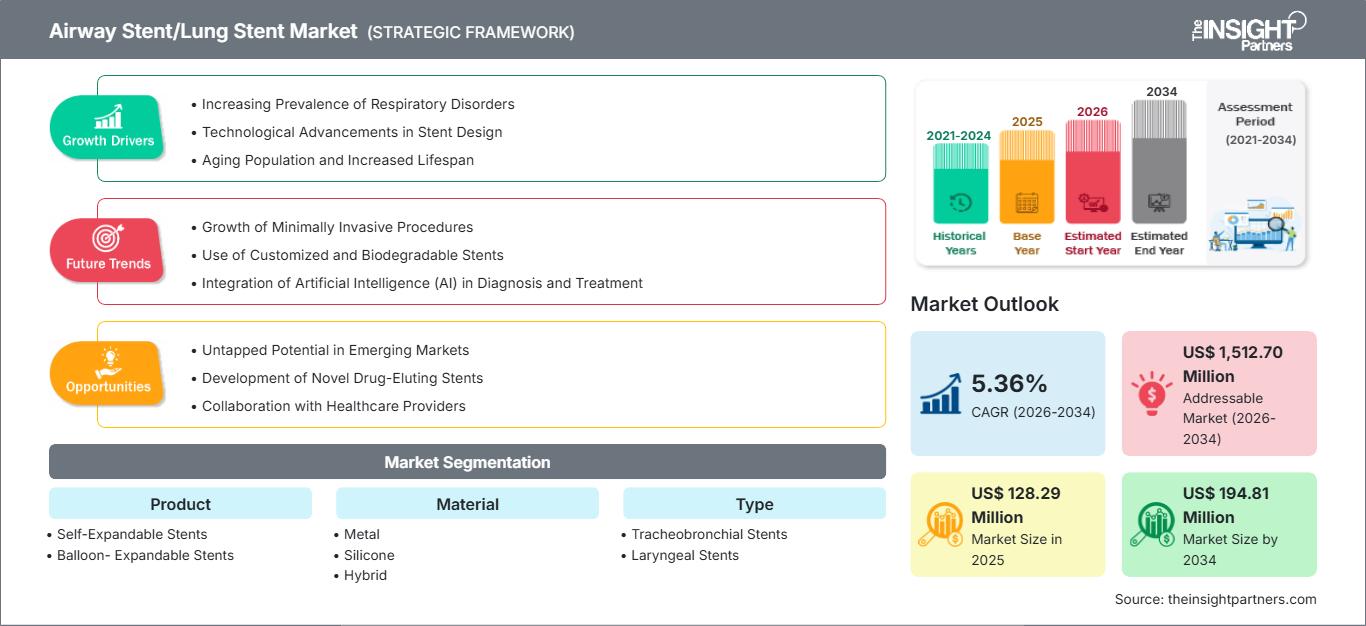
The Airway Stent/Lung Stent market was valued at US$ 128.29 million in 2025 and is expected to reach US$ 194.81 million by 2034; it is estimated to record a CAGR of 4.75% during 2026-2034.
Airway Stent/Lung Stent Market Assessment and Insights
- North America: North America accounts for 40–44% airway stent/lung stent market share in 2025, supported by advanced respiratory care infrastructure, strong oncology treatment systems, and high procedural adoption rates. The region is projected to grow at a CAGR of 5.2–5.7% (2026–2034), driven by rising lung cancer prevalence, COPD cases, and increased adoption of minimally invasive airway interventions.
- US: The United States holds approximately 65–70% of North America’s airway stent/lung stent market share in 2025, driven by high procedural volumes in interventional pulmonology. Growth is projected at a CAGR of 5.2–5.7%, supported by strong reimbursement systems and advanced hospital-based bronchoscopic intervention capabilities.
- Europe: Europe represents 25–28% share in 2025, growing at a CAGR of 5.0–5.4%, led by Germany, the UK, France, Italy, and Spain. Growth is driven by increasing lung cancer incidence, aging population, and structured adoption of minimally invasive airway management procedures.
- Asia Pacific: Asia Pacific holds 22–26% share in 2025, expanding at a CAGR of 5.6–6.2%, led by China, India, Japan, South Korea, and Australia. Rising air pollution exposure, smoking prevalence, and expanding pulmonary care infrastructure are key demand drivers.
- Largest Segment (Self-Expandable Stents): Self-expandable stents account for 55–60% share in 2025, growing at a CAGR of 5.4–5.8%, driven by superior flexibility, ease of deployment, and strong clinical preference in complex airway obstruction cases.
- High Growth Segment (Hybrid Stents): Hybrid stents represent 10–14% share in 2025, growing at a CAGR of 5.8–6.4%, supported by improved structural performance and expanding adoption in complex tracheobronchial interventions.
- Key companies analyzed in detail: Boston Scientific, Cook Medical, Medtronic, ConMed Corporation, Micro-Tech (Nanjing) Co., Ltd., Teleflex Incorporated, Merit Medical Systems, Abbott Laboratories, Eitan Medical, Smiths Medical
Source: The Insight Partners' analysis based on proprietary research, government publications, company annual reports, investor presentations, industry databases, and expert interviews.
The market has changed considerably in terms of technology, shifting from strict methods of surgical airway reconstruction to innovative techniques of endoscopic stenting. In the past, surgical reconstructions used to dominate the market while today self-expanding and silicone-based stents have been placed through the procedure of bronchoscopy. Technological advancements, such as the development of structures made of nitinol material and silicone, increased patient compatibility and prevented stent migration.
As for the market structure, it has always been closely related to an increase in the number of patients diagnosed with respiratory diseases and growth of interventional pulmonology skills. The modern healthcare system tends to implement multidisciplinary approach involving oncology, pulmonology, and thoracic surgery. In the developing countries, there is gradual implementation of advanced bronchoscopy systems.
Airway Stent/Lung Stent Market Report Scope
| Report Attribute | Details |
|---|---|
| Market size in 2025 | US$ 128.29 Million |
| Market Size by 2034 | US$ 194.81 Million |
| Global CAGR (2026 - 2034) | 4.75% |
| Historical Data | 2021-2024 |
| Forecast period | 2026-2034 |
Airway Stent/Lung Stent Market Analysis
Demand from airway stents comes from rising prevalence of lung cancer, tracheal stenosis, and chronic obstructive pulmonary diseases that necessitate airway stenting. Hospitals form the heart of the demand side owing to complexity of procedures as well as the necessity of having an interventional pulmonology unit. Market size of the airway stent/lung stent segment is growing at a steady pace owing to the adoption of minimally invasive procedure in place of conventional surgical reconstruction of airway. Raw materials providers, stent manufacturers, imaging equipment companies, and interventional pulmonologists are some players who form value chain in this segment.
Supply side factors that will play a significant role include advancements in the raw materials used, especially nitinol self-expanding airway stents and silicone stents. Boston Scientific and Cook Medical are working towards enhancing accuracy and reducing the chance of migration while delivering. Endoscopic delivery systems are the focus of Medtronic and Abbott laboratories. The segment features high regulatory environment owing to implantation of these devices in the body.
Competitive landscape is moderately consolidated, with leading global medtech players dominating high-value segments. Strategic investments are increasingly directed toward hybrid stent development and drug-eluting airway solutions. The airway stent/lung stent market report focuses on key companies including Micro-Tech (Nanjing) Co., Ltd. expanding its footprint in cost-efficient stenting solutions for emerging markets, while Merit Medical Systems and Teleflex Incorporated are focusing on portfolio expansion in interventional pulmonology. Partnerships with hospitals and academic centers are accelerating product adoption and clinical validation.
● REPORT CUSTOMIZATION
Tailor This Report To Align With Your Specific Business Requirements
This report can be customized to align precisely with your business objectives, scope, and target markets. Customization options include tailored segmentation, geography, competitive analysis, and strategic insights to support informed decision-making.
Customize This Report →WHAT YOU CAN ADJUST
- ● Segmentations
- ● Geography
- ● Competitive Analysis
- ● Language Preferences
Airway Stent/Lung Stent Market: Strategic Insights
Regional Insights
North America Airway Stent/Lung Stent Market
North America accounted for an estimated share of 38–42% in 2025 and is projected to grow at a CAGR of 5.0–5.7% during 2026–2034. The region maintains leadership due to advanced healthcare systems, strong interventional pulmonology adoption, and availability of specialized respiratory treatment centers. The United States remains the primary contributor due to higher procedure volumes and established medical technology adoption.
Canada supports regional expansion through healthcare modernization and increasing access to advanced respiratory care services. The presence of leading companies such as Boston Scientific Corporation, Medtronic, and Cook Medical strengthens product availability and clinical adoption. Growing focus on minimally invasive treatments, cancer-related airway management, and specialized pulmonary procedures continues supporting demand across hospitals and specialty clinics.
U.S. Airway Stent/Lung Stent Market Market
U.S. represented approximately 78–82% of North America share in 2025 and is expected to register a CAGR of 5.1–5.8% from 2026–2034. The country benefits from extensive healthcare infrastructure, advanced bronchoscopy capabilities, and increasing demand for airway restoration procedures.
Hospitals and specialty respiratory centers are adopting advanced stent technologies for benign and malignant airway conditions. Companies including Boston Scientific Corporation, Medtronic, Cook Medical, and Merit Medical Systems, Inc. maintain significant presence through established product portfolios. Increasing physician training, improved diagnostic techniques, and growing awareness of minimally invasive respiratory interventions continue influencing adoption patterns across the country.
Europe Airway Stent/Lung Stent Market
Europe accounted for an estimated share of 28–32% in 2025 and is anticipated to grow at a CAGR of 4.7–5.4% through 2026–2034. The region benefits from advanced healthcare infrastructure, strong clinical expertise, and increasing adoption of interventional pulmonology procedures. Germany remains the leading country due to its developed medical system and high adoption of advanced respiratory technologies.
The UK market is supported by established healthcare networks and increasing demand for minimally invasive airway procedures. Germany demonstrates strong clinical adoption through specialized respiratory centers and hospitals. France, Italy, and Spain contribute through healthcare modernization, increasing respiratory disease management requirements, and expanding access to advanced treatment options. Regional and international manufacturers continue strengthening distribution networks across European healthcare systems.
APAC Airway Stent/Lung Stent Market
APAC represented approximately 18–22% share in 2025 and is estimated to grow at a CAGR of 6.0–6.8% during 2026–2034. China leads regional demand due to healthcare infrastructure expansion and increasing respiratory care capabilities.
Japan, South Korea, India, and Australia are contributing through improved hospital capacity and rising adoption of advanced pulmonary procedures. Growing healthcare investments, increasing respiratory disease awareness, and expansion of specialized medical facilities are supporting market development. Government healthcare initiatives and improved access to diagnostic technologies are encouraging adoption across emerging economies.
Middle East & Africa Airway Stent/Lung Stent Market
Middle East & Africa Airway Stent/Lung Stent Market accounted for an estimated share of 6–9% in 2025 and is projected to grow at a CAGR of 5.2–6.0% between 2026–2034. Saudi Arabia leads regional growth due to investments in advanced hospitals and specialized healthcare infrastructure.
The UAE and South Africa are contributing through expanding respiratory care services and improving access to specialized procedures. Rest of MEA markets are developing gradually through healthcare modernization programs and infrastructure investments. Economic diversification initiatives in energy-focused countries are supporting healthcare expansion, creating opportunities for advanced respiratory treatment technologies and specialized medical devices.
Segmentation Analysis
Product
The Product segment in the airway stent/lung stent market forecast holds key importance in terms of maintaining the airway patency of patients afflicted with either malignant or benign airway obstruction problems. The market is expected to register a CAGR of 5.3–5.7% (2026–2034). This segment covers self-expanding stents and balloon-expandable stents, which are meant to address certain clinical needs depending upon the nature of the lesions. Growing preference for minimally invasive procedures through bronchoscopy is making the adoption rate higher in hospitals.
- Self-Expandable Stents: These dominate clinical usage due to superior flexibility and adaptability to irregular airway structures. They are widely used in malignant airway obstruction cases and complex tracheobronchial narrowing.
- Balloon-Expandable Stents: These provide controlled expansion and precise placement, making them suitable for rigid stenotic lesions. Their adoption is driven by procedural accuracy requirements in interventional pulmonology.
Material
The material segment is vital in shaping the performance, compatibility, and long-term health impacts of the stents. Materials such as metal, silicone, and composite materials are used in various settings. The segment is projected to experience a CAGR of 5.2-5.6% during 2026-2034 owing to innovations in nitinol alloys and silicone compounds that increase flexibility and prevent airway irritability.
- Metal: Nitinol-based metallic stents are widely used due to their shape memory properties and strong radial force, making them suitable for complex airway obstructions.
- Silicone: Silicone stents are preferred for benign strictures due to their removability and lower tissue reaction profile.
- Hybrid: Hybrid stents combine metal strength with silicone coating advantages, improving migration resistance and patient comfort in long-term applications.
Type
The Type segment includes tracheobronchial stents and laryngeal stents, both addressing different anatomical regions of airway obstruction. Increasing incidence of lung cancer and post-intubation stenosis is driving demand for tracheobronchial interventions. The segment is projected to grow at a CAGR of 5.4–5.8% (2026–2034), supported by expanding interventional pulmonology capabilities and improved bronchoscopic guidance systems that enhance placement accuracy and procedural outcomes.
- Tracheobronchial Stents: These are the most widely used due to high prevalence of central airway obstructions caused by malignancies and chronic respiratory diseases.
- Laryngeal Stents: These are used in complex upper airway reconstruction cases and post-surgical stenosis management, where airway patency restoration is critical.
Opportunity Snapshot
| Segments | Revenue Contribution | Trend Tag | Adoption Stage |
| Self-Expandable Stents | High | Flexible Placement | Mature |
| Balloon- Expandable Stents | Medium | Precise Expansion | Scaling |
| Metal | High | Radial Strength | Mature |
| Silicone | Medium | Removable Design | Mature |
| Hybrid | Medium | Migration Control | Scaling |
| Tracheobronchial Stents | High | Central Airway | Mature |
| Laryngeal Stents | Medium | Upper Airway | Scaling |
Airway Stent/Lung Stent Market Growth Drivers and Impact Analysis
Rising Incidence of Lung Cancer and Airway Obstructions
The rising number of cases of lung cancer and malignant airway obstruction around the world is one of the main reasons behind the growth in the airway stent/ lung stent market. Increased smoking rates, pollution, and exposure to carcinogens due to occupation are leading to the rising prevalence of tracheobronchial problems. Individuals have been observed to suffer from airway constriction, and the need for an urgent treatment becomes a priority. More procedures for interventional pulmonology have been seen in hospitals, especially those in oncology centers. The rising aging population is adding to the disease burden, considering the fact that elderly people are more prone to suffering from airway constriction and obstruction caused by tumors.
Expansion of Minimally Invasive Interventional Pulmonology
Invasive bronchoscopic techniques have made tremendous strides to change the way airway stenting is being done today. With imaging technologies and flexible bronchoscopes, it has become possible to achieve precise stent placement in a manner that is less risky and with faster recovery time. There is an increasing trend towards minimizing open surgery airway reconstructions by opting for stenting. Patients will benefit greatly from this development and will stay shorter in hospitals. Intervational pulmonology units are expanding all over the world due to better training and availability of devices.
Technological Advancements in Stent Design and Materials
The ongoing development of stent materials and design has increased the efficiency and use of stents. The nitinol-based self-expanding stents have increased the adaptability and flexibility of stents. Silicone-based stents are easy to remove when there are benign conditions. Hybrid stents have emerged as a favored method for difficult situations due to their mechanical strength and biocompatibility. The manufacturers have started developing stents that have ant-migration properties and drug eluting surfaces to avoid restenosis and infection. More efficient delivery systems have been developed to make the procedure more effective and independent of the operators.
Airway Stent/Lung Stent Market Future Trends
Shift Toward Personalized and Anatomy-Specific Stenting
The emergence of customized airway stents based on patient anatomy and pathology is driving the airway stent/lung stent market trends. With advances in imaging technology and 3D modeling, customized stents are being designed which are better fit, have lower risks of migration, and help ensure better airway patency. The disadvantages associated with using standard sizes for stents in complex airways, especially malignant blockages, are being recognized by clinicians. As the personalized approach to airway stents is improving procedure success rates and decreasing risks, hospitals that are equipped with interventional pulmonology skills are starting to use them, especially for oncology-related airways interventions.
Integration of Drug-Eluting and Bioactive Stents
Airway stents with elution of drugs and bioactivity have received a lot of attention lately as an emerging strategy for therapy. They can be used to deliver anti-proliferative or anti-inflammatory substances to prevent restenosis and the formation of granulation tissue. The concept is very pertinent in the management of airway obstruction on a long-term basis because recurrence is still a challenge. There are efforts aimed at making antimicrobial stents to prevent infections in immunocompromised patients. There is also collaboration between hospitals and research organizations and medical devices firms to prove their efficacy.
Airway Stent/Lung Stent Market Opportunities
Expansion in Emerging Interventional Pulmonology Infrastructure
Economic emerging nations offer a good potential for growth in airway stent/lung stent market forecast owing to growing investments made by nations towards healthcare infrastructure and oncology care facilities. Nations from the Asia Pacific region, Latin America, and Middle East are increasingly setting up tertiary care centers which include interventional pulmonology units in order to provide better access to patients who have been depending upon surgeries till now. There is growing emphasis made by nations on providing services to their people in terms of cancer treatment, and therefore, there is likely to be increased demand in terms of procedures.
Growth in Hybrid and Advanced Material Stent Adoption
The increasing adoption of hybrid and advanced material stents represents a major commercial opportunity. These stents combine the flexibility of silicone with the structural strength of metallic frameworks, improving performance in complex airway conditions. Hospitals are increasingly adopting these solutions for cases requiring long-term airway patency with reduced migration risk. Demand is also rising for stents with enhanced biocompatibility and reduced inflammatory response. Manufacturers investing in material science innovation and next-generation coatings are expected to gain competitive advantage. As procedural complexity increases, hybrid stents are likely to become a preferred solution in interventional pulmonology practices.
Recent Developments
- March 2026: Boston Scientific Corporation — Boston Scientific expanded its interventional pulmonology portfolio with enhancements in self-expanding airway stent systems designed to improve placement accuracy and reduce migration risk in complex tracheobronchial obstruction cases. The update also strengthens integration with advanced bronchoscopic guidance platforms used in hospital-based interventions globally.
- October 2025: Medtronic plc — Medtronic introduced refinements in its airway intervention solutions focusing on improved delivery catheter systems for bronchoscopic stent placement. The development aims to enhance procedural efficiency and reduce complication rates in interventional pulmonology procedures across high-volume hospitals.
- June 2025: Cook Medical LLC — Cook Medical expanded its airway stent product line with new silicone-based designs targeting benign airway obstruction cases. The expansion supports increasing demand for removable and patient-friendly stenting solutions in specialized respiratory care centers.
Frequently Asked Questions

- Comprehensive Market Sizing and Forecast Analysis
- Detailed Segmentation Analysis
- In-Depth Market Dynamics Assessment
- Regional and Country-Level Insights
- Competitive Landscape and Company Benchmarking
- Strategic Business Intelligence
Recent Reports
Testimonials

The Insight Partners' SCADA System Market report is comprehensive, with valuable insights on current trends and future forecasts. The team was highly professional, responsive, and supportive throughout. We are very satisfied and highly recommend their services.
RAN KEDEM Partner, Reali Technologies LTDs
I requested a report on a very specific software market and the team produced the report in a few days. The information was very relevant and well presented. I then requested some changes and additions to the report. The team was again very responsive and I got the final report in less than a week.
JEAN-HERVE JENN Chairman, Future Analytica
We worked with The Insight Partners for an important market study and forecast. They gave us clear insights into opportunities and risks, which helped shape our plans. Their research was easy to use and based on solid data. It helped us make smart, confident decisions. We highly recommend them.
PIYUSH NAGPAL Sr. Vice President, High Beam Global
The Insight Partners delivered insightful, well-structured market research with strong domain expertise. Their team was professional and responsive throughout. The user-friendly website made accessing industry reports seamless. We highly recommend them for reliable, high-quality research services
YUKIHIKO ADACHI CEO, Deep Blue, LLC.
This is the first time I have purchased a market report from The Insight Partners.While I was unsure at first, I visited their web site and felt more comfortable to take the risk and purchase a market report.I am completely satisfied with the quality of the report and customer service. I had several questions and comments with the initial report, but after a couple of dialogs over email with their analyst I believe I have a report that I can use as input to our strategic planning process.Thank you so much for taking the extra time and making this a positive experience.I will definitely recommend your service to others and you will be my first call when we need further market data.
JOHN SUZUKI President and Chief Executive Officer, Board Director, BK Technologies
I wish to appreciate your support and the professionalism you displayed in the course of attending to my request for information regarding to infectious disease IVD market in Nigeria. I appreciate your patience, your guidance, and the fact that you were willing to offer a discount, which eventually made it possible for us to close a deal. I look forward to engaging The Insight Partners in the future, all thanks to the impression you have created in me as a result of this first encounter.
DR CHIJIOKE ONYIA MANAGING DIRECTOR, PineCrest Healthcare Ltd.Reason to Buy
- Informed Decision-Making
- Understanding Market Dynamics
- Competitive Analysis
- Identifying Emerging Markets
- Customer Insights
- Market Forecasts
- Risk Mitigation
- Boosting Operational Efficiency
- Strategic Planning
- Investment Justification
- Tracking Industry Innovations
- Aligning with Regulatory Trends





 Get Free Sample for