
Algae Protein Market Size, Share & Demand by 2034
Coverage: By Source (Seaweed, Microalgae); Product Type (Spirulina, Chlorella, Others); Form (Powder, Liquid, Others); Application (Dietary Supplements, Food and Beverage, Animal feed, Cosmetics, Others) , and Geography (North America, Europe, Asia Pacific, and South and Central America)
- Status : Data Released
- Report Code : TIPRE00010391
- Category : Food and Beverages
- No. of Pages : 150
- Available Report Formats :


- Last update date : August 19, 2026


2025 Market Size
US$ 1.10 Bn
Base year value
2034 Forecast
US$ 1.62 Bn
Projected by 2034
CAGR 2026-2034
4.45 %
Growth rate
Addressable Market
US$ 12.39 Bn
(2026-2034)
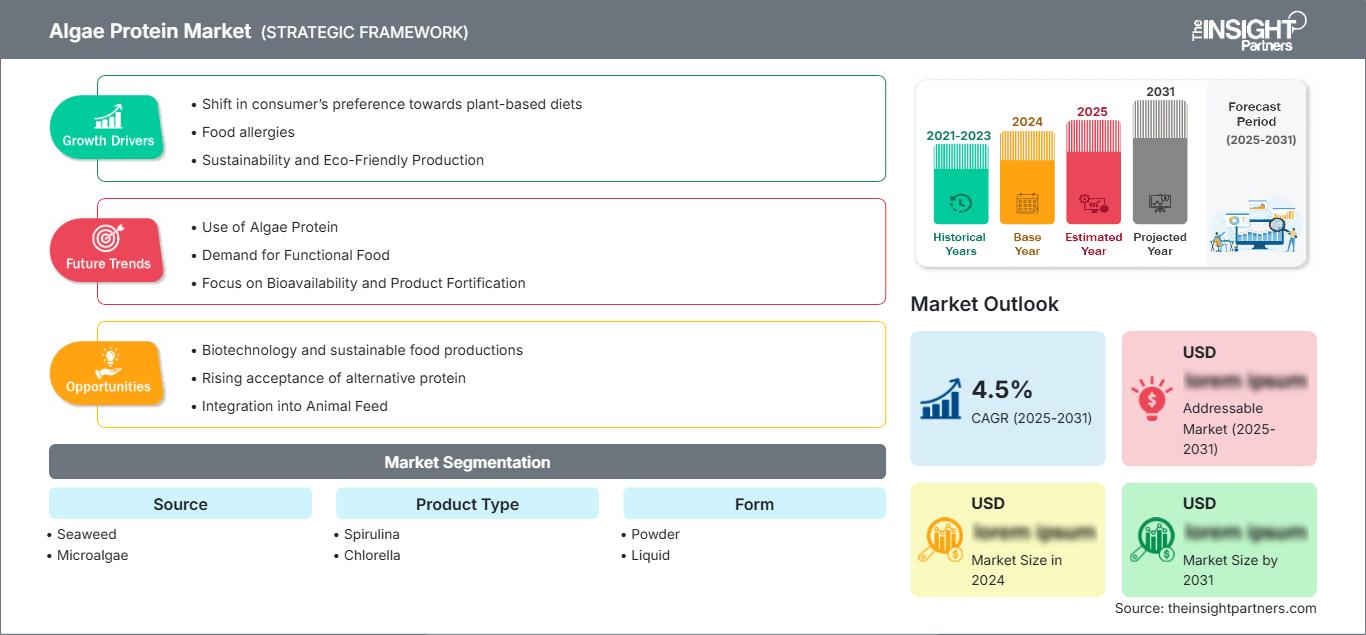
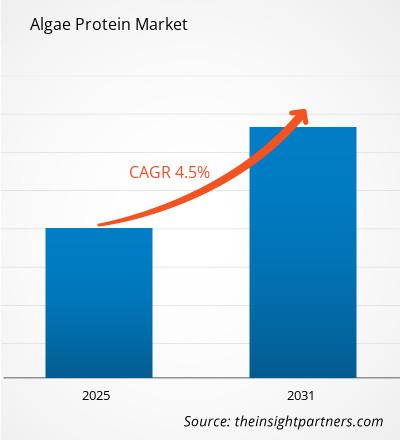
The algae protein market is valued at US$ 1.10 Billion in 2025 and is projected to reach US$ 1.62 Billion by 2034, expanding at a CAGR of 4.45% during 2026–2034. Demand is shaped by the shift toward plant-based nutrition, clean-label supplements, and sustainable ingredient systems that use seaweed and microalgae as high-value protein sources across food, feed, and wellness applications.
North America remains a leading commercialization base, supported by mature dietary supplement channels, specialty nutrition brands, and established microalgae cultivation capabilities. The algae protein market size in the region is supported by a 38–42% share in 2025 and an estimated CAGR range of 4.0–4.6% through 2034, with the US driving formulation innovation in powders, capsules, functional beverages, and premium wellness products.
Algae Protein Market Assessment and Insights
- North America: The region accounts for 38–42% share in 2025 and is expected to grow at a CAGR of 4.0–4.6% during 2026–2034, supported by supplements, sports nutrition, and clean-label food launches.
- US: The US represents 78–82% of North America demand in 2025 and is projected to grow at a CAGR of 4.1–4.7%, led by wellness brands and ingredient innovation.
- Europe: Europe holds 26–30% share in 2025 and is forecast to grow at 4.2–4.8% CAGR, with Germany, France, the UK, Italy, and Spain supporting algae-based nutrition adoption.
- Asia Pacific: Asia Pacific contributes 22–26% share in 2025 and is expected to record 5.0–5.8% CAGR, led by China, Japan, India, South Korea, and Australia.
- Largest Segment: Spirulina holds 48–52% market share in 2025 and grows at 4.2–4.8% CAGR due to established supplement penetration and high protein density.
- High Growth Segment: Chlorella holds 28–32% share in 2025 and grows at 5.0–5.6% CAGR as detox, immunity, and functional nutrition positioning improves.
- Key companies analyzed in detail: Allmicroalgae, Far East Bio-Tec Co., Ltd., Corbion N.V., Cyanotech Corporation, ENERGYbits Inc., Heliae Development, LLC, Roquette Klötze GmbH and Co. KG, E.I.D. Parry (India) Limited, Solazyme, Earthrise Nutritionals, NOW Foods, Prairie Naturals, Vimergy LLC, Thermo Fisher Scientific Inc., Pond Technologies Holdings Inc., ALGAMA, NP Nutra, Arizona Algae Products, LLC, Algatech Ltd., and Parry Nutraceuticals.
Source: The Insight Partners' analysis based on proprietary research, government publications, company annual reports, investor presentations, industry databases, and expert interviews.
Commercial evolution is moving from niche supplement powders toward broader ingredient platforms. Producers are improving drying, extraction, fermentation-assisted cultivation, and strain selection to stabilize color, taste, digestibility, and protein concentration. The algae protein market growth trajectory is also tied to manufacturers seeking alternatives to soy and pea proteins, where allergen concerns, land-use intensity, and flavor limitations can restrict adoption.
Demand from the future will depend on regional localization of ingredients, standardization of biomass in food grade, and regulatory convergence for the use of novel foods. Investments will be made in cost-effective cultivation, closed-loop water systems, and collaborations among ingredient manufacturers and branded product developers. North America and Europe will continue to be premium markets, while Asia Pacific will expand faster with dietary supplements, algae familiarity, and beverages.
Algae Protein Market Report Scope
| Report Attribute | Details |
|---|---|
| Market size in 2025 | US$ 1.10 Billion |
| Market Size by 2034 | US$ 1.62 Billion |
| Global CAGR (2026 - 2034) | 4.45% |
| Historical Data | 2021-2024 |
| Forecast period | 2026-2034 |
Algae Protein Market Analysis
The demand is greatest for products that offer a complete protein solution from plants, alongside trace minerals, pigments, antioxidants, and a clean label. The algae have a history of use in supplements, while the proteins derived from seaweed are more popular in functional food and animal feed applications. However, the supply remains challenged by cultivation costs, energy used in drying, sensory constraints, and variable protein content.
The ecosystem includes algae growers, extractors, ingredient formulators, supplement brands, food manufacturers, aquaculture feed suppliers, and cosmetic ingredient users. Algae protein market analysis shows that powder remains the most practical form because it supports capsules, drink mixes, bars, tablets, and fortified foods. Liquid formats are emerging where beverages, shots, and cosmetic actives require dispersibility and controlled concentration.
The competitive positioning for the industry is shared between the larger ingredients suppliers and the smaller algae companies. Corbion N.V., Roquette Klötze GmbH and Co. KG, Cyanotech Corporation, Allmicroalgae, E.I.D. Parry (India) Limited and Algatech Ltd. concentrate on cultivation, nutritional content, and applications. Energybits Inc., Prairie Naturals, Vimergy LLC, and NOW Foods enhance market presence through end product supplements.
Investment trends are increasingly directed toward productivity per cultivation area, protein isolation, flavor masking, and improved downstream economics. According to the Algae Protein Market Report, strategic differentiation depends on verified origin, non-GMO positioning, organic certification where feasible, and strong quality controls. Companies that combine biomass production with application support are better positioned to accelerate product adoption and convert algae protein from a specialty nutrition ingredient into a mainstream functional ingredient system.
● REPORT CUSTOMIZATION
Tailor This Report To Align With Your Specific Business Requirements
This report can be customized to align precisely with your business objectives, scope, and target markets. Customization options include tailored segmentation, geography, competitive analysis, and strategic insights to support informed decision-making.
Customize This Report →WHAT YOU CAN ADJUST
- ● Segmentations
- ● Geography
- ● Competitive Analysis
- ● Language Preferences
Algae Protein Market: Strategic Insights
Regional Insights
North America algae protein market
North America leads with 38–42% algae protein market share in 2025, supported by high supplement consumption, mature wellness retail, and active ingredient innovation. The region is projected to grow at 4.0–4.6% CAGR through 2034 as protein powders, greens blends, capsules, and functional beverages increase algae inclusion.
US demand anchors the region through premium nutrition brands, sports nutrition formats, and strong online supplement distribution. Canada contributes through natural health product channels and sustainability-oriented consumers. Growth is moderated by high production costs, yet a strong willingness to pay for clean-label and nutrient-dense ingredients supports stable expansion.
U.S. algae protein market
The US accounts for 78–82% of North America's demand in 2025 and is expected to grow at 4.1–4.7% CAGR during 2026–2034. Early uptake of spirulina and chlorella supplements, wellness consumer brands, and formulation abilities helps boost the market.
The company’s presence ranges across Cyanotech Corporation, ENERGYbits Inc., NOW Foods, Earthrise Nutritionals, and Pond Technologies Holdings Inc. Applications in the market include dietary supplements, powdered greens, tablets, functional beverages, and nutrition blends. Increasing preference for certified sourcing, reduced contamination, and products with less marine taste is observed.
Europe algae protein market
Europe holds 26–30% share in 2025 and is projected to grow at 4.2–4.8% CAGR, supported by sustainability policy, plant-based innovation, and nutraceutical demand. Germany drives regional adoption through the functional food and supplement route, whereas France encourages algae-based culinary and ingredient innovation.
Vegan nutrition, clean-label supplements, and health retail via the internet drive the UK market. Wellness foods, capsules, and cosmetic segments are driving Italy and Spain. Longer commercialization periods result from regulatory scrutiny, although quality differentiation becomes more defined for manufacturers who adhere to food safety and traceability regulations.
APAC algae protein market
APAC represents 22–26% share in 2025 and is forecast to expand at 5.0–5.8% CAGR through 2034. While China and Japan already have a proven track record of algae consumption, India and South Korea are quick to accept dietary supplements and functional foods. Premium wellness requirements are provided by Australia.
Regional growth is fueled by increasing protein supplementation, income generation, and policy focus on sustainability in nutrition. The largest regional country market remains China, owing to its market size and ingredient production, while India is set to outperform as plant-based protein knowledge increases among urban populations.
Middle East & Africa algae protein market
Middle East and Africa remain smaller but strategic, with growth estimated at 3.8–4.4% CAGR during 2026–2034. Sustainable food systems, controlled environment production, and high-end wellness products are being looked into by the UAE and Saudi Arabia, while South Africa is backing the niche market for health supplements.
It is hampered by price sensitivity, lack of consumer awareness, and imports. Yet, food security concerns, desert farming experiments, and low water requirements provide a platform for the future. Demand will initially be generated for supplements, functional foods, cosmetics, and animal nutrition products.
Segmentation Analysis
Source
Source is expected to grow at a CAGR of 4.3–4.9% during 2026–2034. The algae protein market scope spans seaweed and microalgae, with microalgae leading high-protein applications and seaweed gaining relevance where volume availability, minerals, and clean-label marine positioning support product development.
- Seaweed: Seaweed supports food, feed, and cosmetic applications through abundant biomass, marine nutrition positioning, and scalable harvesting, although protein concentration is generally lower than that of microalgae sources.
- Microalgae: Microalgae remain strategically important due to higher protein density, controlled cultivation potential, and established use in spirulina and chlorella supplements, powders, tablets, and functional blends.
Product Type
Product Type is projected to grow at a CAGR of 4.5–5.1% during the forecast period, as formulators prioritize nutrient density, brand recognition, and application fit. According to the Algae Protein Market Forecast, spirulina remains the largest segment, while chlorella records faster growth due to detox, immune health, and functional nutrition associations.
- Spirulina: Spirulina leads due to high protein content, established safety perception, wide supplement use, recognizable branding, and suitability for tablets, powders, smoothies, and fortified nutrition products.
- Chlorella: Chlorella is gaining traction in premium supplements, greens blends, and wellness products because of its chlorophyll content, cellular nutrition messaging, and increasing adoption among health-conscious consumers.
Form
Form is forecast to grow at a CAGR of 4.2–4.8% during 2026–2034. Powder dominates due to shelf stability and blending convenience, while liquid formats expand in beverages, shots, cosmetics, and specialized nutrition, where ease of use improves adoption.
- Powder: Powder is the preferred format because it supports capsules, sachets, smoothies, bars, tablets, and bulk ingredients while offering better logistics, concentration, and formulation flexibility.
- Liquid: Liquid formats serve ready-to-drink nutrition, tinctures, cosmetic actives, and functional shots, but require careful stabilization, taste management, and packaging to protect nutrient integrity.
Application
Application is expected to grow at a CAGR of 4.4–5.0% during the forecast period. According to Algae Protein Market Trends, dietary supplements lead revenue contribution, while food and beverage innovation, animal feed sustainability, and cosmetics bioactive positioning expand total addressable demand across consumer and industrial channels.
- Dietary Supplements: Dietary supplements dominate because algae protein aligns with vegan, clean-label, mineral-rich, and high-protein wellness positioning across capsules, tablets, greens powders, and sports nutrition blends.
- Food and Beverage: Food and beverage use is growing in protein bars, smoothies, bakery, snacks, and functional drinks, although color, flavor, and regulatory requirements influence formulation speed.
- Animal Feed: Animal feed applications benefit from sustainable protein interest, aquaculture nutrition demand, and amino acid density, but adoption depends on cost competitiveness and reliable large-volume supply.
- Cosmetics: Cosmetics use algae protein and related bioactives for skin conditioning, antioxidant positioning, and marine-derived ingredient claims, particularly in premium personal care and nutricosmetic concepts.
Opportunity Snapshot
| Application | Revenue Contribution | Trend Tag | Adoption Stage |
| Dietary Supplements | High | Greens Nutrition | Mature |
| Food and Beverage | Medium | Protein Fortification | Scaling |
| Animal Feed | Medium | Aquafeed Protein | Scaling |
| Cosmetics | Low | Marine Bioactives | Emerging |
Algae Protein Market Growth Drivers and Impact Analysis
Plant-Based Protein Diversification Beyond Soy and Pea
Protein lines from food and supplement companies are broadening their protein ranges in order to decrease reliance on conventional soy, pea, whey, and collagen proteins. The use of algae protein provides unique amino acid content, a vegan marketing opportunity, and an environmental sustainability story appropriate for premium nutrition product launches. The effect is most pronounced in the case of powders, pills, functional drinks, and enriched snacks, which allow minimal usage to fulfill protein claims and micronutrient requirements.
Rising Demand for Sustainable, Low-Land-Use Ingredients
The cultivation of algae is one way of generating biomass that does not interfere with agriculture. The seaweeds and microalgae systems have the potential to facilitate the recycling of water, controlled production, and carbon-aware ingredient stories. The business aspect of this development is very important since procurement teams assess ingredients based on their environmental impact, traceability, and supply chain risks. Despite the high cost of producing algae, the differentiation provided by sustainability enables premium pricing.
Functional Nutrition and Clean-Label Supplement Expansion
The trend is moving from basic protein consumption to more functional wellness products that provide a combination of protein, minerals, antioxidants, colorants, and plant-derived ingredients. Spirulina and chlorella are well-positioned due to their ability to fit into green powder mixes, immunity mixes, detox mixes, and sports nutrition products. This trend creates greater demand through e-commerce, health food outlets, and subscription wellness products.
Algae Protein Market Future Trends
Improved Sensory Processing and Neutral-Taste Ingredients
The trends in algae protein are increasingly focusing on developing enhanced sensory capabilities that minimize marine flavors, colors, and texture challenges. The use of more effective extraction, deodorization, blending, and encapsulation techniques will enable algae proteins to become part of regular foods other than dietary supplements. This is relevant since taste is one of the major challenges in the development of bakery, dairy replacement, beverage, and snack applications.
Hybrid Cultivation and Fermentation-Linked Scale-Up
Future capacity expansion will involve the combination of photobioreactors, open ponds, heterotrophic fermentation, and hybrid systems of growth. These methods have the potential to increase consistency in the quality of biomass, reducing the risk of contamination, and increasing the quantity of proteins generated during one production period. The approach will assist in achieving the Algae Protein forecasts as a result of overcoming the challenges of costs and scalability that limit the use of the product as food and feed.
Algae Protein Market Opportunities
Premium Sports Nutrition and Greens Powder Formulation
The premium sports nutrition presents itself as a viable strategy due to the ability to incorporate algae protein with electrolytes, adaptogens, vitamins, and plant proteins into differentiated wellness products for everyday use. It can be used to target vegan athletes, fitness-conscious professionals, and those looking for high-nutrient sources other than regular protein powders. The opportunity lies in the combination of taste-masking capabilities, reliable sourcing, and clean label claims in sachet, tub and ready-to-blend forms.
Sustainable Aquafeed and Specialty Animal Nutrition
There is a clear opportunity in the field of animal nutrition as aqua feed and pet feed manufacturers look for sources of sustainable proteins that offer functionality. Algae products can help in contributing to protein, pigmenting, omega-3 positioning, and trace minerals. However, success in this area will require lowering costs and securing supply, but specialty aqua feeds and pet foods will be able to accept the high-value ingredients sooner than commodity feed.
Frequently Asked Questions

- Comprehensive Market Sizing and Forecast Analysis
- Detailed Segmentation Analysis
- In-Depth Market Dynamics Assessment
- Regional and Country-Level Insights
- Competitive Landscape and Company Benchmarking
- Strategic Business Intelligence
Recent Reports
Testimonials

The Insight Partners provided valuable market intelligence that supported our global go-to-market strategy. Their team was professional, responsive, and attentive to our feedback, providing thoughtful analysis and helpful methodological clarifications throughout the project.
Junmo Kim Chief Financial Officer (CFO), Enertech Co., Ltd.
The Insight Partners' SCADA System Market report is comprehensive, with valuable insights on current trends and future forecasts. The team was highly professional, responsive, and supportive throughout. We are very satisfied and highly recommend their services.
RAN KEDEM Partner, Reali Technologies LTDs
I requested a report on a very specific software market and the team produced the report in a few days. The information was very relevant and well presented. I then requested some changes and additions to the report. The team was again very responsive and I got the final report in less than a week.
JEAN-HERVE JENN Chairman, Future Analytica
We worked with The Insight Partners for an important market study and forecast. They gave us clear insights into opportunities and risks, which helped shape our plans. Their research was easy to use and based on solid data. It helped us make smart, confident decisions. We highly recommend them.
PIYUSH NAGPAL Sr. Vice President, High Beam Global
The Insight Partners delivered insightful, well-structured market research with strong domain expertise. Their team was professional and responsive throughout. The user-friendly website made accessing industry reports seamless. We highly recommend them for reliable, high-quality research services
YUKIHIKO ADACHI CEO, Deep Blue, LLC.
This is the first time I have purchased a market report from The Insight Partners.While I was unsure at first, I visited their web site and felt more comfortable to take the risk and purchase a market report.I am completely satisfied with the quality of the report and customer service. I had several questions and comments with the initial report, but after a couple of dialogs over email with their analyst I believe I have a report that I can use as input to our strategic planning process.Thank you so much for taking the extra time and making this a positive experience.I will definitely recommend your service to others and you will be my first call when we need further market data.
JOHN SUZUKI President and Chief Executive Officer, Board Director, BK Technologies
I wish to appreciate your support and the professionalism you displayed in the course of attending to my request for information regarding to infectious disease IVD market in Nigeria. I appreciate your patience, your guidance, and the fact that you were willing to offer a discount, which eventually made it possible for us to close a deal. I look forward to engaging The Insight Partners in the future, all thanks to the impression you have created in me as a result of this first encounter.
DR CHIJIOKE ONYIA MANAGING DIRECTOR, PineCrest Healthcare Ltd.Reason to Buy
- Informed Decision-Making
- Understanding Market Dynamics
- Competitive Analysis
- Identifying Emerging Markets
- Customer Insights
- Market Forecasts
- Risk Mitigation
- Boosting Operational Efficiency
- Strategic Planning
- Investment Justification
- Tracking Industry Innovations
- Aligning with Regulatory Trends





 Get Free Sample for