
Alginates and Derivatives Market Size, Share & Growth by 2034
Alginates and Derivatives Market Size and Forecasts (2021 - 2034), Global and Regional Share, Trends, and Growth Opportunity Analysis Report Coverage : by Type (Calcium Alginate, Sodium Alginate, Potassium Alginate); Application (Food and Beverage, Pharmaceuticals, Personal Care & Cosmetics); and Geography (North America, Europe, Asia Pacific, and South and Central America)
- Status : Data Released
- Report Code : TIPRE00040303
- Category : Food and Beverages
- No. of Pages : 150
- Available Report Formats :


- Last update date : August 19, 2026


2025 Market Size
US$ 546.30 Mn
Base year value
2034 Forecast
US$ 853.02 Mn
Projected by 2034
CAGR 2026-2034
5.08 %
Growth rate
Addressable Market
US$ 6,350.71 Mn
(2026-2034)
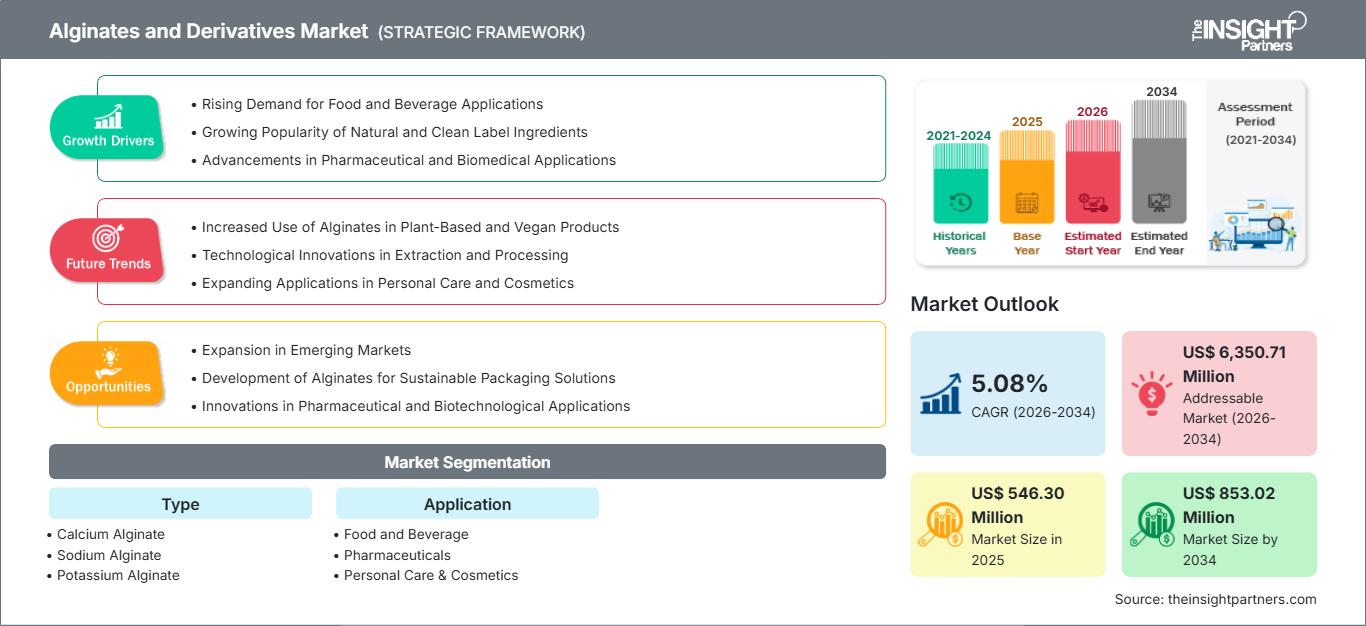
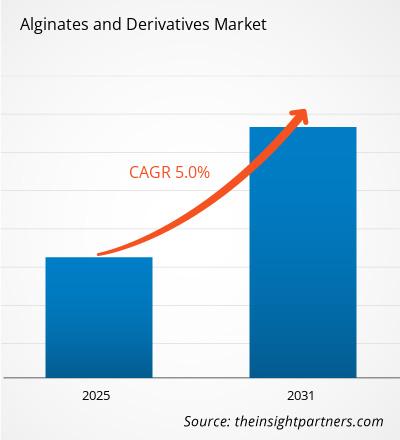
The alginates and derivatives market is projected to grow from US$ 546.30 Million in 2025 to US$ 853.02 Million by 2034, registering a CAGR of 5.08% during 2026–2034. Demand is supported by the widening use of alginate-based hydrocolloids in food texture management, pharmaceutical excipients, wound care materials, and personal care formulations.
North America remains a high-value regional market because food manufacturers, drug formulators, and advanced wound care suppliers continue to use sodium alginate and calcium alginate for clean-label stabilization, controlled release, and moisture management. The alginates and derivatives market size in the region is expected to benefit from steady packaged food innovation and healthcare material demand.
Alginates and Derivatives Market Assessment and Insights
- North America: The region accounted for an estimated 28–32% share in 2025 and is expected to grow at 4.7–5.3% CAGR between 2026–2034, supported by food processing and healthcare applications.
- U.S.: The U.S. represented 72–76% of North American demand in 2025 and is expected to grow at 4.8–5.4% CAGR, led by pharmaceutical and food stabilizer use.
- Europe: Europe held an estimated 24–28% share in 2025 and is projected to grow at 4.3–4.9% CAGR, with Germany, France, the UK, Italy, and Spain leading consumption.
- Asia Pacific: Asia Pacific represented 32–36% share in 2025 and is expected to grow at 5.5–6.2% CAGR, supported by seaweed processing strength in China, Japan, South Korea, and India.
- Largest Segment: Sodium alginate held the leading type position with 43–47% market share in 2025 and 5.0–5.6% CAGR, supported by food, pharmaceutical, and textile applications.
- High Growth Segment: Pharmaceuticals held 20–24% market share in 2025 and is expected to grow at 5.8–6.5% CAGR, driven by wound care and controlled-release formulations.
- Key companies analyzed in detail: Algaia S.A., Ashland Inc., CP Kelco U.S., Inc., Döhler GmbH, Danisco A/S, DuPont de Nemours, Inc., FMC Corporation, Hangzhou Mobel Biotechnology Co., Ltd., Ingredients Solutions, Inc., and KIMICA Corporation.
Source: The Insight Partners' analysis based on proprietary research, government publications, company annual reports, investor presentations, industry databases, and expert interviews.
The alginates and derivatives market growth reflects the movement of hydrocolloids from conventional thickening uses toward higher-value functional roles. Sodium alginate remains important in dairy alternatives, sauces, bakery fillings, and encapsulation systems because it supports viscosity control and gel formation. Calcium alginate is gaining relevance in absorbent wound dressings, while potassium alginate supports specialized food and pharmaceutical systems.
Forward demand will depend on seaweed supply quality, purification standards, and customer preference for naturally derived ingredients. According to the Alginates and Derivatives Market Report, producers with reliable sourcing, consistent viscosity grades, and application development support are better positioned as buyers request cleaner labels, lower impurity profiles, and formulation flexibility across food, pharmaceutical, and personal care uses.
Alginates and Derivatives Market Report Scope
| Report Attribute | Details |
|---|---|
| Market size in 2025 | US$ 546.30 Million |
| Market Size by 2034 | US$ 853.02 Million |
| Global CAGR (2026 - 2034) | 5.08% |
| Historical Data | 2021-2024 |
| Forecast period | 2026-2034 |
Alginates and Derivatives Market Analysis
The alginates and derivatives market growth is closely tied to rising demand for multifunctional ingredients that can thicken, stabilize, gel, and form films while supporting clean-label and naturally derived product positioning. Alginates have been witnessing increased usage by the food and beverage manufacturers in dairy alternatives, desserts, sauces, bakery items, and restructured foods for improving texture, mouthfeel, and stability. Simultaneously, the increasing preference of consumers for natural ingredients is driving the demand for alginates in processed and convenience foods and beverages.
The pharmaceutical and healthcare applications are still expected to remain significant growth segments in the market. Alginate chemistry finds extensive application in drug delivery systems, antacid formulations, wound dressings, and encapsulation due to biocompatibility and functional attributes. Increasing demand for high-tech healthcare products, along with innovations in the pharmaceutical industry, will drive the increased use of high-grade alginates.
Supply behavior is largely determined by the availability of brown algae, efficiency of the supply process, and quality standards of the end products. The countries where key sourcing and manufacturing take place include China, Norway, Japan, and Chile. It is also becoming more and more important to assess suppliers' capacity in terms of traceability, heavy metal handling, sustainability efforts, and batch-to-batch viscosity consistency.
The Alginates and Derivatives Market Analysis highlights a competitive landscape consisting of hydrocolloid specialists and diversified ingredient manufacturers. Companies including Algaia S.A., CP Kelco U.S., Inc., KIMICA Corporation, and Ingredients Solutions, Inc. compete through seaweed expertise and application-focused product portfolios, while Ashland Inc., Danisco A/S, DuPont de Nemours, Inc., and FMC Corporation leverage broader specialty ingredient capabilities. Investment is increasingly directed toward purification technologies, application laboratories, sustainable seaweed sourcing, and regional distribution expansion. Suppliers capable of delivering tailored viscosity grades, comprehensive regulatory documentation, and application development support are expected to strengthen their market position as customers prioritize quality, compliance, and formulation reliability.
● REPORT CUSTOMIZATION
Tailor This Report To Align With Your Specific Business Requirements
This report can be customized to align precisely with your business objectives, scope, and target markets. Customization options include tailored segmentation, geography, competitive analysis, and strategic insights to support informed decision-making.
Customize This Report →WHAT YOU CAN ADJUST
- ● Segmentations
- ● Geography
- ● Competitive Analysis
- ● Language Preferences
Alginates and Derivatives Market: Strategic Insights
Regional Insights
North America alginates and derivatives market
North America held an estimated 28% to 32% share of the alginates and derivatives market in 2025 and is projected to grow at a CAGR of 4.7% to 5.3% during 2026 to 2034. Demand is driven by the widespread use of alginates in clean-label food formulations, frozen desserts, bakery products, and plant-based foods. Healthcare applications, particularly wound dressings, pharmaceutical excipients, and drug delivery systems, also contribute significantly to market growth. Strong regulatory standards, advanced manufacturing capabilities, and ongoing innovation in food and healthcare ingredients further support market expansion across the region.
U.S. alginates and derivatives market
The U.S. accounted for approximately 72% to 76% of North American demand in 2025 and is expected to expand at a CAGR of 4.8% to 5.4% through 2034. Market growth is supported by strong demand from processed foods, nutraceuticals, pharmaceutical formulations, and advanced wound care products. The presence of major ingredient suppliers, application laboratories, and established distribution networks strengthens market development. Increasing consumer preference for natural ingredients and clean-label products is encouraging manufacturers to expand alginate usage across a wide range of commercial applications.
Europe alginates and derivatives market
Europe represented 24% to 28% of the global market in 2025 and is forecast to grow at a CAGR of 4.3% to 4.9%. Germany, France, and the UK remain key markets due to strong demand from food processing, pharmaceutical manufacturing, and personal care industries. Growing consumer preference for clean-label and sustainable ingredients is encouraging wider adoption of alginates in food and nutraceutical products. Regulatory focus on product quality, traceability, and environmental sustainability continues to favor suppliers capable of maintaining high standards and consistent technical performance.
APAC alginates and derivatives market
Asia Pacific held the largest market share at 32% to 36% in 2025 and is expected to register the fastest growth, with a CAGR of 5.5% to 6.2% through 2034. China remains the dominant production and consumption hub, supported by extensive seaweed processing capacity and a large food manufacturing sector. Japan and South Korea drive demand for high-quality food, pharmaceutical, and cosmetic applications, while India and Australia are emerging growth markets. Expanding industrialization, rising health awareness, and increasing demand for functional ingredients are expected to further strengthen regional growth prospects.
Middle East & Africa alginates and derivatives market
The Middle East & Africa market remains relatively small but is expected to grow steadily at a CAGR of 4.5% to 5.1% during the forecast period. Growth is supported by rising demand from the food processing, personal care, and healthcare sectors. Saudi Arabia and the UAE lead regional consumption through increasing use of alginates in premium packaged foods and cosmetic formulations. South Africa serves as an important distribution and pharmaceutical market, while broader regional growth will be supported by expanding food manufacturing investments, healthcare spending, and demand for specialty ingredients.
Segmentation Analysis
Type
The Type segment is led by sodium alginate, which held 43–47% share in 2025 and is expected to grow at 5.0–5.6% CAGR during 2026–2034. The alginates and derivatives market scope across type categories is shaped by solubility, gel strength, viscosity control, and application-specific performance in food, pharmaceutical, and personal care systems.
- Calcium Alginate: Calcium alginate is strategically important in absorbent wound dressings and controlled gel systems, where ion exchange, moisture retention, and biocompatibility support healthcare and specialty formulation demand.
- Sodium Alginate: Sodium alginate dominates due to broad use in food stabilization, pharmaceutical binding, encapsulation, textile printing, and viscosity control, making it the most versatile commercial alginate derivative.
- Potassium Alginate: Potassium alginate serves niche food, pharmaceutical, and personal care formulations where solubility profile, mineral positioning, or specific ionic behavior supports differentiated product development.
Application
Application demand is strongest in food and beverage, which held 44–48% share in 2025 and is projected to grow at 4.9–5.5% CAGR. Pharmaceuticals show the fastest growth as wound care, controlled-release delivery, and specialty excipients create higher-value opportunities across clinical and consumer health channels.
- Food and Beverage: Food and beverage applications rely on alginates for thickening, gelling, stabilization, suspension, and texture control in dairy alternatives, desserts, sauces, bakery fillings, and restructured products.
- Pharmaceuticals: Pharmaceuticals use alginates in tablet binding, controlled release, antacid systems, wound dressings, and encapsulation, making quality documentation and purity increasingly important for supplier selection.
- Personal Care & Cosmetics: Personal care and cosmetics use alginates for viscosity control, film formation, skin feel, and natural-origin positioning in masks, creams, lotions, and specialty formulations.
Opportunity Snapshot
| Application | Revenue Contribution | Trend Tag | Adoption Stage |
| Food and Beverage | High | Clean Label | Mature |
| Pharmaceuticals | Medium | Wound Care | Scaling |
| Personal Care & Cosmetics | Medium | Natural Texture | Scaling |
Alginates and Derivatives Market Growth Drivers and Impact Analysis
Clean-label food formulation demand
With the growing interest from food producers in formulating new food products with identifiable plant-based ingredients that can deliver stability, texture, and suspension, alginates have become a solution to such needs as well as clean-label formulations. The use of alginates is enabled by the gelling, thickening, and stabilization characteristics that they provide for dairy alternatives, sauces, frozen desserts, bakery fillings, and restructured foods. Being a product of seaweed, they correspond to consumer trends in using minimal processing and clear labeling of products. With the growing clean-label trend worldwide, there will be increasing need for sodium alginate with reliable viscosity and performance characteristics.
Rising use in wound care and drug delivery
There is a rising need for alginates in healthcare applications owing to their versatile applications in wound dressing and the pharmaceutical industry. Calcium alginate dressings have widespread applications because of their exudate absorption abilities, maintaining a wet healing environment, and protective gel formation to facilitate healing. Sodium alginate is widely used in the pharmaceutical industry in drug delivery, controlled release, and encapsulation technology applications. There is an increasing demand for high-purity alginates for healthcare applications due to the increasing use of alginates in the highly regulated healthcare sector.
Growing preference for marine-derived hydrocolloids
Hydrocolloid ingredients derived from the marine environment have been receiving increasing attention due to companies’ efforts to source renewable, sustainable, and multifunctional ingredients. Brown seaweed is the main ingredient in the production of alginates, and it has an environmental edge over other sources since its cultivation doesn’t need arable land, irrigation with fresh water, or significant agricultural inputs. There has been an increasing effort on the part of organizations to become more sustainable and for consumers to buy products made from environmentally friendly ingredients.
Alginates and Derivatives Market Future Trends
Higher-purity alginate grades for biomedical use
The alginates and derivatives market trends are expected to include greater demand for purified, low-impurity grades used in wound care, encapsulation, bioprinting research, and controlled-release systems. Suppliers will need stronger analytical controls, endotoxin management, and application-specific documentation. This trend will separate commodity food-grade supply from higher-value healthcare materials and create opportunities for companies with advanced purification and regulatory support capabilities.
Application-specific blends for food texture engineering
Food formulators are likely to use more customized alginate blends that combine viscosity control, gel strength, heat tolerance, and sensory performance. Instead of buying only standard grades, customers will seek systems designed for plant-based dairy, bakery fillings, sauces, and frozen desserts. This trend favors suppliers with application laboratories and technical service teams that can reduce reformulation time and improve product consistency.
Alginates and Derivatives Market Opportunities
Pharmaceutical and advanced wound care expansion
The alginates and derivatives market Forecasts point to attractive opportunities in pharmaceutical excipients and wound care materials. Suppliers can create value by offering calcium alginate and sodium alginate grades with controlled viscosity, purity documentation, and regulatory support. Partnerships with dressing manufacturers, contract development organizations, and drug formulation companies can help producers move into higher-margin applications that are less exposed to food ingredient price competition.
Regional technical service and formulation support
As customers demand faster product development, suppliers can differentiate through regional laboratories, formulation troubleshooting, and customized hydrocolloid systems. This is especially important in Asia Pacific, North America, and Europe, where food, personal care, and pharmaceutical buyers require reliable performance data. Technical service can convert alginate sales from transactional supply into long-term formulation partnerships with stronger retention and premium pricing potential.
Frequently Asked Questions

- Comprehensive Market Sizing and Forecast Analysis
- Detailed Segmentation Analysis
- In-Depth Market Dynamics Assessment
- Regional and Country-Level Insights
- Competitive Landscape and Company Benchmarking
- Strategic Business Intelligence
Recent Reports
Testimonials

The Insight Partners' SCADA System Market report is comprehensive, with valuable insights on current trends and future forecasts. The team was highly professional, responsive, and supportive throughout. We are very satisfied and highly recommend their services.
RAN KEDEM Partner, Reali Technologies LTDs
I requested a report on a very specific software market and the team produced the report in a few days. The information was very relevant and well presented. I then requested some changes and additions to the report. The team was again very responsive and I got the final report in less than a week.
JEAN-HERVE JENN Chairman, Future Analytica
We worked with The Insight Partners for an important market study and forecast. They gave us clear insights into opportunities and risks, which helped shape our plans. Their research was easy to use and based on solid data. It helped us make smart, confident decisions. We highly recommend them.
PIYUSH NAGPAL Sr. Vice President, High Beam Global
The Insight Partners delivered insightful, well-structured market research with strong domain expertise. Their team was professional and responsive throughout. The user-friendly website made accessing industry reports seamless. We highly recommend them for reliable, high-quality research services
YUKIHIKO ADACHI CEO, Deep Blue, LLC.
This is the first time I have purchased a market report from The Insight Partners.While I was unsure at first, I visited their web site and felt more comfortable to take the risk and purchase a market report.I am completely satisfied with the quality of the report and customer service. I had several questions and comments with the initial report, but after a couple of dialogs over email with their analyst I believe I have a report that I can use as input to our strategic planning process.Thank you so much for taking the extra time and making this a positive experience.I will definitely recommend your service to others and you will be my first call when we need further market data.
JOHN SUZUKI President and Chief Executive Officer, Board Director, BK Technologies
I wish to appreciate your support and the professionalism you displayed in the course of attending to my request for information regarding to infectious disease IVD market in Nigeria. I appreciate your patience, your guidance, and the fact that you were willing to offer a discount, which eventually made it possible for us to close a deal. I look forward to engaging The Insight Partners in the future, all thanks to the impression you have created in me as a result of this first encounter.
DR CHIJIOKE ONYIA MANAGING DIRECTOR, PineCrest Healthcare Ltd.Reason to Buy
- Informed Decision-Making
- Understanding Market Dynamics
- Competitive Analysis
- Identifying Emerging Markets
- Customer Insights
- Market Forecasts
- Risk Mitigation
- Boosting Operational Efficiency
- Strategic Planning
- Investment Justification
- Tracking Industry Innovations
- Aligning with Regulatory Trends





 Get Free Sample for