
Alternative Sweeteners Market Trends, Size & Forecast by 2034
Coverage: By Product Type (High-Fructose Syrup, High-Intensity Sweeteners, and Low-Intensity Sweeteners), Source (Natural and Synthetic), and Application (Food & Beverages, Pharmaceuticals & Nutraceuticals, Animal Feed, and Others)
- Status : Data Released
- Report Code : TIPRE00003893
- Category : Food and Beverages
- No. of Pages : 150
- Available Report Formats :


- Last update date : August 19, 2026


2025 Market Size
US$ 9.23 Bn
Base year value
2034 Forecast
US$ 16.82 Bn
Projected by 2034
CAGR 2026-2034
6.89 %
Growth rate
Addressable Market
US$ 117.64 Bn
(2026-2034)
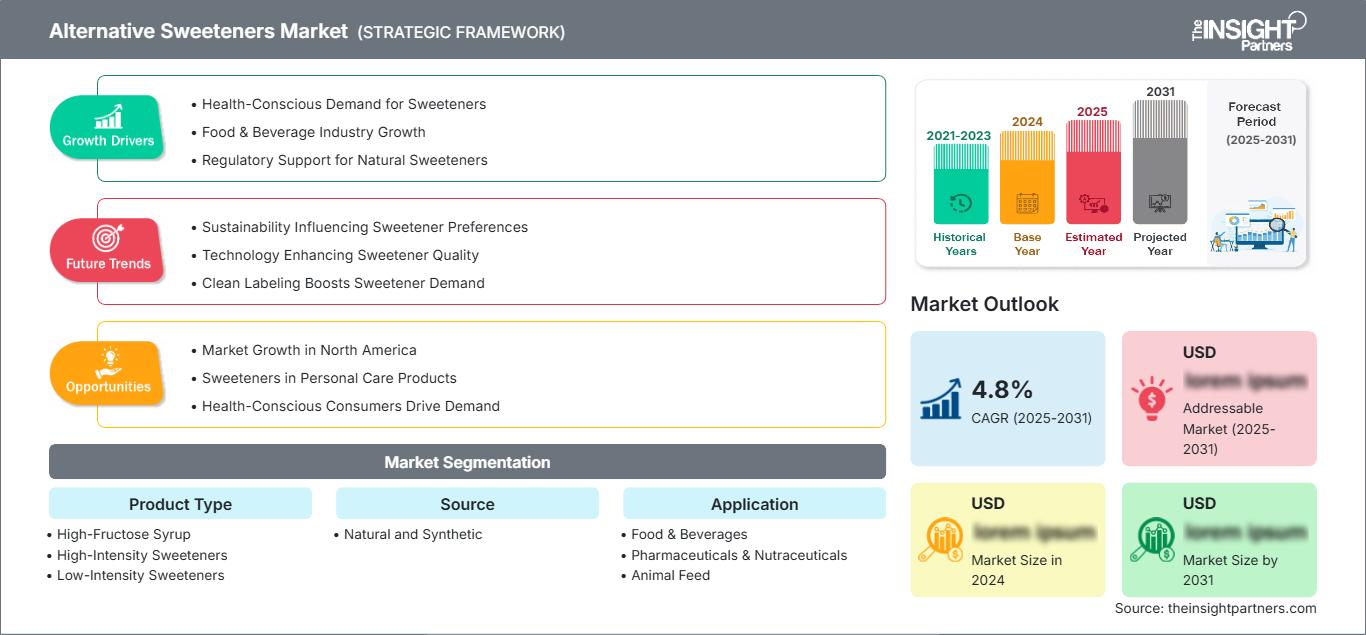
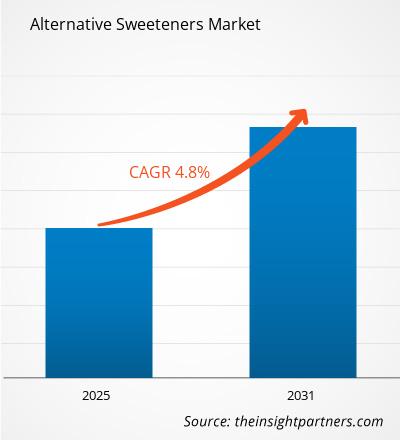
The alternative sweeteners market was valued at US$ 9.23 Billion in 2025 and is projected to reach US$ 16.82 Billion by 2034, expanding at a CAGR of 6.89% during 2026–2034. Industry expansion is supported by increasing demand for reduced-sugar formulations, broader adoption of natural sweetening ingredients, and product innovation across food, beverage, pharmaceutical, and nutraceutical applications. Manufacturers are also investing in ingredient optimization technologies to improve taste profiles and functional performance.
Across North America, rising concerns regarding obesity, diabetes, and excess sugar consumption continue to encourage the adoption of sugar substitutes in packaged foods and beverages. The alternative sweeteners market size in the region benefits from strong food processing infrastructure, active reformulation initiatives by major brands, and growing consumer interest in naturally sourced ingredients. Regional demand is expected to advance at a CAGR range of 6.2–6.8% through the forecast period.
Alternative Sweeteners Market Assessment and Insights
- North America: Share in 2025 estimated at 34–38%, supported by strong demand for sugar-reduced products, mature food manufacturing, and favorable product innovation activity. CAGR between 2026–2034: 6.2–6.8%.
- US: Represents 74–78% of North America in 2025, driven by large-scale food and beverage production and accelerating clean-label adoption. CAGR between 2026–2034: 6.3–6.9%.
- Europe: Share in 2025 estimated at 27–31%, led by Germany, the UK, and France. Regulatory support for sugar reduction supports expansion. CAGR between 2026–2034: 6.0–6.6%.
- Asia Pacific: Share in 2025 estimated at 25–29%, with China, Japan, India, and South Korea driving demand. CAGR between 2026–2034: 7.5–8.1%.
- Largest Segment: Food & Beverages holds a market share of 58–62% in 2025 due to extensive use in beverages, dairy, confectionery, and bakery products. CAGR between 2026–2034: 6.8–7.4%.
- High Growth Segment: Natural Source segment accounts for 42–46% share in 2025 and benefits from consumer preference for plant-derived products. CAGR between 2026–2034: 7.8–8.4%.
- Key companies analyzed in detail: Archer Daniels Midland Company, Associated British Foods plc, Cargill, Incorporated, DuPont de Nemours, Inc., GLG Life Tech Corporation, Heartland Food Products Group, Ingredion Incorporated, PureCircle Limited, Tate & Lyle PLC, Zydus Wellness Limited.
Source: The Insight Partners' analysis based on proprietary research, government publications, company annual reports, investor presentations, industry databases, and expert interviews.
Further developments in production technologies will be seen owing to the growing attention from companies to enhance sweetness perception, lower aftertaste, and stability of ingredients. Thanks to fermentation production technologies, stevia refining techniques, and blending systems, the producers have managed to create new-generation formulas appropriate for beverages, dairy, nutritional, and pharmaceutical uses. The development of diversified sources and integrated supply chain operations is another trend associated with the availability of raw materials.
Further growth is anticipated due to increased investments in the Asia Pacific, Latin America, and the Middle East. Sugar reduction campaigns, health-conscious consumers, and growing consumption of processed food products are among the favorable factors. The producers are expected to form stronger collaborations with food manufacturers and focus on natural sweetener products and sustainable agriculture programs.
Alternative Sweeteners Market Report Scope
| Report Attribute | Details |
|---|---|
| Market size in 2025 | US$ 9.23 Billion |
| Market Size by 2034 | US$ 16.82 Billion |
| Global CAGR (2026 - 2034) | 6.89% |
| Historical Data | 2021-2024 |
| Forecast period | 2026-2034 |
Alternative Sweeteners Market Analysis
Growing consumer focus on healthier diets is a major catalyst for the alternative sweeteners market growth. Sweeteners have become a common choice for companies engaged in food and beverage chains in order to maintain the quality and functionality of their products while reducing their caloric content. This development was brought about by rising cases of obesity and diabetes that have forced companies to introduce new formulations containing lower amounts of sugar. The demand has grown not only for carbonated drinks but also for dairy products, protein drinks, bakery items, and confectionery.
There is growth happening at the supply chain level, too. Ingredient producers continue to explore methods of extracting sweetener ingredients, fermentation-based technologies, and blending. Improvements in the procurement network for ingredients and the efficiency of mass production have helped reduce the cost of the end product. The coordination among ingredient producers, food processors, distributors, and retailers has allowed for wider availability of the product.
The competitive structure of the alternative sweeteners market analysis reflects the presence of multinational ingredient suppliers alongside specialized sweetener companies. Archer Daniels Midland Company, Cargill, Incorporated, Ingredion Incorporated, PureCircle Limited, and Tate & Lyle PLC have continued to emphasize portfolio growth, strategic collaborations, and innovations specific to applications. A number of companies have been involved in research efforts that seek to enhance flavor profiles and adopt a clean-label strategy.
Investments remain heavily oriented towards natural sweeteners, fermentation technology, and nutraceutical applications. DuPont de Nemours, Inc., Associated British Foods plc, GLG Life Tech Corporation, and Heartland Food Products Group have continued to expand their manufacturing and commercial reach. Differentiation among competitors continues to be achieved through sustainable sourcing, intellectual property creation, and customized ingredient systems suited for regional food and beverage needs.
● REPORT CUSTOMIZATION
Tailor This Report To Align With Your Specific Business Requirements
This report can be customized to align precisely with your business objectives, scope, and target markets. Customization options include tailored segmentation, geography, competitive analysis, and strategic insights to support informed decision-making.
Customize This Report →WHAT YOU CAN ADJUST
- ● Segmentations
- ● Geography
- ● Competitive Analysis
- ● Language Preferences
Alternative Sweeteners Market: Strategic Insights
Regional Insights
North America alternative sweeteners market
North America accounted for 34–38% alternative sweeteners market share in 2025. Regional demand is supported by health-conscious consumers, broad penetration of functional beverages, and increasing adoption of low-calorie sweeteners across food manufacturing. Sugar reduction policies and growing interest in clean-label product formulations continue to influence purchasing decisions. The market is projected to expand at a CAGR of 6.2–6.8% through 2034.
Major manufacturers continue to introduce reformulated beverage products, reduced-sugar snacks, and nutritionally enhanced foods. Investments in ingredient innovation and advanced food processing technologies have strengthened commercialization opportunities. Demand remains particularly strong across beverages, dairy alternatives, and nutritional products. High product awareness and established distribution networks further support sustained market expansion throughout the forecast period.
U.S. alternative sweeteners Market
The United States represented 74–78% of North American demand during 2025. Expansion is supported by extensive processed food production, the growing prevalence of weight-management programs, and corporate sugar-reduction commitments. The market is expected to register a CAGR of 6.3–6.9% during the forecast period, supported by steady product innovation and consumer acceptance.
Major ingredient suppliers maintain significant operational footprints throughout the country, enabling efficient commercialization of natural and synthetic sweetener solutions. Demand growth is particularly visible within beverages, sports nutrition products, dietary supplements, and low-sugar packaged foods. Increasing utilization of plant-derived ingredients and clean-label positioning remains a defining trend among leading domestic food manufacturers.
Europe alternative sweeteners Market
Europe accounted for 27–31% of global revenue in 2025 and is projected to advance at a CAGR of 6.0–6.6%. Germany remains the leading regional market due to strong food processing capabilities, extensive beverage production, and increasing adoption of reduced-sugar formulations. Regulatory emphasis on health-focused nutrition continues to support ingredient substitution across multiple product categories.
The United Kingdom demonstrates strong demand driven by sugar reduction initiatives and consumer preference for healthier packaged foods. France, Italy, and Spain continue to expand the utilization of alternative sweeteners in dairy products, bakery items, beverages, and nutritional applications. Rising awareness regarding metabolic health and increasing investments in ingredient innovation have contributed to broader market penetration throughout Western Europe.
APAC alternative sweeteners Market
Asia Pacific held an estimated 25–29% revenue share in 2025 and represents the fastest-growing regional market. Expansion is forecast at a CAGR of 7.5–8.1%, supported by increasing processed food consumption and rising middle-class purchasing power across major economies.
China remains the leading market, while Japan, South Korea, India, and Australia continue to experience strong adoption. Government health awareness programs, expanding beverage industries, and investments in food ingredient manufacturing support demand growth. Regional suppliers are also increasing production capacity to address rising export opportunities.
Middle East & Africa alternative sweeteners Market
The Middle East and Africa market remains smaller but increasingly important as manufacturers target health-oriented consumers. Growing urbanization, packaged food consumption, and healthcare awareness contribute to demand. The market is projected to expand at a CAGR of 5.8–6.4% during the forecast period.
Saudi Arabia and the UAE lead regional adoption due to modern retail expansion and nutrition-focused product launches. South Africa remains a significant market within the continent. Investments in food processing infrastructure and premium consumer products continue to strengthen long-term growth prospects.
Segmentation Analysis
Product Type
The Product Type segment is expected to grow at a CAGR of 6.7–7.3% between 2026 and 2034. Product innovation, evolving taste requirements, and functional performance considerations influence purchasing decisions across applications. The alternative sweeteners market scope continues to expand as manufacturers balance sweetness intensity, stability, and cost efficiency.
- High-Fructose Syrup: Widely used in beverage and processed food manufacturing due to affordability, consistent sweetness performance, and compatibility with large-scale production systems.
- High-Intensity Sweeteners: Deliver substantially higher sweetness levels than sugar and support reduced-calorie formulations across beverages, pharmaceutical products, and specialized nutrition offerings.
- Low-Intensity Sweeteners: Utilized where bulk functionality and balanced sweetness profiles are required, particularly in bakery, confectionery, and selected dairy applications.
Source
The Source segment is projected to expand at a CAGR of 7.1–7.7% through 2034. Consumer preference for transparency, sustainability, and plant-derived ingredients is influencing sourcing strategies. Natural sweeteners continue gaining traction, while synthetic alternatives remain relevant where performance and cost considerations are critical.
- Natural: Supported by clean-label demand, favorable consumer perception, and continuing product innovation aimed at improving taste, stability, and application flexibility.
- Synthetic: Maintains importance in large-scale manufacturing owing to dependable performance characteristics, economic advantages, and long-established regulatory acceptance.
Application
The Application segment is expected to advance at a CAGR of 6.9–7.5%. The Food & Beverages category remains the primary demand center, while nutraceutical and pharmaceutical applications continue expanding due to increasing health and wellness consumption patterns.
- Food & Beverages: The largest application category, benefiting from extensive use in beverages, dairy products, confectionery, baked goods, and convenience foods.
- Pharmaceuticals & Nutraceuticals: Increasingly utilized in supplements, syrups, chewable formats, and wellness products that require palatable taste profiles without excessive sugar content.
- Animal Feed: Applied to improve feed palatability and consumption patterns, supporting nutritional efficiency in selected livestock and companion animal products.
Opportunity Snapshot
| Application | Revenue Contribution | Trend Tag | Adoption Stage |
| Food & Beverages | High | Sugar Reformulation | Mature |
| Pharmaceuticals & Nutraceuticals | Medium | Wellness Nutrition | Scaling |
| Animal Feed | Low | Feed Palatability | Emerging |
| Others | Low | Specialty Uses | Emerging |
Alternative Sweeteners Market Growth Drivers and Impact Analysis
Rising global focus on sugar reduction strategies
There is growing interest among consumers to adopt healthy diets that will allow them to cut down their consumption of sugar in their food items without affecting the taste quality of their food products. In response, food manufacturers are working on reengineering their products, ranging from beverages to dairy, snack foods, and candy products. The public campaigns related to obesity and diabetes issues have made consumers aware of the overconsumption of sugar in their foods. Moreover, regulatory initiatives for nutritional labeling have encouraged the use of alternative sugar ingredients.
Expansion of clean-label and natural ingredient demand
The trend of clean label purchasing is continually influencing the choice of ingredients in the consumer market around the world. The process of assessing sourcing practices, ingredient transparency, and sustainable qualities has become common among consumers while making their purchases. Plant-based natural sweeteners are gaining an advantage because of this shift. The food manufacturers are undertaking full-scale reformulation strategies that are intended to meet the needs of consumers. Advances in agriculture, technology, and improved performance are contributing to the commercial viability of such products.
Innovation in fermentation and ingredient technologies
Technological developments in biotechnology, fermentation, and ingredient technology are making it possible for better sensory qualities in sweetener alternatives. Companies are coming up with solutions to overcome the existing difficulties, such as bitter taste, aftertaste, and formulation difficulties. Improved production processes allow for better scalability and enable suppliers to meet rising demand. Technology-led innovations are also making it easier to create custom blends based on individual needs. The ongoing competition makes it necessary for companies to invest in research and development of new products.
Alternative Sweeteners Market Future Trends
Acceleration of premium natural sweetener portfolios
The alternative sweeteners market trends indicate an increasing shift toward premium natural ingredient systems designed to deliver improved taste and functionality. Advanced formulas of stevia, fermentation-based sweeteners, and ingredient combinations that resolve formulation issues can be expected from companies. Future technological improvements in the process of extraction and production of stevia can be anticipated, which will help in making the product scalable, as well as increase its usage in beverages, nutraceuticals, and packaged foods.
Integration of personalized nutrition strategies
Intersections between advances in technology in health care and innovations in the food industry are likely to lead to the emergence of niche sweeteners. Products geared towards specific goals in health care, like losing weight, treating diabetes, and diets for enhanced performance, are likely to increase in demand. Customized ingredients and formulations of products for particular uses are likely to become significant.
Alternative Sweeteners Market Opportunities
Investment expansion across emerging food processing markets
Emerging economies continue to offer attractive growth prospects due to rising urbanization, increasing disposable incomes, and expanding packaged food consumption. The availability of local manufacturing opportunities and favorable demand trends supports capital investment across production and distribution networks. Alternative sweeteners market Forecasts indicate that regional processing industries will increasingly adopt advanced sweetening systems to satisfy changing consumer preferences. Strategic partnerships with local manufacturers, investments in supply infrastructure, and targeted product portfolios can strengthen long-term market positioning. Participants capable of aligning with regional consumption patterns are expected to capture significant value.
Growth potential in nutraceutical and wellness products
Consumer behavior with regard to health issues opens new possibilities that go beyond conventional applications of food and beverages. Nutritional supplements, functional beverages, specialty nutritional foods, and wellness products need alternative forms of sweeteners that can provide a pleasant taste sensation. Companies should consider developing customized ingredient solutions for specific health categories. The growth of preventive health care and wellness trends is likely to provide a continuing demand.
Frequently Asked Questions

- Comprehensive Market Sizing and Forecast Analysis
- Detailed Segmentation Analysis
- In-Depth Market Dynamics Assessment
- Regional and Country-Level Insights
- Competitive Landscape and Company Benchmarking
- Strategic Business Intelligence
Recent Reports
Testimonials

The Insight Partners' SCADA System Market report is comprehensive, with valuable insights on current trends and future forecasts. The team was highly professional, responsive, and supportive throughout. We are very satisfied and highly recommend their services.
RAN KEDEM Partner, Reali Technologies LTDs
I requested a report on a very specific software market and the team produced the report in a few days. The information was very relevant and well presented. I then requested some changes and additions to the report. The team was again very responsive and I got the final report in less than a week.
JEAN-HERVE JENN Chairman, Future Analytica
We worked with The Insight Partners for an important market study and forecast. They gave us clear insights into opportunities and risks, which helped shape our plans. Their research was easy to use and based on solid data. It helped us make smart, confident decisions. We highly recommend them.
PIYUSH NAGPAL Sr. Vice President, High Beam Global
The Insight Partners delivered insightful, well-structured market research with strong domain expertise. Their team was professional and responsive throughout. The user-friendly website made accessing industry reports seamless. We highly recommend them for reliable, high-quality research services
YUKIHIKO ADACHI CEO, Deep Blue, LLC.
This is the first time I have purchased a market report from The Insight Partners.While I was unsure at first, I visited their web site and felt more comfortable to take the risk and purchase a market report.I am completely satisfied with the quality of the report and customer service. I had several questions and comments with the initial report, but after a couple of dialogs over email with their analyst I believe I have a report that I can use as input to our strategic planning process.Thank you so much for taking the extra time and making this a positive experience.I will definitely recommend your service to others and you will be my first call when we need further market data.
JOHN SUZUKI President and Chief Executive Officer, Board Director, BK Technologies
I wish to appreciate your support and the professionalism you displayed in the course of attending to my request for information regarding to infectious disease IVD market in Nigeria. I appreciate your patience, your guidance, and the fact that you were willing to offer a discount, which eventually made it possible for us to close a deal. I look forward to engaging The Insight Partners in the future, all thanks to the impression you have created in me as a result of this first encounter.
DR CHIJIOKE ONYIA MANAGING DIRECTOR, PineCrest Healthcare Ltd.Reason to Buy
- Informed Decision-Making
- Understanding Market Dynamics
- Competitive Analysis
- Identifying Emerging Markets
- Customer Insights
- Market Forecasts
- Risk Mitigation
- Boosting Operational Efficiency
- Strategic Planning
- Investment Justification
- Tracking Industry Innovations
- Aligning with Regulatory Trends





 Get Free Sample for