
Alumina and Bauxite Market Demand, Share & Growth by 2034
Coverage: by Product Type (Non Metallurgical Products, Metallurgical); Application (Paints, Composite Fibers, Abrasive, Industrial Catalyst, Purification Agent, Proppant), and Geography (North America, Europe, Asia Pacific, and South and Central America)
- Status : Data Released
- Report Code : TIPRE00013362
- Category : Chemicals and Materials
- No. of Pages : 150
- Available Report Formats :


- Last update date : August 07, 2026


2025 Market Size
US$ 15.60 Bn
Base year value
2034 Forecast
US$ 31.42 Bn
Projected by 2034
CAGR 2026-2034
8.09 %
Growth rate
Addressable Market
US$ 211.36 Bn
(2026-2034)
The alumina and bauxite market is set to grow on account of increasing aluminum production, growing consumption of specialty alumina products, and investments in mining and refining capabilities. The market is forecasted to grow from US$ 15.60 Billion in 2025 to US$ 31.42 Billion in 2034 at a CAGR of 8.09%. Infrastructure investment, electrification of transport, renewables deployment, and demand for lightweight materials continue to bolster the market.
North America is an important region in terms of production and consumption due to existing capabilities in aluminum production, aerospace consumption and investment in the supply chains of critical minerals. The alumina and bauxite market size in North America is bolstered by refinery improvements, recycling, and supportive government policies for domestic mineral security. Demand from electric vehicles, defense manufacturing, and catalytic applications is expected to drive a regional CAGR of 7.4% to 7.9%.
Alumina and Bauxite Market Assessment and Insights
- North America: Accounted for 22–26% alumina and bauxite market share in 2025 and is expected to grow at a CAGR of 7.4–7.9% during 2026–2034. Demand is supported by aluminum smelting, aerospace manufacturing, infrastructure modernization, and government initiatives focused on strengthening domestic critical mineral supply chains.
- US: Represented 72–76% of North American demand in 2025 and is projected to expand at a CAGR of 7.5–8.0% through 2034, driven by investments in transportation, packaging, defense, and industrial manufacturing.
- Europe: Held 18–22% market share in 2025 and is forecast to grow at a CAGR of 7.0–7.6%. Germany, France, Norway, and Spain continue to lead consumption owing to strong automotive, aerospace, and specialty chemicals industries.
- Asia Pacific: Accounted for 45–50% share in 2025 and is expected to record the highest regional CAGR of 8.8–9.4%, supported by China, India, Australia, Japan, and Indonesia through continued investments in refining and aluminum production.
- Largest Segment: Metallurgical accounted for 68–72% market share in 2025 and is expected to expand at a CAGR of 8.0–8.5%, driven by sustained global aluminum demand across transportation, construction, and packaging industries.
- High Growth Segment: Industrial Catalyst is anticipated to record the fastest expansion with a market share of 8–11% in 2025 and a CAGR of 9.5–10.2%, supported by refinery upgrades, petrochemical investments, and emission-control technologies.
- Key companies analyzed in detail: BHP Group Limited, Aluminum Corporation of China Limited (CHALCO), CVG Bauxilum, Gencor Industries, Glencore plc, Hindalco Industries Limited, National Aluminium Company Limited (NALCO), Norsk Hydro ASA, Rio Tinto Group, United Company RUSAL International PJSC.
Source: The Insight Partners' analysis based on proprietary research, government publications, company annual reports, investor presentations, industry databases, and expert interviews.
The market keeps developing owing to advancements in technology such as alumina refining, energy-efficient Bayer process optimization, mine management systems, and sustainable management of residue. More use is made by the producers of renewable energy sources, automation, and resource recovery systems as part of efforts to enhance efficiency and reduce carbon footprint. More investments are being made into the production of various grades of specialty alumina used in catalysts, abrasives, ceramics, electronics, and battery manufacturing.
Further developments will be more reliant on supply chain diversification, expansion of refining capacity in areas other than those traditionally engaged in production, and increased environmental regulations. Governments are making domestic minerals security a priority and offering incentives for mining activities. At the same time, producers are intensifying their efforts at decarbonization, residue utilization, renewable energy adoption, and process optimization using digital tools.
Alumina and Bauxite Market Report Scope
| Report Attribute | Details |
|---|---|
| Market size in 2025 | US$ 15.60 Billion |
| Market Size by 2034 | US$ 31.42 Billion |
| Global CAGR (2026 - 2034) | 8.09% |
| Historical Data | 2021-2024 |
| Forecast period | 2026-2034 |
Alumina and Bauxite Market Analysis
With more aluminum usage in transportation, renewables, power transmission systems, packaging, and construction industries, the growth of alumina and bauxite markets will continue growing globally. The increase in electric vehicles manufacturing, transmission networks development, aluminum automotive parts, and sustainable packaging materials has resulted in growing the demand for the primary aluminum and consequently more bauxite mining and alumina refining. On the other hand, governments realize the importance of bauxite and alumina as strategically valuable raw materials for industrial purposes and therefore promote investments along the entire value chain.
Starting from mining and exploration of bauxite, further processing and beneficiation, production of alumina using the Bayer process, aluminum smelting, fabrication, and distribution to the end-users industry represents the entire value chain of bauxite and alumina. Bauxite supply still takes place in Australia, Guinea, Brazil, China, and India, while the alumina refining takes place mainly in Asia and Middle East countries.
In the competitive analysis, trends such as mine expansion and digital mining technology adoption by integrated mining firms, on the one hand, and capacity enhancement and specialty alumina portfolios of downstream players, on the other, have continued to dominate the landscape. The main companies that include Rio Tinto Group, BHP Group Limited, Glencore plc, Aluminum Corporation of China Limited (CHALCO), Hindalco Industries Limited, Norsk Hydro ASA, and National Aluminium Company Limited, are focusing on mine expansion, digital mining, refinery upgrades, renewable energy usage, and supply contracts in order to enhance operational resilience and lower costs.
Increasingly, investment is being made in low carbon aluminum production, red mud recycling techniques, renewable-based refinery operations, and supply chain diversification. The major companies are increasing their production of specialty alumina for abrasive material, catalysts, ceramics, lithium-ion battery separator, and electronic materials while at the same time enhancing efficiency by making use of artificial intelligence, predictive maintenance, automation, and advanced process controls.
● REPORT CUSTOMIZATION
Tailor This Report To Align With Your Specific Business Requirements
This report can be customized to align precisely with your business objectives, scope, and target markets. Customization options include tailored segmentation, geography, competitive analysis, and strategic insights to support informed decision-making.
Customize This Report →WHAT YOU CAN ADJUST
- ● Segmentations
- ● Geography
- ● Competitive Analysis
- ● Language Preferences
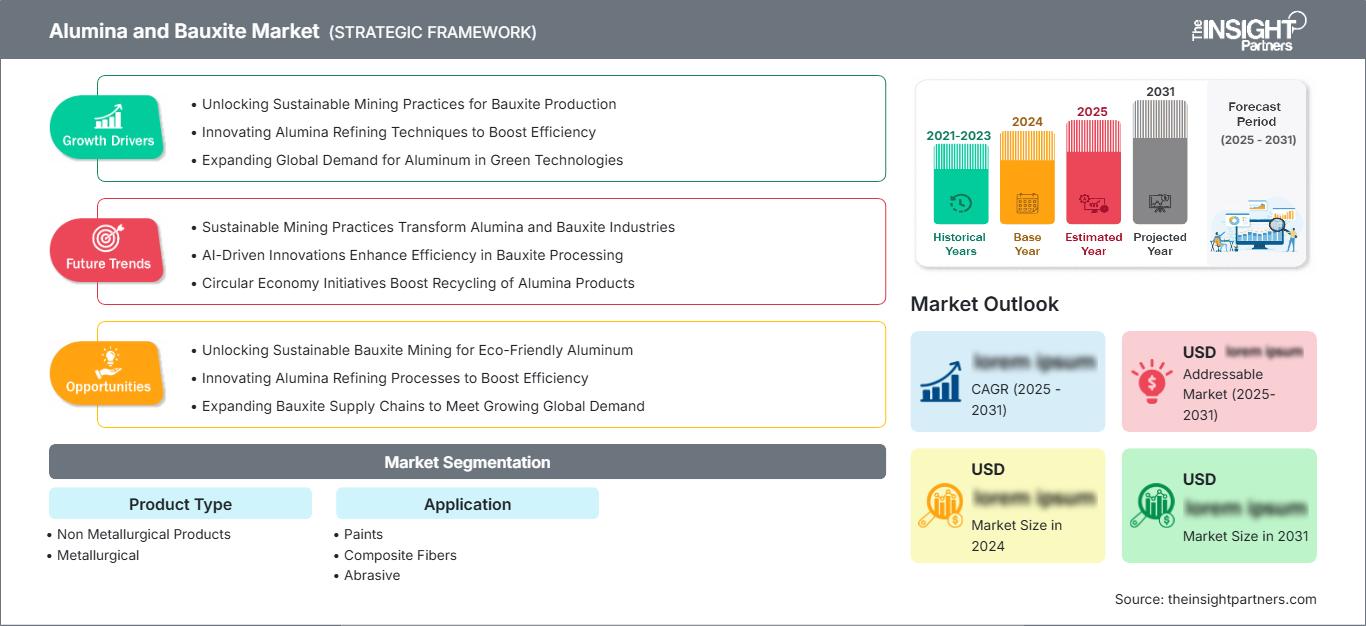
Alumina and Bauxite Market: Strategic Insights
Regional Insights
North America Alumina and Bauxite Market
North America made up 18–22% of the global market in 2025 and is expected to grow at a CAGR of 6.8–7.4% from 2026 to 2034. Some of the drivers of regional demand include aluminum extraction, aerospace manufacturing, automobiles, packaging, and defense. The US and Canada will keep investing in robust critical minerals supply chains, refining facilities, and recycling facilities to lessen their reliance on raw material imports.
There are more investments being made in the production of low-carbon aluminum and renewables as an input source in refining operations in the region. Initiatives aimed at ensuring mineral security in the country, coupled with the modernization of infrastructure and production of electric vehicles, will keep boosting the demand for metallurgical alumina. There will also be higher consumption of specialty non-metallurgical alumina.
U.S. Alumina and Bauxite Market
Approximately 72-76% of the North American market was constituted by the US in 2025, while the CAGR during 2026-2034 will be at 6.9-7.5%. The principal driving factor is the need for lightweight aluminum materials from transportation, aerospace, construction, defense, and packaging industries. Government programs that promote investment into critical mineral supply chains and resilient manufacturing processes boost demand from the downstream and recycling plants.
Continuing growth in the number of electric vehicles manufactured, development of renewable energy sources, and infrastructure renewal contribute to long-term demand for alumina. Producers pay more and more attention to recycled aluminum, digital manufacturing processes, and energy efficiency to increase their competitiveness. Increasing investment in advanced ceramics, catalysts, and specialty alumina usage diversifies demand and secures the country's key position on the regional market.
Europe Alumina and Bauxite Market
In 2025, Europe accounted for 20-24% of the worldwide market and will register a CAGR of 6.3-6.9% during 2026-2034. Sustainability policies, circular economy programs, and rising demand for lightweight materials are expected to fuel investments across the aluminum value chain. Germany is the key regional market owing to its robust automotive, engineering, and manufacturing industries.
While the UK is focused on secure supply chains of critical minerals along with recycling and low-carbon industrial manufacturing to boost local capabilities of aluminum processing, Germany is investing in energy-efficient production and manufacturing technologies, while France, Italy, and Spain have rising demand in transport, aerospace, packaging, and construction segments. The regional producers are adopting renewable energy solutions to minimize carbon emissions from alumina refining and aluminum production.
APAC Alumina and Bauxite Market
The share of Asia Pacific region in global markets was 44-48% in 2025 and this region is expected to grow at a CAGR of 8.8-9.4%, which makes Asia Pacific the fastest growing region in the world. China leads consumption and production of alumina in the region, whereas India and Australia continue their status of major bauxite producers. Japan and South Korea have a contribution through their downstream aluminum and specialty alumina manufacturing. Industrialization, infrastructure development, electric vehicles production, renewable energy projects, and governmental encouragement for domestic mineral processing are some key factors for the growth of the region.
Middle East & Africa Alumina and Bauxite Market
The Middle East & Africa market is expected to record a CAGR of 7.2–7.8% during the forecast period. Saudi Arabia and the UAE continue expanding integrated aluminum production supported by competitive energy resources, while Guinea remains one of the world's largest bauxite suppliers. South Africa contributes through industrial minerals processing and downstream manufacturing activities.
Increasing investments in mining infrastructure, export logistics, and value-added mineral processing are strengthening regional competitiveness. Government policies encouraging mineral beneficiation and foreign investment are expected to support additional alumina refining capacity, while growing industrial development creates new opportunities for non-metallurgical alumina applications across water treatment, catalysts, and specialty chemicals.
Segmentation Analysis
Product Type
The Product Type segment is projected to expand at a CAGR of 7.8–8.3% during 2026–2034. The alumina and bauxite market scope continues to broaden as demand increases across aluminum production, refractories, abrasives, specialty ceramics, catalysts, and environmental applications. While metallurgical-grade products account for the majority of global consumption due to primary aluminum manufacturing, non-metallurgical grades are witnessing faster adoption in high-value industrial applications owing to their superior purity, chemical stability, and functional performance.
- Non Metallurgical Products: High-purity alumina and specialty bauxite products are increasingly utilized in refractories, abrasives, catalysts, ceramics, filtration media, and advanced battery materials. Growing investments in electronics, renewable energy, and specialty chemicals continue to strengthen demand for premium-grade products.
- Metallurgical: Metallurgical-grade bauxite remains the dominant product category, serving as the primary raw material for alumina refining through the Bayer process and subsequent aluminum smelting. Demand is supported by expanding transportation, construction, packaging, and electrical industries, particularly across Asia Pacific and the Middle East.
Application
The Application segment is anticipated to register a CAGR of 8.0–8.5% during 2026–2034. Demand patterns continue to diversify beyond conventional aluminum production as specialty alumina grades gain acceptance across industrial processing, environmental treatment, and advanced manufacturing. Expanding investments in infrastructure, renewable energy, automotive lightweighting, and high-performance materials are supporting sustained consumption across multiple downstream applications, improving market resilience against fluctuations in any single end-use industry.
- Paints: Calcined alumina and specialty bauxite improve durability, corrosion resistance, abrasion performance, and surface finish in industrial coatings, marine paints, and protective coatings used across infrastructure, transportation, and manufacturing sectors.
- Composite Fibers: High-purity alumina supports advanced composite materials requiring superior thermal stability, lightweight characteristics, and mechanical strength for aerospace, automotive, defense, and industrial engineering applications.
- Abrasive: Alumina remains one of the world's most widely used abrasive materials because of its exceptional hardness, wear resistance, and durability, supporting grinding wheels, polishing products, coated abrasives, and precision machining applications.
- Industrial Catalyst: Activated alumina serves as an effective catalyst carrier and adsorbent in petrochemical processing, refining operations, chemical manufacturing, and environmental emission control owing to its high surface area and thermal stability.
- Purification Agent: Activated alumina is extensively deployed for fluoride removal, gas drying, wastewater treatment, hydrogen peroxide production, and industrial air purification systems, driven by tightening environmental regulations and growing investments in water treatment infrastructure.
- Proppant: Calcined bauxite-based ceramic proppants are utilized in hydraulic fracturing operations because of their superior crush strength, conductivity, and durability under high-pressure reservoir conditions, particularly in unconventional oil and gas extraction projects.
Opportunity Snapshot
| Application | Revenue Contribution | Trend Tag | Adoption Stage |
|---|---|---|---|
| Paints | Medium | Protective Coatings | Mature |
| Composite Fibers | Medium | Lightweight Materials | Scaling |
| Abrasive | High | Precision Grinding | Mature |
| Industrial Catalyst | Medium | Clean Refining | Scaling |
| Purification Agent | High | Water Treatment | Scaling |
| Proppant | Medium | Unconventional Drilling | Mature |
Alumina and Bauxite Market Growth Drivers and Impact Analysis
Growing Aluminum Demand from Transportation and Infrastructure
The expansion of transportation, construction, renewable energy, and power transmission infrastructure continues to strengthen global demand for alumina and bauxite. Governments are investing heavily in urban development, rail networks, airports, renewable power installations, and electric vehicle charging infrastructure, all of which require lightweight and corrosion-resistant aluminum products. Aluminum manufacturers are therefore increasing alumina refining capacities and securing long-term bauxite supply agreements to support future production. Developing economies across Asia Pacific, the Middle East, and Africa are witnessing substantial investments in new smelters and downstream fabrication facilities. At the same time, automotive manufacturers continue replacing conventional steel with aluminum to reduce vehicle weight and improve fuel efficiency, creating sustained upstream demand for metallurgical-grade alumina and high-quality bauxite resources.
Expansion of High-Purity Alumina Applications
Demand for specialty alumina grades is rising steadily as industries adopt advanced ceramic materials, lithium-ion batteries, semiconductor substrates, LEDs, catalyst supports, and electronic components requiring extremely high purity. High-purity alumina offers excellent thermal conductivity, electrical insulation, chemical resistance, and mechanical stability, making it suitable for technologically demanding applications. Battery manufacturers are increasingly incorporating alumina-coated separators to improve battery safety and lifecycle performance, while semiconductor investments worldwide are generating additional consumption of specialty alumina products. These evolving applications enable producers to diversify beyond traditional aluminum manufacturing and capture higher-value specialty markets with stronger profit margins and comparatively lower exposure to fluctuations in commodity aluminum pricing.
Environmental Regulations Supporting Activated Alumina Consumption
Governments worldwide are strengthening environmental regulations governing industrial emissions, wastewater discharge, drinking water quality, and hazardous gas treatment. Activated alumina has become an important adsorption medium for fluoride removal, gas dehydration, arsenic treatment, hydrogen peroxide production, and industrial purification processes because of its high adsorption capacity and chemical stability. Growing investments in municipal water infrastructure, industrial wastewater treatment facilities, natural gas processing plants, and petrochemical operations continue to expand consumption across developed and emerging economies. Increasing industrial emphasis on sustainable production, water recycling, and emission reduction further supports long-term adoption of activated alumina, creating stable demand beyond conventional metallurgical applications while reducing dependence on cyclical aluminum industry investments.
Alumina and Bauxite Market Future Trends
Increasing Integration of Low-Carbon Alumina Production Technologies
Sustainability is becoming a defining competitive factor across the alumina and bauxite value chain as producers invest in low-carbon refining technologies, renewable energy integration, residue valorization, and energy-efficient Bayer process improvements. Companies are adopting digital process optimization, electrification, waste heat recovery, and carbon capture initiatives to reduce greenhouse gas emissions while improving production efficiency. The alumina and bauxite market trends increasingly reflect customer preference for responsibly sourced raw materials, particularly among automotive, construction, and packaging manufacturers pursuing decarbonization goals. Environmental certifications, traceable supply chains, and circular economy initiatives are expected to influence procurement decisions, encouraging producers to differentiate through sustainability performance rather than production capacity alone.
Digital Mining and Smart Refinery Operations Transform Production Efficiency
Mining companies and alumina refiners are accelerating investments in automation, artificial intelligence, digital twins, predictive maintenance, autonomous equipment, and advanced analytics to improve operational performance. Smart mining technologies enable better ore characterization, optimized extraction planning, reduced equipment downtime, and enhanced worker safety. Digital refinery solutions improve energy management, process control, inventory optimization, and product quality consistency while lowering production costs. As operational efficiency becomes increasingly important amid fluctuating commodity prices and tightening environmental regulations, digital transformation is expected to become a standard competitive strategy across major alumina and bauxite producers worldwide.
Alumina and Bauxite Market Opportunities
Expansion of High-Purity Alumina Manufacturing for Battery Materials
Growing investments in electric vehicles, energy storage systems, semiconductor manufacturing, and advanced electronics are creating significant opportunities for producers to expand high-purity alumina capacity. High-purity alumina is increasingly used in battery separators, LED substrates, sapphire glass, and semiconductor applications requiring exceptional purity and thermal stability. Alumina and bauxite market Forecasts indicate that specialty alumina production will continue attracting strategic investments because it offers higher margins than conventional metallurgical products while reducing dependence on cyclical aluminum markets. Companies capable of integrating advanced purification technologies, securing premium bauxite feedstock, and establishing long-term supply agreements with battery manufacturers are expected to strengthen their competitive positioning over the forecast period.
Development of Emerging Bauxite Resources Outside Traditional Producing Regions
Governments and mining companies are actively exploring new bauxite reserves across Africa, South America, Southeast Asia, and selected Middle Eastern countries to diversify global raw material supply. Increasing geopolitical uncertainty, export restrictions, and supply chain disruptions have encouraged aluminum producers to reduce dependence on a limited number of mining jurisdictions. Investments in integrated mining, refining, transportation infrastructure, and port facilities are expected to improve supply security while supporting regional industrial development. Companies that establish early partnerships with resource-rich countries, invest in sustainable mining practices, and develop localized refining capabilities will be better positioned to meet growing global demand while strengthening long-term supply chain resilience.
Recent Developments
- July 22, 2026: Rio Tinto plc signed a five-year offtake agreement with Australian bioenergy company SuperChar to supply locally produced bio pellets for its Gladstone alumina refineries in Queensland. The agreement supports Rio Tinto's decarbonization strategy by replacing a portion of coal used in refinery boilers with bio pellet blends ranging from 5% to 50%. Deliveries are expected to commence in 2028, following operational demonstrations and regulatory approvals, helping reduce emissions from one of the most energy-intensive stages of alumina production.
- June 30, 2026: Alcoa Corporation announced the acquisition of South32 Limited's bauxite, alumina, and aluminum assets for an upfront consideration of US$4.1 billion, strengthening its global upstream portfolio across Australia, Brazil, and South Africa. The transaction significantly expands Alcoa's integrated bauxite and alumina production capacity while enhancing long-term supply chain resilience and operational synergies.
Frequently Asked Questions

- Comprehensive Market Sizing and Forecast Analysis
- Detailed Segmentation Analysis
- In-Depth Market Dynamics Assessment
- Regional and Country-Level Insights
- Competitive Landscape and Company Benchmarking
- Strategic Business Intelligence
Recent Reports
Testimonials

The Insight Partners' SCADA System Market report is comprehensive, with valuable insights on current trends and future forecasts. The team was highly professional, responsive, and supportive throughout. We are very satisfied and highly recommend their services.
RAN KEDEM Partner, Reali Technologies LTDs
I requested a report on a very specific software market and the team produced the report in a few days. The information was very relevant and well presented. I then requested some changes and additions to the report. The team was again very responsive and I got the final report in less than a week.
JEAN-HERVE JENN Chairman, Future Analytica
We worked with The Insight Partners for an important market study and forecast. They gave us clear insights into opportunities and risks, which helped shape our plans. Their research was easy to use and based on solid data. It helped us make smart, confident decisions. We highly recommend them.
PIYUSH NAGPAL Sr. Vice President, High Beam Global
The Insight Partners delivered insightful, well-structured market research with strong domain expertise. Their team was professional and responsive throughout. The user-friendly website made accessing industry reports seamless. We highly recommend them for reliable, high-quality research services
YUKIHIKO ADACHI CEO, Deep Blue, LLC.
This is the first time I have purchased a market report from The Insight Partners.While I was unsure at first, I visited their web site and felt more comfortable to take the risk and purchase a market report.I am completely satisfied with the quality of the report and customer service. I had several questions and comments with the initial report, but after a couple of dialogs over email with their analyst I believe I have a report that I can use as input to our strategic planning process.Thank you so much for taking the extra time and making this a positive experience.I will definitely recommend your service to others and you will be my first call when we need further market data.
JOHN SUZUKI President and Chief Executive Officer, Board Director, BK Technologies
I wish to appreciate your support and the professionalism you displayed in the course of attending to my request for information regarding to infectious disease IVD market in Nigeria. I appreciate your patience, your guidance, and the fact that you were willing to offer a discount, which eventually made it possible for us to close a deal. I look forward to engaging The Insight Partners in the future, all thanks to the impression you have created in me as a result of this first encounter.
DR CHIJIOKE ONYIA MANAGING DIRECTOR, PineCrest Healthcare Ltd.Reason to Buy
- Informed Decision-Making
- Understanding Market Dynamics
- Competitive Analysis
- Identifying Emerging Markets
- Customer Insights
- Market Forecasts
- Risk Mitigation
- Boosting Operational Efficiency
- Strategic Planning
- Investment Justification
- Tracking Industry Innovations
- Aligning with Regulatory Trends





 Get Free Sample for