
Amicrobial Enrichment Broth Market Growth, Size & Forecast by 2034
Coverage: by Type (Bacterial, Fungal Microbials, Composite Microbials, Others); End-User (Cereals and Grains, Oilseeds and Pulses, Fruits and Vegetables, Others) , and Geography (North America, Europe, Asia Pacific, and South and Central America)
- Status : Data Released
- Report Code : TIPRE00011043
- Category : Food and Beverages
- No. of Pages : 150
- Available Report Formats :


- Last update date : August 19, 2026


2025 Market Size
US$ 167.23 Mn
Base year value
2034 Forecast
US$ 251.74 Mn
Projected by 2034
CAGR 2026-2034
4.65 %
Growth rate
Addressable Market
US$ 1,902.13 Mn
(2026-2034)
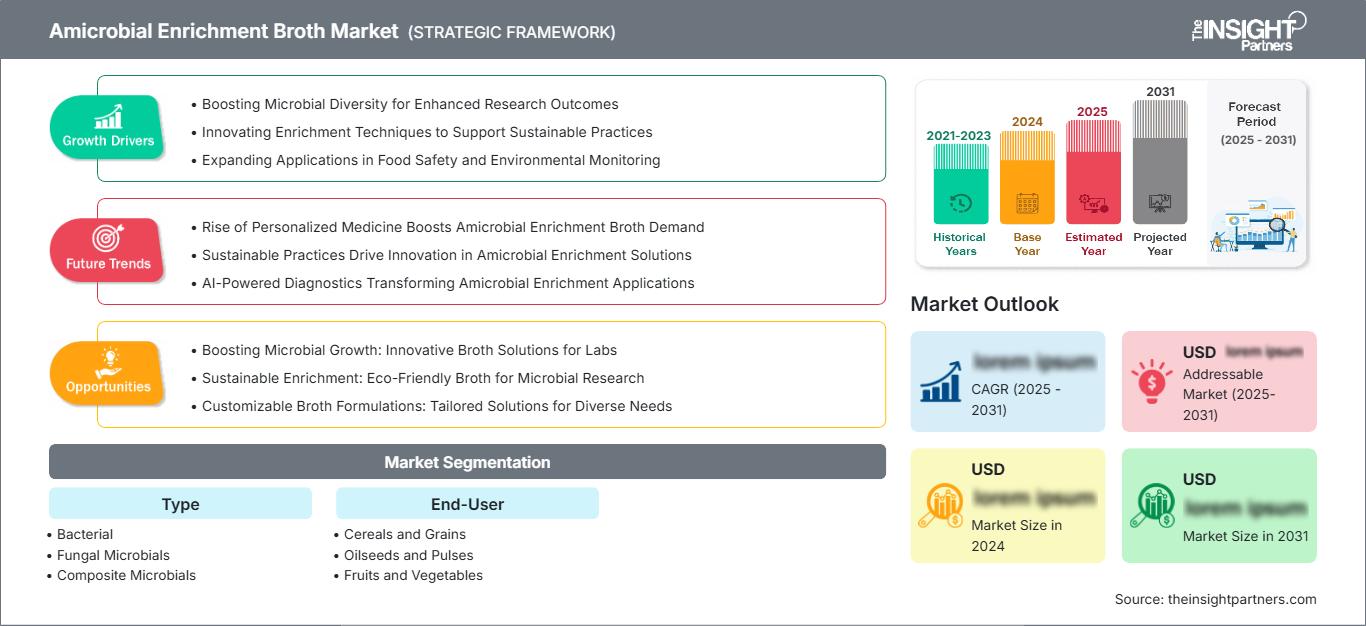
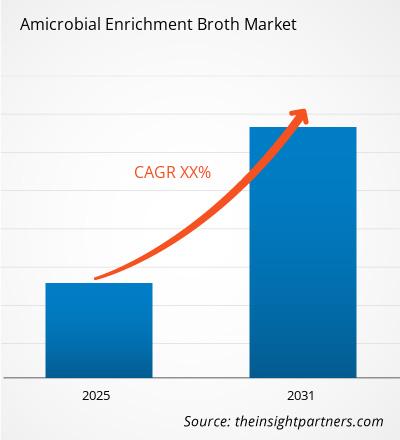
The global Amicrobial Enrichment Broth market was valued at US$ 167.23 million in 2025 and is expected to reach US$ 251.74 million by 2034; it is estimated to record a CAGR of 4.65% during 2026-2034.
Amicrobial Enrichment Broth Market Assessment and Insights
- North America: The region accounted for an estimated 34%–38% share in 2025 and is growing at a CAGR range of 4.8%–5.4% during 2026–2034, led by biological input commercialization and controlled microbial production.
- US: The US represented an estimated 72%–76% of North America in 2025 and is advancing at a CAGR range of 4.9%–5.5%, supported by seed treatment and fermentation innovation.
- Europe: Europe held an estimated 27%–31% share in 2025 and is growing at 4.6%–5.2%, with Germany, France, the Netherlands, Italy, and Spain leading adoption.
- Asia Pacific: Asia Pacific captured an estimated 23%–27% share in 2025 and is expanding at 5.8%–6.4%, led by China, India, Japan, Australia, and South Korea.
- Largest Segment: Bacterial products held an estimated 49%–53% market share in 2025 and are growing at 5.0%–5.6% due to broad use in nutrient cycling and crop productivity applications.
- High Growth Segment: Composite microbials held an estimated 19%–23% share in 2025 and are growing at 6.0%–6.6%, supported by multi-strain formulations and integrated biological crop programs.
- Key companies analyzed in detail: Arysta LifeScience Corporation, BASF SE, Bayer CropScience Limited, Certis USA L.L.C., Gujarat State Fertilizers and Chemicals Ltd., Koppert B.V., Novonesis A/S, Sumitomo Chemical Co., Ltd., Syngenta Group, and The Dow Chemical Company.
Source: The Insight Partners' analysis based on proprietary research, government publications, company annual reports, investor presentations, industry databases, and expert interviews.
Growth in antimicrobial enrichment broth production is shifting from mere microbial replication towards formulation-based on application-specific uses. Suppliers have started optimizing their broth composition based on factors like viability, stability, and suitability for bacterial, fungal, and mixed microbial strains. The change facilitates agriculture biologicals because it helps achieve consistency in fermentation and culture recovery, which are vital in producing biofertilizers, biostimulants, and biocontrol agents used in soil and crop systems.
There is a strong likelihood that forward movement will be observed from the emerging agricultural economies in which farmers are cutting down on their dependence on chemicals but looking for increases in efficiency in spite of stresses in the soil as well as in the weather conditions. Investments made in microbial strain banks, liquid fermentations and quality control media will boost the demand for these items. The involvement of the regulators for the promotion of biological inputs and organic agriculture will further increase the importance of enrichment broths.
Amicrobial Enrichment Broth Market Report Scope
| Report Attribute | Details |
|---|---|
| Market size in 2025 | US$ 167.23 Million |
| Market Size by 2034 | US$ 251.74 Million |
| Global CAGR (2026 - 2034) | 4.65% |
| Historical Data | 2021-2024 |
| Forecast period | 2026-2034 |
Amicrobial Enrichment Broth Market Analysis
Demand for such solutions is linked to the overall trend towards microbial inputs in agriculture, in which biologicals are employed for enhanced nutrient acquisition, root development, and stress resistance. In this process, the production value chain includes strain selection and medium development, followed by fermentation, formulation, field testing, and distribution. Quality of the broth directly impacts the ability to deliver desired concentrations of microorganisms, avoid contamination, and ensure consistent performance during mass production. The increased popularity of sustainable agricultural systems leads to greater demand for enrichment media capable of providing high microbial survival and consistent quality of products for different agricultural purposes.
Supply dynamics are shaped by input standardization, sterile processing, and cold-chain or shelf-life requirements. The amicrobial enrichment broth market analysis indicates that producers with strong microbiology capabilities can support both research laboratories and industrial biological manufacturers. As biological programs specific to the crops increase in number, the need for customized nutrients in broths will increase to suit cereals, pulses, vegetables, and specialty crops. There is also an increased need for formulations that will enable strain performance in different environments and cultivation situations, thus improving the performance and scalability of biological product development.
Competitive positioning will be dictated by knowledge of fermentation, strain libraries, and the availability of distribution networks in agriculture. Biological portfolios in companies include BASF SE, Bayer CropScience Limited, Syngenta Group, Koppert B.V., and Novonesis A/S. Companies such as Certis USA L.L.C. and Gujarat State Fertilizers and Chemicals Ltd. cater to specialized or regional needs. The competition in this industry is characterized by formulation reliability, farmer acceptability, and agronomic proof points. Collaborations, research and innovation are being employed strategically to boost market position and biological agriculture products.
According to the Amicrobial Enrichment Broth Market Report, investment trends favor scalable microbial production, quality assurance, and partnerships between agriscience firms and fermentation specialists. This market is not limited to broth volumes but also involves issues related to reproducibility, compatibility, and cost-effectiveness. It is clear that companies that have developed their media formulation along with biological formulation can provide better services in the area of seed treatment, soil inoculation, and nutrient applications to crops. Future developments in fermentation technologies and microbial formulations will open up new opportunities.
● REPORT CUSTOMIZATION
Tailor This Report To Align With Your Specific Business Requirements
This report can be customized to align precisely with your business objectives, scope, and target markets. Customization options include tailored segmentation, geography, competitive analysis, and strategic insights to support informed decision-making.
Customize This Report →WHAT YOU CAN ADJUST
- ● Segmentations
- ● Geography
- ● Competitive Analysis
- ● Language Preferences
Amicrobial Enrichment Broth Market: Strategic Insights
Regional Insights
North America amicrobial enrichment broth market
North America held an estimated 34%–38% amicrobial enrichment broth market share in 2025 and is projected to grow at a CAGR range of 4.8%–5.4%. Demand is supported by biological crop input adoption, mature agronomy services, and strong quality-control practices across microbial formulation supply chains.
The region benefits from large row-crop acreage, seed treatment penetration, and investments in fermentation capacity. Producers prioritize consistent microbial recovery, sterile handling, and validated media performance, making enrichment broths important for commercial biologicals and research-grade microbial applications.
U.S. amicrobial enrichment broth Market
The US accounted for an estimated 72%–76% of North America in 2025 and is growing at a CAGR range of 4.9%–5.5%. Demand reflects strong seed, crop protection, and biological input ecosystems supported by advanced testing infrastructure.
Company presence is concentrated around agriscience R&D, microbial fermentation, and commercial formulation networks. Application trends include seed-applied bacteria, soil inoculants, and microbial consortia designed to improve nutrient cycling and crop resilience.
Europe amicrobial enrichment broth Market
Europe represented an estimated 27%–31% share in 2025 and is expanding at a CAGR range of 4.6%–5.2%. Germany and France lead through agronomic research, biological crop input registration, and farmer interest in reducing synthetic inputs.
The UK shows demand from research laboratories and controlled-environment agriculture, while Italy and Spain support uptake through fruit, vegetable, and specialty crop production. The Netherlands remains influential through greenhouse horticulture and microbial formulation expertise.
APAC amicrobial enrichment broth Market
APAC held an estimated 23%–27% share in 2025 and is advancing at a CAGR range of 5.8%–6.4%. China and India lead volume potential because of large cropped areas, soil health programs, and demand for cost-effective biological inputs.
Japan, South Korea, and Australia contribute through high-quality agronomic testing, controlled fermentation standards, and specialty crop systems. Policy support for sustainable agriculture is expected to strengthen adoption.
Middle East & Africa amicrobial enrichment broth Market
The Middle East & Africa is projected to grow at a CAGR range of 4.3%–4.9%, led by South Africa, Saudi Arabia, and the UAE. Adoption is linked to controlled farming, soil restoration, and crop productivity under water-stressed conditions.
Demand remains smaller than in other regions, but infrastructure investment, greenhouse expansion, and residue-management needs create opportunities for microbial crop solutions and related enrichment media.
Segmentation Analysis
Type
The type segment is led by bacterial broths, with a CAGR range of 5.0%–5.6% during 2026–2034. The market scope includes bacterial, fungal, microbial, and composite microbial formulations. Adoption depends on compatibility with target strains, contamination control, and the ability to support stable microbial growth for agricultural biologicals.
- Bacterial: Bacterial broths are widely used for nitrogen fixation, phosphate solubilization, and plant growth-promoting strains, making them central to commercial biofertilizer and seed treatment production.
- Fungal Microbials: Fungal microbial broths support mycorrhizal, trichoderma, and related cultures where root interaction, disease suppression, and soil structure benefits influence specialized crop programs.
- Composite Microbials: Composite microbial broths support multi-strain solutions that combine bacteria and fungi, enabling broader functional claims and higher strategic relevance in integrated biological systems.
End-User
The end-user segment is expected to grow at a CAGR range of 5.1%–5.7% during 2026–2034. Cereals and grains remain the largest application area, while fruits and vegetables show stronger specialty-crop adoption. Demand is shaped by crop value, biological input acceptance, residue concerns, and the need for microbial solutions that improve nutrient efficiency.
- Cereals and Grains: This segment benefits from broad acreage, seed treatment penetration, and farmer interest in microbial products that improve nutrient uptake across wheat, corn, rice, and similar crops.
- Oilseeds and Pulses: Demand is linked to rhizobia, nutrient mobilization, and soil health programs, especially where growers seek biological support for nitrogen efficiency and crop resilience.
- Fruits and Vegetables: Higher crop value encourages adoption of microbial enrichment systems for quality, root health, and stress tolerance, particularly in greenhouse and intensive farming environments.
Opportunity Snapshot
| End-User | Revenue Contribution | Trend Tag | Adoption Stage |
| Cereals and Grains | High | Seed Treatment | Mature |
| Oilseeds and Pulses | Medium | Nitrogen Efficiency | Scaling |
| Fruits and Vegetables | Medium | Root Health | Scaling |
Amicrobial Enrichment Broth Market Growth Drivers and Impact Analysis
Rising Shift Toward Biological Crop Inputs
Biological inputs used by farmers and agribusiness companies are becoming popular since they aim at decreasing dependence on chemical inputs and enhancing the health of soils. The direct link between these developments and the market is that microbial products must have proper culture media before their production. These include enrichment broths that enhance the viability of strains, reduce contamination risks, and ensure reproducibility of results from fermentation. Besides, there is an increased interest in sustainable and regenerative agricultural practices that drive investments in microbiology. With increased volumes of production, enrichment broths become critical to the success of biological manufacturing.
Need for Consistent Fermentation and Quality Control
Successful commercial microbial products require batch uniformity, viable counts of cells, and stability during storage and field applications. Enrichment broths serve a very practical purpose in ensuring the performance of cultures from laboratory trials to pilot and full-scale production. Biologicals in crops require reliable providers that will be able to provide proven media for bacterial, fungal, and multiple microbial systems. Commercial success of microbial products leads to increased demands for their reliability and compliance with regulations. Therefore, the demand for good-quality enrichment broths is constantly growing.
Expansion of Specialty and High-Value Crop Applications
The cultivation of fruits and vegetables, protected agriculture, and specialty crops have emerged as sources of demand for microbial-based inputs for enhancing root development, nutrient absorption, and stress resistance. This type of crop is worth investing more in terms of inputs because of the advantages in either quality or yield provided by biological inputs. Media companies could take advantage of this by designing specific media for certain crops.
Amicrobial Enrichment Broth Market Future Trends
Customized Media for Multi-Strain Consortia
Amicrobial enrichment broth market trends increasingly point toward composite microbial formulations that combine bacterial and fungal functions. Future product development will require media that can maintain compatibility across strains without suppressing target organisms. This creates demand for customized nutrient systems, improved buffering, and selective formulations that support multi-strain viability from production to application. Suppliers that build media around specific crop outcomes will have stronger differentiation.
Integration with Digital Quality Monitoring
Fruits, vegetables, protected cultivation, and high-value crops are contributing to the creation of a need for biological products that will enhance root health, nutrition absorption, and stress resistance. Premium crops are those where the use of costly inputs is justified if biologicals add value to the produce. Manufacturers of enrichment broths have a great opportunity to develop their products specifically for different types of microbial consortia according to the needs of the growers who want predictability from their intensive growing systems. The cultivation of premium crops and the development of precision agriculture practices are also adding to the demand.
Amicrobial Enrichment Broth Market Opportunities
Scaling Regional Biological Manufacturing
Amicrobial enrichment broth market Forecasts indicate opportunity in regional manufacturing hubs that serve local crop systems and regulatory requirements. Producers can develop cost-effective media for domestic fermentation facilities in the Asia Pacific, Latin America, and the Middle East. Localized production reduces logistics complexity, improves responsiveness to seasonal demand, and supports customized biological inputs for cereals, pulses, horticulture, and protected cultivation.
Supplying Research-to-Commercial Transition Programs
A key opportunity lies in serving companies and institutes moving microbial strains from discovery into field-ready products. These programs require media that perform consistently at small research scale and larger fermentation scale. Broth suppliers can offer validation support, application-specific formulations, and technical documentation. This creates recurring demand from biological startups, agriscience firms, universities, and contract manufacturers developing new microbial crop solutions.
Frequently Asked Questions

- Comprehensive Market Sizing and Forecast Analysis
- Detailed Segmentation Analysis
- In-Depth Market Dynamics Assessment
- Regional and Country-Level Insights
- Competitive Landscape and Company Benchmarking
- Strategic Business Intelligence
Recent Reports
Testimonials

The Insight Partners provided valuable market intelligence that supported our global go-to-market strategy. Their team was professional, responsive, and attentive to our feedback, providing thoughtful analysis and helpful methodological clarifications throughout the project.
Junmo Kim Chief Financial Officer (CFO), Enertech Co., Ltd.
The Insight Partners' SCADA System Market report is comprehensive, with valuable insights on current trends and future forecasts. The team was highly professional, responsive, and supportive throughout. We are very satisfied and highly recommend their services.
RAN KEDEM Partner, Reali Technologies LTDs
I requested a report on a very specific software market and the team produced the report in a few days. The information was very relevant and well presented. I then requested some changes and additions to the report. The team was again very responsive and I got the final report in less than a week.
JEAN-HERVE JENN Chairman, Future Analytica
We worked with The Insight Partners for an important market study and forecast. They gave us clear insights into opportunities and risks, which helped shape our plans. Their research was easy to use and based on solid data. It helped us make smart, confident decisions. We highly recommend them.
PIYUSH NAGPAL Sr. Vice President, High Beam Global
The Insight Partners delivered insightful, well-structured market research with strong domain expertise. Their team was professional and responsive throughout. The user-friendly website made accessing industry reports seamless. We highly recommend them for reliable, high-quality research services
YUKIHIKO ADACHI CEO, Deep Blue, LLC.
This is the first time I have purchased a market report from The Insight Partners.While I was unsure at first, I visited their web site and felt more comfortable to take the risk and purchase a market report.I am completely satisfied with the quality of the report and customer service. I had several questions and comments with the initial report, but after a couple of dialogs over email with their analyst I believe I have a report that I can use as input to our strategic planning process.Thank you so much for taking the extra time and making this a positive experience.I will definitely recommend your service to others and you will be my first call when we need further market data.
JOHN SUZUKI President and Chief Executive Officer, Board Director, BK Technologies
I wish to appreciate your support and the professionalism you displayed in the course of attending to my request for information regarding to infectious disease IVD market in Nigeria. I appreciate your patience, your guidance, and the fact that you were willing to offer a discount, which eventually made it possible for us to close a deal. I look forward to engaging The Insight Partners in the future, all thanks to the impression you have created in me as a result of this first encounter.
DR CHIJIOKE ONYIA MANAGING DIRECTOR, PineCrest Healthcare Ltd.Reason to Buy
- Informed Decision-Making
- Understanding Market Dynamics
- Competitive Analysis
- Identifying Emerging Markets
- Customer Insights
- Market Forecasts
- Risk Mitigation
- Boosting Operational Efficiency
- Strategic Planning
- Investment Justification
- Tracking Industry Innovations
- Aligning with Regulatory Trends





 Get Free Sample for