
Amniotic Hooks Market Growth, Trends & Demand by 2034
Coverage: by Product Type (Curved Amniotic Hooks and Straight Amniotic Hooks); End User (Diagnostics Laboratories, Gynecology Clinics, and Hospitals) , and Geography (North America, Europe, Asia Pacific, and South and Central America)
- Status : Data Released
- Report Code : TIPRE00008196
- Category : Life Sciences
- No. of Pages : 150
- Available Report Formats :


- Last update date : July 22, 2026


2025 Market Size
US$ 171.6 Mn
Base year value
2034 Forecast
US$ 443.25 Mn
Projected by 2034
CAGR 2026-2034
11.12 %
Growth rate
Addressable Market
US$ 2,714.53 Mn
(2026-2034)
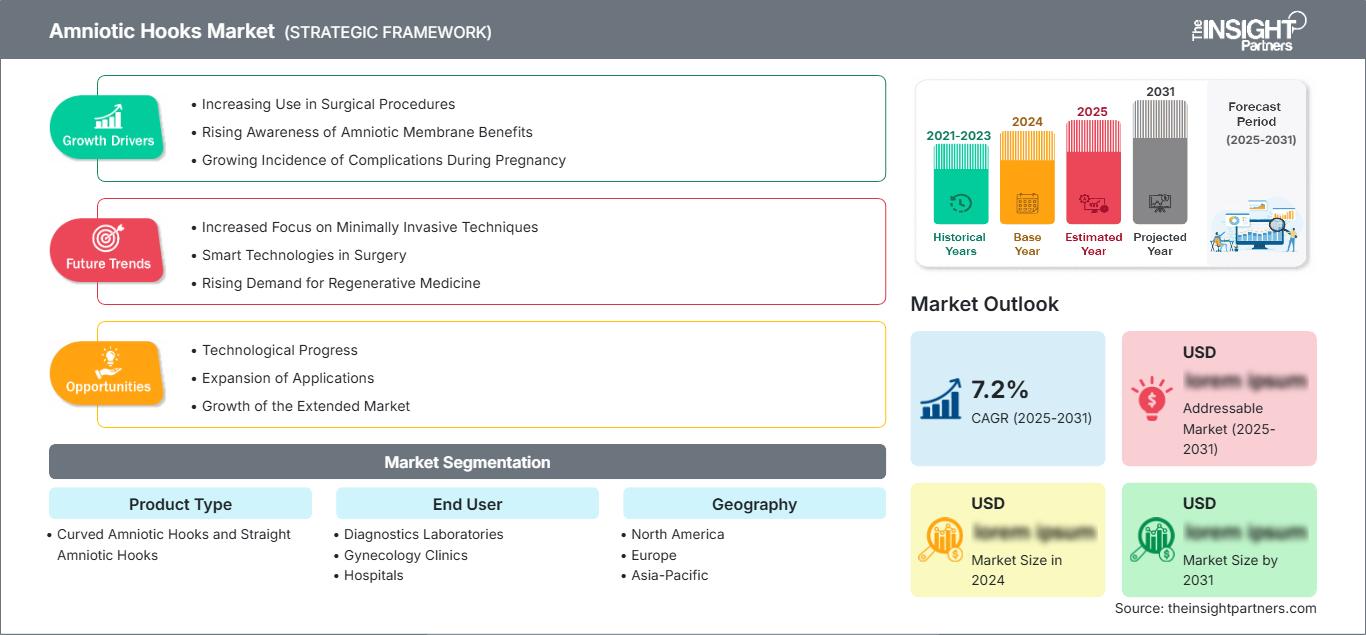
The Amniotic Hooks Market was valued at US$ 171.6 Million in 2025 and is projected to reach US$ 443.25 Million by 2034, growing at a CAGR of 11.12% from 2026 to 2034. The market reflects steady demand for sterile obstetric instruments used in artificial rupture of membranes during labor management, supported by procedure standardization, single-use product preference, and maternity care capacity expansion across hospitals and gynecology clinics.
Across North America, the Amniotic Hooks Market size is supported by mature hospital procurement systems, high institutional delivery rates, and consistent use of disposable labor-and-delivery instruments. The region is estimated to grow at a CAGR of 10.6–11.2% from 2026 to 2034, driven by infection-control purchasing, obstetric protocol compliance, and strong supplier access through group purchasing organizations and clinical distributors.
Amniotic Hooks Market Assessment and Insights
- North America held a 38–41% share in 2025 and is projected to grow at a CAGR of 10.6–11.2% between 2026–2034, supported by hospital-led childbirth care, disposable device preference, and established obstetric supply chains.
- US accounted for 80–84% of North America in 2025 and is expected to grow at a CAGR of 10.4–11.0% between 2026–2034, reflecting high procedure volumes and strong labor ward standardization.
- Europe represented a 24–27% share in 2025 and is projected to grow at a CAGR of 9.3–9.9% between 2026–2034, led by Germany, the UK, France, Italy, and Spain through regulated procurement.
- Asia Pacific captured a 22–25% share in 2025 and is forecast to grow at a CAGR of 12.4–13.1% between 2026–2034, led by China, India, Japan, South Korea, and Australia.
- Largest Segment Curved Amniotic Hooks held a 61–64% market share in 2025 and is expected to grow at a CAGR of 10.8–11.4% between 2026–2034 due to procedural ergonomics.
- High Growth Segment Hospitals held a 48–52% market share in 2025 and are projected to grow at a CAGR of 11.6–12.3% between 2026–2034 as institutional childbirth care expands.
- Key companies analyzed in detail: Boen Healthcare Co., Ltd., CooperSurgical, Inc., DynaMed, Foresight, Go Medical Industries Pty Ltd, Hospitech Manufacturing Services Sdn. Bhd., Insight Medical Products Ltd., Jiangsu Rongye Technology Co., Ltd., Rocket Medical plc, STERIL Medical, Aspen Surgical Products, Inc., and Medline Industries, LP.
Source: The Insight Partners' analysis based on proprietary research, government publications, company annual reports, investor presentations, industry databases, and expert interviews.
The clinical usage of artificial membrane rupture has evolved from the usage of metal tools to disposable plastic instruments, which are compatible with labor room infection control policies. Suppliers are designing products with round tips, covered hooks, single peel packs, and packaging suitable for high-volume maternity hospitals. Production economics continue to depend on polymer supply chain, sterilization via ethylene oxide or radiation, and private label distribution, making the compliance of the supplier more relevant than innovative device differentiation in the market.
Future growth will be determined by the growth of hospitals under construction in developing nations, the increase in the rate of deliveries supervised by trained health care professionals, and regulations favoring disposable devices. Maternity public health programs in the Asia Pacific and some Middle Eastern countries are boosting the use of procedural devices, while suppliers with registration and robust sterilization partnerships will have an advantage. Therefore, the market will continue to grow with procedure volume.
Amniotic Hooks Market Report Scope
| Report Attribute | Details |
|---|---|
| Market size in 2025 | US$ 171.6 Million |
| Market Size by 2034 | US$ 443.25 Million |
| Global CAGR (2026 - 2034) | 11.12% |
| Historical Data | 2021-2024 |
| Forecast period | 2026-2034 |
Amniotic Hooks Market Analysis
Settings for birth care services focus on standardizing labor management, promoting the Amniotic Hooks Market growth due to predictable consumption of low-cost sterile instruments. Demand depends not on high price but rather on procedure frequency, clinical expertise, and stock availability. WHO recommendations for optimizing caesarean sections and general interest in correct vaginal delivery workflow emphasize the necessity of controlled obstetric procedures when clinically necessary.
The value chain includes resin suppliers, instrument molders, sterilizers, regulators, distributors, hospital purchasing departments, and clinicians. Reliable supply chain is dependent on validated manufacturing processes and traceability since hospitals tend to purchase products with reduced variability in handling. Distributors become important in small clinics, while larger hospitals make purchases through tendering or pre-qualified vendors.
Amniotic Hooks Market report reveals highly fragmented competition structure involving global women’s health equipment suppliers together with regional disposable medical device suppliers. CooperSurgical, Inc. takes advantage of broad labor and delivery product portfolio, while Go Medical Industries Pty Ltd and Hospitech Manufacturing Services Sdn. Bhd. compete in specializing on obstetric products and registered regional distribution.
Strategy positioning increasingly relies on regulation documentation, packaging efficiency, and the capability to reach public and private institutions without any shortage. In terms of the first two, Aspen Surgical Products, Inc. and Medline Industries, LP use distribution depth as an advantage, while Asian companies like Jiangsu Rongye Technology Co., Ltd. help cost-oriented purchasing. The money goes to automation, sterilization testing, and renewing the market authorization.
● REPORT CUSTOMIZATION
Tailor This Report To Align With Your Specific Business Requirements
This report can be customized to align precisely with your business objectives, scope, and target markets. Customization options include tailored segmentation, geography, competitive analysis, and strategic insights to support informed decision-making.
Customize This Report →WHAT YOU CAN ADJUST
- ● Segmentations
- ● Geography
- ● Competitive Analysis
- ● Language Preferences
Amniotic Hooks Market: Strategic Insights
Regional Insights
North America Amniotic Hooks Market
North America accounted for a 38–41% share in 2025 and is projected to expand at a CAGR of 10.6–11.2% during 2026–2034. High hospital delivery rates, standardized labor practices, and widespread use of sterile disposable obstetric equipment characterize the region. The Amniotic Hooks Market Share is dominated in institutional distribution, which prefers reliable packaging, clinical experience, and traceability.
The demand is driven by effective obstetric training programs, infection control policies, and networks of distributors to acute care hospitals and outpatient gynecological clinics. The USA dominates the regional consumption, and Canada supports the market via central province-level purchasing. Mexico provides additional growth opportunities for private maternity hospitals, which switch to higher quality labor room consumables.
U.S. Amniotic Hooks Market
The US represented 80–84% of North America in 2025 and is expected to grow at a CAGR of 10.4–11.0% from 2026 to 2034. CDC provisional data reported 3,606,400 births in 2025 and a 32.5% caesarean delivery rate, keeping labor-management decisions closely monitored and protocol-driven. In this environment, hospitals maintain ready access to amniotomy instruments for clinically indicated vaginal delivery management.
Company presence is strongest through CooperSurgical, Inc., Aspen Surgical Products, Inc., and Medline Industries, LP, supported by national distribution systems and group purchasing access. Application trends favor disposable hooks with atraumatic tips, latex-free materials, and box formats suited to labor wards. Gynecology clinics use smaller volumes, mainly for procedural readiness and affiliated maternity services.
Europe Amniotic Hooks Market
Europe held a 24–27% share in 2025 and is forecast to grow at a CAGR of 9.3–9.9% between 2026 and 2034. One of the countries with high importance within the national market is the UK since the protocols for maternity care are well established and hospitals emphasize sterile and traceable single-use surgical instruments. Purchase activity is stable despite relatively low levels of births in Western Europe.
Germany is one of the largest consumers owing to the extensive hospital network, advanced level of obstetrics care and high conformity needs of the medical devices. The contribution of France, Italy and Spain lies in the state maternity networks, regional tenders and private gynecology clinics. Demand growth is slow but steady as a result of demographic trends and steady replacement rates.
APAC Amniotic Hooks Market
APAC accounted for a 22–25% share in 2025 and is projected to grow at a CAGR of 12.4–13.1% from 2026 to 2034. China leads regional demand despite falling births because hospital delivery remains highly institutionalized, while India provides volume upside through expanding public and private maternity infrastructure.
Japan, South Korea, and Australia contribute through quality-led procurement and advanced clinical protocols. Policy support for maternal health, local device manufacturing, and broader insurance coverage creates favorable adoption conditions. Cost-effective sterile hooks are especially important for high-throughput hospitals seeking reliable disposable instruments.
Middle East & Africa Amniotic Hooks Market
Middle East & Africa is expected to grow at a CAGR of 8.5–9.2% between 2026 and 2034. Saudi Arabia and the UAE lead demand through investment in hospital infrastructure, women’s health capacity, and private maternity services. Procurement usually supports the use of international products and reliable regional distributors.
Demand in South Africa within the African sub-region is supported by its network of hospitals, but the Rest of MEA is inconsistent due to budget constraints and varying availability of skilled birth attendants. The development of infrastructure programs funded by energy companies in the Gulf countries is helping obstetric consumables procurement.
Segmentation Analysis
Product Type
The Product Type segment is projected to grow at a CAGR of 10.9–11.5% from 2026 to 2034. Amniotic Hooks Market scope within this segment is defined by clinician preference, tip design, shaft flexibility, sterility assurance, and packaging suitability. Product selection depends on ease of insertion, controlled membrane engagement, and reduced risk of tissue trauma during artificial rupture of membranes.
- Curved Amniotic Hooks occupy the strongest position because their geometry supports controlled access and clinician comfort during amniotomy. Hospitals prefer curved designs for standardized labor-room use and procedural familiarity.
- Straight Amniotic Hooks remain important in cost-sensitive settings and facilities where clinicians prefer direct shaft control. They are strategically relevant for distributors serving public tenders and high-volume procurement.
End User
The End User segment is forecast to grow at a CAGR of 11.2–11.8% from 2026 to 2034. Hospitals dominate consumption because amniotomy is most often performed in supervised labor settings with fetal monitoring and trained staff. Gynecology clinics and diagnostic laboratories contribute smaller but relevant demand where procedural preparation, membrane status assessment, or affiliated maternity services require sterile instruments.
- Diagnostics Laboratories have limited but specialized demand, mostly linked to membrane-related testing workflows, sample-adjacent procedures, and institutional supply coordination with obstetric departments.
- Gynecology Clinics use amniotic hooks in outpatient-linked maternity networks and smaller delivery units where clinician preference and compact inventory formats influence purchasing.
- Hospitals represent the primary revenue base because labor wards require continuous stock, protocol-aligned devices, and reliable sterile packaging for immediate procedural readiness.
Opportunity Snapshot
| End User | Revenue Contribution | Trend Tag | Adoption Stage |
| Diagnostics Laboratories | Low | Membrane Testing | Emerging |
| Gynecology Clinics | Medium | Clinic Births | Scaling |
| Hospitals | High | Labor Protocols | Mature |
Amniotic Hooks Market Growth Drivers and Impact Analysis
Rising Institutional Delivery and Labor-Room Standardization
The trend towards supervision of childbirth within institutions is boosting the consumption of sterile consumables for obstetrics which help manage labor. There needs to be a consistent availability of tools for amniotomy because artificial rupture of the membranes is done for assessment of amniotic fluid, to aid labor progress or assist in internal monitoring. This driver impacts the market directly since each unit requires constant stock availability, despite differences in procedure frequency. Purchasing departments are becoming inclined towards purchasing standard tools which are in line with training programs, have fewer chances of variability in handling and improve record keeping. Expansion of both public and private maternity hospitals in the Asia Pacific and Middle East is benefiting the market.
Preference for Disposable Sterile Obstetric Instruments
The increasing infection control standards have been driving the trend towards greater preference for single-use amniotic hooks over reusable equipment, particularly in labor ward settings within hospitals. Single-use equipment helps lessen the sterilization workload in maternity hospitals and enhances traceability. The effects are already being seen in packaging options in terms of individually peel-packaged amniotic hooks as well as packages of 100 hooks each. Companies with partners for sterilization who have their quality systems in place are in favor due to the increased emphasis on assessing supply chain reliability besides price per unit of equipment.
Expansion of Maternal Health Infrastructure in Emerging Markets
Infrastructure for maternal and neonatal health, through government support, is increasing the accessibility of skilled deliveries and formal birthing facilities. Maternity rooms, improved district hospitals, and private clinics for women's health need basic obstetric instruments like amniotic hooks as part of their labor room kits. It has a higher influence in nations where the rate of deliveries in institutions is growing at a greater pace than the number of deliveries. Those companies that provide products at affordable prices, language instruction guides, and varied packaging options can increase their market shares.
Amniotic Hooks Market Future Trends
Ergonomic Safety Design Becomes a Differentiator
Amniotic Hooks Market trends will increasingly center on small design refinements that improve procedural confidence rather than radical device transformation. With round tips, guarded tips, ergonomic grips, and flexible shafts, suppliers can distinguish themselves from other firms in an industry segment perceived to be commoditized. Hospitals will most probably assess products based on input from medical professionals, their vulnerability to adverse events, and compatibility with current amniotomy methods. Modifying designs to promote safe and efficient membrane ruptures without raising concerns of fetal or maternal injury can affect tender results. During the forecast period, suppliers that have low cost structures along with proven usability advantages will fare better than commodity suppliers.
Regional Registration and Sterilization Traceability Gain Importance
There will be higher regulatory focus for single-use medical devices, particularly as more nations bolster their registration database and post-market monitoring. More weight will be put on the sterilization certification, shelf life expiration, product identification numbers, and compliance. Such a trend will have an impact on competitive advantage, especially where small-scale suppliers lack up-to-date technical files. The regional registration process makes it easier to take part in public bidding processes and provides distributors with confidence. With more digital procurement processes in the health sector, suppliers offering clear documentation, labeling, and quick renewal will get more favorable contract terms.
Amniotic Hooks Market Opportunities
Hospital Procurement Bundles for Labor-and-Delivery Consumables
Suppliers can capture value by bundling amniotic hooks with related labor-and-delivery consumables such as fetal monitoring accessories, membrane assessment products, umbilical cord clamps, and delivery instruments. Amniotic Hooks Market Forecasts suggest that hospitals will continue consolidating vendors to reduce administrative burden and improve supply continuity. Bundled procurement is especially attractive for distributors serving public hospitals and regional maternity networks, where low unit prices make standalone sales less efficient. Companies with broader obstetric portfolios can improve account penetration and reduce tender dependency. This opportunity favors firms that combine regulatory compliance, clinical education support, and dependable stock management across multiple related product lines.
Localized Manufacturing for Cost-Sensitive Maternity Systems
Regional production constitutes an effective strategy that can be used to provide cost-sensitive maternity systems without facing delays from imports and currency risk. Demands in India, Southeast Asia, Africa, and the Middle East are usually determined by cost, registration speed, and the ability of distributors to deliver. Creating a partnership for molding, packaging, and sterilizing processes can help companies to become more responsive during the tender process. This approach is especially appropriate for companies which have the ability to produce a product of stable quality and adjust packs according to requirements of public hospitals..
Recent Developments
- May 2026: Hospitech Manufacturing Services Sdn. Bhd. — Malaysia’s Medical Device Authority registration record listed Hospitech’s Amniotic Hook under registration number GA4953222116, with registration validity from 19/05/2026 to 18/05/2031. The record identifies Hospitech as manufacturer and describes the device as a single-use obstetric instrument intended to puncture membranes containing amniotic fluid
- December 2025: Go Medical Industries Pty Ltd — The company updated the current electronic Instructions for Use for Amnicot, English variant ACD 01-E, to issue LA ACD 002 12 dated 5-Dec-2025. The update supports continued controlled documentation for its single-use fingercot amniotomy device supplied in sterile peel packs of 100 units
- May 2025: Aspen Surgical Products, Inc. — Aspen notified customers of labor-and-delivery product supply-chain changes covering brand, supplier, sterilizer, and selected country-of-origin updates. The notice stated that safety and efficacy would be maintained through process validations, supporting continuity for its broader labor-and-delivery portfolio, including sterile disposable obstetric products
Frequently Asked Questions

- Comprehensive Market Sizing and Forecast Analysis
- Detailed Segmentation Analysis
- In-Depth Market Dynamics Assessment
- Regional and Country-Level Insights
- Competitive Landscape and Company Benchmarking
- Strategic Business Intelligence
Recent Reports
Testimonials

The Insight Partners' SCADA System Market report is comprehensive, with valuable insights on current trends and future forecasts. The team was highly professional, responsive, and supportive throughout. We are very satisfied and highly recommend their services.
RAN KEDEM Partner, Reali Technologies LTDs
I requested a report on a very specific software market and the team produced the report in a few days. The information was very relevant and well presented. I then requested some changes and additions to the report. The team was again very responsive and I got the final report in less than a week.
JEAN-HERVE JENN Chairman, Future Analytica
We worked with The Insight Partners for an important market study and forecast. They gave us clear insights into opportunities and risks, which helped shape our plans. Their research was easy to use and based on solid data. It helped us make smart, confident decisions. We highly recommend them.
PIYUSH NAGPAL Sr. Vice President, High Beam Global
The Insight Partners delivered insightful, well-structured market research with strong domain expertise. Their team was professional and responsive throughout. The user-friendly website made accessing industry reports seamless. We highly recommend them for reliable, high-quality research services
YUKIHIKO ADACHI CEO, Deep Blue, LLC.
This is the first time I have purchased a market report from The Insight Partners.While I was unsure at first, I visited their web site and felt more comfortable to take the risk and purchase a market report.I am completely satisfied with the quality of the report and customer service. I had several questions and comments with the initial report, but after a couple of dialogs over email with their analyst I believe I have a report that I can use as input to our strategic planning process.Thank you so much for taking the extra time and making this a positive experience.I will definitely recommend your service to others and you will be my first call when we need further market data.
JOHN SUZUKI President and Chief Executive Officer, Board Director, BK Technologies
I wish to appreciate your support and the professionalism you displayed in the course of attending to my request for information regarding to infectious disease IVD market in Nigeria. I appreciate your patience, your guidance, and the fact that you were willing to offer a discount, which eventually made it possible for us to close a deal. I look forward to engaging The Insight Partners in the future, all thanks to the impression you have created in me as a result of this first encounter.
DR CHIJIOKE ONYIA MANAGING DIRECTOR, PineCrest Healthcare Ltd.Reason to Buy
- Informed Decision-Making
- Understanding Market Dynamics
- Competitive Analysis
- Identifying Emerging Markets
- Customer Insights
- Market Forecasts
- Risk Mitigation
- Boosting Operational Efficiency
- Strategic Planning
- Investment Justification
- Tracking Industry Innovations
- Aligning with Regulatory Trends





 Get Free Sample for