
Anaesthesia Laryngeal Masks Market Size, Demand & Growth by 2034
Coverage: By Type (Disposable Anaesthesia Laryngeal Masks, Reusable Anaesthesia Laryngeal Masks); End User (Hospitals, Ambulatory Surgical Centers, Clinics, Others), and Geography (North America, Europe, Asia Pacific, and South and Central America)
- Status : Data Released
- Report Code : TIPRE00020209
- Category : Life Sciences
- No. of Pages : 150
- Available Report Formats :


- Last update date : July 30, 2026


2025 Market Size
US$ 41.52 Mn
Base year value
2034 Forecast
US$ 78.62 Mn
Projected by 2034
CAGR 2026-2034
7.35 %
Growth rate
Addressable Market
US$ 541.71 Mn
(2026-2034)
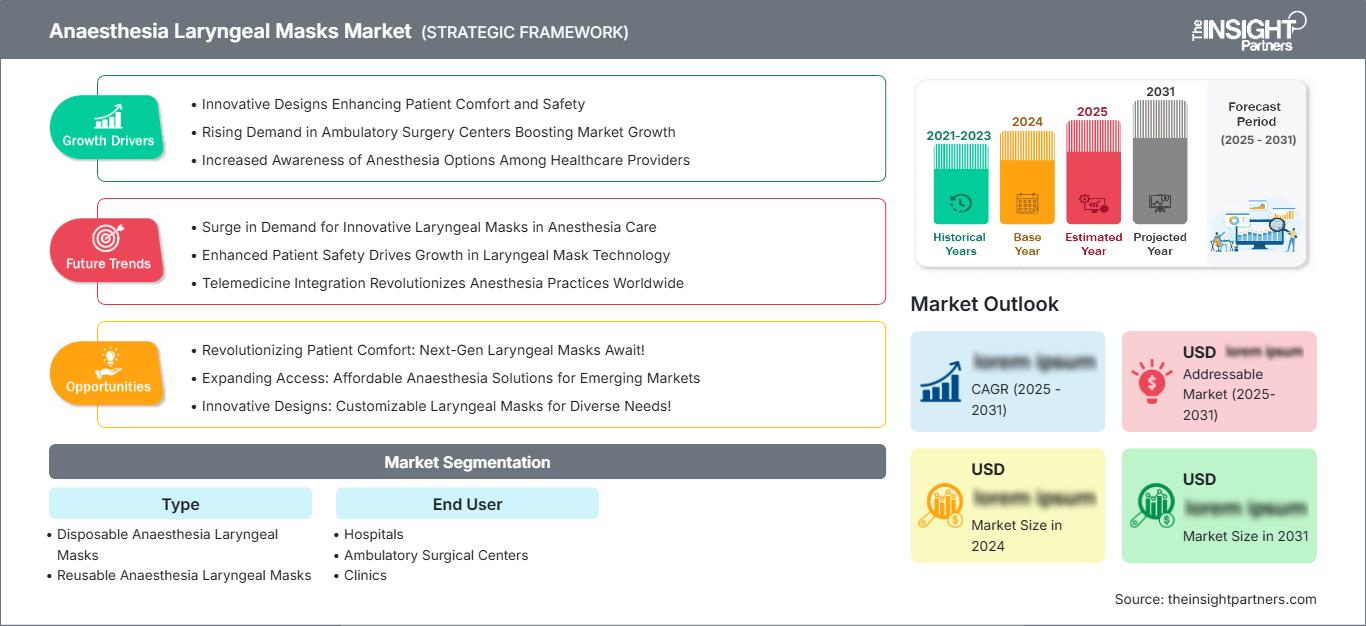
The anaesthesia laryngeal masks market was valued at US$ 41.52 Million in 2025 and is projected to reach US$ 78.62 Million by 2034, registering a CAGR of 7.35% during 2026–2034. The market is advancing as surgical teams, anesthesiologists, and ambulatory care providers use supraglottic airway devices to support routine anesthesia, rescue ventilation, emergency airway management, and short-duration procedures.
Across North America, adoption is expected to grow at a CAGR of 6.8–7.8% through 2034, supported by high surgical procedure volumes, preference for single-use airway devices, and standardized difficult airway protocols. The anaesthesia laryngeal masks market size is influenced by operating room efficiency, infection prevention priorities, ambulatory surgery expansion, and procurement preference for validated airway portfolios.
Anaesthesia Laryngeal Masks Market Assessment and Insights
- North America held 34–37% share in 2025 and is projected to grow at a CAGR between 6.8–7.8% during 2026–2034, supported by high surgical caseloads, ASC penetration, and infection-control-driven single-use adoption.
- US accounted for 84–88% of North America in 2025 and is forecast to grow at a CAGR between 6.9–7.9% during 2026–2034, driven by outpatient anesthesia demand.
- Europe represented 28–31% share in 2025 and is projected to grow at a CAGR between 6.4–7.4% during 2026–2034, led by Germany, the UK, France, Italy, and Spain.
- Asia Pacific captured 22–25% share in 2025 and is expected to grow at a CAGR between 8.1–9.1% during 2026–2034, led by China, India, Japan, South Korea, and Australia.
- Largest Segment Disposable Anaesthesia Laryngeal Masks held 63–66% market share in 2025 and is projected to grow at a CAGR between 7.7–8.7% during 2026–2034.
- High Growth Segment Ambulatory Surgical Centers held 23–26% market share in 2025 and is projected to grow at a CAGR between 8.3–9.3% during 2026–2034.
- Key companies analyzed in detail: GE HealthCare Technologies Inc., Ambu A/S, Medline Industries, LP, Becton, Dickinson and Company, Smiths Group plc, Hsiner Co., Ltd., Intersurgical Ltd., BLS Systems Limited, KindWell Medical, Teleflex Incorporated.
Source: The Insight Partners' analysis based on proprietary research, government publications, company annual reports, investor presentations, industry databases, and expert interviews.
The management of supraglottic airways has moved from reusable generation I products to disposable, anatomically designed, and generation II products, which provide enhanced sealing, gastric access, and intubation support. The hospital assessment parameters are cuff pressure control, ease of insertion, aspiration protection, and ease of packaging. Manufacturing trends point towards large-scale production, sterilized packaging, a size range, and distributors who can ensure a continuous supply in the operating rooms.
Future demand drivers include the ambulatory surgery shift, the older population for anesthesiology and safety standards in airway management. The emerging markets are expanding their surgical capacity, while the developed markets seek to reduce cross-contamination and ensure consistency of the workflow process. The regulatory drivers are based on device quality, biocompatibility, sterility and post-market evaluation, providing an edge to the manufacturers with traceability and clinical data.
Anaesthesia Laryngeal Masks Market Report Scope
| Report Attribute | Details |
|---|---|
| Market size in 2025 | US$ 41.52 Million |
| Market Size by 2034 | US$ 78.62 Million |
| Global CAGR (2026 - 2034) | 7.35% |
| Historical Data | 2021-2024 |
| Forecast period | 2026-2034 |
Anaesthesia Laryngeal Masks Market Analysis
Rising outpatient procedures, increased anesthesia volumes, and clinical preferences for faster airway establishment among appropriate candidates will drive demand. Anaesthesia laryngeal masks market growth is attributed to operating room turnover, preparation for emergencies, and growing use of supraglottic airways as alternatives to intubation in selected cases when ventilation can be provided safely.
The ecosystem comprises polymer and silicone suppliers, device manufacturers, sterilization partners, hospital distributors, anesthesia units, emergency medicine departments, and ambulatory surgical centers. Supply is driven by resin availability, ability to manufacture sterile products, labeling compliance, completeness of size offering, and purchasing contracts. Buyers will place greater emphasis on size availability for adults, children, and newborns since the absence of any size hampers the scheduling of procedures.
Competition is driven by the portfolio breadth, clinician expertise, and scientific design of the device. In the anaesthesia laryngeal masks market report, competition between Ambu A/S, Teleflex Incorporated, Intersurgical Ltd., Medline Industries, LP, and Hsiner Co., Ltd. revolves around both disposable and reusable airway devices, whereas companies such as Becton, Dickinson and Company and GE HealthCare Technologies Inc. develop perioperative ecosystems.
The positioning strategy will revolve around single-use technology, second-generation devices, and a total airway solution. Smiths Group plc, BLS Systems Limited, and KindWell Medical play a role in making devices available via regional value-based purchasing routes. Investments are made for a reliable supply chain, ergonomic design, environmental packaging, and a broad distribution network instead of revolutionary product development.
● REPORT CUSTOMIZATION
Tailor This Report To Align With Your Specific Business Requirements
This report can be customized to align precisely with your business objectives, scope, and target markets. Customization options include tailored segmentation, geography, competitive analysis, and strategic insights to support informed decision-making.
Customize This Report →WHAT YOU CAN ADJUST
- ● Segmentations
- ● Geography
- ● Competitive Analysis
- ● Language Preferences
Anaesthesia Laryngeal Masks Market: Strategic Insights
Regional Insights
North America anaesthesia laryngeal masks market
North America held 34–37% of the anaesthesia laryngeal masks market in 2025 and is projected to grow at a CAGR of 6.8–7.8% during 2026–2034. Market growth will be driven by a high number of surgeries, the use of modern anesthesia methods, and an ongoing trend toward outpatient surgery. Laryngeal masks will continue to be widely utilized in hospitals, ambulatory surgery centers (ASCs), and airway management systems due to their use in common and short-duration procedures.
Other factors driving demand include strict infection control measures, rising preference for disposable airway management devices, and standardized airway management training. Providers in the United States and Canada will prefer devices that do not need reprocessing, allow quick airway sealing, and are easy to insert. Moreover, companies having an extensive distribution network, a wide range of products, and a good supply chain are well-positioned to gain from long-term procurement contracts.
U.S. anaesthesia laryngeal masks Market
The U.S. accounted for an estimated 84–88% of the North American anaesthesia laryngeal masks market in 2025 and is projected to grow at a CAGR of 6.9–7.9% during 2026–2034. The leading position of the nation is based on numerous surgical procedures performed, the wide availability of the ambulatory surgical centers (ASC), well-developed hospital purchasing systems, and historical preference for disposable items for use in operating rooms. All these factors will continue influencing the adoption of the laryngeal masks in various healthcare settings.
The major application segments of the anaesthesia laryngeal masks market consist of routine elective surgeries, day surgery, anesthesia rescue, airway management for endoscopy procedures, and emergency ventilation procedures. The market demand is also supported by the requirements for fast airway access, effective work processes, and infection prevention measures. Leading market players Teleflex Incorporated, Ambu A/S, Medline Industries, LP, Becton, Dickinson and Company, and GE HealthCare Technologies Inc. are represented in the market with a laryngeal mask product line, anesthesia product line, perioperative solutions, and strong relationships with hospitals and healthcare systems in the US.
Europe anaesthesia laryngeal masks Market
Europe represented 28–31% of the anaesthesia laryngeal masks market in 2025 and is expected to grow at a CAGR of 6.4–7.4% during 2026–2034. Growth is supported by well-established anesthesia practices, increasing surgical volumes, and widespread adoption of supraglottic airway devices across hospital and outpatient settings. The UK continues to play an influential role through strong airway management guidelines, active anesthesia training programs, and high awareness of supraglottic rescue pathways. Procurement decisions are increasingly influenced by NHS cost-efficiency requirements, infection prevention priorities, and clinician preference for familiar, proven airway devices.
Germany remains the largest national market within the region, supported by high surgical capacity, advanced perioperative care systems, and both public and private hospital purchasing activity. France, Italy, and Spain also contribute significantly to demand through elective surgeries, day-care procedures, and recurring public hospital replacement cycles. Across the broader anaesthesia laryngeal masks market, healthcare providers are placing greater emphasis on balancing the convenience of disposable devices with sustainability objectives, driving interest in material transparency, environmentally conscious packaging, and clinical products backed by strong performance and safety documentation.
APAC anaesthesia laryngeal masks Market
APAC captured 22–25% share in 2025 and is forecast to grow at a CAGR between 8.1–9.1% during 2026–2034. China is the leading country, followed by India, Japan, South Korea, and Australia, supported by hospital expansion, surgical access growth, and local device manufacturing.
China and India benefit from rising procedure volumes and value-based procurement, while Japan and Australia emphasize high-quality perioperative standards. Regional growth is supported by private hospital chains, medical tourism, and wider anesthesia training, although pricing pressure keeps reusable masks relevant in selected settings.
Middle East & Africa anaesthesia laryngeal masks Market
The Middle East & Africa is projected to grow at a CAGR between 5.6–6.6% during 2026–2034. Saudi Arabia and the UAE lead adoption through tertiary hospital investment, surgical infrastructure modernization, and standardized procurement for operating rooms and emergency departments.
South Africa remains the most developed African market due to private hospital networks and specialist anesthesia capacity. The rest of MEA adoption is gradual because procurement budgets, training, and supply logistics vary. Demand is strongest where facilities expand elective surgery, day-care procedures, and emergency airway preparedness.
Segmentation Analysis
Type
Type is projected to grow at a CAGR between 7.2–8.2% during 2026–2034. Device selection depends on infection-control policy, reprocessing infrastructure, procedure volume, unit cost, and clinical preference. The anaesthesia laryngeal masks market scope is widening as buyers evaluate disposable convenience, reusable economics, cuff material, seal pressure, patient size coverage, and compatibility with routine anesthesia and rescue airway pathways.
- Disposable Anaesthesia Laryngeal Masks dominate demand because single-use packaging reduces reprocessing burden, supports infection prevention, simplifies operating room logistics, and aligns with high-throughput hospital and ASC workflows.
- Reusable Anaesthesia Laryngeal Masks remain relevant where sterilization infrastructure is reliable, budgets are constrained, and facilities prefer durable silicone devices for repeated use under strict cleaning protocols.
End User
End User is projected to grow at a CAGR between 7.0–8.0% during 2026–2034. Adoption varies by procedure volume, staffing model, procurement policy, and emergency readiness. Hospitals remain the main purchasers because they manage complex surgeries and intensive airway protocols, while ambulatory surgical centers drive faster growth through high-volume short procedures that favor disposable supplies and standardized anesthesia kits.
- Hospitals account for substantial demand because operating rooms, emergency departments, ICUs, and recovery units require multiple laryngeal mask sizes for planned anesthesia and rescue ventilation readiness.
- Ambulatory Surgical Centers are gaining strategic importance as elective procedures move to outpatient settings, where rapid turnover, infection prevention, predictable inventory, and disposable devices support efficient anesthesia workflows.
- Clinics use laryngeal masks selectively for minor procedures and emergency preparedness, with purchasing influenced by practitioner training, procedure type, cost sensitivity, and distributor availability.
Opportunity Snapshot
| End User | Revenue Contribution | Trend Tag | Adoption Stage |
| Hospitals | High | OR Airway | Mature |
| Ambulatory Surgical Centers | Medium | Day Surgery | Scaling |
| Clinics | Low | Minor Procedures | Emerging |
Anaesthesia Laryngeal Masks Market Growth Drivers and Impact Analysis
Shift Toward Single-Use Airway Devices
The key driver for single-use adoption lies in the desire of anesthesiology departments to have consistent sterility, reduced reprocessing workload, and quicker set-up in the operating room. Single-use laryngeal masks diminish the reliance on cycles of reprocessing, sterilization, and tracking of instruments, which is especially advantageous in large-volume hospitals and ambulatory surgical centers. The effect of this trend on suppliers is increased recurring consumables purchases and greater focus on packaging and sizing. Training in the hospital is facilitated by the standardization that comes with single-use devices. Suppliers that are able to supply a full range of sizes, second-generation products, and reliable inventory management will be successful in procedure-driven procurement contracts.
Ambulatory Surgery Expansion Increases Airway Consumable Use
The rise in ASCs is creating a need for airway solutions that are geared toward shorter and more predictable surgeries. Laryngeal masks allow for quick anesthesiology management in select patients through quick installation, minimized airway manipulation, and quicker recovery plans than other airway management techniques used when medically necessary. These devices create additional pull from procedures performed in ophthalmology, orthopedics, gynecology, urology, dentistry, and those associated with endoscopy. This market creates greater demand for disposables and pre-packaged airway kits as well as distribution solutions geared to higher volumes of procedures performed on the same day.
Difficult Airway Preparedness Supports Stocking Requirements
The protocols of airway management increase the demand since the supraglottic devices are often used in rescue ventilation and in emergency airway kits. Hospitals will have to keep proper sizes of adult, pediatric, and neonatal devices, irrespective of the frequency of use in routine cases. This will result in a minimum demand for the devices irrespective of whether any surgeries are completed or not. The preferred devices are those that provide a proper seal, ease of insertion, access to the stomach, and intubation assistance in difficult airway situations.
Anaesthesia Laryngeal Masks Market Future Trends
Second-Generation Designs Become Standard Procurement Preference
The most important anaesthesia laryngeal masks market trends will involve wider preference for second-generation designs that improve seal reliability, gastric channel access, and rescue-airway flexibility. These devices help clinicians manage positive pressure ventilation and aspiration concerns more confidently during selected procedures. Future purchasing will increasingly compare clinical versatility, cuff pressure guidance, insertion stability, and compatibility with intubation techniques. As airway training frameworks emphasize structured escalation, hospitals may standardize on masks that perform across routine and unexpected scenarios. Manufacturers that combine safety features with simple insertion and competitive pricing will be better positioned in tender-based purchasing.
Sustainability Scrutiny Shapes Disposable Device Choices
Environmental considerations will shape the purchasing of single-use airways as hospitals seek to address infection control and waste minimization. There will be an increase in questions on material composition, phthalate-free manufacturing, recycled packaging, emissions tracking, and waste minimization. It is not going to stop the demand for single-use products, but it will shape how suppliers are evaluated. Suppliers may be able to differentiate themselves by using less packaging, having a lower-material design, and sustainability reporting in their bids. Europe will be the fastest follower based on its sustainability considerations in hospitals, followed by North America and APAC because of procurement practices in health systems.
Anaesthesia Laryngeal Masks Market Opportunities
Standardized Airway Kits for Ambulatory Centers
A strong opportunity exists in standardized airway kits tailored to ambulatory surgical centers. The anaesthesia laryngeal masks market Forecasts indicate that procedure migration to outpatient settings will increase demand for predictable, easy-to-stock, disposable airway products. Suppliers can create kits combining laryngeal masks, lubricant, syringes, bite blocks, and size-selection guidance to reduce preparation time and inventory errors. Distributors can support recurring orders linked to procedure schedules and case-mix trends. The strongest opportunities will emerge where suppliers integrate clinical education, supply assurance, and cost-per-case contracting with ASC procurement systems.
Emerging Market Surgical Infrastructure Expansion
The developing world presents itself as an opportunity as both public and private hospitals upgrade their operating theaters, emergency wards, and day surgery departments. Investments should be made in distributor relationships, clinician education, cost-effective disposable ranges, and reusables where there is a proven sterilization process. The emerging markets of China, India, Southeast Asia, and the Gulf states are particularly interesting since surgical access and upgrading of hospitals are going up at the same time. There will be differentiation in terms of range of sizes, product registration in the local markets, multi-language instruction, and reliability of supply.
Recent Developments
- November 2025: Ambu A/S released its 2024/25 annual report, reporting 13.1% organic revenue growth and 9.9% organic growth in Anesthesia & Patient Monitoring. The update indicated continued commercial momentum in perioperative and anesthesia-related product categories, supporting Ambu’s positioning in single-use airway and respiratory care portfolios.
- October 2025: Smiths Group plc published its FY2025 Annual Report and Accounts, reporting 8.9% organic revenue growth and outlining its strategy to become a more focused technology business. Although Smiths’ current portfolio focus has shifted, the disclosure remained relevant to airway market tracking because legacy anesthesia and airway assets continue to influence supplier mapping.
- November 2025: The Difficult Airway Society published updated 2025 guidelines for management of unanticipated difficult tracheal intubation in adults, maintaining supraglottic airway device ventilation as Plan B and emphasizing continuous oxygen delivery, structured escalation, and education. The update supports institutional stocking and training relevance for laryngeal mask devices.
Frequently Asked Questions

- Comprehensive Market Sizing and Forecast Analysis
- Detailed Segmentation Analysis
- In-Depth Market Dynamics Assessment
- Regional and Country-Level Insights
- Competitive Landscape and Company Benchmarking
- Strategic Business Intelligence
Recent Reports
Testimonials

The Insight Partners' SCADA System Market report is comprehensive, with valuable insights on current trends and future forecasts. The team was highly professional, responsive, and supportive throughout. We are very satisfied and highly recommend their services.
RAN KEDEM Partner, Reali Technologies LTDs
I requested a report on a very specific software market and the team produced the report in a few days. The information was very relevant and well presented. I then requested some changes and additions to the report. The team was again very responsive and I got the final report in less than a week.
JEAN-HERVE JENN Chairman, Future Analytica
We worked with The Insight Partners for an important market study and forecast. They gave us clear insights into opportunities and risks, which helped shape our plans. Their research was easy to use and based on solid data. It helped us make smart, confident decisions. We highly recommend them.
PIYUSH NAGPAL Sr. Vice President, High Beam Global
The Insight Partners delivered insightful, well-structured market research with strong domain expertise. Their team was professional and responsive throughout. The user-friendly website made accessing industry reports seamless. We highly recommend them for reliable, high-quality research services
YUKIHIKO ADACHI CEO, Deep Blue, LLC.
This is the first time I have purchased a market report from The Insight Partners.While I was unsure at first, I visited their web site and felt more comfortable to take the risk and purchase a market report.I am completely satisfied with the quality of the report and customer service. I had several questions and comments with the initial report, but after a couple of dialogs over email with their analyst I believe I have a report that I can use as input to our strategic planning process.Thank you so much for taking the extra time and making this a positive experience.I will definitely recommend your service to others and you will be my first call when we need further market data.
JOHN SUZUKI President and Chief Executive Officer, Board Director, BK Technologies
I wish to appreciate your support and the professionalism you displayed in the course of attending to my request for information regarding to infectious disease IVD market in Nigeria. I appreciate your patience, your guidance, and the fact that you were willing to offer a discount, which eventually made it possible for us to close a deal. I look forward to engaging The Insight Partners in the future, all thanks to the impression you have created in me as a result of this first encounter.
DR CHIJIOKE ONYIA MANAGING DIRECTOR, PineCrest Healthcare Ltd.Reason to Buy
- Informed Decision-Making
- Understanding Market Dynamics
- Competitive Analysis
- Identifying Emerging Markets
- Customer Insights
- Market Forecasts
- Risk Mitigation
- Boosting Operational Efficiency
- Strategic Planning
- Investment Justification
- Tracking Industry Innovations
- Aligning with Regulatory Trends





 Get Free Sample for