
Anesthesia Carts Market Size, Demand & Growth by 2034
Coverage: By Type (Auto-Locking Carts, Isolation Carts, Standard Carts); Application (Hospitals, Ambulatory Surgical Centers, Clinics, Others) , and Geography (North America, Europe, Asia Pacific, and South and Central America)
- Status : Data Released
- Report Code : TIPRE00019569
- Category : Life Sciences
- No. of Pages : 150
- Available Report Formats :


- Last update date : August 04, 2026


2025 Market Size
US$ 1.70 Bn
Base year value
2034 Forecast
US$ 3.25 Bn
Projected by 2034
CAGR 2026-2034
7.45 %
Growth rate
Addressable Market
US$ 22.29 Bn
(2026-2034)
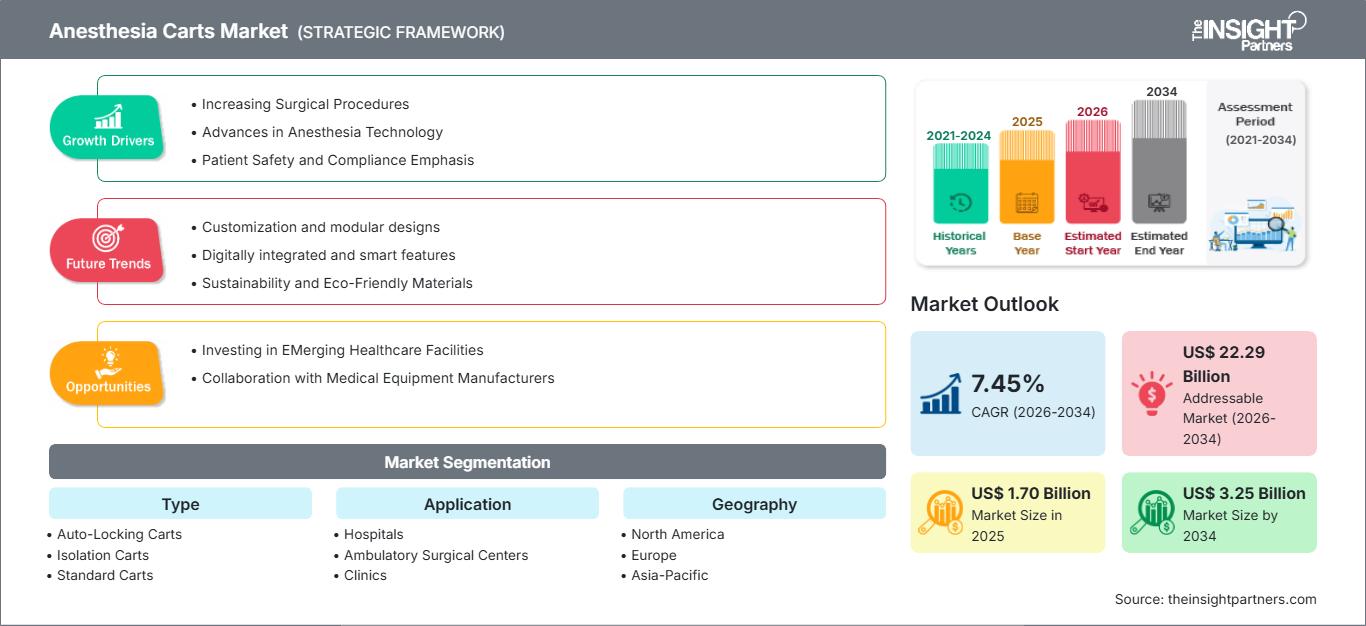
The anesthesia carts market is projected to grow from US$ 1.70 Billion in 2025 to US$ 3.25 Billion by 2034, registering a CAGR of 7.45% during 2026–2034. Demand is supported by operating room standardization, controlled medication storage, anesthesia workflow optimization, and broader adoption of mobile clinical storage systems across hospitals, ambulatory surgical centers, and outpatient procedure environments.
North America remains the leading regional base as hospitals continue to modernize perioperative storage, medication security, and operating room supply access. The anesthesia carts market size in the region is supported by high surgical procedure volumes, mature hospital infrastructure, and stronger demand for locking systems aligned with medication control practices. Regional expansion is expected to remain in the 6.7–7.3% CAGR range through 2034.
Anesthesia Carts Market Assessment and Insights
- North America: North America accounted for 38–42% share in 2025 and is projected to grow at 6.7–7.3% CAGR between 2026–2034, supported by operating room modernization, medication security practices, and strong hospital procurement networks.
- US: The US represented 84–88% of North America in 2025 and is expected to grow at 6.6–7.2% CAGR between 2026–2034, driven by hospital replacement cycles and ambulatory surgery expansion.
- Europe: Europe held 24–28% share in 2025 and is forecast to grow at 6.3–6.9% CAGR between 2026–2034, led by Germany, the UK, France, Italy, and Spain.
- Asia Pacific: Asia Pacific captured 22–26% share in 2025 and is projected to expand at 8.4–9.1% CAGR between 2026–2034, with China, Japan, India, South Korea, and Australia leading adoption.
- Largest Segment: Hospitals held 66–71% market share in 2025 and is expected to grow at 7.0–7.6% CAGR between 2026–2034, reflecting operating room concentration and medication management complexity.
- High Growth Segment: Ambulatory Surgical Centers accounted for 18–23% market share in 2025 and is projected to grow at 8.1–8.8% CAGR between 2026–2034, supported by outpatient procedure migration.
- Key companies analyzed in detail: Bell Medical, Inc., The Harloff Company, Armstrong Medical Ltd., DR Instruments Inc., Capsa Healthcare, McKesson Medical-Surgical Government Solutions LLC, Pedigo USA, Mercury Enterprises, Inc., DiaMedical USA, and Waterloo Healthcare.
Source: The Insight Partners' analysis based on proprietary research, government publications, company annual reports, investor presentations, industry databases, and expert interviews.
Clinical storage has developed from simple utility carts to configurable, lockable and department-specific carts. Anesthesia departments are demanding features such as drawer configurations, tilt bins, sharps disposal devices, catheter storage devices, drug trays, electronic locks and other features that minimize search times during procedures. Production trends have evolved into modular components, aluminum and steel construction, antimicrobial surfaces and reduced customization cycles, which enable suppliers to cater to standardized healthcare systems as well as single-site surgical departments.
Future demand will be driven by capacity in out-patient surgery, medication safety guidelines, and infrastructure modernization. Unit demand in the Asia Pacific and Middle East regions will result from hospitals being constructed, whereas in North America and Europe, the demand will come from replacements, standardizations and infection control. Buyers will tend to favor suppliers who produce carts that are durable, secure, easy to move, configurable and accessories readily available.
Anesthesia Carts Market Report Scope
| Report Attribute | Details |
|---|---|
| Market size in 2025 | US$ 1.70 Billion |
| Market Size by 2034 | US$ 3.25 Billion |
| Global CAGR (2026 - 2034) | 7.45% |
| Historical Data | 2021-2024 |
| Forecast period | 2026-2034 |
Anesthesia Carts Market Analysis
The anesthesia carts market growth is driven by rising surgical volume, stricter medication control, and the need to keep anesthesia supplies organized at point of care. Hospitals need carts that facilitate quick access to drugs, airway equipment, syringes, labels, masks, catheters, and emergency supplies. The demand is also driven by the turnover pressures in the operating rooms, where the standardized carts can help save time in preparing for the procedures and retrieving the supplies.
The value chain consists of cart frames, drawers, locks, castors, plastic tops, dividers, bins, rails, labels, and replacement parts. The supply chain relies on metal manufacturing, plastics, lock technology, distribution, and logistics. Increasingly, healthcare buyers evaluate the warranty, lead times, customizability, infection control compliance, and compatibility with their medication handling policies.
The anesthesia carts market analysis indicates a fragmented competitive environment where specialists compete through customization, product depth, distributor access, and installed-base support. Harloff, Waterloo Healthcare, Capsa Healthcare, and Pedigo USA have excellent visibility in the US clinical storage market; Bell Medical, Inc., DiaMedical USA, and McKesson Medical-Surgical Government Solutions LLC provide procurement support through their sales and distribution channels.
Strategic positioning is also affected by health system consolidations and large-scale replacement programs. Armstrong Medical Ltd., DR Instruments Inc., and Mercury Enterprises, Inc. cater to regional and institutional demands where sturdy design and useful drawer configuration are critical. Those vendors that can provide for multi-site standardization, electronic locking features, accessory customization options, and quick replenishment capabilities are more strategically positioned than those who offer only cart models.
● REPORT CUSTOMIZATION
Tailor This Report To Align With Your Specific Business Requirements
This report can be customized to align precisely with your business objectives, scope, and target markets. Customization options include tailored segmentation, geography, competitive analysis, and strategic insights to support informed decision-making.
Customize This Report →WHAT YOU CAN ADJUST
- ● Segmentations
- ● Geography
- ● Competitive Analysis
- ● Language Preferences
Anesthesia Carts Market: Strategic Insights
Regional Insights
North America anesthesia carts market
North America accounted for 38–42% share in 2025 and is projected to grow at 6.7–7.3% CAGR during 2026–2034. Demand is concentrated in hospitals, ambulatory surgical centers, specialty clinics, and academic medical centers. The region benefits from high operating room density, controlled-substance handling practices, and established purchasing channels for mobile medical storage systems.
The anesthesia carts market share in North America is reinforced by the replacement of aging storage fleets, expansion of outpatient surgery, and stronger attention to medication access control. Buyers increasingly request electronic locks, proximity access, antimicrobial work surfaces, and configurable drawer layouts. Distribution networks and manufacturer service coverage support repeat procurement across hospital systems and integrated delivery networks.
U.S. anesthesia carts Market
The US represented 84–88% of North America in 2025 and is expected to grow at 6.6–7.2% CAGR during 2026–2034. The demand is backed by extensive hospitals, ambulatory surgical centers, orthopedic procedural centers, endoscopy centers, and pain management centers. The operating rooms need standard cart layouts for medication safety and accessibility.
The competitive presence is high as The Harloff Company, Capsa Healthcare, Waterloo Healthcare, Pedigo USA, DiaMedical USA, and McKesson Medical-Surgical Government Solutions LLC have direct or distributor access to the healthcare facilities. American buyers are now giving importance to carts that feature electronic locks, mobility, customization of drawers, accessories, and availability of after-purchase parts.
Europe anesthesia carts Market
Europe held 24–28% share in 2025 and is forecast to grow at 6.3–6.9% CAGR during 2026–2034. The UK boosts demand through NHS surgical capacity initiatives, OR refurbishing and replacing old clinical storage solutions. Carts preferred by the buyers must enhance medication management and be able to meet infection control requirements.
Germany leads Europe in terms of its sizeable hospital network, highly developed surgical infrastructure and emphasis on process standardization within the clinical setting. Providers of healthcare services are increasingly buying carts with modular drawers, secure access points and good mobility in high-traffic perioperative settings.
France, Italy and Spain contribute to demand through upgrading hospitals, expanding private clinics and increasing the number of outpatient surgical procedures performed. In these countries, demand is related to an aging population and increasing throughput pressures on procedures as well as improving OR readiness.
APAC anesthesia carts Market
Asia Pacific accounted for 22–26% share in 2025 and is expected to grow at 8.4–9.1% CAGR during 2026–2034. China has the highest regional demand due to hospital development, construction of surgical facilities, and standard clinical storage system procurement. Japan and South Korea still have demand for high-quality carts within advanced hospitals.
India and Australia contribute to growth due to investments in private hospitals, ambulatory procedures, and operating rooms. There is an increased cart purchase driven by increased policy backing of healthcare infrastructural developments and increased procedure volumes. The role of local distributors is essential since purchasers need configuration assistance, delivery coordination, and accessory replacements.
Middle East & Africa anesthesia carts Market
Middle East & Africa is expected to grow at 7.2–7.9% CAGR during 2026–2034. Saudi Arabia and the UAE lead regional demand through hospital construction, medical city expansion, and specialty surgery investment. New facilities require complete operating room equipment packages, including anesthesia carts and secure clinical storage.
South Africa remains the most established regional market, supported by private healthcare networks, academic hospitals, and surgical service demand. The rest of MEA adoption is emerging through hospital modernization, donor-supported facilities, and private clinic development. Procurement is shaped by tenders, distributor availability, financing, and the need for durable carts that withstand heavy utilization.
Segmentation Analysis
Type
Type is projected to grow at 7.1–7.7% CAGR during 2026–2034 as healthcare sites align cart selection with medication security, infection control, and workflow intensity. The anesthesia carts market scope across types is widening because buyers require different access controls, isolation support, and standardized configurations across operating rooms. Auto-locking carts are gaining relevance, while standard carts remain important for routine use.
- Auto-Locking Carts: Auto-Locking Carts are preferred in operating rooms and procedural areas managing controlled substances, where automatic relocking, user accountability, and restricted drawer access support medication security protocols.
- Isolation Carts: Isolation Carts serve facilities focused on infection prevention, supply segregation, and rapid access to protective materials in areas requiring controlled handling of clinical supplies.
- Standard Carts: Standard Carts remain widely used because they offer practical storage, lower acquisition cost, straightforward maintenance, and flexible drawer configurations for routine anesthesia workflows.
Application
Application is expected to grow at 7.2–7.9% CAGR during 2026–2034 as usage expands across inpatient surgical departments, ambulatory sites, and clinic-based procedures. Hospitals continue to dominate because complex surgeries require larger cart fleets and more accessories. Ambulatory settings are growing faster because procedure migration increases demand for compact, secure, and easy-to-clean storage near the point of care.
- Hospitals: Hospitals generate the highest demand because multiple operating rooms, intensive procedural schedules, and controlled medication handling require durable cart fleets with secure drawer systems and organized accessories.
- Ambulatory Surgical Centers: Ambulatory Surgical Centers require compact anesthesia carts that support fast turnover, efficient supply access, medication control, and standardized workflows across high-volume outpatient procedures.
- Clinics: Clinics use anesthesia carts for minor procedures, sedation support, and supply organization, where space efficiency, ease of cleaning, and simple access control are critical.
Opportunity Snapshot
| Segment Name | Revenue Contribution | Trend Tag | Adoption Stage |
| Hospitals | High | OR Standardization | Mature |
| Ambulatory Surgical Centers | Medium | Outpatient Shift | Scaling |
| Clinics | Medium | Procedure Rooms | Scaling |
| Others | Low | Specialty Storage | Emerging |
Anesthesia Carts Market Growth Drivers and Impact Analysis
Operating Room Standardization Across Hospital Networks
There is a trend towards standardization of equipment used in the operating rooms, which is aimed at minimizing the variations in order to ease training and prepare for emergencies. Anesthesia carts are becoming an integral part of perioperative processes due to the fact that the drawers' design, labeling, locking mechanism and accessories have a direct effect on clinical efficiency. Having standardized fleets of carts makes it easier for anesthesiologists to find drugs and airway devices when conducting elective and emergency surgeries. Commercial effect can be seen in orders for fleets, recurring need for accessories and replacement associated with operating room renovation.
Medication Security and Controlled Substance Management
The rise in medication safety protocols is leading to the requirement for medication carts that come equipped with highly sophisticated locking mechanisms, drawer restrictions, and medication management systems. Anesthesia units need to keep dangerous medications, syringes, and equipment in their respective carts, which makes it very important to design these carts with great care in terms of security and compliance. Advanced lock mechanisms, keypad locks, proximity cards, and tamper-proof design of the carts enable healthcare organizations to minimize risks of unauthorized access to the medication carts and manage the internal handling processes effectively.
Outpatient Procedure Migration and Compact Cart Demand
There is increasing development in ambulatory surgical centers and procedure centers as healthcare systems continue to shift suitable cases to ambulatory rather than inpatient facilities. Such ambulatory centers require anesthesia carts that can be easily moved, have the ability to be cleaned quickly, and also have sufficient drawer storage capacity for procedures. Smaller carts with basic accessories are useful, especially in endoscopic procedures, ophthalmic surgeries, orthopedic procedures, pain management, and dentistry anesthetic practices. The effects are likely to lead to increased adoption of smaller and more flexible cart designs. The companies that offer packages of carts based on the workflow can capitalize on such opportunities.
Anesthesia Carts Market Future Trends
Electronic Access Control Becomes a Standard Feature
Electronic locking will become one of the most important anesthesia carts market trends as healthcare facilities strengthen medication traceability and reduce manual key management. Carts in the future would feature keypad locks, proximity locks, auto-lock, audit-compliant processes, and built-in security options. Adoption of the technology would be highest in hospitals and ambulatory surgery centers where there is handling of controlled drugs or procedure rooms in multiple numbers. Suppliers have to take care of balancing the two aspects since anesthesiologists must have quick access to the cart for patient safety reasons. Battery life, override function, credentialing of personnel, and ease of maintenance would affect the buying decisions of electronic access systems.
Configurable and Procedure-Specific Cart Fleets Expand
The next phase of product demand will favor configurable cart programs rather than one-size-fits-all models. Hospitals will increasingly specify carts by procedure type, room size, medication policy, and anesthesia team preference. This will increase demand for modular drawer systems, accessory rails, tilt bins, removable trays, label holders, sharps brackets, and lightweight frame options. Procedure-specific fleets can improve readiness and reduce waste by aligning stored supplies with actual clinical use. Manufacturers with online configurators, rapid quotation tools, and flexible production processes will be better positioned as procurement teams seek both standardization and department-level customization.
Anesthesia Carts Market Opportunities
Health System Fleet Replacement Programs
Large health systems represent a strong opportunity because many hospitals operate mixed cart fleets accumulated over several replacement cycles. Standardizing anesthesia carts can simplify maintenance, reduce accessory variation, improve staff familiarity, and strengthen medication control. The anesthesia carts market Forecasts indicate that replacement programs will favor suppliers offering portfolio breadth, electronic locks, accessory packages, and predictable lead times. Vendors can expand account value by bundling carts with drawer dividers, bins, labels, rails, and service support. Multi-site health systems also create opportunities for preferred supplier agreements that cover operating rooms, ambulatory centers, clinics, and specialty procedure departments.
Emerging Surgical Infrastructure in Growth Economies
New hospitals and specialty surgical centers in the Asia Pacific, the Gulf, and selected African markets are creating opportunities for complete clinical storage packages. These facilities often procure operating room equipment in bundled projects, making anesthesia carts part of broader infrastructure planning. Suppliers that work with distributors, planners, and biomedical teams can secure early-stage specifications before tenders are finalized. The opportunity is strongest where healthcare investment is expanding procedure capacity and improving perioperative standards. Durable construction, cleanable surfaces, flexible accessories, and after-sales support will be decisive because new facilities need long-term reliability and practical maintenance.
Recent Developments
- June 2026: Capsa Healthcare acquired The Harloff Company, a manufacturer of healthcare storage and mobility products. The transaction broadened Capsa Healthcare’s clinical care portfolio across mobile medical storage, procedure carts, medication storage, and endoscopic processing solutions, while allowing existing Harloff customers to continue accessing products and support through a larger service infrastructure.
- September 2025: Waterloo Healthcare’s product catalog highlighted its expanded medical cart offering across emergency carts, anesthesia carts, isolation carts, bedside carts, and treatment or procedure carts. The catalog emphasized free drawer customization, turnkey delivery availability, fully assembled carts, in-house manufacturing, and configuration flexibility for large cart projects across hospitals and procedure departments.
- August 2025: Harloff medical carts were featured through distributor inventory covering procedure carts, anesthesia carts, emergency carts, infection control carts, and medication carts. The listed anesthesia configurations included lightweight aluminum models, electronic locking carts, multi-drawer designs, and specialty airway cart packages for operating rooms and surgical teams.
Frequently Asked Questions

- Comprehensive Market Sizing and Forecast Analysis
- Detailed Segmentation Analysis
- In-Depth Market Dynamics Assessment
- Regional and Country-Level Insights
- Competitive Landscape and Company Benchmarking
- Strategic Business Intelligence
Recent Reports
Testimonials

The Insight Partners' SCADA System Market report is comprehensive, with valuable insights on current trends and future forecasts. The team was highly professional, responsive, and supportive throughout. We are very satisfied and highly recommend their services.
RAN KEDEM Partner, Reali Technologies LTDs
I requested a report on a very specific software market and the team produced the report in a few days. The information was very relevant and well presented. I then requested some changes and additions to the report. The team was again very responsive and I got the final report in less than a week.
JEAN-HERVE JENN Chairman, Future Analytica
We worked with The Insight Partners for an important market study and forecast. They gave us clear insights into opportunities and risks, which helped shape our plans. Their research was easy to use and based on solid data. It helped us make smart, confident decisions. We highly recommend them.
PIYUSH NAGPAL Sr. Vice President, High Beam Global
The Insight Partners delivered insightful, well-structured market research with strong domain expertise. Their team was professional and responsive throughout. The user-friendly website made accessing industry reports seamless. We highly recommend them for reliable, high-quality research services
YUKIHIKO ADACHI CEO, Deep Blue, LLC.
This is the first time I have purchased a market report from The Insight Partners.While I was unsure at first, I visited their web site and felt more comfortable to take the risk and purchase a market report.I am completely satisfied with the quality of the report and customer service. I had several questions and comments with the initial report, but after a couple of dialogs over email with their analyst I believe I have a report that I can use as input to our strategic planning process.Thank you so much for taking the extra time and making this a positive experience.I will definitely recommend your service to others and you will be my first call when we need further market data.
JOHN SUZUKI President and Chief Executive Officer, Board Director, BK Technologies
I wish to appreciate your support and the professionalism you displayed in the course of attending to my request for information regarding to infectious disease IVD market in Nigeria. I appreciate your patience, your guidance, and the fact that you were willing to offer a discount, which eventually made it possible for us to close a deal. I look forward to engaging The Insight Partners in the future, all thanks to the impression you have created in me as a result of this first encounter.
DR CHIJIOKE ONYIA MANAGING DIRECTOR, PineCrest Healthcare Ltd.Reason to Buy
- Informed Decision-Making
- Understanding Market Dynamics
- Competitive Analysis
- Identifying Emerging Markets
- Customer Insights
- Market Forecasts
- Risk Mitigation
- Boosting Operational Efficiency
- Strategic Planning
- Investment Justification
- Tracking Industry Innovations
- Aligning with Regulatory Trends





 Get Free Sample for