
Anesthesia Gas Evaporators Market Size, Share & Forecast by 2034
Coverage: by Chemical Type (Desflurane, Enflurane, Isoflurane, Sevoflurane, Halothane, and Other Chemicals); Modality (Desktop and Portable); Application (Human Medicine and Veterinary Medicine); End User (Hospitals & Clinics, Home Care Settings, Research Laboratories, and Other End Users), and Geography (North America, Europe, Asia Pacific, and South and Central America)
- Status : Data Released
- Report Code : TIPRE00008198
- Category : Life Sciences
- No. of Pages : 150
- Available Report Formats :


- Last update date : August 04, 2026


2025 Market Size
US$ 321.61 Mn
Base year value
2034 Forecast
US$ 528.23 Mn
Projected by 2034
CAGR 2026-2034
5.67 %
Growth rate
Addressable Market
US$ 3,852.34 Mn
(2026-2034)
The anesthesia gas evaporators market is projected to grow from US$ 321.61 Million in 2025 to US$ 528.23 Million by 2034, registering a CAGR of 5.67% during 2026–2034. Demand is supported by sustained surgical volumes, inhalation anesthesia use, veterinary anesthesia expansion, and replacement of older vapor delivery systems with safer, agent-specific, calibrated devices across hospitals, clinics, research facilities, and specialty care environments.
North America remains a high-value regional base due to mature anesthesia infrastructure, strong veterinary procedure volumes, and established procurement of calibrated vapor delivery equipment. The anesthesia gas evaporators market size in the region is supported by operating room replacement cycles, device safety expectations, and demand for low-flow anesthesia systems. Regional growth is expected to remain within a 4.9–5.5% CAGR range through 2034.
Anesthesia Gas Evaporators Market Assessment and Insights
- North America: North America accounted for 34–38% share in 2025 and is projected to grow at 4.9–5.5% CAGR between 2026–2034, supported by hospital replacements, veterinary anesthesia demand, and safety-focused vaporizer adoption.
- US: The US represented 82–86% of North America in 2025 and is expected to grow at 4.8–5.4% CAGR between 2026–2034, driven by surgical centers, veterinary clinics, and strong service networks.
- Europe: Europe held 27–31% share in 2025 and is forecast to grow at 4.7–5.3% CAGR between 2026–2034, led by Germany, the UK, France, Italy, and Spain.
- Asia Pacific: Asia Pacific captured 23–27% share in 2025 and is projected to expand at 6.6–7.3% CAGR between 2026–2034, with China, Japan, India, South Korea, and Australia leading demand.
- Largest Segment: Sevoflurane held 48–53% market share in 2025 and is expected to grow at 5.8–6.4% CAGR between 2026–2034, owing to broad clinical acceptance and low-flow suitability.
- High Growth Segment: Portable modality accounted for 24–29% market share in 2025 and is projected to grow at 6.9–7.6% CAGR between 2026–2034, supported by veterinary and mobile care use.
- Key companies analyzed in detail: Anestéo, Drägerwerk AG & Co. KGaA, Jorgensen Laboratories, MSS International, OES Medical Limited, Oricare, Inc., Penlon Limited, SIARE Engineering International Group S.r.l., Spacelabs Healthcare, Inc., and Supera Anesthesia Innovations.
Source: The Insight Partners' analysis based on proprietary research, government publications, company annual reports, investor presentations, industry databases, and expert interviews.
Current trend in the inhalation anesthesia industry technology is shifting from conventional mechanical vaporizers to advanced vaporizers that possess features such as good visibility, safe filling ability, compatibility with anesthesia workstations and interlocks, and reduced maintenance cost. The manufacturing process would be affected by the vendors' efforts to calibrate vaporizers to achieve high accuracy and durability of components, as well as compatibility with anesthesia workstations.
Demand in the future would be generated by the modernization of operating theaters, veterinary clinics, and regulatory requirements on the administration of anesthetic agents. APAC and ME regions would experience increased volumes through hospital constructions and investments in the animal healthcare sector. North America and Europe would generate demand due to the replacement and servicing of vaporizers, agent switch, low flow anesthesia, and sustainable procurement.
Anesthesia Gas Evaporators Market Report Scope
| Report Attribute | Details |
|---|---|
| Market size in 2025 | US$ 321.61 Million |
| Market Size by 2034 | US$ 528.23 Million |
| Global CAGR (2026 - 2034) | 5.67% |
| Historical Data | 2021-2024 |
| Forecast period | 2026-2034 |
Anesthesia Gas Evaporators Market Analysis
The anesthesia gas evaporators market growth is driven by continued reliance on volatile anesthetic agents in surgery, veterinary care, and controlled laboratory procedures. Vaporizers are still essential since they convert liquid anesthetic into vapor in a specific concentration in the breathing circuit. The demand for such products is determined by the precision required from the user due to the various factors, including flow rate, ambient temperature, carrier gas composition, and the patient's state.
The value chain involves vaporizer bodies, fill devices, calibrated knobs, mounting devices, agent reservoirs, sealing materials, servicing kits, and testing instruments. The supply of market products depends on accurate manufacturing, validation, biomedical servicing, and machine integration. The new buyers evaluate the precision of the agent, the fill device, the servicing period, the mounting devices, and lifetime service support.
The anesthesia gas evaporators market analysis indicates a specialized competitive landscape where established anesthesia equipment companies compete with veterinary-focused and regional manufacturers. Drägerwerk AG & Co. KGaA and Penlon Limited have very high recognition for OR vapor delivery, whereas Supera Anesthesia Innovations, Jorgensen Laboratories, and Anestéo cater to veterinary and specialized anesthesia markets.
Strategic positioning is more about compatibility, serviceability, and channel access than size alone. OES Medical Limited and SIARE Engineering International Group S.r.l. help build anesthetic workstation ecosystems, whereas Oricare, Inc., MSS International, and Spacelabs Healthcare, Inc. provide support for equipment lines and regional purchasing needs. Suppliers that offer good calibration services, low flow rates, and specific agent fillings can be well-positioned for institutional replacement programs.
● REPORT CUSTOMIZATION
Tailor This Report To Align With Your Specific Business Requirements
This report can be customized to align precisely with your business objectives, scope, and target markets. Customization options include tailored segmentation, geography, competitive analysis, and strategic insights to support informed decision-making.
Customize This Report →WHAT YOU CAN ADJUST
- ● Segmentations
- ● Geography
- ● Competitive Analysis
- ● Language Preferences
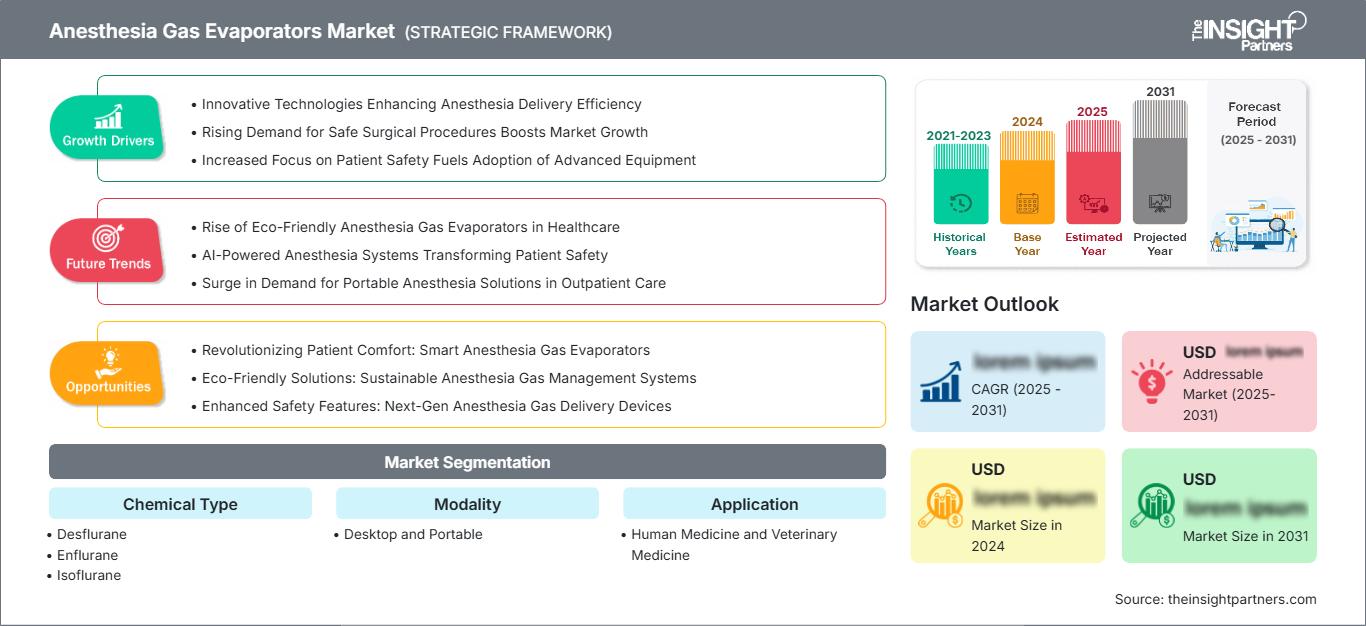
Anesthesia Gas Evaporators Market: Strategic Insights
Regional Insights
North America anesthesia gas evaporators market
North America accounted for 34–38% share in 2025 and is projected to grow at 4.9–5.5% CAGR during 2026–2034. Demand is supported by hospital operating rooms, ambulatory surgical centers, veterinary hospitals, university research facilities, and biomedical service providers. The region benefits from installed anesthesia machine fleets that require compatible vaporizers and periodic replacement.
The anesthesia gas evaporators market share in North America is reinforced by stringent clinical protocols, established anesthesia equipment purchasing channels, and broad veterinary anesthesia adoption. Hospitals prioritize vaporizers that support low-flow anesthesia, visible agent levels, filling safeguards, and mounting interlocks. Veterinary clinics also contribute steady purchases of isoflurane and sevoflurane vaporizers for companion animal procedures.
U.S. anesthesia gas evaporators Market
The US represented 82–86% of North America in 2025 and is expected to grow at 4.8–5.4% CAGR during 2026–2034. Demand is driven by hospital surgical departments, ambulatory centers, animal hospitals, university veterinary programs, and laboratory animal facilities. Replacement cycles are influenced by accreditation, service records, and clinical preference for reliable agent delivery.
The competitive base is supported by direct suppliers, distributors, and biomedical service companies. Drägerwerk AG & Co. KGaA, Penlon Limited, Supera Anesthesia Innovations, Jorgensen Laboratories, Oricare, Inc., and Spacelabs Healthcare, Inc. benefit from established product availability. US buyers emphasize maintenance access, compatibility with existing anesthesia machines, and filling systems that reduce agent handling risk.
Europe anesthesia gas evaporators Market
Europe held 27–31% share in 2025 and is forecast to grow at 4.7–5.3% CAGR during 2026–2034. Demand is stimulated in the UK through the upgrading of operating theaters, veterinary specialties, and the application of the low-flow anesthesia technique. Procurement in this region is determined by sustainability considerations, equipment life cycle thinking, and medical devices regulation compliance.
Germany continues to be the leader of Europe due to its large hospital base, high level of anesthesia equipment adoption, and quality engineering focus. Vaporizer replacement in Germany will be stimulated by the standardization of operating rooms, servicing planning, and preferences for medical devices compatible with workstations.
France, Italy, and Spain add to the regional market through renovation of public hospitals, private surgery chains, and veterinary facilities. French, Italian, and Spanish buyers give priority to safe operation, servicing capability, convenient filling, and price control. The European procurement market is becoming more and more sensitive to anesthetic gases' waste reduction, especially for gases with high global warming potential.
APAC anesthesia gas evaporators Market
Asia Pacific accounted for 23–27% share in 2025 and is expected to grow at 6.6–7.3% CAGR during 2026–2034. China leads regional demand through hospital construction, surgical capacity expansion, and veterinary clinic modernization. Japan and South Korea maintain demand for calibrated devices in advanced hospitals and university-based clinical settings.
India and Australia add growth through private hospital investment, veterinary healthcare expansion, and research laboratory activity. Policy support for healthcare infrastructure and rising companion animal care expenditure is expanding the buyer base. Distributor networks remain critical because customers require training, installation, compatibility verification, and maintenance support across diverse care settings.
Middle East & Africa anesthesia gas evaporators Market
The Middle East & Africa is expected to grow at 5.8–6.5% CAGR during 2026–2034. Saudi Arabia and the UAE lead regional demand through surgical suite development, specialty hospital investment, and expanding veterinary services. New healthcare projects require anesthesia systems and compatible vaporizers as part of broader operating room equipment packages.
South Africa remains the most mature regional market, supported by private hospitals, academic centers, and veterinary practices. The rest of the MEA demand is emerging through hospital modernization, mobile surgical missions, and animal health service growth. Procurement is often shaped by distributor availability, service capability, budget cycles, and the need for robust devices in variable operating environments.
Segmentation Analysis
Chemical Type
Chemical Type is projected to grow at 5.3–5.9% CAGR during 2026–2034 as agent selection continues to influence vaporizer demand, filling systems, and replacement priorities. The anesthesia gas evaporators market scope across chemical type is led by sevoflurane and isoflurane because they are widely used in human and veterinary anesthesia. Desflurane demand is more selective due to cost and sustainability considerations.
- Desflurane: Desflurane vaporizers serve high-control anesthesia workflows requiring rapid onset and offset, but demand is moderated by environmental concerns, specialized heating requirements, and higher operating costs.
- Enflurane: Enflurane vaporizers represent a declining installed-base segment, mainly relevant in legacy systems or selected low-resource settings where older anesthesia equipment remains operational.
- Isoflurane: Isoflurane remains important across human and veterinary anesthesia because of familiarity, availability, cost-effectiveness, and compatibility with many standard vaporizer configurations.
- Sevoflurane: Sevoflurane holds the strongest commercial position owing to broad clinical acceptance, smoother induction characteristics, pediatric suitability, and relevance in low-flow anesthesia practices.
- Halothane: Halothane demand is limited and declining, but some legacy or resource-constrained environments may continue using compatible vaporizers where transition to newer agents is slower.
Modality
Modality is expected to grow at 5.6–6.2% CAGR during 2026–2034 as buyers select devices based on care setting, mobility requirements, and anesthesia machine compatibility. Desktop vaporizers dominate hospital operating rooms due to stable workstation integration. Portable vaporizers are gaining momentum in veterinary clinics, field anesthesia, research laboratories, and mobile procedure settings requiring compact, flexible equipment.
- Desktop: Desktop systems remain the main choice in hospitals and clinics because they integrate with anesthesia workstations, support routine surgical use, and align with standardized operating room workflows.
- Portable: Portable vaporizers are increasingly adopted in veterinary, research, and mobile care environments where compact design, simple mounting, and flexible transport improve clinical usability.
Application
Application is projected to grow at 5.4–6.0% CAGR during 2026–2034 as vaporizer demand expands across human surgery and veterinary procedures. Human medicine remains the largest revenue base because hospitals and ambulatory centers use vaporizers in routine and complex surgeries. Veterinary medicine is a faster-developing application as companion animal care and specialty veterinary surgeries increase.
- Human Medicine: Human Medicine generates the greatest demand because hospitals and surgical centers require calibrated vapor delivery for general anesthesia across adult, pediatric, emergency, and specialty procedures.
- Veterinary Medicine: Veterinary Medicine is expanding as animal hospitals, universities, and research facilities adopt isoflurane and sevoflurane vaporizers for safer and more controlled anesthesia delivery.
End User
End User is expected to grow at 5.5–6.1% CAGR during 2026–2034 as demand remains concentrated in hospitals and clinics but widens in research and home-linked care support. Hospitals & clinics dominate because they conduct most surgical procedures. Research laboratories use vaporizers for animal studies, while home care settings remain niche and tied to specialized respiratory or veterinary applications.
- Hospitals & Clinics: Hospitals & Clinics account for the highest demand due to surgical volumes, workstation integration, anesthesia safety protocols, and recurring replacement of calibrated vapor delivery equipment.
- Home Care Settings: Home Care Settings remain a limited but emerging area where specialized care models, veterinary support, or equipment rental channels may require compact vapor delivery systems.
- Research Laboratories: Research Laboratories use vaporizers for controlled animal anesthesia in preclinical studies, academic research, and veterinary training applications requiring reproducible anesthetic dosing.
Opportunity Snapshot
| Segment Name | Revenue Contribution | Trend Tag | Adoption Stage |
| Hospitals & Clinics | High | OR Replacement | Mature |
| Home Care Settings | Low | Specialty Use | Emerging |
| Research Laboratories | Medium | Animal Studies | Scaling |
| Other End Users | Low | Field Anesthesia | Emerging |
Anesthesia Gas Evaporators Market Growth Drivers and Impact Analysis
Replacement of Aging Vapor Delivery Systems
Older vaporizers are being phased out by hospitals, clinics, and animal hospitals in favor of improved precision, filling safety, and compatibility with modern anesthesia workstations. Installed units can last for many years, but factors such as calibration testing, maintenance records, and quality control considerations will play roles in deciding when to replace old units with new ones. New vaporizers provide improved visibility and agent-specific protections, as well as mounting capabilities that will limit operational hazards. Market penetration will be greatest in developed markets, where replacement of old units drives purchases.
Growth in Veterinary Surgical and Research Procedures
The field of veterinary medicine is emerging as a more significant factor driving demand due to the increased use of companion animal surgery, specialty clinics, and veterinary medicine education at universities. Isoflurane and sevoflurane vaporizers are widely employed due to the need for consistent and controlled administration of anesthesia for a variety of animals and procedures in the clinics. Research laboratories also demand vaporizers for preclinical animal research that requires a consistent dose in order to be scientifically valid. This driver drives innovation toward portable and compact vaporizers, especially among manufacturers specializing in veterinary products.
Low-Flow Anesthesia and Safety-Focused Procurement
There is an increasing pressure on the design of vaporizers because of the use of low-flow anesthesia, which means the need to minimize the use of agents, minimize costs, and increase the environmental performance of vaporizers. The precise delivery of vapor becomes even more essential because of decreasing flows, and the calibration and stability of the vaporizer become key factors in buying such equipment. In addition, the hospitals increase their requirements for procedures such as the filling of agents, vaporizer identification, interlocking and alarms, so the vendor should be ready for this challenge.
Anesthesia Gas Evaporators Market Future Trends
Agent Efficiency and Environmental Accountability
Agent efficiency will become one of the key anesthesia gas evaporators market trends as hospitals evaluate the environmental footprint of inhaled anesthetics. Purchase decisions will be influenced more and more by the precision of the vaporizer at low flows, its ability to work with gas consumption monitors, and its capacity to use agents with a lower environmental impact. These factors will especially become apparent in Europe and North America, where there are better-defined sustainability programs for hospitals. The industry can react to this development by enhancing visibility, fill management, and integration into anesthesia devices supporting clinical agent management.
Veterinary and Mobile Anesthesia Platforms Become More Specialized
The demand for portable vaporizers will increase as veterinarians, mobile veterinary service providers, surgical teams working in the field, and laboratories use anesthesia systems that allow for flexibility. The future will see an emphasis on robust design, ease of installation, spill-proof filling mechanism, portability, and suitability with compact anesthesia machines. Veterinary customers will require precision and efficiency from human-grade equipment adapted to their needs. Such developments will provide an edge for companies that offer their equipment along with support services. The market growth will come mainly from companion animal care and educational institutions.
Anesthesia Gas Evaporators Market Opportunities
Integrated Vaporizer and Workstation Replacement Programs
Hospitals replacing anesthesia workstations represent a strong opportunity for vaporizer suppliers because facilities often procure compatible vaporizers, mounting systems, and accessories together. The anesthesia gas evaporators market Forecasts indicate that replacement demand will favor suppliers offering accurate delivery, low-flow suitability, filling safety, and service continuity. Vendors can build value by partnering with anesthesia machine providers, biomedical teams, and procurement departments during operating room upgrades. Bundled programs can reduce compatibility risk and simplify maintenance. The opportunity is strongest among hospital networks standardizing equipment across multiple surgical suites and ambulatory procedure centers.
Veterinary Channel Expansion in Emerging Economies
There exists a promising possibility within emerging markets for veterinary services because of increased pet keeping and the opening of special clinics and training programs within universities. Many clinics have begun to shift from using injectable anesthetics to inhalation anesthetics, which involve specialized vaporizers and their accessories. Manufacturers may take advantage of the demand through educating distributors about the use of the products, offering affordable portable vaporizers, providing servicing, and training agents on how to handle the vaporizers. There exists potential growth within the Asia Pacific, Latin American, and Gulf markets due to the increase in premium veterinary services.
Recent Developments
- February 2025: U.S. military clinical guidance updated the Universal Portable Anesthesia Complete vaporizer and mechanical ventilation guide, emphasizing safe deployed-setting use and highlighting operating risks when combining vaporizer workflows with mechanical ventilation configurations under specific oxygen supply conditions. The update reinforces the importance of training, configuration control, and safety review in portable anesthesia applications.
- January 2025: Penlon Limited updated its Sigma Delta vaporizer sales documentation, highlighting sevoflurane, isoflurane, and halothane options; multiple filler systems; five backbar mounting systems; low-flow performance; low body weight; and service-free positioning across a presumed ten-year product life. The update supports demand for flexible vaporizers compatible with diverse anesthesia workstation platforms.
- January 2025: Drägerwerk AG & Co. KGaA continued positioning the Vapor 3000 and D-Vapor 3000 series with features focused on illuminated control visibility, filling-level indicators, Perseus A500 communication, low-level alarms, and no recalibration during the device period of use, supporting operating room confidence and workflow efficiency.
Frequently Asked Questions

- Comprehensive Market Sizing and Forecast Analysis
- Detailed Segmentation Analysis
- In-Depth Market Dynamics Assessment
- Regional and Country-Level Insights
- Competitive Landscape and Company Benchmarking
- Strategic Business Intelligence
Recent Reports
Testimonials

The Insight Partners provided valuable market intelligence that supported our global go-to-market strategy. Their team was professional, responsive, and attentive to our feedback, providing thoughtful analysis and helpful methodological clarifications throughout the project.
Junmo Kim Chief Financial Officer (CFO), Enertech Co., Ltd.
The Insight Partners' SCADA System Market report is comprehensive, with valuable insights on current trends and future forecasts. The team was highly professional, responsive, and supportive throughout. We are very satisfied and highly recommend their services.
RAN KEDEM Partner, Reali Technologies LTDs
I requested a report on a very specific software market and the team produced the report in a few days. The information was very relevant and well presented. I then requested some changes and additions to the report. The team was again very responsive and I got the final report in less than a week.
JEAN-HERVE JENN Chairman, Future Analytica
We worked with The Insight Partners for an important market study and forecast. They gave us clear insights into opportunities and risks, which helped shape our plans. Their research was easy to use and based on solid data. It helped us make smart, confident decisions. We highly recommend them.
PIYUSH NAGPAL Sr. Vice President, High Beam Global
The Insight Partners delivered insightful, well-structured market research with strong domain expertise. Their team was professional and responsive throughout. The user-friendly website made accessing industry reports seamless. We highly recommend them for reliable, high-quality research services
YUKIHIKO ADACHI CEO, Deep Blue, LLC.
This is the first time I have purchased a market report from The Insight Partners.While I was unsure at first, I visited their web site and felt more comfortable to take the risk and purchase a market report.I am completely satisfied with the quality of the report and customer service. I had several questions and comments with the initial report, but after a couple of dialogs over email with their analyst I believe I have a report that I can use as input to our strategic planning process.Thank you so much for taking the extra time and making this a positive experience.I will definitely recommend your service to others and you will be my first call when we need further market data.
JOHN SUZUKI President and Chief Executive Officer, Board Director, BK Technologies
I wish to appreciate your support and the professionalism you displayed in the course of attending to my request for information regarding to infectious disease IVD market in Nigeria. I appreciate your patience, your guidance, and the fact that you were willing to offer a discount, which eventually made it possible for us to close a deal. I look forward to engaging The Insight Partners in the future, all thanks to the impression you have created in me as a result of this first encounter.
DR CHIJIOKE ONYIA MANAGING DIRECTOR, PineCrest Healthcare Ltd.Reason to Buy
- Informed Decision-Making
- Understanding Market Dynamics
- Competitive Analysis
- Identifying Emerging Markets
- Customer Insights
- Market Forecasts
- Risk Mitigation
- Boosting Operational Efficiency
- Strategic Planning
- Investment Justification
- Tracking Industry Innovations
- Aligning with Regulatory Trends





 Get Free Sample for