
Anesthetic Analyzers Market Size, Share & Demand by 2034
Coverage: By Product Type (Stationary Anesthetic Analyzer, Portable Anesthetic Analyzer) ; End User (Hospitals, Clinics and Others) , and Geography (North America, Europe, Asia Pacific, and South and Central America)
- Status : Data Released
- Report Code : TIPRE00008687
- Category : Life Sciences
- No. of Pages : 150
- Available Report Formats :


- Last update date : July 31, 2026


2025 Market Size
US$ 317.62 Mn
Base year value
2034 Forecast
US$ 503.99 Mn
Projected by 2034
CAGR 2026-2034
5.26 %
Growth rate
Addressable Market
US$ 3,726.19 Mn
(2026-2034)
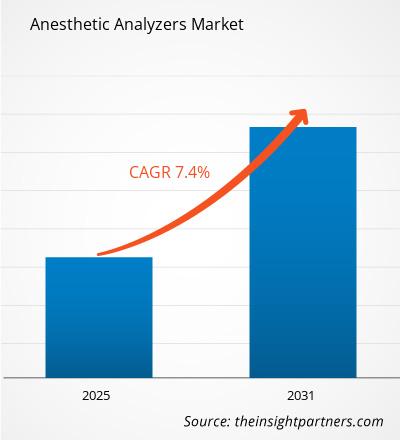
The anesthetic analyzers market is projected to grow from US$ 317.62 Million in 2025 to US$ 503.99 Million by 2034, registering a CAGR of 5.26% during 2026–2034. Demand is supported by safer anesthesia delivery, perioperative gas monitoring, biomedical equipment testing, and broader adoption of analyzers that measure oxygen, carbon dioxide, nitrous oxide, and volatile anesthetic agents across surgical and critical care environments.
North America remains a leading commercial region due to advanced operating room infrastructure, high anesthesia machine utilization, and established biomedical engineering programs. The anesthetic analyzers market size in the region is supported by hospital equipment testing cycles, patient monitoring upgrades, and demand for portable verification tools. Regional growth is expected to remain within a 4.6–5.2% CAGR range through 2034, led by the US.
Anesthetic Analyzers Market Assessment and Insights
- North America: North America accounted for 36–40% share in 2025 and is projected to grow at 4.6–5.2% CAGR between 2026–2034, supported by operating room modernization, biomedical testing protocols, and installed monitoring infrastructure.
- US: The US represented 84–88% of North America in 2025 and is expected to grow at 4.5–5.1% CAGR between 2026–2034, driven by hospitals, surgery centers, and clinical engineering departments.
- Europe: Europe held 27–31% share in 2025 and is forecast to grow at 4.4–5.0% CAGR between 2026–2034, led by Germany, the UK, France, Italy, and Spain.
- Asia Pacific: Asia Pacific captured 22–26% share in 2025 and is projected to expand at 6.1–6.8% CAGR between 2026–2034, with China, Japan, India, South Korea, and Australia leading adoption.
- Largest Segment: Stationary Anesthetic Analyzer held 61–66% market share in 2025 and is expected to grow at 4.8–5.4% CAGR between 2026–2034, reflecting use in integrated monitoring environments.
- High Growth Segment: Portable Anesthetic Analyzer accounted for 34–39% market share in 2025 and is projected to grow at 6.2–6.9% CAGR between 2026–2034, supported by mobile testing and service use.
- Key companies analyzed in detail: OSI Systems, Inc., imtmedical AG, Fritz Stephan GmbH, Criticare Technologies, Inc., HEYER Medical AG, GE HealthCare Technologies Inc., Drägerwerk AG & Co. KGaA, Koninklijke Philips N.V., Triton Electronic Systems Ltd., and Fluke Biomedical.
Source: The Insight Partners' analysis based on proprietary research, government publications, company annual reports, investor presentations, industry databases, and expert interviews.
The clinical monitoring trend is gradually changing from single gas readings to integrated modules, which include the identification of anesthetic agents, oxygen, carbon dioxide, respiratory rate, and minimal alveolar concentrations. The production trend is also moving towards compact sensor devices, water trap efficiency, easy calibration process, and compatibility with anesthesia machines. Nowadays, biomedical groups are increasingly demanding analysis machines for quick and efficient preventive maintenance.
In the future, market growth will depend on the digitalization of operating rooms, portability of test processes, and increasing the capability of anesthesia in developing countries. The Asia-Pacific region and the Middle East will contribute to installation demands due to hospital constructions, whereas in mature markets, the demand will depend on replacement and calibration needs.
Anesthetic Analyzers Market Report Scope
| Report Attribute | Details |
|---|---|
| Market size in 2025 | US$ 317.62 Million |
| Market Size by 2034 | US$ 503.99 Million |
| Global CAGR (2026 - 2034) | 5.26% |
| Historical Data | 2021-2024 |
| Forecast period | 2026-2034 |
Anesthetic Analyzers Market Analysis
The anesthetic analyzers market growth is driven by the need to verify gas concentration, detect anesthetic agent delivery errors, and maintain safe ventilation during surgical procedures. Analyzers are needed in hospitals for the monitoring of patients, checking of equipment, and adherence to internal schedules for biomedical maintenance. The demand is also driven by increasing use of low-flow anesthesia, where agent monitoring is critical.
The value chain involves IR gas sensors, paramagnetic oxygen sensors, sample tubing, water traps, analyzer module, portable testing kits, calibration gases, software, and service agreements. Factors influencing the supply include the accuracy of sensors, validation, electronics, and the hospital purchasing cycle. Customers evaluate the range of measurements, speed of responses, ability to detect mixed agents, portability, connectivity, and maintenance cost.
The anesthetic analyzers market analysis indicates a competitive landscape led by patient monitoring companies, anesthesia workstation suppliers, and biomedical test equipment specialists. GE HealthCare Technologies Inc., Drägerwerk AG & Co. KGaA, and Koninklijke Philips N.V. compete through integrated monitoring ecosystems, while Fluke Biomedical addresses preventive maintenance and equipment testing needs.
Strategic positioning is also influenced by specialized respiratory and neonatal care expertise. imtmedical AG, Fritz Stephan GmbH, HEYER Medical AG, OSI Systems, Inc., Criticare Technologies, Inc., and Triton Electronic Systems Ltd. address targeted product niches where compact design, serviceability, and clinical workflow fit matter. Vendors offering both integrated and portable solutions are better positioned for multi-site health systems.
● REPORT CUSTOMIZATION
Tailor This Report To Align With Your Specific Business Requirements
This report can be customized to align precisely with your business objectives, scope, and target markets. Customization options include tailored segmentation, geography, competitive analysis, and strategic insights to support informed decision-making.
Customize This Report →WHAT YOU CAN ADJUST
- ● Segmentations
- ● Geography
- ● Competitive Analysis
- ● Language Preferences
Anesthetic Analyzers Market: Strategic Insights
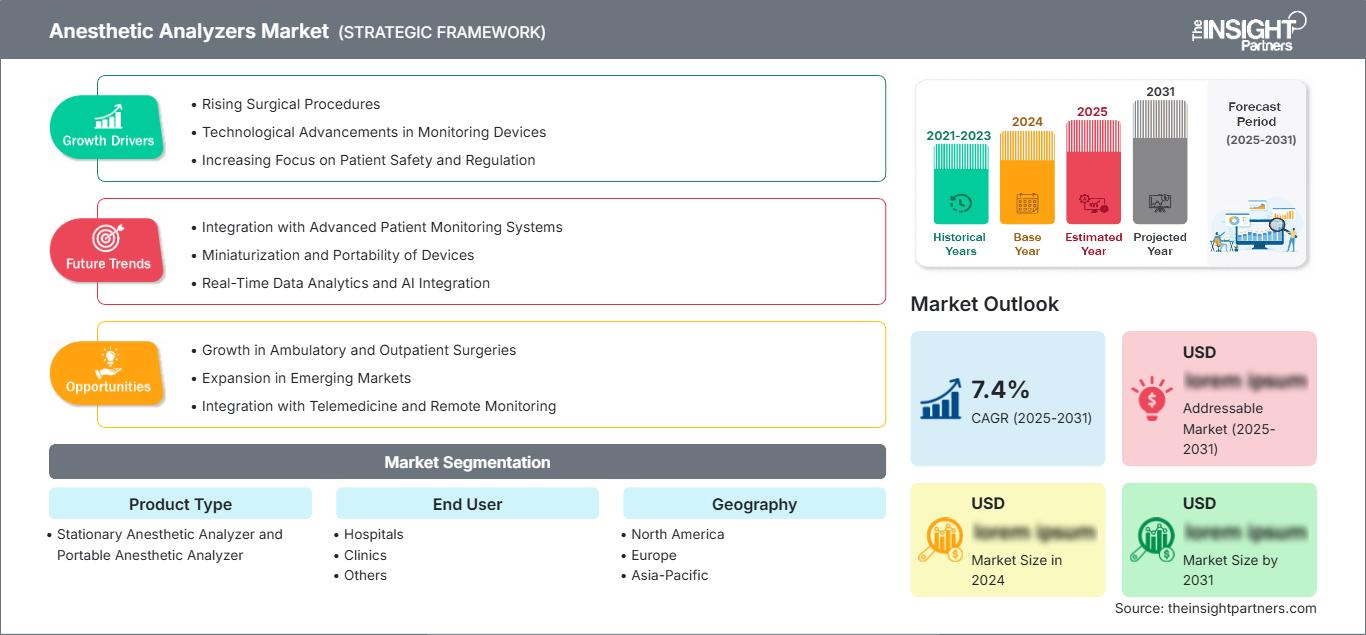
Regional Insights
North America anesthetic analyzers market
North America accounted for 36–40% share in 2025 and is projected to grow at 4.6–5.2% CAGR during 2026–2034. Demand is supported by hospitals, ambulatory surgical centers, intensive care units, and biomedical engineering departments. Mature anesthesia machine fleets create a recurring need for integrated gas monitoring modules and portable analyzers used during preventive maintenance.
The anesthetic analyzers market share in North America is reinforced by patient safety programs, equipment testing requirements, and high surgical throughput. Facilities prioritize devices that identify multiple volatile agents, measure oxygen and carbon dioxide, and support documentation. Procurement is also influenced by group purchasing, service contracts, device interoperability, and the availability of trained clinical engineering teams.
U.S. anesthetic analyzers Market
The US represented 84–88% of North America in 2025 and is expected to grow at 4.5–5.1% CAGR during 2026–2034. The factors influencing demand include hospital chains, ambulatory surgery centers, academic medical centers, and independent service organizations. Portable analyzers play a key role for biomedical teams responsible for maintaining several anesthesia machines.
Supplier influence is strong in the monitoring and testing segments. The suppliers that stand to gain from the ties hospitals maintain with them, service offerings, and equipment product line include GE HealthCare Technologies Inc., Drägerwerk AG & Co. KGaA, Koninklijke Philips N.V., Fluke Biomedical, and OSI Systems, Inc.
Europe anesthetic analyzers Market
Europe held 27–31% share in 2025 and is forecast to grow at 4.4–5.0% CAGR during 2026–2034. UK drives demand by way of the NHS OR refurbishment, patient monitoring replacement and biomedical equipment management. The buyers will continue to evaluate the analyzers' suitability for their low-flow anesthesia, traceability and ability to interface with the hospitals' IT infrastructure.
Germany continues to be the leader in Europe because of the size of the surgical market, a well-established environment for medical technology and focus on equipment reliability. Hospitals and university institutes use both stationary modules and portable instruments in order to provide safety during anesthesia procedures.
France, Italy and Spain participate via modernization of the public hospitals, development of the surgical networks and increasing ambulatory procedures. European buyers usually emphasize their demand for the CE-certified products, sensor reliability, water trap control, availability of servicing and downtime reduction. Increased attention to sustainability and lower use of anesthetic gases encourages precise measuring and low-flow procedures.
APAC anesthetic analyzers Market
Asia Pacific accounted for 22–26% share in 2025 and is expected to grow at 6.1–6.8% CAGR during 2026–2034. China leads regional demand through hospital expansion, operating room construction, and adoption of advanced anesthesia workstations. Japan and South Korea maintain demand for premium monitoring modules in tertiary hospitals.
India and Australia add growth through private hospital investment, surgical capacity expansion, and biomedical testing upgrades. Public healthcare investment and rising procedural volumes are increasing analyzer purchases. Distributor support remains important because customers require installation guidance, sensor maintenance, calibration supplies, and user training across diverse hospital tiers.
Middle East & Africa anesthetic analyzers Market
Middle East & Africa is expected to grow at 5.5–6.2% CAGR during 2026–2034. Saudi Arabia and the UAE lead demand through medical city projects, specialty hospitals, and operating room equipment upgrades. New facilities often procure gas monitoring modules as part of integrated anesthesia and patient monitoring packages.
South Africa remains the most established regional market, supported by private hospital networks, academic centers, and clinical engineering capabilities. The rest of MEA adoption is emerging through surgical infrastructure growth, international hospital partnerships, and donor-supported equipment programs. Procurement is shaped by budget cycles, distributor reliability, calibration support, and availability of trained users.
Segmentation Analysis
Product Type
Product Type is projected to grow at 5.0–5.6% CAGR during 2026–2034 as buyers balance fixed monitoring needs with mobile testing requirements. The anesthetic analyzers market scope across product type is led by stationary systems because they are embedded in operating rooms and patient monitoring platforms. Portable units are gaining traction among biomedical engineers and independent service providers.
- Stationary Anesthetic Analyzer: Stationary Anesthetic Analyzer products are preferred in operating rooms and intensive care environments where continuous agent identification, oxygen measurement, carbon dioxide monitoring, and MAC calculations support clinical decision-making.
- Portable Anesthetic Analyzer: Portable Anesthetic Analyzer products are gaining demand among biomedical teams, service organizations, and multi-site hospitals requiring rapid testing, documentation, and preventive maintenance of anesthesia delivery systems.
End User
End User is expected to grow at 5.1–5.7% CAGR during 2026–2034 as analyzer demand remains concentrated in hospitals but expands across clinics and other care settings. Hospitals dominate because they operate the largest surgical infrastructure and require continuous monitoring. Clinics are increasing purchases as outpatient procedures and sedation services expand.
- Hospitals: Hospitals generate the highest demand because operating rooms, recovery departments, critical care units, and biomedical engineering teams require accurate gas monitoring and routine anesthesia machine performance verification.
- Clinics: Clinics use analyzers in outpatient procedure rooms, specialty surgery centers, and sedation settings where compact monitoring and equipment confidence are important for safe anesthesia delivery.
Opportunity Snapshot
| Segment Name | Revenue Contribution | Trend Tag | Adoption Stage |
| Hospitals | High | OR Monitoring | Mature |
| Clinics | Medium | Outpatient Sedation | Scaling |
| Others | Low | Service Testing | Emerging |
Anesthetic Analyzers Market Growth Drivers and Impact Analysis
Rising Emphasis on Safe Anesthetic Gas Monitoring
Confirmation of the correct levels of oxygen, carbon dioxide, nitrous oxide, and volatile anesthetics is necessary in clinical teams during anesthesia administration. Anesthetic analyzers assist in lowering risks associated with incorrect agent concentration, hypoventilation, disconnections, and accidental changes in anesthetic delivery. This driver is more evident in cases where there are high volumes of surgeries done in a hospital setting. The market effects include continuous replacements and increasing integration of monitoring systems. Suppliers who provide prompt responses, automated agent identification, trend analysis, and performance of water traps have advantages in procurement preferences.
Growth in Preventive Maintenance and Biomedical Testing
There is growth in preventive maintenance activities of anesthesia machines, ventilators, and gas delivery systems among the biomedical engineering departments. The analyzers are important to confirm the effectiveness of the vaporizer, the flow, pressure, oxygen, and anesthetic agent concentrations at scheduled intervals. This is the driver that will lead to increased demand from non-clinical users because the service companies and hospital engineering departments require the analyzers that are portable and can integrate with automated reporting systems. The business opportunity is seen in the purchase of test instruments, calibration gases, and accessories, among others.
Expansion of Outpatient and Specialty Procedure Environments
Settings such as ambulatory surgeries, endoscopy centers, dental sedation facilities, ophthalmologic practices, and specialty clinics are growing the number of care facilities at which anesthesia or sedation is provided. Such locations require portable monitors or module systems that allow for the provision of patient monitoring in a safe way, but without having to rely on all the technology infrastructure that exists in large hospitals. There is an additional increase due to the standardization of safety procedures among providers working in outpatient environments. The greatest effect is experienced by clinic operators who are looking for reliable equipment but do not have a large technical staff.
Anesthetic Analyzers Market Future Trends
Integrated Gas Analytics Within Connected Perioperative Platforms
Integrated gas monitoring will be one of the key anesthetic analyzer market trends as operating rooms become more connected and data-driven. Future systems will increasingly combine gas concentration, agent identification, respiratory parameters, alarms, and trend data into broader perioperative monitoring platforms. This will help clinicians view anesthetic delivery alongside ventilation, hemodynamics, and patient status. Demand will be strongest in hospitals upgrading monitoring networks and anesthesia workstations. Suppliers that enable interoperability, automated documentation, and intuitive display formats will gain an advantage as buyers seek fewer standalone devices and more unified clinical workflows.
Portable Testing Devices Become More Workflow-Automated
Portables will gradually offer automatic test setups, digital results, cloud logging, and workflows to help biomedical engineering teams. It is a way to cope with labor shortages because more devices need testing and fewer technical personnel are available. Future portables will focus on faster setup, automatic agent recognition, built-in checklists, and calibration management simplification. Such a trend will become apparent in multi-hospital complexes where standardized documentation is required. Companies that provide accurate measurements along with workflow software will benefit from customer loyalty and additional revenue via services.
Anesthetic Analyzers Market Opportunities
Hospital Network Standardization of Monitoring Modules
Large health systems create a strong opportunity by standardizing anesthetic gas monitoring across operating rooms, intensive care units, and ambulatory sites. The anesthetic analyzers market Forecasts indicate that buyers will favor suppliers offering consistent measurement performance, shared modules, simple water trap management, and integration with existing monitors. Standardization reduces staff training variation and simplifies spare part inventories. Vendors can expand account penetration by bundling analyzers with patient monitors, anesthesia workstations, service contracts, and training. The strongest opportunity lies in replacement programs where health systems seek interoperability and lifecycle cost control.
Biomedical Service Providers Need Advanced Portable Test Tools
Independent service organizations and hospital biomedical teams represent a growing opportunity for portable anesthetic analyzers. These users require rugged devices that can test multiple anesthesia machines, generate reports, and support compliance documentation. Demand is strongest where equipment fleets are distributed across operating rooms, ambulatory centers, and satellite clinics. Suppliers can differentiate through automated workflows, onboard memory, software connectivity, and strong technical support. Portable tools also open aftermarket opportunities through calibration services, accessories, and software subscriptions. Vendors that reduce test time while improving documentation quality can capture recurring demand from technical service customers.
Recent Developments
- October 2025: GE HealthCare Technologies Inc. introduced new patient monitoring and anesthesia solutions, including the Carestation 850 anesthesia device designed for high-acuity settings. The launch emphasized automation, decision support, connectivity, and workflow efficiency, reflecting demand for advanced perioperative systems that integrate anesthesia delivery and monitoring capabilities.
- October 2025: Drägerwerk AG & Co. KGaA participated with Ascom and B. Braun in a Silent ICU solution that reroutes bedside medical device alarms to dashboards and mobile devices. The development reflects the broader movement toward connected monitoring workflows, alarm management, and integrated clinical communication across high-acuity care environments.
- January 2025: Fluke Biomedical continued to position its VT900A Gas Flow Analyzer with VAPOR Anesthesia Tester as a complete anesthesia machine preventive maintenance solution. The system supports anesthetic agent auto-detection, concentration measurement, customized test profiles, onboard memory, automatic reports, and OneQA workflow automation for biomedical teams.
Frequently Asked Questions

- Comprehensive Market Sizing and Forecast Analysis
- Detailed Segmentation Analysis
- In-Depth Market Dynamics Assessment
- Regional and Country-Level Insights
- Competitive Landscape and Company Benchmarking
- Strategic Business Intelligence
Recent Reports
Testimonials

The Insight Partners provided valuable market intelligence that supported our global go-to-market strategy. Their team was professional, responsive, and attentive to our feedback, providing thoughtful analysis and helpful methodological clarifications throughout the project.
Junmo Kim Chief Financial Officer (CFO), Enertech Co., Ltd.
The Insight Partners' SCADA System Market report is comprehensive, with valuable insights on current trends and future forecasts. The team was highly professional, responsive, and supportive throughout. We are very satisfied and highly recommend their services.
RAN KEDEM Partner, Reali Technologies LTDs
I requested a report on a very specific software market and the team produced the report in a few days. The information was very relevant and well presented. I then requested some changes and additions to the report. The team was again very responsive and I got the final report in less than a week.
JEAN-HERVE JENN Chairman, Future Analytica
We worked with The Insight Partners for an important market study and forecast. They gave us clear insights into opportunities and risks, which helped shape our plans. Their research was easy to use and based on solid data. It helped us make smart, confident decisions. We highly recommend them.
PIYUSH NAGPAL Sr. Vice President, High Beam Global
The Insight Partners delivered insightful, well-structured market research with strong domain expertise. Their team was professional and responsive throughout. The user-friendly website made accessing industry reports seamless. We highly recommend them for reliable, high-quality research services
YUKIHIKO ADACHI CEO, Deep Blue, LLC.
This is the first time I have purchased a market report from The Insight Partners.While I was unsure at first, I visited their web site and felt more comfortable to take the risk and purchase a market report.I am completely satisfied with the quality of the report and customer service. I had several questions and comments with the initial report, but after a couple of dialogs over email with their analyst I believe I have a report that I can use as input to our strategic planning process.Thank you so much for taking the extra time and making this a positive experience.I will definitely recommend your service to others and you will be my first call when we need further market data.
JOHN SUZUKI President and Chief Executive Officer, Board Director, BK Technologies
I wish to appreciate your support and the professionalism you displayed in the course of attending to my request for information regarding to infectious disease IVD market in Nigeria. I appreciate your patience, your guidance, and the fact that you were willing to offer a discount, which eventually made it possible for us to close a deal. I look forward to engaging The Insight Partners in the future, all thanks to the impression you have created in me as a result of this first encounter.
DR CHIJIOKE ONYIA MANAGING DIRECTOR, PineCrest Healthcare Ltd.Reason to Buy
- Informed Decision-Making
- Understanding Market Dynamics
- Competitive Analysis
- Identifying Emerging Markets
- Customer Insights
- Market Forecasts
- Risk Mitigation
- Boosting Operational Efficiency
- Strategic Planning
- Investment Justification
- Tracking Industry Innovations
- Aligning with Regulatory Trends





 Get Free Sample for