
Anesthetic Apparatus Professional Market Size, Share & Demand by 2034
Coverage: By Type (general and local); Application (cardiology, neurology, dental, ophthalmology, urology, and orthopedic) And , and by Geography (North America, Europe, Asia Pacific, and South and Central America)
- Status : Data Released
- Report Code : TIPRE00026513
- Category : Life Sciences
- No. of Pages : 150
- Available Report Formats :


- Last update date : August 03, 2026


2025 Market Size
US$ 18.76 Bn
Base year value
2034 Forecast
US$ 35.18 Bn
Projected by 2034
CAGR 2026-2034
7.24 %
Growth rate
Addressable Market
US$ 243.39 Bn
(2026-2034)
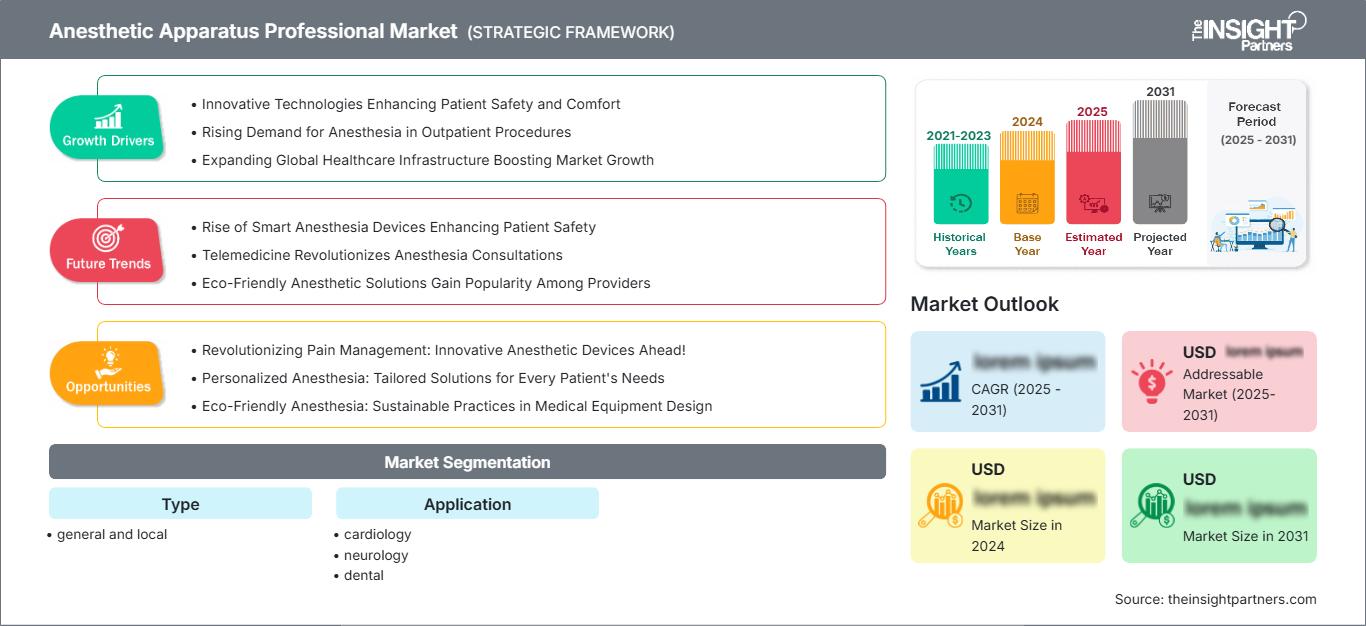
The Anesthetic Apparatus Professional market was valued at US$ 18.76 billion in 2025 and is expected to reach US$ 35.18 billion by 2034; it is estimated to record a CAGR of 7.24% during 2026-2034.
Anesthetic Apparatus Professional Market Assessment and Insights
- North America: North America accounted for 36–40% share in 2025 and is projected to grow at 7.4–8.0% CAGR between 2026–2034, supported by complex surgical volumes, ambulatory procedure migration, and connected anesthesia platform adoption.
- US: The US represented 84–88% of North America in 2025 and is expected to grow at 7.3–7.9% CAGR between 2026–2034, driven by hospitals, specialty surgery centers, and outpatient procedural care.
- Europe: Europe held 25–29% share in 2025 and is forecast to grow at 7.0–7.6% CAGR between 2026–2034, led by Germany, the UK, France, Italy, and Spain.
- Asia Pacific: Asia Pacific captured 24–28% share in 2025 and is projected to expand at 9.0–9.8% CAGR between 2026–2034, with China, India, Japan, South Korea, and Australia leading adoption.
- Largest Segment: General anesthesia held 62–67% market share in 2025 and is expected to grow at 7.8–8.5% CAGR between 2026–2034, reflecting higher use in complex surgery.
- High Growth Segment: Orthopedic applications accounted for 18–23% market share in 2025 and are projected to grow at 9.1–9.9% CAGR between 2026–2034, supported by aging populations and joint procedures.
- Key companies analyzed in detail: GE HealthCare Technologies Inc., Becton, Dickinson and Company, Smiths Group plc, Ambu A/S, Teleflex Incorporated, Ventlab, LLC, Drägerwerk AG & Co. KGaA, SunMed LLC, 3M Company, and AirSep Corporation.
Source: The Insight Partners' analysis based on proprietary research, government publications, company annual reports, investor presentations, industry databases, and expert interviews.
The market for clinical apparatus is gradually moving away from standalone anesthesia machines towards apparatus ecosystems encompassing gas delivery devices, airway access equipment, patient interfaces, regional anesthesia apparatus, circuits, and oxygen equipment. The production trends will focus on modularity, disposability of airway apparatus, smart vaporizers, cybersecurity-enabled workstations and manufacturing scalable consumables. Hospitals will start evaluating apparatus based on its workflow value, range of patients, supply continuity and compatibility with perioperative connected platforms.
Future demands will include growth in outpatient surgeries, increased use of regional anesthesia and capacity additions in developing countries. In the Asia Pacific region, hospitals will create new surgery rooms, while North America and Europe will need to replace old systems. Procurements will increasingly favor platforms that enable rapid setup, safe ventilation, reduce waste, facilitate interoperable monitoring and consistent clinical workflows.
Anesthetic Apparatus Professional Market Analysis
The anesthetic apparatus professional market growth is driven by rising surgical procedures, increasing minimally invasive interventions, and wider access to specialty care. General anesthesia equipment is critical to high-acuity procedures, whereas local and regional anesthesia equipment helps to facilitate shorter hospitalization periods, better pain management, and the efficiency of procedures performed outside hospitals. Growing demand for the equipment is driven by aging populations that need treatments in the fields of orthopedics, urology, cardiology, and ophthalmology.
The value chain covers anesthetic delivery equipment, regional anesthesia needles, masks, breathing tubes, oxygenators, valves, filters, tubes, accessories, and maintenance services. Production issues revolve around electronics, medical polymers, sterilization, and logistics of equipment distribution across the globe. The buyers pay attention to the reliability of equipment, its availability, training, and lifecycle costs.
The anesthetic apparatus professional market analysis indicates competition across broad equipment suppliers and consumable specialists. GE HealthCare Technologies Inc. and Drägerwerk AG & Co. KGaA compete through anesthesia workstations, software, and monitoring integration, while Becton, Dickinson and Company supports regional anesthesia through spinal, epidural, and tray portfolios.
Strategic positioning can be impacted by airway management as well as perioperative consumables. Products related to masks, circuits, airway access, and respiratory support include Ambu A/S, Teleflex Incorporated, SunMed LLC, Ventlab, LLC, and Smiths Group plc. 3M Company plays an important role in the area of perioperative consumables, and AirSep Corporation adds strength to oxygen supply capabilities.
Anesthetic Apparatus Professional Market Report Scope
| Report Attribute | Details |
|---|---|
| Market size in 2025 | US$ 18.76 Billion |
| Market Size by 2034 | US$ 35.18 Billion |
| Global CAGR (2026 - 2034) | 7.24% |
| Historical Data | 2021-2024 |
| Forecast period | 2026-2034 |
Anesthetic Apparatus Professional Market Analysis
The anesthetic apparatus professional market growth is driven by rising surgical procedures, increasing minimally invasive interventions, and wider access to specialty care. General anesthesia equipment is critical to high-acuity procedures, whereas local and regional anesthesia equipment helps to facilitate shorter hospitalization periods, better pain management, and the efficiency of procedures performed outside hospitals. Growing demand for the equipment is driven by aging populations that need treatments in the fields of orthopedics, urology, cardiology, and ophthalmology.
The value chain covers anesthetic delivery equipment, regional anesthesia needles, masks, breathing tubes, oxygenators, valves, filters, tubes, accessories, and maintenance services. Production issues revolve around electronics, medical polymers, sterilization, and logistics of equipment distribution across the globe. The buyers pay attention to the reliability of equipment, its availability, training, and lifecycle costs.
The anesthetic apparatus professional market analysis indicates competition across broad equipment suppliers and consumable specialists. GE HealthCare Technologies Inc. and Drägerwerk AG & Co. KGaA compete through anesthesia workstations, software, and monitoring integration, while Becton, Dickinson and Company supports regional anesthesia through spinal, epidural, and tray portfolios.
Strategic positioning can be impacted by airway management as well as perioperative consumables. Products related to masks, circuits, airway access, and respiratory support include Ambu A/S, Teleflex Incorporated, SunMed LLC, Ventlab, LLC, and Smiths Group plc. 3M Company plays an important role in the area of perioperative consumables, and AirSep Corporation adds strength to oxygen supply capabilities.
● REPORT CUSTOMIZATION
Tailor This Report To Align With Your Specific Business Requirements
This report can be customized to align precisely with your business objectives, scope, and target markets. Customization options include tailored segmentation, geography, competitive analysis, and strategic insights to support informed decision-making.
Customize This Report →WHAT YOU CAN ADJUST
- ● Segmentations
- ● Geography
- ● Competitive Analysis
- ● Language Preferences
Anesthetic Apparatus Professional Market: Strategic Insights
Regional Insights
North America anesthetic apparatus professional market
North America accounted for 36–40% share in 2025 and is projected to grow at 7.4–8.0% CAGR during 2026–2034. Demand is supported by high surgical volumes, advanced operating room networks, ambulatory surgery expansion, and strong procurement of anesthesia workstations and airway consumables. Hospitals are replacing older platforms with connected and workflow-efficient systems. The anesthetic apparatus professional market share in North America is reinforced by established clinical engineering programs, group purchasing organizations, and strong vendor service networks. Facilities prioritize smart vaporization, low-flow anesthesia capability, disposable airway products, and regional anesthesia trays. Orthopedic, cardiology, and urology procedures support recurring demand for both general and local apparatus.
U.S. anesthetic apparatus professional Market
The US represented 84–88% of North America in 2025 and is expected to grow at 7.3–7.9% CAGR during 2026–2034. Demand is driven by large hospital networks, outpatient surgery centers, cardiac catheterization suites, dental anesthesia facilities, and specialty intervention centers. Procedure migration into ambulatory sites is increasing the demand for compact and standardized products. The supplier base is extensive, with GE HealthCare Technologies Inc., Drägerwerk AG & Co. KGaA, Becton, Dickinson and Company, Teleflex Incorporated, SunMed LLC, and Ambu A/S maintaining strong hospital and distributor access. US buyers emphasize uptime, smart alarms, supply resilience, disposable availability, and compatibility with electronic medical record-connected perioperative workflows.
Europe anesthetic apparatus professional Market
Europe held 25–29% share in 2025 and is forecast to grow at 7.0–7.6% CAGR during 2026–2034. The UK supports demand through surgical waiting list reduction, NHS theater modernization, and rising day-surgery activity. Buyers focus on low-flow anesthesia, consumable standardization, and compliance with medical device requirements. Germany remains the leading European country due to its large hospital base, advanced perioperative infrastructure, and strong adoption of integrated anesthesia systems. Domestic influence from Drägerwerk AG & Co. KGaA reinforces regional technology access, while university hospitals continue deploying advanced platforms. France, Italy, and Spain contribute through public hospital upgrades, private clinic expansion, and growth in orthopedic, ophthalmic, and urologic procedures. European procurement increasingly weighs sustainability, device interoperability, clinician ergonomics, and long-term maintenance support alongside price and clinical performance.
APAC anesthetic apparatus professional Market
Asia Pacific accounted for 24–28% share in 2025 and is expected to grow at 9.0–9.8% CAGR during 2026–2034. China leads regional demand through hospital construction, surgical suite expansion, and procurement of advanced anesthesia equipment. India is accelerating adoption through private hospital chains and expanding health insurance coverage. Japan and South Korea maintain premium demand in advanced hospitals, while Australia supports stable replacement and outpatient procedure expansion. Regional growth is supported by infrastructure investment, rising specialist availability, and higher procedure volumes. Distributor strength remains important because installation, consumables supply, and after-sales support influence purchasing decisions.
Middle East & Africa anesthetic apparatus professional Market
Middle East & Africa is expected to grow at 7.6–8.4% CAGR during 2026–2034. Saudi Arabia and the UAE lead demand through medical city projects, specialty hospitals, and surgical capacity expansion. New facilities often procure complete anesthesia systems, airway products, and oxygen support infrastructure together. South Africa remains the most developed regional market, supported by private hospitals, academic centers, and specialty procedure demand. The rest of MEA adoption is emerging through hospital refurbishment, public healthcare investment, and international healthcare partnerships. Procurement is shaped by tenders, financing capacity, distributor support, and the need for durable products in high-utilization environments.
Segmentation Analysis
Type
Type is projected to grow at 7.9–8.6% CAGR during 2026–2034 as healthcare providers optimize anesthesia selection for procedure complexity, recovery profile, and care setting. The anesthetic apparatus professional market scope across types is led by general anesthesia for complex surgery, while local and regional techniques gain traction in outpatient, orthopedic, dental, and ophthalmology procedures.
- general: General anesthesia apparatus remains central to high-acuity surgery because complex cardiology, neurology, urology, and orthopedic procedures require controlled airway management, ventilation, and continuous anesthetic delivery.
- local: Local anesthesia products are expanding with ambulatory procedures, regional blocks, and pain management workflows where targeted anesthesia supports faster recovery and shorter facility stays.
Application
Application is expected to grow at 8.0–8.7% CAGR during 2026–2034 as anesthesia requirements broaden across procedure-specific environments. Cardiology and neurology require high-control platforms, while dental and ophthalmology drive compact apparatus demand. Orthopedic procedures are expanding rapidly because aging populations and joint interventions require general, local, and regional anesthesia options.
- cardiology: Cardiology applications require reliable anesthesia support for interventional, electrophysiology, and surgical procedures where hemodynamic stability and monitoring integration are critical.
- neurology: Neurology procedures require precise anesthesia control, airway security, and monitoring compatibility because patient response, ventilation, and recovery assessment are clinically sensitive.
- dental: Dental applications are expanding through office-based sedation, maxillofacial surgery, and pediatric dental anesthesia, creating demand for compact apparatus and airway consumables.
- ophthalmology: Ophthalmology procedures use local and monitored anesthesia care frequently, emphasizing patient comfort, fast turnover, and reliable oxygenation support in outpatient settings.
- urology: Urology applications benefit from regional and general anesthesia across endoscopic, oncology, and reconstructive procedures requiring flexible equipment and efficient perioperative workflows.
- orthopedic: Orthopedic demand is rising through joint replacement, trauma care, sports medicine, and regional block adoption, making it a major growth application for anesthesia apparatus suppliers.
Opportunity Snapshot
| Segment Name | Revenue Contribution | Trend Tag | Adoption Stage |
|---|---|---|---|
| Cardiology | High | Cath Lab | Mature |
| Neurology | Medium | Precision Care | Scaling |
| Dental | Medium | Office Sedation | Scaling |
| Ophthalmology | Medium | Day Surgery | Mature |
| Urology | Medium | Endoscopic Care | Scaling |
| Orthopedic | High | Joint Care | Scaling |
Anesthetic Apparatus Professional Market Growth Drivers and Impact Analysis
Rising Surgical Complexity and Procedure Volumes
The healthcare system has become increasingly complicated in its processes in cardiology, neurology, orthopedics, urology, and ophthalmology, which has caused a high need for the use of anesthesia systems, breathing systems, circuits, and regional anesthesia solutions. Older patients require more ventilator control and recovery monitoring, which has led to the significance of the proper functioning of equipment. This effect has been seen through operating room replacements, increased sales of consumables, and the need for specialty-specific equipment. Companies offering an integration of workstations, masks, circuits, regional solutions, and oxygen delivery would be able to increase account sizes.
Expansion of Ambulatory and Office-Based Anesthesia
A larger proportion of surgeries in dentistry, ophthalmology, orthopedics, pain management, and urology are being performed in ambulatory surgical centers and office-based locations. They need equipment that is effective yet space-saving to administer safe anesthesia in an environment that lacks a complete hospital facility. There is a rising need for portable oxygen supply units, disposables for airways, regional anesthesia kits, and easy-to-use monitoring compatible devices. It has implications for a wider variety of clients apart from tertiary care hospitals. Companies offering value-for-money packages along with training assistance and distributor-based replenishment can gain.
Technology Modernization in Anesthesia Workflows
Modern anesthesia systems have been installed to enhance workflow, ensure patients' safety, and facilitate data exchange. Contemporary workstations allow intelligent vaporization, end-tidal management, ventilation, cybersecurity, and better usability. As a result, there is a need not only for modernized equipment but also for consumables, airway devices, oxygen systems, and regional anesthesia devices. The effect on the market will be increased tender value and better cooperation after sales. Manufacturers with platforms and accessories that can be upgraded are well-prepared to help the hospitals that face staff shortages and the growing complexity of procedures.
Anesthetic Apparatus Professional Market Future Trends
Connected Anesthesia Platforms Reshape Perioperative Workflows
Connected platforms will be among the most important anesthetic apparatus professional market trends as hospitals shift toward integrated perioperative data environments. The devices of the future will see greater integration of anesthesia delivery, ventilations, gases, alarms, and patient monitoring on common screens and clinical records. This will decrease paperwork and increase situational awareness. It will also allow for standardization of care protocols. The use of such devices will occur in the high acuity hospitals and in the large ambulatory care networks. Suppliers that can integrate hardware, software, cyber security, and support will have an edge.
Regional and Local Anesthesia Gain Strategic Importance
Local and regional anesthesia shall take a significant strategy role as healthcare facilities strive for quick recovery, less opioids, and shorter stays. Surgical departments like orthopedics, dental surgery, ophthalmology, and urology shall increasingly utilize regional anesthesia wherever applicable. This shall drive the demand for needles, trays, syringes, ultrasound-compatible items, and kits. The trend shall not diminish the demand for general anesthesia equipment, but expand the range of procurements. Companies that produce both general anesthesia and regional anesthesia products can offer their services to the entire clinical pathway.
Anesthetic Apparatus Professional Market Opportunities
Integrated Procurement for Multi-Site Health Systems
Large health systems represent a strong opportunity because they increasingly standardize anesthesia apparatus, airway products, and regional anesthesia supplies across hospitals and ambulatory centers. The anesthetic apparatus professional market Forecasts indicate that multi-site buyers will favor suppliers offering compatible platforms, bundled consumables, service contracts, and training support. Standardization can reduce staff variation, simplify inventories, and improve maintenance planning. Vendors should target enterprise agreements that include operating rooms, procedure suites, dental anesthesia sites, and specialty surgery centers. Long-term value will come from installed-base retention and recurring consumables demand.
Emerging Market Surgical Infrastructure Expansion
The developing nations are establishing surgical suites, specialized hospitals, and clinics that perform procedures. There is therefore a need for anesthesia equipment kits in the market. The Asia-Pacific region, the Gulf, and some countries in Africa offer great opportunities since the newly established hospitals will have to install anesthesia workstations, oxygen units, circuits, masks, and regional anesthesia devices, among others. Companies can get early specifications from hospital planners, distributors, and biomedical engineers. Issues like training, installation, spare parts, and financing will be vital. Companies that can give durable equipment and consumables will establish a position in the market.
Recent Developments
- October 2025: GE HealthCare Technologies Inc. unveiled the Carestation 850 anesthesia delivery system at ANESTHESIOLOGY 2025. The system features a 22-inch display, smart vaporization, end-tidal control, upgradeable design, and tools intended to support low-flow anesthesia, clinical precision, workflow efficiency, and future-ready perioperative care.
- August 2025: Drägerwerk AG & Co. KGaA announced that its Atlan A350 and A350 XL anesthesia workstations received Authority to Operate certification under the US Department of Defense Risk Management Framework. The certification supports cybersecurity, interoperability, continuous monitoring, and secure integration with hospital networks and electronic medical records.
- March 2025: Becton, Dickinson and Company updated its US regional anesthesia portfolio materials, highlighting BD spinal needles, epidural trays, combined spinal epidural trays, and a position as the top-selling spinal needle portfolio in the US. The portfolio supports regional anesthesia procedures with multiple needle and tray configurations.
Frequently Asked Questions

- Comprehensive Market Sizing and Forecast Analysis
- Detailed Segmentation Analysis
- In-Depth Market Dynamics Assessment
- Regional and Country-Level Insights
- Competitive Landscape and Company Benchmarking
- Strategic Business Intelligence
Recent Reports
Testimonials

The Insight Partners provided valuable market intelligence that supported our global go-to-market strategy. Their team was professional, responsive, and attentive to our feedback, providing thoughtful analysis and helpful methodological clarifications throughout the project.
Junmo Kim Chief Financial Officer (CFO), Enertech Co., Ltd.
The Insight Partners' SCADA System Market report is comprehensive, with valuable insights on current trends and future forecasts. The team was highly professional, responsive, and supportive throughout. We are very satisfied and highly recommend their services.
RAN KEDEM Partner, Reali Technologies LTDs
I requested a report on a very specific software market and the team produced the report in a few days. The information was very relevant and well presented. I then requested some changes and additions to the report. The team was again very responsive and I got the final report in less than a week.
JEAN-HERVE JENN Chairman, Future Analytica
We worked with The Insight Partners for an important market study and forecast. They gave us clear insights into opportunities and risks, which helped shape our plans. Their research was easy to use and based on solid data. It helped us make smart, confident decisions. We highly recommend them.
PIYUSH NAGPAL Sr. Vice President, High Beam Global
The Insight Partners delivered insightful, well-structured market research with strong domain expertise. Their team was professional and responsive throughout. The user-friendly website made accessing industry reports seamless. We highly recommend them for reliable, high-quality research services
YUKIHIKO ADACHI CEO, Deep Blue, LLC.
This is the first time I have purchased a market report from The Insight Partners.While I was unsure at first, I visited their web site and felt more comfortable to take the risk and purchase a market report.I am completely satisfied with the quality of the report and customer service. I had several questions and comments with the initial report, but after a couple of dialogs over email with their analyst I believe I have a report that I can use as input to our strategic planning process.Thank you so much for taking the extra time and making this a positive experience.I will definitely recommend your service to others and you will be my first call when we need further market data.
JOHN SUZUKI President and Chief Executive Officer, Board Director, BK Technologies
I wish to appreciate your support and the professionalism you displayed in the course of attending to my request for information regarding to infectious disease IVD market in Nigeria. I appreciate your patience, your guidance, and the fact that you were willing to offer a discount, which eventually made it possible for us to close a deal. I look forward to engaging The Insight Partners in the future, all thanks to the impression you have created in me as a result of this first encounter.
DR CHIJIOKE ONYIA MANAGING DIRECTOR, PineCrest Healthcare Ltd.Reason to Buy
- Informed Decision-Making
- Understanding Market Dynamics
- Competitive Analysis
- Identifying Emerging Markets
- Customer Insights
- Market Forecasts
- Risk Mitigation
- Boosting Operational Efficiency
- Strategic Planning
- Investment Justification
- Tracking Industry Innovations
- Aligning with Regulatory Trends





 Get Free Sample for