
Animal Microchip Implant Market Growth, Share & Trends by 2034
Animal Microchip Implant Market Size and Forecasts (2021–2034), Global and Regional Share, Trends, and Growth Opportunity Analysis Report Coverage : by Animal Type (Dogs, Cats, Horses); Scanner Type (134.2 kHz, 125 KHz, 128 KHz); End User (Veterinary Healthcare Facilities, Breeders); and Geography (North America, Europe, Asia Pacific, and South and Central America)
- Status : Data Released
- Report Code : TIPRE00040837
- Category : Life Sciences
- No. of Pages : 150
- Available Report Formats :


- Last update date : August 05, 2026


2025 Market Size
US$ 3.22 Bn
Base year value
2034 Forecast
US$ 6.6 Bn
Projected by 2034
CAGR 2026-2034
9.39 %
Growth rate
Addressable Market
US$ 46.62 Bn
(2026-2034)
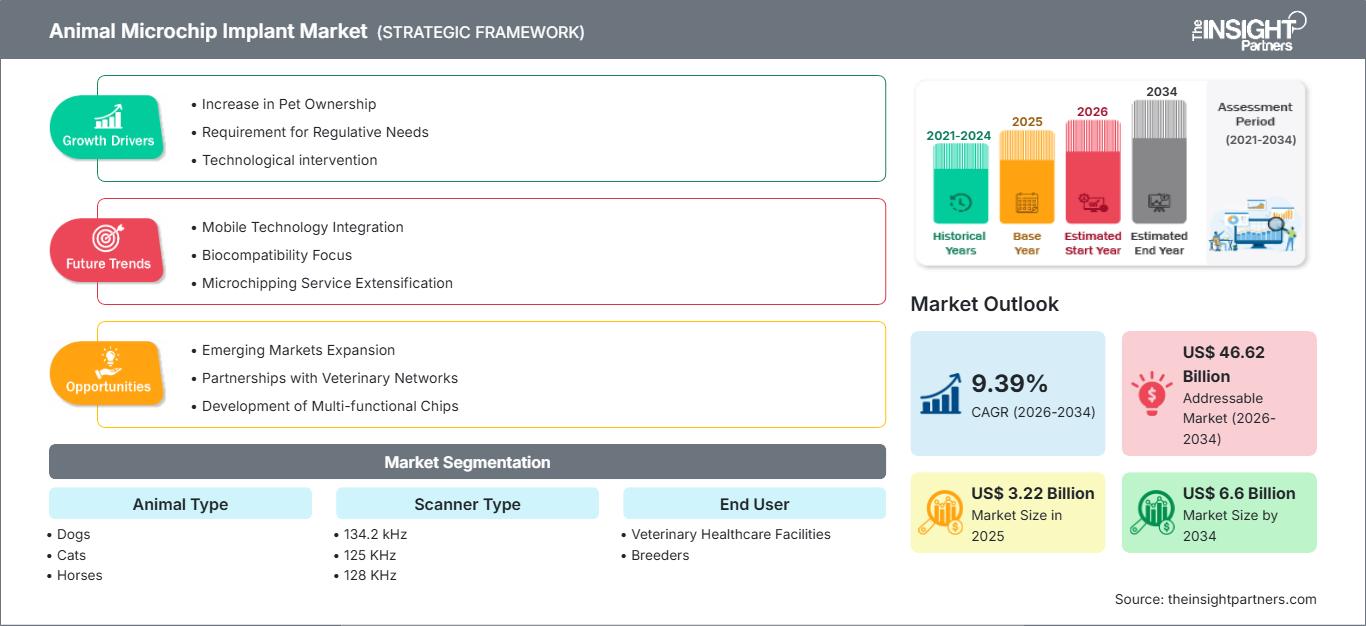
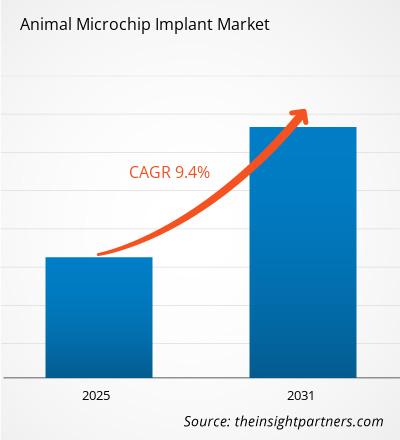
The animal microchip implant market size is estimated to increase from US$ 3.22 Billion in 2025 to US$ 6.6 Billion by 2034 at a compound annual growth rate (CAGR) of 9.39% during 2026–2034. The growth is fueled by rising pet ownerships, mandatory microchip policies, breeder cooperation, permanent identification of pets, and increased usage of scanners in veterinary hospitals, shelters, horse stables, and animal welfare networks.
North America continues to be one of the major regions in terms of market adoption where market size growth is driven by the compound annual growth rate of 8.7% to 9.3% in 2026-2034. Growth factors include availability of veterinary care services, recovery databases, animal shelter entry policies, and requirement for ISO 134.2 kHz microchips for effective recovery of dogs, cats, and horses.
Animal Microchip Implant Market Assessment and Insights
- North America held 36–39% share in 2025 and is projected to grow at a CAGR between 2026–2034 of 8.7–9.3%, supported by pet recovery registries, shelter scanning practices, and high veterinary procedure penetration.
- US accounted for 80–83% of North America in 2025 and is projected to grow at a CAGR between 2026–2034 of 8.8–9.4%, led by veterinary healthcare facilities.
- Europe represented 28–31% share in 2025 and is projected to grow at a CAGR between 2026–2034 of 8.1–8.7%, with the UK, Germany, France, Italy, and Spain leading compliance-linked adoption.
- Asia Pacific captured 22–25% share in 2025 and is projected to grow at a CAGR between 2026–2034 of 10.3–11.0%, led by China, Japan, South Korea, India, and Australia.
- Largest Segment Dogs held 51–55% market share in 2025 and are projected to grow at a CAGR range of 9.1–9.7% during 2026–2034 due to ownership scale.
- High Growth Segment Cats held 31–35% market share in 2025 and are projected to grow at a CAGR range of 10.0–10.8% during 2026–2034, supported by mandatory identification.
- Key companies analyzed in detail: Merck & Co., Inc., Peeva Inc., Virbac S.A., ID Tech Solutions, Dipole RFID, Trovan Ltd., Wuxi Fofia Technology Co., Ltd., Avid Identification Systems, Inc., Datamars SA, Pethealth Inc.
Source: The Insight Partners' analysis based on proprietary research, government publications, company annual reports, investor presentations, industry databases, and expert interviews.
Technological advancements have pushed the animal microchip implant market from merely simple identifiers into more integrated systems that provide identification using ISO-compliant microchips, universal scanners, databases in the cloud, and digital processes for pet recovery. The production process has shifted its focus on biocompatible glass, anti-migration coatings, sterilized implanters, micro-miniaturization of the chip, and scanner compatibility. Products are being evaluated based on read accuracy, database connections, needle size, registration ease, and ownership data accuracy.
Future demand trends include compulsory microchipping of cats, rules for animal transportation, breeder registration and disclosure, and upgrading of municipal shelters. Increased investment is anticipated in the Asia Pacific region, Latin America, and the Middle East due to increased urban pet population. Regulatory headwinds will include frequency standardization, registry approval, and scanner process to decrease time lost in handling and increase accountability in various veterinary, breeder, rescue, and animal control settings.
Animal Microchip Implant Market Report Scope
| Report Attribute | Details |
|---|---|
| Market size in 2025 | US$ 3.22 Billion |
| Market Size by 2034 | US$ 6.6 Billion |
| Global CAGR (2026 - 2034) | 9.39% |
| Historical Data | 2021-2024 |
| Forecast period | 2026-2034 |
Animal Microchip Implant Market Analysis
Increased demand is being driven by pet humanization trends, the requirement to get pets reunited with their owners from animal shelters, pet travel laws, and animal welfare legislation. Growth of the market for animal microchipping devices is the fastest in regions where pet identification through microchips is performed on a regular basis and is a part of the standard care, as opposed to being an additional service.
The industry participants include producers of RFID chips, sterile implanter assemblers, scanners suppliers, chip registration companies, veterinary distributors, breeders, veterinary clinics, animal shelters, and animal welfare organizations. While the market supply situation is improving due to standardization of 134.2 kHz products and making the RFID chips compatible with ISO 11784 and ISO 11785 standards, fragmentation of registries, inaccurate or obsolete information regarding owners' contact details, and uneven distribution of scanners still pose challenges for suppliers.
Positioning depends on the scope of database, veterinary relationships, scanner compatibility, and clinical applicability. In the light of the animal microchip implant market report, Merck & Co., Inc., Virbac S.A., Datamars SA, Avid Identification Systems, Inc., Trovan Ltd., and Pethealth Inc. position themselves through microchips, retrieving databases, and channels for marketing, whereas Peeva Inc., Dipole RFID, ID Tech Solutions, and Wuxi Fofia Technology Co., Ltd. position themselves through better electronics lookup capability, RFID parts, and international sourcing opportunities.
The industry is shifting its focus towards development of temperature sensing microchips, mini microchips for small animals, universal scanners, and integrated retrieval solutions. Microchip vendors are also differentiating themselves through such factors as free or life-time registration, breeder batch registration, and integration with practice management solutions. Strategic positioning will be based on the elimination of barriers between implantation, registration, scanning, owner alert, and information management.
● REPORT CUSTOMIZATION
Tailor This Report To Align With Your Specific Business Requirements
This report can be customized to align precisely with your business objectives, scope, and target markets. Customization options include tailored segmentation, geography, competitive analysis, and strategic insights to support informed decision-making.
Customize This Report →WHAT YOU CAN ADJUST
- ● Segmentations
- ● Geography
- ● Competitive Analysis
- ● Language Preferences
Animal Microchip Implant Market: Strategic Insights
Regional Insights
North America animal microchip implant market
North America occupied the market share of 36–39% in 2025 and is expected to grow at CAGR of 8.7–9.3% from 2026 to 2034. Market share in animal microchip implant market share is driven by high pet population, shelter scan, and active involvement of veterinary hospitals for permanent pet identification. Recovery database in U.S., breeder program, and animal welfare organization add to chip and scanner repurchase.
Canada promotes adoption through registration of companion animals, documentation for travel, and sheltering process in cities, while Mexico is growing in terms of chip demand because of improved access to veterinary care. ISO-compliance of chip, quality of handheld scanners, and registries that can quickly contact the owner become preferences among North American consumers. Growth is increasingly becoming dependent on correction of unregistered chips and outdated contacts.
U.S. animal microchip implant Market
The U.S. accounted for 80–83% of North America in 2025 and is projected to grow at a CAGR range of 8.8–9.4% during 2026–2034. The country’s leadership reflects large veterinary networks, established pet recovery brands, municipal shelter scanning, and strong breeder adoption. Dogs remain the largest species base, while cats are gaining faster momentum through welfare campaigns.
Company presence is widespread and includes the involvement of Merck & Co., Inc., Peeva Inc., Avid Identification Systems, Inc., Datamars SA, Trovan Ltd., and Pethealth Inc. Some of the application trends are lifelong registration, computerized lost pet notices, temperature sensing chips, breeder batch registration, and universal look up programs aimed at reducing the period from detection to notification of an owner.
Europe animal microchip implant Market
Europe held 28–31% share in 2025 and is projected to grow at a CAGR range of 8.1–8.7% during 2026–2034. The UK is the leading country because dog microchipping is established and cat microchipping became mandatory in England in 2024. UK demand is tied to approved databases, shelter compliance, breeder accountability, and enforcement of accurate keeper information.
This country is a valuable market due to the professional approach to the care for pets and frequent combination of microchipping procedures with vaccination, travel documentation and owner registration in the veterinary clinics. The demand for chips is also fueled by the transport of animals within Europe where the standardization of identification based on ISO is used. The purchasers prefer chips which are compatible with the scanners, have unique codes, are biocompatible and are integrated into databases of pets.
France, Italy and Spain provide their contribution in terms of high population of pets, improvement of the animal welfare legislation and need for identification in the process of traveling. France puts stress on the registration and traceability, Italy promotes adoption programs via companion animals control and Spain develops the responsible pet ownership practices.
APAC animal microchip implant Market
APAC had 22-25% market share in 2025 and is expected to exhibit a CAGR of 10.3-11.0% from 2026-2034. China is the dominant player due to increased pet urbanization, chain veterinary services, and pet registrations in cities. Japan and South Korea have policies promoting responsible pet ownership, whereas Australia has efficient identification methods in companion animals and horses.
India is growing based on world-class veterinary hospitals, breed registry programs, and pet shelters creating awareness. The factors responsible for the growth of the region would include increased purchasing power of pet owners from the middle class, digitization in veterinary hospitals, and import and export policies for pets. Companies that provide cheap ISO certified pet ID chips and scanners will succeed in this region.
Middle East & Africa animal microchip implant Market
The Middle East & Africa region is expected to experience an 8.9% - 9.6% CAGR growth rate between 2026 and 2034, with UAE dominating through pet traveling, high-end veterinary services, and pets' documentation process. Saudi Arabia is focusing on building up veterinary centers, whereas South Africa encourages companion animal identification, equine use, and welfare-driven scanning.
Adoption across Rest of MEA varies greatly due to the different level of penetration into clinics and registration awareness. Yet, improvement of demand is achieved due to expats' pet relocation, breeders' professional development, and adoption centers' modernization. Development of this region will depend on affordability of scanners, coordination of databases, and vet-related training about the need for correct data.
Segmentation Analysis
Animal Type
The Animal Type segment is expected to grow at a CAGR range of 9.1–9.8% during 2026–2034. The animal microchip implant market scope across species is shaped by ownership scale, legal requirements, travel needs, and recovery risk. Dogs form the largest installed base, cats are gaining momentum through mandatory identification, and horses require microchips for sport, breed registry, and movement documentation.
- Dogs dominate demand because they represent the largest routine microchipping category across veterinary clinics, shelters, breeders, and licensing systems, with strong owner awareness around permanent identification and recovery.
- Cats are gaining strategic importance as indoor and outdoor cats increasingly fall under mandatory or recommended identification programs, creating new demand among shelters, welfare groups, and companion animal clinics.
- Horses require reliable identification for breeding, competition, insurance, transport, and ownership validation, making microchips important in equine veterinary practices, registries, and regulated event participation.
Scanner Type
The Scanner Type segment is expected to grow at a CAGR range of 8.8–9.5% during 2026–2034. Demand is centered on the need to identify animals regardless of chip origin. 134.2 kHz scanners are preferred in ISO-aligned markets, while 125 KHz and 128 KHz scanners remain relevant in legacy systems. Universal readers are increasingly important where shelters encounter animals implanted across different years, countries, or manufacturers.
- 134.2 kHz scanners hold the strongest position because they support ISO-based identification, international travel compatibility, modern veterinary workflows, and broad adoption across Europe, North America, and Asia Pacific.
- 125 KHz scanners remain necessary in markets with legacy chips, especially in the U.S., where older implants may still appear in shelters, clinics, and pet recovery operations.
- 128 KHz scanners serve narrower installed bases but remain strategically relevant for backward compatibility, ensuring animals with less common chip frequencies are not missed during shelter intake.
End User
The End User segment is expected to grow at a CAGR range of 9.0–9.7% during 2026–2034. Veterinary healthcare facilities account for most implantation and scanning activity because clinics combine microchipping with wellness visits, vaccination, neutering, and travel documentation. Breeders represent a smaller but important channel because early microchipping improves ownership transfer, pedigree confidence, and post-sale traceability.
- Veterinary Healthcare Facilities are the principal demand centers because veterinarians implant chips, scan animals during visits, update records, and educate owners on the importance of active registry details.
- Breeders use microchips to document litters, support transfer records, confirm animal identity, and reduce ownership disputes, especially in purebred dogs, cats, and high-value horses.
Opportunity Snapshot
| End User | Revenue Contribution | Trend Tag | Adoption Stage |
|---|---|---|---|
| Veterinary Healthcare Facilities | High | Clinic Enrollment | Mature |
| Breeders | Medium | Litter Traceability | Scaling |
Animal Microchip Implant Market Growth Drivers and Impact Analysis
Mandatory Pet Identification and Ownership Accountability
Mandatory microchipping is a major driver because it converts identification from a recommended welfare practice into a legal responsibility. England’s cat microchipping rule, effective from June 2024, illustrates how regulation can quickly expand adoption beyond dogs into a larger feline population. Similar policies and breeder documentation rules are strengthening demand in Europe, Australia, and parts of North America. The practical market impact is broad: veterinary clinics receive more implantation visits, registries gain new enrollments, and shelters can identify owners more consistently. Compliance also increases demand for scanners, database access, and owner education tools that keep contact records accurate after implantation.
Higher Lost-Pet Recovery Expectations Across Shelters and Clinics
Lost-pet recovery is a strong commercial and welfare driver because microchips provide permanent identification when collars, tags, or paperwork are unavailable. Veterinary associations and animal welfare organizations consistently emphasize that microchipped pets are more likely to be reunited when registry information is current. This strengthens demand for chips and scanners across shelters, rescue centers, emergency clinics, and municipal animal control facilities. The market impact is especially visible in urban areas with high intake volumes, where rapid scanning reduces holding time and improves reunification rates. Vendors that connect chips with dependable lookup systems and owner notification workflows can create value beyond hardware sales.
Growth in Pet Travel, Breeding, and Veterinary Digitization
International pet movement, breeder professionalism, and digital veterinary records are expanding the role of microchips in identity verification. Many travel documents, vaccination certificates, and breed records require a unique animal identifier that can be scanned and matched to official paperwork. Clinics are also digitizing patient records, making microchip numbers useful for linking treatment history, ownership transfers, and preventive care reminders. This driver increases demand for ISO-compliant chips and universal readers that work across borders. It also creates opportunities for registry companies to integrate with practice management software, breeder portals, shelter systems, and mobile owner dashboards that keep identity data updated.
Animal Microchip Implant Market Future Trends
Temperature-Sensing and Multi-Function Microchips
The next phase of animal microchip implant market trends will include implants that combine identification with basic wellness indicators. Temperature-sensing chips are gaining interest because they can support less invasive routine checks in veterinary clinics, shelters, and breeder facilities. These devices will not replace clinical diagnosis, but they can make repeated monitoring easier and improve animal handling comfort. Adoption will be strongest where veterinarians prioritize workflow efficiency, fear-reduction protocols, and digital records. Suppliers will need to demonstrate scanner compatibility, measurement repeatability, biocompatibility, and clear use cases. This trend will shift purchasing criteria from identification alone toward clinical utility and user experience.
Registry Interoperability and Universal Lookup Integration
Registry interoperability will become increasingly important as pets move across regions, shelters, breeders, and ownership records. Fragmented databases reduce the value of implanted chips when scanners detect numbers, but staff cannot quickly contact owners. Future systems will prioritize universal lookup, automatic registration validation, secure owner updates, and clinic software integration. Regulatory authorities may also require clearer data governance for approved databases. Vendors that simplify ownership transfer, privacy compliance, and multi-country search will gain trust from shelters and veterinary professionals. The strongest platforms will combine hardware reliability with accurate, accessible, and continuously updated recovery data.
Animal Microchip Implant Market Opportunities
Digitized Cat Identification Programs
Cat identification offers a strong investment opportunity because feline microchipping has historically trailed dog adoption despite large pet populations. Regulatory action, shelter campaigns, and owner education are changing this pattern, especially in Europe and urban North America. animal microchip implant market Forecasts indicate that suppliers can expand by offering smaller needles, mini chips, bundled registration, and clinic materials explaining why indoor cats also need permanent identification. Welfare organizations and low-cost clinics are important partners because price sensitivity remains a barrier. Programs that combine implantation, registration verification, and annual contact updates will generate stronger recovery performance and recurring database engagement.
Integrated Scanner and Registry Solutions for Shelters
Shelters and rescues represent a practical opportunity because they sit at the point where lost animals are most often scanned. Many facilities need universal readers, faster lookup tools, and automated owner notification systems that reduce manual workload. Suppliers can create bundled offerings that include scanners, staff training, registry access, and software links to intake systems. This opportunity is especially relevant in high-volume shelters, disaster response networks, and municipal animal control departments. Investment should prioritize rugged scanners, multi-frequency reading, simple interfaces, and secure data workflows. The commercial value lies in connecting every scanned chip to a rapid recovery action.
Recent Developments
- February 2026: Virbac S.A. launched BackHome Eco-packs in the UK, introducing reusable multi-injectors for packs of 10 sterile microchips. The company stated that the format reduces single-use plastic by 9 times, improves storage efficiency, and maintains ISO 11784 and ISO 11785 FDX-B compliant microchips with PETtrac database support.
- December 2025: Pethealth Inc. announced that the 24Petwatch Microchip Registry would transition to PetPlace.com in 2026. The move is designed to transfer existing microchip data and pet parent accounts while maintaining lost-pet services, with the registry continuing as a large North American microchip recovery platform.
- October 2025: AKC Reunite launched a temperature-sensing ISO 134.2 kHz microchip for nationwide U.S. availability. The chip identifies pets through a unique number and can read temperature when scanned with compatible equipment, supporting veterinary, shelter, and breeder workflows that require calmer wellness checks.
Frequently Asked Questions

- Comprehensive Market Sizing and Forecast Analysis
- Detailed Segmentation Analysis
- In-Depth Market Dynamics Assessment
- Regional and Country-Level Insights
- Competitive Landscape and Company Benchmarking
- Strategic Business Intelligence
Recent Reports
Testimonials

The Insight Partners' SCADA System Market report is comprehensive, with valuable insights on current trends and future forecasts. The team was highly professional, responsive, and supportive throughout. We are very satisfied and highly recommend their services.
RAN KEDEM Partner, Reali Technologies LTDs
I requested a report on a very specific software market and the team produced the report in a few days. The information was very relevant and well presented. I then requested some changes and additions to the report. The team was again very responsive and I got the final report in less than a week.
JEAN-HERVE JENN Chairman, Future Analytica
We worked with The Insight Partners for an important market study and forecast. They gave us clear insights into opportunities and risks, which helped shape our plans. Their research was easy to use and based on solid data. It helped us make smart, confident decisions. We highly recommend them.
PIYUSH NAGPAL Sr. Vice President, High Beam Global
The Insight Partners delivered insightful, well-structured market research with strong domain expertise. Their team was professional and responsive throughout. The user-friendly website made accessing industry reports seamless. We highly recommend them for reliable, high-quality research services
YUKIHIKO ADACHI CEO, Deep Blue, LLC.
This is the first time I have purchased a market report from The Insight Partners.While I was unsure at first, I visited their web site and felt more comfortable to take the risk and purchase a market report.I am completely satisfied with the quality of the report and customer service. I had several questions and comments with the initial report, but after a couple of dialogs over email with their analyst I believe I have a report that I can use as input to our strategic planning process.Thank you so much for taking the extra time and making this a positive experience.I will definitely recommend your service to others and you will be my first call when we need further market data.
JOHN SUZUKI President and Chief Executive Officer, Board Director, BK Technologies
I wish to appreciate your support and the professionalism you displayed in the course of attending to my request for information regarding to infectious disease IVD market in Nigeria. I appreciate your patience, your guidance, and the fact that you were willing to offer a discount, which eventually made it possible for us to close a deal. I look forward to engaging The Insight Partners in the future, all thanks to the impression you have created in me as a result of this first encounter.
DR CHIJIOKE ONYIA MANAGING DIRECTOR, PineCrest Healthcare Ltd.Reason to Buy
- Informed Decision-Making
- Understanding Market Dynamics
- Competitive Analysis
- Identifying Emerging Markets
- Customer Insights
- Market Forecasts
- Risk Mitigation
- Boosting Operational Efficiency
- Strategic Planning
- Investment Justification
- Tracking Industry Innovations
- Aligning with Regulatory Trends





 Get Free Sample for