
Anthracite Mining Market Growth, Trends & Forecast by 2034
Coverage: By Product Type (Standard Grade Anthracite, High Grade Anthracite, Ultra-High Grade Anthracite); Mines (Shaft Mine, Drift Mine, Slope Mine, Surface Mine); End User (Metallurgical Industry, Water Treatment, Others) , and Geography (North America, Europe, Asia Pacific, and South and Central America)
- Status : Data Released
- Report Code : TIPRE00029608
- Category : Chemicals and Materials
- No. of Pages : 150
- Available Report Formats :


- Last update date : August 27, 2026


2025 Market Size
US$ 4.08 Bn
Base year value
2034 Forecast
US$ 6.74 Bn
Projected by 2034
CAGR 2026-2034
5.73 %
Growth rate
Addressable Market
US$ 49.02 Bn
(2026-2034)
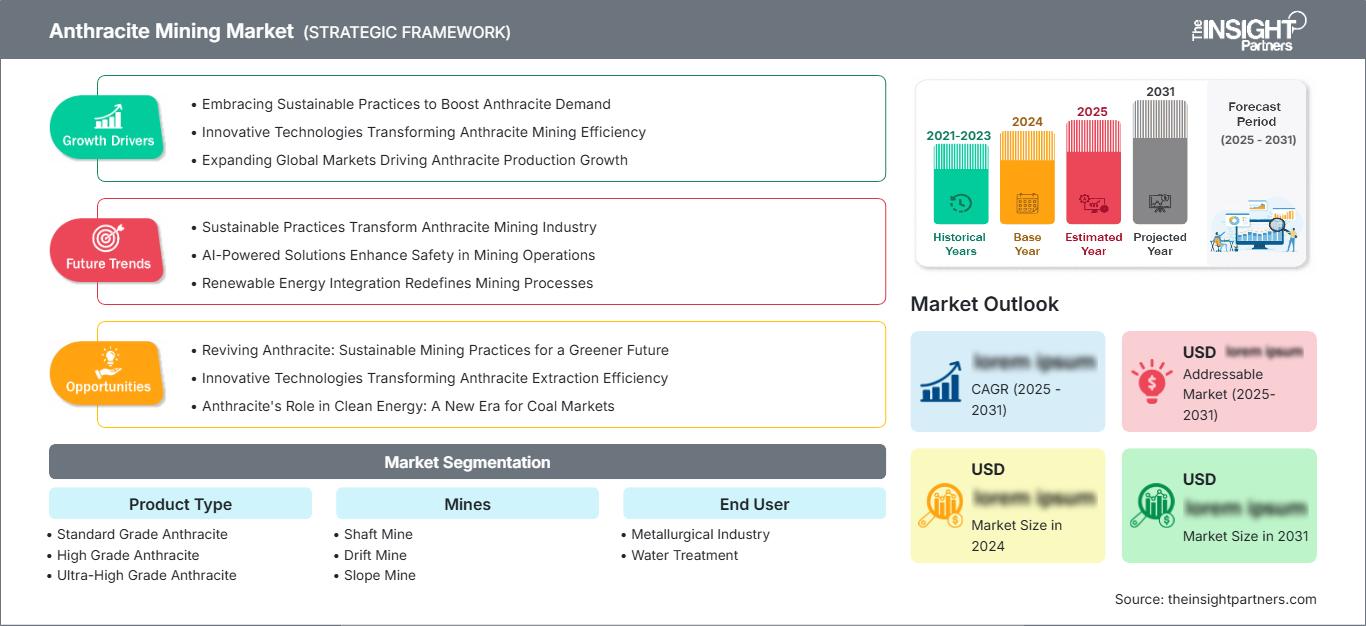
The anthracite mining market is projected to expand from US$ 4.08 Billion in 2025 to US$ 6.74 Billion by 2034, registering a CAGR of 5.73% during 2026–2034. Growth reflects continued demand for high-carbon coal in metallurgical applications, water treatment, and specialized industrial processes. Product quality, mine productivity, beneficiation efficiency, logistics economics, and changing trade flows remain important determinants of revenue performance across major producing and consuming regions.
North America represents a comparatively specialized demand center, supported by metallurgical processing, municipal and industrial water treatment, and established anthracite resources in the US. The anthracite mining market size in the region is expected to rise at an estimated 3.8–4.4% CAGR during 2026–2034, with demand shaped by premium-grade applications, replacement requirements, and domestic supply considerations.
Anthracite Mining Market Assessment and Insights
- North America is expected to account for a 18–22% share in 2025 and grow at a 3.8–4.4% CAGR between 2026–2034, supported by established anthracite production, metallurgical consumption, and specialized water-treatment applications.
- US is projected to represent 76–80% of North America's 2025 demand, expanding at a 4.0–4.5% CAGR during 2026–2034 as premium coal and filtration applications sustain consumption.
- Europe is estimated at a 20–24% share in 2025 and a 4.7–5.2% CAGR between 2026–2034, with Germany, the UK, Italy, France, and Spain representing important industrial and water-treatment demand centers.
- Asia Pacific is expected to hold a 44–48% share in 2025 and expand at a 6.1–6.6% CAGR between 2026–2034, led by China, India, Japan, and South Korea through metallurgical and industrial applications.
- Largest Segment: is expected to be Metallurgical Industry, holding a 72–76% market share in 2025 and expanding at a 5.4–5.9% CAGR during 2026–2034.
- High Growth Segment: is expected to be Water Treatment, representing a 24–28% market share in 2025 and advancing at a 6.3–6.9% CAGR during 2026–2034.
- Key companies analyzed in detail: PGK, Yuzhny Kuzbass, Sibuglemet, AIR, RZD, Uzhkuzbassugol, Mezhdurechye, Siberian Anthracite, Jacutugol, Vostsibugol.
Source: The Insight Partners' analysis based on proprietary research, government publications, company annual reports, investor presentations, industry databases, and expert interviews.
Mining economics are increasingly determined by seam quality, stripping ratios, mine depth, beneficiation yield, and transport access rather than production capacity alone. The anthracite mining market has consequently shifted toward higher-value grades, selective extraction, automated equipment, and improved screening and washing. Surface operations remain important where geology permits, while underground mines require stronger ventilation, safety, and productivity controls.
Increasingly, the forward-looking perspective will reward companies that are able to integrate high specifications with logistics and environmental compliance. Asian demand centers will continue to play an important role in this process as producers divert supplies from strained European routes. Investments will need to be made in areas such as mine rehabilitation, beneficiation, rail transport, dust suppression, methane handling, and digital tracking, among others.
Anthracite Mining Market Report Scope
| Report Attribute | Details |
|---|---|
| Market size in 2025 | US$ 4.08 Billion |
| Market Size by 2034 | US$ 6.74 Billion |
| Global CAGR (2026 - 2034) | 5.73% |
| Historical Data | 2021-2024 |
| Forecast period | 2026-2034 |
Anthracite Mining Market Analysis
Demand is concentrated in metallurgical applications where high fixed-carbon content and low volatile matter can support carbon-intensive processing requirements. The anthracite mining market growth outlook is therefore closely linked with steel production, ferroalloy manufacturing, sintering, and specialized carbon applications. Water purification is another demand avenue for anthracite, as the material can serve as a filter in dual and multimedia filtration arrangements. The value chain includes producers, processors, traders, railways, ports, and industry users as the main players.
The supply chain economics are determined by factors such as the geological quality, extraction technique, beneficiation recovery, labor efficiency, and the costs of transport inland. Open-pit, drift, slope, and shaft mining involve distinctly different costs and capital needs. A high-quality deposit may be able to realize a higher value in the event that its consistency in quality is maintained; however, long-distance hauls tend to reduce profitability.
Competition remains fragmented across producing regions, with Russian, Chinese, North American, and other regional suppliers competing through grade consistency, mine scale, logistics access, and customer relationships. The anthracite mining market analysis therefore, requires assessment beyond production volumes, particularly where sanctions, freight constraints, currency movements, and changing trade routes influence delivered costs. Yuzhny Kuzbass, Siberian Anthracite, Sibuglemet, and Vostsibugol illustrate the importance of resource positioning and regional infrastructure.
Strategic positioning is focused more on efficient operations than on volume growth. Mezhdurechye and Uzhkuzbassugol compete in a Russian mining industry environment where the level of demand and logistics facilities affect their performance, whereas for PGK, AIR, RZD, Jacutugol, and Mezhdurechye, the involvement also includes production/transportation infrastructure in the region. Investments go into replacing the equipment, upgrading ore processing, mine safety, rail facilities, and IT for mine management.
● REPORT CUSTOMIZATION
Tailor This Report To Align With Your Specific Business Requirements
This report can be customized to align precisely with your business objectives, scope, and target markets. Customization options include tailored segmentation, geography, competitive analysis, and strategic insights to support informed decision-making.
Customize This Report →WHAT YOU CAN ADJUST
- ● Segmentations
- ● Geography
- ● Competitive Analysis
- ● Language Preferences
Anthracite Mining Market: Strategic Insights
Regional Insights
North America anthracite mining market
North America is estimated to represent an 18–22% of the anthracite mining market share in 2025 and is projected to grow at a 3.8–4.4% CAGR through 2034. Advantages include proven reserves of anthracite, well-developed mining facilities, and specific industrial applications. Pennsylvania is the main producer of anthracite in the United States, whereas Canada produces very small quantities of this coal type. Applications by metallurgical consumers and filtration media producers represent more stable demands and are less susceptible to fluctuations in thermal power needs.
Mine economics take into account seam accessibility, labor availability, reclamation requirements, and transport costs. Companies strive to differentiate their products with premium sizing and consistent quality. In terms of sales, contract business has become more important than the general commodity market. Water treatment can be used as a way of diversifying products, while environmental issues can affect investments.
U.S. anthracite mining Market
The US is estimated to account for 76–80% of North America's 2025 anthracite mining market demand and is projected to grow at a 4.0–4.5% CAGR through 2034. Pennsylvania remains central to domestic supply, with anthracite supporting metallurgical uses, specialty carbon applications, and water-filtration media. Domestic producers compete through quality, sizing, reliable delivery, and proximity to industrial customers.
Demands are increasingly moving toward those where the attributes of anthracite offer some benefits in comparison to being used simply as an alternative bulk fuel source. The mining firms experience higher expenses as far as safety issues, reclamation, machinery and manpower are concerned. Thus, for regional consumers, the specifications and supply become more important. Water treatment can be seen as a diversification strategy, especially for multimedia filters.
Europe anthracite mining Market
Europe is estimated to hold a 20–24% share of the anthracite mining market in 2025 and is expected to expand at a 4.7–5.2% CAGR through 2034, with Germany representing an important industrial demand center. With the reduction in domestic hard coal production, there is increased dependence on specialty coal imports, which means that logistics, compliance with sanctions, and diversification of suppliers become key elements.
The United Kingdom still needs specialty carbon materials and industrial filtration in spite of its structural decarbonization. Germany is another key country owing to its sizeable industrial and metallurgical capacity. France, Italy, and Spain also offer demand in terms of steel production, foundries, filtration, and industrial water treatment. The criteria of quality, documentation, and delivery have become more important than price.
APAC anthracite mining Market
APAC is expected to represent a 44–48% share of the anthracite mining market in 2025 and expand at a 6.1–6.6% CAGR through 2034, making it the leading regional market. China remains the largest demand center, while India, Japan, and South Korea contribute substantial metallurgical consumption. Industrialization, steel capacity, and regional trade links support sustained requirements.
China utilizes domestic manufacturing with downstream processing, whereas India is focusing more on steel capacity enhancement and diversification of supplies. Japan and South Korea require consistent grades from imports for industrial purposes. Australia is still significant for the region due to logistical reasons. The focus on efficient industrial production and clean production leads to the selection of high-quality coal.
Middle East & Africa anthracite mining Market
The Middle East and Africa anthracite mining market demand is comparatively specialized, with Saudi Arabia, the UAE, South Africa, and other markets using anthracite in metallurgical, filtration, and industrial applications. The region is expected to record a 4.5–5.2% CAGR through 2034, supported by industrial diversification and infrastructure investment.
South Africa has an excellent mining environment; Saudi Arabia and the UAE are working on developing infrastructure for industry and water treatment. Water treatment plants and desalination are areas that require anthracite filters. Issues related to logistics, dependence on imports, and certification continue to be key factors when making purchases. Buyers prefer companies that can consistently deliver in bulk.
Segmentation Analysis
Product Type
The Product Type segment is expected to expand at a 5.4–5.8% CAGR during 2026–2034. The anthracite mining market scope across grades is shaped by fixed-carbon content, volatile matter, ash, sulfur, sizing, and end-use requirements. Higher grades command stronger strategic relevance where metallurgical performance or filtration efficiency justifies premium pricing.
- Standard Grade Anthracite serves industrial consumers requiring dependable carbon content and cost-effective specifications. Demand is supported by applications where ultra-high purity is unnecessary, allowing producers to optimize resource utilization and market coverage.
- High Grade Anthracite occupies an important position in metallurgical and industrial applications requiring stronger carbon characteristics. Consistent quality and controlled ash and sulfur levels enhance its suitability for demanding processing environments.
- Ultra-High Grade Anthracite has strategic importance in premium metallurgical and specialty carbon applications. Producers with access to suitable deposits can differentiate through high fixed carbon, low impurities, consistent sizing, and specialized customer qualification.
Mines
The Mines segment is projected to register a 5.1–5.6% CAGR through 2034. Mining method selection influences capital intensity, extraction recovery, operating risk, and environmental obligations. Surface mining can offer productivity advantages where geology permits, while underground methods remain necessary for deeper or structurally constrained deposits.
- Shaft Mine supports extraction from deeper deposits where surface access is limited. Higher capital intensity is balanced by access to resources that may otherwise remain uneconomic, making mine planning and productivity optimization critical.
- Drift Mine provides horizontal access where geological conditions and terrain permit. Its comparatively direct access can reduce certain infrastructure requirements while supporting efficient extraction from suitable shallow or inclined deposits.
- Slope Mine uses inclined underground access to reach seams positioned below the surface. It remains relevant where deposit geometry prevents conventional drift access, with productivity depending strongly on haulage design and seam continuity.
- Surface Mine offers high equipment productivity and relatively direct material handling where deposits occur near the surface. Its strategic role depends on stripping ratios, land constraints, reclamation requirements, and deposit quality.
End User
The End User segment is anticipated to grow at a 5.6–6.0% CAGR during 2026–2034. The market structure remains dominated by metallurgical consumption, while water treatment provides a faster-growing specialty outlet. The anthracite mining market increasingly benefits from applications where material properties provide measurable process or filtration performance.
- Metallurgical Industry remains the principal demand center because anthracite provides high fixed carbon and low volatile matter for selected iron, steel, ferroalloy, and carbon-intensive processes. Purchasing decisions emphasize chemistry, sizing, consistency, and delivered cost.
- Water Treatment represents an expanding specialty application in multimedia and dual-media filtration. Anthracite's lower density relative to sand enables layered filtration designs, creating demand from municipal, industrial, and desalination-related treatment systems.
Opportunity Snapshot
| End User | Revenue Contribution | Trend Tag | Adoption Stage |
| Metallurgical Industry | High | Carbon Feedstock | Mature |
| Water Treatment | Medium | Filter Media | Scaling |
Anthracite Mining Market Growth Drivers and Impact Analysis
Expansion of Metallurgical Capacity in Emerging Economies
Steelmaking and ferroalloy capacity additions remain important demand catalysts because anthracite can provide a high-carbon feedstock for selected metallurgical processes. Expansion is particularly relevant in Asia, where industrial investment and infrastructure development continue to support steel consumption. The impact is not limited to tonnage growth: customers increasingly specify tighter chemistry, controlled sizing, and predictable ash and sulfur characteristics. This encourages miners to invest in beneficiation and quality-control systems rather than simply increasing raw extraction. Producers capable of supplying consistent premium grades can secure longer-term customer relationships, while lower-quality operations face stronger substitution and pricing pressure. The resulting market effect is a gradual shift toward value-based product differentiation, with mining economics increasingly linked to recoverable saleable product rather than headline run-of-mine output.
Increasing Use of Anthracite in Advanced Filtration Systems
Applications in water treatment constitute a structurally different demand pathway due to the use of anthracite as a filter medium, not a fuel or a metallurgical raw material. Water treatment plants, industrial effluent treatment plants, and desalination plants may employ anthracite in the form of multimedia filters because of its density and particle structure, which enable it to be layered with sand and other media. Investment in water treatment plants in areas suffering from a shortage of water thus increases the pool of customers. The effect will benefit those producers who can provide anthracite that is washed, graded, and uniform in chemical composition in terms of specifications needed for treatment.
Mine Modernization and Productivity Improvement
The operators of mining companies have an obligation to enhance the quality of their product while managing labor, energy, maintenance, and safety expenses. The introduction of new technologies to enhance excavation, hauling, crushing, screening, washing, and monitoring can help raise recovery rates and minimize variance in the quality of the product batches produced. The use of mine management systems will also facilitate equipment utilization, predictive maintenance, monitoring of workers, and geological control. It is especially important in the case of underground mines, because shutdowns and safety problems may significantly influence the cost per unit. The same advantages could be enjoyed by the surface mines through optimizing their fleet and implementing automated dispatching. This approach would help with regulatory compliance as well.
Anthracite Mining Market Future Trends
Greater Premiumization of Export-Oriented Anthracite
The anthracite mining market trends are likely to increasingly favor premium grades with documented chemistry, consistent sizing, and predictable performance. There is an increasing likelihood of customers being particular with their purchases due to the potential impact of product variation on subsequent operations or the need for additional blending. As a result, manufacturers are likely to invest in lab testing, quality tracking using technology, automation, and customized blending. Premiumization will also allow producers to be better able to cope with transport volatility since they will be able to absorb these costs in higher value products rather than in low value bulk products. Looking further into the future, there could be different specifications for use in steelmaking, ferroalloy production, filtration, and specialty carbon applications.
Digital Mine-to-Customer Traceability
Traceability is likely to grow in importance in the future due to the increasing need for transparency in terms of origin, quality, processing, and environmental factors. Mines are capable of linking geological data to production batches, results of the enrichment process, stockpiles, rail transport, and requirements of the customers. Traceability is helpful in resolving disputes in case of quality issues and in the proper distribution of grades if several grades are mined from one deposit. Remote tracking can be used for safety management and planning of maintenance activities for both underground and surface mining. In the case of international transactions, traceability helps in easier compliance with the regulations and in providing evidence for provenance to the buyer. Traceability might become a key factor differentiating the supplier in the future.
Anthracite Mining Market Opportunities
Developing Specialty Anthracite Products for Water Treatment
Producers can pursue higher-margin opportunities by developing dedicated filtration-grade anthracite rather than relying exclusively on commodity coal sales. The opportunity involves controlled particle sizing, washing, impurity management, hardness testing, and technical certification for multimedia filtration systems. Suppliers can target municipal water authorities, industrial treatment operators, desalination projects, and engineering contractors across water-stressed markets. The anthracite mining market Forecasts indicate that diversification toward specialty applications can reduce exposure to metallurgical cycles and create more stable customer relationships. Investment priorities should include dedicated processing lines, laboratory capabilities, packaging infrastructure, and technical sales teams. Partnerships with filtration-equipment companies could further accelerate qualification because product specifications can be incorporated directly into system designs and procurement standards.
Expanding Asian Supply Partnerships and Logistics Integration
Asian buyers offer opportunities for producers to strengthen long-term commercial relationships through integrated supply agreements, regional stock points, and optimized rail-to-port logistics. India, China, Japan, and South Korea have distinct quality requirements, creating room for differentiated product strategies rather than uniform export programs. Producers can improve delivered economics through port partnerships, dedicated rail capacity, inventory hubs, and flexible shipment scheduling. The opportunity is particularly relevant where geopolitical changes redirect trade flows toward alternative suppliers. Strategic investments should prioritize customers with recurring industrial requirements and strong payment profiles. Suppliers can also reduce market-entry friction by working with local distributors and technical agents that understand customs, quality certification, and downstream operating conditions.
Recent Developments
- February 26, 2026: Coalstar – Russia's Bogatyr open-pit mine, located in the Novosibirsk anthracite basin, was reported to have produced approximately 1.1 million tonnes of anthracite in 2025, with plans to substantially increase output during 2026. The development demonstrates capacity expansion at one of Russia's major anthracite deposits and supports the importance of mine productivity and export-oriented supply.
- May 1, 2025: Menar completed its acquisition of Springlake Colliery in KwaZulu-Natal from Mylotex following the mine's placement under business rescue. The transaction helped in expanding Menar's anthracite footprint and reinforcing consolidation within South Africa's anthracite mining industry. The acquisition highlights supply availability, mine restructuring, and domestic anthracite production.
Frequently Asked Questions

- Comprehensive Market Sizing and Forecast Analysis
- Detailed Segmentation Analysis
- In-Depth Market Dynamics Assessment
- Regional and Country-Level Insights
- Competitive Landscape and Company Benchmarking
- Strategic Business Intelligence
Recent Reports
Testimonials

The Insight Partners provided valuable market intelligence that supported our global go-to-market strategy. Their team was professional, responsive, and attentive to our feedback, providing thoughtful analysis and helpful methodological clarifications throughout the project.
Junmo Kim Chief Financial Officer (CFO), Enertech Co., Ltd.
The Insight Partners' SCADA System Market report is comprehensive, with valuable insights on current trends and future forecasts. The team was highly professional, responsive, and supportive throughout. We are very satisfied and highly recommend their services.
RAN KEDEM Partner, Reali Technologies LTDs
I requested a report on a very specific software market and the team produced the report in a few days. The information was very relevant and well presented. I then requested some changes and additions to the report. The team was again very responsive and I got the final report in less than a week.
JEAN-HERVE JENN Chairman, Future Analytica
We worked with The Insight Partners for an important market study and forecast. They gave us clear insights into opportunities and risks, which helped shape our plans. Their research was easy to use and based on solid data. It helped us make smart, confident decisions. We highly recommend them.
PIYUSH NAGPAL Sr. Vice President, High Beam Global
The Insight Partners delivered insightful, well-structured market research with strong domain expertise. Their team was professional and responsive throughout. The user-friendly website made accessing industry reports seamless. We highly recommend them for reliable, high-quality research services
YUKIHIKO ADACHI CEO, Deep Blue, LLC.
This is the first time I have purchased a market report from The Insight Partners.While I was unsure at first, I visited their web site and felt more comfortable to take the risk and purchase a market report.I am completely satisfied with the quality of the report and customer service. I had several questions and comments with the initial report, but after a couple of dialogs over email with their analyst I believe I have a report that I can use as input to our strategic planning process.Thank you so much for taking the extra time and making this a positive experience.I will definitely recommend your service to others and you will be my first call when we need further market data.
JOHN SUZUKI President and Chief Executive Officer, Board Director, BK Technologies
I wish to appreciate your support and the professionalism you displayed in the course of attending to my request for information regarding to infectious disease IVD market in Nigeria. I appreciate your patience, your guidance, and the fact that you were willing to offer a discount, which eventually made it possible for us to close a deal. I look forward to engaging The Insight Partners in the future, all thanks to the impression you have created in me as a result of this first encounter.
DR CHIJIOKE ONYIA MANAGING DIRECTOR, PineCrest Healthcare Ltd.Reason to Buy
- Informed Decision-Making
- Understanding Market Dynamics
- Competitive Analysis
- Identifying Emerging Markets
- Customer Insights
- Market Forecasts
- Risk Mitigation
- Boosting Operational Efficiency
- Strategic Planning
- Investment Justification
- Tracking Industry Innovations
- Aligning with Regulatory Trends





 Get Free Sample for