
Anti-Fog Lidding Films Market Trends, Size & Growth by 2034
Coverage: By Material (PVC, Polyethylene, PET, Polyamide, Polypropylene, Others); Sealing Type (Re-sealable, Peelable.); End Use Industry (Ready-To-Eat Products, Frozen Food, Confectionery and Bakery, Meat and Poultry Products, Seafood, Others) , and Geography (North America, Europe, Asia Pacific, and South and Central America)
- Status : Data Released
- Report Code : TIPRE00022639
- Category : Chemicals and Materials
- No. of Pages : 150
- Available Report Formats :


- Last update date : August 27, 2026


2025 Market Size
US$ 911.79 Mn
Base year value
2034 Forecast
US$ 1,416.59 Mn
Projected by 2034
CAGR 2026-2034
5.66 %
Growth rate
Addressable Market
US$ 10,916.15 Mn
(2026-2034)
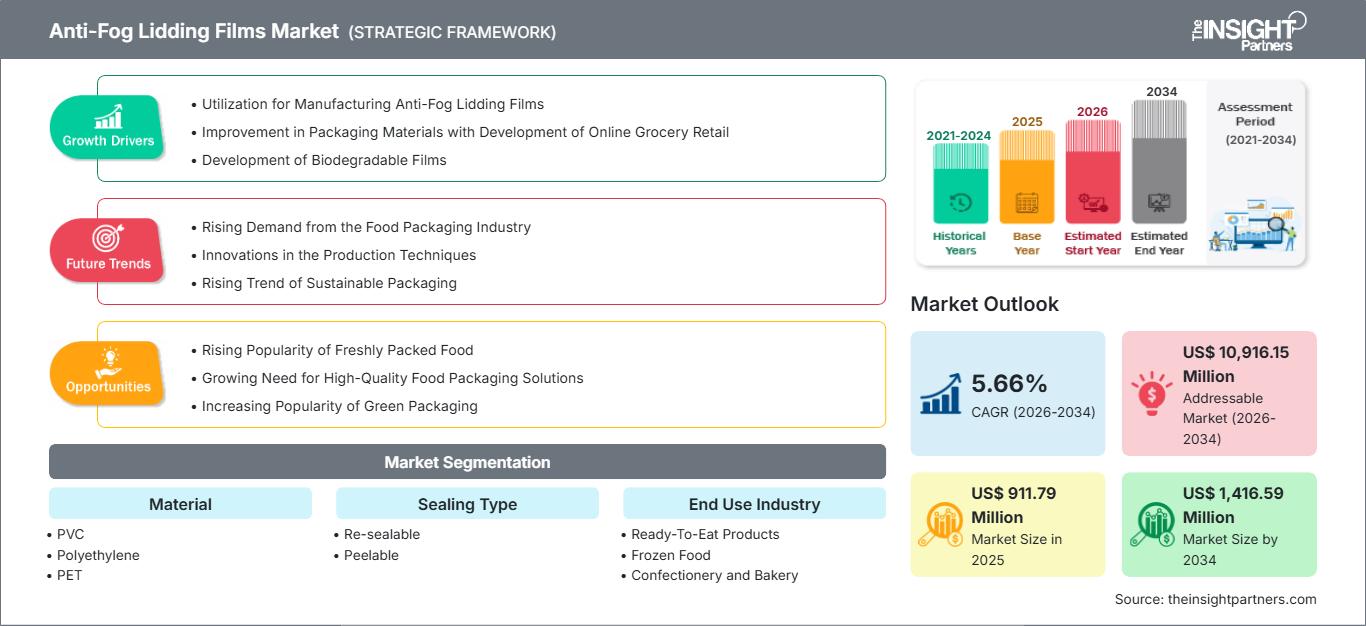
The anti-fog lidding films market is valued at US$ 911.79 Million in 2025 and is projected to reach US$ 1,416.59 Million by 2034, registering a CAGR of 5.66% during 2026–2034. Growth is supported by demand for transparent packaging that preserves product visibility under refrigeration, alongside increasing adoption of ready-to-eat meals, fresh proteins, seafood, and other moisture-sensitive food formats requiring reliable sealing and condensation control.
The Anti-Fog Lidding Films Market size remains important in North America, with expansion supported by chilled and prepared food consumption, sophisticated tray-sealing infrastructure, and continued movement toward high-performance packaging formats. The regional market is estimated to progress at a 4.8–5.4% CAGR during 2026–2034. Demand is also influenced by retailer requirements for shelf presentation, food-waste reduction, and packaging structures that combine anti-fog performance with peelability and recyclability.
Anti-Fog Lidding Films Market Assessment and Insights
- North America: North America is estimated to represent 31–35% share in 2025, with the market growing at a 4.8–5.4% CAGR between 2026–2034, supported by prepared foods, fresh proteins, cold-chain distribution, and advanced tray-sealing infrastructure.
- US: The US accounts for 74–78% of North American demand in 2025, expanding at a 4.9–5.5% CAGR between 2026–2034 as chilled meals, meat, poultry, and seafood packaging adoption increases.
- Europe: Europe represents 27–31% share in 2025 and is expected to grow at a 5.0–5.6% CAGR between 2026–2034, led by Germany, the UK, France, Italy, and Spain.
- Asia Pacific: Asia Pacific holds 25–29% share in 2025, with a 6.1–6.8% CAGR between 2026–2034. China, Japan, South Korea, and India lead demand through expanding processed-food and cold-chain industries.
- Largest Segment: Polyethylene is estimated to hold 31–35% market share in 2025, growing at a 5.3–5.9% CAGR between 2026–2034 due to sealing flexibility and broad tray compatibility.
- High Growth Segment: Ready-To-Eat Products represent 22–26% share in 2025, advancing at a 6.2–6.9% CAGR between 2026–2034 as convenience-oriented food consumption expands.
- Key companies analyzed in detail: Klöckner Pentaplast, Toray Plastics Inc., PLASTOPIL, Effegidi International, Sealed Air Corporation, Berry Global Inc., Flexopack S.A., Winpak Ltd., Coveris Management GmbH, and Flair Flexible Packaging Corporation.
Source: The Insight Partners' analysis based on proprietary research, government publications, company annual reports, investor presentations, industry databases, and expert interviews.
While the market used to depend solely on transparent films to provide sealing, there is a trend that sees the development of film structures with anti-fog and controlled peel strength, barrier properties, thinner gauge, and recyclable tray compatibility. Coextrusion, surface coating, and sealant film solutions are allowing producers to tackle condensation issues without compromising the optical transparency of the material. Manufacturing focuses on downgauging, machinability and compatibility with tray sealing machines and modified atmosphere packaging machinery.
During the forecast period, investments will go into recyclable mono-material films, clear PET and PE solutions, and films suitable for chilled and ready-to-eat foods. Regulation regarding packaging waste will drive material simplification and downgauging, whereas expansion of production capacities driven by growing Asian food processing centers will take place. Suppliers with integrated extrusion, coating, and converting capabilities are positioned to address increasingly customized performance requirements. The Anti-Fog Lidding Films Market report assesses these investment priorities and their influence on future product development and market expansion.
Anti-Fog Lidding Films Market Report Scope
| Report Attribute | Details |
|---|---|
| Market size in 2025 | US$ 911.79 Million |
| Market Size by 2034 | US$ 1,416.59 Million |
| Global CAGR (2026 - 2034) | 5.66% |
| Historical Data | 2021-2024 |
| Forecast period | 2026-2034 |
Anti-Fog Lidding Films Market Analysis
Demand across the anti-fog lidding films market growth ecosystem originates with polymer producers, additive suppliers, film extruders, coating specialists, converters, tray manufacturers, food processors, retailers, and packaging equipment providers. Fresher food packagers need materials that meet the challenges of clarity, sealing, oxygen barrier, and condensation control. Polyethylene and PET layers continue to be relevant since they have proven processability and a good fit with existing tray designs.
The economics of supply are driven by resin costs, film gauge, coatings formulation, energy cost, and converting capacity. Filmmakers increasingly tailor their multilayer design to minimize weight without affecting puncture resistance and sealability. Package converters also work with the food packager to qualify sealing parameters, anti-fog properties, and machinability at high speed.
The anti-fog lidding films market analysis indicates a competitive environment shaped by film technology, substrate compatibility, geographic manufacturing presence, and application specialization. Klöckner Pentaplast, Toray Plastics Inc., PLASTOPIL, and Effegidi International differentiate themselves through film structure and application competence, whereas Sealed Air Corporation sustains a competitive position in protein and convenience food packaging due to integration of tray and film packaging solutions.
Berry Global Inc., Flexopack S.A., Winpak Ltd., Coveris Management GmbH, and Flair Flexible Packaging Corporation have a presence in specialized films, lidding films, and food packaging formats. Investment focus in competition is shifting towards development of recyclable structures, down gauging, high-speed processes, and better peeling properties. Thus, competitive positioning should take into account performance, materials efficiency, compliance with food contact regulations, and customers' equipment requirements.
● REPORT CUSTOMIZATION
Tailor This Report To Align With Your Specific Business Requirements
This report can be customized to align precisely with your business objectives, scope, and target markets. Customization options include tailored segmentation, geography, competitive analysis, and strategic insights to support informed decision-making.
Customize This Report →WHAT YOU CAN ADJUST
- ● Segmentations
- ● Geography
- ● Competitive Analysis
- ● Language Preferences
Anti-Fog Lidding Films Market: Strategic Insights
Regional Insights
North America anti-fog lidding films market
North America represented 31–35% of the anti-fog lidding films market share in 2025 and is projected to expand at a 4.8–5.4% CAGR during 2026–2034. The area boasts existing tray-sealing infrastructure, ample distribution of chilled foods, and consumption of large amounts of packaged meats, poultry, fish, and prepared foods. The demand is driven by consumers' preference for clearly packaged products that retain their appeal during refrigerated storage and transport.
The United States is the leading consumer of the region, with Canada adding to the demand due to the packaging of prepared foods, dairy products, seafood, and fresh produce. Downgauged film, compatibility with recyclable trays, and robust sealing over contaminated food become the key requirements for lidding structures. Leading film manufacturers, converters, tray producers, processors, and packaging machinery providers form a well-established regional value chain.
U.S. anti-fog lidding films Market
The US accounted for 74–78% of North American anti-fog lidding films market demand in 2025 and is expected to grow at a 4.9–5.5% CAGR through 2034. The strong demand for applications exists with respect to ready meals, meat, poultry, seafood, bakery, and refrigerated convenience products. The widespread penetration of MAP creates an opportunity to use clear lid films for preserving the visibility of the packaged products.
Sealed Air Corporation, Berry Global Inc., and Winpak Ltd., among other packaging companies, possess significant capacity when it comes to US food processing plants. The growing relevance of adoption has much to do with mono-material trays, recyclable packaging designs, and thin films that minimize the consumption of materials but at the same time provide puncture and seal resistance.
Europe anti-fog lidding films Market
Europe accounted for 27–31% share of the anti-fog lidding films market in 2025 and is projected to register a 5.0–5.6% CAGR during 2026–2034. Germany represents the leading market, supported by food processing, meat packaging, prepared meals, and advanced flexible-packaging manufacturing. European demand is increasingly influenced by packaging recyclability, downgauging, and material simplification requirements.
The UK maintains demand through chilled convenience foods, ready meals, seafood, and fresh produce, while Germany benefits from its large food-processing and packaging machinery ecosystem. France, Italy, and Spain contribute through meat, bakery, dairy, seafood, and prepared-food applications. Across the region, producers are developing thinner structures and recyclable configurations while maintaining anti-fog performance, sealing integrity, and compatibility with automated packaging lines.
APAC anti-fog lidding films Market
APAC represented 25–29% share of the anti-fog lidding films market in 2025 and is forecast to expand at a 6.1–6.8% CAGR during 2026–2034. China leads regional demand, followed by Japan, South Korea, India, and Australia. Growth is supported by food-processing modernization, expanding cold-chain networks, and increasing packaged-meal consumption.
China combines a large manufacturing base with growing domestic demand for processed foods. Japan and South Korea emphasize high-quality convenience foods and advanced packaging technologies, while India benefits from expanding organized food processing and refrigerated distribution. Australia contributes through meat and seafood packaging. Investments in local film production and packaging automation should strengthen regional supply capabilities.
Middle East & Africa anti-fog lidding films Market
The Middle East and Africa anti-fog lidding films market demand is supported by expanding food-processing capacity, modern retail, and investment in cold-chain infrastructure. Saudi Arabia and the UAE lead regional adoption, while South Africa remains an important market for meat, poultry, seafood, and prepared-food packaging. The region is estimated to progress at a 4.2–4.8% CAGR during 2026–2034.
Saudi Arabia benefits from food-security investments and domestic processing initiatives, while the UAE serves as a logistics and food-distribution hub. South Africa supports demand through established packaged-food manufacturing, with the Rest of MEA developing gradually. Increasing dependence on temperature-controlled distribution strengthens the value of films capable of maintaining visibility and pack integrity under refrigerated conditions.
Segmentation Analysis
Material
The Material segment is expected to grow at a 5.4–6.0% CAGR during 2026–2034. Material selection depends on transparency, sealability, thermal resistance, stiffness, barrier performance, and compatibility with trays. The anti-fog lidding films market scope increasingly includes structures designed to reduce material consumption while maintaining functional performance across chilled and prepared-food applications.
- PVC: PVC films remain relevant in selected tray applications where clarity, stiffness, and established sealing characteristics support processing requirements. Their use is increasingly evaluated against recycling and material-simplification objectives.
- Polyethylene: Polyethylene benefits from flexible sealing behavior, toughness, and broad compatibility with food trays. It is particularly suited to fresh proteins, seafood, and chilled foods requiring reliable sealing and condensation management.
- PET: PET provides high clarity, dimensional stability, thermal resistance, and compatibility with PET and rPET trays. Its role is strengthening as converters pursue recyclable tray-and-lid combinations.
- Polyamide: Polyamide contributes mechanical strength and puncture resistance to multilayer structures. It is particularly useful where packaging must withstand demanding handling, vacuum, and high-abuse conditions.
- Polypropylene: Polypropylene supports applications requiring heat resistance, microwave compatibility, and compatibility with PP trays. Its adoption is linked to mono-material packaging strategies and convenience-food formats.
- Others: Other materials serve specialized requirements involving barrier enhancement, sealing customization, and application-specific performance where conventional polymers cannot independently provide the required balance.
Sealing Type
The Sealing Type segment of the anti-fog lidding films market is projected to expand at a 5.2–5.8% CAGR during 2026–2034. Seal design influences consumer convenience, pack integrity, production efficiency, and compatibility with different tray substrates. Peelable structures remain important for ready meals and fresh foods, while resealable formats address repeated-access consumption.
- Re-sealable: Re-sealable films support repeated opening and closing, extending convenience after initial consumption. They are particularly relevant to cheese, prepared foods, snacks, and portioned products requiring secondary shelf-life protection.
- Peelable: Peelable films provide controlled opening while maintaining strong seals during distribution. Their adoption is supported by ready meals, meat, seafood, and chilled products, where consumer convenience and pack presentation are important.
End Use Industry
The End Use Industry segment is forecast to register a 5.8–6.5% CAGR during 2026–2034. Convenience food consumption, refrigerated logistics, modified-atmosphere packaging, and demand for visible products influence adoption. The segment encompasses applications where condensation control directly affects presentation, freshness perception, and packaging functionality.
- Ready-To-Eat Products: Ready-to-eat meals require clear, peelable, and heat-compatible lids that maintain visibility after refrigeration or reheating. Anti-fog performance supports presentation, while convenient opening improves consumer handling.
- Frozen Food: Frozen food packaging requires films capable of maintaining sealing performance and optical properties under low-temperature conditions. Robust structures help protect products through storage, transportation, and retail handling.
- Confectionery and Bakery: Bakery and confectionery applications value clarity, seal integrity, and presentation. Films help protect products from environmental exposure while supporting attractive shelf display and convenient opening.
- Meat and Poultry Products: Meat and poultry represent major applications because condensation can obscure product appearance. Anti-fog films support clear presentation while high-barrier structures protect freshness during refrigerated distribution.
- Seafood: Seafood packaging requires strong moisture management, puncture resistance, and reliable seals. Anti-fog structures help preserve visibility across chilled supply chains where temperature fluctuations can produce condensation.
- Others: Other food applications include dairy, fresh produce, pasta, and specialty chilled products requiring combinations of transparency, barrier performance, anti-fog functionality, and sealing reliability.
Opportunity Snapshot
| End Use Industry | Revenue Contribution | Trend Tag | Adoption Stage |
| Ready-To-Eat Products | High | Meal Convenience | Scaling |
| Frozen Food | Medium | Cold Storage | Mature |
| Confectionery and Bakery | Medium | Shelf Display | Scaling |
| Meat and Poultry Products | High | Protein Visibility | Mature |
| Seafood | Medium | Cold Chain | Scaling |
| Others | Low | Specialty Foods | Emerging |
Anti-Fog Lidding Films Market Growth Drivers and Impact Analysis
Expansion of Refrigerated Convenience Food Consumption
The proliferation of chilled meals, proteins, seafood, and convenience foods increases the amount of packaging subject to condensation in the course of storage and transport. The need for packaging that keeps the product visible from production to point-of-sale, especially when appearance is a factor in buying decisions, is becoming greater. Anti-fog films meet this need without necessitating any alteration in the fundamental process of tray-sealing. Portion-sized foods have also led to the desire for packaging that includes both clear lids and resealability, as well as microwavability. With increased mechanization in food processing plants, film machinability is just as much a necessity. Suppliers who can maintain optical properties and provide efficient sealing will find their market among larger food producers.
Advancement of Recyclable and Downgauged Lidding Structures
Sustainability through packaging is becoming an increasingly important consideration in film development, especially where producers are addressing the requirements of extended producer responsibility legislation and retailer packaging objectives. This will lead to development in the direction of thin films, mono-materials, and lids compatible with PET, rPET, PE, or PP trays. Anti-fog technology needs to be incorporated into such films without negatively affecting recyclability, sealing performance, or optical qualities. The move towards downgauging will help in reducing raw material use, increasing roll yield, and enhancing logistics. However, this technical challenge provides an opportunity for suppliers who have expertise in extrusion, coating, and formulation. As food brands evaluate their packaging programs, anti-fog films with reduced material intensity will be preferred over multilayer films.
Growth of Modified-Atmosphere and Automated Tray Packaging
Increasingly, modified atmosphere packaging (MAP) is driving the use of rigid trays and lidding films for meat products, seafood, prepared meals, and fresh foods. Films used in MAP need to provide reliable sealing, as well as barrier and visual characteristics. Automation creates even more demands when it comes to consistent sealing windows, roll length, registration, and contamination resistance during the filling process. Anti-fog properties become increasingly critical because moisture content may negatively affect the visual advantage of MAP films. The increase in automation makes cost-per-film considerations less relevant, as the focus of purchase decisions is shifting towards the performance of the entire packaging line. Film companies able to validate films on high-speed tray sealing and thermoforming machines may be able to increase their customer retention.
Anti-Fog Lidding Films Market Future Trends
Integration of Anti-Fog Functionality with Mono-Material Packaging
The anti-fog lidding films market trends are increasingly moving toward mono-material structures that integrate condensation control without creating difficult-to-recycle combinations. PET-to-PET and PE-to-PE configurations are receiving greater attention because they can simplify sorting and recycling pathways when compatible with local systems. Future formulations are likely to focus on surface chemistry that delivers stable anti-fog performance while minimizing coating weight and preserving food-contact compliance. Film producers will also seek lower sealing temperatures and improved hot tack to support energy efficiency and faster packaging cycles. Development activity is expected to emphasize compatibility with recycled polymers, particularly rPET and mechanically recycled PE, while maintaining clarity and mechanical performance. These advances can help reconcile sustainability objectives with the functional requirements of refrigerated food packaging.
Smart Film Engineering for Extended Cold-Chain Performance
Future product developments will probably emphasize films designed to endure severe temperature and humidity variations rather than just utilizing anti-fog ingredients alone. Exposure of cold chain packaging to temperature and humidity variations through processing, refrigerating, shipping, storage, and consumer handling makes the impact on condensation behavior, the strength of sealants, and film optical clarity inevitable. Optimization of multi-layer design, surface characteristics, barrier performance, and sealant formulas will be crucial for manufacturers. Through computer modeling and laboratory trials, the process of validating their effectiveness for various foods and tray materials will be accelerated. The outcome of such efforts will yield films that perform better and are able to meet the extended shelf-life requirement. Customization of film will be preferred over standard grades of film by processors running multiple lines and a product range.
Anti-Fog Lidding Films Market Opportunities
Localized Production in High-Growth Asian Food Markets
The anti-fog lidding films market Forecasts indicate that Asia Pacific should offer attractive opportunities for localized film manufacturing and technical conversion capacity. China and India combine large food-processing industries with expanding modern retail and cold-chain infrastructure, while Japan and South Korea provide sophisticated demand for convenience foods and advanced packaging. Local production can reduce lead times, improve technical support, and allow converters to customize films for regional tray substrates and sealing equipment. Investment opportunities extend across extrusion, coating, slitting, and specialty sealant technologies. Producers entering these markets can also develop formulations compatible with regional recycling initiatives and food-contact requirements. Partnerships with tray manufacturers and food processors can accelerate qualification and reduce the time required to commercialize application-specific structures.
High-Performance Films for Fresh Protein and Seafood Packaging
Fresh meat, poultry, and seafood provide a significant opportunity because packaging must simultaneously address condensation, puncture resistance, oxygen management, sealing reliability, and shelf presentation. Producers can differentiate through high-barrier anti-fog structures designed specifically for MAP, vacuum, and thermoformed formats. Films that provide controlled peel force and reliable seals through minor contamination can improve packaging-line performance and reduce rejected packs. Investment in thinner high-abuse structures can further improve material efficiency without sacrificing protection. The opportunity extends to premium seafood and protein brands where transparent presentation is central to retail merchandising. Suppliers with application-testing capabilities can create specialized grades for different humidity, temperature, and tray conditions, strengthening their position in technically demanding food-packaging applications.
Recent Developments
- February 19, 2026: Cosmo Films launched a sealable, peelable transparent anti-fog BOPET lidding film for refrigerated and fresh foods. The film uses an anti-fog coating on the sealable side, supports low-temperature sealing, and is compatible with PP, HIPS, PET, PVC, and LDPE containers. The company also states that the structure can extend freshness for selected fresh-food applications.
- June 11, 2025: KM Packaging introduced K-Peel 4G, a mono PET lidding film offering clean peeling from PET trays at sealing temperatures as low as 110°C with a 0.3-second dwell time. The film is available in 21- and 25-micron gauges, provides anti-fog properties, and supports ambient, chilled, and frozen applications.
Frequently Asked Questions

- Comprehensive Market Sizing and Forecast Analysis
- Detailed Segmentation Analysis
- In-Depth Market Dynamics Assessment
- Regional and Country-Level Insights
- Competitive Landscape and Company Benchmarking
- Strategic Business Intelligence
Recent Reports
Testimonials

The Insight Partners' SCADA System Market report is comprehensive, with valuable insights on current trends and future forecasts. The team was highly professional, responsive, and supportive throughout. We are very satisfied and highly recommend their services.
RAN KEDEM Partner, Reali Technologies LTDs
I requested a report on a very specific software market and the team produced the report in a few days. The information was very relevant and well presented. I then requested some changes and additions to the report. The team was again very responsive and I got the final report in less than a week.
JEAN-HERVE JENN Chairman, Future Analytica
We worked with The Insight Partners for an important market study and forecast. They gave us clear insights into opportunities and risks, which helped shape our plans. Their research was easy to use and based on solid data. It helped us make smart, confident decisions. We highly recommend them.
PIYUSH NAGPAL Sr. Vice President, High Beam Global
The Insight Partners delivered insightful, well-structured market research with strong domain expertise. Their team was professional and responsive throughout. The user-friendly website made accessing industry reports seamless. We highly recommend them for reliable, high-quality research services
YUKIHIKO ADACHI CEO, Deep Blue, LLC.
This is the first time I have purchased a market report from The Insight Partners.While I was unsure at first, I visited their web site and felt more comfortable to take the risk and purchase a market report.I am completely satisfied with the quality of the report and customer service. I had several questions and comments with the initial report, but after a couple of dialogs over email with their analyst I believe I have a report that I can use as input to our strategic planning process.Thank you so much for taking the extra time and making this a positive experience.I will definitely recommend your service to others and you will be my first call when we need further market data.
JOHN SUZUKI President and Chief Executive Officer, Board Director, BK Technologies
I wish to appreciate your support and the professionalism you displayed in the course of attending to my request for information regarding to infectious disease IVD market in Nigeria. I appreciate your patience, your guidance, and the fact that you were willing to offer a discount, which eventually made it possible for us to close a deal. I look forward to engaging The Insight Partners in the future, all thanks to the impression you have created in me as a result of this first encounter.
DR CHIJIOKE ONYIA MANAGING DIRECTOR, PineCrest Healthcare Ltd.Reason to Buy
- Informed Decision-Making
- Understanding Market Dynamics
- Competitive Analysis
- Identifying Emerging Markets
- Customer Insights
- Market Forecasts
- Risk Mitigation
- Boosting Operational Efficiency
- Strategic Planning
- Investment Justification
- Tracking Industry Innovations
- Aligning with Regulatory Trends





 Get Free Sample for