
Anti-Reflective Glass Coatings Market Size, Demand & Growth by 2034
Coverage: By Technology (Physical Vapor Deposition, Chemical Vapor Deposition); Application (Large Area Glass Coatings, Small Batch-Coated Lenses) , and Geography (North America, Europe, Asia Pacific, and South and Central America)
- Status : Data Released
- Report Code : TIPRE00021785
- Category : Chemicals and Materials
- No. of Pages : 150
- Available Report Formats :


- Last update date : August 27, 2026


2025 Market Size
US$ 4.66 Bn
Base year value
2034 Forecast
US$ 9.75 Bn
Projected by 2034
CAGR 2026-2034
8.55 %
Growth rate
Addressable Market
US$ 64.64 Bn
(2026-2034)
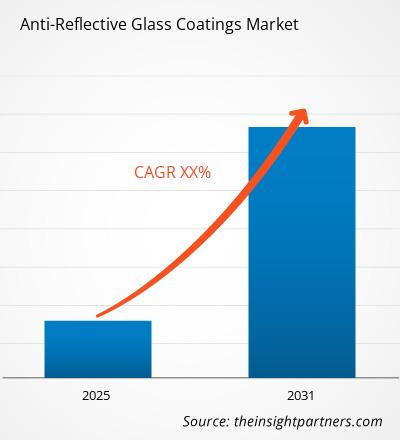
The Anti-Reflective Glass Coatings market was valued at US$ 4.66 billion in 2025 and is expected to reach US$ 9.75 billion by 2034; it is estimated to record a CAGR of 8.55% during 2026-2034.
Anti-Reflective Glass Coatings Market Assessment and Insights
- North America: North America is estimated to hold a 24–28% share in 2025 and grow at a 8.7–9.3% CAGR during 2026–2034, supported by premium displays, automotive glazing, architectural applications, and optical components.
- US: The US represents approximately 72–77% of North American demand in 2025 and is expected to grow at a 8.5–9.1% CAGR through 2034, led by electronics and specialty glass.
- Europe: Europe accounts for a 25–29% share in 2025 and is projected to expand at a 8.8–9.4% CAGR, led by Germany, France, Italy, the UK, and Spain across architectural and optical applications.
- Asia Pacific: Asia Pacific represents a 34–39% share in 2025 and is expected to record a 10.0–10.7% CAGR, led by China, Japan, South Korea, and India through solar and electronics manufacturing.
- Largest Segment: Large Area Glass Coatings hold a 62–67% market share in 2025 and are expected to grow at a 9.2–9.8% CAGR during 2026–2034, supported by solar and architectural demand.
- High Growth Segment: Chemical Vapor Deposition holds a 32–37% market share in 2025 and is projected to expand at a 10.1–10.8% CAGR, reflecting scalable coating and solar applications.
- Key companies analyzed in detail: 3M Company, Abrisa Technologies, Essilor International, EuropeTec Groupe, GroGlass, Guardian Industries Corporation, Huihua Glass Company Ltd., JMT Glass, Saint-Gobain S.A., SCHOTT AG.
Source: The Insight Partners' analysis based on proprietary research, government publications, company annual reports, investor presentations, industry databases, and expert interviews.
There is a trend in the anti-reflective glass coatings industry towards multifunctional coating solutions, where reflection reduction is complemented by other properties such as hardness, chemical resistance, easy-to-clean nature, and improved transmittance. Large area glass production is becoming more dependent on the use of coating technology in continuous manufacturing processes, and optical and display applications demand better control of film thickness, refractive index, spectral performance, and surface defects.
Going forward, there is a growing preference for high-speed coating equipment, durable multi-layer structures, and tailored optical coatings. Solar glass will be an important volume application, while automotive displays, augmented reality optics, electronics, museums, retail, and specialty lenses are the high value opportunities. Asia Pacific will lead in terms of faster capacity expansion, and Europe and North America will remain dominant in optical and architectural applications.
Anti-Reflective Glass Coatings Market Report Scope
| Report Attribute | Details |
|---|---|
| Market size in 2025 | US$ 4.66 Billion |
| Market Size by 2034 | US$ 9.75 Billion |
| Global CAGR (2026 - 2034) | 8.55% |
| Historical Data | 2021-2024 |
| Forecast period | 2026-2034 |
Anti-Reflective Glass Coatings Market Analysis
The Anti-Reflective Glass Coatings Market Growth is highly associated with the demand for higher optical transmission and low reflection in glasses-based industries. The value chain comprises glass substrates makers, coating materials suppliers, equipment for deposition manufacturers, processors of glass, optical companies, module makers, distributors, and end-users. The success of coating depends on the properties of substrates, film structure, deposition process control, curing, and after-coating treatment.
There is a considerable difference in demands depending on particular application. In large-area solar and architectural glass, efficiency, uniformity, durability, and price per unit area are important parameters; however, precise spectral parameters and surfaces are critical for lenses and special displays. PVD technology is suitable for controlled multi-layer structures, while CVD technology allows scalable deposition of coatings on specific substrates.
The competitive positioning in the Anti-Reflective Glass Coatings Market Report is based on the combination of large-scale glass production and coating experience. Saint-Gobain S.A., Guardian Industries Corporation, and SCHOTT AG have participation in various coated glass and optical applications; GroGlass is mainly concentrated on anti-reflective architectural and display applications of glass, while Essilor International specializes in optical lenses. 3M Company and Abrisa Technologies are more diverse in terms of specialty glass coatings.
Increasing investments are made into automation of the deposition processes, process control, improvement of the resistance properties and development of multi-functional coatings. Application-specific solutions for various industries, such as solar energy, automotive displays, museum applications, retail glazing, and optical applications, are also required. Market research shows that manufacturers able to combine substrate treatment with coating processes are able to achieve better quality control and reduce qualification time of customers.
● REPORT CUSTOMIZATION
Tailor This Report To Align With Your Specific Business Requirements
This report can be customized to align precisely with your business objectives, scope, and target markets. Customization options include tailored segmentation, geography, competitive analysis, and strategic insights to support informed decision-making.
Customize This Report →WHAT YOU CAN ADJUST
- ● Segmentations
- ● Geography
- ● Competitive Analysis
- ● Language Preferences
Anti-Reflective Glass Coatings Market: Strategic Insights
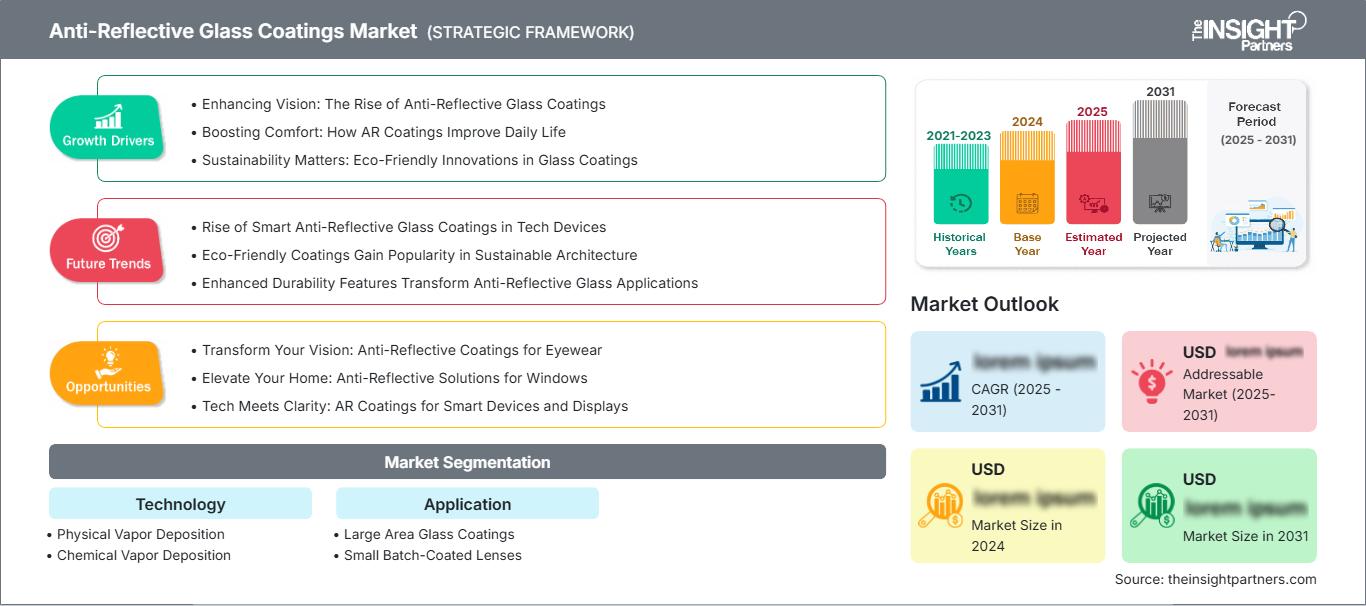
Regional Insights
North America anti-reflective glass coatings market
North America is expected to be responsible for 24–28% of the Anti-Reflective Glass Coatings Market Share in 2025, with an anticipated CAGR of 8.7–9.3% through 2034. Demand in North America is driven by the US, which is bolstered by developments in the field of electronics, automotive displays, optical components, and architectural glazing. In Canada, demand is spurred on by construction applications and optical technology, while Mexico sees demand from production processes in US electronics and automotive industries.
Growing demand in North America is becoming increasingly dependent on coating technologies that offer both optical and abrasion resistant properties, as well as being environmentally durable. Automotive manufacturers are developing bigger surface areas for displays, and thus need coatings that manage glare and reflections. In architecture, coatings for low reflection glazing are also used for high-visibility applications such as retail or museum windows.
U.S. anti-reflective glass coatings Market
The US accounts for 72-77% of demand in North America in 2025 and is forecast to experience an 8.5-9.1% CAGR through 2034. Electronics, automobile displays, optical equipment, specialty lenses, and premium architectural glass represent the key applications for demand. Local technological expertise enables coatings with strict requirements for optics and mechanics.
The application scope is moving towards larger displays for automobiles, smart gadgets, optical sensors, and premium glass. 3M Company and Abrisa Technologies provide coatings for special applications, while global companies of glass and optical components supply premium applications. More use of advanced display units increases demand for coatings that enhance visibility in bright ambient lighting without deteriorating image quality, longevity, or tactile functionality.
Europe anti-reflective glass coatings Market
Europe’s share is in the range of 25-29%, growing at a rate of 8.8-9.4% CAGR between 2025 and 2034. Europe is dominated by Germany due to its importance as an automotive manufacturer, industry leader in optics, and high level of glass processing. UK is driven by specialty glazing, optics, and display technologies; France is driven by construction and luxury retail applications.
Germany's automotive and industrial segment drives the need for coatings for displays, sensors, and specialty glazing. France and Italy drive the segment through architecture, museums, retailing, optics, and luxury interior coatings. Spain drives the market through construction, solar panel applications, and commercial glazing. There is a rising importance among European customers for coatings that are durable, energy-efficient, and chemically resistant.
APAC anti-reflective glass coatings Market
The APAC region accounts for 34-39% of the global market in 2025 and will witness CAGR of 10.0-10.7% up to 2034. China is the key country, with solar glass, electronics, display, and mass production of glass as key drivers. Japan and South Korea are important contributors through electronics and optics.
India is developing as a market through solar manufacturing and architectural development activities, and Australia has smaller but significant contribution because of solar and specialty glazing applications. Industrial policies encouraging local solar and electronics manufacturing in the region are increasing the coated substrates' addressable base.
Middle East & Africa anti-reflective glass coatings Market
Demand in the Middle East and Africa region will be rising at 7.2-7.9% CAGR until 2034. Leading the market prospects in the region are Saudi Arabia and UAE due to significant construction activity, commercial glass application, solar installations, and diversification of industries. South Africa offers strong established market for specialty glass and solar products.
The demand from the rest of the Middle East and Africa is not very high; however, there is gradual growth of the market due to the rise of infrastructure development and investment in renewables. High solar radiation makes it important for coatings to improve glass' energy transmission and maintain its performance in harsh conditions.
Segmentation Analysis
Technology
Technology is projected to expand at a 9.4–10.0% CAGR during 2026–2034 as manufacturers balance deposition precision, coating durability, throughput, and cost. Technology selection varies according to substrate dimensions, optical requirements, production volumes, and the thermal limitations of the glass or optical component.
- Physical Vapor Deposition enables controlled multilayer structures with precise optical properties. It is strategically important for optical components, displays, specialty lenses, and applications requiring tightly engineered refractive-index transitions.
- Chemical Vapor Deposition supports scalable coating processes and is particularly relevant to large-area glass. Its ability to integrate with continuous manufacturing strengthens its importance in solar and architectural applications.
Application
Application is expected to grow at a 9.5–10.1% CAGR through 2034, reflecting continued demand from solar, architectural glazing, displays, optical products, and specialty glass. Application requirements determine coating thickness, durability, optical performance, and processing economics.
- Large Area Glass Coatings represent the principal volume base because solar modules, architectural glazing, retail displays, and museum glass require uniform treatment across substantial surface areas.
- Small Batch-Coated Lenses serve higher-value applications where optical precision, customized spectral performance, and low defect rates are more important than coating throughput or surface area.
Opportunity Snapshot
| Application | Revenue Contribution | Trend Tag | Adoption Stage |
|---|---|---|---|
| Large Area Glass Coatings | High | Solar Transmission | Mature |
| Small Batch-Coated Lenses | Medium | Optical Precision | Scaling |
Anti-Reflective Glass Coatings Market Growth Drivers and Impact Analysis
Rapid Expansion of High-Efficiency Solar Modules
Solar module manufacturers increasingly use anti-reflective treatments to improve the amount of incident light reaching photovoltaic cells. Higher module efficiency increases the economic value of even incremental transmission improvements, particularly for utility-scale installations where energy yield directly affects project economics. The expansion of bifacial modules and larger-format glass further strengthens requirements for consistent optical performance across extensive surfaces. Coating suppliers are therefore investing in uniform deposition, durability, and resistance to cleaning cycles and environmental exposure. The effect extends across the value chain because glass producers increasingly integrate coating operations into solar-glass manufacturing rather than relying exclusively on downstream processors. As photovoltaic manufacturing capacity expands across China, India, Southeast Asia, and other regions, demand for scalable coating systems is expected to increase accordingly.
Growing Display Surface Area in Automotive and Consumer Electronics
Automotive cockpits are incorporating larger central displays, digital instrument clusters, passenger screens, and head-up-display technologies, increasing the surface area requiring controlled optical behavior. At the same time, smartphones, tablets, laptops, and monitors compete on outdoor readability and visual clarity. Anti-reflective treatments reduce distracting reflections and can improve contrast under challenging lighting conditions. This driver favors coatings that combine optical performance with scratch resistance, chemical resistance, touch compatibility, and low haze. The commercial impact is significant because display manufacturers can justify higher-value coating technologies when they improve perceived product quality. As display surfaces become larger and more integrated into vehicle interiors, coating specifications are becoming increasingly application-specific.
Growth of Premium Architectural and Specialty Display Glass
Architectural designers, museums, galleries, luxury retailers, and commercial developers increasingly use high-transparency glass where reflections can interfere with visibility or aesthetics. Anti-reflective coatings enable clearer views through façades, showcases, picture frames, and exhibition glazing while maintaining the structural function of the glass. Demand is particularly relevant for premium projects where visual quality carries greater economic importance than basic glazing cost. Durable outdoor formulations are expanding the application range beyond traditional indoor picture frames and showcases. The market impact includes greater demand for large-format coated glass, improved abrasion resistance, and weather durability. Suppliers with integrated glass processing and coating capabilities can address these requirements more efficiently.
Anti-Reflective Glass Coatings Market Future Trends
Multifunctional Coatings Combining Optical and Surface Performance
The anti-reflective glass coatings market trends are moving toward multifunctional architectures that combine reflection reduction with anti-soiling, hydrophobicity, scratch resistance, UV management, and easier cleaning. Solar applications are especially suited to this approach because maintaining optical transmission over the module lifetime is as important as initial coating performance. Architectural and display applications can similarly benefit from coatings that reduce reflections while resisting fingerprints, abrasion, and cleaning chemicals. Future formulations are likely to use multilayer structures with carefully selected refractive indices and protective topcoats. The result should be greater product differentiation, longer service intervals, and increased value per coated surface rather than simple competition based on coating price.
More Durable and Environment-Specific Deposition Architectures
Future coating development will increasingly focus on durability under distinct environmental conditions rather than treating optical performance as the sole design objective. Solar glass may require resistance to humidity, dust, thermal cycling, and repeated cleaning, while automotive displays face temperature changes, fingerprints, abrasion, and chemical exposure. Architectural glass requires long-term weatherability and stable appearance. This shift will encourage denser films, improved adhesion layers, protective topcoats, and more rigorous accelerated-aging protocols. Manufacturers are also likely to use process analytics to control thickness and defect rates more precisely. These developments can improve product consistency while enabling suppliers to qualify coatings for increasingly demanding applications.
Anti-Reflective Glass Coatings Market Opportunities
Localized Coating Capacity for Asian Solar Manufacturing
The anti-reflective glass coatings market Forecasts indicate that Asian manufacturing expansion will create opportunities for localized coating capacity close to photovoltaic glass and module production clusters. China already has extensive solar-glass infrastructure, while India and Southeast Asia are expanding domestic photovoltaic manufacturing. Local coating lines can reduce transportation costs, shorten qualification cycles, and allow formulations to be adapted to regional glass compositions and module designs. Equipment suppliers, coating-material producers, and glass processors can pursue partnerships that combine deposition technology with application laboratories and quality-control systems. Investments should prioritize scalable lines, automated thickness monitoring, and durability testing because solar customers increasingly require consistent optical performance across high-volume production.
Premium Optical and Automotive Display Coating Platforms
A second opportunity lies in customized coating platforms for automotive displays, augmented-reality optics, smart glasses, and premium electronic devices. These applications typically require tighter control of reflection, haze, color shift, scratch resistance, and environmental stability than standard architectural products. Suppliers can target this segment through small-batch development laboratories capable of rapidly modifying multilayer stacks before transferring qualified formulations to larger production lines. Partnerships with display, optical-component, and automotive Tier 1 manufacturers can create early access to new product programs. The opportunity is attractive because qualification requirements create customer stickiness once a coating has passed reliability testing and entered a standardized production platform.
Recent Developments
- July 11, 2025: NSG Group announced the opening of a new rolled-glass production line at Greengate Works in St Helens, UK, following a multimillion-pound investment. The line consolidates production and is expected to reduce annual CO2 emissions by 15,000 tonnes, supporting the group's specialty and functional-glass manufacturing capabilities.
- January 22, 2025: Corning Incorporated and Samsung Electronics Co., Ltd. introduced Gorilla Armor 2 for the Galaxy S25 Ultra. The glass ceramic combines anti-reflective performance with scratch resistance and durability, with Corning reporting improved drop performance and more than four times the scratch resistance of specified competing cover glasses.
Frequently Asked Questions

- Comprehensive Market Sizing and Forecast Analysis
- Detailed Segmentation Analysis
- In-Depth Market Dynamics Assessment
- Regional and Country-Level Insights
- Competitive Landscape and Company Benchmarking
- Strategic Business Intelligence
Recent Reports
Testimonials

The Insight Partners' SCADA System Market report is comprehensive, with valuable insights on current trends and future forecasts. The team was highly professional, responsive, and supportive throughout. We are very satisfied and highly recommend their services.
RAN KEDEM Partner, Reali Technologies LTDs
I requested a report on a very specific software market and the team produced the report in a few days. The information was very relevant and well presented. I then requested some changes and additions to the report. The team was again very responsive and I got the final report in less than a week.
JEAN-HERVE JENN Chairman, Future Analytica
We worked with The Insight Partners for an important market study and forecast. They gave us clear insights into opportunities and risks, which helped shape our plans. Their research was easy to use and based on solid data. It helped us make smart, confident decisions. We highly recommend them.
PIYUSH NAGPAL Sr. Vice President, High Beam Global
The Insight Partners delivered insightful, well-structured market research with strong domain expertise. Their team was professional and responsive throughout. The user-friendly website made accessing industry reports seamless. We highly recommend them for reliable, high-quality research services
YUKIHIKO ADACHI CEO, Deep Blue, LLC.
This is the first time I have purchased a market report from The Insight Partners.While I was unsure at first, I visited their web site and felt more comfortable to take the risk and purchase a market report.I am completely satisfied with the quality of the report and customer service. I had several questions and comments with the initial report, but after a couple of dialogs over email with their analyst I believe I have a report that I can use as input to our strategic planning process.Thank you so much for taking the extra time and making this a positive experience.I will definitely recommend your service to others and you will be my first call when we need further market data.
JOHN SUZUKI President and Chief Executive Officer, Board Director, BK Technologies
I wish to appreciate your support and the professionalism you displayed in the course of attending to my request for information regarding to infectious disease IVD market in Nigeria. I appreciate your patience, your guidance, and the fact that you were willing to offer a discount, which eventually made it possible for us to close a deal. I look forward to engaging The Insight Partners in the future, all thanks to the impression you have created in me as a result of this first encounter.
DR CHIJIOKE ONYIA MANAGING DIRECTOR, PineCrest Healthcare Ltd.Reason to Buy
- Informed Decision-Making
- Understanding Market Dynamics
- Competitive Analysis
- Identifying Emerging Markets
- Customer Insights
- Market Forecasts
- Risk Mitigation
- Boosting Operational Efficiency
- Strategic Planning
- Investment Justification
- Tracking Industry Innovations
- Aligning with Regulatory Trends





 Get Free Sample for