
Anti-Snoring Treatment Market Trends, Demand & Growth by 2034
Coverage: By Devices (Mandible Advancement Devices, Tongue Stabilizing Devices, Nasal Devices, Continuous Positive Airway Pressure Devices, Chin Straps); Distribution Channel (Hospitals, Clinics, Retail Pharmacies, E-commerce) , and Geography (North America, Europe, Asia Pacific, and South and Central America)
- Status : Data Released
- Report Code : TIPRE00021849
- Category : Life Sciences
- No. of Pages : 150
- Available Report Formats :


- Last update date : August 26, 2026


2025 Market Size
US$ 1.71 Bn
Base year value
2034 Forecast
US$ 3.35 Bn
Projected by 2034
CAGR 2026-2034
7.78 %
Growth rate
Addressable Market
US$ 22.80 Bn
(2026-2034)
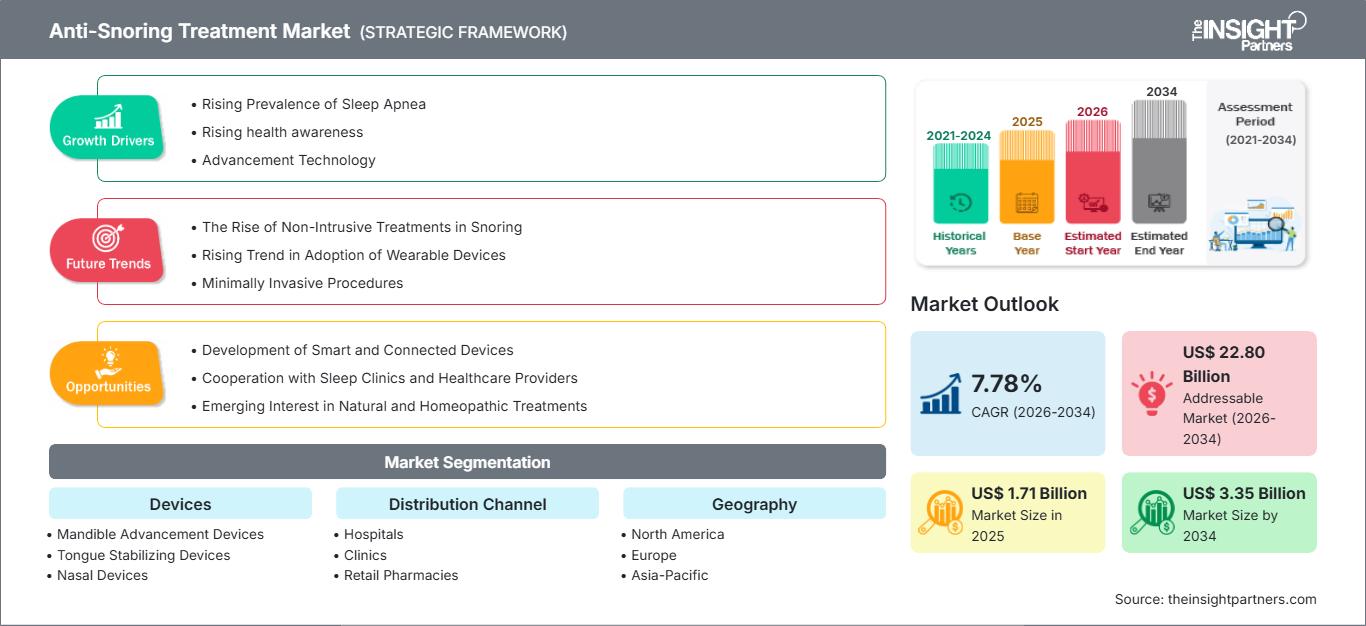
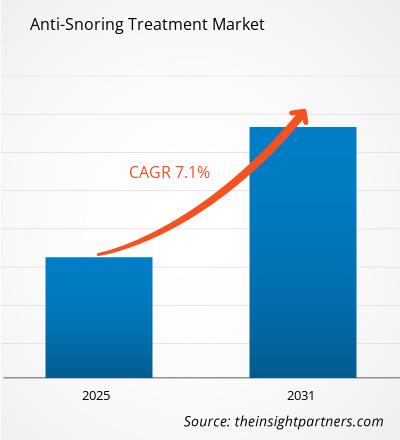
The anti-snoring treatment market size is poised for consistent growth, driven by the growing preference for non-invasive treatment modalities among consumers, healthcare professionals, and device manufacturers for sleep-disorder breathing. The value of the anti-snore treatment market is estimated to be US$ 1.71 Billion in 2025 and is anticipated to grow to reach US$ 3.35 Billion by 2034 at a CAGR of 7.78% between 2026 and 2034.
The North America region is considered the dominant commercial market, backed by the presence of a developed sleep medicine industry, high rate of diagnosis, reimbursement policies, and adoption of oral and positive airway pressure devices. The anti-snore treatment market size in the region is anticipated to grow at a CAGR of approximately 8.0–8.5% through 2034, boosted by sleep disordered breathing due to obesity and the increasing preference for home-based treatments.
Anti-Snoring Treatment Market Assessment and Insights
- North America: The region is expected to account for a 40–44% anti-snoring treatment Market share in 2025, supported by mature sleep-care infrastructure and established device adoption, while growing at a CAGR of 8.0–8.5% between 2026–2034.
- US: The US represents approximately 84–88% of North America’s 2025 share, with established CPAP and oral-appliance usage supporting a 7.9–8.4% CAGR between 2026–2034.
- Europe: Europe is estimated at a 28–32% share in 2025, led by Germany, the UK, France, Italy, and Spain, and is projected to grow at a 7.4–7.9% CAGR between 2026–2034.
- Asia Pacific: Asia Pacific is estimated to hold a 19–23% share in 2025, with China, Japan, South Korea, India, and Australia supporting adoption and a 8.6–9.1% CAGR between 2026–2034.
- Largest Segment: Devices represent an estimated 88–92% market share in 2025, with established CPAP and oral-device utilization supporting a 7.7–8.1% CAGR between 2026–2034.
- High Growth Segment: E-commerce within distribution is estimated at an 11–15% share in 2025, benefiting from consumer purchasing and home delivery, with a 10.2–10.8% CAGR between 2026–2034.
- Key companies analyzed in detail: Philips Healthcare, SomnoMed, GlaxoSmithKline plc, Airway Management, Tomed GmbH, ResMed, Theravent, EZ Sleep, MEDiTAS Ltd., GSK plc, Tomed Dr. Toussaint GmbH, HoMedics Group Canada Co., Contour Products, Inc., MPowRx Health & Wellness Products, Innovative Health Technologies (NZ) Ltd.
Source: The Insight Partners' analysis based on proprietary research, government publications, company annual reports, investor presentations, industry databases, and expert interviews.
Treatment technologies have progressed from simple mechanical devices to adjustable oral appliances, linked positive-airway-pressure devices, neuromuscular stimulation, and more compact nasal devices. Current manufacturing techniques now focus on patient comfort, customization of the fit, reusability of components, digital tracking, and scalable polymer production. FDA classifications include intraoral devices for snoring and obstructive sleep apnea, and new tongue stimulation devices show further development beyond mechanical solutions.
The anti-snoring treatment Market report indicates that future growth is expected to be increasingly influenced by early detection of sleep-disordered breathing, wider use of at-home diagnostics, and inclusion of treatment into digital health platforms. Additional market opportunities exist in emerging markets of Asia Pacific and select Middle Eastern countries as sleep clinics, dental sleep medicine, and e-health portals expand. Future regulatory requirements are expected to place an increasing premium on treatment devices that can be objectively proven to be effective, safe, usable, and compliant.
Anti-Snoring Treatment Market Report Scope
| Report Attribute | Details |
|---|---|
| Market size in 2025 | US$ 1.71 Billion |
| Market Size by 2034 | US$ 3.35 Billion |
| Global CAGR (2026 - 2034) | 7.78% |
| Historical Data | 2021-2024 |
| Forecast period | 2026-2034 |
Anti-Snoring Treatment Market Analysis
The increasing recognition of untreated snoring and sleep-disordered breathing is one of the key elements driving the expansion of the anti-snoring treatment market. The industry ecosystem includes screening services, sleep doctors, dentists, manufacturers of medical devices, pharmacies, distributors, online marketplaces, and home care providers. The demand trends are shifting towards products with high efficacy and comfort, convenience, and simplicity of use on a daily basis. The supply side is dominated by companies that provide standardized devices with the ability to personalize the fitting process where necessary.
The availability of diagnostic services also adds value to the value chain. At-home sleep tests can help to detect those patients who need further treatment. There are also alternative solutions like oral appliances and other non-PAP devices. FDA documents make the distinction between the intraoral devices for snoring and OSA and those used for central apnea.
The competitive positioning strategy is becoming more driven by product differentiation than just the availability of the device itself. ResMed has the complete package of PAP device, diagnostic, connected software, and home care infrastructure, whereas SomnoMed has a strong focus on oral appliance therapy. Other small players like Theravent, Contour Products, MPowRx Health & Wellness Products, and Innovative Health Technologies (NZ) Ltd. are specialized in their mechanical or consumer focused niche. This means that the analysis of the anti-snoring treatment market needs to take into account clinical positioning, reimbursement, reach, and patient compliance.
The investments are shifting towards connected care, personalized fitting, diagnostic integration, and patient engagement. SomnoMed has made investments to boost its manufacturing capabilities and has emphasized compliance monitoring capabilities of its Rest Assure platform. Similarly, ResMed has enhanced its digital diagnostic capability through acquisitions and connected care development.
● REPORT CUSTOMIZATION
Tailor This Report To Align With Your Specific Business Requirements
This report can be customized to align precisely with your business objectives, scope, and target markets. Customization options include tailored segmentation, geography, competitive analysis, and strategic insights to support informed decision-making.
Customize This Report →WHAT YOU CAN ADJUST
- ● Segmentations
- ● Geography
- ● Competitive Analysis
- ● Language Preferences
Anti-Snoring Treatment Market: Strategic Insights
Regional Insights
North America anti-snoring treatment market
North America is expected to dominate in terms of region, with a market share of 40-44% in 2025 and 8.0-8.5% CAGR from 2024-2034. The US leads the regional market owing to the presence of sleep laboratories, home sleep testing, dental sleep medicine, and high awareness about obstructive sleep apnea. Canada helps with respiratory and sleep care services led by specialists. High obesity rates, aging population, and increasing awareness about the cardiovascular consequences of sleep apnea ensure sustained treatment conversion.
The regional dynamics also allow for different types of devices. While CPAP machines continue to play an important role in the treatment of clinically-diagnosed obstructive sleep apnea, oral appliances help select patients in search of alternatives or those who cannot use PAP devices. With the help of FDA clearance, the category has expanded to include neuromuscular tongue stimulation and compliance-assisted intraoral devices.
U.S. anti-snoring treatment Market
The United States represents about 84–88% of North America’s market share in 2025 due to the availability of specialized infrastructure, consumer knowledge, insurance avenues, and accessibility to sleep diagnostics. The market is anticipated to expand at a CAGR of 7.9–8.4% up to 2034. ResMed, SomnoMed, Philips Healthcare, and specialized equipment manufacturers have established their presence in the markets of PAP, oral devices, diagnostics, and sleep accessories.
Trends in application are linking snoring to the assessment for possible obstructive sleep apnea instead of addressing each instance as a separate issue of consumer complaints. Home testing and digital screening can streamline the diagnostic process, while prescription oral devices will play a role in proper cases. For example, ResMed mentioned that its NightOwl sleep apnea test at home became available throughout the United States in 2025.
Europe anti-snoring treatment Market
Europe is estimated to hold a 28–32% share in 2025 and is forecast to grow at a 7.4–7.9% CAGR, with Germany representing a leading national market. The UK and Germany have comparatively developed sleep-medicine and dental-care networks, while France, Italy, and Spain provide additional demand through expanding specialist services and consumer awareness.
The UK market is characterized by organized clinical pathways and growing awareness of sleep-disordered breathing. Germany has a good infrastructure for distributing medical devices along with dental and respiratory care. The French, Italian, and Spanish markets offer potential via private clinics, hospitals, pharmacies, and the Internet. The regulation of medical devices in the EU is gradually shifting to focus on clinical data, quality systems, post-market surveillance, and product performance.
APAC anti-snoring treatment Market
APAC accounts for around 19–23% of the 2025 market and is expected to register a CAGR of 8.6–9.1%, making it the fastest growing region. The order of commercialization of APAC countries is China, Japan, South Korea, India, and Australia. Growing infrastructure of urban healthcare facilities and increasing awareness about sleep health facilitate adoption.
China and Japan have the advantage of existing medical devices infrastructure, whereas South Korea has high technology adoption. India provides long-term potential due to improvements in private hospitals, diagnostic centers, and e-commerce. Australia has relatively developed sleep medicine services. Industrialization, manufacturing, digital diagnostics, and government focus on chronic disease management would gradually increase accessibility of treatment.
Middle East & Africa anti-snoring treatment Market
MEA & Africa is estimated to grow at an 8.2-8.8% CAGR, where Saudi Arabia is a prominent market opportunity, followed by the UAE and South Africa. Demand will be driven by investments in hospitals, specialist clinics, respiratory services, and medical device distributors. RoMEA region has comparatively low penetration levels, yet there is some additional growth opportunity due to improved diagnosis.
In the case of Saudi Arabia and the UAE, the presence of well-developed healthcare infrastructure and private investments will help, whereas South Africa will serve as a regional base for specialist respiratory and sleep services. The high level of healthcare investments in the Gulf countries may help in faster adoption of new diagnostic and PAP devices.
Segmentation Analysis
Devices
Devices represent the dominant product category, supported by established clinical use, consumer familiarity, and the availability of multiple approaches for different anatomical and severity profiles. The segment is expected to grow at a 7.7–8.1% CAGR from 2026–2034. Manufacturers increasingly differentiate through comfort, adjustability, portability, compliance monitoring, and personalized fit.
- Mandible Advancement Devices: Widely positioned for mechanically enlarging the upper-airway space, these appliances benefit from established dental sleep medicine workflows and demand for alternatives to conventional PAP therapy.
- Tongue Stabilizing Devices: These products address tongue-position-related airway obstruction and provide a non-invasive option for selected patients, particularly where mandibular advancement is unsuitable or poorly tolerated.
- Nasal Devices: Compact nasal solutions target airflow optimization and consumer convenience, making them particularly relevant to individuals seeking less intrusive approaches for uncomplicated or position-related snoring.
- Continuous Positive Airway Pressure Devices: CPAP remains clinically important for obstructive sleep apnea, supported by extensive clinical evidence, connected monitoring, and increasingly comfortable masks and interfaces.
- Chin Straps: These mechanically simple products support mouth closure and nasal breathing during sleep, typically serving as adjunctive solutions rather than comprehensive treatments for clinically significant sleep apnea.
Distribution Channel
Distribution Channel is expected to expand at a 7.9–8.4% CAGR from 2026–2034 as consumers gain more purchasing options and healthcare providers increasingly combine clinical recommendations with home delivery. Channel economics differ substantially because prescription devices require professional involvement, whereas selected consumer products can move through retail and online channels.
- Hospitals: Hospitals remain important for clinically evaluated patients, particularly where snoring is associated with suspected obstructive sleep apnea requiring multidisciplinary assessment and treatment planning.
- Clinics: Sleep, dental, respiratory, and specialist clinics are central to fitting, titration, follow-up, and patient education, especially for oral appliances requiring professional customization.
- Retail Pharmacies: Pharmacies provide accessible points of purchase for selected non-prescription or lower-complexity products, supporting consumer awareness and convenient replenishment.
- E-commerce: Online channels are increasingly influential because they enable product comparison, home delivery, direct-to-consumer education, and broader access to devices that do not require complex clinical fitting.
Opportunity Snapshot
| Distribution Channel | Revenue Contribution (High/Medium/Low) | Trend Tag (MAX 2 words) | Adoption Stage (Emerging/Scaling/Mature) |
|---|---|---|---|
| Hospitals | High | Clinical Referral | Mature |
| Clinics | High | Dental Fitting | Mature |
| Retail Pharmacies | Medium | OTC Access | Scaling |
| E-commerce | Medium | Home Delivery | Scaling |
Anti-Snoring Treatment Market Growth Drivers and Impact Analysis
Increasing Recognition of Undiagnosed Sleep-Disordered Breathing
The relationship between habitual snoring, obstructive sleep apnea, daytime impairment, and cardiovascular risk is improving awareness among patients and primary-care professionals. This creates a broader screening funnel and increases the number of individuals progressing from self-management toward clinically appropriate treatment. The commercial impact is strongest for devices that can be introduced after diagnosis or professional assessment, including oral appliances and PAP systems. Greater awareness also encourages manufacturers to invest in educational programs, screening tools, and digital patient engagement. As diagnosis becomes more accessible, the addressable population shifts from consumers seeking symptom reduction toward patients requiring sustained therapeutic management. This transition increases demand for products supported by clinical evidence, monitoring capabilities, and professional follow-up rather than low-complexity mechanical solutions alone.
Expansion of Home-Based Diagnosis and Treatment Pathways
Home sleep testing is changing the economics and convenience of sleep-disorder evaluation by reducing dependence on laboratory-based testing for appropriate patients. The resulting shorter pathway from suspicion to diagnosis can increase treatment conversion, particularly where specialist capacity is constrained. Digital tools further enable remote monitoring, patient reminders, and therapy-support interventions after initial prescription. For manufacturers, this creates an opportunity to integrate diagnostic and treatment workflows, improving patient retention and enabling more data-driven product development. The market impact extends across channels because patients diagnosed remotely may receive devices through home-care providers, clinics, pharmacies, or digital commerce. Companies capable of combining hardware, software, clinical data, and service support can therefore capture greater value across the treatment journey.
Patient Comfort and Adherence as Product Selection Criteria
Treatment effectiveness increasingly depends on whether patients can consistently use a device throughout the night. Comfort, noise, bulk, pressure, fit, and ease of maintenance therefore influence purchasing decisions alongside clinical performance. Manufacturers are responding with lighter materials, improved interfaces, adjustable oral appliances, compact nasal products, and digital compliance features. The commercial effect is a gradual shift from purely functional product competition toward user-experience differentiation. Devices capable of demonstrating improved comfort or adherence can command stronger clinical preference and reduce abandonment. This is particularly relevant for long-term sleep apnea therapy, where persistent usage determines practical treatment value. The resulting competition encourages iterative product development and creates opportunities for specialized suppliers targeting specific anatomical, lifestyle, or tolerance requirements.
Anti-Snoring Treatment Market Future Trends
Connected Compliance Monitoring and Personalized Therapy
Future product development is likely to emphasize objective measurement of treatment use, fit, and therapeutic response. Compliance-enabled oral appliances and connected PAP ecosystems can provide clinicians with actionable information rather than relying exclusively on patient recall. Personalized algorithms may increasingly adjust comfort settings, identify poor adherence, and flag patients requiring reassessment. The anti-snoring treatment market trends will consequently move toward devices that operate as components of broader digital care pathways. This evolution can strengthen clinical confidence in non-PAP alternatives by generating measurable real-world evidence. Manufacturers may also use anonymized usage data to identify design limitations, refine fitting protocols, and prioritize product improvements. Over time, connected monitoring should become an important differentiator in reimbursement discussions and specialist purchasing decisions.
Integration of Sleep Care With Broader Metabolic Health Management
Sleep disorders are increasingly considered alongside obesity, cardiovascular disease, diabetes, and metabolic health rather than as isolated respiratory conditions. Future treatment pathways may therefore integrate sleep screening into broader chronic-care programs, particularly as obesity-management medicines and digital health platforms expand. This creates opportunities for screening tools to identify patients whose snoring indicates underlying sleep-disordered breathing. The resulting pathway could connect primary care, weight management, sleep medicine, dentistry, and home respiratory services. The anti-snoring treatment market trends will consequently reflect a wider patient-management ecosystem, where treatment selection considers weight, airway anatomy, medication use, comorbidities, and patient preferences. Companies able to establish clinical interoperability and evidence across these disciplines may gain stronger positioning as sleep care becomes more integrated.
Anti-Snoring Treatment Market Opportunities
Expansion of Professionally Fitted Oral Appliance Networks
A significant commercial opportunity exists in expanding networks of dentists and sleep specialists capable of evaluating and fitting oral appliances. Such networks can address geographic gaps while creating recurring demand for adjustments, replacements, follow-up testing, and compliance management. Manufacturers can support expansion through standardized training, digital fitting workflows, remote consultation, and evidence-based patient-selection protocols. The anti-snoring treatment market Forecasts should therefore consider not only unit sales but also the service infrastructure required to convert diagnosed patients into sustained users. Companies with established clinical education programs can accelerate penetration by partnering with dental groups and sleep centers. This approach also reduces dependence on direct consumer advertising and creates stronger professional referral channels.
Digital Commerce for Lower-Complexity Sleep Solutions
E-commerce provides an attractive route for products that do not require individualized clinical fitting or prescription management. Manufacturers can improve conversion through educational content, product-comparison tools, virtual screening questionnaires, and post-purchase support. The channel also enables rapid geographic expansion without requiring equivalent physical distribution infrastructure. However, commercial strategies must clearly distinguish consumer wellness products from therapies intended for diagnosed obstructive sleep apnea. This creates an opportunity for companies to build tiered portfolios, using digital commerce for accessible products while directing higher-risk consumers toward professional evaluation. The approach can increase reach in emerging markets and complement pharmacy distribution. Successful operators will likely combine transparent claims, regulatory compliance, localized fulfillment, and digital customer support.
Recent Developments
- June 2026: ResMed presented 13 research abstracts at SLEEP 2026 covering smartphone-based obstructive sleep apnea screening, treatment patterns following expanded GLP-1 use, wearable sleep monitoring, sex-specific screening, and cardiovascular healthcare utilization. The program illustrates the company’s increasing focus on personalized, digitally supported sleep-care pathways extending beyond conventional device delivery.
- July 2026: SomnoMed’s investor disclosures continued to highlight expansion of oral-appliance manufacturing capacity and development of its Rest Assure compliance-monitoring platform. The company’s FY25 report stated that manufacturing expansion was expected to provide at least 25% additional capacity during FY26, supporting regional growth and technology-enabled oral-appliance therapy.
- March 2025: Signifier Medical Technologies Limited introduced a new eXciteOSA SKU incorporating a hardware remote control designed around US Medicare and Medicaid reimbursement requirements. The change was intended to improve access for eligible patients while aligning the device configuration with CMS reimbursement requirements for neuromuscular tongue-stimulation therapy.
Frequently Asked Questions

- Comprehensive Market Sizing and Forecast Analysis
- Detailed Segmentation Analysis
- In-Depth Market Dynamics Assessment
- Regional and Country-Level Insights
- Competitive Landscape and Company Benchmarking
- Strategic Business Intelligence
Recent Reports
Testimonials

The Insight Partners' SCADA System Market report is comprehensive, with valuable insights on current trends and future forecasts. The team was highly professional, responsive, and supportive throughout. We are very satisfied and highly recommend their services.
RAN KEDEM Partner, Reali Technologies LTDs
I requested a report on a very specific software market and the team produced the report in a few days. The information was very relevant and well presented. I then requested some changes and additions to the report. The team was again very responsive and I got the final report in less than a week.
JEAN-HERVE JENN Chairman, Future Analytica
We worked with The Insight Partners for an important market study and forecast. They gave us clear insights into opportunities and risks, which helped shape our plans. Their research was easy to use and based on solid data. It helped us make smart, confident decisions. We highly recommend them.
PIYUSH NAGPAL Sr. Vice President, High Beam Global
The Insight Partners delivered insightful, well-structured market research with strong domain expertise. Their team was professional and responsive throughout. The user-friendly website made accessing industry reports seamless. We highly recommend them for reliable, high-quality research services
YUKIHIKO ADACHI CEO, Deep Blue, LLC.
This is the first time I have purchased a market report from The Insight Partners.While I was unsure at first, I visited their web site and felt more comfortable to take the risk and purchase a market report.I am completely satisfied with the quality of the report and customer service. I had several questions and comments with the initial report, but after a couple of dialogs over email with their analyst I believe I have a report that I can use as input to our strategic planning process.Thank you so much for taking the extra time and making this a positive experience.I will definitely recommend your service to others and you will be my first call when we need further market data.
JOHN SUZUKI President and Chief Executive Officer, Board Director, BK Technologies
I wish to appreciate your support and the professionalism you displayed in the course of attending to my request for information regarding to infectious disease IVD market in Nigeria. I appreciate your patience, your guidance, and the fact that you were willing to offer a discount, which eventually made it possible for us to close a deal. I look forward to engaging The Insight Partners in the future, all thanks to the impression you have created in me as a result of this first encounter.
DR CHIJIOKE ONYIA MANAGING DIRECTOR, PineCrest Healthcare Ltd.Reason to Buy
- Informed Decision-Making
- Understanding Market Dynamics
- Competitive Analysis
- Identifying Emerging Markets
- Customer Insights
- Market Forecasts
- Risk Mitigation
- Boosting Operational Efficiency
- Strategic Planning
- Investment Justification
- Tracking Industry Innovations
- Aligning with Regulatory Trends





 Get Free Sample for