
Anti-Surge Valves Market Size, Demand & Growth by 2034
Coverage: by Actuation (Hydraulic, Pneumatic, Electric); Application (Gas Production, Gas Storage and Transmission, LNG, Olefins, FPSO, Chemical/Fertilizer Plant, Others) , and Geography (North America, Europe, Asia Pacific, and South and Central America)
- Status : Data Released
- Report Code : TIPRE00010589
- Category : Manufacturing and Construction
- No. of Pages : 150
- Available Report Formats :


- Last update date : July 15, 2026


2025 Market Size
US$ 1.75 Bn
Base year value
2034 Forecast
US$ 2.77 Bn
Projected by 2034
CAGR 2026-2034
5.23 %
Growth rate
Addressable Market
US$ 20.50 Bn
(2026-2034)
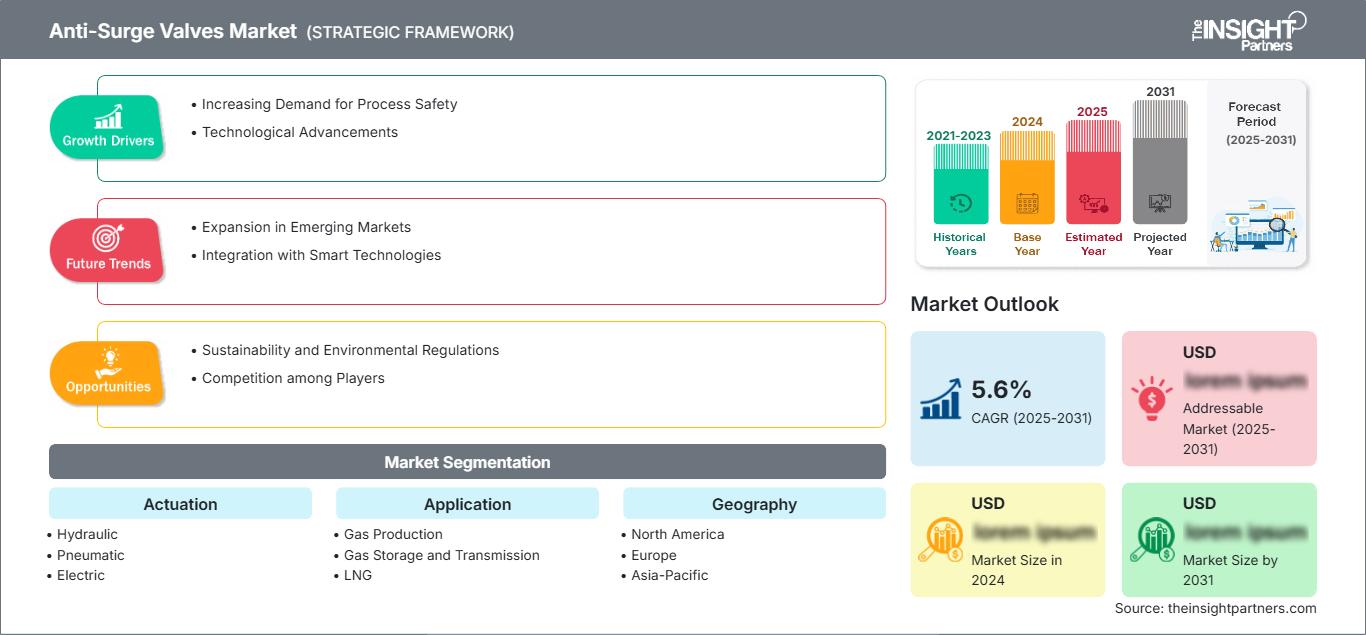
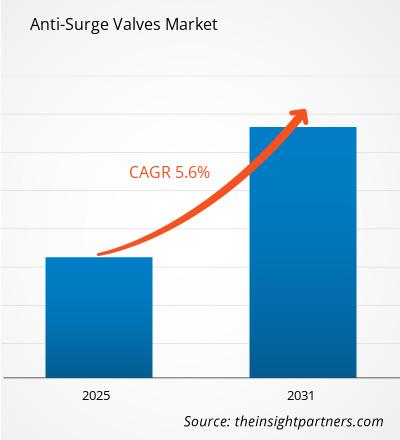
The global anti-surge valves market size is estimated to grow from US$ 1.75 Billion in 2025 to US$ 2.77 Billion by 2034 at a CAGR of 5.23% between 2026-2034. The market growth is driven by the need for protecting compressors through anti-surge measures in natural gas production, liquefied natural gas, olefin plants, FPSO operations, and chemical/fertilizer plants. Fast acting valves lower the risks of surge and damages and plant shutdowns within critical process systems.
North America is a technologically advanced demand region and anti-surge valves market growth in this region is driven by shale gas processing, liquefied natural gas export, upgradation of compressor stations and petrochemical plants. North America is expected to register 4.7%-5.2% CAGR over 2026-2034 due to need for fast acting valves and control systems.
Anti-Surge Valves Market Assessment and Insights
- North America held 28–31% anti-surge valves market share in 2025 and is expected to grow at a 4.7–5.2% CAGR between 2026–2034, driven by LNG terminals, gas transmission upgrades, and compressor reliability spending.
- US accounted for 78–82% of North America in 2025 and is projected to grow at a 4.8–5.3% CAGR between 2026–2034.
- Europe represented 22–25% share in 2025 and is forecast to grow at a 4.1–4.7% CAGR between 2026–2034, led by Germany, the UK, France, Italy, and Spain.
- Asia Pacific held 30–34% share in 2025 and is expected to grow at a 5.8–6.4% CAGR between 2026–2034, with China, India, Japan, and South Korea leading demand.
- Largest Segment Pneumatic actuation held 51–55% market share in 2025, with a 4.6–5.1% CAGR between 2026–2034 due to fast response and proven plant reliability.
- High Growth Segment Electric actuation held 17–20% market share in 2025, with a 6.2–6.8% CAGR between 2026–2034 as digital plants adopt precise diagnostics.
- Key companies analyzed in detail: Baker Hughes Company, Emerson Electric Co., Flowserve Corporation, Mokveld Valves B.V., SAMSON AG, KOSO Kent Introl Limited, kmo turbo GmbH, IMI Critical Engineering, CIRCOR International, Inc., Schroeder Valves GmbH & Co. KG.
Source: The Insight Partners' analysis based on proprietary research, government publications, company annual reports, investor presentations, industry databases, and expert interviews.
The evolution of technologies is leading to a shift away from mechanical protection devices to compressor protection solutions. More sophisticated pneumatic boosters, electro-hydraulic solutions, intelligent positioners, and quiet trim configurations are increasingly used to extend operating ranges in LNG trains and gas pipelines. Dynamics are also evolving, as EPCs now request pre-tested assemblies of valves, actuators, and controls to accelerate commissioning and reduce tuning requirements in the field.
Going forward, demand will be generated in Asia-Pacific gas infrastructure, Middle-East LNG projects and chemical brownfield plants looking for increased reliability. Process safety and methane control regulations are reinforcing replacement cycles, while cooperation between compressor OEMs and anti-surge vendors is increasing application-specific offerings of solutions. Future investments may go to suppliers with dynamic testing capabilities, severe-service trim options, and life-cycle services.
Anti-Surge Valves Market Report Scope
| Report Attribute | Details |
|---|---|
| Market size in 2025 | US$ 1.75 Billion |
| Market Size by 2034 | US$ 2.77 Billion |
| Global CAGR (2026 - 2034) | 5.23% |
| Historical Data | 2021-2024 |
| Forecast period | 2026-2034 |
Anti-Surge Valves Market Analysis
Market growth in anti-surge valves is built on economics of compressor downtime. One surge occurrence may lead to damaging effects on the rotating equipment, loss in capacity, and need for emergency repairs, where fast recycle will become an important selection criterion. Gas processing facilities, LNG liquefaction facilities, olefin plants, and fertilizers require valves with proven stroking time, controllability range, and stability in the presence of large pressure drops.
The value chain consists of compressor OEMs, valve manufacturers, actuators producers, control systems integrators, EPC companies, and plant owners/operators. Supply factors remain specific due to the fact that anti-surge valves should be designed for transient conditions, noise, vibrations, and fail open performance. Lead times are dependent on the forged bodies availability, machining of severe service trim, and actuator testing.
Anti-surge valves market analysis indicates a highly competitive environment in which performance of systems prevails over the pricing of individual units. The advantage that Baker Hughes Company and Emerson Electric Co. have is the integration of compressors and controls, while Flowserve Corporation, Mokveld Valves B.V., SAMSON AG, and IMI Critical Engineering have a competitive edge based on severe-service engineering, installed base, and projects.
Strategic positioning is shifting toward bundled lifecycle support, digital diagnostics, and regional service capability. KOSO Kent Introl Limited, kmo turbo GmbH, CIRCOR International, Inc., and Schroeder Valves GmbH & Co. KG are relevant in engineered niches where response speed, reliability, and aftermarket responsiveness influence award decisions. Investment is concentrated in test facilities, smart actuation, and noise reduction.
● REPORT CUSTOMIZATION
Tailor This Report To Align With Your Specific Business Requirements
This report can be customized to align precisely with your business objectives, scope, and target markets. Customization options include tailored segmentation, geography, competitive analysis, and strategic insights to support informed decision-making.
Customize This Report →WHAT YOU CAN ADJUST
- ● Segmentations
- ● Geography
- ● Competitive Analysis
- ● Language Preferences
Anti-Surge Valves Market: Strategic Insights
Regional Insights
North America Anti-Surge Valves Market
The North American share of the anti-surge valve market was recorded at 28-31% in 2025 and is expected to grow at a 4.7-5.2% CAGR from 2026 to 2034. There is a demand for recycle valves that provide high reliability due to LNG export facilities, shale gas collection systems, and the modernization of interstate compressor stations.
In the North American market, buying behavior tends to favor qualified vendors with local presence, quick delivery of spares, and evidence of dynamic response testing. The replacement demand is high as compressor units in the midstream and petrochemical industry need to have faster actuation, diagnosis ability, and low acoustic hazard without process reconstruction.
U.S. Anti-Surge Valves Market
The U.S. represented 78–82% of North America in 2025 and is forecast to grow at a 4.8–5.3% CAGR through 2034. Gas processing plants, Gulf Coast LNG trains, refinery compressor systems, and chemical complexes make the country the region’s most concentrated demand base for anti-surge valves.
Company presence is supported by Emerson Electric Co., Flowserve Corporation, Baker Hughes Company, and CIRCOR International, Inc., which serve EPCs and plant operators through engineering, controls, and aftermarket channels. Application trends include LNG compressor recycle, ethylene plant turbomachinery protection, and midstream pipeline compression upgrades.
Europe Anti-Surge Valves Market
Europe held 22–25% share in 2025 and is estimated to grow at a 4.1–4.7% CAGR during 2026–2034. Germany leads regional demand through chemical, fertilizer, hydrogen-ready compression, and industrial gas assets, while the UK supports offshore, LNG receiving, and brownfield petrochemical replacement activity.
France, Italy, and Spain contribute through refining, regasification, and chemical modernization projects where compressor protection must align with safety and emissions objectives. European buyers often prioritize low-noise trim design, pressure-balanced construction, and certified actuator packages, supporting specialists such as Mokveld Valves B.V., SAMSON AG, and IMI Critical Engineering.
APAC Anti-Surge Valves Market
The APAC region has 30-34% market share in 2025 and will witness the highest CAGR at 5.8-6.4% over 2025-2030. The largest contributor is China with the capacity for petrochemicals and gas processing, followed by India with additional demand for fertilizers, refining, and city gas-related compressors.
The key demand drivers for Japan and South Korea are gas import terminals, industrial gas applications, and reliable chemical facilities, while in Australia they are LNG and upstream gas projects. Focus of policy makers on clean gas, manufacturing resilience, and chemicals production drives the procurement of digitally actuated anti-surge valves.
Middle East & Africa Anti-Surge Valves Market
Middle East & Africa is expected to grow at a 5.3–5.9% CAGR during 2026–2034, led by Saudi Arabia and the UAE through gas processing, petrochemicals, and LNG-linked infrastructure. South Africa contributes through refining and industrial gas upgrades.
Regional projects often require severe-service valves that tolerate high temperatures, sand exposure, large pressure drops, and remote operating conditions. Rest of MEA demand is supported by compressor additions in gas monetization, fertilizer production, and pipeline systems, where reliability and field serviceability influence supplier selection.
Segmentation Analysis
Actuation
It is estimated that the actuation category will witness a CAGR of 5.0–5.6% from 2026 to 2034. The application area of anti-surge valves within actuation is defined by the parameters of speed of response, fail-safe philosophy, availability of utilities, and connection with the compressor control. Pneumatic solutions will continue to dominate, hydraulics will be used for heavy-duty work, while electric actuators will become increasingly popular.
- Hydraulic actuation is preferred for large valves requiring high thrust, stable movement, and rapid emergency opening under severe pressure drops in LNG, gas transmission, and offshore compressor systems.
- Pneumatic actuation remains the leading choice because of proven fail-open behavior, fast stroking capability, familiar maintenance practices, and broad acceptance across refineries, gas plants, and chemical facilities.
- Electric actuation is scaling in digitally monitored plants where precise positioning, reduced air infrastructure, predictive diagnostics, and integration with automation platforms support higher lifecycle visibility.
Application
The Application Market is forecasted to experience a 5.1%-5.7% CAGR from 2026-2034. The highest demand is seen in areas where centrifugal compressors work under varying flow regimes and areas where downtime entails production risks or safety hazards. Gas production, LNG, olefins, FPSO, and fertilizer facilities are the key end-use markets for noise suppression and fast recycle, along with durable actuation.
- Gas Production relies on anti-surge valves to stabilize compressors during fluctuating well flows, dehydration, separation, and export compression, making reliability central to upstream asset availability.
- Gas Storage and Transmission uses these valves in compressor stations where load swings, seasonal withdrawal cycles, and pipeline pressure changes require rapid recycle protection and predictable fail-safe performance.
- LNG applications require large, fast, low-noise valves that protect refrigeration and boil-off gas compressors while allowing plants to maximize throughput without excessive conservative surge margins.
- Olefins plants deploy anti-surge valves around cracked gas and refrigeration compressors, where process variability, high-value production streams, and turnaround costs justify premium severe-service specifications.
- FPSO installations need compact, corrosion-resistant, and highly reliable valve packages because offshore space limits, vibration, and maintenance access make compressor protection especially critical.
- Chemical/Fertilizer Plant demand is supported by ammonia, methanol, urea, and specialty chemical assets that require stable compression, continuous operation, and protection against process upsets.
Opportunity Snapshot
| Application | Revenue Contribution | Trend Tag | Adoption Stage |
| Gas Production | High | Well Compression | Mature |
| Gas Storage and Transmission | High | Pipeline Recycle | Mature |
| LNG | High | Mega Trains | Scaling |
| Olefins | Medium | Cracker Reliability | Mature |
| FPSO | Medium | Offshore Compact | Scaling |
| Chemical/Fertilizer Plant | Medium | Ammonia Stability | Mature |
| Others | Low | Custom Duty | Emerging |
Anti-Surge Valves Market Growth Drivers and Impact Analysis
LNG and Gas Processing Capacity Expansion
An increased number of new LNG trains, gas processing facilities and compressor stations results in an increase of the installed base of the anti-surge valves. According to the IEA, expansion of the LNG supply will transform the gas markets by 2030, while any gas liquefaction and transmission projects use the centrifugal compressors which need protection when starting, during turndown operation and when facing the operational disturbances. These requirements result in the need for larger valves capable of fast full stroke operation, high controllability and acoustics reduction.
Operational Reliability and Asset Protection Priorities
Downtime in compressors could cause an interruption to whole process lines; thus, people have come to regard anti-surge valves more as safety devices than commodities. Costs involved would include downtime, emergency maintenance, compressor repair, and delay in restarting the process. It is particularly relevant for olefins, fertilizers, FPSO and LNG plants whose margin of profitability relies on compression. Purchasing personnel are assigning increased importance to dynamic testing, fail-open certification and service experience, all of which help sell premium engineered products and services.
Automation, Diagnostics, and Safety Compliance
The process industry is moving toward improving their compressor protective schemes with intelligent positioners, diagnostic features for valves, and combined controllers. The advantage of such approach is early detection of sticking, hysteresis, problems with air supply and actuator failure prior to any surge condition taking place. Safety and environmental regulations also motivate the use of more reliable final control elements since uncontrolled process disturbance leads to increased flaring and emission of gas into the atmosphere. The consequence of this is that anti-surge valves become performance oriented.
Anti-Surge Valves Market Future Trends
Digitally Verified Compressor Protection
For the anti-surge valves market trends, there will be an increased emphasis on digital proof of valve performance, as opposed to specifications alone. The operators will seek evidence of stroke signatures, response time, valve condition monitoring, and controller interface information, both at the time of procurement and while in use. This will influence differentiation within the supply chain, as the ability to provide performance information through digitization will lower the potential for conflict during commissioning and aid in maintenance planning.
Application-Specific Severe-Service Engineering
The future approach to procurement will be toward valves based on specific compressor maps, recycle line configuration, noise restrictions, and transient conditions. Existing standard control valves will have to deal with increasing pressures from LNG mega trains, offshore facilities, and large diameter gas pipelines where big size, fast reaction time, and stable modulating are needed. Manufacturers who have simulation technology, high flow rate test facilities, and acoustic/vibration control know-how will be more advantageous.
Anti-Surge Valves Market Opportunities
Retrofit Programs for Aging Compressor Fleets
A major opportunity lies in replacing legacy recycle valves that no longer meet response, noise, or diagnostic expectations. Many gas transmission, refinery, and chemical assets were designed before current digital monitoring practices became common, creating a practical case for upgrades without full compressor replacement. The anti-surge valves market forecasts indicate that retrofit demand can provide resilient revenue because it is tied to reliability, safety audits, and maintenance budgets rather than only new project cycles. Suppliers can capture value by offering site surveys, dynamic testing, trim upgrades, actuator modernization, and lifecycle service packages.
Integrated Packages for LNG and Petrochemical EPCs
EPC contractors increasingly prefer pre-engineered valve, actuator, positioner, and controller packages that reduce interface risk and commissioning time. This creates an opportunity for manufacturers that can collaborate early with compressor OEMs and automation vendors. LNG, olefins, and fertilizer projects are particularly attractive because compression reliability affects entire train performance. Suppliers can strengthen win rates by providing documented response curves, acoustic calculations, cybersecurity-ready diagnostics, and local commissioning support. Package-based selling also improves aftermarket access through installed base visibility.
Recent Developments
- July 2026: Emerson Electric Co. — Emerson introduced next-generation portable ultrasonic flow meters for plant-wide transparency, strengthening diagnostic capability around process systems that include compressors and control valves. The development supports broader condition monitoring and verification workflows relevant to compressor protection projects.
- June 2025: Severn Glocon Group — Severn highlighted a compressor surge control valve solution for LNG plants, emphasizing response in less than two seconds, accurate valve control, and performance benefits for large valves in mega-train environments. The update addressed LNG efficiency and surge-margin optimization.
- May 2025: Mokveld Valves B.V. — Mokveld announced NSF/ANSI 61 and 372 certification, reinforcing its qualification base for engineered valve applications. While water-focused, the certification demonstrates the company’s continued investment in validated valve performance, compliance, and international project readiness.
Frequently Asked Questions

- Comprehensive Market Sizing and Forecast Analysis
- Detailed Segmentation Analysis
- In-Depth Market Dynamics Assessment
- Regional and Country-Level Insights
- Competitive Landscape and Company Benchmarking
- Strategic Business Intelligence
Recent Reports
Testimonials

The Insight Partners' SCADA System Market report is comprehensive, with valuable insights on current trends and future forecasts. The team was highly professional, responsive, and supportive throughout. We are very satisfied and highly recommend their services.
RAN KEDEM Partner, Reali Technologies LTDs
I requested a report on a very specific software market and the team produced the report in a few days. The information was very relevant and well presented. I then requested some changes and additions to the report. The team was again very responsive and I got the final report in less than a week.
JEAN-HERVE JENN Chairman, Future Analytica
We worked with The Insight Partners for an important market study and forecast. They gave us clear insights into opportunities and risks, which helped shape our plans. Their research was easy to use and based on solid data. It helped us make smart, confident decisions. We highly recommend them.
PIYUSH NAGPAL Sr. Vice President, High Beam Global
The Insight Partners delivered insightful, well-structured market research with strong domain expertise. Their team was professional and responsive throughout. The user-friendly website made accessing industry reports seamless. We highly recommend them for reliable, high-quality research services
YUKIHIKO ADACHI CEO, Deep Blue, LLC.
This is the first time I have purchased a market report from The Insight Partners.While I was unsure at first, I visited their web site and felt more comfortable to take the risk and purchase a market report.I am completely satisfied with the quality of the report and customer service. I had several questions and comments with the initial report, but after a couple of dialogs over email with their analyst I believe I have a report that I can use as input to our strategic planning process.Thank you so much for taking the extra time and making this a positive experience.I will definitely recommend your service to others and you will be my first call when we need further market data.
JOHN SUZUKI President and Chief Executive Officer, Board Director, BK Technologies
I wish to appreciate your support and the professionalism you displayed in the course of attending to my request for information regarding to infectious disease IVD market in Nigeria. I appreciate your patience, your guidance, and the fact that you were willing to offer a discount, which eventually made it possible for us to close a deal. I look forward to engaging The Insight Partners in the future, all thanks to the impression you have created in me as a result of this first encounter.
DR CHIJIOKE ONYIA MANAGING DIRECTOR, PineCrest Healthcare Ltd.Reason to Buy
- Informed Decision-Making
- Understanding Market Dynamics
- Competitive Analysis
- Identifying Emerging Markets
- Customer Insights
- Market Forecasts
- Risk Mitigation
- Boosting Operational Efficiency
- Strategic Planning
- Investment Justification
- Tracking Industry Innovations
- Aligning with Regulatory Trends





 Get Free Sample for