
Antiglare Glass Market Trends, Share & Demand by 2034
Coverage: By Type (Ball Bearings, Roller Bearings); Application (Automotive, Aerospace, Healthcare, Others), and Geography (North America, Europe, Asia Pacific, and South and Central America)
- Status : Data Released
- Report Code : TIPRE00013625
- Category : Chemicals and Materials
- No. of Pages : 150
- Available Report Formats :


- Last update date : September 01, 2026


2025 Market Size
US$ 3.55 Bn
Base year value
2034 Forecast
US$ 7.07 Bn
Projected by 2034
CAGR 2026-2034
7.97 %
Growth rate
Addressable Market
US$ 47.80 Bn
(2026-2034)
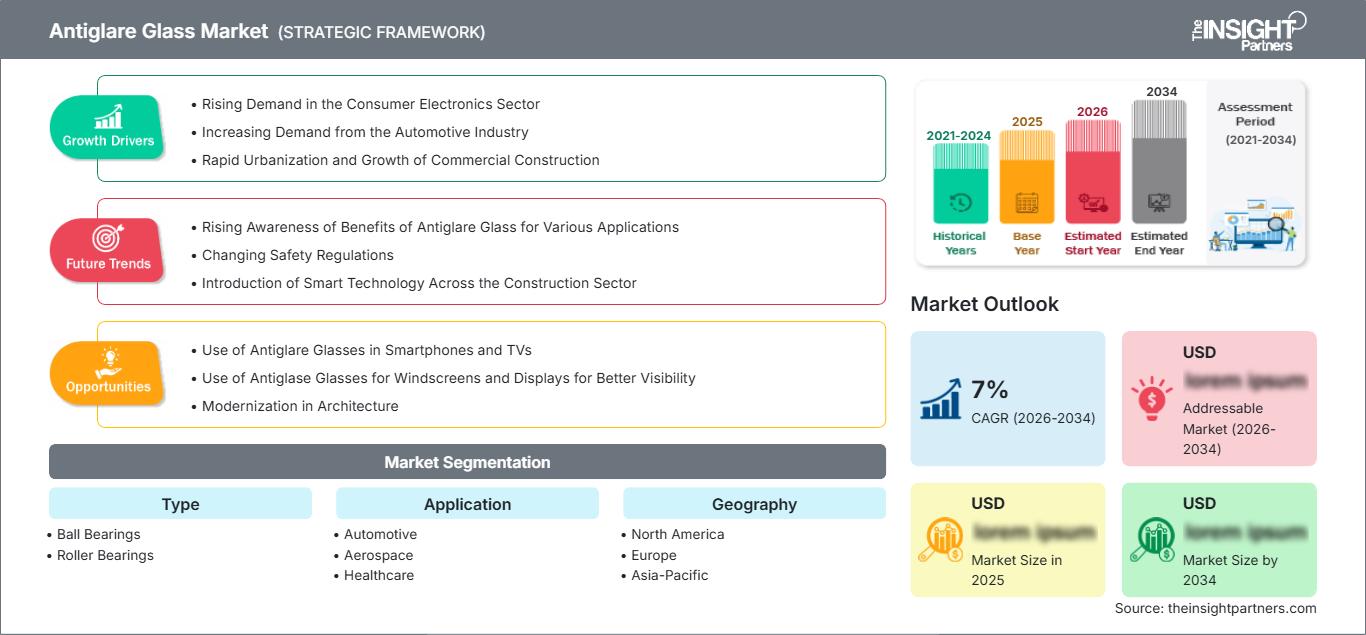
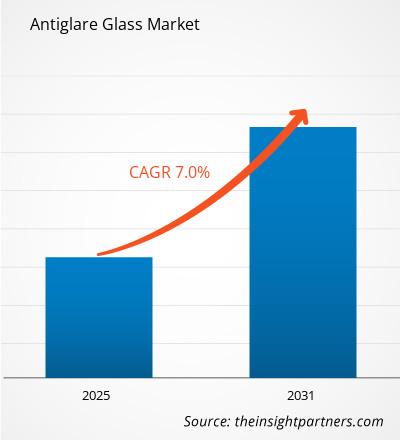
The antiglare glass market size was valued at US$ 3.55 Billion in 2025 and is projected to reach US$ 7.07 Billion by 2034, expanding at a CAGR of 7.97% during 2026–2034. Market development is supported by increasing requirements for reflection control, optical clarity, visual comfort, and durability across automotive, aerospace, healthcare, and specialized optical applications. Advancements in multilayer coatings, surface engineering, and precision optical manufacturing are also broadening the performance envelope of antiglare glass products.
North America is expected to remain a strategically important market, supported by sophisticated automotive display systems, aerospace and defense optics, healthcare imaging equipment, and premium ophthalmic applications. The region benefits from established optical manufacturing capabilities, high adoption of advanced coatings, stringent performance requirements, and continued investment in next-generation vehicle displays and precision optical systems.
Antiglare Glass Market Assessment and Insights
- North America: North America represented an estimated 28–32% Antiglare Glass Market share in 2025 and is projected to expand at a 7.2–7.8% CAGR during 2026–2034, supported by aerospace optics, automotive displays, healthcare imaging, and advanced ophthalmic products.
- US: The US accounted for approximately 62–66% of North America's 2025 market and is expected to grow at a 7.4–8.0% CAGR during 2026–2034, led by aerospace, automotive, and healthcare applications.
- Europe: Europe held approximately 22–26% share in 2025 and is expected to register a 7.0–7.6% CAGR during 2026–2034, with Germany, France, Italy, and the UK supporting advanced automotive, medical, and optical manufacturing.
- Asia Pacific: Asia Pacific represented approximately 31–35% share in 2025 and is projected to record an 8.4–9.0% CAGR during 2026–2034, driven by China, Japan, South Korea, and India across electronics, automotive, healthcare, and optical production.
- Largest Segment: Automotive represented an estimated 28–32% market share in 2025 and is projected to grow at an 8.2–8.8% CAGR during 2026–2034, supported by expanding display and visibility requirements.
- High Growth Segment: Healthcare accounted for approximately 18–22% share in 2025 and is forecast to grow at a 9.0–9.6% CAGR during 2026–2034, reflecting increasing use in diagnostic and surgical optical equipment.
- Key companies analyzed in detail: Carl Zeiss AG, Essilor International S.A., Honeywell International Inc., Hoya Corporation, Janos Technology LLC, Lumentum Technologies, Inc., Optical Coatings Japan, PPG Industries, Inc., Rodenstock GmbH, Royal DSM, AGC Inc., and SCHOTT AG.
Source: The Insight Partners' analysis based on proprietary research, government publications, company annual reports, investor presentations, industry databases, and expert interviews.
The Antiglare Glass Market is changing from traditional methods of reducing reflections to optical glass surfaces that possess antireflection properties along with being scratch resistant, hydrophobic, contamination free, and selectively spectrally selective. This has led to increased reliance on precision deposition, multi layer interference techniques, surface texturing, and glass processing. Optical industries will thus move towards application specific designs for use in automotive displays, medical optics, aircraft windows, ophthalmic lenses, and high-end imaging assemblies.
The Antiglare Glass Market report states that in the forecast period, there would be investment in the field of high performing coating materials, localized finishing, and optical components meant for future vehicles and medical applications. The region of Asia Pacific would become more significant due to the growth in optical and automotive industries in the region. The markets of North America and Europe would maintain their strengths in the fields of aerospace, healthcare, specialized optics, and high-end ophthalmic glasses.
Antiglare Glass Market Report Scope
| Report Attribute | Details |
|---|---|
| Market size in 2025 | US$ 3.55 Billion |
| Market Size by 2034 | US$ 7.07 Billion |
| Global CAGR (2026 - 2034) | 7.97% |
| Historical Data | 2021-2024 |
| Forecast period | 2026-2034 |
Antiglare Glass Market Analysis
The Antiglare Glass Market forecast indicates that demand is driven by the requirement for clarity of vision with high illumination and various viewing angles. The supply chain includes specialized glass manufacturers, optical substrates suppliers, coating materials manufacturers, deposition firms, component manufacturers, system integrators, and end consumers. Raw material costs are determined based on the optical glass composition, the composition of the coating materials, deposition technology, energy, and precision finishing process.
The supply side is becoming more differentiated with respect to coating capabilities rather than solely based on glass manufacture capabilities. Those who are able to control the thickness of the layers, difference of indices of refraction, adhesion, resistance to abrasion, and environmental stability will be able to satisfy the demand of more high-value applications. Customers from automotive and aerospace industry also need good optical performance of the coated substrate with various shapes.
The competitive environment consists of diversified optical companies, specialist coating firms, ophthalmic technology firms, and precision component providers. Carl Zeiss AG and Essilor International S.A. dominate coated ophthalmic optics products, while Hoya Corporation and Rodenstock GmbH have a share in advanced lens products. Honeywell International Inc. provides aerospace products and sensing solutions, while PPG Industries, Inc. offers optical coating solutions. AGC Inc. and SCHOTT AG compete through specialty glass and optical components.
More emphasis is placed on multifunctional coatings, automated coating, high-throughput finishing operations, and optics engineering based on specific applications. SCHOTT AG combines specialty glass and coating technologies, while AGC Inc. works on high refractive index glass and coated optical substrates. Royal DSM and PPG Industries, Inc. enhance their materials competencies to build a competitive environment where coating resistance, optical quality, application suitability, and manufacturing capability define competitive advantage.
● REPORT CUSTOMIZATION
Tailor This Report To Align With Your Specific Business Requirements
This report can be customized to align precisely with your business objectives, scope, and target markets. Customization options include tailored segmentation, geography, competitive analysis, and strategic insights to support informed decision-making.
Customize This Report →WHAT YOU CAN ADJUST
- ● Segmentations
- ● Geography
- ● Competitive Analysis
- ● Language Preferences
Antiglare Glass Market: Strategic Insights
Regional Insights
North America Antiglare Glass Market
North America accounted for an estimated 28–32% share in 2025 and is expected to register a 7.2–7.8% CAGR during 2026–2034. The regional market will enjoy existing aerospace, defense, healthcare, automotive, and ophthalmic manufacturing ecosystems. The demand will be driven by the need for precision optics and optics for aircraft, imaging, display and interface systems, and premium optical lenses with coatings. The US will still be the key player because of the extensive industrial presence and number of aerospace and technology firms.
Sensing and optical systems’ investments are enhancing the demand for highly durable and low reflection surface treatments. The automotive industry needs larger displays and heads up interfaces which make it important to have high visibility under different lighting conditions. Healthcare equipment manufacturers also have a demand for optical components that transmit light effectively in imaging and diagnostic systems. The Canadian economy participates through aerospace and advanced manufacturing, while Mexico provides support to the automotive manufacturing sector.
U.S. Antiglare Glass Market
The US represented approximately 62–66% of North America's 2025 market and is projected to grow at a 7.4–8.0% CAGR during 2026–2034. The demand is segmented into aerospace, defense, automotive, medical devices, ophthalmic products, and special optical systems. Honeywell International Inc. applies for aerospace applications and sensors, while Carl Zeiss AG, PPG Industries, Inc. and others are applicable in precision optics and ophthalmic applications.
Automotive displays, head-up displays, visibility at night time, medical imaging, surgery optics and premium eyewear form separate demand channels. Coatings for aerospace applications must withstand transmission under such conditions as abrasion, humidity, temperature changes and other factors. For ophthalmic coatings the major concern is reducing glare and improving visual comfort. The developed research framework of the country and highly concentrated technology businesses are favorable for developing of thin film deposition, optical metrology and surface treatment techniques.
Europe Antiglare Glass Market
Europe represented approximately 22–26% share in 2025 and is forecast to expand at a 7.0–7.6% CAGR during 2026–2034. Germany is the most dominant regional market driven by automotive engineering, optical manufacturing, and specialty glass industry. The UK and France have contributions through aerospace, healthcare, and advanced engineering applications, whereas the contribution from Italy and Spain comes in the form of automotive, architecture, medical and industrial markets.
The UK has an established aerospace and defense industry sector requiring the use of optical windows, sensors, cockpit display systems, and high precision imaging systems. Germany has the presence of advanced automotive and optical manufacturing industries with a focus on advanced display systems, visibility, ophthalmic lenses, and specialty coatings. France has a combination of aerospace, healthcare, and automotive applications, whereas the contributions from Italy and Spain come through automotive manufacturing, medical and specialty glass industries.
APAC Antiglare Glass Market
APAC accounted for approximately 31–35% share in 2025 and is expected to record an 8.4–9.0% CAGR during 2026–2034. China leads regional demand, followed by Japan, South Korea, India, and Australia. Automotive electronics, optical manufacturing, healthcare equipment, and electronics production are major demand contributors.
Whereas China has advantage from manufacturing economy of scale, Japan and South Korea are rich in advanced optical and electronics manufacturing technology. While India is increasing its automotive and healthcare manufacturing, Australia adds through its expertise in medical, defense, and optical manufacturing technologies. Policy to promote electronics, automotive localization, and advanced manufacturing must lead to increased manufacturing capability for coatings and optics components.
Middle East & Africa Antiglare Glass Market
Middle East & Africa is expected to register a 6.3–7.0% CAGR during 2026–2034. Saudi Arabia and the UAE lead regional demand through infrastructure modernization, automotive activity, healthcare investment, and specialized commercial developments. South Africa remains an important market for healthcare, industrial, automotive, and optical applications.
The regional opportunity is linked to large infrastructure programs, harsh solar exposure, advanced healthcare facilities, and modernization of transport systems. Demand for glare-control glazing and optical components can increase where strong sunlight affects visibility and occupant comfort. Saudi Arabia is positioned as the leading market, while the UAE benefits from high-value construction and technology projects. South Africa and the rest of MEA provide incremental demand through healthcare, transportation, industrial equipment, and specialty applications.
Segmentation Analysis
Type
Type segmentation covers Ball Bearings and Roller Bearings as specified in the market framework. The category requires differentiation according to the optical and functional characteristics assigned within the underlying dataset. The segment is expected to expand as manufacturers improve precision processing, coating consistency, durability, and application-specific performance. The Type segment is projected to register a 7.5–8.1% CAGR during 2026–2034, with demand influenced by product qualification, manufacturing repeatability, and specialized optical requirements.
- Ball Bearings: This sub-segment represents one defined category within the supplied classification framework. Its strategic relevance depends on the application mapping used by manufacturers and customers, particularly where standardized component specifications influence procurement and production planning.
- Roller Bearings: This category provides a second classification point for the market dataset. Demand is shaped by the specifications assigned to the segment, supplier qualification, manufacturing consistency, and requirements for repeatable component performance across targeted applications.
Application
Application represents the principal demand-side segmentation and includes Automotive, Aerospace, Healthcare, and Others. The segment is projected to grow at an 8.0–8.6% CAGR during 2026–2034, supported by expanding requirements for glare control, visibility, optical precision, and surface durability. Automotive is the largest application, while healthcare is positioned as the faster-growing segment because imaging, diagnostic, and surgical equipment increasingly require high-quality optical surfaces.
- Automotive: Demand is supported by head-up displays, instrument clusters, infotainment screens, cameras, and other vehicle interfaces where glare reduction improves readability and visibility. Strategic priorities include curved-surface coating, durability, and optical consistency.
- Aerospace: Aerospace applications prioritize optical transmission, environmental resistance, low reflection, and long service life. Demand is concentrated in cockpit systems, sensors, optical windows, displays, imaging equipment, and defense-related electro-optical systems requiring stringent qualification.
- Healthcare: Healthcare applications increasingly use coated optical components in diagnostic imaging, surgical visualization, microscopes, endoscopes, and medical displays. Reliability, optical clarity, sterilization compatibility, and resistance to repeated handling are important purchasing considerations.
Opportunity Snapshot
| Application | Revenue Contribution (High/Medium/Low) | Trend Tag | Adoption Stage |
| Automotive | High | HUD Visibility | Scaling |
| Aerospace | Medium | Sensor Optics | Mature |
| Healthcare | High | Imaging Clarity | Scaling |
| Others | Low | Specialty Optics | Emerging |
Antiglare Glass Market Growth Drivers and Impact Analysis
Expansion of Advanced Automotive Display Systems
Automotive display architecture is moving toward larger screens, digital instrument clusters, head-up displays, camera-based interfaces, and integrated cockpit systems. The use of such technologies will increase the area where the optical surface will be exposed to light from the sun and inside the vehicle, thus turning reflective control into a functional necessity, not just an aesthetical solution. The antiglare surface will help to enhance legibility of the material as well as reduce reflections depending on different observation angles. It becomes especially relevant in case of premium and more advanced mid-market cars. Coating vendors who can apply coatings to curved, chemically toughened, laminated or otherwise engineered glass will have a chance to tackle more valuable programs.
Growth of Precision Optical and Medical Equipment
Applications such as medical imaging, surgical imaging, diagnostic tools, and lab optics need surfaces that provide maximum transmission under harsh conditions of intensive usage. Reflection from lenses, windows, displays, and optical modules can impair imaging by causing difficulty in image interpretation especially where there is illumination of the system. With increasing use of advanced medical equipment by health professionals, suppliers are now being scrutinized for their optical integrity, durability, contamination resistance, and capability of being cleaned and sterilized. Thus, it provides a better value-added product than traditional glass because the qualification is closely associated with system functionality. The aerospace sensing and defense electro-optics create another demand channel especially for coatings that can still have high transmission after being exposed to environments.
Increasing Demand for High-Performance Ophthalmic Lenses
Applications for the ophthalmics segment in the Antiglare Glass Market continue to move from simple reduction of reflection to multi-functional coatings including antireflection, scratch resistance, hydrophobic, oleophobic, UV and blue-light filters. Consumers become more and more inclined to assess lenses based on both prescription functionality and clarity of vision, as well as ease of care of the lenses. This is beneficial for the adoption of high-end coatings as it pushes lens manufacturers to use coatings as one of their differentiators. Competitive effects span everything from coatings chemistry and deposition technology to compatibility of the hard-coats and finishing process. Manufacturers that can combine multiple features without compromising on clarity and minimal residual coloring of the coating enjoy access to higher value markets.
Antiglare Glass Market Future Trends
Multifunctional Optical Surfaces Become the Standard
The Antiglare Glass Market trends show that future products are expected to combine glare reduction with multiple surface functions rather than relying on a single antireflective property. Coating architectures will increasingly integrate scratch resistance, water and oil repellence, contamination control, UV management, spectral filtering, and improved cleanability. The technological challenge will be maintaining high visible-light transmission while controlling residual color and reflection across broad wavelengths and viewing angles. Automotive and aerospace applications will particularly benefit from coatings engineered for curved surfaces and changing incidence angles. Ophthalmic products are likely to continue moving toward personalized coating packages based on lifestyle, driving conditions, digital-device exposure, and outdoor activity. Greater use of automated deposition, optical metrology, and process monitoring should also improve consistency and reduce coating defects during high-volume production.
Application-Specific Coating Architectures Gain Ground
The Antiglare Glass Market is likely to shift toward coatings designed around specific operating environments rather than universal formulations. Automotive components may require resistance to temperature cycling, cleaning chemicals, abrasion, and prolonged sunlight, whereas aerospace optics require broader environmental resistance and stable transmission. Healthcare systems can prioritize cleanability and optical neutrality, while ophthalmic products emphasize comfort, durability, and appearance. This specialization will encourage suppliers to develop modular coating platforms that can be adjusted for substrate type, refractive index, thickness, wavelength range, and environmental exposure. Advanced modeling and simulation should reduce development cycles by predicting optical behavior before physical production. As customer specifications become more detailed, coating suppliers with application engineering capabilities and established qualification protocols will increasingly participate earlier in product design and component selection.
Antiglare Glass Market Opportunities
Expansion into Automotive Head-Up Display and Camera Optics
Automotive displays and sensing systems represent an attractive investment area in the Antiglare Glass Market because the number and functional importance of optical interfaces inside vehicles are increasing. Head-up displays require high transmission and controlled reflection to project information without compromising forward visibility, while camera systems require stable optical performance under changing illumination. Suppliers can pursue opportunities through customized coatings for windshields, display cover glass, camera windows, and optical modules. Partnerships with vehicle manufacturers, Tier 1 suppliers, and display-system developers can reduce qualification barriers and support program-specific design wins. The strongest opportunities are likely to involve coatings compatible with curved or laminated substrates and capable of surviving abrasion, cleaning, temperature cycling, and ultraviolet exposure. Regional production near major automotive manufacturing clusters can further improve responsiveness and reduce logistics complexity.
Specialty Optical Components for Aerospace and Healthcare
Specialty optical components provide an opportunity to move beyond high-volume glass applications into higher-value systems requiring stringent performance qualification. Aerospace windows, sensors, targeting systems, medical imaging components, surgical optics, and laboratory instruments can require customized antireflective structures with specific wavelength ranges and environmental resistance. Suppliers can create differentiation through coating design, precision deposition, optical metrology, and application engineering rather than commodity substrate production. Developing coating platforms compatible with infrared, visible, and ultraviolet wavelengths can broaden addressable applications. Localized production and qualification capabilities may also become strategically valuable as customers seek resilient supply chains for mission-critical components. Companies that integrate glass processing, coating, testing, and assembly can capture more value while reducing interface risk between separate manufacturing stages.
Recent Developments
- April 15, 2026: SCHOTT AG introduced assembled protective windows manufactured in the US, combining specialty optical materials with durable antireflective coatings designed to maintain transmission and scratch resistance after exposure to abrasion, sand, salt fog, and humidity. The solution targets demanding electro-optical and defense applications, demonstrating the increasing integration of coating, glass, and assembly capabilities.
- February 4, 2026: JinkoSolar Holding Co., Ltd. launched anti-glare, low-reflection photovoltaic modules for transportation infrastructure, including airports, highways, and elevated barriers. The modules combine glass-surface texturing with a low-reflective coating to reduce glare intensity by up to 80% and reflectivity by more than 85% versus conventional modules while maintaining comparable glass transmittance. The solution has been certified by TÜV Rheinland and Swiss SPF and deployed across approximately 40 MW at Taiyuan Wusu International Airport.
Frequently Asked Questions

- Comprehensive Market Sizing and Forecast Analysis
- Detailed Segmentation Analysis
- In-Depth Market Dynamics Assessment
- Regional and Country-Level Insights
- Competitive Landscape and Company Benchmarking
- Strategic Business Intelligence
Recent Reports
Testimonials

The Insight Partners provided valuable market intelligence that supported our global go-to-market strategy. Their team was professional, responsive, and attentive to our feedback, providing thoughtful analysis and helpful methodological clarifications throughout the project.
Junmo Kim Chief Financial Officer (CFO), Enertech Co., Ltd.
The Insight Partners' SCADA System Market report is comprehensive, with valuable insights on current trends and future forecasts. The team was highly professional, responsive, and supportive throughout. We are very satisfied and highly recommend their services.
RAN KEDEM Partner, Reali Technologies LTDs
I requested a report on a very specific software market and the team produced the report in a few days. The information was very relevant and well presented. I then requested some changes and additions to the report. The team was again very responsive and I got the final report in less than a week.
JEAN-HERVE JENN Chairman, Future Analytica
We worked with The Insight Partners for an important market study and forecast. They gave us clear insights into opportunities and risks, which helped shape our plans. Their research was easy to use and based on solid data. It helped us make smart, confident decisions. We highly recommend them.
PIYUSH NAGPAL Sr. Vice President, High Beam Global
The Insight Partners delivered insightful, well-structured market research with strong domain expertise. Their team was professional and responsive throughout. The user-friendly website made accessing industry reports seamless. We highly recommend them for reliable, high-quality research services
YUKIHIKO ADACHI CEO, Deep Blue, LLC.
This is the first time I have purchased a market report from The Insight Partners.While I was unsure at first, I visited their web site and felt more comfortable to take the risk and purchase a market report.I am completely satisfied with the quality of the report and customer service. I had several questions and comments with the initial report, but after a couple of dialogs over email with their analyst I believe I have a report that I can use as input to our strategic planning process.Thank you so much for taking the extra time and making this a positive experience.I will definitely recommend your service to others and you will be my first call when we need further market data.
JOHN SUZUKI President and Chief Executive Officer, Board Director, BK Technologies
I wish to appreciate your support and the professionalism you displayed in the course of attending to my request for information regarding to infectious disease IVD market in Nigeria. I appreciate your patience, your guidance, and the fact that you were willing to offer a discount, which eventually made it possible for us to close a deal. I look forward to engaging The Insight Partners in the future, all thanks to the impression you have created in me as a result of this first encounter.
DR CHIJIOKE ONYIA MANAGING DIRECTOR, PineCrest Healthcare Ltd.Reason to Buy
- Informed Decision-Making
- Understanding Market Dynamics
- Competitive Analysis
- Identifying Emerging Markets
- Customer Insights
- Market Forecasts
- Risk Mitigation
- Boosting Operational Efficiency
- Strategic Planning
- Investment Justification
- Tracking Industry Innovations
- Aligning with Regulatory Trends





 Get Free Sample for