
Antimicrobial Ingredients Market Size, Growth & Demand by 2034
Coverage: by Product (Antibacterial Agent, Antifungal Agent, Antiviral Agent, Antiparasitic Agent); Type (Dry, Liquid, Others); Application (Healthcare Industry, Food Industry, Agriculture Industry, Others); , and Geography (North America, Europe, Asia Pacific, and South and Central America)
- Status : Data Released
- Report Code : TIPRE00007347
- Category : Life Sciences
- No. of Pages : 150
- Available Report Formats :


- Last update date : August 24, 2026


2025 Market Size
US$ 3.57 Bn
Base year value
2034 Forecast
US$ 5.97 Bn
Projected by 2034
CAGR 2026-2034
5.88 %
Growth rate
Addressable Market
US$ 43.22 Bn
(2026-2034)
The global Antimicrobial Ingredients market was valued at US$ 3.57 billion in 2025 and is expected to reach US$ 5.97 billion by 2034; it is estimated to record a CAGR of 5.88% during 2026-2034.
Antimicrobial Ingredients Market Assessment and Insights
- North America: North America represents an estimated 32–36% share in 2025 and is expected to grow at a 5.8–6.5% CAGR between 2026–2034, supported by healthcare, food safety, specialty chemicals, and advanced formulation capabilities.
- US: The US accounts for approximately 70–74% of North America's 2025 value and is projected to grow at a 5.7–6.4% CAGR during 2026–2034, driven by regulatory scrutiny and infection prevention.
- Europe: Europe holds an estimated 27–31% share in 2025 and is forecast to grow at a 5.5–6.2% CAGR between 2026–2034. Germany, France, the UK, Italy, and Spain provide strong specialty chemical and healthcare demand.
- Asia Pacific: Asia Pacific captures approximately 23–27% share in 2025 and is anticipated to expand at a 7.0–7.8% CAGR through 2034, led by China, Japan, South Korea, India, and Australia.
- Largest Segment: Antibacterial Agent is estimated to command a 46–50% market share in 2025 and grow at a 6.0–6.7% CAGR through 2034, reflecting broad application penetration.
- High Growth Segment: Antiviral Agent is estimated at a 9–12% market share in 2025 and is projected to grow at a 7.2–8.0% CAGR, supported by preventive applications.
- Key companies analyzed in detail: Novartis (Sandoz International GmbH), Merck & Co., Inc., Pfizer Inc., Solvay, Lonza Group Ltd., BASF SE, Clariant AG, Destiny Pharma plc, Ashland Global Holdings Inc., and The Dow Chemical Company.
Source: The Insight Partners' analysis based on proprietary research, government publications, company annual reports, investor presentations, industry databases, and expert interviews.
There have been changes in the market for antimicrobial ingredients from conventional preservatives to more advanced systems that can offer targeted microbial control along with stable formulations. Development of new products takes into account compatibility with various polymer coatings, cosmetics, pharmaceuticals, and food contact materials. Manufacturers are adding liquid and powdered forms to add flexibility to their processes. Formulation support is increasingly part of the strategy of specialty chemicals manufacturers in addition to ingredient supply.
The antimicrobial ingredients Market report indicates that future growth is expected to be driven by manufacture of products in the Asia Pacific region and applications needing long-lasting protection at lower concentrations. Investments will be made in bio-based ingredients, low residue formulations, formulation enhancers, and ingredients that decrease persistence in the environment. The regulatory framework for antimicrobial claims and active agents is also impacting product choice. The One Health concept of the WHO concerning antimicrobial resistance emphasizes the need for prudent use of antimicrobials.
Antimicrobial Ingredients Market Report Scope
| Report Attribute | Details |
|---|---|
| Market size in 2025 | US$ 3.57 Billion |
| Market Size by 2034 | US$ 5.97 Billion |
| Global CAGR (2026 - 2034) | 5.88% |
| Historical Data | 2021-2024 |
| Forecast period | 2026-2034 |
Antimicrobial Ingredients Market Analysis
The growth demand in the antimicrobial ingredient market will be dictated by infection prevention needs, food contamination control, pharmaceutical formulations requirements, and microbial stabilization needs in consumer products. The supply chain involves raw material suppliers, specialty chemical companies, formulators, distributors, contract manufacturers, and user companies. Competition among suppliers is based on purity, compatibility, regulatory dossiers, application services, and regional availability rather than antimicrobial activity.
There is a huge variation in production factors depending on the chemistry. Big chemical companies take advantage of the integration of feedstocks and their global manufacturing facilities whereas specialty chemical companies have their competitive edge based on unique antimicrobial properties. The regional manufacturing model of BASF is an example of the importance of localization whereby BASF estimates that about 90% of its sales in Europe and North America are made in these regions.
The antimicrobial ingredients market competitive landscape reveals a fragmented competition environment comprised of diversified chemical firms, pharmaceutical firms, and antimicrobial developers. BASF SE, Clariant AG, Solvay, Ashland Global Holdings Inc., and The Dow Chemical Company use a portfolio of formulation and technical support based on client requirements. However, Merck & Co., Inc., Pfizer Inc., and Novartis (Sandoz International GmbH) leverage pharmaceutical expertise. Destiny Pharma plc uses innovation in infection prevention.
There seems to be an emerging trend of strategic investments made to develop resilient production capabilities, specialty formulation, sustainable chemistry, and targeted antimicrobial actions. For instance, the strategic investments by Ashland towards 2025 in Brazil increased their pharmaceutical manufacturing capability and microbial protection capability through regional manufacturing platforms. Strategic investments in specialty chemistry and process efficiency made by Clariant are also an indication.
● REPORT CUSTOMIZATION
Tailor This Report To Align With Your Specific Business Requirements
This report can be customized to align precisely with your business objectives, scope, and target markets. Customization options include tailored segmentation, geography, competitive analysis, and strategic insights to support informed decision-making.
Customize This Report →WHAT YOU CAN ADJUST
- ● Segmentations
- ● Geography
- ● Competitive Analysis
- ● Language Preferences
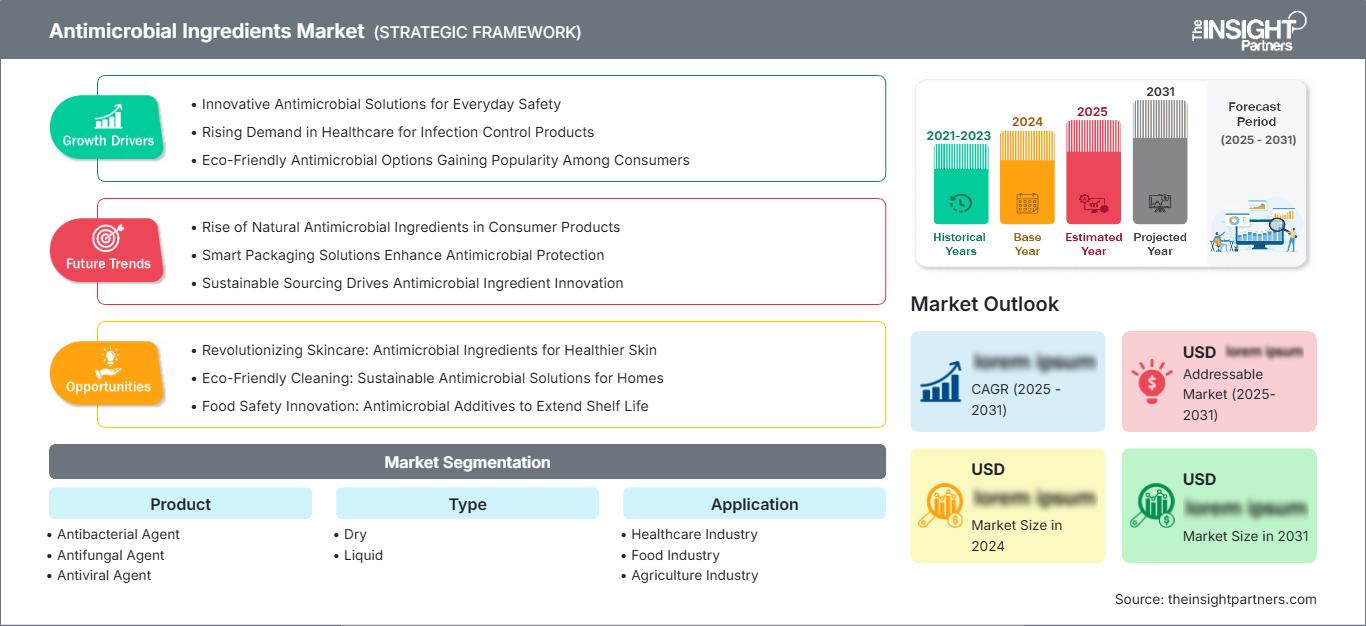
Antimicrobial Ingredients Market: Strategic Insights
Regional Insights
North America antimicrobial ingredients market
North America is estimated to represent 32–36% of the antimicrobial ingredients market share in 2025 and is projected to expand at a 5.8–6.5% CAGR through 2034. The US dominates regional demand because of advanced healthcare infrastructure, extensive food-processing capacity, specialty chemical manufacturing, and regulatory requirements governing antimicrobial claims and formulations. Canada contributes through healthcare, food, and industrial applications.
The demand is driven by hospital infection control, anti-microbial surface technology, pharmaceuticals manufacturing, and food contact sanitization applications. Increasingly, suppliers highlight formulations that deliver microbial protection without affecting material properties. Also, regulation drives the need for efficacy and control on active ingredient use. The technically sophisticated consumer base in North America drives technically differentiated products, while investment in local production and application laboratories improves supply chain and qualification processes.
U.S. antimicrobial ingredients Market
The US accounts for approximately 70–74% of North America's 2025 antimicrobial ingredients market and is expected to grow at a 5.7–6.4% CAGR during 2026–2034. Demand spans healthcare, food processing, personal care, pharmaceutical manufacturing, and industrial hygiene applications. Major international suppliers maintain substantial commercial and technical operations in the country.
Antimicrobial ingredients Market trends include demand for persistent activity, multi-functional materials, and formulation-friendly products. Regulatory standards set by the US Environmental Protection Agency and Food and Drug Administration impact selection of active ingredients, labeling, efficacy, and positioning of products. A major advantage in the market is a wide network of specialty formulators who can quickly commercialize innovations in ingredients. Antimicrobial resistance concerns have increased the interest in complementary infection control measures.
Europe antimicrobial ingredients Market
In 2025, Europe accounts for about 27–31% market share of antimicrobial active ingredients and is expected to grow at a 5.5–6.2% CAGR up to 2034. Germany continues to be the market leader with the benefit of specialized chemicals, healthcare manufacturing, industrial formulating, and advanced food processing infrastructure. The other markets of the United Kingdom, France, Italy, and Spain contribute demand from healthcare, consumer goods, and food applications.
There is robust demand in the UK for specialized technologies for antimicrobial action and infection prevention in healthcare and personal care. Germany is unique in its chemical manufacturing expertise coupled with high sustainability demands. France has a diversified market with pharmaceuticals and food processing industry. Italy and Spain contribute to the demand in their food manufacturing, agricultural, healthcare, and consumer formulating industries.
APAC antimicrobial ingredients Market
Asia Pacific is estimated to account for 23–27% of the antimicrobial ingredients market in 2025 and is projected to grow at a 7.0–7.8% CAGR through 2034. China is the leading market, followed by Japan, South Korea, India, and Australia. Expanding pharmaceutical, food-processing, agricultural, and specialty chemical industries underpin regional consumption.
China and India provide manufacturing scale, while Japan and South Korea emphasize advanced formulation technologies and quality systems. Australia contributes through food safety and agricultural applications. Industrial expansion, pharmaceutical localization, improving sanitation infrastructure, and government attention to antimicrobial resistance support demand. The region also offers manufacturers opportunities to establish local production and distribution platforms closer to rapidly expanding formulation and processing industries.
Middle East & Africa antimicrobial ingredients Market
Middle East & Africa is expected to expand at a 6.3–7.1% CAGR through 2034, supported by healthcare infrastructure development, food security initiatives, pharmaceutical localization, and industrial diversification. Saudi Arabia leads regional demand, followed by the UAE and South Africa, while other Middle Eastern and African markets remain smaller but increasingly accessible.
Saudi Arabia's healthcare and industrial investment programs support antimicrobial applications, while the UAE benefits from advanced logistics and food-processing infrastructure. South Africa provides the strongest sub-Saharan commercial base through healthcare, agriculture, and manufacturing. Energy revenues in Gulf markets enable infrastructure investment, whereas African markets increasingly require affordable, stable antimicrobial solutions suited to local production and distribution constraints.
Segmentation Analysis
Product
The Product segment is expected to expand at a 6.1–6.9% CAGR during 2026–2034. Antibacterial agents remain the principal demand category because of their broad use across healthcare, food, agriculture, personal care, and industrial formulations. Antifungal and antiviral technologies gain importance where contamination prevention requires broader microbial coverage, while antiparasitic agents remain comparatively specialized.
- Antibacterial Agent: Broad application across healthcare, food processing, agriculture, and consumer formulations supports sustained demand. Suppliers increasingly differentiate through low-dose efficacy, compatibility, stability, and resistance-conscious mechanisms.
- Antifungal Agent: Demand is concentrated in healthcare, agriculture, food preservation, and personal care. Product development emphasizes broad fungal control, formulation stability, and reduced environmental impact.
- Antiviral Agent: Antiviral ingredients address specialized infection-prevention and surface-protection requirements. Their strategic importance is increasing as formulators seek broader-spectrum protection across healthcare and consumer environments.
- Antiparasitic Agent: Antiparasitic ingredients serve targeted healthcare and agricultural applications. Adoption depends heavily on validated efficacy, regulatory acceptance, safety profiles, and suitability for specific parasite-control requirements.
Type
The Type segment is projected to grow at a 6.0–6.8% CAGR from 2026 to 2034. Liquid systems benefit from ease of incorporation and dosing, while dry ingredients provide advantages in transportation, storage stability, concentrated formulations, and applications requiring controlled-release or powder-processing characteristics.
- Dry: Dry ingredients are strategically important where long shelf life, simplified transportation, concentrated dosing, and compatibility with powder formulations improve manufacturing economics and operational flexibility.
- Liquid: Liquid ingredients remain widely used because they enable straightforward metering, blending, and dispersion across aqueous formulations, supporting healthcare, food, personal care, and industrial processing requirements.
Application
The Application segment is forecast to grow at a 6.4–7.2% CAGR between 2026 and 2034. Healthcare remains a major application because of infection prevention requirements, while food and agriculture provide additional volume opportunities through microbial contamination management and crop or animal health applications.
- Healthcare Industry: Healthcare applications prioritize validated antimicrobial efficacy, biocompatibility, resistance considerations, and regulatory compliance. Demand spans pharmaceuticals, medical environments, wound care, and infection-prevention products.
- Food Industry: Food applications require microbial control while maintaining product quality and food-contact compliance. Demand is linked to sanitation, shelf-life management, processing hygiene, and contamination prevention.
- Agriculture Industry: Agricultural applications support crop protection, animal health, and microbial management. Regulatory scrutiny is encouraging more targeted use and alternatives that reduce unnecessary antimicrobial exposure.
Opportunity Snapshot
| Segment Name | Revenue Contribution | Trend Tag | Adoption Stage |
|---|---|---|---|
| Healthcare Industry | High | Infection Prevention | Mature |
| Food Industry | Medium | Food Safety | Scaling |
| Agriculture Industry | Medium | Crop Protection | Scaling |
Antimicrobial Ingredients Market Growth Drivers and Impact Analysis
Rising antimicrobial resistance and infection-prevention requirements
Antimicrobial resistance is strengthening the economic rationale for infection prevention, surface protection, and technologies that reduce reliance on repeated therapeutic antimicrobial exposure. WHO identifies inappropriate antimicrobial use, weak infection prevention, inadequate sanitation, and environmental contamination as major drivers of resistance. Its current global response emphasizes a One Health framework spanning humans, animals, plants, and environmental systems. This creates opportunities for ingredients that provide effective microbial control while supporting stewardship objectives. Suppliers able to demonstrate targeted efficacy, rapid action, low resistance potential, and controlled environmental behavior can achieve stronger differentiation. The impact extends beyond pharmaceuticals into healthcare surfaces, food production, agriculture, and hygiene formulations, broadening the addressable customer base for specialty antimicrobial ingredients.
Stricter microbial safety requirements across food and healthcare
Food manufacturers and healthcare providers face increasing pressure to prevent contamination before it creates costly downstream consequences. Antimicrobial ingredients can support sanitation, formulation stability, microbial control, and infection-prevention protocols across multiple points in the value chain. WHO highlights the connection between antimicrobial resistance and food production, noting that resistant organisms can move through food from farm to consumer. Consequently, manufacturers increasingly evaluate antimicrobial technologies according to efficacy, residue behavior, material compatibility, and regulatory status. This expands the role of ingredient suppliers from simple active-chemical providers toward formulation and compliance partners. Companies that maintain technical laboratories, regulatory documentation, and application expertise can shorten qualification cycles for customers and improve retention in highly regulated end-use markets.
Expansion of specialty formulations and multifunctional ingredients
Formulators increasingly prefer ingredients that provide antimicrobial functionality while contributing additional properties such as stabilization, moisturization, compatibility, or processing performance. This trend creates opportunities for specialty suppliers to move away from price-based competition and toward multifunctional solutions. Ashland, for example, markets antimicrobial stabilizer technologies that combine microbial protection with formulation benefits. Such products can reduce the number of individual additives required in a formulation and simplify manufacturing. The commercial effect is particularly relevant in personal care, healthcare, and home-care applications, where sensory performance and regulatory requirements coexist with microbial-control objectives. Suppliers capable of offering formulation-specific technical support can therefore capture value through differentiated systems rather than competing solely on active ingredient volume.
Antimicrobial Ingredients Market Future Trends
Biodegradable and lower-persistence antimicrobial chemistries
Future product development is likely to prioritize antimicrobial ingredients with improved biodegradability, lower environmental persistence, and more favorable lifecycle profiles without compromising microbial efficacy. Regulatory authorities and major formulators are increasingly evaluating environmental fate alongside performance, particularly for applications involving repeated release into wastewater or agricultural environments. This will encourage suppliers to develop bio-based actives, optimized molecular structures, and lower-use-concentration systems. Innovation will also extend to formulation architectures that immobilize active ingredients or provide controlled release, reducing unnecessary exposure while preserving protection. The competitive advantage will increasingly depend on evidence covering efficacy, environmental behavior, toxicology, and compatibility. Companies with established regulatory and analytical capabilities should be better positioned to commercialize next-generation antimicrobial platforms across multiple jurisdictions.
Data-led formulation and application-specific antimicrobial systems
The next phase of innovation will increasingly use microbiological datasets, formulation modeling, and automated screening to identify antimicrobial combinations suited to specific applications. Rather than relying on broad-spectrum activity alone, suppliers can optimize ingredient selection around pathogen profile, pH, temperature, substrate, contact time, and end-use requirements. This approach may reduce development cycles and improve reproducibility for customers operating under strict quality systems. Digital formulation tools can also help manufacturers evaluate compatibility and concentration requirements before pilot production. Over time, application-specific libraries may become strategic assets, enabling suppliers to offer tailored antimicrobial packages for healthcare, food, agriculture, and consumer products. Such systems can strengthen customer relationships because the supplier becomes embedded in product-development workflows rather than remaining a commodity ingredient source.
Antimicrobial Ingredients Market Opportunities
Local manufacturing platforms in high-growth Asian markets
Asia Pacific provides an attractive investment opportunity because expanding pharmaceutical, food, agriculture, and specialty chemical production is increasing demand for locally available antimicrobial ingredients. Investors and manufacturers can establish regional production, blending, technical-service, and distribution capabilities in markets such as China and India while using established quality systems to serve neighboring countries. Local platforms can reduce logistics costs, shorten customer qualification timelines, and improve supply resilience. Partnerships with domestic formulators can further accelerate market entry by providing application knowledge and regulatory familiarity. The antimicrobial ingredients market Forecasts indicate that suppliers combining local manufacturing with global technical standards can capture demand without relying exclusively on imports. This model is particularly relevant where customers require rapid delivery and formulation support.
Integrated antimicrobial solutions for food and healthcare
An additional opportunity lies in developing integrated systems that combine antimicrobial ingredients with formulation, coating, dispensing, or application technologies. Healthcare customers can benefit from solutions designed around infection-prevention workflows, while food processors can adopt ingredient systems aligned with sanitation and food-contact requirements. Suppliers can increase customer switching costs by providing validated application protocols, microbiological testing, regulatory documentation, and technical troubleshooting alongside the active ingredient. The antimicrobial ingredients market Forecasts therefore favor companies that move toward solution-oriented commercial models rather than selling isolated molecules. Strategic alliances with equipment providers, contract manufacturers, and specialist formulators can broaden distribution while reducing the capital required for direct market expansion.
Recent Developments
- March 2026: Ashland Global Holdings Inc. appointed Catalite Co., Ltd., an affiliate of Azelis Group NV, as its new distribution partner for microbial protection solutions in Thailand. The agreement covers microbial technologies for skin, hair, oral, and home care, including multifunctional and eco-conscious ingredients, strengthening regional access to Ashland's antimicrobial portfolio.
- February 2026: Clariant AG published its 2025 Integrated Report, highlighting continued execution of its sustainability-focused specialty-chemicals strategy. The company reported its performance under GRI, Swiss Code of Obligations, and European Sustainability Reporting Standards, reinforcing the importance of sustainability and innovation in specialty chemical product development.
- September 2025: EMV Capital's wholly owned subsidiary Moirai Acquisitions Limited acquired certain assets from Destiny Pharma relating to its XF drug platform. The platform uses an ultra-rapid mechanism designed to reduce the likelihood of bacterial resistance, strengthening the relevance of differentiated infection-prevention technologies.
Frequently Asked Questions

- Comprehensive Market Sizing and Forecast Analysis
- Detailed Segmentation Analysis
- In-Depth Market Dynamics Assessment
- Regional and Country-Level Insights
- Competitive Landscape and Company Benchmarking
- Strategic Business Intelligence
Recent Reports
Testimonials

The Insight Partners provided valuable market intelligence that supported our global go-to-market strategy. Their team was professional, responsive, and attentive to our feedback, providing thoughtful analysis and helpful methodological clarifications throughout the project.
Junmo Kim Chief Financial Officer (CFO), Enertech Co., Ltd.
The Insight Partners' SCADA System Market report is comprehensive, with valuable insights on current trends and future forecasts. The team was highly professional, responsive, and supportive throughout. We are very satisfied and highly recommend their services.
RAN KEDEM Partner, Reali Technologies LTDs
I requested a report on a very specific software market and the team produced the report in a few days. The information was very relevant and well presented. I then requested some changes and additions to the report. The team was again very responsive and I got the final report in less than a week.
JEAN-HERVE JENN Chairman, Future Analytica
We worked with The Insight Partners for an important market study and forecast. They gave us clear insights into opportunities and risks, which helped shape our plans. Their research was easy to use and based on solid data. It helped us make smart, confident decisions. We highly recommend them.
PIYUSH NAGPAL Sr. Vice President, High Beam Global
The Insight Partners delivered insightful, well-structured market research with strong domain expertise. Their team was professional and responsive throughout. The user-friendly website made accessing industry reports seamless. We highly recommend them for reliable, high-quality research services
YUKIHIKO ADACHI CEO, Deep Blue, LLC.
This is the first time I have purchased a market report from The Insight Partners.While I was unsure at first, I visited their web site and felt more comfortable to take the risk and purchase a market report.I am completely satisfied with the quality of the report and customer service. I had several questions and comments with the initial report, but after a couple of dialogs over email with their analyst I believe I have a report that I can use as input to our strategic planning process.Thank you so much for taking the extra time and making this a positive experience.I will definitely recommend your service to others and you will be my first call when we need further market data.
JOHN SUZUKI President and Chief Executive Officer, Board Director, BK Technologies
I wish to appreciate your support and the professionalism you displayed in the course of attending to my request for information regarding to infectious disease IVD market in Nigeria. I appreciate your patience, your guidance, and the fact that you were willing to offer a discount, which eventually made it possible for us to close a deal. I look forward to engaging The Insight Partners in the future, all thanks to the impression you have created in me as a result of this first encounter.
DR CHIJIOKE ONYIA MANAGING DIRECTOR, PineCrest Healthcare Ltd.Reason to Buy
- Informed Decision-Making
- Understanding Market Dynamics
- Competitive Analysis
- Identifying Emerging Markets
- Customer Insights
- Market Forecasts
- Risk Mitigation
- Boosting Operational Efficiency
- Strategic Planning
- Investment Justification
- Tracking Industry Innovations
- Aligning with Regulatory Trends





 Get Free Sample for