
Apoptosis Market Size, Growth & Demand by 2034
Coverage: By Drug class and Consumables (Direct apoptogens, First generation indirect apoptogens, Second generation indirect apoptogens, Reagents and kits); Indications (Cancer, Cardiovascular, Neurodegenerative diseases), and Geography (North America, Europe, Asia Pacific, and South and Central America)
- Status : Data Released
- Report Code : TIPRE00018005
- Category : Life Sciences
- No. of Pages : 150
- Available Report Formats :


- Last update date : August 24, 2026


2025 Market Size
US$ 7.38 Bn
Base year value
2034 Forecast
US$ 14.96 Bn
Projected by 2034
CAGR 2026-2034
8.16 %
Growth rate
Addressable Market
US$ 100.35 Bn
(2026-2034)
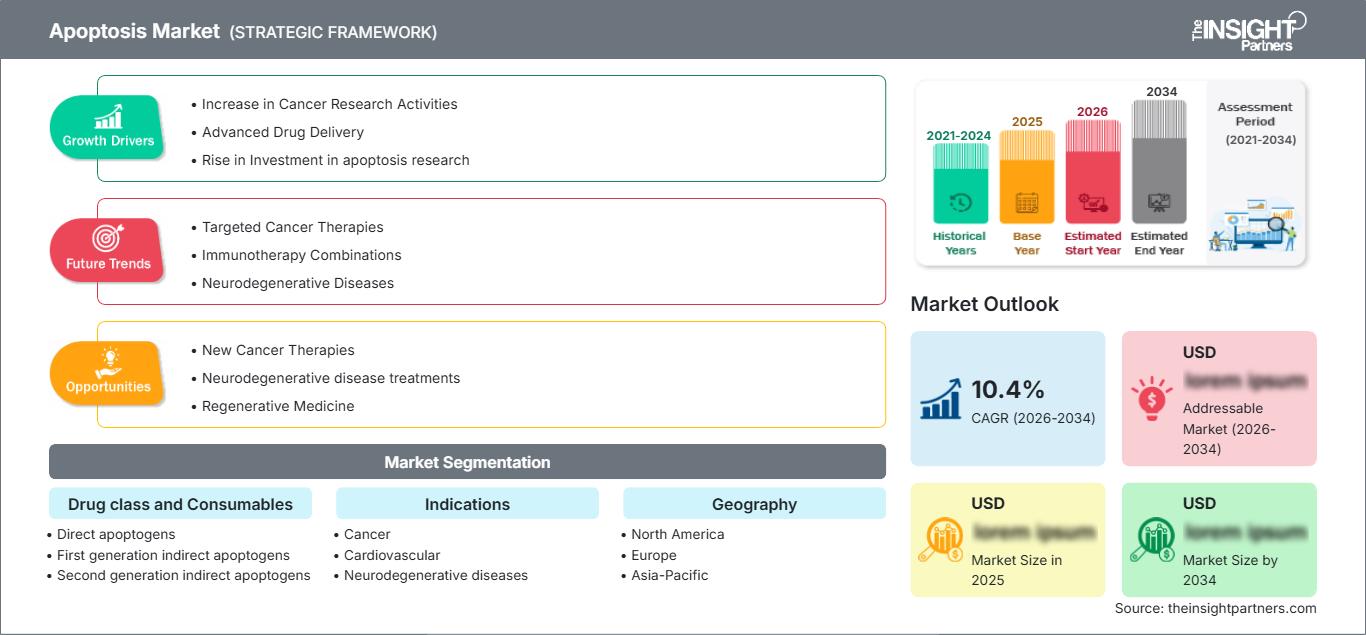
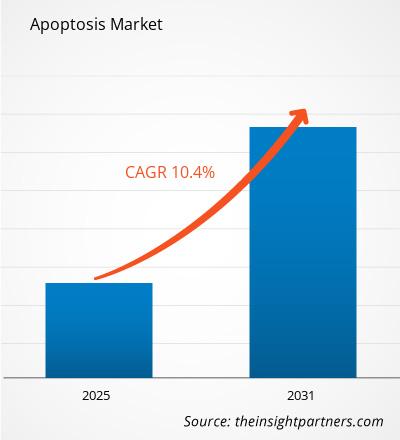
The apoptosis market is positioned at the intersection of cell biology research, drug discovery, translational medicine, and therapeutic development. The market is valued at US$ 7.38 Billion in 2025 and is projected to reach US$ 14.96 Billion by 2034, advancing at a CAGR of 8.16% during 2026–2034. Growth reflects increasing use of apoptosis modulation and detection across oncology, cardiovascular research, and neurodegenerative disease studies, supported by expanding assay portfolios and pathway-focused drug development.
North America remains a structurally attractive market, supported by extensive pharmaceutical R&D infrastructure, advanced cell-analysis capabilities, and substantial academic research activity. The apoptosis market size is expected to expand at an estimated 8.5–9.2% CAGR through 2034. Demand is reinforced by the adoption of high-content imaging, flow cytometry, multiplex assays, and targeted apoptosis research within oncology and preclinical drug-development programs.
Apoptosis Market Assessment and Insights
- North America: North America represents an estimated 34–38% share in 2025 and is projected to grow at a CAGR of 8.6–9.2% between 2026–2034, supported by established pharmaceutical research, sophisticated cell-analysis infrastructure, and high adoption of pathway-specific assays.
- US: The US accounts for approximately 88–92% of North American revenue in 2025 and is expected to grow at a CAGR of 8.5–9.1% between 2026–2034, led by oncology and drug-discovery applications.
- Europe: Europe holds an estimated 28–32% share in 2025 and is projected to register a CAGR of 7.6–8.3% between 2026–2034. Germany, the UK, France, Italy, and Spain support demand through biopharmaceutical research, academic laboratories, and translational medicine programs.
- Asia Pacific: Asia Pacific is estimated to represent 22–26% share in 2025 and is forecast to expand at a CAGR of 9.4–10.2% between 2026–2034, with China, Japan, South Korea, India, and Australia benefiting from expanding biotechnology capacity.
- Largest Segment: Drug class and Consumables commands an estimated 65–69% market share in 2025 and is expected to grow at a CAGR of 8.0–8.6% through 2034, supported by recurring reagent requirements.
- High Growth Segment: Neurodegenerative diseases represent an estimated 14–18% share in 2025 and are projected to expand at a CAGR of 9.8–10.6%, reflecting increased investigation of neuronal cell-death mechanisms.
- Key companies analyzed in detail: Abbott Laboratories, Inc., Thermo Fisher Scientific Inc., Amgen Inc., Pfizer Inc., Novartis AG, Bio-Rad Laboratories, Inc., Merck KGaA, Becton, Dickinson and Company, Abcam plc., and Sartorius AG.
Source: The Insight Partners' analysis based on proprietary research, government publications, company annual reports, investor presentations, industry databases, and expert interviews.
From traditional approaches of measuring the endpoints of cell death processes to multiparametric apoptosis pathway detection, the market has come a long way. The assessment of caspase activity, mitochondrial membrane potential, phosphatidylserine translocation, and DNA fragmentation is becoming common practice in order to differentiate between apoptosis and necrosis or other forms of cell death. As a result, more varieties of flow cytometric, imaging, plate-based, and multiplexing reagents have been introduced by manufacturers.
Going forward, investments will likely be made in terms of automation and longitudinal analysis, especially within high-throughput screenings and more complex cell models. Biotech hubs in the Asia Pacific region will boost reagent consumption as more translational capabilities are being developed. Regulations that focus on reproducibility and validated methodologies may further drive the adoption of standardized assays. There is also an emerging trend of assessing organoid and three-dimensional cell models, which calls for heterogeneity-capable and longitudinal apoptosis measurement.
Apoptosis Market Report Scope
| Report Attribute | Details |
|---|---|
| Market size in 2025 | US$ 7.38 Billion |
| Market Size by 2034 | US$ 14.96 Billion |
| Global CAGR (2026 - 2034) | 8.16% |
| Historical Data | 2021-2024 |
| Forecast period | 2026-2034 |
Apoptosis Market Analysis
The apoptosis market growth is driven by the increasing need to characterize programmed cell death during drug discovery, toxicity assessment, disease modeling, and therapeutic-response studies. The ecosystem spans reagent manufacturers, antibody suppliers, assay developers, instrument providers, pharmaceutical companies, biotechnology firms, contract research organizations, hospitals, and academic laboratories. Consumables generate recurring demand because apoptosis experiments frequently require repeated staining, pathway confirmation, and control measurements. Supply dynamics increasingly favor integrated workflows combining reagents, software, imaging, and cytometry, while laboratories seek lower hands-on time and greater assay consistency.
At the upstream level, antibody specificity, fluorophore availability, recombinant proteins, substrate chemistry, and assay validation influence product differentiation. Downstream demand depends on research intensity and the number of experiments performed across discovery and preclinical programs. Cancer research remains the largest application pool because apoptosis is central to evaluating treatment-induced cell death and resistance mechanisms. Cardiovascular and neurodegenerative investigations broaden demand by examining inappropriate or insufficient apoptosis in tissue injury and neuronal degeneration.
Competitive positioning is increasingly shaped by the breadth of assay portfolios and compatibility with established laboratory platforms. Thermo Fisher Scientific Inc., Bio-Rad Laboratories, Inc., Becton, Dickinson and Company, Abcam plc., and Sartorius AG address detection workflows through antibodies, kits, flow cytometry, imaging, and high-throughput analysis. The apoptosis market analysis, therefore, extends beyond individual reagents to workflow integration, assay reproducibility, automation, and data interpretation capabilities.
Competitive dynamics are affected by pharmaceutical companies not only from research platforms inside but also outside. Abbott Laboratories, Inc., Amgen Inc., Pfizer Inc., and Novartis AG participate in the development of medicines based on diseases, where the use of apoptosis modulation or apoptosis detection will contribute to the mechanism of action or response evaluation. The research tools are provided by Merck KGaA along with its other life science initiatives, while Sartorius AG increasingly integrates cell analysis with bioprocessing and cell model workflows.
● REPORT CUSTOMIZATION
Tailor This Report To Align With Your Specific Business Requirements
This report can be customized to align precisely with your business objectives, scope, and target markets. Customization options include tailored segmentation, geography, competitive analysis, and strategic insights to support informed decision-making.
Customize This Report →WHAT YOU CAN ADJUST
- ● Segmentations
- ● Geography
- ● Competitive Analysis
- ● Language Preferences
Apoptosis Market: Strategic Insights
Regional Insights
North America apoptosis market
North America held an estimated 34–38% share in 2025 and is projected to grow at a CAGR of 8.6–9.2% through 2034. USA takes the lead in regional demand due to cell biology infrastructure which is well developed among pharmaceuticals, biotechnology companies, universities and research hospitals. Regular usage of such analytical methods as flow cytometry, high-content imaging and multiplexing makes laboratories use apoptotic reagents and kits repeatedly.
Canada helps in meeting regional demand through academic research, development of biotechnology and translational medicine. Oncology research in the region is highly developed and uses apoptosis assays for the investigation of cytotoxicity and response to therapy. The presence of Abbott Laboratories, Inc., Thermo Fisher Scientific Inc., Becton, Dickinson and Company, Bio-Rad Laboratories, Inc. and Abcam plc. helps to have access to specialized analytical platforms.
U.S. apoptosis Market
The US represents approximately 88–92% of North American revenue in 2025 and is expected to expand at a CAGR of 8.5–9.1% through 2034. This location represents a vast network of pharmaceutical and biotechnology companies, a strong network of government and academic researchers, and a high density of specialized laboratories. Cancer studies continue to be a significant application, but cardiovascular and neurodegenerative disease programs help expand the use of assays.
Thermo Fisher Scientific Inc., Abbott Laboratories, Inc., Becton, Dickinson and Company, Bio-Rad Laboratories, Inc., Sartorius AG, and Abcam plc. offer the research tools, reagents, antibodies, and analytical solutions used in US laboratories. Current applications are increasingly using multiparametric assays incorporating Annexin V, caspase, mitochondrial, and viability markers. Demand is additionally driven by screening applications needing scalable processes for 96- and 384-well plates.
Europe apoptosis Market
Europe accounts for an estimated 28–32% of the apoptosis market share in 2025 and is forecast to grow at a CAGR of 7.6–8.3% through 2034. Germany is the leading country, supported by pharmaceutical research, academic institutes, and life-science manufacturing. The UK also maintains substantial demand through biotechnology, oncology research, and translational science.
Germany benefits from a dense life-science ecosystem and a strong research instrumentation base. The UK combines university-led biomedical research with biotechnology commercialization, while France, Italy, and Spain contribute through oncology, cardiovascular, and neuroscience research programs. Demand increasingly favors standardized kits, validated antibodies, and automated imaging workflows that improve reproducibility. Merck KGaA and Sartorius AG strengthen European supplier capabilities, alongside global providers serving regional laboratories.
APAC apoptosis Market
APAC represents an estimated 22–26% share of the apoptosis market in 2025 and is expected to grow at a CAGR of 9.4–10.2% through 2034. China is the leading country, followed by Japan, South Korea, India, and Australia. Expanding biotechnology manufacturing, academic research, and pharmaceutical localization are increasing laboratory demand.
China benefits from expanding life-science investment and domestic drug discovery, while Japan and South Korea maintain advanced research infrastructures. India is developing biotechnology capacity and research services, and Australia contributes through university and translational programs. Industrial expansion, government-backed biotechnology initiatives, and increasing outsourcing of research activities support reagent and assay consumption across the region.
Middle East & Africa apoptosis Market
The Middle East and Africa apoptosis market is projected to expand at a CAGR of 7.0–7.8% through 2034. Saudi Arabia and the UAE are developing advanced healthcare and research infrastructure, while South Africa remains an important regional center for biomedical research. The rest of MEA contributes through gradually expanding hospital and academic laboratory capabilities.
Saudi Arabia and the UAE are using broader economic diversification programs to develop biotechnology and advanced healthcare capacity. South Africa benefits from established universities and clinical research networks. Energy revenues in Gulf economies can support laboratory infrastructure investment, whereas other MEA markets remain constrained by equipment costs and specialized personnel availability. Regional adoption should therefore favor modular assays and centralized testing capabilities.
Segmentation Analysis
Drug class and Consumables
The drug class and Consumables segment of the apoptosis market is estimated to grow at a CAGR of 8.0–8.6% between 2026–2034. This segment benefits from recurring consumption of assay reagents, pathway-specific compounds, antibodies, and kits. The apoptosis market scope within this category increasingly includes standardized multiplex products that reduce protocol complexity and support high-throughput screening.
- Direct apoptogens: Direct apoptogens are used to induce programmed cell death through established cellular mechanisms and remain important experimental controls for validating apoptosis assays and studying drug-response pathways.
- First generation indirect apoptogens: These compounds influence upstream signaling or cellular stress pathways and support mechanistic studies where researchers need to evaluate intermediate events preceding apoptotic execution.
- Second generation indirect apoptogens: Second-generation agents enable more selective pathway investigation and are strategically relevant to targeted therapeutic research involving resistance mechanisms and differentiated cellular responses.
- Reagents and kits: Reagents and kits support routine detection of caspase activation, phosphatidylserine exposure, DNA fragmentation, and mitochondrial changes, making them central to recurring laboratory workflows.
Indications
The indications segment of the apoptosis market is expected to expand at a CAGR of 8.4–9.0% between 2026–2034. Cancer remains the dominant application because apoptosis induction is fundamental to evaluating therapeutic efficacy. Cardiovascular and neurodegenerative research increasingly examines abnormal cell survival or excessive cell death, broadening experimental demand.
- Cancer: Cancer research represents the principal application because apoptosis measurement supports evaluation of cytotoxicity, treatment response, resistance, and mechanism-of-action across drug-development studies.
- Cardiovascular: Cardiovascular research uses apoptosis analysis to investigate myocardial injury, vascular dysfunction, ischemic damage, and cellular responses associated with therapeutic intervention and tissue remodeling.
- Neurodegenerative diseases: Neurodegenerative research examines neuronal apoptosis and mitochondrial dysfunction, supporting investigation of disease mechanisms, biomarker development, and candidate treatments for progressive neurological conditions.
Opportunity Snapshot
| Segment Name | Revenue Contribution (High/Medium/Low) | Trend Tag | Adoption Stage |
| Cancer | High | Targeted Killing | Mature |
| Cardiovascular | Medium | Cell Injury | Scaling |
| Neurodegenerative diseases | Medium | Neuronal Death | Scaling |
Apoptosis Market Growth Drivers and Impact Analysis
Expansion of oncology drug discovery and mechanism-based screening
The increasing complexity of the oncology pipeline raises the importance of the measurement of cell death as a result of treatment. It is becoming increasingly necessary to determine whether the phenomenon being analyzed is apoptosis or mere cytotoxicity, especially in the case of analyzing targeted compounds, combination therapy, and mechanisms of resistance. This creates a demand for assays that can measure more than one biological process, as opposed to just using one parameter. The most affected by this trend is going to be the reagents and kits companies because each screening campaign will require the purchase of additional consumables. The value of antibodies, stains, substrates, and analysis software that are compatible with multiparametric processes will also increase.
Growing use of multiparametric cell-death characterization
It is increasingly appreciated by researchers that none of the available markers can serve as an indicator of all aspects of programmed cell death. Annexin V staining, caspase activity, mitochondrial membrane potential, DNA fragmentation, and membrane integrity could be indicative of separate steps of the process. Therefore, there is a tendency to use multiplex technologies, which allow acquiring complementary data during the course of one experiment. This tendency creates business opportunities for vendors that can supply reagents, allowing such multiplexing in a convenient manner. Additionally, it makes the customers inclined to change from single reagents to ready panels and kits. The effect will have a positive impact on both the pharmaceutical and academic research markets since a multiparametric approach allows getting more reliable conclusions regarding the mechanism of action.
Rising investment in translational and advanced cell models
The rise in investments made in organoids, 3D cultures, primary cells, and more complicated disease models is complicating the process of apoptosis measurement. This technology is able to recreate the interactions and biological behavior that cannot be easily recreated using standard 2D cultures; however, they also necessitate imaging methods and techniques able to identify the heterogeneity of the response. The market implications of such development include a steady transition to live-cell, automated, and longitudinal assays. The suppliers may take advantage of developing reagents compatible with the extended time of monitoring and instruments capable of measuring complex populations of cells. Pharmaceutical companies and biotech firms will most probably seek workflows linking phenotype analysis to pathway quantification.
Apoptosis Market Future Trends
Real-time longitudinal apoptosis measurement
The apoptosis market trends are likely to shift toward continuous measurement rather than isolated endpoint testing. Longitudinal live-cell imaging technologies have the ability to observe morphological changes, caspase activation, membrane changes, and cell viability over long periods of time, providing the ability for scientists to develop treatment response profiles. It is possible through this technology to detect the difference between reversible and irreversible cell damage, which cannot always be detected using endpoint analyses. The coupling of this technology with automated image analysis will help eliminate interpretation time and increase experimental throughput. In drug development, this technology may also provide the ability to determine the timeframe of pharmacological activity and differentiate between cytostatic and cytotoxic responses.
AI-enabled interpretation of complex cell-death datasets
The application of artificial intelligence is likely to increase in understanding the high-dimensional apoptosis data from images, cytometric analysis, and multiplex experiments. Machine learning algorithms can be used for classifying different phenotypes and analyzing their morphologies, and linking multiple markers to treatment conditions. It is possible that this approach can help to lower the cost of manual gating and image analysis, and improve the repeatability of these processes in big screening experiments. The biggest opportunity for such an approach is provided when apoptosis analysis is combined with proliferation, viability, morphology, and molecular markers. Reagent suppliers and instrument companies may compete by providing advanced data analysis capabilities together with their detection technologies. Interoperability of data becomes an important strategic factor.
Apoptosis Market Opportunities
Localized assay manufacturing in emerging biotechnology hubs
Emerging biotechnology centers in Asia offer opportunities for localized production, distribution, and technical support for apoptosis reagents and kits. Domestic manufacturing can reduce lead times and improve availability for academic institutions, biotechnology companies, and contract research organizations. Suppliers entering these markets can prioritize commonly used Annexin V, caspase, TUNEL, and mitochondrial assays before expanding into specialized pathway products. Partnerships with regional distributors, research institutes, and pharmaceutical organizations can provide market access without requiring extensive fixed infrastructure. The apoptosis market Forecasts should therefore consider regional procurement economics, import dependencies, technical-support requirements, and local validation practices when assessing investment priorities. Companies that combine localized supply with application-specific training can strengthen adoption in laboratories transitioning toward more sophisticated cell-death workflows.
Integrated apoptosis workflows for precision drug development
A second opportunity lies in combining apoptosis induction, detection, imaging, and data analysis within integrated research workflows. Pharmaceutical companies increasingly need reproducible evidence connecting a candidate compound with a defined biological mechanism. Suppliers can respond by linking pathway-specific compounds with validated detection panels, automated instruments, and analytical software. Such combinations can shorten assay development and reduce variability between laboratories. Strategic partnerships between reagent manufacturers and instrument providers could create application-specific solutions for oncology, neuroscience, and cardiovascular research. Investment should prioritize interoperable systems that support both discovery-scale screening and confirmatory experiments. Vendors capable of demonstrating workflow continuity from treatment through quantitative analysis may achieve stronger customer retention than suppliers competing primarily on individual reagent pricing.
Recent Developments
- July 2026: Sartorius AG reported continued positive momentum in its first half of 2026, with operational group sales revenue excluding tariff compensation increasing 7.7% in constant currencies. The company also highlighted new cell-therapy and bioanalytics launches, including the Ambr 250 HT Cell Therapies Vessel and expanded digital process capabilities, reinforcing its focus on automated cell and life-science workflows.
- June 2026: Abcam plc. announced a partnership with EpiCypher to combine validated antibodies with ChIC/CUT&RUN technology for higher-confidence epigenomic analysis. The collaboration targets reproducible molecular research and illustrates the broader movement toward integrated, application-specific assay workflows supporting biomarker and therapeutic-target investigations.
- March 2026: Sartorius AG launched the Eveo Cell Therapy Platform, an integrated system combining raw materials, production equipment, software, and quality-control assays for autologous cell-therapy manufacturing. The platform is designed to increase production efficiency and address manufacturing bottlenecks, demonstrating continued investment in automated workflows and advanced cell-analysis infrastructure relevant to translational research.
Frequently Asked Questions

- Comprehensive Market Sizing and Forecast Analysis
- Detailed Segmentation Analysis
- In-Depth Market Dynamics Assessment
- Regional and Country-Level Insights
- Competitive Landscape and Company Benchmarking
- Strategic Business Intelligence
Recent Reports
Testimonials

The Insight Partners' SCADA System Market report is comprehensive, with valuable insights on current trends and future forecasts. The team was highly professional, responsive, and supportive throughout. We are very satisfied and highly recommend their services.
RAN KEDEM Partner, Reali Technologies LTDs
I requested a report on a very specific software market and the team produced the report in a few days. The information was very relevant and well presented. I then requested some changes and additions to the report. The team was again very responsive and I got the final report in less than a week.
JEAN-HERVE JENN Chairman, Future Analytica
We worked with The Insight Partners for an important market study and forecast. They gave us clear insights into opportunities and risks, which helped shape our plans. Their research was easy to use and based on solid data. It helped us make smart, confident decisions. We highly recommend them.
PIYUSH NAGPAL Sr. Vice President, High Beam Global
The Insight Partners delivered insightful, well-structured market research with strong domain expertise. Their team was professional and responsive throughout. The user-friendly website made accessing industry reports seamless. We highly recommend them for reliable, high-quality research services
YUKIHIKO ADACHI CEO, Deep Blue, LLC.
This is the first time I have purchased a market report from The Insight Partners.While I was unsure at first, I visited their web site and felt more comfortable to take the risk and purchase a market report.I am completely satisfied with the quality of the report and customer service. I had several questions and comments with the initial report, but after a couple of dialogs over email with their analyst I believe I have a report that I can use as input to our strategic planning process.Thank you so much for taking the extra time and making this a positive experience.I will definitely recommend your service to others and you will be my first call when we need further market data.
JOHN SUZUKI President and Chief Executive Officer, Board Director, BK Technologies
I wish to appreciate your support and the professionalism you displayed in the course of attending to my request for information regarding to infectious disease IVD market in Nigeria. I appreciate your patience, your guidance, and the fact that you were willing to offer a discount, which eventually made it possible for us to close a deal. I look forward to engaging The Insight Partners in the future, all thanks to the impression you have created in me as a result of this first encounter.
DR CHIJIOKE ONYIA MANAGING DIRECTOR, PineCrest Healthcare Ltd.Reason to Buy
- Informed Decision-Making
- Understanding Market Dynamics
- Competitive Analysis
- Identifying Emerging Markets
- Customer Insights
- Market Forecasts
- Risk Mitigation
- Boosting Operational Efficiency
- Strategic Planning
- Investment Justification
- Tracking Industry Innovations
- Aligning with Regulatory Trends





 Get Free Sample for