
Apple Fiber Market Growth, Trends & Demand by 2034
Coverage: By Product Type (Organic, Conventional); Application (Food and beverages, Jams, Jellies, And spreads, Dairy and frozen desserts, Beverages, Bakery and confectionery, Others), and Geography (North America, Europe, Asia Pacific, and South and Central America)
- Status : Data Released
- Report Code : TIPRE00014040
- Category : Food and Beverages
- No. of Pages : 150
- Available Report Formats :


- Last update date : August 26, 2026


2025 Market Size
US$ 223.54 Mn
Base year value
2034 Forecast
US$ 378.16 Mn
Projected by 2034
CAGR 2026-2034
6.02 %
Growth rate
Addressable Market
US$ 2,725.66 Mn
(2026-2034)
The apple fiber market was valued at US$ 223.54 Million in 2025 and is projected to reach US$ 378.16 Million by 2034; it is expected to register a CAGR of 6.02% from 2026 to 2034. Demand is being shaped by the broader adoption of fruit-derived dietary fibers in clean-label formulations, especially where manufacturers need fiber enrichment, moisture binding, natural color, and texture enhancement without synthetic additives.
Across North America, the apple fiber market size is supported by reformulation in bakery, beverage, snack, and dairy-alternative products, with regional demand expected to advance at a CAGR range of 5.6–6.1% during 2026–2034. Growth is linked to high consumer awareness of digestive health, western supply chains for apple pomace valorization, and food manufacturers’ preference for recognizable ingredients that support fiber claims and reduce formulation complexity.
Apple Fiber Market Assessment and Insights
- North America held 28–32% share in 2025 and is projected to grow at a CAGR range of 5.6–6.1% during 2026–2034, supported by clean-label bakery, functional beverages, and upcycled ingredient sourcing.
- US accounted for 78–82% of North America in 2025 and is projected to grow at a CAGR range of 5.7–6.2% during 2026–2034, led by prepared foods.
- Europe held 34–38% share in 2025 and is projected to grow at a CAGR range of 5.4–5.9% during 2026–2034, with Germany, the UK, France, Italy, and Spain leading adoption.
- Asia Pacific held 22–26% share in 2025 and is projected to grow at a CAGR range of 6.6–7.2% during 2026–2034, led by China, Japan, India, South Korea, and Australia.
- Largest Segment: Conventional products held 63–67% market share in 2025 and are projected to grow at a CAGR range of 5.4–5.9% during 2026–2034, driven by scale availability.
- High Growth Segment: Organic products held 33–37% market share in 2025 and are projected to grow at a CAGR range of 6.8–7.4% during 2026–2034, supported by premium formulations.
- Key companies analyzed in detail: J. Rettenmaier & Söhne GmbH + Co KG, CFF GmbH & Co. KG, Pestell Minerals & Ingredients Inc, Herbafood Ingredients GmbH, Xi'an DN Biology Co., Ltd., Marshall Ingredients, LaBudde Group Incorporated, Rejoice Life Ingredients, Greenfield Ingredients, Mayer Brothers Ingredients.
Source: The Insight Partners' analysis based on proprietary research, government publications, company annual reports, investor presentations, industry databases, and expert interviews.
The process has evolved from the basic drying of pomace to milling, purification, and functional grading that enhances water-binding ability, dispersibility, and flavor stability. Manufacturers continue to market apple fiber both as a nutritive and functional ingredient for bakery freshness, fruit preparations, sauces, beverages, and frozen desserts. Economic factors revolve around juice-processing residues, efficient drying, particle size, and food-grade traceability, which favor integrated fruit processors and fiber specialists.
In terms of future investments, application laboratories, organic fiber production facilities, and regional sourcing partnerships are anticipated to capture increasing funding. The Asia-Pacific region and certain countries in the Middle East could experience additional demand due to fiber fortification in packaged foods and beverages. Regulation of dietary fiber labeling, waste reduction, and circular food systems will boost commercial interest, especially in situations whereby pomace valorization enhances processing margins and sustainability reporting.
Apple Fiber Market Report Scope
| Report Attribute | Details |
|---|---|
| Market size in 2025 | US$ 223.54 Million |
| Market Size by 2034 | US$ 378.16 Million |
| Global CAGR (2026 - 2034) | 6.02% |
| Historical Data | 2021-2024 |
| Forecast period | 2026-2034 |
Apple Fiber Market Analysis
The apple fiber market growth is primarily driven by demand for soluble and insoluble fiber systems that can improve texture while supporting nutrition positioning. Apple pomace is one of the ingredients that formulators can count on as a known botanical source, with a slight fruit aroma, and synergy with baking, fruit fillings, dairy-like desserts, beverages, and confectionery. Its supply depends on apple juice/cider production, meaning that the regions with many orchards and processing capabilities can have better access to it.
The value chain for apple pomace involves producers, processors, dryers, millers, ingredient suppliers, and food processors. The market values players who can provide a certain level of consistency in terms of the product’s composition, microbiology, and particle size. The economics of energy use is still a factor because drying of pomace is water-intensive. Logistics favors regional processing. That leads to regional hubs in Europe, North America, and China with growing import needs for countries where the capacity of packaged food exceeds the production of apple processing waste.
Competitive positioning is fragmented but technically differentiated, and apple fiber market analysis shows that formulation support is becoming as important as raw material access. J. Rettenmaier & Söhne GmbH + Co KG and CFF GmbH & Co. KG compete through technical-grade fiber portfolios, while Herbafood Ingredients GmbH emphasizes multifunctional fruit fibers and clean-label formulation. Mayer Brothers Ingredients and LaBudde Group Incorporated strengthen North American supply through apple-processing links.
Investments are made in higher-function fibers, organic certification, and distributor alliances as opposed to significant capacity expansions on a stand-alone basis. Companies such as Pestell Minerals & Ingredients Inc., Marshall Ingredients, Xi'an DN Biology Co., Ltd., Rejoice Life Ingredients, and Greenfield Ingredients assist in expanding product accessibility via their specialty ingredient distribution and sourcing channels. The competitive advantage now hinges on being able to prove these capabilities, remaining neutral from a sensory perspective, having water-binding characteristics, and co-formulating with customers.
● REPORT CUSTOMIZATION
Tailor This Report To Align With Your Specific Business Requirements
This report can be customized to align precisely with your business objectives, scope, and target markets. Customization options include tailored segmentation, geography, competitive analysis, and strategic insights to support informed decision-making.
Customize This Report →WHAT YOU CAN ADJUST
- ● Segmentations
- ● Geography
- ● Competitive Analysis
- ● Language Preferences
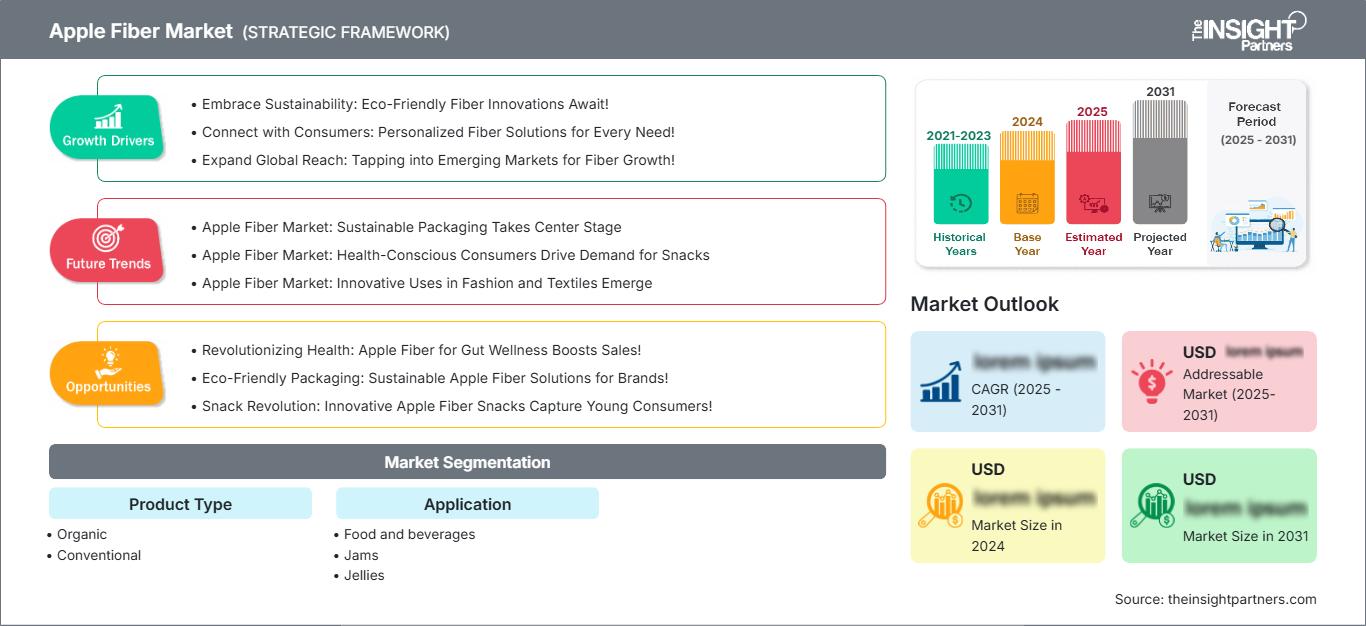
Apple Fiber Market: Strategic Insights
Regional Insights
North America apple fiber market
North America accounted for 28–32% share in 2025 and is expected to expand at a CAGR range of 5.6–6.1% during 2026–2034. The region benefits from mature apple processing, strong demand for fiber-enriched bakery products, and accelerated clean-label reformulation across snacks, beverages, sauces, and dairy alternatives. Upcycled ingredient narratives also support procurement interest among branded food manufacturers.
The apple fiber market share in North America is shaped by the US, Canada, and Mexico, with the US remaining dominant due to larger packaged food output and a deeper specialty ingredient distribution base. Regional processors are prioritizing traceable pomace streams, particle-size consistency, and allergen-friendly positioning for gluten-free bakery, fruit preparations, ready-to-drink beverages, and frozen dessert systems.
U.S. apple fiber Market
The US represented 78–82% of North America apple fiber market in 2025 and is projected to grow at a CAGR range of 5.7–6.2% during 2026–2034. Demand is supported by prepared food manufacturers seeking recognizable fiber sources, especially in bakery mixes, nutrition bars, fruit fillings, smoothie powders, and reduced-sugar spreads, where apple fiber can support body and mouthfeel.
Company presence is reinforced by Mayer Brothers Ingredients, LaBudde Group Incorporated, Pestell Minerals & Ingredients Inc, and distributors carrying European fiber lines. Application trends favor gluten-free bakery, natural thickening in sauces, and fiber enrichment in beverages. US suppliers also benefit from domestic apple processing in New York, Michigan, Washington, and other orchard states with established juice and cider by-product streams.
Europe apple fiber Market
Europe held 34–38% share of the apple fiber market in 2025 and is projected to grow at a CAGR range of 5.4–5.9% during 2026–2034. Germany leads regional supply and application development through specialist fiber producers and advanced food technology networks. The UK uses apple fiber in clean-label bakery, cereals, and reformulated prepared foods, supported by retailer pressure for simpler ingredient declarations.
Germany benefits from J. Rettenmaier & Söhne GmbH + Co KG, CFF GmbH & Co. KG, and Herbafood Ingredients GmbH, making it the leading European country for technical fruit fiber innovation. France and Italy show steady demand in fruit preparations, jams, dairy desserts, and bakery fillings, while Spain adds beverage and confectionery uptake through Mediterranean food-processing clusters.
APAC apple fiber Market
APAC accounted for 22–26% share of the apple fiber market in 2025 and is projected to grow at a CAGR range of 6.6–7.2% during 2026–2034. China is the leading country because of its apple production scale, ingredient manufacturing capacity, and expanding functional food demand. Japan and South Korea favor premium applications, while India and Australia add growth through bakery and beverage reformulation.
Industrial drivers include urban packaged food consumption, broader dietary fiber awareness, and investment in fruit-processing by-product utilization. Policy attention to food-waste reduction and domestic agricultural value addition supports pomace upgrading. Xi'an DN Biology Co., Ltd. and regional specialty suppliers are positioned to serve powdered ingredient demand across beverages, confectionery, and nutraceutical-adjacent formulations.
Middle East & Africa apple fiber Market
The Middle East & Africa region is projected to grow at a CAGR range of 5.9–6.4% during 2026–2034, supported by packaged food expansion in Saudi Arabia, the UAE, and South Africa. Imported ingredients prevail due to insufficient raw materials locally from apple processing. Distributors’ dependability and the ability to store in powder form play significant roles in ensuring the availability of these ingredients for manufacturers.
Demand in Saudi Arabia and the UAE prevails through bakery, beverage, and dairy dessert production due to initiatives on food security and industrial diversification. Demand in South Africa is influenced by fruit processing and clean-label adoption through retail. It is necessary to consider the energy and infrastructure context since it influences ingredient costs.
Segmentation Analysis
Product Type
Product Type is central to the apple fiber market scope because procurement decisions differ between cost-efficient conventional grades and premium organic-certified ingredients. The segment is projected to grow at a CAGR range of 5.9–6.5% during 2026–2034. Demand depends on certification, sensory performance, microbiological control, and compatibility with clean-label claims across bakery, beverages, spreads, frozen desserts, and confectionery.
- Organic products serve premium brands, certified organic bakery mixes, infant-adjacent foods, and wellness-positioned beverages where ingredient origin, residue control, and traceability support higher-value claims.
- Conventional products remain the volume base due to broader availability, competitive pricing, and suitability for mainstream fiber enrichment, water binding, and texture improvement in large-scale food production.
Application
Application is projected to grow at a CAGR range of 6.0–6.6% during 2026–2034 as food manufacturers broaden apple fiber usage from nutrition fortification into texture, moisture management, and stabilization. Adoption is strongest where apple-derived functionality can reduce reliance on modified starches, improve fruit perception, and support plant-based or gluten-free reformulation without introducing unfamiliar label language.
- Food and beverages represent the broadest use base, with demand spanning nutrition bars, mixes, sauces, snacks, and functional drinks that require fiber enrichment and clean-label texturizing.
- Jams, Jellies, spreads use apple fiber for viscosity, fruit texture, and water management, especially in reduced-sugar formats where conventional solids and gel structure need support.
- Dairy and frozen desserts benefit from mouthfeel enhancement, syneresis control, and natural stabilization, particularly in plant-based yogurts, frozen desserts, and fruit-preparation inclusions.
- Beverages use fine-particle grades for fiber fortification, suspension support, and fruit-style positioning, although formulation success depends on dispersibility, sediment control, and sensory neutrality.
- Bakery and confectionery rely on apple fiber for moisture retention, crumb softness, filling stability, dusting, and fiber claims in cookies, bars, breads, cakes, and fruit-based confectionery systems.
Opportunity Snapshot
| Application | Revenue Contribution (High/Medium/Low) | Trend Tag (MAX 2 words, specific) | Adoption Stage (Emerging/Scaling/Mature) |
| Food and beverages | High | Fiber Fortification | Scaling |
| Jams, Jellies, spreads | Medium | Sugar Reduction | Mature |
| Dairy and frozen desserts | Medium | Texture Stability | Scaling |
| Beverages | Medium | Clean Suspension | Emerging |
| Bakery and confectionery | High | Moisture Retention | Mature |
Apple Fiber Market Growth Drivers and Impact Analysis
Clean-label reformulation in bakery and prepared foods
Clean-label reformulation is a primary demand driver as apple fiber can be used to substitute or cut back on less favorable stabilizers, texture modifiers, and bulking agents in certain formulations. It helps bakery manufacturers increase crumb softness, moisture holding capacity, and fiber placement, and fruit formulations and spreads to provide viscosity and fruit flavor support. Its commercial value is highest in cases when retailers demand fewer ingredients, and brands market themselves as products for digestive health. Application labs have a distinct competitive edge as apple fiber behavior varies depending on the size of particles, level of hydration, pH and thermal treatment. As reformulation becomes faster, the ingredient purchasers will most likely prefer proven grades of the ingredient.
Upcycling of apple pomace into food-grade ingredients
The value of apple pomace valorization to the economic structure of the value chain is that it transforms an annual processing byproduct into a year-round ingredient of greater monetary value per unit. Juice and cider producers benefit through reductions in disposal challenges, while specialist driers and millers provide standardized powders to food producers. This has commercial significance given that the sustainability functions of food companies consider ingredient circularity, waste reduction and agricultural by-products more and more. It requires food-grade quality upcycling through controlled drying, microbial management, traceability and contamination control, setting the qualified suppliers apart from low specification sources.
Rising demand for fiber-enriched functional foods
Fiber fortification continues to be a robust growth area, as consumers relate digestion, satiety, and nutrition balance to their food consumption as opposed to being associated with supplements only. Apple fiber qualifies well for this trend since it can be added to various common product types such as bars, baked foods, beverages, cereals, and frozen products. The effect is more pronounced in regions where nutrition claims and wellness-focused new product developments play a role in purchase decisions. The combination of soluble and insoluble components makes formulating simpler. Nevertheless, its success will depend on factors like dosing, mouthfeel, coloration, and processability.
Apple Fiber Market Future Trends
Next-generation functional apple fiber grades
The most important apple fiber market trends will involve higher-function grades engineered for improved water binding, lower grittiness, better cold dispersion, and neutral sensory performance. These attributes allow fruit fibers to move beyond basic fortification into stabilizing roles in beverages, dairy alternatives, sauces, and confectionery. Future launches are expected to emphasize application-specific grades rather than generic powders, with suppliers offering technical data on viscosity, swelling, hydration kinetics, and bake stability. This trend will alter competitive dynamics by rewarding producers that combine raw material control with food science expertise. Premium pricing should remain possible where performance reduces recipe complexity or replaces multiple additives.
Regionalization of pomace-based ingredient supply
It is anticipated that regional sourcing will become increasingly significant as food producers become less vulnerable to fluctuations in freight costs, extended lead times, and inconsistent paperwork. Apple fiber production will be able to integrate itself within regional clusters of orchards and fruit juice processing plants in North America, Europe, and China. This development will foster collaboration among fruit processors, drying specialists, and ingredient suppliers. Regionalization will also favor better management of raw materials, traceability, and reduced emissions from transportation activities. Buyers will increasingly evaluate secondary suppliers regionally, particularly those with products that need to meet organic, allergen, non-GMO, and microbial standards.
Apple Fiber Market Opportunities
Application-led partnerships with bakery and beverage manufacturers
The strongest near-term opportunity is to co-develop formulations with bakery and beverage manufacturers that need fiber enrichment without compromising texture or taste. Apple fiber market Forecasts indicate that suppliers can capture higher value by selling documented solutions rather than undifferentiated powder. In the bakery, the opportunity lies in moisture retention, gluten-free structure, and reduced-sugar fillings. In beverages, it centers on fine particles, suspension behavior, and sensory neutrality. Ingredient companies should invest in pilot trials, recipe libraries, and regional technical service teams. This approach shortens qualification cycles and helps customers justify switching from modified starches or synthetic stabilizers to fruit-derived alternatives.
Organic and premium clean-label product expansion
Investment in organic apple fiber becomes a promising option since premium food manufacturers are ready to invest in certified raw materials, enabling natural, organic, and traceable positioning of the product. The most promising sectors include organic bakery products, healthy drinks, organic children's snacks, and dairy substitutes in which ingredient provenance is carefully evaluated by consumers. Competitive advantage may be gained via certified raw material acquisition, residual content tests, clear tracking of the product through the whole supply chain, and consistent particle size distribution. Seasonal variations in apple raw materials and the limited quantity of certified pomace need to be considered in capacity planning.
Frequently Asked Questions

- Comprehensive Market Sizing and Forecast Analysis
- Detailed Segmentation Analysis
- In-Depth Market Dynamics Assessment
- Regional and Country-Level Insights
- Competitive Landscape and Company Benchmarking
- Strategic Business Intelligence
Recent Reports
Testimonials

The Insight Partners provided valuable market intelligence that supported our global go-to-market strategy. Their team was professional, responsive, and attentive to our feedback, providing thoughtful analysis and helpful methodological clarifications throughout the project.
Junmo Kim Chief Financial Officer (CFO), Enertech Co., Ltd.
The Insight Partners' SCADA System Market report is comprehensive, with valuable insights on current trends and future forecasts. The team was highly professional, responsive, and supportive throughout. We are very satisfied and highly recommend their services.
RAN KEDEM Partner, Reali Technologies LTDs
I requested a report on a very specific software market and the team produced the report in a few days. The information was very relevant and well presented. I then requested some changes and additions to the report. The team was again very responsive and I got the final report in less than a week.
JEAN-HERVE JENN Chairman, Future Analytica
We worked with The Insight Partners for an important market study and forecast. They gave us clear insights into opportunities and risks, which helped shape our plans. Their research was easy to use and based on solid data. It helped us make smart, confident decisions. We highly recommend them.
PIYUSH NAGPAL Sr. Vice President, High Beam Global
The Insight Partners delivered insightful, well-structured market research with strong domain expertise. Their team was professional and responsive throughout. The user-friendly website made accessing industry reports seamless. We highly recommend them for reliable, high-quality research services
YUKIHIKO ADACHI CEO, Deep Blue, LLC.
This is the first time I have purchased a market report from The Insight Partners.While I was unsure at first, I visited their web site and felt more comfortable to take the risk and purchase a market report.I am completely satisfied with the quality of the report and customer service. I had several questions and comments with the initial report, but after a couple of dialogs over email with their analyst I believe I have a report that I can use as input to our strategic planning process.Thank you so much for taking the extra time and making this a positive experience.I will definitely recommend your service to others and you will be my first call when we need further market data.
JOHN SUZUKI President and Chief Executive Officer, Board Director, BK Technologies
I wish to appreciate your support and the professionalism you displayed in the course of attending to my request for information regarding to infectious disease IVD market in Nigeria. I appreciate your patience, your guidance, and the fact that you were willing to offer a discount, which eventually made it possible for us to close a deal. I look forward to engaging The Insight Partners in the future, all thanks to the impression you have created in me as a result of this first encounter.
DR CHIJIOKE ONYIA MANAGING DIRECTOR, PineCrest Healthcare Ltd.Reason to Buy
- Informed Decision-Making
- Understanding Market Dynamics
- Competitive Analysis
- Identifying Emerging Markets
- Customer Insights
- Market Forecasts
- Risk Mitigation
- Boosting Operational Efficiency
- Strategic Planning
- Investment Justification
- Tracking Industry Innovations
- Aligning with Regulatory Trends





 Get Free Sample for