
Application-level Encryption Market Growth, Size & Forecast by 2034
Coverage: By Deployment Type (On-Premises, Cloud); Enterprise Size (SMEs, Large Enterprise); End-Users (BFSI, IT and Telecom, Government, Healthcare, Retail and E-Commerce, Media and Entertainment, Manufacturing, Transportation and Logistics, Energy and Utility, Others) , and Geography (North America, Europe, Asia Pacific, and South and Central America)
- Status : Data Released
- Report Code : TIPRE00019486
- Category : Technology, Media and Telecommunications
- No. of Pages : 150
- Available Report Formats :


- Last update date : August 28, 2026


2025 Market Size
US$ 2.09 Bn
Base year value
2034 Forecast
US$ 7.96 Bn
Projected by 2034
CAGR 2026-2034
18.20 %
Growth rate
Addressable Market
US$ 47.56 Bn
(2026-2034)
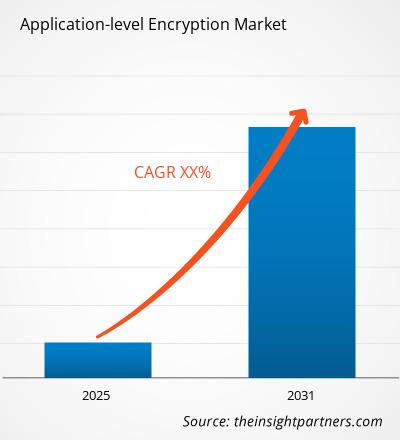
The application-level encryption market is projected to grow from US$ 2.09 Billion in 2025 to US$ 7.96 Billion by 2034, recording a CAGR of 18.20% during 2026–2034. Demand is rising as enterprises move sensitive workflows into cloud, mobile, API, and software-as-a-service environments where protection must operate at the application layer rather than only across networks or storage systems.
North America remains the leading regional contributor, supported by mature cybersecurity budgets, compliance-intensive sectors, cloud-native development, and high digital payment activity. The application-level encryption market size in the region is reinforced by BFSI, healthcare, government, and technology enterprises that require granular encryption, strong key management, and audit-ready data protection across distributed application estates.
Application-level Encryption Market Assessment and Insights
- North America: North America accounted for 36–39% share in 2025 and is projected to grow at a CAGR of 17–19% during 2026–2034, supported by federal cybersecurity modernization, cloud migration, and strong regulated-industry spending.
- US: The US represented 78–82% of North America in 2025 and is expected to expand at a CAGR of 17–18.5% as enterprises prioritize zero-trust application security.
- Europe: Europe held 24–27% share in 2025 and is forecast to grow at a CAGR of 16–18%, led by the UK, Germany, and France, where privacy mandates strengthen application-level controls.
- Asia Pacific: Asia Pacific represented 21–24% share in 2025 and is projected to post a CAGR of 20–23%, with China, Japan, India, South Korea, and Australia advancing secure digital services.
- Largest Segment: Cloud deployment held 62–66% market share in 2025 and is expected to grow at a CAGR of 20–22%, reflecting scalable encryption demand across cloud-native applications.
- High Growth Segment: SMEs held 31–35% share in 2025 and are projected to grow at a CAGR of 21–24% as managed security and cloud tools reduce adoption barriers.
- Key companies analyzed in detail: Blue Star Limited, Chino Srls, Dell Inc., F5, Inc., Futurex, IBM Corporation, McAfee LLC, OpenText Corporation, Microsoft Corporation, and Entrust Corporation.
Source: The Insight Partners' analysis based on proprietary research, government publications, company annual reports, investor presentations, industry databases, and expert interviews.
Market evolution has shifted from perimeter-centric data protection to application-embedded encryption that protects information during processing, storage, and transmission. The application-level encryption market growth is shaped by privacy-by-design development, API security, database field-level controls, tokenization, and externalized key management. Cryptographic security is becoming more essential as organizations demand solutions that can protect data wherever it goes, without degrading transactional performance or interfering with developer processes.
The future belongs to vendors that can deliver encryption for the use cases involving protected, high-value, or persistent sensitive information. In financial services, healthcare, government, retail platforms, and telecommunication networks, encryption is being implemented within zero trust, cloud security posture management, and post-quantum security architecture.
Application-level Encryption Market Report Scope
| Report Attribute | Details |
|---|---|
| Market size in 2025 | US$ 2.09 Billion |
| Market Size by 2034 | US$ 7.96 Billion |
| Global CAGR (2026 - 2034) | 18.20% |
| Historical Data | 2021-2024 |
| Forecast period | 2026-2034 |
Application-level Encryption Market Analysis
The application-level encryption market is expanding because enterprises need controls that secure data before it leaves the application context. The market for this technology will see its greatest demand in use cases that include customer information, payments, health records, identity, messaging, and intellectual property. Applications on the cloud, microservices, APIs, and mobile apps drive the creation of more points where sensitive data can be handled, resulting in higher demand for encryption within the software code itself.
Factors that influence supply include software companies, cloud security solutions, hardware security module companies, and consultancy-driven implementations. The supply chain consists of cryptographic modules, policy enforcement mechanisms, key management systems, tools for developers, and services for regulatory compliance. Application-level encryption evaluation by buyers becomes more focused on impact on performance, integration, certificate management, auditing, and legacy application compatibility.
The competitive landscape of the Application-level Encryption Market includes broad technology companies and specialists capable of linking encryption with identity, cloud, application delivery, and data protection. Some companies like IBM Corporation, Microsoft Corporation, Dell Inc., F5, Inc., Futurex, Entrust Corporation, McAfee LLC, OpenText Corporation, Chino Srls, and Blue Star Limited have focused on various market segments through enterprise infrastructure, application security, key management, and managed protection solutions.
The focus of investments will shift towards post-quantum cryptography preparedness, crypto-agility, automatic key rotation, and centralized cryptographic discovery. The vendors are differentiating themselves in terms of platform integration rather than standalone encryption modules. The buyers are also focusing on operational resilience because encryption failures may impact payments, health care, public sector services, and digital customer channels.
● REPORT CUSTOMIZATION
Tailor This Report To Align With Your Specific Business Requirements
This report can be customized to align precisely with your business objectives, scope, and target markets. Customization options include tailored segmentation, geography, competitive analysis, and strategic insights to support informed decision-making.
Customize This Report →WHAT YOU CAN ADJUST
- ● Segmentations
- ● Geography
- ● Competitive Analysis
- ● Language Preferences
Application-level Encryption Market: Strategic Insights
Regional Insights
North America application-level encryption market
North America led with 36–39% application-level encryption market share in 2025 and is projected to grow at a CAGR of 17–19% during 2026–2034. The market has access to high levels of concentration of cloud infrastructure, cybersecurity spending, financial technology ecosystems, and strict regulations in the healthcare, banking, and public sector systems.
Large companies are implementing application-level controls to ensure the security of the transfer of information through APIs, software as a service (SaaS), and distributed database systems. This market is also driven by post-quantum planning, zero-trust requirements, and the need for cryptography governance. Cloud-based deployments are favored due to their ease of implementation.
U.S. application-level encryption Market
The US accounted for 78–82% of the North America Application-level Encryption Market in 2025 and is forecast to grow at a CAGR of 17–18.5%. Demand is strongest among banks, healthcare networks, cloud service providers, government agencies, and technology companies operating high-volume digital applications that require field-level data protection.
Enterprise adoption is reinforced by application modernization, API-led services, and stronger board-level attention to data breach prevention. Major vendors and hyperscale cloud providers based in the country support rapid product integration, while regulated industries continue to invest in encryption that supports auditability, key separation, and privacy compliance.
Europe application-level encryption Market
Europe held 24–27% share of the Application-level Encryption Market in 2025 and is projected to grow at a CAGR of 16–18% through 2034. The UK and Germany lead regional demand due to mature financial services, cloud adoption, cybersecurity regulation, and industrial digitization. France, Italy, and Spain are expanding adoption across healthcare, government, retail, and telecom applications.
The region’s buyers emphasize privacy, sovereignty, and encryption governance. GDPR, NIS2 implementation, and critical infrastructure requirements are pushing enterprises to protect sensitive fields within applications instead of relying only on database or network encryption. Cloud and on-premises deployment continue to coexist because some sectors require local key control.
APAC application-level encryption Market
Asia Pacific represented 21–24% share in 2025 and is expected to grow at a CAGR of 20–23%, making it the fastest-expanding region. China, India, Japan, South Korea, and Australia are increasing encryption adoption across digital payments, e-commerce, telecom services, government platforms, and healthcare modernization programs.
Regional growth is supported by expanding cloud regions, mobile-first application usage, and data protection laws that require stronger safeguards for personal and financial information. India and Southeast Asia are gaining momentum through digital public infrastructure and fintech scale, while Japan and Australia prioritize secure enterprise modernization.
Middle East & Africa application-level encryption Market
The Middle East & Africa Application-level Encryption Market is projected to grow at a CAGR of 18–21% during 2026–2034. Saudi Arabia and the UAE lead adoption through smart government, banking modernization, energy-sector cybersecurity, and cloud investment. South Africa contributes through financial services and telecom security demand.
Regional buyers are moving from basic perimeter controls toward application-specific protection as critical infrastructure becomes more digitized. Encryption is increasingly linked with national cybersecurity strategies, digital identity projects, and secure cross-border services. Deployment choices vary, with regulated institutions often favoring hybrid models to retain direct control over cryptographic keys.
Segmentation Analysis
Deployment Type
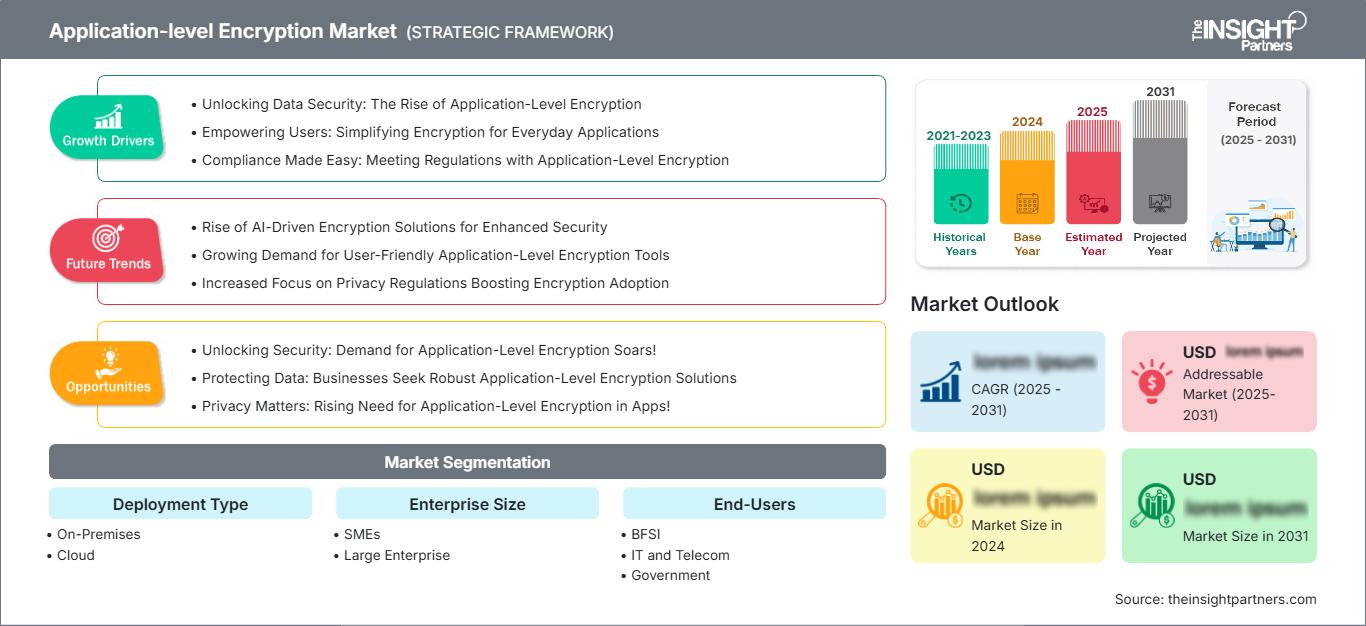
Deployment Type is expected to grow at a CAGR of 18–20% during 2026–2034. The application-level encryption market scope across deployment models is shaped by how enterprises balance scalability, compliance, latency, and key control. Cloud options are gaining share, while on-premises remains relevant for high-assurance environments.
- On-Premises: On-premises deployment remains important for government, defense, banking, and critical infrastructure users that require direct control over cryptographic keys, hardware security modules, and internal compliance procedures.
- Cloud: Cloud deployment leads adoption because it supports faster rollout, centralized policy control, API integration, and elastic protection for SaaS, microservices, digital payment, and customer engagement platforms.
Enterprise Size
Enterprise Size is forecast to grow at a CAGR of 18–21% during 2026–2034. Large enterprises dominate spending because of complex application estates and regulatory exposure, while SMEs are accelerating adoption through managed cloud encryption, lower upfront costs, and simplified security administration.
- SMEs: SMEs are adopting application-level encryption through cloud-native tools, managed services, and packaged compliance features that reduce the need for deep internal cryptography expertise.
- Large Enterprise: Large enterprises require scalable encryption governance across multi-cloud, legacy, and custom applications, making integration, key lifecycle automation, and performance assurance central procurement criteria.
End-Users
End-Users are projected to grow at a CAGR of 17–20% during 2026–2034. BFSI leads adoption because transaction integrity and customer privacy are non-negotiable. Healthcare, government, retail, telecom, manufacturing, logistics, media, and utilities are experiencing increasing demand as digital workflows expose sensitive operational and personal data.
- BFSI: BFSI remains the largest user group because digital banking, payments, insurance platforms, and customer onboarding require strong encryption, tokenization, auditability, and secure key management.
- IT and Telecom: IT and telecom providers use application-level encryption to secure APIs, subscriber data, messaging platforms, enterprise services, and cloud-hosted software delivery environments.
- Government: Government agencies deploy encryption to protect citizen records, digital identity platforms, tax systems, defense applications, and public-service portals against unauthorized access.
- Healthcare: Healthcare adoption is driven by patient records, connected care platforms, insurance claims, and clinical data exchange that require privacy-focused application security.
- Retail and E-Commerce: Retailers and e-commerce platforms use encryption to protect payment information, loyalty data, customer profiles, fraud analytics, and omnichannel transaction workflows.
- Media and Entertainment: Media companies apply encryption to protect subscriber information, premium content platforms, digital rights workflows, and advertising data exchanged across applications.
- Manufacturing: Manufacturers use application-level controls to secure intellectual property, connected factory data, supplier portals, design files, and operational technology integration layers.
- Transportation and Logistics: Logistics providers protect shipment records, fleet platforms, customer data, customs documentation, and partner APIs as supply chains become more digitally connected.
- Energy and Utility: Energy and utility firms require encryption for customer records, grid applications, billing platforms, field operations, and critical infrastructure data exchange.
Opportunity Snapshot
| End Users | Revenue Contribution | Trend Tag | Adoption Stage |
| BFSI | High | Secure Payments | Mature |
| IT and Telecom | High | API Security | Scaling |
| Government | Medium | Digital Identity | Scaling |
| Healthcare | Medium | Patient Privacy | Scaling |
| Retail and E-Commerce | Medium | Checkout Protection | Scaling |
| Media and Entertainment | Low | Content Access | Emerging |
| Manufacturing | Medium | IP Protection | Emerging |
| Transportation and Logistics | Low | Supply APIs | Emerging |
| Energy and Utility | Medium | Grid Security | Scaling |
Application-level Encryption Market Growth Drivers and Impact Analysis
Rising Regulatory Pressure on Sensitive Application Data
Regulatory pressure is one of the biggest motivators since companies have to demonstrate that their sensitive data is secure during the collection, processing, storage, and exchange of such data. Privacy laws, payment card industry data security standards, healthcare regulations, and cybersecurity standards for various sectors compel the use of encryption at an application level. Application-level encryption allows companies to identify protected fields, employ role-based access and keep track of logs. It also decreases risk if the database, API, or cloud gets hacked. It is apparent from the procurement process that compliance checks, key isolation, and reporting are as important as encryption itself.
Cloud-Native Applications Expanding Encryption Demand
The trend towards cloud-native technology has led to the emergence of a requirement for encryption capabilities that are able to span microservices, containers, APIs, and distributed databases. Old school solutions, including network-level or disk-based encryption, are no longer applicable as the flow of sensitive information continuously goes through services and external partners. By using application-level encryption, it is possible for security engineers to implement their policies even before the data enters shared infrastructure. This particular factor has considerable influence on the market due to the fact that cloud deployment is currently the most prominent and agile model.
Post-Quantum Readiness and Crypto-Agility Planning
Organizations are now looking at cryptographic agility as an essential component of strategy owing to the potential risk of decryption in the future for long-term critical information. The quantum readiness process not only concerns transport security but is also relevant in the manner in which applications handle keys, algorithms, certificates, and data security policies. Cryptographic solutions that facilitate algorithm agility and governance can make future migrations simpler. The implications are particularly critical for banks, governments, health care providers, defense departments, and energy companies. There is an increasing need for platforms that discover weaknesses in cryptographic implementations.
Application-level Encryption Market Future Trends
Crypto-Agile Application Security Architecture
One of the most important application-level encryption market trends is the movement toward crypto-agile architecture. The objective of businesses is to have an application security architecture that will enable the algorithms, keys, certificates, and policies to evolve without changing the business application. This factor will affect procurement in that customers will look for technologies that can adjust in line with post-quantum standards, compliance requirements from regions and new breach scenarios. There will be a tendency by vendors to integrate encryption, key management, discovery and policy orchestration into one platform.
Encryption Embedded into DevSecOps Workflows
DevSecOps pipelines will increasingly have encryption capabilities integrated within them as companies look to push security measures further along the software development lifecycle. This will mean that developers need ready-to-use encryption libraries, automatic policy enforcement, secure secrets management, and tools to test whether sensitive data fields are encrypted prior to release. This creates a smoother deployment process and enables encryption at the application level to be standard in software development. Eventually, vendors offering integration with popular development platforms, cloud providers, and API gateways will become more prominent in the market.
Application-level Encryption Market Opportunities
Managed Encryption Services for Mid-Market Buyers
Managed encryption services create a strong application-level encryption market forecasts opportunity because SMEs and mid-market enterprises often lack specialist cryptography teams. These buyers still handle payment data, employee records, customer identities, and sensitive application workflows, but they prefer subscription-based tools with simplified administration. Providers can capture demand by bundling application encryption, key management, compliance reporting, monitoring, and incident support. This opportunity is especially attractive in cloud-heavy sectors such as retail, healthcare practices, professional services, and digital commerce. Lower implementation complexity can widen market access and increase recurring revenue visibility.
Sector-Specific Encryption Templates and Compliance Packs
Vendors have an opportunity to offer preconfigured encryption templates for BFSI, healthcare, government, retail, and energy applications. Sector-specific policy packs can shorten deployment timelines by aligning data classification, key rotation, access control, logging, and reporting with common regulatory expectations. This approach makes encryption easier for buyers who need confidence but cannot build custom frameworks from scratch. It also enables service providers to differentiate beyond generic cryptographic capability. As applications become more modular, industry-specific accelerators can help vendors win faster adoption and expand professional services revenue.
Frequently Asked Questions

- Comprehensive Market Sizing and Forecast Analysis
- Detailed Segmentation Analysis
- In-Depth Market Dynamics Assessment
- Regional and Country-Level Insights
- Competitive Landscape and Company Benchmarking
- Strategic Business Intelligence
Recent Reports
Testimonials

The Insight Partners' SCADA System Market report is comprehensive, with valuable insights on current trends and future forecasts. The team was highly professional, responsive, and supportive throughout. We are very satisfied and highly recommend their services.
RAN KEDEM Partner, Reali Technologies LTDs
I requested a report on a very specific software market and the team produced the report in a few days. The information was very relevant and well presented. I then requested some changes and additions to the report. The team was again very responsive and I got the final report in less than a week.
JEAN-HERVE JENN Chairman, Future Analytica
We worked with The Insight Partners for an important market study and forecast. They gave us clear insights into opportunities and risks, which helped shape our plans. Their research was easy to use and based on solid data. It helped us make smart, confident decisions. We highly recommend them.
PIYUSH NAGPAL Sr. Vice President, High Beam Global
The Insight Partners delivered insightful, well-structured market research with strong domain expertise. Their team was professional and responsive throughout. The user-friendly website made accessing industry reports seamless. We highly recommend them for reliable, high-quality research services
YUKIHIKO ADACHI CEO, Deep Blue, LLC.
This is the first time I have purchased a market report from The Insight Partners.While I was unsure at first, I visited their web site and felt more comfortable to take the risk and purchase a market report.I am completely satisfied with the quality of the report and customer service. I had several questions and comments with the initial report, but after a couple of dialogs over email with their analyst I believe I have a report that I can use as input to our strategic planning process.Thank you so much for taking the extra time and making this a positive experience.I will definitely recommend your service to others and you will be my first call when we need further market data.
JOHN SUZUKI President and Chief Executive Officer, Board Director, BK Technologies
I wish to appreciate your support and the professionalism you displayed in the course of attending to my request for information regarding to infectious disease IVD market in Nigeria. I appreciate your patience, your guidance, and the fact that you were willing to offer a discount, which eventually made it possible for us to close a deal. I look forward to engaging The Insight Partners in the future, all thanks to the impression you have created in me as a result of this first encounter.
DR CHIJIOKE ONYIA MANAGING DIRECTOR, PineCrest Healthcare Ltd.Reason to Buy
- Informed Decision-Making
- Understanding Market Dynamics
- Competitive Analysis
- Identifying Emerging Markets
- Customer Insights
- Market Forecasts
- Risk Mitigation
- Boosting Operational Efficiency
- Strategic Planning
- Investment Justification
- Tracking Industry Innovations
- Aligning with Regulatory Trends





 Get Free Sample for