
Arteriotomy Closure Devices Market Growth, Trends & Forecast by 2034
Arteriotomy Closure Devices Market Size and Forecasts (2021–2034), Global and Regional Share, Trends, and Growth Opportunity Analysis Report Coverage : by Product (Active Closure Devices and Passive Closure Devices); Application (Femoral Arterial Access Procedures and Radial Arterial Access Procedures); End User (Hospitals, Ambulatory Care Centers, Other End Users); and Geography (North America, Europe, Asia Pacific, and South and Central America)
- Status : Data Released
- Report Code : TIPRE00040715
- Category : Life Sciences
- No. of Pages : 150
- Available Report Formats :


- Last update date : September 01, 2026


2025 Market Size
US$ 1.64 Bn
Base year value
2034 Forecast
US$ 2.89 Bn
Projected by 2034
CAGR 2026-2034
6.5 %
Growth rate
Addressable Market
US$ 20.49 Bn
(2026-2034)
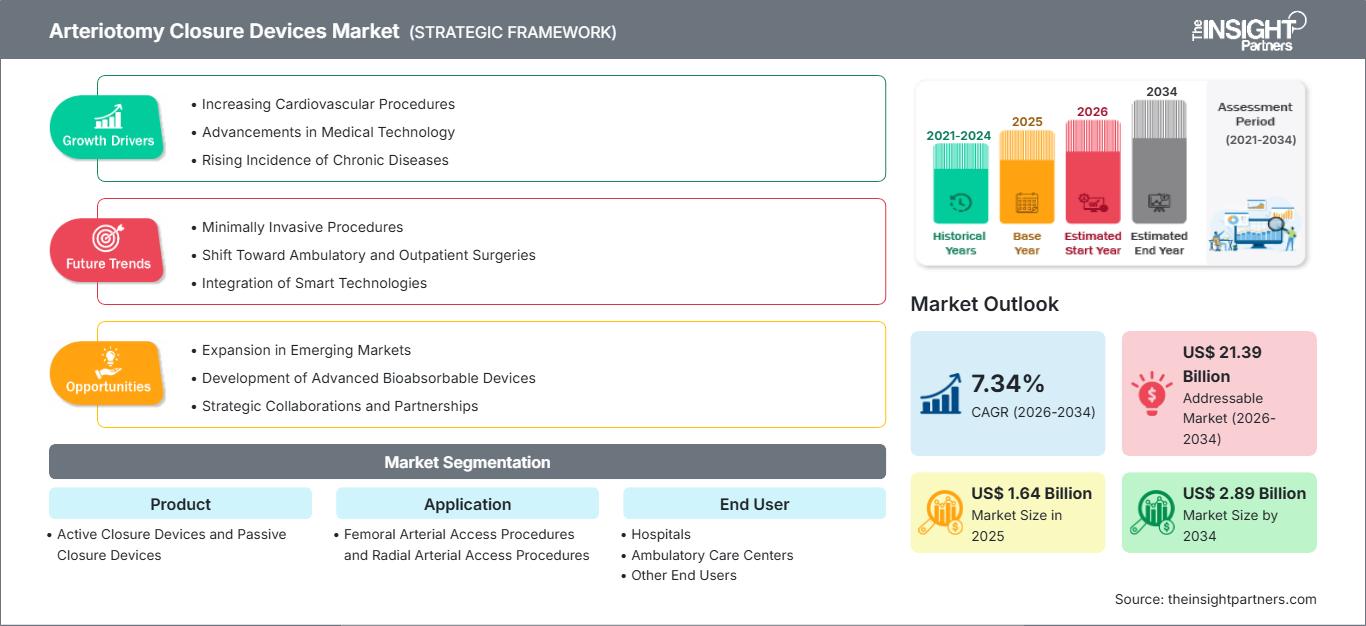
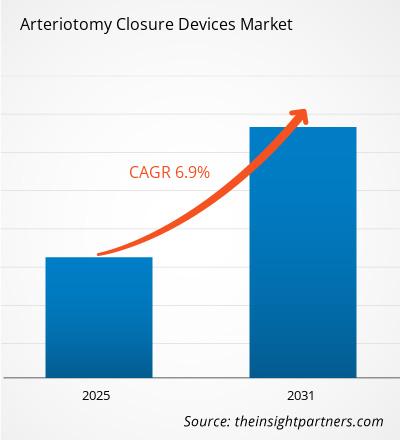
The Arteriotomy Closure Devices market was valued at US$ 1.64 billion in 2025 and is expected to reach US$ 2.89 billion by 2034; it is estimated to record a CAGR of 6.5% during 2026-2034.
Arteriotomy Closure Devices Market Assessment and Insights
- North America: North America represented a 38–42% arteriotomy closure devices market share in 2025 and is expected to grow at a 7.0–7.5% CAGR between 2026–2034, supported by mature interventional infrastructure, broad device availability, and high adoption of closure technologies.
- US: The US accounted for 72–76% of North American revenue in 2025 and is projected to expand at a 7.1–7.6% CAGR between 2026–2034, led by structural-heart, electrophysiology, peripheral, and coronary procedures.
- Europe: Europe held a 27–31% share in 2025 and is expected to grow at a 6.8–7.3% CAGR between 2026–2034, with Germany, the UK, France, Italy, and Spain providing the principal procedural base.
- Asia Pacific: Asia Pacific represented a 21–25% share in 2025 and is forecast to grow at a 7.8–8.4% CAGR between 2026–2034, led by China, Japan, South Korea, India, and Australia as interventional capacity expands.
- Largest Segment: Active Closure Devices held a 63–67% market share in 2025 and is expected to grow at a 7.0–7.5% CAGR between 2026–2034, reflecting strong femoral adoption.
- High Growth Segment: Radial Arterial Access Procedures represented a 30–34% market share in 2025 and is expected to grow at an 8.0–8.6% CAGR between 2026–2034 as transradial workflows mature.
- Key companies analyzed in detail: Abbott Laboratories, Terumo Corporation, Cardinal Health, Medtronic plc, W. L. Gore & Associates, Inc., Boston Scientific Corporation, Vascular Solutions, Inc., Teleflex Incorporated, Merit Medical Systems, Inc., Cordis US Corp.
Source: The Insight Partners' analysis based on proprietary research, government publications, company annual reports, investor presentations, industry databases, and expert interviews.
The development of devices will continue to move towards predictable placement, fewer procedures, and closure system technologies which will work effectively with increasingly complicated access profiles. Suture-mediated, collagen, sealant, and biomechanical closure system solutions will be combined together as manufacturers work on improving the ergonomics and the hemostasis efficacy of devices. The production will focus more on sterile single use manufacturing and supply chain reliability.
In the coming years, the growth will not only come from well-established centers located in North America and Europe but will expand into selected Asian and Middle Eastern markets. Technologies that reduce recovery time without sacrificing access site safety will receive investment. Regulatory requirements on usability, biocompatibility, sterility, and clinical evidence will play an important role in product development as hospitals evaluate closure systems based on procedure effectiveness rather than cost alone.
Arteriotomy Closure Devices Market Report Scope
| Report Attribute | Details |
|---|---|
| Market size in 2025 | US$ 1.64 Billion |
| Market Size by 2034 | US$ 2.89 Billion |
| Global CAGR (2026 - 2034) | 6.5% |
| Historical Data | 2021-2024 |
| Forecast period | 2026-2034 |
Arteriotomy Closure Devices Market Analysis
The demand is driven by increasing numbers of catheter-based cardiovascular procedures performed and the necessity to ensure reliable hemostasis after performing punctures in arteries. In this regard, arteriotomy closure devices market growth can be attributed to procedure mix, access site management strategies, and shift to minimally invasive procedures. The value chain includes manufacturers of polymers, sutures, collagens, metals, delivery systems, specialty manufacturers, sterilization firms, distributors, hospitals, and interventional cardiologists.
Supply environment stays dominated by manufacturers with approved devices, training for physicians, and global distribution. Economics of product is defined by device complexity, manufacturing yield of sterile products, components availability, and number of procedures. Big players have an advantage due to already developed cardiovascular portfolio and sales networks, while niche companies can compete based on unique design suitable for large bore closure, radial access, or easier deployment. Procurement criteria include reliability, training costs, inventories, and total procedure time.
Competitive landscape is differentiated by closure technique, compatibility with sheaths, indication for specific access site, and ease of deployment. Abbott Laboratories markets Perclose systems, which use suture-mediated closure. Terumo Corporation promotes Angio-Seal technology. MANTA system is promoted by Teleflex Incorporated, while Cordis US Corp provides such solutions as ExoSeal, Mynx Control, and MynxGrip. Boston Scientific Corporation, Medtronic plc, Merit Medical Systems, Inc., and W. L. Gore & Associates, Inc. have cardiovascular devices in their portfolios.
Current investment trends are shifting towards procedural simplicity, broadening indications, and devices that will allow the same-day procedure. Thus, arteriotomy closure devices market analysis identifies those companies, which are able to combine clinical evidence with production capacity and physician education. Vascular Solutions, Inc., now being a legacy firm of Teleflex, can be included into competitive landscape, while Cardinal Health adds distribution and healthcare supply capabilities to the equation.
● REPORT CUSTOMIZATION
Tailor This Report To Align With Your Specific Business Requirements
This report can be customized to align precisely with your business objectives, scope, and target markets. Customization options include tailored segmentation, geography, competitive analysis, and strategic insights to support informed decision-making.
Customize This Report →WHAT YOU CAN ADJUST
- ● Segmentations
- ● Geography
- ● Competitive Analysis
- ● Language Preferences
Arteriotomy Closure Devices Market: Strategic Insights
Regional Insights
North America arteriotomy closure devices market
North America is estimated at 38–42% of global revenue in 2025 and is expected to expand at a 7.0–7.5% CAGR through 2034. There is significant infrastructure in terms of catheterization services, high volume usage of structure heart and electrophysiology interventions, established protocols for vascular access and high awareness on the part of physicians regarding active closure devices. There is growing interest in predictable hemostasis and early mobilization. Procedure volumes also drive utilization in tertiary and community-based interventional sites.
The US is dominant in terms of demand in this region due to high cardiovascular procedure volumes, complex ambulatory pathways and established reimbursement frameworks. Demand from Canada stems from specialized cardiac facilities and growing adoption of minimally invasive interventions. Competitive dynamics are high due to major device suppliers having local regulatory, educational and distribution capabilities. Large-bore femoral closure is commercially significant whereas there is growing interest in radial access as operators adopt transradial techniques.
U.S. arteriotomy closure devices market
The US accounts for 72–76% of North American revenue in 2025 and is projected to grow at a 7.1–7.6% CAGR through 2034. Abbott Laboratories, Terumo Corporation, Teleflex Incorporated, Boston Scientific Corporation, Medtronic plc, Merit Medical Systems, Inc., and Cordis US Corp contribute to the competitiveness of the local environment. The strongest adoption occurs in hospitals conducting a high number of coronary, peripheral, structural heart, and electrophysiology procedures. Physician training programs also contribute to the adoption of new closure technologies.
There is a growing diversification of applications as radial entry gains acceptance, but femoral closure continues to play a crucial role for sheaths that are larger. Selection is becoming more complex based on anatomy, sheath size, type of closure device, operator preference, and discharge objectives. Ambulatory care of the heart drives even more need for predictability in access site management. Product development, training, and product line bundling continue to be important factors supporting adoption in cardiovascular service lines.
Europe arteriotomy closure devices market
Europe represented 27–31% of global revenue in 2025 and is forecast to grow at a 6.8–7.3% CAGR through 2034. Germany is the dominant country, backed by state-of-the-art cardiovascular centers and procedural expertise. The UK, France, Italy, and Spain act as additional sources of demand, thanks to developed catheterization infrastructure and the rising trend towards minimally invasive procedures. The regional arteriotomy closure devices market share is enabled by specialist centers and widespread use of proven closure technologies.
The UK is focused on effective hospital workflows and day case cardiovascular procedures; thus, there is demand for closure technologies, which help to minimize immobilization and need for recovery time. Germany provides a combination of high procedural volume and advanced structural-heart and peripheral interventions, resulting in the need for both standard and large-bore closure. France, Italy, and Spain are developing catheter-based interventions in specialized centers; meanwhile, purchasing is driven by clinical performance, device reliability, and cost-effectiveness.
APAC arteriotomy closure devices market
APAC held a 21–25% share in 2025 and is projected to grow at a 7.8–8.4% CAGR. Leading in terms of market share are China, then Japan, followed by South Korea, India, and Australia. Expansion is due to the increasing cardiovascular procedures, hospital developments in urban areas, improvements in catheterization capabilities, and increased awareness among physicians regarding minimally invasive techniques.
Long-term procedural expansion opportunities exist in China and India, but mature clinical practices can be found in Japan and Australia. South Korea combines the benefits of highly developed interventional practices and the high level of adoption by specialists. Focus on hospitals' development and production of medical devices locally can increase accessibility, although issues related to reimbursement, pricing, and regulations still need to be taken into account.
Middle East & Africa arteriotomy closure devices market
MEA is expected to expand at a 6.2–6.8% CAGR through 2034, with Saudi Arabia the leading demand center, followed by the UAE and South Africa. Investment in tertiary hospitals and cardiovascular centers supports gradual adoption of vascular closure technologies across major metropolitan systems.
Saudi Arabia and the UAE benefit from healthcare infrastructure programs and concentration of advanced procedural facilities. South Africa remains an important regional hub for specialist cardiovascular care, while the rest of MEA shows uneven access and procurement capacity. Energy-linked public investment can support hospital modernization, but supplier strategies must account for distributor dependence, training requirements, reimbursement variation, and differing regulatory pathways.
Segmentation Analysis
Product
The Product segment is expected to expand at a 6.9–7.5% CAGR from 2026–2034. Active Closure Devices retain a stronger position because they directly address hemostasis with dedicated mechanisms, whereas passive systems remain important where compression or simpler closure approaches fit procedural requirements. Portfolio decisions increasingly reflect sheath size, vessel anatomy, operator preference, and discharge objectives. The arteriotomy closure devices market scope therefore includes competing closure mechanisms rather than a single technology pathway.
- Active Closure Devices: These products support faster device-mediated hemostasis and are strategically important for femoral interventions when early ambulation or large-bore access management is clinically valuable.
- Passive Closure Devices: These systems remain relevant where procedural simplicity or established compression-based workflows influence purchasing decisions, complementing active technologies in mixed hospital protocols.
Application
The Application segment is projected to grow at a 7.2–8.0% CAGR from 2026–2034. Femoral procedures remain the principal revenue base because of larger sheath requirements and broad use in structural, peripheral, and complex interventions. Radial procedures are developing faster as clinicians seek lower access-site burden and more efficient recovery. The mix is increasingly determined by procedure type, anatomy, operator training, and institutional protocols.
- Femoral Arterial Access Procedures: Femoral access remains strategically important for large-bore and complex interventions, sustaining demand for suture-mediated, collagen-based, and biomechanical closure systems.
- Radial Arterial Access Procedures: Radial access is gaining procedural relevance as transradial practice expands, creating opportunities for compact closure solutions and standardized post-procedure protocols.
End User
The End User segment is expected to grow at a 6.8–7.8% CAGR from 2026–2034. Hospitals remain the primary purchasing base because they perform the broadest range of complex interventions. Ambulatory Care Centers are positioned for faster expansion as selected cardiovascular procedures shift toward shorter stays and standardized recovery pathways. Other End Users remain smaller and more heterogeneous, with demand tied to specialist procedural capacity.
- Hospitals: Hospitals account for the broadest demand because they manage high procedure volumes, complex anatomies, and multiple access strategies requiring diverse closure portfolios.
- Ambulatory Care Centers: These centers increasingly value closure technologies that support predictable recovery, streamlined staffing, and discharge planning for suitable minimally invasive procedures.
- Other End Users: Smaller specialist facilities contribute selective demand where vascular intervention capabilities are concentrated around regional referral services.
Opportunity Snapshot
| End User | Revenue Contribution | Trend Tag | Adoption Stage |
|---|---|---|---|
| Hospitals | High | Complex Access | Mature |
| Ambulatory Care Centers | Medium | Same-Day Care | Scaling |
| Other End Users | Low | Specialist Referral | Emerging |
Arteriotomy Closure Devices Market Growth Drivers and Impact Analysis
Expansion of catheter-based cardiovascular intervention
Increasing use of minimally invasive cardiovascular treatment expands the addressable base for arterial closure technologies. Structural heart, electrophysiology, peripheral vascular, and complex coronary procedures may require reliable access site management, especially if large sheath sizes or more than one access site is needed. With increased procedural volume in hospitals, closure reliability relates to room turnover, post-procedural observation, and discharge management. This adds commercial value to solutions which incorporate reliable placement together with effective hemostasis. Companies may generate additional revenue through designing devices that address the access-related needs of specific procedures rather than developing a solution which is universal. The effect will be most significant in those hospitals where capacity for interventional cardiology procedures is growing and post-access procedures are being standardized.
Pressure to shorten recovery and optimize hospital resources
Healthcare providers increasingly evaluate access-site management through operational outcomes rather than device price alone. Faster hemostasis can facilitate earlier ambulation, reduce prolonged observation, and support same-day discharge when clinically appropriate. These benefits are particularly relevant for high-volume interventional centers facing pressure on beds, nursing capacity, and procedure-room utilization. Closure devices can therefore influence the economics of an entire care pathway rather than a single consumable line item. Procurement teams are likely to compare technical success, complication profiles, training requirements, and workflow efficiency alongside acquisition cost. Suppliers that provide evidence supporting operational improvements may gain stronger negotiating positions with hospitals and integrated delivery networks. The market impact should be most visible where cardiovascular services are transitioning from inpatient models toward outpatient or short-stay pathways.
Growth of large-bore and complex access procedures
Large-bore catheter-based interventions create specific technical requirements for arterial closure and encourage continued product innovation. Transcatheter valve procedures, endovascular repair, mechanical circulatory support, and selected peripheral interventions can require larger access profiles than conventional diagnostic procedures. Closure failure in these settings can create clinically significant complications and additional intervention, increasing the value placed on reliable device deployment. This environment favors technologies with predictable anchoring, controlled delivery, and compatibility across broader sheath ranges. It also creates room for specialized products that address vessel anatomy, calcification, and challenging puncture conditions. Manufacturers with strong clinical evidence and training infrastructure can use these requirements to differentiate their portfolios. As complex procedures expand into additional hospitals, demand should move beyond major tertiary centers into capable regional institutions.
Arteriotomy Closure Devices Market Future Trends
Procedure-specific closure platforms and smarter deployment
The arteriotomy closure devices market trends are likely to favor increasingly tailored technologies designed around access size, anatomy, and procedural context rather than broad closure categories. Manufacturers may integrate clearer deployment cues, improved tactile feedback, smaller delivery profiles, and adaptable sealing mechanisms. Digital training content and simulation could become part of commercialization, helping standardize operator technique across expanding procedural networks. For large-bore interventions, development will focus on reproducible closure under challenging anatomy and minimizing rescue interventions. For radial procedures, compact systems and workflow integration will become more important. Companies able to translate clinical evidence into intuitive device design should gain stronger positions as hospitals emphasize standardized, reproducible access-site management and procedure-specific device selection.
Greater integration with outpatient cardiovascular workflows
The next phase of adoption is likely to connect closure-device selection with broader outpatient pathway design. Hospitals and ambulatory centers may evaluate products according to their contribution to recovery milestones, staffing requirements, and discharge readiness. This could encourage manufacturers to develop systems that simplify setup, deployment, confirmation, and post-procedure monitoring. Clinical protocols may increasingly define closure choice alongside access strategy before the intervention begins. As radial and femoral techniques coexist, algorithms based on procedure type, sheath profile, and patient anatomy could guide device selection. Training platforms may reinforce standardized workflows and reduce variation between operators. The resulting market structure would place greater emphasis on integrated procedural value, making closure technology an increasingly visible component of cardiovascular service-line optimization rather than a standalone disposable purchase.
Arteriotomy Closure Devices Market Opportunities
Local manufacturing and regional distribution partnerships
Manufacturers have an opportunity to strengthen positions in emerging cardiovascular markets through localized production, regional sterilization capacity, and partnerships with specialized distributors. China, India, Southeast Asia, the Middle East, and selected Latin American markets require different combinations of pricing flexibility, regulatory support, clinical education, and supply continuity. A regional strategy can reduce lead times and improve responsiveness to hospital tenders while creating opportunities for locally adapted packaging and training. Partnerships with established cardiovascular distributors can accelerate access to specialist centers where direct commercial infrastructure is limited. Investment should prioritize markets with expanding catheterization capacity rather than population size alone. Companies combining regulatory expertise, physician education, and dependable inventory management may establish stronger barriers to entry than competitors relying mainly on price-based tender participation.
Portfolio expansion through complementary access-site technologies
A second opportunity lies in combining arterial closure with adjacent access-management technologies, training services, and procedural consumables. Companies with established cardiovascular portfolios can cross-sell closure systems alongside introducer sheaths, guidewires, compression technologies, or structural-heart equipment. Such bundling can improve account penetration while giving hospitals a more coordinated procurement model. Acquisitions and licensing can accelerate access to specialized closure mechanisms without requiring complete internal development programs. Smaller manufacturers may instead focus on niche indications, challenging anatomy, or radial workflows and partner with larger distributors. The arteriotomy closure devices market Forecasts indicate that strategic value will increasingly come from portfolio fit, evidence generation, and account-level integration. Investors should therefore assess technology differentiation together with distribution reach, regulatory status, manufacturing scalability, and physician adoption barriers.
Recent Developments
- April 2026: Abbott Laboratories continued clinical and educational positioning for the Perclose ProStyle Suture-Mediated Closure and Repair System at EHRA 2026, emphasizing femoral access-site closure in electrophysiology workflows and the device’s broad arterial and venous indications. The development reinforces the company’s strategy of integrating closure technology with expanding cardiac rhythm procedure pathways.
- 2025: Terumo Corporation continued expanding its broader interventional technology portfolio during 2025 while supporting vascular-access management products. Its Puerto Rico manufacturing expansion for Angio-Seal was designed to add production capacity and was scheduled for completion in summer 2025, reflecting investment aimed at meeting demand for vascular closure technologies.
- 2025: Teleflex Incorporated supported hands-on physician training for the MANTA Vascular Closure Device at the 2025 India Valves Forum in Jaipur. The program focused on practical familiarity with large-bore femoral arterial closure, illustrating the company’s emphasis on procedural education and adoption in expanding structural-heart markets.
Frequently Asked Questions

- Comprehensive Market Sizing and Forecast Analysis
- Detailed Segmentation Analysis
- In-Depth Market Dynamics Assessment
- Regional and Country-Level Insights
- Competitive Landscape and Company Benchmarking
- Strategic Business Intelligence
Recent Reports
Testimonials

The Insight Partners provided valuable market intelligence that supported our global go-to-market strategy. Their team was professional, responsive, and attentive to our feedback, providing thoughtful analysis and helpful methodological clarifications throughout the project.
Junmo Kim Chief Financial Officer (CFO), Enertech Co., Ltd.
The Insight Partners' SCADA System Market report is comprehensive, with valuable insights on current trends and future forecasts. The team was highly professional, responsive, and supportive throughout. We are very satisfied and highly recommend their services.
RAN KEDEM Partner, Reali Technologies LTDs
I requested a report on a very specific software market and the team produced the report in a few days. The information was very relevant and well presented. I then requested some changes and additions to the report. The team was again very responsive and I got the final report in less than a week.
JEAN-HERVE JENN Chairman, Future Analytica
We worked with The Insight Partners for an important market study and forecast. They gave us clear insights into opportunities and risks, which helped shape our plans. Their research was easy to use and based on solid data. It helped us make smart, confident decisions. We highly recommend them.
PIYUSH NAGPAL Sr. Vice President, High Beam Global
The Insight Partners delivered insightful, well-structured market research with strong domain expertise. Their team was professional and responsive throughout. The user-friendly website made accessing industry reports seamless. We highly recommend them for reliable, high-quality research services
YUKIHIKO ADACHI CEO, Deep Blue, LLC.
This is the first time I have purchased a market report from The Insight Partners.While I was unsure at first, I visited their web site and felt more comfortable to take the risk and purchase a market report.I am completely satisfied with the quality of the report and customer service. I had several questions and comments with the initial report, but after a couple of dialogs over email with their analyst I believe I have a report that I can use as input to our strategic planning process.Thank you so much for taking the extra time and making this a positive experience.I will definitely recommend your service to others and you will be my first call when we need further market data.
JOHN SUZUKI President and Chief Executive Officer, Board Director, BK Technologies
I wish to appreciate your support and the professionalism you displayed in the course of attending to my request for information regarding to infectious disease IVD market in Nigeria. I appreciate your patience, your guidance, and the fact that you were willing to offer a discount, which eventually made it possible for us to close a deal. I look forward to engaging The Insight Partners in the future, all thanks to the impression you have created in me as a result of this first encounter.
DR CHIJIOKE ONYIA MANAGING DIRECTOR, PineCrest Healthcare Ltd.Reason to Buy
- Informed Decision-Making
- Understanding Market Dynamics
- Competitive Analysis
- Identifying Emerging Markets
- Customer Insights
- Market Forecasts
- Risk Mitigation
- Boosting Operational Efficiency
- Strategic Planning
- Investment Justification
- Tracking Industry Innovations
- Aligning with Regulatory Trends





 Get Free Sample for