
Aspiration and Biopsy Needle Market Analysis, Size, Trends, and Forecast by 2034
Aspiration and Biopsy Needle Market Size and Forecasts (2021 - 2034), Global and Regional Share, Trends, and Growth Opportunity Analysis Report Coverage : by Product (Aspiration Needle, CNB, VAB); Application (Breast, Lung, Bone Cancer); Procedure (Image-guided, Non-image-guided); End User (Hospital, ASC, Academia); and Geography (North America, Europe, Asia Pacific, and South and Central America)
- Status : Data Released
- Report Code : TIPRE00040854
- Category : Life Sciences
- No. of Pages : 150
- Available Report Formats :


- Last update date : September 08, 2026


2025 Market Size
US$ 1.07 Bn
Base year value
2034 Forecast
US$ 1.92 Bn
Projected by 2034
CAGR 2026-2034
6.68 %
Growth rate
Addressable Market
US$ 13.49 Bn
(2026-2034)
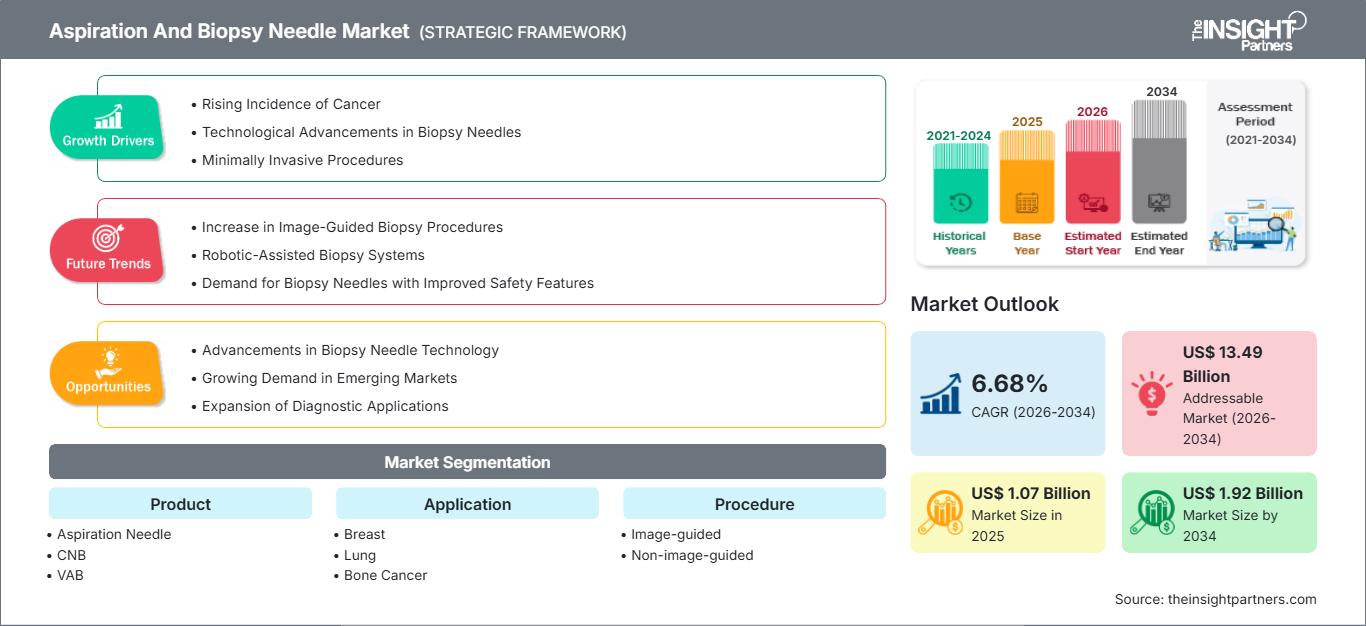
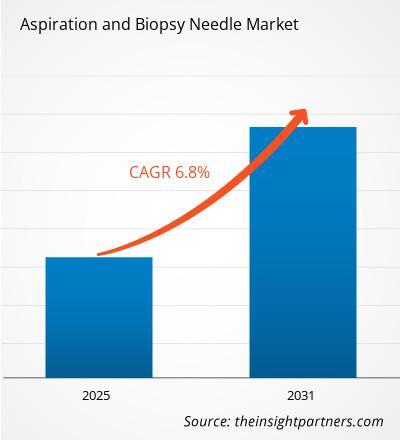
The aspiration and biopsy needle market was valued at US$ 1.07 Billion in 2025 and is projected to reach US$ 1.92 Billion by 2034, expanding at a CAGR of 6.68% during 2026–2034. The market consists of aspiration needles, core needle biopsy (CNB) devices, and vacuum-assisted biopsy (VAB) devices applied in breast, lung, and bone cancer applications. The growing trend towards minimally-invasive methods of tissue acquisition, image-guided biopsy, and improved specimen quality influences the design and use of the technology in major health care organizations.
North America drives the Aspiration and biopsy needle market size due to the high penetration of interventional radiology, cancer screening practices, and imaging-guided diagnostic procedures within the region. The projected regional CAGR of 6.3-6.8% in the period from 2026 to 2034 is driven by replacement needs, procedure growth, and the increased adoption of devices intended to improve sample precision and minimize re-procedures.
Aspiration and Biopsy Needle Market Assessment and Insights
- North America: North America is expected to represent a 34–38% share in 2025, supported by established biopsy infrastructure and high procedural volumes, while the region is projected to grow at a 6.3–6.8% CAGR between 2026–2034.
- US: The US is expected to account for 82–86% of North American revenue in 2025, with growth of 6.2–6.7% CAGR between 2026–2034, driven by oncology diagnostics and minimally invasive procedures.
- Europe: Europe is estimated at a 27–31% share in 2025, led by Germany, the UK, France, Italy, and Spain, with a 5.9–6.5% CAGR between 2026–2034 as hospitals expand precision-guided biopsy capabilities.
- Asia Pacific: Asia Pacific is projected to hold a 25–29% share in 2025, with China, Japan, South Korea, and India leading regional adoption and supporting a 7.0–7.6% CAGR between 2026–2034.
- Largest Segment: CNB is estimated to command a 44–48% market share in 2025, reflecting broad tissue-acquisition use, and is projected to expand at a 6.2–6.7% CAGR from 2026–2034.
- High Growth Segment: VAB is estimated at a 22–26% market share in 2025, supported by breast biopsy adoption, and is projected to record a 7.5–8.2% CAGR from 2026–2034.
- Key companies analyzed in detail: Medtronic, Becton, Dickinson and Company, Boston Scientific Corporation, Cook Medical, Hologic, Inc., Merit Medical Systems, Inc., Olympus Corporation, Stryker Corporation, Biopsybell, Smith+Nephew.
Source: The Insight Partners' analysis based on proprietary research, government publications, company annual reports, investor presentations, industry databases, and expert interviews.
Aspiration and biopsy needle market have shifted from traditional manual aspiration technology to more advanced technologies such as cutting geometry needles, spring core systems, vacuum assisted technology, and ultrasound, stereotactic, CT, and endoscopic needles. Key factors which will differentiate these products include specimen quality, needle flexibility, echogenicity, deployment, and compatibility with imaging systems. Manufacturing considerations will focus on disposable devices, precise machining, and reliable supply chain.
For the future, the Aspiration and biopsy needle market will enjoy favorable trends due to greater use of cancer diagnostic services in developing countries, outpatient services, and image-guided interventions. Regulation that emphasizes safe design and traceability of devices will advantage those manufacturers with validated production processes. Collaboration of device manufacturers, imaging system providers, and health care delivery organizations will be helpful where there is a lack of specialized biopsy experience.
Aspiration and Biopsy Needle Market Report Scope
| Report Attribute | Details |
|---|---|
| Market size in 2025 | US$ 1.07 Billion |
| Market Size by 2034 | US$ 1.92 Billion |
| Global CAGR (2026 - 2034) | 6.68% |
| Historical Data | 2021-2024 |
| Forecast period | 2026-2034 |
Aspiration and Biopsy Needle Market Analysis
The aspiration and biopsy needle market is enabled by a diagnostic process that starts with lesion identification and imaging, followed by needle selection, tissue sampling, pathology, and treatment planning. Cancer incidence, screening practices, procedural capacity, and availability of skilled clinicians have particular bearing on demand conditions. CNB procedures will continue to be used where preservation of tissue structure is necessary, while aspiration products will be important in cases where cytopathology and certain superficial or endoscopic procedures are desired.
For product providers along the value chain, competition takes place through tip design, materials, ergonomic qualities of the device, packaging, sterilization, and compatibility with other equipment used in procedures. Hospitals and ambulatory care clinics look increasingly at total procedure efficiency rather than cost per item. Thus, suppliers are those who can keep a steady gauge size, sharpness, sterility, and distribution capacity.
The aspiration and biopsy needle market report highlights competition for aspiration and biopsy needles is fragmented between diversified medical technology vendors and dedicated biopsy equipment providers. Medtronic, Becton, Dickinson and Company, Boston Scientific Corporation, Cook Medical, Hologic, Inc., Merit Medical Systems, Inc., Olympus Corporation, Stryker Corporation, Biopsybell, and Smith+Nephew operate within this market segment by deploying various combinations of soft tissue, breast, bone, endoscopic, and image-guided biopsies. Wide product portfolio and clinical presence are key sources of competitive advantage.
The focus of strategic positioning for leading companies becomes increasingly based on specimen adequacy, procedure control, safety, and compatibility with imaging workflow. In addition, acquisitions, new product development, and regional expansion are being utilized by companies to improve their portfolios. Development efforts are being made mostly in technologies enabling challenging anatomy access, large specimen size, low insertion force, and accurate sampling.
● REPORT CUSTOMIZATION
Tailor This Report To Align With Your Specific Business Requirements
This report can be customized to align precisely with your business objectives, scope, and target markets. Customization options include tailored segmentation, geography, competitive analysis, and strategic insights to support informed decision-making.
Customize This Report →WHAT YOU CAN ADJUST
- ● Segmentations
- ● Geography
- ● Competitive Analysis
- ● Language Preferences
Aspiration and Biopsy Needle Market: Strategic Insights
Regional Insights
North America Aspiration and biopsy needle market
North America is estimated to hold a 34–38% of the aspiration and biopsy needle market share in 2025 and is projected to expand at a 6.3–6.8% CAGR through 2034. The region benefits from extensive cancer screening, high availability of interventional radiology, established pathology networks, and broad use of image-guided procedures. The US remains the principal revenue contributor because of its large installed base of advanced imaging systems and high procedural intensity.
The regional demand in Canada is driven by central hospital procurement processes and adoption of minimally invasive diagnostics. Growth in this market will be driven by migration towards biopsy procedures done on an outpatient basis, where small disposable devices will allow for better standardization. Having the knowledge of reimbursement issues and the ability to enter into agreements with hospitals will give manufacturers an edge.
U.S. Aspiration and biopsy needle Market
The US is expected to contribute 82–86% of North American revenue in 2025 and is projected to grow at a 6.2–6.7% CAGR. Its market position reflects high oncology diagnostic activity, extensive breast screening, sophisticated imaging infrastructure, and established adoption of minimally invasive biopsy techniques across hospitals and outpatient centers.
Applications in breast, lungs, and bones create different demand patterns, and Hologic, Medtronic, Becton, Dickinson and Company, Boston Scientific Corporation, and Merit Medical Systems, Inc., have significant business presence. Growth is now more dependent on image guided procedures, quality specimen, and shift to out-patient environments. Thus, suppliers of devices are concentrating on procedure efficiency, specimen harvesting capacity, needle management, and integration with imaging processes.
Europe Aspiration and biopsy needle Market
In 2025, Europe is forecasted to account for 27-31% of the market share, with an estimated growth rate of 5.9-6.5% CAGR. Germany is the key country, backed by superior hospital infrastructure and procedure rates. The United Kingdom gains from cancer pathways and enhanced diagnosis capabilities. France, Italy, and Spain will make their contributions through imaging facilities and the development of minimally invasive procedures. Germany is set to grow at 6.0-6.5%, the United Kingdom at 5.8-6.4%, France at 5.7-6.3%, Italy at 5.6-6.2%, and Spain at 5.8-6.4%.
APAC Aspiration and biopsy needle Market
APAC is estimated at a 25–29% share in 2025 and is projected to record a 7.0–7.6% CAGR. China is the leading market, followed by Japan, South Korea, India, and Australia. Expanding oncology diagnosis, hospital modernization, broader access to imaging, and public investment in cancer care are supporting demand. China is expected to grow at 7.3–7.9%, while Japan, South Korea, India, and Australia are projected at 6.4–7.0%, 6.8–7.4%, 7.6–8.2%, and 6.5–7.1%, respectively.
Middle East & Africa Aspiration and biopsy needle Market
Middle East & Africa region is expected to grow at a 5.5-6.2% CAGR up to 2034 due to growth in hospital infrastructure and investments in oncology diagnostic solutions. Among them, Saudi Arabia and UAE are at the forefront, with South Africa being an important hub in the region for specialized diagnostics procedures. Growth in Saudi Arabia is expected to be in the range of 6.0-6.6%, UAE to be in the range of 6.1-6.7% and South Africa to be in the range of 5.2-5.8%.
Moreover, there are growing investments in advanced imaging systems, minimally invasive diagnostics devices, and oncology care path. Initiatives led by the government towards improvement of the healthcare system in the region, increasing investments in healthcare and initiatives towards early cancer detection have been driving hospitals towards upgrading their diagnostics capabilities and adopting specialized diagnostics procedures. Growing investments in medical cities, private healthcare systems, and referral centers in the region have been contributing positively to the market. Moreover, training programs for physicians and collaboration with medical technology companies from around the world would provide opportunities for growth up to 2034.
Segmentation Analysis
Product
The Product segment in the aspiration and biopsy needle market is projected to expand at a 6.3–6.9% CAGR from 2026–2034. Product selection depends on required specimen architecture, lesion accessibility, imaging modality, and clinician preference. CNB maintains broad use because it retrieves tissue cores, while aspiration needles remain valuable for cytological sampling. VAB is increasingly relevant where multiple specimens are needed through a single access point, particularly in breast procedures.
- Aspiration Needle: Aspiration needles retain strong relevance for cytological sampling and minimally invasive access. Their relatively simple design, broad gauge availability, and compatibility with several guidance methods support continued use across diagnostic workflows.
- CNB: CNB represents the largest product category because intact tissue architecture supports histopathological assessment. Demand remains strong across breast, lung, bone, and soft-tissue procedures requiring reliable core specimens.
- VAB: VAB systems provide repeated tissue acquisition through a single insertion and are strategically important for breast lesions. Adoption is supported by specimen volume, procedural consistency, and integration with image-guided biopsy platforms.
Application
The Application segment in the aspiration and biopsy needle market is expected to grow at a 6.4–7.0% CAGR during 2026–2034, reflecting differentiated biopsy requirements across cancer types. Breast procedures benefit from mature screening infrastructure, lung procedures from increased use of image-guided pulmonary diagnostics, and bone procedures from oncology and orthopedic applications requiring precise tissue acquisition.
- Breast: Breast biopsy represents a major application because organized screening programs generate substantial diagnostic follow-up volumes. Demand favors VAB and image-compatible systems designed for accurate lesion targeting.
- Lung: Lung biopsy demand is supported by growing requirements for tissue confirmation following imaging abnormalities. Needle flexibility, pneumothorax mitigation, and precise CT or ultrasound guidance influence product selection.
- Bone Cancer: Bone applications require robust penetration and controlled tissue retrieval, particularly for dense or difficult lesions. Product design increasingly emphasizes structural strength, depth control, and specimen integrity.
Procedure
The Procedure segment in the aspiration and biopsy needle market is forecast to grow at a 6.2–6.8% CAGR from 2026–2034. Image-guided procedures account for the larger opportunity because accurate lesion localization can improve targeting and reduce unnecessary sampling. Non-image-guided procedures continue to serve accessible lesions and settings where advanced imaging is unavailable or unnecessary.
- Image-guided: Image-guided procedures are strategically important for deep, small, or anatomically complex lesions. Compatibility with ultrasound, CT, MRI, stereotactic, and endoscopic guidance supports accurate targeting and broader procedural adoption.
- Non-image-guided: Non-image-guided procedures remain relevant for superficial and readily accessible lesions. Lower equipment requirements can support adoption in outpatient settings and healthcare systems with limited advanced imaging infrastructure.
End User
The End User segment in the aspiration and biopsy needle market is projected to grow at a 6.0–6.6% CAGR during 2026–2034. Hospitals retain the largest installed procedural base, while ambulatory surgical centers increasingly attract lower-complexity biopsy procedures. Academic institutions remain influential through clinical research, training, technology evaluation, and adoption of emerging biopsy techniques.
- Hospital: Hospitals represent the principal end-user group because they provide multidisciplinary oncology, radiology, pathology, and surgical services. Complex lesions and higher-acuity procedures continue to favor hospital-based biopsy infrastructure.
- ASC: ASCs are gaining relevance as reimbursement and clinical workflows support outpatient procedures. Their demand favors disposable systems that enable efficient preparation, shorter procedure times, and predictable supply.
- Academia: Academic institutions influence technology adoption through clinical research, training programs, and evaluation of novel biopsy approaches. Their purchasing decisions can shape broader clinician acceptance of emerging devices.
Opportunity Snapshot
| End User | Revenue Contribution | Trend Tag | Adoption Stage |
| Hospital | High | Complex Diagnostics | Mature |
| ASC | Medium | Outpatient Biopsy | Scaling |
| Academia | Low | Clinical Innovation | Emerging |
Aspiration and Biopsy Needle Market Growth Drivers and Impact Analysis
Increasing demand for minimally invasive cancer diagnosis
Tissue-based cancer diagnosis has become crucial prior to therapy selection, hence leading to an increasing need for biopsy needles in multiple clinical indications. Minimally invasive methods of sampling can be less demanding than invasive ones and could be done using radiology, gastroenterology, pulmonology, breast imaging, and orthopedic equipment. Commercial implications include not only the number of procedures but also a possibility of re-interventions due to insufficient tissue samples, which will lead to an increased cost and delay in the decision-making process regarding cancer therapy. This leads to an increasing trend of evaluating instruments based on the amount of collected samples, accuracy, controllability of insertion and complications' rate. It creates additional advantages for technological differentiation of needles rather than un-differentiated commodity items.
Expansion of image-guided and outpatient biopsy workflows
The increasing use of image-guided procedures is changing how biopsy services are organized across hospitals and ambulatory settings. Ultrasound, CT, stereotactic, MRI, and endoscopic guidance allow clinicians to target lesions that would be difficult to approach using conventional techniques. As more procedures move toward outpatient environments, suppliers face greater demand for sterile, disposable, easy-to-deploy devices that minimize setup complexity. This transition can increase utilization even when inpatient procedure volumes remain stable because diagnostic capacity becomes distributed across more facilities. The impact is particularly relevant for breast and lung applications, where imaging-guided targeting is central to procedural planning. Companies can benefit by optimizing needle flexibility, echogenicity, handle ergonomics, and compatibility with existing guidance platforms. Procurement teams are also likely to emphasize workflow efficiency and complication management when comparing competing products.
Rising importance of specimen adequacy for precision oncology
Precision oncology is increasing the diagnostic importance of obtaining tissue that is sufficiently representative for histological, immunohistochemical, and molecular assessment. This requirement favors devices capable of retrieving intact and adequately sized specimens while maintaining procedural control. The impact is especially pronounced when tissue is limited or lesions are located in anatomically challenging areas. Product development is consequently shifting toward advanced cutting geometries, improved needle-tip configurations, flexible shafts, and systems capable of obtaining multiple samples through controlled access. For manufacturers, specimen adequacy creates an opportunity to compete on clinical performance rather than price alone. Healthcare providers can potentially reduce repeat procedures and improve diagnostic workflow when the first intervention provides sufficient material for pathology and downstream testing. These considerations strengthen demand for differentiated CNB and VAB technologies.
Aspiration and Biopsy Needle Market Future Trends
Integration of biopsy devices with digital imaging workflows
Future development will increasingly connect biopsy needles with digital imaging and procedural planning platforms. Manufacturers are likely to prioritize systems that provide clearer visualization, predictable needle trajectories, and compatibility with increasingly sophisticated image-guidance environments. Software-assisted targeting may improve planning before needle deployment and support more consistent positioning during complex interventions. In breast procedures, integration with digital mammography and tomosynthesis can strengthen lesion localization, while endoscopic ultrasound applications may benefit from enhanced needle visibility and controlled access. The commercial opportunity will extend beyond the needle itself as suppliers develop integrated procedural ecosystems. Hospitals may increasingly evaluate devices according to their ability to connect imaging, sampling, specimen handling, and documentation. The aspiration and biopsy needle market trend could increase switching costs and strengthen competitive advantages for companies with broad imaging and interventional portfolios.
Greater emphasis on single-use precision and procedural standardization
Single-use biopsy technologies are likely to gain further attention as healthcare systems seek consistent procedural performance and simplified reprocessing requirements. Standardized disposable designs can reduce variation associated with reusable components while supporting predictable sterile preparation. Future products are expected to emphasize lighter handles, improved tactile feedback, controlled deployment, and optimized needle-tip geometry. These developments could be particularly valuable in high-volume outpatient environments where procedure turnover and infection-control requirements influence purchasing decisions. Manufacturers may also develop application-specific needles that are optimized for breast, lung, bone, or endoscopic procedures rather than relying on broadly configured devices. As clinical teams seek reproducible outcomes, product standardization may become an important purchasing criterion. Suppliers capable of demonstrating procedural consistency alongside cost efficiency are positioned to strengthen adoption across decentralized diagnostic networks.
Aspiration and Biopsy Needle Market Opportunities
Localized manufacturing and distribution in emerging markets
Emerging healthcare markets provide an opportunity for manufacturers to establish localized production, assembly, or distribution models for biopsy devices. Demand can expand as cancer screening, imaging availability, and specialist diagnostic capacity improve, but procurement remains sensitive to affordability and supply reliability. Localized inventory can shorten lead times and reduce dependence on imported products, particularly for frequently used needle gauges. Manufacturers can also create tiered portfolios that combine premium image-guided systems with cost-efficient products for high-volume applications. Partnerships with regional distributors, hospitals, and diagnostic networks can accelerate clinical training and improve product availability. India, Southeast Asia, Latin America, and selected Middle Eastern markets represent opportunities where expanding oncology infrastructure can support incremental procedural volumes. A localized commercial strategy can therefore improve market access while allowing suppliers to adapt product configurations to regional clinical and procurement requirements.
Specialized biopsy systems for difficult-to-access lesions
A further opportunity in the aspiration and biopsy needle market forecast exists in developing biopsy systems for lesions where conventional needle access is constrained by anatomy, lesion depth, tissue density, or proximity to critical structures. Demand for specialized solutions can increase as imaging detects smaller and more complex abnormalities earlier in the diagnostic pathway. Product developers can focus on flexible shafts, steerable components, improved cutting surfaces, depth-control mechanisms, and enhanced visualization characteristics. Bone lesions and anatomically challenging pulmonary or endoscopic targets are particularly suitable for application-specific innovation. Partnerships with interventional specialists can support iterative product design and clinical validation. Companies that establish differentiated solutions for difficult access may achieve stronger clinical positioning than suppliers competing primarily on standard needle specifications. The opportunity also supports premium pricing where improved procedural control can reduce repeat sampling or complication-related resource utilization.
Recent Developments
- August 2026: Hologic, Inc. received FDA 510(k) clearance for the Brevera 9G biopsy needle. The company stated that the clearance represents an important milestone toward the planned return of the Brevera Breast Biopsy System to the US market by the end of 2026. Hologic also reported actions to increase Eviva biopsy needle supply while supporting affected clinical workflows.
- January 2026: Becton, Dickinson and Company announced FDA 510(k) clearance for the EnCor EnCompass Breast Biopsy and Tissue Removal System. The multi-modality system was designed to provide clinicians with flexibility across breast imaging modalities, with commercial availability planned for early 2026. The development strengthens BD's breast biopsy portfolio and supports image-guided diagnostic workflows.
- October 2025: Olympus Corporation launched SecureFlex, a single-use fine needle biopsy device for endoscopic ultrasound-guided fine needle biopsy. The device was introduced in Europe and Japan, with subsequent global rollout subject to regulatory requirements. Its design targets larger, intact tissue specimens and difficult anatomical access, including pancreatic lesions.
Frequently Asked Questions

- Comprehensive Market Sizing and Forecast Analysis
- Detailed Segmentation Analysis
- In-Depth Market Dynamics Assessment
- Regional and Country-Level Insights
- Competitive Landscape and Company Benchmarking
- Strategic Business Intelligence
Recent Reports
Testimonials

The Insight Partners' SCADA System Market report is comprehensive, with valuable insights on current trends and future forecasts. The team was highly professional, responsive, and supportive throughout. We are very satisfied and highly recommend their services.
RAN KEDEM Partner, Reali Technologies LTDs
I requested a report on a very specific software market and the team produced the report in a few days. The information was very relevant and well presented. I then requested some changes and additions to the report. The team was again very responsive and I got the final report in less than a week.
JEAN-HERVE JENN Chairman, Future Analytica
We worked with The Insight Partners for an important market study and forecast. They gave us clear insights into opportunities and risks, which helped shape our plans. Their research was easy to use and based on solid data. It helped us make smart, confident decisions. We highly recommend them.
PIYUSH NAGPAL Sr. Vice President, High Beam Global
The Insight Partners delivered insightful, well-structured market research with strong domain expertise. Their team was professional and responsive throughout. The user-friendly website made accessing industry reports seamless. We highly recommend them for reliable, high-quality research services
YUKIHIKO ADACHI CEO, Deep Blue, LLC.
This is the first time I have purchased a market report from The Insight Partners.While I was unsure at first, I visited their web site and felt more comfortable to take the risk and purchase a market report.I am completely satisfied with the quality of the report and customer service. I had several questions and comments with the initial report, but after a couple of dialogs over email with their analyst I believe I have a report that I can use as input to our strategic planning process.Thank you so much for taking the extra time and making this a positive experience.I will definitely recommend your service to others and you will be my first call when we need further market data.
JOHN SUZUKI President and Chief Executive Officer, Board Director, BK Technologies
I wish to appreciate your support and the professionalism you displayed in the course of attending to my request for information regarding to infectious disease IVD market in Nigeria. I appreciate your patience, your guidance, and the fact that you were willing to offer a discount, which eventually made it possible for us to close a deal. I look forward to engaging The Insight Partners in the future, all thanks to the impression you have created in me as a result of this first encounter.
DR CHIJIOKE ONYIA MANAGING DIRECTOR, PineCrest Healthcare Ltd.Reason to Buy
- Informed Decision-Making
- Understanding Market Dynamics
- Competitive Analysis
- Identifying Emerging Markets
- Customer Insights
- Market Forecasts
- Risk Mitigation
- Boosting Operational Efficiency
- Strategic Planning
- Investment Justification
- Tracking Industry Innovations
- Aligning with Regulatory Trends





 Get Free Sample for