
Audiology Devices Market Growth, Trends & Demand by 2034
Coverage: By Product Type (Hearing Aids, Cochlear Implants, BAHA/BAHS, Diagnostic Devices); Technology (Digital, Analog); Sales Channel (Retail Sales, Government Purchases, E-commerce) , and Geography (North America, Europe, Asia Pacific, and South and Central America)
- Status : Data Released
- Report Code : TIPRE00007054
- Category : Life Sciences
- No. of Pages : 150
- Available Report Formats :


- Last update date : September 15, 2026


2025 Market Size
US$ 10.95 Bn
Base year value
2034 Forecast
US$ 17.46 Bn
Projected by 2034
CAGR 2026-2034
6.01 %
Growth rate
Addressable Market
US$ 133.45 Bn
(2026-2034)
The Audiology Devices Market is US$ 10.95 Billion in 2025 and forecast to reach US$ 17.46 Billion by 2034 registering a CAGR of 6.01% in 2026 to 2034. Market growth will be fueled by increasing hearing loss awareness, advancements in digital signal processing technology, adoption of implantable technology, and improved access to hearing care among developed and developing healthcare infrastructure. Product innovations focus on connectivity, miniaturization, personalization, and integration within the digital health eco-systems.
The North American Audiology Devices Market Size will continue to remain structurally favorable for the industry due to presence of existing audiologic infrastructure, high rates of diagnosis and treatment, insurance and government reimbursement frameworks, and increased consumer acceptance of technology-driven hearing care solutions. The region will be driven by direct consumer sales channels and ongoing developments in wireless, artificial intelligence, and remotely programmable hearing technologies.
Audiology Devices Market Assessment and Insights
- North America: North America represented approximately 38–42% share in 2025 and is expected to expand at a 5.5–6.5% CAGR between 2026–2034, supported by mature hearing-care infrastructure, reimbursement availability, replacement demand, and digital fitting adoption.
- US: The US accounted for approximately 32–35% share in 2025 and is projected to grow at a 5.5–6.5% CAGR between 2026–2034, supported by broad provider networks and consumer access.
- Europe: Europe held approximately 27–30% share in 2025 and is expected to record a 5.0–6.0% CAGR between 2026–2034. Germany, the UK, France, Italy, and Spain remain important markets because of established clinical networks and public or social reimbursement systems.
- Asia Pacific: Asia Pacific represented approximately 20–23% share in 2025 and is expected to grow at a 7.0–8.0% CAGR between 2026–2034. China, Japan, South Korea, India, and Australia are leading demand centers as diagnosis and specialist capacity expand.
- Largest Segment: Hearing Aids represented approximately 62–66% market share in 2025 and are expected to grow at a 5.5–6.5% CAGR during 2026–2034, retaining category leadership.
- High Growth Segment: Cochlear Implants represented approximately 12–15% market share in 2025 and are expected to expand at a 7.0–8.0% CAGR during 2026–2034, driven by broader candidacy and pediatric intervention.
- Key companies analyzed in detail: Demant A/S, GN Store Nord A/S, Sonova Holding AG, Starkey Laboratories, Inc., Siemens AG, WS Audiology A/S, MAICO Diagnostics GmbH, Natus Medical Incorporated, MED-EL Elektromedizinische Geräte Gesellschaft m.b.H., and MedRx, Inc.
Source: The Insight Partners' analysis based on proprietary research, government publications, company annual reports, investor presentations, industry databases, and expert interviews.
The audiology devices market has developed from an analog amplifier to digital, wireless and software-enabled platforms. Modern hearing aids include noise management technology, directionality features, Bluetooth technology, recharging battery, and control via smartphones. In addition, diagnostic devices have become digital. Manufacturing trends are moving towards modular electronics, specialized acoustic parts, miniature batteries, software differentiators and scalable manufacturing processes.
During the forecast period, the market for audiology devices is expected to benefit from increased diagnosis in developing countries, increased pediatric hearing screening, better availability of cochlear implant procedures, and increased investment in connected hearing platforms. The market will benefit from the approval of new types of devices, development of tele-audiology infrastructure, and healthcare IT. Regional distribution agreements, clinical training, and device design will also be considered by manufacturers during the forecast period.
Audiology Devices Market Report Scope
| Report Attribute | Details |
|---|---|
| Market size in 2025 | US$ 10.95 Billion |
| Market Size by 2034 | US$ 17.46 Billion |
| Global CAGR (2026 - 2034) | 6.01% |
| Historical Data | 2021-2024 |
| Forecast period | 2026-2034 |
Audiology Devices Market Analysis
Demand is driven by the presence of age-related hearing impairment, greater awareness of hearing loss, occupational hearing risk, and better diagnostics. The value chain includes component makers, hearing aid makers, software companies, distribution channels, audiologists, ENT doctors, hearing aid sellers, hospitals, and end users. Replacement schedules generate demand for repeat purchases, whereas technology advances spur premiumization. Supply of hearing products is consolidated amongst specialty manufacturers with significant capabilities in engineering, clinical, regulatory, and logistics.
As for supply side, the manufacture of hearing aids involves electronic components, acoustic transducers, batteries, connectivity components, software, and fitting systems. For cochlear implants, there are implantable electronics, electrodes, surgical tools, and clinical programming systems to be added. Diagnostic equipment involves sensors, audiometric equipment, software, and accessories. It is therefore no surprise that hearing product manufacturing economics benefit firms with engineering economies combined with clinical and regulatory capabilities.
Increasingly, competition within the Audiology Devices Market report center around differentiated signal processing, artificial intelligence, connectivity, fitting precision, experience for patients, and product breadth. Demant A/S, Sonova Holding AG, WS Audiology A/S, GN Store Nord A/S, and Starkey Laboratories, Inc. all compete actively in the field of hearing aids, whereas MED-EL Elektromedizinische Geräte Gesellschaft m.b.H. occupies a unique niche in implantable hearing aids. Engineering capability is provided by Siemens AG and others who bring a technological focus to the business, and diagnostics capability comes from Natus Medical Incorporated, MAICO Diagnostics GmbH, and MedRx, Inc.
The strategic emphasis is now turning towards software, remote fitting, connected devices, clinical integration of data, and interoperable ecosystems. The deal signed in March 2026 under which GN Store Nord A/S agreed to sell its Hearing business to Amplifon for DKK 17.0 billion demonstrates the ongoing interest in merging hearing technology with hearing care.
● REPORT CUSTOMIZATION
Tailor This Report To Align With Your Specific Business Requirements
This report can be customized to align precisely with your business objectives, scope, and target markets. Customization options include tailored segmentation, geography, competitive analysis, and strategic insights to support informed decision-making.
Customize This Report →WHAT YOU CAN ADJUST
- ● Segmentations
- ● Geography
- ● Competitive Analysis
- ● Language Preferences
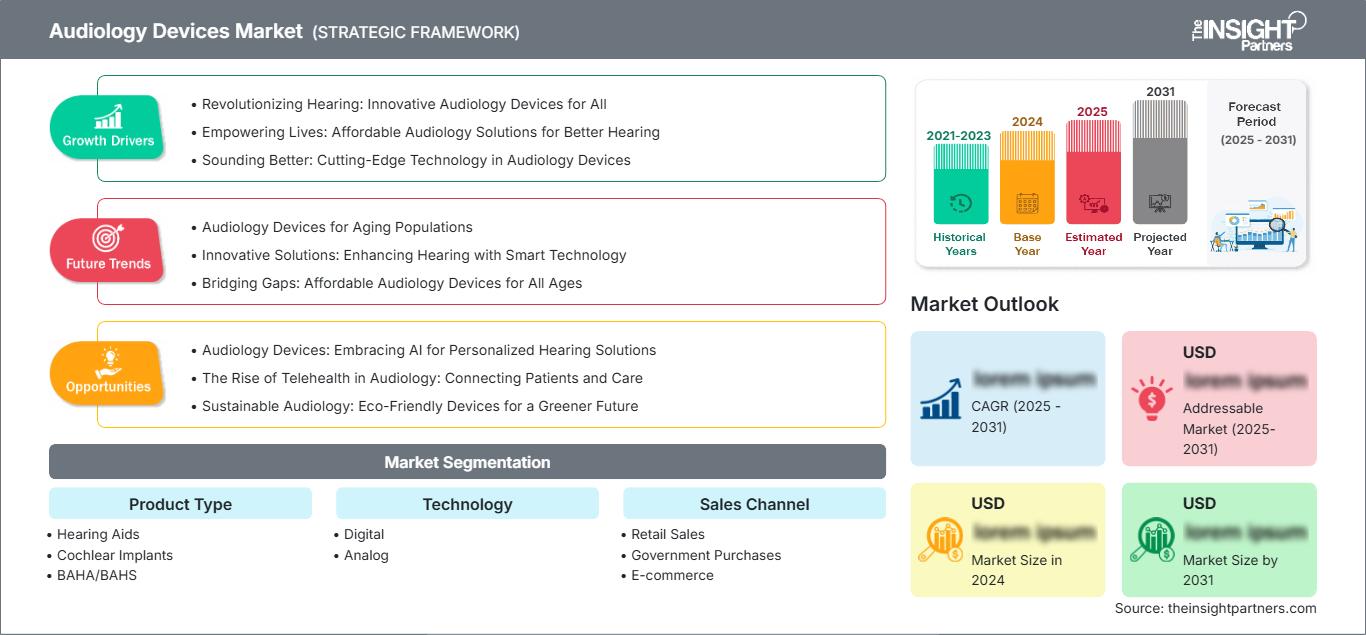
Audiology Devices Market: Strategic Insights
Regional Insights
North America audiology devices market
North America has captured around 38-42% share in the audiology devices market in 2025 and will continue growing with 5.5-6.5% CAGR until 2034. Demand from the US accounts for a majority due to the presence of strong audiology and ENT networks, higher device replacements, private insurance coverages, clinical pathways associated with Medicare, and knowledge about modern hearing devices among consumers.
Furthermore, the growth of the regional market is driven by the use of direct to consumer hearing pathways, tele-audiology services, connectivity and smartphone-based fitting. The manufacturers are focusing on rechargeable platforms, artificial intelligence, speech processing and personalization of the devices. The United States holds approximately 83-86% of the revenue in North America, while Canada holds the rest of regional demand.
U.S. audiology devices Market
The U.S. audiology devices market constitutes about 83% to 86% of North America's revenue and is estimated to exhibit a compound annual growth rate of 5.5% to 6.5% till 2034. The country has good audiology clinics, ENT specialists, hospitals, specialized retailers, and manufacturer presence. Hearing aids constitute the major share of devices, followed by cochlear implants and diagnostics for high-acuity applications.
Growing application areas include remote programming, Bluetooth connectivity, rechargeability, artificial intelligence-based speech processing, and custom fitting. The key competition in this industry includes Demant A/S, Sonova Holding AG, GN Store Nord A/S, Starkey Laboratories, Inc., and MED-EL Elektromedizinische Geräte Gesellschaft m.b.H. Ongoing regulatory updates with regard to access by consumers and product classification affect the channel economics and manufacturers' positioning.
Europe audiology devices Market
The Europe region accounted for around 27-30% of the total market share of the audiology devices market during 2025 and is expected to grow at a CAGR of 5.0-6.0% during 2024-2034. Germany represents an important market owing to the presence of a well-established hearing care system and reimbursement policies. The UK accounts for significant demand via public health system whereas France, Italy and Spain leverage their aging population and specialty services.
Germany represents a developed fitting professionals network and a developed replacement market which allows the penetration of high-end digital hearing aids and diagnostic instruments. The UK derives benefits from large scale public purchase and increasing demand for technologically advanced devices. France, Italy and Spain represent both private and public care channels wherein adoption depends on factors such as reimbursement, cost-effectiveness, specialty doctors and geographic reach.
APAC audiology devices Market
APAC accounted for 20% to 23% of the overall audiology device market in 2025 and would record a CAGR of 7.0% to 8.0% until 2034. China drives regional demand, followed by Japan, South Korea, India, and Australia. The growth is driven by the factors including aging population, better diagnostic capability, specialized training, awareness, and investments in healthcare facilities.
China has seen an expansion of its urban healthcare facilities, while Japan has age-based hearing needs. South Korea will benefit from the adoption of advanced healthcare technologies, India from growing diagnosis, and Australia has access to specialized healthcare services. The focus on hearing tests and rehabilitation is boosting the patient population, while regional distribution channels and affordable product lines are becoming key.
Middle East & Africa audiology devices Market
MEA demands are relatively smaller but growing due to healthcare facility upgrades. In Saudi Arabia and UAE, there are investments in specialized hospitals, diagnostics, and medical technology which makes these two countries the pioneers in terms of adoption in the region. In South Africa, private audiology services and specialist clinics still represent significant opportunities; whereas other MEA countries will rely on public tenders and imported devices.
In terms of growth potential, 5.0%-6.0% CAGR till 2034 can be expected driven by healthcare infrastructure upgrades, specialist centers, and diagnostics investments. In the region, Saudi Arabia can be viewed as a key market whereas UAE is considered to be a key technology adoption country. With further infrastructure development, device imports, and focus on accessible hearing rehabilitation, penetration will be improved over time in underpenetrated markets.
Segmentation Analysis
Product Type
The Product Type segment is expected to expand at a 5.5–6.5% CAGR during 2026–2034. Hearing aids remain the primary revenue contributor because of broad patient eligibility and recurring replacement demand. Cochlear implants and BAHA/BAHS benefit from clinical innovation, while diagnostic devices remain essential to screening, assessment, fitting, and follow-up workflows.
- Hearing Aids: The dominant category serves mild to profound hearing loss and benefits from digital processing, rechargeable designs, connectivity, miniaturization, and replacement demand across aging populations.
- Cochlear Implants: Demand is supported by expanding clinical candidacy, pediatric intervention, improved speech outcomes, and advances in implant design, audio processing, connectivity, and surgical techniques.
- BAHA/BAHS: Bone-conduction systems address conductive, mixed, and selected single-sided hearing-loss applications, with demand supported by minimally invasive options and improved patient-specific fitting.
- Diagnostic Devices: Audiometers, tympanometers, screening systems, and related equipment remain essential for detection and clinical decision-making, with demand increasingly influenced by digital workflow integration.
Technology
The Technology segment in the Audiology Devices Market is expected to grow at a 5.5–6.5% CAGR during 2026–2034. Digital technology remains structurally dominant because programmable processing, wireless communication, adaptive noise management, and software-based fitting offer advantages over legacy analog architectures.
- Digital: Digital platforms dominate professional and consumer applications through programmable processing, wireless connectivity, rechargeable operation, smartphone integration, and increasingly sophisticated software-enabled personalization.
- Analog: Analog systems retain limited demand in price-sensitive and replacement markets, but their strategic importance is declining as consumers and clinicians increasingly favor programmable digital functionality.
Sales Channel
The Sales Channel segment in the Audiology Devices Market is projected to grow at a 5.5–6.5% CAGR during 2026–2034. Channel economics are increasingly shaped by consumer convenience, reimbursement, clinical fitting requirements, and manufacturer relationships with professional providers.
- Retail Sales: Specialist hearing retailers and clinics remain important because hearing assessment, fitting, counseling, after-sales servicing, and device adjustment require professional involvement.
- Government Purchases: Public procurement supports access in countries where hearing rehabilitation is funded through national or regional healthcare programs, particularly for pediatric and institutional applications.
- E-commerce: Online channels are expanding product discovery and accessory purchases while increasingly supporting selected hearing devices, although clinical assessment and fitting requirements constrain full digital substitution.
Opportunity Snapshot
| Segments | Revenue Contribution | Trend Tag | Adoption Stage |
|---|---|---|---|
| Hearing Aids | High | AI Fitting | Mature |
| Cochlear Implants | Medium | Pediatric Access | Scaling |
| BAHA/BAHS | Medium | Bone Conduction | Scaling |
| Diagnostic Devices | Medium | Digital Audiometry | Mature |
| Digital | High | Wireless Connectivity | Mature |
| Analog | Low | Basic Amplification | Mature |
| Retail Sales | High | Clinic Integration | Mature |
| Government Purchases | Medium | Public Procurement | Scaling |
| E-commerce | Medium | Remote Commerce | Scaling |
Audiology Devices Market Growth Drivers and Impact Analysis
Rising Prevalence and Earlier Identification of Hearing Loss
Growing awareness of untreated hearing loss is expanding the diagnosed population and encouraging earlier intervention. Aging demographics are particularly important because age-related hearing impairment increases the need for amplification, diagnostic testing, and rehabilitation. Pediatric screening programs create an additional pathway by identifying congenital or early-onset hearing loss before communication delays become entrenched. Earlier diagnosis can increase lifetime device utilization because patients may enter structured care sooner and require subsequent upgrades or replacements. For manufacturers, the commercial implication is a broader addressable population rather than dependence solely on severe cases. Providers are consequently investing in screening capacity, referral networks, and patient education, while manufacturers increasingly design products for different severity levels, lifestyles, connectivity requirements, and affordability profiles.
Advances in Wireless, Artificial Intelligence, and Digital Signal Processing
Technological development is increasing the functional value of hearing devices beyond basic sound amplification. Wireless streaming, adaptive noise suppression, directional microphones, rechargeable batteries, motion-based processing, and software-enabled personalization are improving usability in complex acoustic environments. Artificial intelligence is increasingly applied to classify sound environments and prioritize speech, creating differentiation between premium and standard products. Connectivity also allows devices to interact with smartphones, televisions, remote-care platforms, and accessibility applications. These capabilities can support higher-value product tiers and encourage replacement when users perceive meaningful performance improvements. Manufacturers with strong software engineering, signal-processing expertise, clinical validation, and ecosystem partnerships are therefore better positioned to capture premium demand and defend margins as hardware components become progressively commoditized.
Expansion of Specialist Infrastructure and Reimbursement Pathways
Investment in audiology clinics, ENT facilities, diagnostic centers, and public hearing programs is improving access to devices, particularly in emerging economies. Infrastructure expansion reduces a major adoption constraint because hearing technologies require diagnosis, fitting, counseling, rehabilitation, and follow-up. Reimbursement also influences device selection and replacement behavior by reducing patient out-of-pocket expenditure. Countries expanding pediatric screening or subsidized rehabilitation can create stronger demand for hearing aids, cochlear implants, and diagnostic equipment. For suppliers, these developments create opportunities to establish local distributor networks, train clinicians, participate in institutional procurement, and introduce products at multiple price points. The resulting market effect is a gradual shift from sporadic device purchases toward more structured hearing-care pathways with recurring clinical and replacement demand.
Audiology Devices Market Future Trends
AI-Enabled Personalized Hearing Experiences
Artificial intelligence is expected to move from a premium feature toward a broader design principle across hearing devices. Future platforms are likely to use continuous environmental recognition, user behavior, speech separation, and contextual learning to automatically optimize sound output. Instead of relying primarily on clinician-selected presets, devices could increasingly combine fitting data with real-world listening patterns to refine personalization. Manufacturers may also use anonymized performance data to improve algorithms and identify product-development priorities. This Audiology Devices Market trends will increase the importance of software architecture, data governance, cybersecurity, and computing efficiency. Companies able to integrate algorithm development with clinical validation should gain stronger differentiation, while providers may increasingly evaluate devices according to measurable real-world speech performance and patient adherence rather than hardware specifications alone.
Convergence of Hearing Devices and Digital Health Platforms
The boundary between audiology hardware and digital healthcare is expected to become increasingly fluid. Future devices may connect continuously with smartphones, tele-audiology platforms, electronic health records, remote monitoring systems, and accessibility services. This convergence can enable remote adjustments, adherence monitoring, software updates, virtual consultations, and earlier identification of declining device performance. It may also allow manufacturers and providers to establish longer patient relationships beyond the initial sale. Commercial models could increasingly include software services, subscription-supported features, connected accessories, and remote professional support. Interoperability will therefore become strategically important because consumers are likely to favor ecosystems that work across communication devices and healthcare platforms. Regulatory and cybersecurity requirements will remain important considerations as connectivity expands.
Audiology Devices Market Opportunities
Expansion into Underserved Emerging Hearing-Care Markets
Emerging economies provide substantial whitespace where hearing-loss diagnosis remains constrained by limited specialist availability, affordability barriers, and uneven infrastructure. Manufacturers can address these markets through tiered product portfolios, localized distribution, portable diagnostic systems, clinician training, and partnerships with hospitals or public-health programs. Lower-cost digital hearing aids can broaden access without relying exclusively on legacy analog architectures. Companies can also combine remote support with regional clinical networks to reduce follow-up costs. India, Southeast Asia, Latin America, and selected Middle Eastern markets offer opportunities for manufacturers that can adapt pricing, service models, and product specifications to local conditions. Strategic success will depend on balancing affordability with reliability, professional support, regulatory compliance, and sustainable distribution economics.
Integrated Implant and Hearing-Aid Ecosystems
A significant opportunity in the Audiology Devices Market forecast lies in creating coordinated solutions for patients who use different technologies across their ears or treatment journey. Partnerships between hearing-aid and implant manufacturers can enable synchronized streaming, shared connectivity standards, and simplified user experiences. MED-EL and Starkey demonstrated this direction through their DualSync collaboration, which enables compatible hearing aids and cochlear implant processors to stream Apple-device audio together. Similar ecosystem strategies can increase switching costs, strengthen patient loyalty, and create differentiation beyond individual device specifications. Manufacturers can also pursue joint clinical education, interoperable applications, and coordinated fitting workflows. Such approaches could improve the experience for bimodal users while opening partnership opportunities across previously separate product categories.
Recent Developments
- February 2026: GN Store Nord A/S unveiled new ReSound hearing aids and fitting solutions, including custom In-the-Canal and Completely-In-Canal styles, Auracast broadcast audio capability, and an updated ReSound Smart Fit platform incorporating NAL-NL3 support. The company positioned these developments around improved accessibility, connectivity, fitting precision, and professional workflow efficiency.
- December 2025: MED-EL Elektromedizinische Geräte Gesellschaft m.b.H. received US FDA approval for an expanded cochlear implant indication covering children seven months and older with bilateral sensorineural hearing loss. The approval expands access to implantation at an earlier age and is supported by clinical evidence involving 123 children.
- May 2026: Sonova Holding AG reported FY2025/26 sales of CHF 3,605.9 million, representing 5.9% growth in local currencies. The company reported continued market outperformance and improved profitability, reflecting sustained demand across its hearing solutions portfolio and continued investment in its global hearing-care platform.
Frequently Asked Questions

- Comprehensive Market Sizing and Forecast Analysis
- Detailed Segmentation Analysis
- In-Depth Market Dynamics Assessment
- Regional and Country-Level Insights
- Competitive Landscape and Company Benchmarking
- Strategic Business Intelligence
Recent Reports
Testimonials

The Insight Partners' SCADA System Market report is comprehensive, with valuable insights on current trends and future forecasts. The team was highly professional, responsive, and supportive throughout. We are very satisfied and highly recommend their services.
RAN KEDEM Partner, Reali Technologies LTDs
I requested a report on a very specific software market and the team produced the report in a few days. The information was very relevant and well presented. I then requested some changes and additions to the report. The team was again very responsive and I got the final report in less than a week.
JEAN-HERVE JENN Chairman, Future Analytica
We worked with The Insight Partners for an important market study and forecast. They gave us clear insights into opportunities and risks, which helped shape our plans. Their research was easy to use and based on solid data. It helped us make smart, confident decisions. We highly recommend them.
PIYUSH NAGPAL Sr. Vice President, High Beam Global
The Insight Partners delivered insightful, well-structured market research with strong domain expertise. Their team was professional and responsive throughout. The user-friendly website made accessing industry reports seamless. We highly recommend them for reliable, high-quality research services
YUKIHIKO ADACHI CEO, Deep Blue, LLC.
This is the first time I have purchased a market report from The Insight Partners.While I was unsure at first, I visited their web site and felt more comfortable to take the risk and purchase a market report.I am completely satisfied with the quality of the report and customer service. I had several questions and comments with the initial report, but after a couple of dialogs over email with their analyst I believe I have a report that I can use as input to our strategic planning process.Thank you so much for taking the extra time and making this a positive experience.I will definitely recommend your service to others and you will be my first call when we need further market data.
JOHN SUZUKI President and Chief Executive Officer, Board Director, BK Technologies
I wish to appreciate your support and the professionalism you displayed in the course of attending to my request for information regarding to infectious disease IVD market in Nigeria. I appreciate your patience, your guidance, and the fact that you were willing to offer a discount, which eventually made it possible for us to close a deal. I look forward to engaging The Insight Partners in the future, all thanks to the impression you have created in me as a result of this first encounter.
DR CHIJIOKE ONYIA MANAGING DIRECTOR, PineCrest Healthcare Ltd.Reason to Buy
- Informed Decision-Making
- Understanding Market Dynamics
- Competitive Analysis
- Identifying Emerging Markets
- Customer Insights
- Market Forecasts
- Risk Mitigation
- Boosting Operational Efficiency
- Strategic Planning
- Investment Justification
- Tracking Industry Innovations
- Aligning with Regulatory Trends





 Get Free Sample for