
Autolytic Debridement Products Market Trends, Demand & Growth by 2034
Coverage: By Product (Gels, Ointments); Wound Type (Diabetic foot ulcers, Pressure ulcers, Venous leg ulcers, Surgical and trauma wounds, Burns, Other wounds); End User (Hospitals, Clinics, Other), and Geography (North America, Europe, Asia Pacific, and South and Central America)
- Status : Data Released
- Report Code : TIPRE00018818
- Category : Life Sciences
- No. of Pages : 150
- Available Report Formats :


- Last update date : November 02, 2026


2025 Market Size
US$ 1.33 Bn
Base year value
2034 Forecast
US$ 2.56 Bn
Projected by 2034
CAGR 2026-2034
7.55 %
Growth rate
Addressable Market
US$ 17.53 Bn
(2026-2034)
The autolytic debridement products market is valued at US$ 1.33 Billion in 2025 and is projected to reach US$ 2.56 Billion by 2034, expanding at a CAGR of 7.55% during 2026–2034. The market covers gels and ointments used to support removal of non-viable tissue across diabetic foot ulcers, pressure ulcers, venous leg ulcers, surgical and trauma wounds, burns, and other wounds, with hospitals and clinics representing the principal end-user settings.
The autolytic debridement products market size is supported by the increasing prevalence of chronic wounds, wider emphasis on wound-bed preparation, and greater use of conservative debridement approaches where selective tissue removal and patient tolerance are important. North America is modeled to expand at a CAGR of ~8% through 2034, supported by advanced wound-care infrastructure, established reimbursement pathways, and broad availability of specialized wound-management products.
Autolytic Debridement Products Market Assessment and Insights
Regional Outlook
- North America: ~42% of the global autolytic debridement products market share in 2025 | ~8% CAGR through 2034. Market position: North America holds the largest regional position, supported by advanced wound-care infrastructure, established chronic wound management pathways, specialist clinician availability, and comparatively high adoption of advanced topical products.
- US: ~87% of North American market revenue in 2025 | ~8% CAGR through 2034. Market position: The US represents the principal country market within North America, supported by a large wound-care provider network, established product reimbursement, extensive diabetes care, and strong supplier presence across advanced wound management.
- Europe: ~29% of the global market in 2025 | ~8% CAGR through 2034. Market position: Europe has a mature wound-care ecosystem and broad use of moist wound-management approaches. Germany represents the leading country in Europe, supported by healthcare infrastructure, specialist wound services, and medical-device manufacturing capabilities.
- Asia Pacific: ~22% of the global market in 2025 | ~10% CAGR through 2034. Market position: Asia Pacific is the fastest-growing region, supported by expanding healthcare access, rising chronic disease burden, improving wound-care infrastructure, and increasing availability of advanced dressings and topical debridement products.
Segment Outlook
- Product: ~100% Share in 2025 | ~8% CAGR through 2034. Market position: Product is the core revenue classification because the market is defined by topical gels and ointments used to facilitate autolytic tissue removal. Demand is supported by recurring wound-management requirements and broad clinical applicability.
- Wound Type: ~100% Share in 2025 | ~9% CAGR through 2034. Market position: Wound Type has the strongest growth outlook as chronic diabetic, pressure, and venous wounds require repeated wound-bed preparation. Increasing emphasis on selective and less invasive debridement supports continued product utilization.
Competitive Coverage
Smith+Nephew, B. Braun Melsungen AG, ConvaTec Group Plc, Mölnlycke Health Care AB, Coloplast A/S, Lohmann & Rauscher GmbH & Co. KG, Integra LifeSciences Holdings Corporation, Medline Industries, LP, PAUL HARTMANN AG, MediWound Ltd.
Methodology
The Insight Partners follows Data Collection & Secondary Research, Primary Research, Data Analysis, and Data Triangulation & Final Review to validate market estimates and insights.
Source: The Insight Partners' analysis based on proprietary research, government publications, company annual reports, investor presentations, industry databases, and expert interviews.
Topical wound-bed preparation has increasingly centered on moisture balance, targeted devitalized tissue removal, and dressing compatibility. Hydrogels, moisture-enhancing dressings, and topical ointments permit the medical professional to aid in utilizing the body’s natural tissue-debridement process, rather than employing solely sharp or surgical debridement methods. The focus of manufacturers has thus shifted to developing dressings and formulations that maintain correct wound bed moisture, manage exudate, and protect periwound tissue. These changes have also made the use of dressings for this application increasingly important.
Future growth will be based on the growing importance of chronic wounds, as well as greater spending on healthcare services outside the traditional western markets. Asia Pacific has particularly good prospects for growth due to the development of diabetes care services, wound clinics, and hospital infrastructure. Future regulations that emphasize clinical evidence, safety, wound-care protocol, and treatment outcome will also impact the market. Portfolio-based suppliers that offer products that help at different stages of treatment pathway, as well as focused companies, will have a competitive advantage.
Autolytic Debridement Products Market Report Scope
| Report Attribute | Details |
|---|---|
| Market size in 2025 | US$ 1.33 Billion |
| Market Size by 2034 | US$ 2.56 Billion |
| Global CAGR (2026 - 2034) | 7.55% |
| Historical Data | 2021-2024 |
| Forecast period | 2026-2034 |
Autolytic Debridement Products Market Analysis
The autolytic debridement products market is highly dependent on the requirement for controlled wound bed preparation in patients with chronic wounds or those that are difficult to heal. Patients with diabetes, immobility, venous disease, surgical wounds or trauma may have wounds with necrotic tissue or slough preventing healing. Autolytic techniques use a moist wound environment and the endogenous enzymes to slowly debride the dead tissue. This makes it applicable where a non-invasive technique, comfort or compatibility with dressing changes is prioritized. The supply chain in this market includes formulation developers, dressing manufacturers, pharmaceutical and medical device suppliers, contract manufacturers, distributors, hospitals, specialist clinics and community wound care providers.
Competitive advantage in supply dynamics will be available to firms capable of combining expertise in formulation with expertise in wound dressings and secondary dressings. Product performance is determined by many aspects including ability to retain moisture, viscosity, application properties, contact with the wound bed, absorption of exudates, stability, packaging and removal. As such, competition is not only on the formulation of the product but also on its compatibility with the wound care regimen.
Autolytic Debridement Products Market report reveals competitive market environment involving diversified wound care providers and niche providers specializing in tissue debridement. Smith+Nephew is involved in hydrogels, advanced wound care, bioactives, and debridement technology, while Coloplast and Mölnlycke Health Care have broad portfolio of products covering dressings and wound bed preparation. Additional competition from such wound management products providers as ConvaTec, B. Braun Melsungen AG, Lohmann & Rauscher GmbH & Co. KG, PAUL HARTMANN AG; and more broadly in terms of their clinical and wound care portfolios - Integra LifeSciences Holdings Corporation and Medline Industries, LP. MediWound Ltd. appears to have specialized development-oriented market positioning.
Market investments will increasingly be oriented towards clinical evidence, differentiation, wound types diversification and integration with advanced wound care solutions. Development programs of such players as MediWound Ltd. illustrate that debridement can be used as a standalone therapy rather than a characteristic of a dressing. While existing vendors can rely on their clinical relationships and distribution network, niche vendors can use clinical evidence and unique debridement technology as competitive advantages. Therefore, strategic positioning will involve demonstrating tangible wound bed advantages at affordable cost and simple clinical workflow.
● REPORT CUSTOMIZATION
Tailor This Report To Align With Your Specific Business Requirements
This report can be customized to align precisely with your business objectives, scope, and target markets. Customization options include tailored segmentation, geography, competitive analysis, and strategic insights to support informed decision-making.
Customize This Report →WHAT YOU CAN ADJUST
- ● Segmentations
- ● Geography
- ● Competitive Analysis
- ● Language Preferences
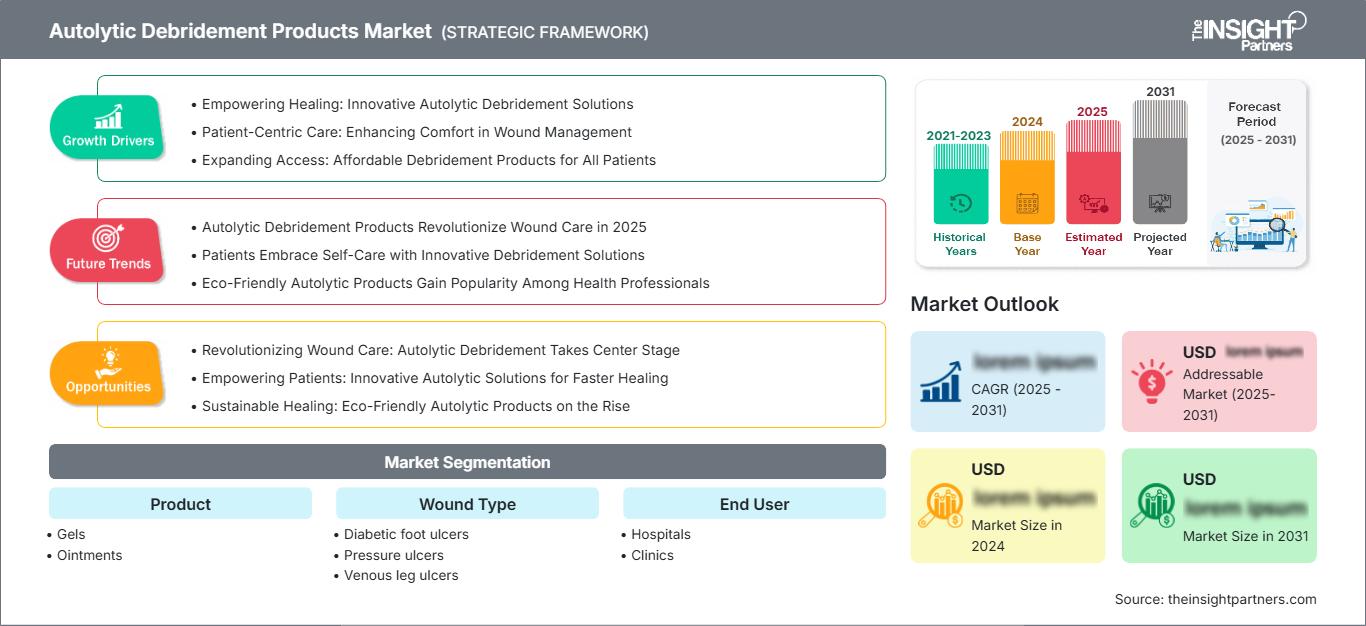
Autolytic Debridement Products Market: Strategic Insights
Regional Insights
North America autolytic debridement products market
North America represented ~42% of the global autolytic debridement products market in 2025 and is modeled to grow at ~8% CAGR through 2034. Its geographic positioning is a result of an advanced wound care infrastructure, large number of hospitals and clinics, adoption of advanced dressings, and emphasis on chronic wounds. In terms of geography, the United States represents about 87% of North America revenues, with additional demand coming from Canada via hospitals and community-based channels for wound care. Additionally, there is a favorable environment created by suppliers. Smith+Nephew offers a wide range of wound care products including hydrogels and debriding agents, whereas other large companies within the wound care space offer moisture balancing and wound bed preparation products. Chronic wounds drive the demand, including diabetic foot ulcers, pressure ulcers, and venous leg ulcers. The adoption is driven by the preference of clinicians, reimbursement needs, evidence, and combination of autolytic products with secondary dressings, compression, offloading, infection control, etc.
U.S. autolytic debridement products market
The US represents ~87% of North American autolytic debridement products market revenue in 2025 and is modeled to expand at ~8% CAGR through 2034. Its position reflects a substantial wound-care provider base, established use of advanced topical products, extensive diabetes management, and strong supplier capabilities. Hospitals and specialized wound centers remain important purchasers, while outpatient and community settings support continued product utilization.
Smith+Nephew has a significant presence in US advanced wound management, including hydrogels and collagenase-based debridement products. The application landscape is broad, with diabetic foot ulcers and pressure ulcers generating recurring wound-bed preparation needs, while venous leg ulcers and postsurgical wounds provide additional demand. Product adoption is increasingly influenced by ease of application, moisture management, clinical evidence, compatibility with secondary dressings, and the ability to fit within standardized wound-care protocols.
Europe autolytic debridement products market
Europe accounted for ~29% of the global autolytic debridement products market in 2025 and is projected to expand at ~8% CAGR through 2034. Germany is the leading country in Europe, supported by established wound-care services, a strong medical-technology ecosystem, and extensive healthcare infrastructure. The UK has an important role in specialist wound management and clinical practice development, while France provides demand through its large healthcare system and chronic disease management network. Italy and Spain contribute through hospital, outpatient, and community wound-care services.
Germany's medical-device manufacturing capabilities create an important supplier base, with B. Braun Melsungen AG and PAUL HARTMANN AG representing established participants in the broader wound-management ecosystem. The UK market is influenced by structured wound-care pathways and cost-conscious procurement, encouraging products that can demonstrate practical clinical and economic value. France, Italy, and Spain show demand across chronic wound categories, particularly where aging populations and diabetes increase the need for ongoing wound management.
Across Europe, product selection is increasingly connected to wound assessment, moisture balance, exudate control, and integration with secondary dressings. The region's emphasis on clinical evidence and resource-efficient care can support autolytic approaches when they provide an appropriate balance between treatment intensity, patient tolerance, and wound-bed progression.
APAC autolytic debridement products market
Asia Pacific represented ~22% of the global autolytic debridement products market in 2025 and is modeled to expand at ~10% CAGR through 2034, making it the fastest-growing region. China is the leading country in Asia Pacific, supported by healthcare expansion, pharmaceutical and medical-device manufacturing, and increasing demand for advanced wound management. Japan provides a mature healthcare market with established clinical capabilities.
South Korea benefits from advanced medical technology and hospital infrastructure, while India offers a large chronic disease population and expanding specialist healthcare capacity. Australia has a developed wound-care ecosystem and established clinical use of advanced dressings. Across APAC, industrial localization, healthcare investment, and greater availability of advanced wound products are improving access. Growth is also supported by increasing recognition of structured wound-bed preparation as part of chronic wound management.
Middle East & Africa autolytic debridement products market
The Middle East and Africa region is modeled to expand at ~9% CAGR through 2034. Saudi Arabia represents the leading country in the Middle East and Africa where healthcare modernization, hospital investment, and specialist service development are supporting demand for advanced wound products. The UAE contributes through private healthcare infrastructure and medical-tourism-oriented facilities, while South Africa has a comparatively established clinical and distribution ecosystem.
Demand across the region remains influenced by healthcare infrastructure, product affordability, specialist availability, and supply-chain reliability. Gulf countries can benefit from continued investment in hospitals and chronic disease management, while South Africa provides a developed base for advanced wound-care adoption. Rest of MEA markets offer longer-term potential as access to diabetes management, specialist wound clinics, and modern dressings improves.
Segmentation Analysis
Product
The Product segment is modeled to expand at ~8% CAGR during 2026–2034 and includes Gels and Ointments. The autolytic debridement products market scope within this classification centers on topical products designed to create or maintain conditions that facilitate endogenous breakdown and removal of non-viable tissue. Product selection depends on wound moisture, necrotic tissue characteristics, exudate, dressing compatibility, clinician preference, and ease of application.
- Gels: Gels are widely suited to dry or necrotic wounds because they can donate moisture and support a moist wound environment. Their compatibility with secondary dressings and flexible application supports use across chronic and acute wound-care pathways.
- Ointments: Ointment formulations provide a more persistent topical interface and can be selected where controlled application and direct contact with devitalized tissue are required. Their clinical relevance is strengthened by established enzymatic and topical debridement workflows.
Wound Type
The Wound Type segment is projected to grow at ~9% CAGR through 2034 as chronic wounds generate recurring requirements for wound-bed preparation. Clinical selection depends on wound etiology, tissue characteristics, exudate, infection status, perfusion, and the patient's overall treatment plan. Diabetic foot ulcers, pressure ulcers, and venous leg ulcers are particularly relevant because they can require prolonged management.
- Diabetic foot ulcers: Diabetic foot ulcers create sustained demand for wound-bed preparation because impaired healing, neuropathy, and vascular complications can prolong treatment. Products must be integrated with offloading, infection management, vascular assessment, and broader diabetes care.
- Pressure ulcers: Pressure ulcers require coordinated pressure redistribution, skin protection, moisture management, and debridement. Autolytic products can provide a conservative option when the clinical objective is gradual removal of non-viable tissue within a broader pressure-injury management pathway.
- Venous leg ulcers: Venous leg ulcers frequently require prolonged wound management alongside compression therapy. Autolytic products can support wound-bed preparation where gradual tissue removal is clinically appropriate, with product selection influenced by exudate and wound-bed condition.
- Surgical and trauma wounds: Surgical and trauma wounds vary substantially in depth, tissue condition, contamination, and healing trajectory. Topical debridement products can complement cleansing and dressing protocols when residual non-viable tissue requires gradual removal.
- Burns: Burn wounds require careful assessment of depth, viability, infection risk, and healing potential. Topical approaches can have a role in selected wounds, although the choice of debridement technique depends strongly on clinical severity and treatment setting.
End User
The End User segment is modeled to grow at ~8% CAGR during 2026–2034 and includes Hospitals and Clinics. Hospitals remain important for complex wounds and multidisciplinary management, while clinics support recurring outpatient treatment and follow-up. Purchasing decisions are influenced by clinical protocols, product availability, wound-care expertise, and total treatment economics.
- Hospitals: Hospitals remain central to complex wound management because they provide multidisciplinary assessment, surgical backup, specialist wound teams, and treatment for patients with significant comorbidities. Autolytic products can form part of inpatient and discharge wound-care protocols.
- Clinics: Clinics support recurring wound assessment and dressing changes, particularly for chronic wounds managed outside acute hospitals. Their role creates demand for easy-to-apply products that can be incorporated into standardized outpatient wound-care workflows.
Opportunity Snapshot
| End User | Revenue Contribution | Trend Tag | Adoption Stage |
| Hospitals | High | Complex Wounds | Mature |
| Clinics | Medium | Outpatient Care | Scaling |
Autolytic Debridement Products Market Growth Drivers and Impact Analysis
Increasing chronic wound burden and prolonged treatment requirements
The expanding burden of chronic wounds is a fundamental demand driver because wounds associated with diabetes, immobility, vascular disease, and aging can require repeated assessment and prolonged treatment. The World Health Organization reports that diabetes affects hundreds of millions of adults globally, reinforcing the underlying population requiring diabetes-related complication management. Diabetic foot disease can create particularly persistent wound-care needs, while pressure and venous ulcers add demand from different patient populations. For product manufacturers, the implication is sustained recurring utilization rather than one-time procedural demand. Suppliers can capture value by providing formulations that fit repeated dressing cycles, maintain appropriate moisture, and complement infection control, offloading, compression, and other components of comprehensive wound management.
Preference for selective and less invasive wound-bed preparation
Clinical decision-making increasingly considers the patient's condition, wound characteristics, practitioner expertise, available resources, and desired treatment intensity when selecting a debridement approach. Autolytic methods can be useful when gradual, non-invasive removal of non-viable tissue is appropriate. This creates a differentiated role alongside sharp, surgical, mechanical, and enzymatic techniques rather than positioning one modality as universally applicable. Commercially, the distinction encourages manufacturers to develop products that are simple to apply and compatible with routine dressing changes. The impact is particularly relevant in outpatient and community settings, where specialist procedural resources may be less available and clinicians require practical options that can be incorporated into continuing wound-care plans.
Integration of debridement into complete wound-bed preparation
Debridement is increasingly treated as one component of a broader wound-bed preparation strategy involving cleansing, exudate control, infection management, pressure relief, compression, and protection of periwound skin. This creates opportunities for suppliers with complementary product portfolios because clinicians can standardize treatment pathways around combinations of products rather than purchasing an isolated debridement solution. For manufacturers, the commercial impact is greater cross-selling potential and stronger customer relationships with hospitals and wound-care clinics. It also raises the importance of compatibility between gels or ointments and secondary dressings. Products that maintain moisture without creating excessive maceration or interfering with subsequent treatment steps can become more useful within standardized protocols.
Autolytic Debridement Products Market Future Trends
Evidence-led differentiation will reshape topical debridement competition
The autolytic debridement products market trends are expected to move toward stronger differentiation through clinical evidence rather than formulation claims alone. Suppliers will increasingly need to demonstrate how their products affect wound-bed quality, tissue removal, dressing-change requirements, patient comfort, and progression toward healing. Comparative evidence may also clarify where autolytic approaches are most appropriate relative to enzymatic, sharp, surgical, or mechanical methods. This will encourage manufacturers to design clinical programs around defined wound populations rather than broad wound-care claims. The result could be greater segmentation by wound type, severity, and care setting, with procurement teams placing greater emphasis on documented outcomes, protocol compatibility, and resource utilization when evaluating topical debridement products.
Combination wound-care pathways will become more commercially important
Future product development is likely to place greater emphasis on how debridement products interact with secondary dressings, compression systems, infection-control products, and wound-monitoring workflows. Rather than being evaluated solely as standalone gels or ointments, products may increasingly be selected according to their ability to support a defined treatment sequence. This approach is particularly relevant to venous leg ulcers, where compression and exudate management are central, and diabetic foot ulcers, where offloading and infection assessment are also critical. Manufacturers that design evidence packages around complete care pathways can improve clinical differentiation. Digital wound assessment may further support this shift by enabling clinicians to document wound progression and adjust treatment intensity based on observed changes.
Autolytic Debridement Products Market Opportunities
Expansion into emerging chronic wound-care systems
The autolytic debridement products market Forecasts indicate an opportunity to expand distribution and clinical education in healthcare systems where advanced wound-care adoption is still developing. Asia Pacific provides a particularly relevant target because healthcare infrastructure, diabetes management, and specialist services are expanding simultaneously. Commercial strategies can combine local distribution with clinician education, hospital tenders, specialist wound clinics, and partnerships with regional healthcare providers. Manufacturers should also adapt packaging, formulation presentation, and pricing structures to local procurement conditions while maintaining regulatory and quality standards. Building local clinical evidence can further support adoption because wound-care protocols differ across health systems. Companies with established manufacturing platforms can use regional partnerships to expand access without creating entirely separate product architectures.
Clinical development of next-generation debridement therapies
A second opportunity lies in developing differentiated therapies that bridge the gap between gradual autolysis and more active debridement modalities. MediWound's EscharEx development program illustrates commercial interest in advanced topical approaches for chronic wounds, including venous leg ulcers and planned investigation in diabetic foot ulcers and pressure ulcers. Suppliers can pursue opportunities through new active mechanisms, improved formulations, combination products, or technologies that accelerate tissue removal while maintaining selectivity. Investment should prioritize controlled clinical development, wound-type-specific evidence, regulatory strategy, and manufacturing scalability. Partnerships with established wound-care companies can provide access to distribution and clinical networks while enabling specialized developers to concentrate on formulation and therapeutic innovation.
Recent Developments
- September 2026: MediWound Ltd., an independent Data and Safety Monitoring Board recommended that MediWound's Phase III VALUE study of EscharEx for venous leg ulcers continue without modification after a prespecified safety review. The company stated that the interim sample-size reassessment and completion of enrollment remain on track for the end of the first quarter of 2027, supporting continued development of advanced debridement therapy.
- April 2026: MediWound Ltd. presented new EscharEx data at major wound-care conferences, covering venous leg ulcers and diabetic foot ulcers and supporting continued Phase III development. MediWound also described planned expansion into diabetic foot ulcers and pressure ulcers, demonstrating a strategy to broaden the clinical scope of advanced topical debridement beyond its current investigational indication.
- August 2025: Mölnlycke Health Care AB maintained an active wound-bed preparation portfolio spanning products intended to support cleansing, moistening, debridement, and management of different wound conditions. Its Granudacyn Wound Gel is positioned for acute and chronic wounds and can be used under healthcare-professional supervision, while the company also provides products supporting wound-bed preparation across multiple clinical settings.
Frequently Asked Questions

- Comprehensive Market Sizing and Forecast Analysis
- Detailed Segmentation Analysis
- In-Depth Market Dynamics Assessment
- Regional and Country-Level Insights
- Competitive Landscape and Company Benchmarking
- Strategic Business Intelligence
Recent Reports
Testimonials

The Insight Partners provided valuable market intelligence that supported our global go-to-market strategy. Their team was professional, responsive, and attentive to our feedback, providing thoughtful analysis and helpful methodological clarifications throughout the project.
Junmo Kim Chief Financial Officer (CFO), Enertech Co., Ltd.
The Insight Partners' SCADA System Market report is comprehensive, with valuable insights on current trends and future forecasts. The team was highly professional, responsive, and supportive throughout. We are very satisfied and highly recommend their services.
RAN KEDEM Partner, Reali Technologies LTDs
I requested a report on a very specific software market and the team produced the report in a few days. The information was very relevant and well presented. I then requested some changes and additions to the report. The team was again very responsive and I got the final report in less than a week.
JEAN-HERVE JENN Chairman, Future Analytica
We worked with The Insight Partners for an important market study and forecast. They gave us clear insights into opportunities and risks, which helped shape our plans. Their research was easy to use and based on solid data. It helped us make smart, confident decisions. We highly recommend them.
PIYUSH NAGPAL Sr. Vice President, High Beam Global
The Insight Partners delivered insightful, well-structured market research with strong domain expertise. Their team was professional and responsive throughout. The user-friendly website made accessing industry reports seamless. We highly recommend them for reliable, high-quality research services
YUKIHIKO ADACHI CEO, Deep Blue, LLC.
This is the first time I have purchased a market report from The Insight Partners.While I was unsure at first, I visited their web site and felt more comfortable to take the risk and purchase a market report.I am completely satisfied with the quality of the report and customer service. I had several questions and comments with the initial report, but after a couple of dialogs over email with their analyst I believe I have a report that I can use as input to our strategic planning process.Thank you so much for taking the extra time and making this a positive experience.I will definitely recommend your service to others and you will be my first call when we need further market data.
JOHN SUZUKI President and Chief Executive Officer, Board Director, BK Technologies
I wish to appreciate your support and the professionalism you displayed in the course of attending to my request for information regarding to infectious disease IVD market in Nigeria. I appreciate your patience, your guidance, and the fact that you were willing to offer a discount, which eventually made it possible for us to close a deal. I look forward to engaging The Insight Partners in the future, all thanks to the impression you have created in me as a result of this first encounter.
DR CHIJIOKE ONYIA MANAGING DIRECTOR, PineCrest Healthcare Ltd.Reason to Buy
- Informed Decision-Making
- Understanding Market Dynamics
- Competitive Analysis
- Identifying Emerging Markets
- Customer Insights
- Market Forecasts
- Risk Mitigation
- Boosting Operational Efficiency
- Strategic Planning
- Investment Justification
- Tracking Industry Innovations
- Aligning with Regulatory Trends





 Get Free Sample for