
Automated Cardiopulmonary Resuscitation Machine Market Growth, Trends & Forecast by 2034
Coverage: By Compressor Type (Battery Driven, Pneumatic Driven, Mechanically Actuated and Battery Driven); Application (Emergency Departments, Ambulances, Coronary and Intensive Care Units, Cardiac Catheterization Labs, Others); End User (Hospitals, Cardiac Centers, Specialty Hospitals, Others) , and Geography (North America, Europe, Asia Pacific, and South and Central America)
- Status : Data Released
- Report Code : TIPRE00008776
- Category : Life Sciences
- No. of Pages : 150
- Available Report Formats :


- Last update date : November 02, 2026


2025 Market Size
US$ 242.68 Mn
Base year value
2034 Forecast
US$ 553.05 Mn
Projected by 2034
CAGR 2026-2034
9.58 %
Growth rate
Addressable Market
US$ 3,547.97 Mn
(2026-2034)
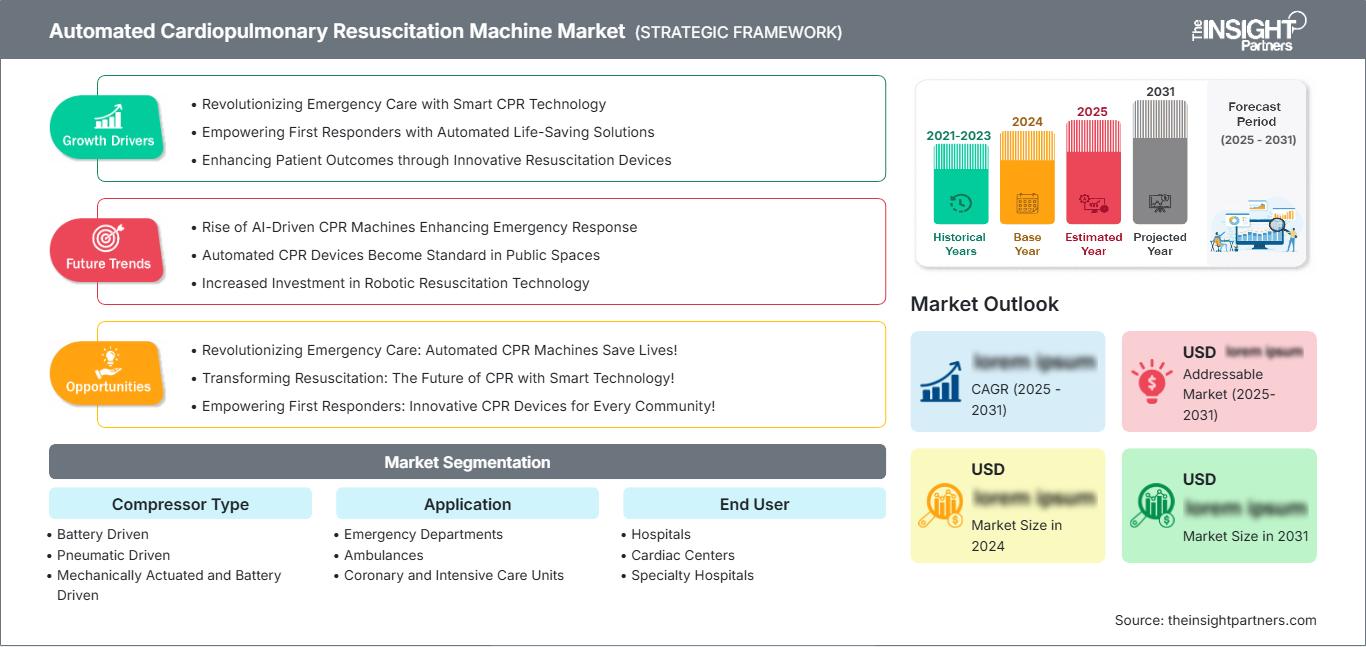
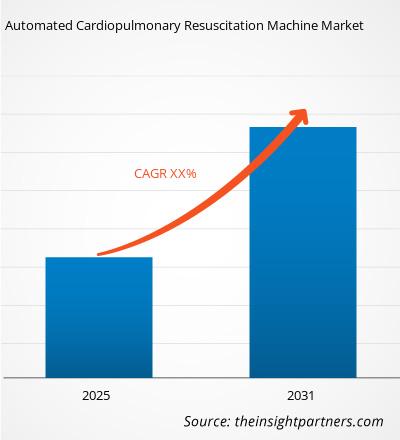
The automated cardiopulmonary resuscitation machine market size is valued at US$ 242.68 Million in 2025 and is projected to reach US$ 553.05 Million by 2034, expanding at a 9.58% CAGR during 2026–2034. The market covers automated mechanical systems designed to deliver consistent chest compressions during cardiac arrest across emergency, transport, critical care, and interventional settings. Demand is shaped by the need for uninterrupted CPR, caregiver safety, rapid deployment, and integration with established resuscitation workflows.
North America is expected to expand at approximately ~9% CAGR through 2034, supported by established emergency medical services infrastructure and continued procurement of mechanical CPR systems by hospitals and ambulance operators. The region also benefits from extensive clinical familiarity with automated compression technologies and demand for equipment that can maintain CPR quality during patient movement, prolonged resuscitation, and procedures where manual compressions are difficult.
Automated Cardiopulmonary Resuscitation Machine Market Assessment and Insights
Regional Outlook
- North America: ~39% of the global automated cardiopulmonary resuscitation machine market share in 2025 | ~9% CAGR through 2034. Market position: North America holds the largest regional position, supported by mature EMS networks, hospital procurement, established mechanical CPR adoption, and demand for systems that improve caregiver safety during transport and complex resuscitation procedures.
- US: ~86% of North American market revenue in 2025 | ~9% CAGR through 2034. Market position: The US represents the principal North American revenue base, supported by extensive EMS coverage, hospital cardiac arrest programs, emergency department utilization, and established suppliers such as ZOLL Medical Corporation and Stryker.
- Europe: ~27% of the global market in 2025 | ~9% CAGR through 2034. Market position: Europe represents a mature market supported by structured emergency care systems. Germany leads Europe, followed by established demand in the UK and France, while Italy and Spain contribute through hospital and EMS procurement.
- Asia Pacific: ~25% of the global market in 2025 | ~12% CAGR through 2034. Market position: Asia Pacific is the fastest-growing region as China, Japan, South Korea, India, and Australia expand emergency-care infrastructure, modernize hospitals, and increase access to advanced resuscitation technologies.
Segment Outlook
- Hospitals: ~61% Share in 2025 | ~9% CAGR through 2034. Market position: Hospitals lead because automated CPR systems can be deployed across emergency departments, intensive care environments, cardiac units, and transport pathways, providing consistent compressions while clinical teams address airway, medication, defibrillation, and diagnostic requirements.
- Cardiac Centers: ~23% Share in 2025 | ~10% CAGR through 2034. Market position: Cardiac centers are positioned for comparatively rapid expansion because mechanical CPR can support prolonged interventions and procedures requiring uninterrupted access, particularly during catheterization, PCI, and other advanced cardiovascular interventions.
Competitive Coverage
ZOLL Medical Corporation (Asahi Kasei Group Company), CPR Medical Devices, Inc., Michigan Instruments, Koninklijke Philips N.V., Abbott, Physio-Control, Inc. (Stryker), Defibtech, LLC., Resuscitation International, SunLife Science, SCHILLER AG
Methodology
The Insight Partners follows Data Collection & Secondary Research, Primary Research, Data Analysis, and Data Triangulation & Final Review to validate market estimates and insights.
Source: The Insight Partners' analysis based on proprietary research, government publications, company annual reports, investor presentations, industry databases, and expert interviews.
The process of development of technologies used in automated CPR has moved away from the simplest forms of compression machines to more portable solutions that can ensure proper functioning on the go and during complicated procedures. Systems based on battery provide better portability through ambulances and hospital hallways, whereas pneumatic models may still be utilized in locations with reliable power supply and oxygen system. Nowadays, new CPR machines are being developed with special focus on speed of setup, flexible compression settings, convenient transportation and accessibility for advanced treatment procedures.
Therefore, development of mechanical CPR technology is strongly linked with issues of efficiency of work processes rather than the substitution of manual CPR techniques. Future prospects of mechanical CPR technology are expected to include its adoption due to development of infrastructure related to emergency response and treatment of cardiovascular diseases in the health care system. Expansion into Asia Pacific region could be one of the possible ways to promote the technology since modernization of hospitals and improvements in emergency medicine are accompanied by growth of cardiovascular disease burden in the region.
Automated Cardiopulmonary Resuscitation Machine Market Report Scope
| Report Attribute | Details |
|---|---|
| Market size in 2025 | US$ 242.68 Million |
| Market Size by 2034 | US$ 553.05 Million |
| Global CAGR (2026 - 2034) | 9.58% |
| Historical Data | 2021-2024 |
| Forecast period | 2026-2034 |
Automated Cardiopulmonary Resuscitation Machine Market Analysis
Automated cardiopulmonary resuscitation machine sales are heavily dependent on the level of operational difficulties in providing quality manual compression for resuscitation during transportation, prolonged resuscitation, and multi-manual interventions by health care personnel. The demand for automated cardiopulmonary resuscitation machines would be highest wherever personnel availability, patient transfer, and clinical difficulty make manual resuscitation difficult. Ambulance services provide a key operating environment because personnel need to stay secured while moving the vehicle, whereas emergency departments and intensive care units require the use of mechanical devices whenever there is prolonged resuscitation leading to physical exhaustion.
The value chain comprises product developers, component manufacturers, power supply companies, health care distribution firms, EMS procurement organizations, hospitals, heart centers, and maintenance suppliers. Competition among suppliers is based on consistency in compression, portability, setup time, ability to accommodate different patient sizes, durability, battery capacity, and compliance with clinical processes. The procurement decision is also determined by training costs, consumables and maintenance expenses, device life span, and regulatory clearance.
Competitiveness is focused on existing providers of emergency-care services and manufacturers of defibrillation/critical-care equipment. AutoPulse system is produced by ZOLL Medical Corporation, while LUCAS system by Physio-Control, Inc. that belongs to Stryker. Michigan Instruments is positioned with pneumatic products such as Life-Stat and Thumper. Competing firms in the competitive landscape are CPR Medical Devices, Koninklijke Philips N.V., Abbott, Defibtech, Resuscitation International, SunLife Science and SCHILLER AG.
Innovation trends are now moving towards portability, ease of use, workflow and data-driven resuscitation. Thus, for instance, LUCAS system manufactured by Stryker has features of connectivity and analysis of events, while the recent ZOLL AutoPulse system concentrates on continuous compressions and cath lab access. Positioning of manufacturers in this respect moves beyond the compressor itself and covers emergency care ecosystem, education, support, monitoring and fleet management.
● REPORT CUSTOMIZATION
Tailor This Report To Align With Your Specific Business Requirements
This report can be customized to align precisely with your business objectives, scope, and target markets. Customization options include tailored segmentation, geography, competitive analysis, and strategic insights to support informed decision-making.
Customize This Report →WHAT YOU CAN ADJUST
- ● Segmentations
- ● Geography
- ● Competitive Analysis
- ● Language Preferences
Automated Cardiopulmonary Resuscitation Machine Market: Strategic Insights
Regional Insights
North America automated cardiopulmonary resuscitation machine market
North America represents approximately ~39% of the global market in 2025 and is expected to record a ~9% CAGR through 2034. There are well-established emergency medical care systems in place, there is a high capacity for hospitals, well-developed cardiac care protocols, and the existence of qualified EMS personnel. Mechanical CPR is especially important in situations where the responder needs to perform compressions on patients who are being transported, while being protected themselves inside the ambulance.
North America represents around ~86% of the market revenues in this area, with expected growth of ~9% CAGR. Procurement will be driven by ambulance fleet applications, emergency department, cardiac center and intensive care environment applications. ZOLL Medical Corporation and Stryker have excellent commercial presence, while Michigan Instruments offers a competing pneumatic technology.
U.S. automated cardiopulmonary resuscitation machine market
The US contributes approximately ~86% of North American revenue in 2025 and is expected to expand at ~9% CAGR through 2034. The extensive base of emergency medical vehicles and hospitals gives rise to regular chances to upgrade the equipment as well as expand the fleets. Cardiac arrest frequency, emergency medical services infrastructure, hospitals' resuscitation policies, and physical strain relief are some of the factors affecting this market segment.
Applications include emergency department, ambulances, coronary and intensive care units, and cardiac catheterization labs. AutoPulse of ZOLL Medical Corporation and LUCAS system of Stryker are examples showing the significance of devices that can assist in CPR while in transit and perform other functions of cardiovascular aid. Michigan Instruments provides pneumatic devices for hospital and EMS applications. Setup, reliability, portability, maintenance, training, and compatibility with the existing emergency care equipment are among the criteria of procurement.
Europe automated cardiopulmonary resuscitation machine market
The automated cardiopulmonary resuscitation machine market forecast shows that Europe represents approximately ~27% of the global market in 2025 and is projected to grow at ~9% CAGR through 2034. The region has comparatively mature resuscitation systems, but adoption differs according to EMS organization, hospital procurement structures, clinical protocols, and national healthcare budgets. Germany is the leading country in Europe, supported by a substantial hospital base and developed emergency medical infrastructure.
The UK is still a relevant market because emergency systems and hospital pathways make opportunities for the deployment of mechanical CPR. Germany is one of the most advanced markets in terms of hospital facilities and the need for emergency and critical care devices, while France drives adoption through hospitals and emergency medical service systems. Italy is relevant in terms of transportation and advanced cardiac interventions, while Spain helps through hospital emergency and cardiovascular care. In all those countries, the portability of the devices, quick installation, safety of caregivers, and compatibility with existing systems are becoming increasingly important factors.
European practice guidelines for resuscitation are another factor influencing the European market. According to the existing European practice guidelines, manual CPR cannot be replaced by mechanical CPR systems in a routine way. However, there are cases when mechanical compression can be used instead of manual one, if the latter is not possible or if there is a risk of harm to the provider.
APAC automated cardiopulmonary resuscitation machine market
Asia Pacific accounts for approximately ~25% of the global market in 2025 and is expected to record a ~12% CAGR, making it the fastest-growing region. China leads the way in Asia-Pacific owing to hospital upgrades, increase in emergency care capabilities, and increased supply of technologically advanced cardiovascular equipment. Japan and South Korea play their parts through efficient hospital networks and technology-based procurement.
On the other hand, India and Australia offer alternative paths of demand. India's tertiary healthcare facilities aid in improved access to advanced resuscitation equipment, while Australia is favored by the existence of its EMS and hospital emergency care. Regional suppliers and global players compete on factors like portability, affordability, and usability at hospitals operating in various settings.
Middle East & Africa automated cardiopulmonary resuscitation machine market
The Middle East and Africa market is projected to expand at approximately ~10% CAGR through 2034. Saudi Arabia represents the leading country in the Middle East and Africa based on healthcare infrastructure development and investment in advanced hospital capacity. UAE healthcare facilities also provide a strong addressable base for advanced emergency and cardiovascular technologies.
Saudi Arabia and the UAE are investing in tertiary hospitals, emergency services, and specialized cardiovascular facilities, while South Africa provides an important sub-Saharan demand center. Energy-sector and industrial environments also require dependable emergency-response infrastructure, supporting interest in portable systems. Across Rest of MEA, adoption remains more dependent on hospital modernization, distributor networks, procurement budgets, and availability of trained personnel.
Segmentation Analysis
Compressor Type
Compressor Type represents an important technology distinction because the power source affects portability, operating duration, maintenance, and suitability for different care environments. Battery-operated systems are favored for mobile EMS applications, whereas pneumatic systems can provide extended operation where compressed oxygen infrastructure is accessible. Mechanically actuated architectures address consistent compression delivery and controlled operation. Overall adoption depends on the balance between mobility, reliability, setup requirements, and lifecycle cost.
- Battery Driven: Battery-driven systems support mobile emergency response by avoiding dependence on fixed pneumatic infrastructure. Their portability makes them suitable for ambulances, interfacility transfers, and hospital movement, although procurement teams must consider charging, battery replacement, operating duration, and fleet management.
- Pneumatic Driven: Pneumatic systems remain relevant in hospitals and EMS environments with established oxygen infrastructure. Their value proposition centers on prolonged operation and reduced dependence on rechargeable power systems, supporting facilities that prioritize operational simplicity and predictable extended-use performance.
- Mechanically Actuated: Mechanically actuated systems emphasize controlled, repeatable compression delivery and consistent positioning. They are strategically relevant where resuscitation teams need stable compression performance while managing airway procedures, medications, defibrillation, transport, or advanced cardiovascular interventions.
Application
Application determines the operational environment in which mechanical CPR is deployed. The segment is expected to expand at approximately ~9% CAGR as hospitals and EMS organizations seek technologies that can sustain CPR when manual compression is difficult. Demand varies according to patient movement, procedure complexity, responder safety, and availability of trained personnel. Ambulance applications particularly benefit from hands-free compression during transport.
- Emergency Departments: Emergency departments require rapidly deployable systems for high-acuity cardiac arrest management. Demand is influenced by emergency volume, resuscitation-team organization, space constraints, and the need to free clinicians for airway management, medication administration, and defibrillation.
- Ambulances: Ambulance use emphasizes portability, rapid application, secure positioning, and continued compression while the vehicle is moving. Systems must accommodate constrained working environments and allow EMS personnel to remain secured while other critical interventions continue.
- Coronary and Intensive Care Units: Coronary and intensive care environments require dependable performance during prolonged or complex arrests. Automated systems can support teams when manual compressions interfere with simultaneous clinical interventions or create substantial provider fatigue.
- Cardiac Catheterization Labs: Cath-lab applications require devices that permit continued CPR while maintaining access to imaging and interventional equipment. Radiolucent or low-profile designs can support selected procedures where uninterrupted compressions and procedural access are important.
End User
End User segmentation captures the healthcare setting purchasing and deploying these systems. Hospitals are expected to expand at approximately ~9% CAGR, reflecting broad applicability across emergency and critical-care units. Cardiac centers are expected to record approximately ~10% CAGR, supported by advanced cardiovascular interventions and demand for reliable CPR during procedure-intensive care. Specialty hospitals remain relevant where high-acuity cardiac services are concentrated.
- Hospitals: Hospitals represent the largest end-user base because one device can support multiple clinical areas, including emergency departments, intensive care units, coronary care, operating environments, and patient transport between departments.
- Cardiac Centers: Cardiac centers have specialized requirements for resuscitation during cardiovascular procedures. Their demand is strengthened by cath-lab activity, interventional cardiology, advanced imaging, and the need to maintain access to the patient during complex treatment.
- Specialty Hospitals: Specialty hospitals provide targeted opportunities where cardiac, critical-care, or emergency services are concentrated. Procurement is shaped by case mix, institutional protocols, equipment standardization, and the need for dependable support during high-acuity events.
Opportunity Snapshot
| End Users | Revenue Contribution | Trend Tag | Adoption Stage |
|---|---|---|---|
| Hospitals | High | Multi-unit Deployment | Mature |
| Cardiac Centers | Medium | Cath-lab Integration | Scaling |
| Specialty Hospitals | Medium | Critical-care Focus | Scaling |
Automated Cardiopulmonary Resuscitation Machine Market Growth Drivers and Impact Analysis
Provider Safety During Transport and Prolonged Resuscitation
CPR through manual techniques tends to become difficult when the process requires clinicians to perform CPR within a moving ambulance, transport the patient between different locations, or perform compressions during prolonged CPR procedures. Automated methods allow for sustained performance of CPR in the form of consistent compressions without distracting the clinician from performing such activities as airway management, venous access, drugs administration, assessment of cardiac rhythms, and defibrillation. Thus, there are practical benefits that go beyond the benefits to the clinical outcome. Contemporary guidelines for resuscitation address cases when automated CPR becomes necessary when it is difficult or even dangerous to perform high-quality CPR manually. Therefore, purchase decisions are becoming increasingly related to transport and occupational safety policies.
Expansion of Advanced Cardiac Intervention Infrastructure
Growth in specialized cardiovascular care creates additional situations in which continuous mechanical compression can support treatment. Cardiac catheterization laboratories may require CPR while imaging, angiography, PCI, or mechanical circulatory support procedures are being considered. A mechanical system can maintain compressions while reducing the number of clinicians physically occupied with manual chest compressions. This allows teams to concentrate on diagnosis and intervention when clinically appropriate. Devices designed with radiolucent or low-profile components are particularly relevant because they can preserve access to imaging equipment. The resulting opportunity extends the addressable setting beyond conventional emergency response into procedure-intensive cardiovascular care, strengthening demand for systems engineered around interventional workflows rather than standalone compression performance.
Hospital Workforce Optimization and Resuscitation Standardization
Healthcare providers face the practical challenge of maintaining consistent CPR performance across different shifts, teams, and clinical environments. Automated systems provide standardized mechanical movement and reduce dependence on the physical endurance of individual responders. This can support hospitals seeking more predictable resuscitation workflows while simultaneously reducing the number of staff required to perform continuous compressions. The impact is especially relevant during prolonged events, patient movement, and situations in which several clinicians must perform concurrent interventions. Procurement decisions consequently extend beyond clinical functionality to training, storage, maintenance, deployment time, and integration with existing code-response processes. Vendors able to demonstrate efficient deployment and straightforward staff training can address institutional requirements for operational consistency.
Automated Cardiopulmonary Resuscitation Machine Market Future Trends
Connected Resuscitation and Post-event Data Integration
The automated cardiopulmonary resuscitation machine market trends show that future platforms are likely to place greater emphasis on digital connectivity around the mechanical CPR event. Rather than operating solely as compression devices, systems can increasingly become components of emergency-care data workflows involving device status, event records, quality review, fleet management, and clinical documentation. Connectivity can help organizations evaluate deployment frequency, maintenance requirements, battery status, and protocol adherence while supporting structured post-event review. Integration with broader EMS and hospital information environments could also improve asset utilization and simplify quality-improvement programs. The strongest opportunity will be for vendors that can combine dependable mechanical performance with secure data architecture without increasing deployment complexity. This trend shifts competition toward the wider emergency-care ecosystem and recurring software or service relationships.
More Portable Systems for Distributed Emergency Care
Emergency response is moving toward care models in which advanced interventions begin outside conventional hospital rooms. Ambulances, helicopter transport, emergency departments, cardiac centers, and interfacility transfer pathways increasingly require equipment that can operate across locations. Future mechanical CPR systems are therefore likely to prioritize lower weight, compact storage, faster application, flexible power options, and improved compatibility with transport equipment. Design improvements may also address patient-size accommodation and access to the chest during simultaneous interventions. For healthcare organizations, portability can improve utilization because the same equipment can serve multiple emergency pathways. For manufacturers, this creates an incentive to engineer systems around the complete patient journey rather than a single stationary treatment environment.
Automated Cardiopulmonary Resuscitation Machine Market Opportunities
Regional Expansion Through Localized Emergency-care Platforms
Asia Pacific and selected Middle Eastern markets provide opportunities for manufacturers that can align mechanical CPR products with local hospital modernization and EMS development. Market entry strategies can focus on distributor partnerships, clinical education, localized technical support, and product configurations suited to regional procurement requirements. Affordability is particularly relevant where hospitals are expanding capacity while managing capital budgets. Manufacturers can also build demand by positioning mechanical CPR alongside complementary emergency technologies such as defibrillators, patient monitors, transport systems, and resuscitation training. Localization of service networks and spare-parts availability can further reduce procurement barriers. This approach can support sustainable adoption without assuming that purchasing behavior in emerging healthcare systems will mirror mature North American or European markets.
Integrated Emergency-care Procurement and Fleet Management
A second opportunity lies in institutional procurement models that evaluate mechanical CPR devices as part of a broader emergency-care fleet. Hospitals and EMS organizations can benefit from standardized equipment, centralized maintenance, common training protocols, and coordinated replacement cycles. Vendors can respond by integrating mechanical CPR with defibrillation, monitoring, data review, asset management, and service capabilities. Such integration can create operational efficiencies for organizations managing multiple vehicles or clinical sites. The opportunity is particularly relevant where procurement teams increasingly assess lifecycle cost rather than acquisition price alone. Suppliers that provide reliable device availability, training resources, preventive maintenance, and fleet visibility can address institutional needs while creating longer-term relationships with healthcare providers.
Recent Developments
- August 2025: ZOLL Medical Corporation Asahi Kasei Group Company ZOLL Medical launched the AutoPulse NXT electrically powered mechanical CPR system in Japan. The device is designed to provide continuous automated chest compressions and includes a radiolucent design intended to support use in catheterization laboratories while maintaining imaging access.
- 2025: Physio-Control, Inc., Stryker continued commercial support for the LUCAS 3, v3.1 chest compression system, emphasizing continuous compressions during transport and advanced interventions such as ECMO and PCI. The platform also supports configurable CPR protocols and post-event data review through connected systems in applicable markets.
- 2025: Michigan Instruments continued commercial availability of its Life-Stat and Thumper automated CPR systems for hospitals and EMS organizations. The company's current portfolio emphasizes hands-free operation, pneumatic operation, rapid deployment, and use across emergency departments, intensive care, transport, and other high-acuity environments.
Frequently Asked Questions

- Comprehensive Market Sizing and Forecast Analysis
- Detailed Segmentation Analysis
- In-Depth Market Dynamics Assessment
- Regional and Country-Level Insights
- Competitive Landscape and Company Benchmarking
- Strategic Business Intelligence
Recent Reports
Testimonials

The Insight Partners provided valuable market intelligence that supported our global go-to-market strategy. Their team was professional, responsive, and attentive to our feedback, providing thoughtful analysis and helpful methodological clarifications throughout the project.
Junmo Kim Chief Financial Officer (CFO), Enertech Co., Ltd.
The Insight Partners' SCADA System Market report is comprehensive, with valuable insights on current trends and future forecasts. The team was highly professional, responsive, and supportive throughout. We are very satisfied and highly recommend their services.
RAN KEDEM Partner, Reali Technologies LTDs
I requested a report on a very specific software market and the team produced the report in a few days. The information was very relevant and well presented. I then requested some changes and additions to the report. The team was again very responsive and I got the final report in less than a week.
JEAN-HERVE JENN Chairman, Future Analytica
We worked with The Insight Partners for an important market study and forecast. They gave us clear insights into opportunities and risks, which helped shape our plans. Their research was easy to use and based on solid data. It helped us make smart, confident decisions. We highly recommend them.
PIYUSH NAGPAL Sr. Vice President, High Beam Global
The Insight Partners delivered insightful, well-structured market research with strong domain expertise. Their team was professional and responsive throughout. The user-friendly website made accessing industry reports seamless. We highly recommend them for reliable, high-quality research services
YUKIHIKO ADACHI CEO, Deep Blue, LLC.
This is the first time I have purchased a market report from The Insight Partners.While I was unsure at first, I visited their web site and felt more comfortable to take the risk and purchase a market report.I am completely satisfied with the quality of the report and customer service. I had several questions and comments with the initial report, but after a couple of dialogs over email with their analyst I believe I have a report that I can use as input to our strategic planning process.Thank you so much for taking the extra time and making this a positive experience.I will definitely recommend your service to others and you will be my first call when we need further market data.
JOHN SUZUKI President and Chief Executive Officer, Board Director, BK Technologies
I wish to appreciate your support and the professionalism you displayed in the course of attending to my request for information regarding to infectious disease IVD market in Nigeria. I appreciate your patience, your guidance, and the fact that you were willing to offer a discount, which eventually made it possible for us to close a deal. I look forward to engaging The Insight Partners in the future, all thanks to the impression you have created in me as a result of this first encounter.
DR CHIJIOKE ONYIA MANAGING DIRECTOR, PineCrest Healthcare Ltd.Reason to Buy
- Informed Decision-Making
- Understanding Market Dynamics
- Competitive Analysis
- Identifying Emerging Markets
- Customer Insights
- Market Forecasts
- Risk Mitigation
- Boosting Operational Efficiency
- Strategic Planning
- Investment Justification
- Tracking Industry Innovations
- Aligning with Regulatory Trends





 Get Free Sample for