
Automated Packaging Machinery Market Size, Demand & Growth Opportunities by 2034
Coverage: By Machine Type (Filling Machines, FFS Machines, Palletizing Machines, Labelling Machines, Wrapping Machines, and Others), by End-user Industry (Food & Beverage, Pharmaceuticals, Chemicals, Cosmetics, and Others), and Geography (North America, Europe, Asia Pacific, and South and Central America)
- Status : Data Released
- Report Code : TIPMC00002508
- Category : Manufacturing and Construction
- No. of Pages : 150
- Available Report Formats :


- Last update date : August 26, 2026


2025 Market Size
US$ 85.04 Bn
Base year value
2034 Forecast
US$ 153.24 Bn
Projected by 2034
CAGR 2026-2034
6.76 %
Growth rate
Addressable Market
US$ 1,076.68 Bn
(2026-2034)
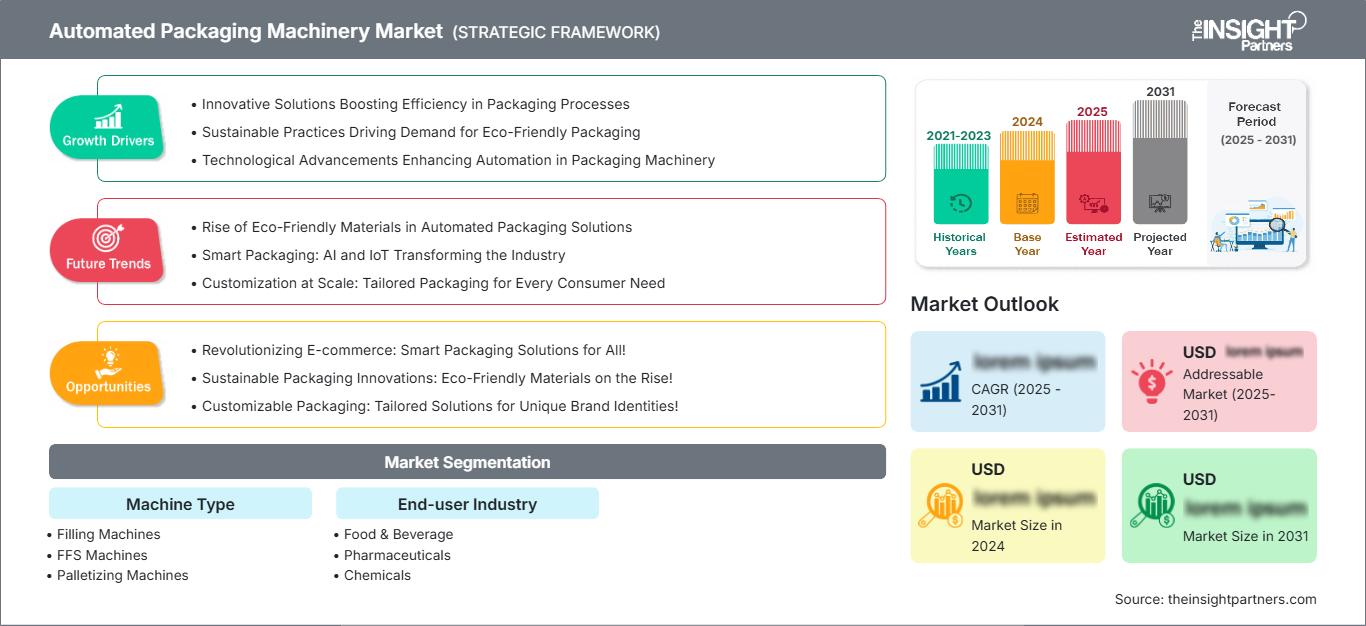
The automated packaging machinery market is projected to expand from US$ 85.04 Billion in 2025 to US$ 153.24 Billion by 2034, registering a CAGR of 6.76% during 2026–2034. Growth reflects manufacturers’ sustained shift from isolated equipment toward integrated, sensor-enabled lines that improve throughput, repeatability, hygiene, and traceability across food and beverage, pharmaceutical, chemical, and cosmetics production environments while supporting increasingly diverse pack formats.
North American automated packaging machinery market size is expected to advance at a modeled 6.1–6.6% CAGR through 2034. Persistent manufacturing labor constraints and investment in validated, digitally connected production lines support replacement demand. Food processors are prioritizing flexible changeovers, while regulated healthcare manufacturers require serialized labeling, inspection integration, and auditable process data, reinforcing spending on higher-specification equipment and lifecycle services.
Automated Packaging Machinery Market Assessment and Insights
- North America held an estimated 24–26% share in 2025 and is projected to grow at 6.1–6.6% CAGR during 2026–2034, supported by labor substitution, food safety controls, and pharmaceutical serialization investment.
- US represented 82–86% of North American revenue in 2025 and is expected to expand at 6.2–6.7% CAGR through 2034.
- Europe accounted for an estimated 21–23% share in 2025 and is forecast at 5.8–6.3% CAGR, led by Germany, Italy, France, the UK, and Spain.
- Asia Pacific captured an estimated 31–34% share in 2025 and should grow at 7.7–8.3% CAGR, with China leading and Japan, India, and South Korea sustaining investment.
- Largest Segment Filling Machines held an estimated 29–32% market share in 2025 and is projected to register 6.4–6.9% CAGR during 2026–2034.
- High Growth Segment Pharmaceuticals represented an estimated 20–23% market share in 2025 and is forecast to expand at 7.4–8.0% CAGR during 2026–2034.
- Key companies analyzed in detail: The Adelphi Group of Companies, Aetna Group S.p.A., Barry-Wehmiller Companies, Inc., CKD Corporation, Coesia S.p.A., Fuji Machinery Co., Ltd., I.M.A. Industria Macchine Automatiche S.p.A., MULTIVAC Group, Ishida Co., Ltd., and Marchesini Group S.p.A.
Source: The Insight Partners' analysis based on proprietary research, government publications, company annual reports, investor presentations, industry databases, and expert interviews.
Machine architecture has been shifting away from mechanical synchronization to modular servo machines with connections between filling, sealing, labeling, inspection, case packing, and palletizing operations. Equipment manufacturers have started to focus more on overall line efficiency than the nameplate speed and have developed a preference for recipe control, remote diagnostics, machine vision, and fast tool changes. As a result, machine suppliers are now bundling their proprietary hardware with software, validation skills, consumables knowledge, and service agreements.
From 2020 through 2034, capacity increases must be expected in Asia, the Middle East, and certain manufacturing zones of Latin America; whereas, mature regions will see the growth mostly in brownfield investments. Policy concerns about packaging waste will drive investments in machines that can manage with down-gauged, recyclable, paper-based, or mono-material substrates without compromising seal integrity. In terms of capital investments, connected cells with clear cost savings in energy, material, and labor are going to be prioritized. Localized pharmaceutical production and cold-chain manufacturing will also contribute to investments in validated filling, labeling, and end-of-line systems.
Automated Packaging Machinery Market Report Scope
| Report Attribute | Details |
|---|---|
| Market size in 2025 | US$ 85.04 Billion |
| Market Size by 2034 | US$ 153.24 Billion |
| Global CAGR (2026 - 2034) | 6.76% |
| Historical Data | 2021-2024 |
| Forecast period | 2026-2034 |
Automated Packaging Machinery Market Analysis
Growth in the market for automated packaging machinery is being influenced by needs for throughput, hygiene, speed, shorter cycles, and challenges in finding people to operate repetitive production jobs. Brand holders now demand that their equipment be able to handle a range of SKUs, assure quality on the line, and record any problems. The order passes through an entire ecosystem of machinery manufacturers, component makers, robotics specialists, system integrators, distributors, and service providers.
While supply dynamics depend on precision parts, controls, and engineering, standard module systems speed deliveries while specialized pharmaceutical and fast food lines need more factory testing time. Thus, the customer balances the initial purchase price against availability, yield reduction, change-over time, manpower needs, power consumption, and service responsiveness. Retrofit systems are becoming increasingly important since they enable vision systems, connectivity, or robotics without changing good machinery.
Analysis of the automated packaging machines industry reveals that competition is becoming less about individual machines and more about entire line accountability. Competitors such as I.M.A. Industria Macchine Automatiche S.p.A., Coesia S.p.A., Marchesini Group S.p.A., and MULTIVAC Group differentiate themselves with comprehensive portfolios and application engineering, whereas Ishida Co., Ltd. and Fuji Machinery Co., Ltd. have maintained their focus on food packaging.
Aetna Group S.p.A. focuses on end-of-line automation, Barry-Wehmiller Companies, Inc. integrates several packaging platforms, and CKD Corporation caters to precision automation needs. Adelphi Group of Companies provides a niche for healthcare. Investments will be made in digital service platforms, sustainable material experimentation, demonstration centers in regions, and strategic acquisitions involving software and complementary equipment. Strategic position will depend upon service revenues from installed bases, local spare parts availability, modular lines integration, and validation across unknown substrates.
● REPORT CUSTOMIZATION
Tailor This Report To Align With Your Specific Business Requirements
This report can be customized to align precisely with your business objectives, scope, and target markets. Customization options include tailored segmentation, geography, competitive analysis, and strategic insights to support informed decision-making.
Customize This Report →WHAT YOU CAN ADJUST
- ● Segmentations
- ● Geography
- ● Competitive Analysis
- ● Language Preferences
Automated Packaging Machinery Market: Strategic Insights
Regional Insights
North America automated packaging machinery market
North America held an estimated 24–26% automated packaging machinery market share in 2025 and is projected to register 6.1–6.6% CAGR during 2026–2034. The aging infrastructure replacement, constant labor shortage, and stringent food and drug regulation provide good grounds for investments. The customers opt more and more often for integrated solutions that include inspection, coding, serializing, robotic handling, and reporting from production together with capability to handle short-run and multi-material packaging.
Canada can make contributions with its food processing, cannabis, personal care, and pharmaceutical production. Mexico has the advantage of nearshoring and export-oriented consumer goods production. The regional customers pay high importance to local serviceability including technicians, spares, validation services, and cyber-ready connections. In general, the capital investments are justified by decreased labor cost, decreased giveaway, improved overall equipment efficiency, and fast changeover of formats instead of maximized line speed.
U.S. Automated Packaging Machinery Market
The U.S. represented an estimated 82–86% of North American revenue in 2025 and is expected to grow at 6.2–6.7% CAGR through 2034. A wide variety of facilities involved in food packaging, beverages, pharmaceuticals, chemicals, and beauty products manufacture form a large replacement market. Implementation of such equipment is most prominent in markets where the high cost of labor, hygiene standards, and SKU explosion due to demand from retailers justify automation.
Barry-Wehmiller Company, Inc.'s domestic manufacturing operations and service networks of global vendors are used to implement projects. Food and beverage applications are concerned with wash down capability, soft product handling, sustainable packaging, and robotic case packing. Pharmaceutical facilities focus on validated recipes, electronic batch records, serialization, and containment. Chemical and cosmetic manufacturers demand precise dosing and flexible container handling. Integrators tend to combine proven mechanical systems with machine vision, collaborative robots, and maintenance connected to the cloud network for step-by-step brownfield upgrades.
Europe Automated Packaging Machinery Market
Europe captured an estimated 21–23% of the Automated packaging machinery market in 2025 and should expand at 5.8–6.3% CAGR through 2034. Germany is the market leader, backed up by high-level food, chemical, and pharmaceutical manufacturing capabilities and a robust automation supplier infrastructure. The UK market focuses on labor-reducing retrofits and regulatory compliance, whereas Germany has a preference for high-performance automation systems featuring energy consumption monitoring, precision motion control, and lifetime maintenance contracts.
In France, there is an overlap of high cosmetic, food, and pharmaceutical demand with packaging waste regulation pressure. In Italy, the machinery industry is supported by a highly concentrated machinery industry with four key players, including I.M.A. Industria Macchine Automatiche S.p.A., Coesia S.p.A., Aetna Group S.p.A., and Marchesini Group S.p.A. Food exports from Spain fuel investments in filling, wrapping, and labeling operations. In this region, equipment capable of handling recyclable or thin-gauge materials becomes increasingly strategic due to substrate changes affecting sealing window, stiffness, friction, and system stability.
APAC Automated Packaging Machinery Market
Asia Pacific held an estimated 31–34% of the Automated packaging machinery market in 2025 and is forecast to grow at 7.7–8.3% CAGR. China drives on account of manufacturing scale, domestic equipment capability, and food, pharmaceutical, and consumer goods investments. Japan stresses precision, small footprint, and labor-saving technology.
In South Korea, advanced manufacturing drives connectivity of the equipment, while in India, the formalization of the food and pharmaceutical sectors generates greenfield demand. Labor productivity and food exports drive Australia. Manufacturing localization, product safety policies, higher wage rates, and modern retail push automated filling, FFS, labeling, wrapping, and palletizing equipment.
Middle East & Africa Automated Packaging Machinery Market
Middle East and Africa Automated packaging machinery market is projected to advance at 6.6–7.2% CAGR through 2034. Saudi Arabia takes the lead due to industrial diversification and food security programs that drive local manufacturing of food, pharmaceutical, and consumer goods. UAE supports regional distribution and specialized food and cosmetic lines.
South Africa continues to be the key sub-Saharan Automated packaging machinery market due to existing food, beverage, and chemical industries. The rest-of-MEA market is more selective due to different financing and services. Energy efficiency, dust resistance and tolerance to heat, remote diagnostics, ease of operation, and spare parts availability influence suppliers’ selection for infrastructure-related manufacturing projects.
Segmentation Analysis
Machine Type
Machine Type segment in the Automated packaging machinery market is projected to advance at 6.5–7.0% CAGR during 2026–2034. The automated packaging machinery market scope spans primary, secondary, and tertiary operations, but purchasing patterns increasingly favor interoperable modules and central line control. Format flexibility, sanitation, dosing accuracy, substrate compatibility, and integration support determine adoption, while lifecycle service and retrofitability influence total ownership economics.
- Filling Machines remain the largest machine category because precise liquid, viscous, powder, and particulate dosing is fundamental to food, pharmaceutical, chemical, and cosmetics production.
- FFS Machines combine forming, filling, and sealing in one platform, supporting high-throughput flexible packaging with lower handling requirements and efficient material utilization.
- Palletizing Machines address labor-intensive end-of-line handling, improve load consistency, and support warehouse automation through robotic cells capable of managing varied cases and patterns.
- Labelling Machines gain strategic importance as manufacturers require accurate identification, serialization, traceability, regulatory information, and rapid SKU transitions across containers and pack formats.
- Wrapping Machines protect individual products, bundles, cases, and pallet loads while suppliers optimize film use, sealing control, and compatibility with recyclable or downgauged substrates.
End-user Industry
End-user Industry demand is forecast to grow at 6.7–7.2% CAGR during 2026–2034. Adoption varies by hygiene, validation, throughput, product sensitivity, and packaging diversity. Food and beverage delivers scale, pharmaceuticals require documentation and containment, chemicals prioritize dosing safety, and cosmetics demand frequent format changes with strong presentation quality. Suppliers increasingly configure common platforms around sector-specific risk controls.
- Food & Beverage generates broad demand for high-speed filling, FFS, wrapping, labeling, and palletizing, with sanitation, shelf life, gentle handling, and waste reduction central.
- Pharmaceuticals require validated processes, precise dosing, contamination control, serialization, inspection, and electronic records, supporting premium machinery configurations and specialist after-sales services.
- Chemicals prioritize corrosion resistance, hazardous-area design, accurate filling, secure closure, and robust pallet loads across industrial, agricultural, and household product applications.
- Cosmetics favor flexible equipment capable of managing premium containers, short campaigns, multiple closures, decorative labels, and accurate filling without damaging product presentation.
Opportunity Snapshot
| End-user Industry | Revenue Contribution | Trend Tag | Adoption Stage |
| Food & Beverage | High | Flexible Lines | Mature |
| Pharmaceuticals | High | Validated Automation | Scaling |
| Chemicals | Medium | Safe Dosing | Scaling |
| Cosmetics | Medium | Format Agility | Scaling |
Automated Packaging Machinery Market Growth Drivers and Impact Analysis
Labor Scarcity Strengthens Automation Economics
Reevaluation is underway in the manual packaging environment because of constraints related to recruitment, training, staff turnover and ergonomic risk exposure that limit productivity. Automation systems turn labor costs that fluctuate due to human factors into capacity that is more predictable, especially with respect to case packing, palletizing, labeling and repetitive loading operations. Successful initiatives incorporate robotics together with standardized infeeds, machine vision and central control instead of simply replacing an operator. Benefits include more than reduced manpower: predictable cycle times allow reduced work in progress, steady handling reduces product damage, and diagnostic capability limits downtime. Suppliers win by being able to document staffing savings and system availability in a particular application environment.
Regulated Production Requires Traceable Process Control
There are increasing demands for quality documentation, accurate identification, hygienic design, and repeatable processes for food, pharmaceutical, chemical, and cosmetics companies. Packaging machines are now providing compliance information through recipe, alarm, inspection results, rejection, and intervention data. For pharmaceutical products, serialization and change control add to the importance of integrated labeling, vision systems, and e-records. Cleanability, allergen changeover, sealing, and foreign body detection are the key considerations in food manufacturing. Dosing accuracy and safety handling are needed in chemical manufacturing. This driver creates an advantage for packaging machine suppliers capable of combining machine capability with software governance, validation documentation, and applications. It is also increasing after-market needs as the control system upgrade, audit support, calibration, and cyber security maintenance continue through the machine life cycle.
SKU Proliferation Rewards Flexible Line Architecture
There is a trend towards the use of more pack formats, flavors, recipes, and customized configurations for individual channels by brand owners, making it uneconomical to utilize fixed single configuration machines. There is the need for flexible systems with servo control, toolless components, recipe handling and robotic systems to make it possible for shorter campaigns with minimal machine downtime. Evidence of this effect can be seen from the factors that customers consider when buying – for example, changeover time, first part quality, and repeatability have become just as important as speed. There is a need for equipment which can handle future unknown formats for contract manufacturers.
Automated Packaging Machinery Market Future Trends
Self-Optimizing, Data-Rich Packaging Lines
Automated packaging machinery market trends will increasingly center on data models that detect drift, predict component wear, and recommend adjustments before quality deteriorates. Connected machines will combine servo, vision, inspection, and environmental data to distinguish equipment faults from upstream product variation. Suppliers are likely to package analytics as subscription services tied to remote support and performance guarantees. Adoption will progress fastest where plants establish secure data ownership, consistent machine naming, and maintenance workflows capable of acting on alerts. Human supervision will remain important, but operators will shift from repetitive observation toward exception management, assisted changeovers, and structured continuous improvement across multiple interconnected assets.
Material-Agnostic Packaging Platforms
Future equipment will be designed around wider processing windows as brands test paper structures, mono-material films, recycled content, thinner gauges, and alternative coatings. These substrates can behave differently under heat, tension, friction, and forming pressure, making adaptable sealing, web handling, and inspection critical. Machine builders will expand application laboratories and digital recipes that accelerate qualification while protecting throughput and pack integrity. Commercial advantage will move toward suppliers that coordinate machinery, materials, and package design early in development. Modular sealing stations and closed-loop controls should reduce conversion risk, allowing manufacturers to respond faster as recycling infrastructure and packaging policy evolve.
Automated Packaging Machinery Market Opportunities
Brownfield Modernization as a Scalable Entry Strategy
Automated packaging machinery market Forecasts indicate a broad opportunity in installed lines that remain mechanically viable but lack modern controls, vision, robotics, or data connectivity. Suppliers can develop repeatable retrofit kits for servo conversion, inspection, remote diagnostics, safety upgrades, and automated format adjustment. This route reduces shutdown time and capital intensity for users while creating recurring engineering, software, and service revenue. Attractive targets include multi-site food processors and contract manufacturers operating similar legacy platforms. Success requires detailed asset audits, cybersecurity boundaries, verified performance baselines, and migration plans that preserve production. Partnerships with regional integrators can expand coverage without requiring every original equipment manufacturer to maintain a large direct workforce.
Localized Pharmaceutical and Biologics Packaging Capacity
Governments and manufacturers seeking resilient medicine supply chains are expanding domestic production, creating opportunities for validated filling, inspection, labeling, and secondary packaging systems. Equipment providers can target modular lines that scale from clinical or contract batches to commercial output while maintaining recipe control, containment, and traceability. High-value offerings include integrated qualification documentation, factory and site acceptance testing, operator training, and rapid local service. Vendors should build partnerships with cleanroom specialists, serialization providers, and regional engineering firms. Demonstration centers configured around vials, syringes, bottles, and cartons can shorten buyer evaluation and de-risk unfamiliar automation, particularly in emerging pharmaceutical hubs with limited installed engineering capability.
Recent Developments
- May 2026: Aetna Group S.p.A. completed its four-year FUTURE@PACKAGING project, reporting 12 patent filings, prototype machine assemblies, software applications, and pilot installations in beverage, food, and logistics. The program focused on machinery and digital services compatible with recycled, recyclable, and sustainable materials, strengthening the group’s platform for commercial product integration.
- October 2025: The Adelphi Group of Companies announced a distribution agreement with ARaymondlife for RayDyLyo vial caps. The push-fit closure eliminates traditional crimping, supports tamper evidence, standard vial compatibility, and ready-to-use or ready-to-sterilize workflows, signaling demand for packaging components that simplify pharmaceutical capping processes and reduce manual handling.
- February 2025: MULTIVAC Group detailed connected processing and packaging solutions for IFFA 2025, including a fully automated line designed to operate with up to 70% fewer personnel, product changeovers with up to 95% less downtime, and pack concepts offering recyclability of up to 95%. The launch emphasized measurable labor, flexibility, and material-efficiency outcomes.
Frequently Asked Questions

- Comprehensive Market Sizing and Forecast Analysis
- Detailed Segmentation Analysis
- In-Depth Market Dynamics Assessment
- Regional and Country-Level Insights
- Competitive Landscape and Company Benchmarking
- Strategic Business Intelligence
Recent Reports
Testimonials

The Insight Partners' SCADA System Market report is comprehensive, with valuable insights on current trends and future forecasts. The team was highly professional, responsive, and supportive throughout. We are very satisfied and highly recommend their services.
RAN KEDEM Partner, Reali Technologies LTDs
I requested a report on a very specific software market and the team produced the report in a few days. The information was very relevant and well presented. I then requested some changes and additions to the report. The team was again very responsive and I got the final report in less than a week.
JEAN-HERVE JENN Chairman, Future Analytica
We worked with The Insight Partners for an important market study and forecast. They gave us clear insights into opportunities and risks, which helped shape our plans. Their research was easy to use and based on solid data. It helped us make smart, confident decisions. We highly recommend them.
PIYUSH NAGPAL Sr. Vice President, High Beam Global
The Insight Partners delivered insightful, well-structured market research with strong domain expertise. Their team was professional and responsive throughout. The user-friendly website made accessing industry reports seamless. We highly recommend them for reliable, high-quality research services
YUKIHIKO ADACHI CEO, Deep Blue, LLC.
This is the first time I have purchased a market report from The Insight Partners.While I was unsure at first, I visited their web site and felt more comfortable to take the risk and purchase a market report.I am completely satisfied with the quality of the report and customer service. I had several questions and comments with the initial report, but after a couple of dialogs over email with their analyst I believe I have a report that I can use as input to our strategic planning process.Thank you so much for taking the extra time and making this a positive experience.I will definitely recommend your service to others and you will be my first call when we need further market data.
JOHN SUZUKI President and Chief Executive Officer, Board Director, BK Technologies
I wish to appreciate your support and the professionalism you displayed in the course of attending to my request for information regarding to infectious disease IVD market in Nigeria. I appreciate your patience, your guidance, and the fact that you were willing to offer a discount, which eventually made it possible for us to close a deal. I look forward to engaging The Insight Partners in the future, all thanks to the impression you have created in me as a result of this first encounter.
DR CHIJIOKE ONYIA MANAGING DIRECTOR, PineCrest Healthcare Ltd.Reason to Buy
- Informed Decision-Making
- Understanding Market Dynamics
- Competitive Analysis
- Identifying Emerging Markets
- Customer Insights
- Market Forecasts
- Risk Mitigation
- Boosting Operational Efficiency
- Strategic Planning
- Investment Justification
- Tracking Industry Innovations
- Aligning with Regulatory Trends





 Get Free Sample for