
Automatic Capping Machine Market Size, Share & Forecast by 2034
Coverage: By Bottle Type (Glass Bottles, Plastic Bottles); Cap Type (Ropp Caps, Screw Caps, Snap-on-Caps, Crown Caps, Corks); End-Use Industry (Chemical, Pharmaceutical, Cosmetics, Food and Beverages, Others) , and Geography (North America, Europe, Asia Pacific, and South and Central America)
- Status : Data Released
- Report Code : TIPRE00023136
- Category : Manufacturing and Construction
- No. of Pages : 150
- Available Report Formats :


- Last update date : November 03, 2026


2025 Market Size
US$ 4.23 Bn
Base year value
2034 Forecast
US$ 7.21 Bn
Projected by 2034
CAGR 2026-2034
6.1 %
Growth rate
Addressable Market
US$ 51.79 Bn
(2026-2034)
The Automatic Capping Machine Market was valued at US$ 4.23 Billion in 2025 and is expected to reach US$ 7.21 Billion by 2034, expanding at a CAGR of 6.10% during 2026–2034. The scope includes automated machinery that applies, tightens, presses, rolls, or closes the closure on bottles and containers for chemicals, pharmaceuticals, cosmetics, food, and beverages. Market demand will be influenced by packaging line automation, closure integrity needs, speed of production, and rising use of integrated filling and capping machines.
The North American market represents the technologically advanced market, with the size of the Automatic Capping Machine Market driven by the presence of established packaging machinery manufacturers, automation penetration, and replacement purchases by food & beverage, pharmaceutical, and personal care companies. The region will grow at a ~5% CAGR up to 2034. Demand is boosted by capitalization on flexible production lines and machinery capable of torque control and fast changeovers.
Automatic Capping Machine Market Assessment and Insights
Regional Outlook
- North America: ~29% of the global market in 2025 | ~5% CAGR through 2034. Market position: North America represents a mature, high-value equipment market supported by automated packaging infrastructure, pharmaceutical production, established food and beverage manufacturing, and replacement of legacy capping systems with digitally controlled equipment.
- US: ~80% of North American market revenue in 2025 | ~5% CAGR through 2034. Market position: The US accounts for the largest portion of North American demand, supported by broad packaging automation adoption, domestic machinery suppliers, and requirements for repeatable torque, throughput, traceability, and integration across production lines.
- Europe: ~25% of the global market in 2025 | ~5% CAGR through 2034. Market position: Europe has a mature machinery base and strong engineering capabilities. Germany represents the leading country in Europe, while Italy, France, the UK, and Spain contribute through beverage, food, pharmaceutical, cosmetics, and industrial packaging production.
- Asia Pacific: ~34% of the global market in 2025 | ~8% CAGR through 2034. Market position: Asia Pacific is the fastest-growing region, supported by expanding packaged food and beverage production, pharmaceutical manufacturing, industrialization, and investments in automated production lines. China represents the leading country in Asia Pacific, followed by Japan, South Korea, India, and Australia.
Segment Outlook
- Food and Beverages: ~45% Share in 2025 | ~6% CAGR through 2034. Market position: Food and beverage packaging represents the largest main segment within the supplied end-use taxonomy because high-volume bottling requires continuous, repeatable closure application. Demand spans glass and plastic containers and multiple closure formats.
- Cap Type: ~25% Share in 2025 | ~7% CAGR through 2034. Market position: Cap Type is positioned as the high-growth main segment because manufacturers increasingly require flexible equipment that can accommodate changing closure formats, precise torque requirements, faster changeovers, and emerging lightweight or specialized closures.
Competitive Coverage
Kinex Cappers LLC, Meena Pharma Equipments, Asia-PacificKS, E-PAK Machinery, Inc., Crown Holdings, Inc., Tecnocap S.p.A., Federal Mfg. Co., Karmelle Liquid Filling and Capping Solutions Limited, Accutek Packaging Equipment Companies, Inc., Closure Systems International
Methodology
The Insight Partners follows Data Collection & Secondary Research, Primary Research, Data Analysis, and Data Triangulation & Final Review to validate market estimates and insights.
Source: The Insight Partners' analysis based on proprietary research, government publications, company annual reports, investor presentations, industry databases, and expert interviews.
The Automatic Capping Machine Market has seen a transformation from mechanically operated application-specific devices to systems that can cater to a variety of closures and bottles. The earlier automatic capping machines were mainly focused on mechanical performance and efficiency while the current machines have adopted features like servo-driven operations, programmable controls, torque measurement, automated cap feeding, and changeover systems. Such changes have come about owing to the requirement for minimal human interference and effective sealing performances. Producers are beginning to see the capping equipment as part of an entire line-up for filling, conveying, inspection, and labeling.
Future trends in the Automatic Capping Machine Market scope will involve equipment that can handle light-weighted bottles, recyclable materials, special pharmaceutical closures and flexible batches of products. The opportunities for growth in the future lie mainly in the Asia Pacific region due to the emergence of capacity for the manufacturing of food & beverages, pharmaceuticals, and personal care products. In the developed regions, the market is more oriented towards modernizing and replacement than first-time automation of the process. Requirements for integrity, security, hygiene, and traceability of the packages are encouraging producers to invest in such equipment.
Automatic Capping Machine Market Report Scope
| Report Attribute | Details |
|---|---|
| Market size in 2025 | US$ 4.23 Billion |
| Market Size by 2034 | US$ 7.21 Billion |
| Global CAGR (2026 - 2034) | 6.1% |
| Historical Data | 2021-2024 |
| Forecast period | 2026-2034 |
Automatic Capping Machine Market Analysis
Packaging automation is based on the requirement for consistent closure application in high volume production environment. Capping machines take the filled bottles, feed or position the closure, apply the necessary torque and deliver the closed bottle to further stages of packaging. The demand thus depends on the combination of the shape of the bottle, material of the closure, speed of operation, nature of the product and quality requirements. Food and beverage companies tend to focus on high throughput and reliability of operations, while pharmaceuticals and chemical companies focus on accurate torque, containment, validation and repeatability of operations.
The value chain comprises suppliers of bottles and closures, suppliers of cap feeding and sorting equipment, machine builders, automation equipment suppliers, system integrators, operators of packaging lines, and maintenance companies. The competition among equipment suppliers occurs on the basis of flexibility of the machines, accuracy of the machines, support services, downtime reduction, hygienic design and capability of operating with various formats of the closures. Dynamics of supply are determined by stainless steel machining, motors, drives, sensors, control systems, tooling and special capping heads.
Capping positioning ranges from specialists in capping machinery to providers of packaging lines/closure ecosystem solutions. Kinex Cappers is specialized in automatic, spindle, snap, and screw cappers, whereas E-PAK Machinery is positioned as a provider of integrated liquid packaging and capping solutions. Accutek Packaging Equipment Companies competes by offering automated filling and capping combinations, while Federal Mfg. Co. is a supplier of capping systems for monobloc filling machines. Closure Systems International offers a combination of capping equipment and closure systems, which provides an integrated solution in high-speed applications.
Increasing emphasis of investments will be put on automation, flexibility, torque measurement, and system integration rather than increasing machine speeds. The integration of Karmelle into the Adelphi Group in 2025 is another good example of the significance of having combined filling, capping, labeling, engineering, and service capabilities within packaging-system platforms.
● REPORT CUSTOMIZATION
Tailor This Report To Align With Your Specific Business Requirements
This report can be customized to align precisely with your business objectives, scope, and target markets. Customization options include tailored segmentation, geography, competitive analysis, and strategic insights to support informed decision-making.
Customize This Report →WHAT YOU CAN ADJUST
- ● Segmentations
- ● Geography
- ● Competitive Analysis
- ● Language Preferences
Automatic Capping Machine Market: Strategic Insights
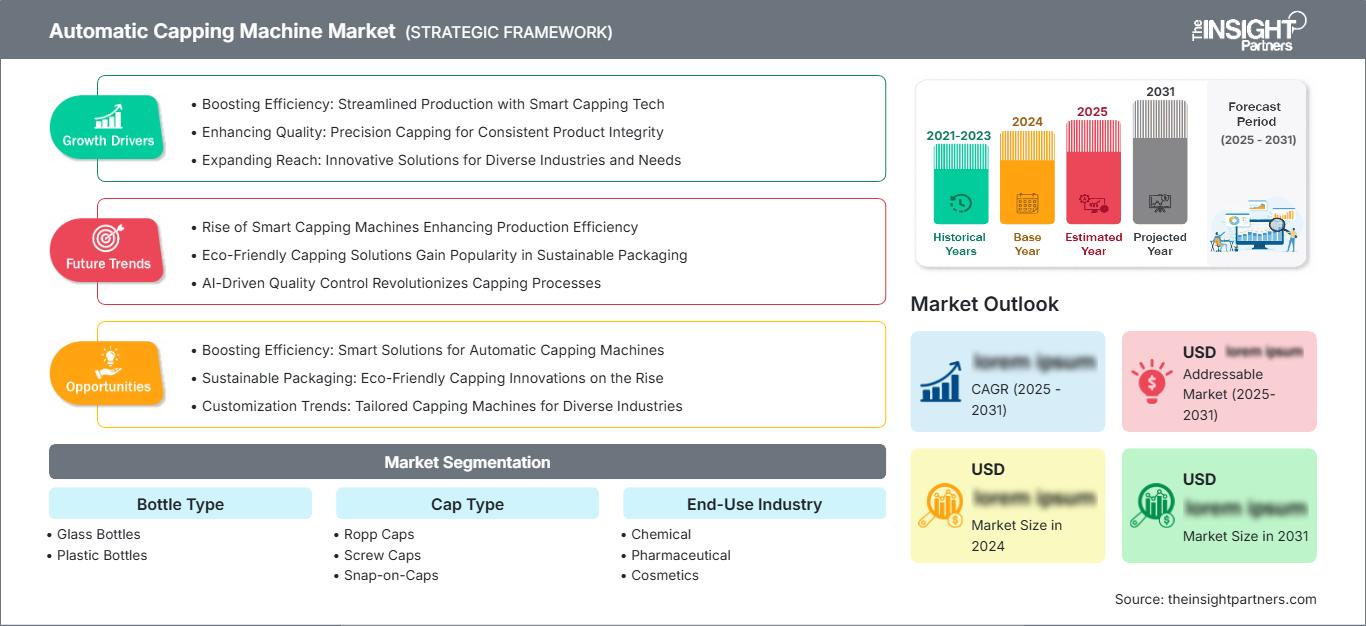
Regional Insights
North America Automatic Capping Machine Market
North America accounted for ~29% of the global Automatic Capping Machine Market in 2025 and is projected to grow at a ~5% CAGR through 2034. The region benefits from a mature installed base of packaging machinery and a large concentration of food, beverage, pharmaceutical, chemical, and personal-care manufacturers. Replacement demand is consequently important, with producers upgrading equipment to improve torque consistency, line availability, operator safety, and production flexibility. The US represents the primary demand center because of its extensive packaging manufacturing base and established automation ecosystem.
The food processing, beverages, consumer goods, and manufacturing companies based in Canada and Mexico complement the regional demand for machinery. It is common for the buyers to look for machines that would be able to integrate themselves into an already existing chain of conveyors, fillers, caps, inspection and control units. In such a way, the regional market operates under the concepts of modernization and customization.
U.S. Automatic Capping Machine Market
The US accounted for roughly 80% of the North American Automatic Capping Machine Market Share in 2025 and is estimated to witness a ~5% CAGR through 2034. The growth of the market is driven by well-developed automated packaging facilities and availability of specialized machinery. Machinery makers like Kinex Cappers, Accutek Packaging Equipment Companies, Federal Mfg. Co. and others offer different capabilities for different volumes of closures, types of closures and different containers. For the pharmaceutical and food industries, the equipment needs to be repeatable, hygienic and controllable, and for the chemical industry, the machinery needs to be strong and able to handle harsh materials.
Another driving force for the market in the US is the upgrade of older filling and packaging lines. As equipment makers consider their capping equipment in terms of the entire production process, such factors as cap handling, torque verification, line changeovers and equipment diagnostics become more important.
Europe Automatic Capping Machine Market
Europe held ~25% of the global Automatic Capping Machine Market in 2025 and is projected to expand at a ~5% CAGR through 2034. Germany is the leading country in Europe, supported by a strong industrial machinery ecosystem and extensive food, beverage, pharmaceutical, and chemical manufacturing. Italy is also important because of its packaging machinery capabilities and metal-closure ecosystem. France, the UK, and Spain contribute through established beverage, food, personal-care, and pharmaceutical production bases.
Requirements in Europe place more emphasis on precision, energy efficiency, hygiene, flexibility of equipment, and compatibility with evolving packaging formats. The Italian company, Tecnocap, specializes in its capping machines as well as in the production of automated equipment used to manufacture glass bottles and metal closures, whereas engineering customizations are typical of competitive packaging machinery companies in Europe. This region enjoys an already established installed base which leads to a large replacement market with investments geared towards servo control, quick changeover, better seal quality, and networking.
In the UK, there is a high level of specialist machinery with Karmelle producing filling, capping, and labeling machines. Both Spain and France can take advantage of their well-established beverage and consumer goods production industry whereas in the pharmaceutical industry, there is a need for controlled and repeatable closure application.
Segmentation Analysis
Bottle Type
Bottle Type encompasses Glass Bottles and Plastic Bottles. The segment is influenced by container material, neck finish, bottle geometry, product characteristics, and required closure force. Plastic containers support high-volume applications and flexible packaging formats, while glass remains important in beverages, pharmaceuticals, cosmetics, and selected chemical applications. The Automatic Capping Machine Market scope within this segment therefore depends on equipment flexibility and the ability to maintain closure integrity without damaging lightweight or rigid containers.
- Glass Bottles: Glass bottles remain important where product protection, chemical compatibility, premium presentation, or established beverage formats influence packaging selection. Capping systems must accommodate rigid containers and provide controlled closure placement without excessive force that could damage the bottle or closure.
- Plastic Bottles: Plastic bottles support large-scale beverage, chemical, pharmaceutical, household, and personal-care applications. Demand favors equipment capable of high throughput, flexible neck handling, controlled torque, and rapid format changes as manufacturers introduce different bottle sizes and lightweight packaging designs.
Cap Type
Cap Type is expected to expand at a ~7% CAGR through 2034. The segment is shaped by growing variation in closure designs and the need for equipment capable of precise application across multiple formats. ROPP, screw, snap-on, crown, and cork closures require different feeding, positioning, torque, or compression mechanisms. Equipment suppliers increasingly focus on changeover flexibility and controlled application to accommodate diverse packaging portfolios.
- Ropp Caps: ROPP caps are widely used where tamper evidence, controlled sealing, and metal closure performance are required. Equipment must accurately position and roll the closure onto the container while maintaining consistent thread formation and seal quality.
- Screw Caps: Screw caps represent a broad application category across beverages, food, chemicals, pharmaceuticals, and cosmetics. Automatic systems emphasize torque consistency, cap feeding, thread alignment, and rapid changeovers between container and closure formats.
- Snap-on-Caps: Snap-on caps require controlled downward force and accurate positioning rather than conventional screw tightening. Their use across consumer and household products creates demand for systems that can maintain consistent application while accommodating different cap geometries.
- Crown Caps: Crown caps remain associated with glass-bottle beverage applications and require dedicated capping mechanisms to apply pressure consistently. Equipment demand is tied to high-throughput bottling lines where repeatability and bottle handling are critical.
- Corks: Cork closures serve selected beverage, pharmaceutical, cosmetic, and specialty packaging applications. Capping and corking equipment must manage insertion or compression requirements while preserving closure integrity and avoiding container damage.
End-Use Industry
End-Use Industry is the largest main segment and is projected to grow at a ~6% CAGR through 2034. Food and beverage manufacturing contributes the largest demand base because of high-volume bottling requirements, while pharmaceutical and cosmetics applications place greater emphasis on controlled closure performance. Chemical manufacturers prioritize compatibility, durability, and safe sealing. The segment's outlook therefore reflects both production scale and application-specific packaging requirements.
- Chemical: Chemical packaging requires dependable sealing for products that may be corrosive, volatile, viscous, or sensitive to contamination. Equipment selection is influenced by material compatibility, container design, closure torque, safety requirements, and the need to limit leakage during storage and transportation.
- Pharmaceutical: Pharmaceutical applications prioritize repeatability, hygiene, controlled torque, tamper evidence, and validated packaging processes. Automated capping systems support consistent closure application for bottles containing medicines, nutraceuticals, and related products.
- Cosmetics: Cosmetics manufacturers use glass and plastic containers across skincare, haircare, fragrance, and personal-care products. Capping systems must balance visual quality with reliable sealing and frequently require flexibility to accommodate diverse bottle shapes and closure designs.
- Food and Beverages: Food and beverage is the largest end-use sub-segment because continuous bottling operations require high-throughput, repeatable closure application. Equipment demand spans water, carbonated beverages, sauces, oils, dairy products, and other packaged products using diverse bottle and cap configurations.
Opportunity Snapshot
| End-Use Industry | Revenue Contribution | Trend Tag | Adoption Stage |
| Chemical | Medium | Chemical Sealing | Scaling |
| Pharmaceutical | Medium | Precision Capping | Scaling |
| Cosmetics | Medium | Flexible Formats | Scaling |
| Food and Beverages | High | High-Speed Bottling | Mature |
Automatic Capping Machine Market Growth Drivers and Impact Analysis
Expansion of Automated Packaging Lines Across High-Volume Manufacturing
Manufacturers are increasing automation across filling, capping, labeling, inspection, and conveying because packaging operations must maintain consistent output while reducing manual intervention. Capping is a critical point in the line because poor closure placement can create leakage, contamination, product loss, and downstream quality failures. As production volumes increase, automated systems provide repeatable cap placement and controlled torque while reducing dependence on operator technique. The Automatic Capping Machine Market share is therefore closely linked to the broader modernization of liquid and solid-product packaging facilities. Integrated equipment also allows manufacturers to synchronize machine speeds and reduce bottlenecks. Demand is strongest where plants operate multiple shifts or handle standardized, high-volume packaging formats, making automation economically attractive through higher utilization, lower rework, and more predictable production performance.
Rising Requirements for Closure Integrity and Process Consistency
Packaging integrity has become an increasingly important purchasing criterion across food, beverage, pharmaceutical, cosmetics, and chemical applications. A closure must protect the product during storage and distribution while meeting application-specific requirements for tamper evidence, leak prevention, and shelf-life protection. Automatic capping equipment supports this requirement through controlled force, torque management, repeatable positioning, and machine-level monitoring. In pharmaceutical and chemical applications, these characteristics are particularly important because inconsistent sealing can create safety, compliance, or product-quality consequences. For food and beverage producers, stable closure application supports continuous production and reduces line interruptions. The resulting emphasis on measurable process performance is shifting equipment selection away from basic mechanical functionality toward systems that combine automation, monitoring, flexible tooling, and predictable operating parameters.
Growth of Flexible Packaging Production and Multi-Format Manufacturing
Manufacturers increasingly operate production lines that handle multiple bottle sizes, materials, and closure formats. This trend increases the value of capping machines capable of rapid changeovers and configurable tooling. Producers can reduce downtime when machines accommodate different cap diameters, container geometries, and application methods without extensive mechanical modification. The requirement is particularly relevant to cosmetics, specialty foods, chemicals, and pharmaceutical products, where product portfolios can contain numerous packaging configurations. Flexible equipment also reduces the need for dedicated machinery for every format, improving asset utilization and helping manufacturers manage smaller production batches. As packaging portfolios become more varied, suppliers that combine modular machine architecture, automated adjustment, cap feeding, and digital controls can address a wider range of applications within the same production environment.
Automatic Capping Machine Market Future Trends
Greater Integration of Smart Controls and In-Line Quality Monitoring
The Automatic Capping Machine Market trends are moving toward greater use of sensors, programmable controls, servo systems, and production monitoring. Future systems are likely to provide more detailed information on torque, closure presence, machine speed, faults, and changeover settings, allowing operators to identify deviations earlier. Integration with broader manufacturing-control systems can also support production records and predictive maintenance. For pharmaceutical and food applications, data visibility can strengthen quality assurance, while beverage and consumer-product manufacturers can use machine information to optimize throughput and minimize stoppages. The trend is not limited to new machines; retrofit packages can extend the capabilities of installed equipment by adding sensors, upgraded drives, control interfaces, and monitoring functions. This creates a parallel modernization opportunity in mature markets with large installed equipment bases.
Equipment Adaptation to Lightweight and More Sustainable Closures
Closure and container designs are evolving as manufacturers seek material efficiency and improved recyclability. Lighter bottles and closures can reduce material consumption, but they may also narrow operating tolerances during capping. Equipment must therefore apply sufficient force or torque to achieve reliable sealing without deforming the container or closure. Future machines are expected to emphasize precise control, adaptive settings, improved changeover mechanisms, and tooling designed for newer packaging formats. Closure suppliers are also introducing designs that can integrate with existing filling and capping infrastructure, reducing the need for complete line replacement. This interaction between packaging-material innovation and machinery capability is expected to encourage equipment suppliers to develop more configurable systems that can accommodate changing closure specifications without compromising production reliability.
Automatic Capping Machine Market Opportunities
Smart Retrofit Solutions for Existing Packaging Lines
A significant opportunity lies in upgrading existing filling and packaging lines rather than replacing complete systems. Many established plants can improve capping performance through new capping heads, servo drives, torque-control systems, sensors, cap feeders, machine interfaces, and upgraded control software. Such retrofits can address inconsistent closure application, extended changeover times, equipment obsolescence, and limited production visibility while preserving usable conveyors and upstream machinery. Suppliers that provide engineering assessment, testing, installation, validation, and aftermarket support can develop recurring revenue relationships with established manufacturers. The opportunity in the Automatic Capping Machine Market forecast is particularly relevant in North America and Europe, where mature installed bases create a substantial modernization requirement. In emerging manufacturing centers, modular retrofit packages can also help plants transition from semi-automatic equipment to higher levels of automated operation without requiring an immediate full-line investment.
Integrated Capping Platforms for Pharmaceutical and Specialty Packaging
Pharmaceutical, nutraceutical, cosmetic, and specialty chemical producers offer opportunities for customized capping platforms that combine closure feeding, precision application, inspection, and production data capture. These applications often require tighter control of sealing parameters than conventional high-volume packaging. Equipment suppliers can differentiate through validated operating procedures, hygienic machine construction, flexible tooling, rapid changeover, and service capabilities. CSI's 2025 introduction of a lightweight child-resistant closure platform illustrates how closure development can create corresponding requirements for compatible capping and filling equipment. Suppliers that collaborate with closure manufacturers and end users during equipment design can improve compatibility and shorten commissioning cycles. This opportunity also supports higher-value aftermarket services because specialized applications require periodic tooling replacement, calibration, process verification, and technical support.
Recent Developments
- October 2025: Accutek Packaging Equipment Companies, Inc. Accutek published updated guidance on automating the capping process, emphasizing the role of automated capping in improving throughput, consistency, torque control, and integration with filling systems. The company highlighted automation as a response to production growth and manual capping bottlenecks, reinforcing the industry's movement toward integrated packaging lines.
- August 2025: Closure Systems International. CSI introduced the Defender-Lok child-resistant closure platform for over-the-counter and nutraceutical applications. The lightweight closure was designed for integration with existing filling and capping lines and incorporates recycled-content resin, reflecting the intersection of closure safety, sustainability, and capping-equipment compatibility.
- July 2025: Closure Systems International. CSI detailed its capping-equipment portfolio covering high-throughput capping machines, cap handling systems, precision headsets and chucks, and spare-parts support. The company emphasized torque accuracy, closure integrity, uptime, and support across beverage, food, household, and industrial packaging applications.
Frequently Asked Questions

- Comprehensive Market Sizing and Forecast Analysis
- Detailed Segmentation Analysis
- In-Depth Market Dynamics Assessment
- Regional and Country-Level Insights
- Competitive Landscape and Company Benchmarking
- Strategic Business Intelligence
Recent Reports
Testimonials

The Insight Partners provided valuable market intelligence that supported our global go-to-market strategy. Their team was professional, responsive, and attentive to our feedback, providing thoughtful analysis and helpful methodological clarifications throughout the project.
Junmo Kim Chief Financial Officer (CFO), Enertech Co., Ltd.
The Insight Partners' SCADA System Market report is comprehensive, with valuable insights on current trends and future forecasts. The team was highly professional, responsive, and supportive throughout. We are very satisfied and highly recommend their services.
RAN KEDEM Partner, Reali Technologies LTDs
I requested a report on a very specific software market and the team produced the report in a few days. The information was very relevant and well presented. I then requested some changes and additions to the report. The team was again very responsive and I got the final report in less than a week.
JEAN-HERVE JENN Chairman, Future Analytica
We worked with The Insight Partners for an important market study and forecast. They gave us clear insights into opportunities and risks, which helped shape our plans. Their research was easy to use and based on solid data. It helped us make smart, confident decisions. We highly recommend them.
PIYUSH NAGPAL Sr. Vice President, High Beam Global
The Insight Partners delivered insightful, well-structured market research with strong domain expertise. Their team was professional and responsive throughout. The user-friendly website made accessing industry reports seamless. We highly recommend them for reliable, high-quality research services
YUKIHIKO ADACHI CEO, Deep Blue, LLC.
This is the first time I have purchased a market report from The Insight Partners.While I was unsure at first, I visited their web site and felt more comfortable to take the risk and purchase a market report.I am completely satisfied with the quality of the report and customer service. I had several questions and comments with the initial report, but after a couple of dialogs over email with their analyst I believe I have a report that I can use as input to our strategic planning process.Thank you so much for taking the extra time and making this a positive experience.I will definitely recommend your service to others and you will be my first call when we need further market data.
JOHN SUZUKI President and Chief Executive Officer, Board Director, BK Technologies
I wish to appreciate your support and the professionalism you displayed in the course of attending to my request for information regarding to infectious disease IVD market in Nigeria. I appreciate your patience, your guidance, and the fact that you were willing to offer a discount, which eventually made it possible for us to close a deal. I look forward to engaging The Insight Partners in the future, all thanks to the impression you have created in me as a result of this first encounter.
DR CHIJIOKE ONYIA MANAGING DIRECTOR, PineCrest Healthcare Ltd.Reason to Buy
- Informed Decision-Making
- Understanding Market Dynamics
- Competitive Analysis
- Identifying Emerging Markets
- Customer Insights
- Market Forecasts
- Risk Mitigation
- Boosting Operational Efficiency
- Strategic Planning
- Investment Justification
- Tracking Industry Innovations
- Aligning with Regulatory Trends





 Get Free Sample for