
Automatic Palletizer and Depalletizer Market Size, Share & Forecast by 2034
Coverage: By Type (Palletizer, Depalletizer); Industry Vertical (Food and Beverage, Pharmaceutical and Personal Care, Chemicals, Others) , and Geography (North America, Europe, Asia Pacific, and South and Central America)
- Status : Data Released
- Report Code : TIPRE00007909
- Category : Manufacturing and Construction
- No. of Pages : 150
- Available Report Formats :


- Last update date : August 26, 2026


2025 Market Size
US$ 1.24 Bn
Base year value
2034 Forecast
US$ 1.99 Bn
Projected by 2034
CAGR 2026-2034
5.43 %
Growth rate
Addressable Market
US$ 14.67 Bn
(2026-2034)
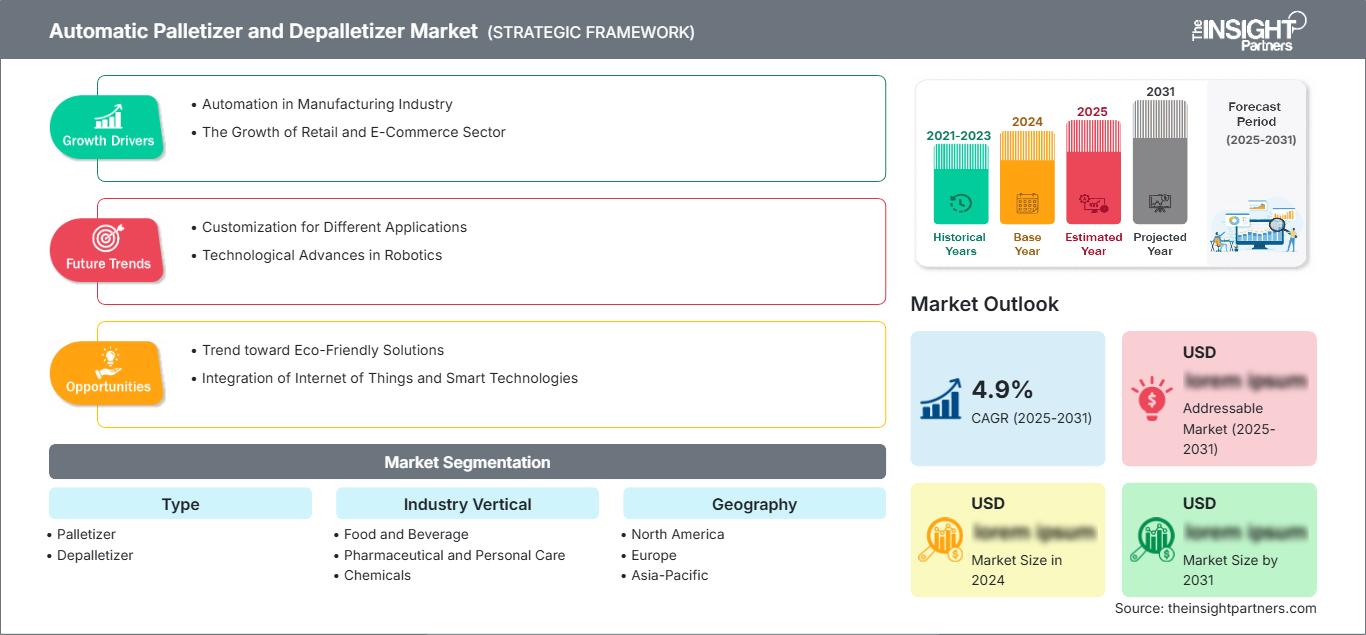
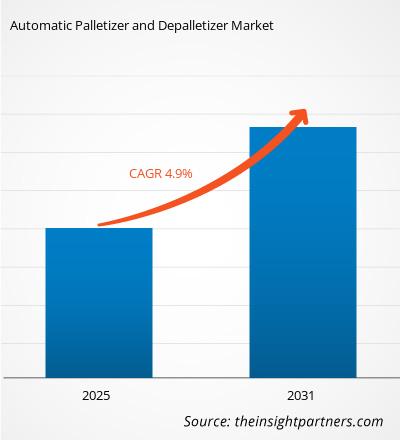
The automatic palletizer and depalletizer market was valued at US$ 1.24 Billion in 2025 and is expected to reach US$ 1.99 Billion by 2034. It is projected to register a CAGR of 5.43% during 2026–2034. Demand reflects manufacturers’ need to automate repetitive end-of-line handling while sustaining throughput, load consistency, and safer operations across production and distribution environments.
North American automatic palletizer and depalletizer market size expansion is modeled at a 5.0–5.5% CAGR through 2034, supported by persistent manufacturing labor constraints and modernization of food, beverage, pharmaceutical, and distribution facilities. Buyers increasingly favor modular robotic cells, digital monitoring, and retrofit-compatible controls that shorten commissioning, accommodate greater SKU variability, and reduce ergonomic exposure without requiring complete packaging-line replacement.
Automatic Palletizer and Depalletizer Market Assessment and Insights
- North America: Accounted for 32–34% share in 2025 and is projected to grow at 5.0–5.5% CAGR during 2026–2034 as plants automate end-of-line handling and retrofit brownfield packaging assets.
- US: Represented 78–82% of North America in 2025 and is expected to expand at 5.1–5.6% CAGR through 2034 on reshoring and warehouse automation.
- Europe: Held 26–28% share in 2025 and is forecast at 4.6–5.1% CAGR during 2026–2034, led by Germany, the UK, France, Italy, and Spain.
- Asia Pacific: Captured 29–31% of the Automatic Palletizer and Depalletizer Market in 2025 and should record 6.1–6.6% CAGR through 2034, with China, Japan, South Korea, India, and Australia supporting adoption.
- Largest Segment: Palletizer held 64–68% market share in 2025 and is projected to grow at 5.1–5.6% CAGR during 2026–2034.
- High Growth Segment: Depalletizer represented 32–36% in 2025 and is forecast to expand at 5.8–6.3% CAGR during 2026–2034.
- Key companies analyzed in detail: ABB Ltd., A-B-C Packaging Machine Corporation, American-Newlong, Inc., Arrowhead Systems, Inc., BEUMER Group GmbH & Co. KG, Columbia Machine, Inc., FANUC Corporation, KUKA AG, Ouellette Machinery Systems, Inc., and Yaskawa Electric Corporation.
Source: The Insight Partners' analysis based on proprietary research, government publications, company annual reports, investor presentations, industry databases, and expert interviews.
Equipment technology has advanced from rigid-patterned mechanical stackers to more flexible robotic cells featuring machine vision, servomotion, recipe management, and line level communication. In today’s production environment, the need for rapid format changes, mixed case handling, and pallet dispensers, conveyors, stretch wrapping, and inspection is increasingly valued. The automatic palletizer and depalletizer business consequently involves robot manufacturers, special purpose machinery manufacturers, gripper manufacturers, system integrators, controls providers, and after-market service firms. Modularity is reducing implementation risks, and predictive diagnostics and remote support are enhancing machine availability in multi-shift facilities.
Until 2034, capital investment is expected to expand from highly automated North American, Western European, Japanese, and Korean locations to India, Southeast Asia, the Middle East, and select African manufacturing regions. Regulations on food safety, pharmaceutical traceability, worker protection, and government subsidies will strengthen demand. Investment will value scalability, standard interfaces, low-energy drives, and service agreements that safeguard the total cost of ownership. Local capability in engineering, spare parts, training, and financing will give these suppliers an edge in converting interest in the emerging markets.
Automatic Palletizer and Depalletizer Market Report Scope
| Report Attribute | Details |
|---|---|
| Market size in 2025 | US$ 1.24 Billion |
| Market Size by 2034 | US$ 1.99 Billion |
| Global CAGR (2026 - 2034) | 5.43% |
| Historical Data | 2021-2024 |
| Forecast period | 2026-2034 |
Automatic Palletizer and Depalletizer Market Analysis
The automatic palletizers and depalletizers industry growth factors are linked to labor availability, ergonomics considerations, and increasing product output complexity. According to the International Federation of Robotics data, there are 542,000 industrial robots installed in 2024 and 4.664 million units in operation globally, pointing at a well-developed automation industry infrastructure. High number of SKUs and small batch sizes increase costs for manual changeover of pattern.
Value delivery ranges from robot arm and frame construction to vision system, gripper, safety devices, control software, integration, installation, commissioning, and life-cycle services. The supplier faces risks related to availability of servo motors, control systems, sensors, and engineering expertise. Purchasers also consider installed support, parts procurement lead times, software compatibility, and simulation capabilities along with cost of equipment itself. An integrator with reusable cell design can reduce engineering time and improve profit margins.
The Automatic Palletizer and Depalletizer Market analysis points to competition among global robotics solutions and application-specific packaging vendors. The vendors such as ABB Ltd., FANUC Corporation, KUKA AG, and Yaskawa Electric Corporation are able to take advantage of flexibility of robots, while A-B-C Packaging Machine Corporation, Columbia Machine, Inc., and BEUMER Group GmbH & Co. KG possess comprehensive engineering capability and vertical specialization.
CapEx investments are shifting to configure-ability, digital twins, machine vision, and subscription revenues. Arrowhead Systems, Inc., American-Newlong, Inc., and Ouellette Machinery Systems, Inc. have competitive advantage through customize-ability and installed base advantage. Competitive advantage is increasingly dependent on cycle performance validation, flexible grippers, hygienic/dusty applications, and control retrofits. Cooperation between robot suppliers, integrators, and conveyors is reducing risks of execution and broadening customer reach.
● REPORT CUSTOMIZATION
Tailor This Report To Align With Your Specific Business Requirements
This report can be customized to align precisely with your business objectives, scope, and target markets. Customization options include tailored segmentation, geography, competitive analysis, and strategic insights to support informed decision-making.
Customize This Report →WHAT YOU CAN ADJUST
- ● Segmentations
- ● Geography
- ● Competitive Analysis
- ● Language Preferences
Automatic Palletizer and Depalletizer Market: Strategic Insights
Regional Insights
North America automatic palletizer and depalletizer market
North America held 32–34% of global revenue in 2025, with a modeled 5.0–5.5% CAGR for 2026–2034. The automatic palletizer and depalletizer market shares are impacted by the substantial presence of automated packaging equipment for food, beverages, consumer health products, and chemicals. The lack of labor, ergonomic requirements, and the need to improve overall equipment efficiency favor robotic cells and layer palletizers.
Regional market demand is further fueled by reshoring, warehouse expansion, and automation integrator expertise. Vision-guided depalletizing, multiple SKU pallet handling, digital simulation, and upgradeable controls have become key considerations. Canada is a market because of its food processing and industrial packaging, while Mexico is a market due to beverages, consumer goods, and export manufacturing projects.
U.S. Automatic Palletizer and Depalletizer Market
The U.S. represented 78–82% of North American demand in 2025 and is modeled to expand at a 5.1–5.6% CAGR through 2034. Its competitive strength stems from the high concentration of beverages, packaged foods, drugs, cosmetics, and logistics capabilities. In 2024, the nation deployed 34,200 industrial robots. This indicates that the country has an understanding of robotics as well as an integration infrastructure.
Companies such as ABB Ltd., FANUC Corporation, KUKA AG, Columbia Machine, Inc., Arrowhead Systems, Inc., and A-B-C Packaging Machine Corporation provide their products and services within the nation. Modern projects tend to use packaging, labeling, palletizing, stretch wrapping, and warehouse transfer under one control system. There is demand for this where labor-intensive processes have repetitive lifting, multi-shift production, or need to change patterns frequently.
Europe Automatic Palletizer and Depalletizer Market
Europe captured 26–28% share in 2025 and is projected to grow at 4.6–5.1% CAGR through 2034. Germany excels through complex machines production, chemicals, food, and pharmaceutical manufacturing; advanced robot implementation; and good engineering standards. Procurement is affected by energy savings, machine safety, and the life-cycle serviceability of machines, whereas the replacement of old fixed automation causes retrofit needs.
The UK market is defined by food processing, beverage processing, retail distribution, and labor-saving purchases, with customers looking for compact cells and diagnostic solutions at a distance. Germany prefers highly productive and interoperable systems that benefit from simulation technologies and automation platforms. The French, Italian, and Spanish markets provide additional business chances in beverages, dairy products, cosmetics, chemicals, and contract packaging, where flexibility of formats and soft product handling are important.
APAC Automatic Palletizer and Depalletizer Market
APAC held 29–31% share in 2025 and is forecast at 6.1–6.6% CAGR through 2034. China leads on manufacturing scale and robot deployment, while Japan and South Korea contribute advanced robotics, electronics, and precision integration capabilities.
India’s record 9,100 industrial robot installations in 2024 and expanding packaged-goods capacity support faster adoption. Australia emphasizes automation in food, beverage, and warehousing. Industrial policy, local robot production, rising wages, export-quality requirements, and new factories increasingly favor modular cells with localized engineering and service.
Middle East & Africa Automatic Palletizer and Depalletizer Market
MEA is modeled to grow at 5.5–6.0% CAGR through 2034, led by Saudi Arabia. Programmes for diversification, petrochemicals downstream investments, initiatives for food security and new logistics facilities require palletising systems that can handle dusty, hot and fast moving environments.
UAE focuses on modern logistics and handling of consumer goods whereas South Africa requires packaging for foodstuffs, beverages, chemicals and minerals. The rest of MEA remains project driven. Companies with remote assistance, training, robust components and regional spares are well placed where there are no specialized engineering resources available.
Segmentation Analysis
Type
The automatic palletizer and depalletizer market scope by type covers palletizer and depalletizer systems. The main type segment is projected to expand at a 5.3–5.8% CAGR during 2026–2034. Palletizers dominate installed demand because nearly every outbound packaging line requires unit-load formation, while depalletizers gain relevance in inbound logistics, can handling, mixed-case distribution, and automated production feeding.
- Palletizer: This sub-segment holds the leading position through broad use in cartons, bags, trays, cases, and containers, with mechanical and robotic architectures addressing different speed, flexibility, and payload requirements.
- Depalletizer: Adoption is rising where inbound loads must be separated safely and accurately, especially in beverage, warehousing, and mixed-SKU operations requiring vision, layer handling, or adaptive gripping.
Industry Vertical
The industry vertical segment is modeled at a 5.4–5.9% CAGR during 2026–2034. Food and beverage remains the anchor vertical because high line speeds, repetitive case handling, hygiene, and product protection make automation economically compelling. Pharmaceutical and personal care values validation and traceability, while chemicals require robust handling for bags, pails, drums, and dust-prone environments.
- Food and Beverage: The leading demand pool prioritizes sanitary construction, gentle container handling, rapid format change, and continuous throughput across beverage, dairy, bakery, frozen food, and packaged-grocery lines.
- Pharmaceutical and Personal Care: Demand centers on repeatability, line clearance, serialized workflows, and controlled handling, making compact cells and documented software changes strategically important for regulated production and contract manufacturing.
- Chemicals: Producers require durable systems for sacks, cartons, pails, and drums, with dust control, hazardous-area options, stable load formation, and dependable operation central to investment decisions.
Opportunity Snapshot
| Industry Vertical | Revenue Contribution | Trend Tag | Adoption Stage |
| Food and Beverage | High | Hygienic Automation | Mature |
| Pharmaceutical and Personal Care | Medium | Validated Handling | Scaling |
| Chemicals | Medium | Bag Palletizing | Scaling |
| Others | Low | Flexible Cells | Emerging |
Automatic Palletizer and Depalletizer Market Growth Drivers and Impact Analysis
Labor Scarcity and Ergonomic Risk Reduction
Pallet handling that requires repetitive lifting is strenuous and hard to staff through multiple shifts; absenteeism or turnover can cause problems. Automation involves heavy and frequent lifting to be performed by machinery while an operator oversees the process, restocks supplies, handles exceptions and conducts quality assurance. The benefits are most relevant to food and beverages, chemicals, and distribution where the movement of cases, bags and containers occurs continuously. Potential buyers are starting to factor the system cost against overtime, risk of injuries, recruitment expenses, and reduction in productivity. This widens the economic justification for robot cells and retrofits. Providers that quantify the cycle time, assumptions on uptime, required training, and maintenance can assist in developing a realistic cost model.
Rising SKU Complexity and Shorter Production Runs
Choice by the consumer, private labels, seasonal packs, and channel-specific pack configurations result in more cases and pack patterns that enter the facility. Although fixed automation is still useful for constant patterns and high volume products, robotic cells start adding value if there are often changes in the recipe, and many production lines use the same palletizer. Vision, automatic tool change, gripper configuration, and pattern creation through software allow less manual intervention, thus maintaining productivity while making the transition from one recipe to another. There are other consequences that go beyond productivity, such as reduced damage to products, improved use of space on trailers, and smooth operation down stream.
Integrated End-of-Line Automation Investment
Palletizing is now being considered by manufacturers as one point in a whole end-of-line system rather than as a stand-alone machine. There should be coordination of case packing, inspection, labeling, conveyer control, pallet provision, wrapping, and transfer into warehouses to avoid bottlenecks. Thus there is a need for common controls, compatible software, line diagnostics, and overall accountability. Integrating a project will lead to increased order value for machine builders and lower interface risks for the customers but at the same time, such integration will increase the complexities of execution. Service opportunities arise out of interconnected installations via condition monitoring, remote troubleshooting, software updating, and performance improvement leading to increased availability of assets.
Automatic Palletizer and Depalletizer Market Future Trends
Adaptive Vision and AI-Assisted Handling
The automatic palletizer and depalletizer market trends will increasingly center on perception software that identifies irregular cases, damaged cartons, reflective surfaces, and unfamiliar pallet patterns. The robotic depalletizer from ABB already integrates machine vision and software for variable boxes and pallets, showing where the technology is going. Future depalletizers need to focus on confidence scoring, exception processing, and autonomous self-recovery and not just path execution. Enhanced perception capabilities will help take depalletizing into more unstructured environments and cut engineering effort for new SKUs. In business terms, equipment suppliers could offer pre-validated machine vision modules, simulation results, and software subscriptions along with the hardware, while integrators create application templates.
Lifecycle Intelligence and Outcome-Based Service
Condition monitoring will evolve from alarm dashboards toward recommendations tied to wear, cycle history, energy consumption, and production schedules. BEUMER Guardian’s 2025 introduction demonstrates growing supplier emphasis on data diagnostics for end-of-line packaging systems. Customers will increasingly expect remote triage, planned maintenance windows, and benchmarking that links equipment behavior to throughput or downtime. This supports subscription, pay-per-use, and performance-linked commercial models, particularly where customers want automation benefits without building deep internal robotics teams. Winning suppliers will need secure connectivity, transparent data governance, and service organizations capable of converting machine data into timely interventions across geographically dispersed installed bases.
Automatic Palletizer and Depalletizer Market Opportunities
Brownfield Retrofit Packages for Mid-Sized Manufacturers
Many plants cannot justify replacing otherwise serviceable conveyors, wrappers, or packaging machines. The automatic palletizer and depalletizer market forecasts therefore support investment in standardized retrofit cells that preserve existing layouts while adding modern robots, controls, guarding, and digital diagnostics. Suppliers should develop site-assessment tools, pre-engineered cell families, fast-installation plans, and financing options aligned with planned shutdowns. KUKA’s retrofit work replacing an aging palletizing robot while retaining the established system layout illustrates the practical need. The opportunity is especially attractive among regional food, beverage, personal care, and chemical producers that require flexibility but lack large automation teams. Clear upgrade paths and guaranteed spare-parts strategies can lower perceived lifecycle risk.
Localized Engineering and Service in Emerging Markets
Asia, the Middle East, and selected African markets combine new factory investment with uneven access to specialized integration skills. Suppliers can capture more projects by pairing global platforms with local application engineering, training centers, spare-parts hubs, and remote support. BEUMER Group’s 2025 India manufacturing investment and 2026 Taicang expansion indicate how proximity can shorten delivery and strengthen customer confidence. Market entry should prioritize food, beverage, chemicals, and consumer goods clusters where standardized pallet loads and higher line speeds create visible returns. Partnerships with regional conveyor builders and system integrators can reduce installation risk, while modular products enable customers to begin with one cell and scale as volumes increase.
Recent Developments
- September 2025: BEUMER Group GmbH & Co. KG – Delivered three high-speed form-fill-seal packaging lines to Packwell in Texas, including industrial palletizers, stretch hood machines, conveyors, and polymer-handling equipment. The multi-million-dollar implementation targeted higher petrochemical packaging capacity and illustrates demand for integrated, full-line systems rather than standalone palletizing assets.
- March 2025: FANUC Corporation – Presented new warehouse applications at ProMat 2025, including full-layer depalletizing with the M-410/800F-32C robot and R-50iA controller, plus cart-to-cart palletizing and depalletizing using AI box detection and 3D vision. The demonstrations emphasized heavy payloads and difficult edge recognition.
- January 2025: KUKA AG – Introduced four palletizing robots across the KR FORTEC PA and KR FORTEC ultra PA families. Payload capacities extend to 500 kg and 800 kg respectively, while modular components, energy-conscious operation, and compatibility with linear axes address heavy-duty applications spanning beverage containers, drums, and construction materials.
Frequently Asked Questions

- Comprehensive Market Sizing and Forecast Analysis
- Detailed Segmentation Analysis
- In-Depth Market Dynamics Assessment
- Regional and Country-Level Insights
- Competitive Landscape and Company Benchmarking
- Strategic Business Intelligence
Recent Reports
Testimonials

The Insight Partners' SCADA System Market report is comprehensive, with valuable insights on current trends and future forecasts. The team was highly professional, responsive, and supportive throughout. We are very satisfied and highly recommend their services.
RAN KEDEM Partner, Reali Technologies LTDs
I requested a report on a very specific software market and the team produced the report in a few days. The information was very relevant and well presented. I then requested some changes and additions to the report. The team was again very responsive and I got the final report in less than a week.
JEAN-HERVE JENN Chairman, Future Analytica
We worked with The Insight Partners for an important market study and forecast. They gave us clear insights into opportunities and risks, which helped shape our plans. Their research was easy to use and based on solid data. It helped us make smart, confident decisions. We highly recommend them.
PIYUSH NAGPAL Sr. Vice President, High Beam Global
The Insight Partners delivered insightful, well-structured market research with strong domain expertise. Their team was professional and responsive throughout. The user-friendly website made accessing industry reports seamless. We highly recommend them for reliable, high-quality research services
YUKIHIKO ADACHI CEO, Deep Blue, LLC.
This is the first time I have purchased a market report from The Insight Partners.While I was unsure at first, I visited their web site and felt more comfortable to take the risk and purchase a market report.I am completely satisfied with the quality of the report and customer service. I had several questions and comments with the initial report, but after a couple of dialogs over email with their analyst I believe I have a report that I can use as input to our strategic planning process.Thank you so much for taking the extra time and making this a positive experience.I will definitely recommend your service to others and you will be my first call when we need further market data.
JOHN SUZUKI President and Chief Executive Officer, Board Director, BK Technologies
I wish to appreciate your support and the professionalism you displayed in the course of attending to my request for information regarding to infectious disease IVD market in Nigeria. I appreciate your patience, your guidance, and the fact that you were willing to offer a discount, which eventually made it possible for us to close a deal. I look forward to engaging The Insight Partners in the future, all thanks to the impression you have created in me as a result of this first encounter.
DR CHIJIOKE ONYIA MANAGING DIRECTOR, PineCrest Healthcare Ltd.Reason to Buy
- Informed Decision-Making
- Understanding Market Dynamics
- Competitive Analysis
- Identifying Emerging Markets
- Customer Insights
- Market Forecasts
- Risk Mitigation
- Boosting Operational Efficiency
- Strategic Planning
- Investment Justification
- Tracking Industry Innovations
- Aligning with Regulatory Trends





 Get Free Sample for