
Automotive Acoustic Engineering Services Market Trends, Size & Growth by 2034
Coverage: By Solution Type (Physical Testing, Virtual Testing); Application (Powertrain, Drivetrain, Body and Structure, Interior); Software (Calibration, Signal Analysis, Simulation, Vibration); Vehicle Type (Light Duty Vehicle, Heavy Duty Vehicle, Electric and Hybrid Vehicle), and Geography
- Status : Data Released
- Report Code : TIPAT00002204
- Category : Automotive and Transportation
- No. of Pages : 150
- Available Report Formats :


- Last update date : August 26, 2026


2025 Market Size
US$ 5.91 Bn
Base year value
2034 Forecast
US$ 11.26 Bn
Projected by 2034
CAGR 2026-2034
7.43 %
Growth rate
Addressable Market
US$ 77.42 Bn
(2026-2034)
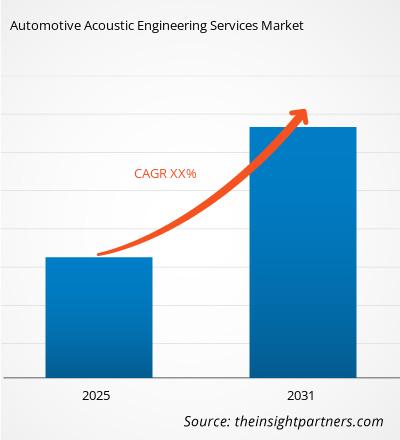
The Automotive acoustic engineering services market is witnessing increasing demand as vehicle manufacturers prioritize cabin comfort, electric mobility refinement, and compliance with tightening global noise regulations. The automotive acoustic engineering services market was valued at US$ 5.91 Billion in 2025 and is projected to reach US$ 11.26 Billion by 2034, expanding at a CAGR of 7.43% during 2026–2034. Continuous investments in vehicle electrification, digital engineering, and advanced simulation technologies are strengthening the long-term outlook for acoustic development services across passenger and commercial vehicle platforms.
North America remains a significant innovation hub owing to the concentration of global automotive OEMs, engineering service providers, and technology developers. The automotive acoustic engineering services market size across the region is supported by increasing electric vehicle production, stricter vehicle noise regulations, and rising adoption of virtual engineering workflows. The regional market is expected to expand at a CAGR ranging between 6.8% and 7.4% through 2034 as manufacturers accelerate investments in lightweight, quieter, and digitally optimized vehicle architectures.
Automotive Acoustic Engineering Services Market Assessment and Insights
- North America: Accounted for 34–37% share in 2025 and is anticipated to expand at a CAGR of 6.8–7.4% during 2026–2034, supported by strong automotive R&D expenditure, established engineering service ecosystems, and increasing electric vehicle development programs.
- US: Represented 78–82% of the North American market in 2025 and is projected to register a CAGR of 6.9–7.5% through 2034, driven by continuous investment in vehicle NVH optimization and software-based acoustic validation.
- Europe: Held 28–31% share in 2025 while advancing at a CAGR of 7.1–7.7% between 2026 and 2034. Germany, France, Italy, and the UK continue leading engineering innovation supported by premium vehicle manufacturing and regulatory emphasis on passenger comfort.
- Asia Pacific: Accounted for 25–28% share in 2025 and is forecast to grow at a CAGR of 8.2–8.8% through 2034. China, Japan, South Korea, and India remain key contributors owing to expanding EV production and growing engineering outsourcing activities.
- Largest Segment: Physical Testing represented 55–59% market share in 2025 and is expected to record a CAGR of 6.6–7.2%, supported by regulatory certification requirements and real-world vehicle validation.
- High Growth Segment: Electric and Hybrid Vehicles accounted for 28–32% market share in 2025 and are anticipated to expand at a CAGR of 9.4–10.1%, reflecting growing demand for advanced acoustic optimization in electrified mobility platforms.
- Key companies analyzed in detail: AVL List GmbH, STS Group AG, Siemens Digital Industries Software, IAV GmbH, Schaeffler AG, Autoneum Holding AG, EDAG Engineering GmbH, Bertrandt AG, Continental AG, Brüel & Kjær.
Source: The Insight Partners' analysis based on proprietary research, government publications, company annual reports, investor presentations, industry databases, and expert interviews.
Vehicle Acoustic Engineering has come a long way from traditional noise suppression and towards optimizing sound quality engineering that forms part of the product development process. The use of digital twins, cloud-based simulations, and artificial intelligence-assisted NVH simulations has helped reduce reliance on physical prototyping and enhanced engineering precision. Companies are now using virtual simulations and focused physical tests in the development of their vehicles to achieve shorter development cycles, increased passenger comfort, and optimal component integration for traditional and electrified vehicles.
The anticipated future growth of the industry will be driven by additional engineering investment in the Asia Pacific and chosen Middle Eastern automotive production centers. Government campaigns aimed at reducing noise pollution in urban areas, the continued adoption of software-defined vehicles, and collaborations between Original Equipment Manufacturers (OEMs) and specialized engineering companies are driving the adoption of advanced acoustic engineering solutions.
Automotive Acoustic Engineering Services Market Report Scope
| Report Attribute | Details |
|---|---|
| Market size in 2025 | US$ 5.91 Billion |
| Market Size by 2034 | US$ 11.26 Billion |
| Global CAGR (2026 - 2034) | 7.43% |
| Historical Data | 2021-2024 |
| Forecast period | 2026-2034 |
Automotive Acoustic Engineering Services Market Analysis
Growing demand for quieter passenger cabins, improved driving refinement, and enhanced electric vehicle user experiences continues to accelerate automotive acoustic engineering services market growth across global automotive production. The transition toward electrified mobility has eliminated traditional engine noise, making secondary sounds from tires, wind interaction, drivetrains, and auxiliary systems increasingly noticeable. Consequently, manufacturers are investing more heavily in advanced noise, vibration, and harshness engineering throughout vehicle development.
The engineering eco-system has grown to become much more collaborative in nature, with OEMs, tier one suppliers, specialists in digital simulation, software programmers, and test facilities all working as part of an integrated engineering process. The increased use of virtual prototypes means that acoustic problems can be identified early on and the cost of developing products is kept low through reduced prototyping.
Competitive positioning within the automotive acoustic engineering services market analysis is increasingly determined by digital engineering capabilities, software integration expertise, and global validation infrastructure. AVL List GmbH, Siemens Digital Industries Software, Continental AG, Bertrandt AG, EDAG Engineering GmbH, and IAV GmbH continue expanding simulation capabilities, while Autoneum Holding AG and Brüel & Kjær strengthen comprehensive NVH development solutions for vehicle manufacturers worldwide.
The focus on investment is gradually shifting towards AI, simulation environments through clouds, digital twins, and vehicle development platforms. Collaborations among automotive OEMs and experts in engineering help in shortening the product development cycle while enhancing acoustic performance. Another trend includes the expansion of regional engineering centers due to increased demand from electric vehicle companies in the Asia Pacific and North America.
● REPORT CUSTOMIZATION
Tailor This Report To Align With Your Specific Business Requirements
This report can be customized to align precisely with your business objectives, scope, and target markets. Customization options include tailored segmentation, geography, competitive analysis, and strategic insights to support informed decision-making.
Customize This Report →WHAT YOU CAN ADJUST
- ● Segmentations
- ● Geography
- ● Competitive Analysis
- ● Language Preferences
Automotive Acoustic Engineering Services Market: Strategic Insights
Regional Insights
North America Automotive Acoustic Engineering Services Market
North America accounted for 34–37% of the global market in 2025 and is projected to expand at a CAGR of 6.8–7.4% during 2026–2034. The automotive acoustic engineering services market share in the region is supported by strong vehicle engineering capabilities, increasing electric vehicle production, and continuous investment in advanced NVH laboratories. OEMs increasingly integrate simulation-driven acoustic validation into early vehicle development to reduce costs while meeting stricter customer expectations regarding ride refinement and interior comfort.
The United States and Canada continue investing in software-defined vehicle platforms that require sophisticated acoustic optimization across propulsion systems, lightweight body structures, and electronic components. Collaboration between engineering firms, software providers, and Tier-1 suppliers supports continuous innovation. Government support for domestic EV manufacturing and expansion of automotive R&D facilities further strengthens regional demand for engineering services focused on vehicle sound quality and vibration control.
U.S. Automotive Acoustic Engineering Services Market
The United States represented 78–82% of the North American market in 2025 and is expected to register a CAGR of 6.9–7.5% through 2034. The nation boasts some of the top engineering centers for automotive engineering, state-of-the-art testing facilities, and acoustic optimization software development capabilities in passenger cars, commercial vehicles, and future electric vehicles. Increased use of virtual validation tools is leading to increased efficiency in the development process while lowering the costs of prototypes.
Key engineering firms like AVL List GmbH, Siemens Digital Industries Software, Continental AG, EDAG Engineering GmbH, and Brüel & Kjær run considerable businesses catering to local OEMs and international automakers. The need for integrated NVH engineering, digital simulation, and cabin sound optimization continues to grow in light of premium customer experiences and compliance with new federal vehicle performance standards.
Europe Automotive Acoustic Engineering Services Market
Europe accounted for 28–31% of global revenue in 2025 and is anticipated to expand at a CAGR of 7.1–7.7% throughout the forecast period. Germany is still the leading region in terms of high-end automobile producers, engineering companies, and research centers. Investment in electric vehicles, lightweight vehicles, and digital engineering keeps contributing to the demand for advanced NVH development services in the future.
The United Kingdom keeps investing in engineering development with the help of vehicle simulation, development of autonomous vehicles, and collaborations between universities and industries to advance NVH. The combined efforts of France, Italy, and Spain are positively impacted by the growth of EVs manufacturing, localization, and the modernization of the automotive plants. Environmental regulations and customer demands for comfortable cabins stimulate manufacturers to integrate NVH into their vehicle development process.
APAC Automotive Acoustic Engineering Services Market
Asia Pacific represented 25–28% of global revenue in 2025 and is forecast to record a CAGR of 8.2–8.8% during 2026–2034. China leads regional demand owing to large-scale EV production, while Japan and South Korea contribute through advanced automotive engineering and technology innovation.
India and Australia are experiencing increasing engineering investments driven by expanding vehicle production, localization initiatives, and digital engineering adoption. Government incentives supporting electric mobility, together with rising R&D expenditure by international OEMs, continue to strengthen regional demand for acoustic engineering services.
Middle East & Africa Automotive Acoustic Engineering Services Market
The Middle East & Africa market is projected to register a CAGR of 5.8–6.4% between 2026 and 2034. Saudi Arabia and the United Arab Emirates are investing in automotive manufacturing diversification and advanced industrial capabilities, creating opportunities for engineering service providers supporting premium vehicle production.
South Africa remains the leading automotive production hub within the region, while the rest of MEA benefits from gradual industrial development and infrastructure investment. Expansion of mobility manufacturing ecosystems and increasing adoption of advanced engineering practices are expected to support steady long-term market development.
Segmentation Analysis
Solution Type
The Solution Type segment is expected to grow at a CAGR of 7.2–7.8% during 2026–2034. The automotive acoustic engineering services market scope continues to expand as manufacturers increasingly combine virtual and physical validation methods to improve development efficiency, reduce prototype iterations, and achieve higher vehicle refinement. Integrated engineering workflows are enabling faster product development while maintaining compliance with evolving global noise regulations.
- Physical Testing continues to represent the largest share because regulatory certification, component validation, and final vehicle performance assessment still require real-world laboratory and road testing before commercial vehicle launch.
- Virtual Testing is experiencing rapid adoption as digital twins, finite element analysis, and computational acoustic simulation reduce engineering costs while enabling faster optimization of vehicle structures during early development stages.
Application
The Application segment is projected to record a CAGR of 7.4–8.0% throughout the forecast period. Automotive manufacturers increasingly optimize acoustic performance across complete vehicle systems rather than individual components. Engineering priorities include reducing vibration transmission, improving passenger comfort, and enhancing overall sound quality in both conventional and electrified vehicle platforms.
- Powertrain remains an important application as manufacturers continue optimizing combustion engine refinement while addressing changing acoustic characteristics associated with hybrid propulsion technologies.
- Drivetrain engineering focuses on minimizing gear noise, transmission vibration, and rotational resonance to improve overall vehicle refinement and customer driving experience.
- Body and Structure applications emphasize lightweight material optimization, structural damping, and vibration isolation to enhance passenger comfort without significantly increasing vehicle weight.
- Interior engineering supports cabin sound management through advanced insulation materials, active noise control technologies, optimized trim design, and improved occupant acoustic comfort.
Vehicle Type
The Vehicle Type segment is anticipated to expand at a CAGR of 7.8–8.4% between 2026 and 2034. Vehicle electrification, premium cabin expectations, and increasingly stringent comfort standards continue driving demand for advanced acoustic engineering across multiple vehicle categories. Engineering service providers increasingly customize acoustic development according to propulsion architecture and end-user performance expectations.
- Light Duty Vehicle represents the largest demand owing to high global production volumes, increasing consumer preference for quieter cabins, and widespread integration of digital engineering throughout passenger vehicle development.
- Heavy-duty vehicle demand is supported by commercial fleet operators seeking improved driver comfort, lower operational fatigue, and compliance with increasingly rigorous transportation noise standards.
- Electric and Hybrid Vehicle is emerging as the fastest-growing sub-segment because reduced powertrain noise makes secondary acoustic sources more noticeable, requiring advanced engineering, simulation, and active sound management solutions.
Opportunity Snapshot
| Segment Name | Revenue Contribution | Trend Tag | Adoption Stage |
|---|---|---|---|
| Powertrain | High | EV NVH | Mature |
| Drivetrain | Medium | Gear Noise | Scaling |
| Body and Structure | High | Lightweight Panels | Scaling |
| Interior | High | Active Acoustics | Emerging |
Automotive Acoustic Engineering Services Market Growth Drivers and Impact Analysis
Expansion of Electric Vehicle Manufacturing and NVH Optimization
The fast-growing production of battery-powered and hybrid cars is changing the focus areas of acoustic engineering within the automotive industry. Unlike their internal combustion engine counterparts, electric drive systems emit much less noise during propulsion, thus making the noise generated by tires, airflow, drive systems, and other auxiliary components more noticeable to passengers. This change will make it necessary for carmakers to develop sophisticated simulation and validation technologies as well as active noise control solutions. Engineering service companies are developing new competencies in both virtual and physical testing to meet these emerging demands. The growing number of EVs produced around the world is likely to fuel the need for acoustic engineering services.
Growing Adoption of Digital Engineering and Virtual Validation
The digital revolution is revolutionizing the development process of automobiles through the capability of engineers to test the acoustic performance of the automobile even before any prototype can be created. Simulation software, artificial intelligence, cloud computing, and finite element analysis ensure faster engineering processes while ensuring more accurate designs. There is a trend in the industry that has seen car manufacturers combine virtual validation with physical tests in an effort to reduce the cost of making prototypes and also speed up the time taken to bring products into the market. Engineering firms that have the capacity to combine simulation and validation are gaining a competitive edge due to fast development cycles and efficient engineering processes.
Increasing Consumer Expectations for Premium Cabin Comfort
Current car purchasers judge vehicles not only according to their performance criteria but also by considering the degree of interior refinement, quality, and comfort that the vehicle is able to provide. Superior sound performance, minimized vibration levels, minimized road noise levels, and increased passenger comfort have become significant factors in decision-making when selecting a vehicle, irrespective of whether it belongs to the segment of luxury cars or ordinary models. Thus, the manufacturers keep investing in NVH engineering during vehicle design. Now, acoustic optimization does not only serve as a solution for regulation requirements but rather becomes a competitive advantage for a company and its customers.
Automotive Acoustic Engineering Services Market Future Trends
Artificial Intelligence Enhancing Predictive Acoustic Engineering
Artificial intelligence is increasingly transforming vehicle acoustic development by enabling predictive simulation, automated optimization, and faster engineering decisions. Machine learning algorithms analyze extensive testing datasets to identify potential vibration sources earlier within development cycles while improving engineering precision. The automotive acoustic engineering services market trends indicate growing adoption of AI-assisted digital twins, cloud-based simulation environments, and automated validation workflows. These technologies reduce prototype dependency, accelerate development timelines, improve engineering consistency, and enable manufacturers to optimize complete vehicle acoustic performance before production begins.
Integrated Digital Twin Platforms Becoming Industry Standard
Digital twins are being made integral to the engineering process strategy by integrating structural, thermal, aerodynamic, and acoustic simulations in a single development platform. Engineering companies have started using multidisciplinary optimization that takes care of lightweight, safety, durability, and passenger comfort at the same time. Integration of digital twins in the whole process of product development helps in detecting problems in the designs early and also reduces engineering costs. Further developments in cloud computing and engineering collaboration platforms will encourage more companies to adopt this technology in the forecast period.
Automotive Acoustic Engineering Services Market Opportunities
Expansion of Engineering Centers Across Emerging Automotive Regions
Growing vehicle production in Asia Pacific, Eastern Europe, and selected Middle Eastern economies creates significant opportunities for engineering firms expanding regional development capabilities. International manufacturers increasingly establish localized engineering operations to shorten development cycles, strengthen collaboration with suppliers, and address regional regulatory requirements. Automotive acoustic engineering services market Forecasts indicate sustained investment opportunities for companies offering integrated simulation, validation, digital engineering, and complete NVH optimization solutions. Organizations capable of combining local engineering expertise with global technical resources are well positioned to capture expanding demand from both established manufacturers and emerging electric vehicle producers.
Advanced Software Platforms Supporting Service Portfolio Diversification
Engineering companies can strengthen long-term competitiveness by expanding beyond conventional testing toward comprehensive digital engineering platforms integrating simulation, artificial intelligence, cloud collaboration, and lifecycle management. Service providers capable of delivering end-to-end acoustic optimization across concept development, virtual validation, prototype testing, and production support are expected to secure larger strategic partnerships with vehicle manufacturers. Continued investment in software-enabled engineering services also supports recurring revenue models while enabling faster adaptation to rapidly evolving vehicle architectures, electrification technologies, and customer expectations regarding acoustic performance.
Frequently Asked Questions

- Comprehensive Market Sizing and Forecast Analysis
- Detailed Segmentation Analysis
- In-Depth Market Dynamics Assessment
- Regional and Country-Level Insights
- Competitive Landscape and Company Benchmarking
- Strategic Business Intelligence
Recent Reports
Testimonials

The Insight Partners provided valuable market intelligence that supported our global go-to-market strategy. Their team was professional, responsive, and attentive to our feedback, providing thoughtful analysis and helpful methodological clarifications throughout the project.
Junmo Kim Chief Financial Officer (CFO), Enertech Co., Ltd.
The Insight Partners' SCADA System Market report is comprehensive, with valuable insights on current trends and future forecasts. The team was highly professional, responsive, and supportive throughout. We are very satisfied and highly recommend their services.
RAN KEDEM Partner, Reali Technologies LTDs
I requested a report on a very specific software market and the team produced the report in a few days. The information was very relevant and well presented. I then requested some changes and additions to the report. The team was again very responsive and I got the final report in less than a week.
JEAN-HERVE JENN Chairman, Future Analytica
We worked with The Insight Partners for an important market study and forecast. They gave us clear insights into opportunities and risks, which helped shape our plans. Their research was easy to use and based on solid data. It helped us make smart, confident decisions. We highly recommend them.
PIYUSH NAGPAL Sr. Vice President, High Beam Global
The Insight Partners delivered insightful, well-structured market research with strong domain expertise. Their team was professional and responsive throughout. The user-friendly website made accessing industry reports seamless. We highly recommend them for reliable, high-quality research services
YUKIHIKO ADACHI CEO, Deep Blue, LLC.
This is the first time I have purchased a market report from The Insight Partners.While I was unsure at first, I visited their web site and felt more comfortable to take the risk and purchase a market report.I am completely satisfied with the quality of the report and customer service. I had several questions and comments with the initial report, but after a couple of dialogs over email with their analyst I believe I have a report that I can use as input to our strategic planning process.Thank you so much for taking the extra time and making this a positive experience.I will definitely recommend your service to others and you will be my first call when we need further market data.
JOHN SUZUKI President and Chief Executive Officer, Board Director, BK Technologies
I wish to appreciate your support and the professionalism you displayed in the course of attending to my request for information regarding to infectious disease IVD market in Nigeria. I appreciate your patience, your guidance, and the fact that you were willing to offer a discount, which eventually made it possible for us to close a deal. I look forward to engaging The Insight Partners in the future, all thanks to the impression you have created in me as a result of this first encounter.
DR CHIJIOKE ONYIA MANAGING DIRECTOR, PineCrest Healthcare Ltd.Reason to Buy
- Informed Decision-Making
- Understanding Market Dynamics
- Competitive Analysis
- Identifying Emerging Markets
- Customer Insights
- Market Forecasts
- Risk Mitigation
- Boosting Operational Efficiency
- Strategic Planning
- Investment Justification
- Tracking Industry Innovations
- Aligning with Regulatory Trends





 Get Free Sample for