
Automotive Component Market Share, Size & Demand by 2034
Coverage: By Component (Brakes (ABS and EBS), Suspension System (Air Suspension, Hydraulic and Mechanic), Drive Train (Manual and Automatic), Camera and Sensor Cleaning, Thermal Management, Autonomous or Semi-Autonomous Driving, Pressure Sensor, Speed Sensor, Engine (ICE, Electric and Hydrogen), and Damping System (Pneumatic, Hydraulic and Mechanic)), Application (Passenger Car, Light Commercial Vehicle (Pickup Trucks, Small Vans, Minibus and Trucks, and Passenger Vans), Medium Commercial Vehicle (Delivery Vans, Medium Buses and Medium Trucks), and Heavy Commercial Vehicle (Heavy Trucks, Large Buses, Tractors, Special Purpose Vehicles, and Trailers)), and Geography
- Status : Published
- Report Code : TIPRE00043795
- Category : Automotive and Transportation
- No. of Pages : 441
- Available Report Formats :


- Last update date : September 03, 2026


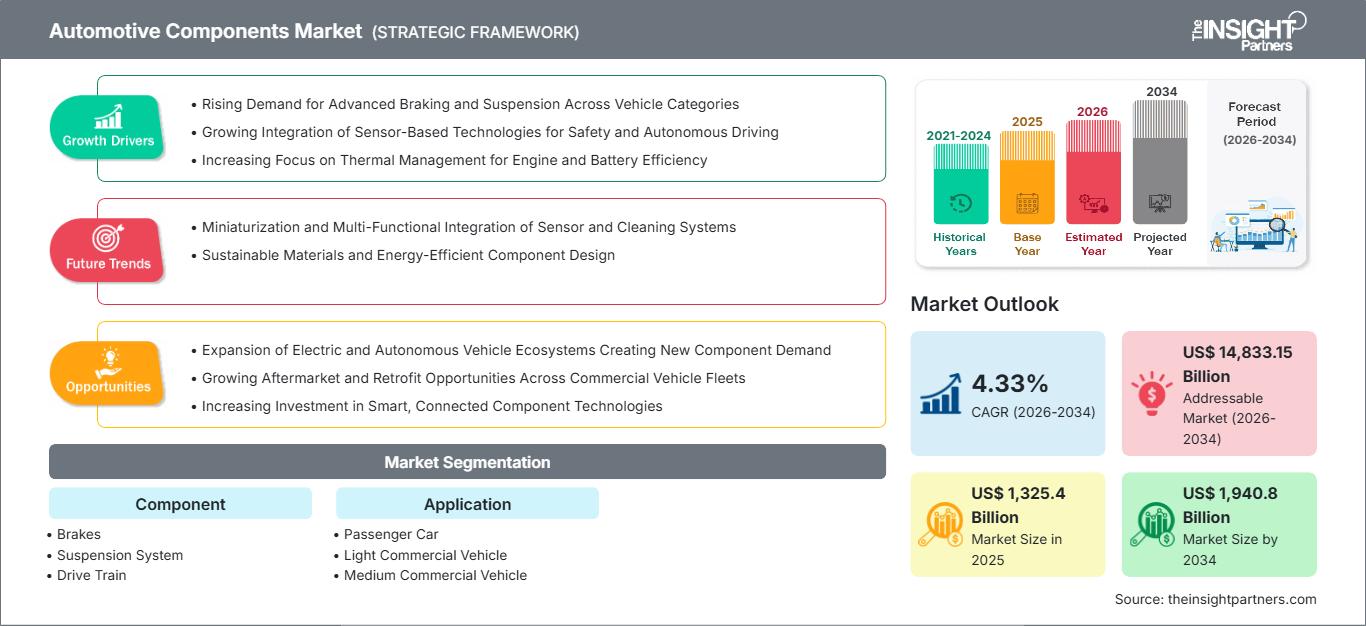
2025 Market Size
US$ 1,325.4 Bn
Base year value
2034 Forecast
US$ 1,940.8 Bn
Projected by 2034
CAGR 2026-2034
4.33 %
Growth rate
Addressable Market
US$ 14,833.15 Bn
(2026-2034)
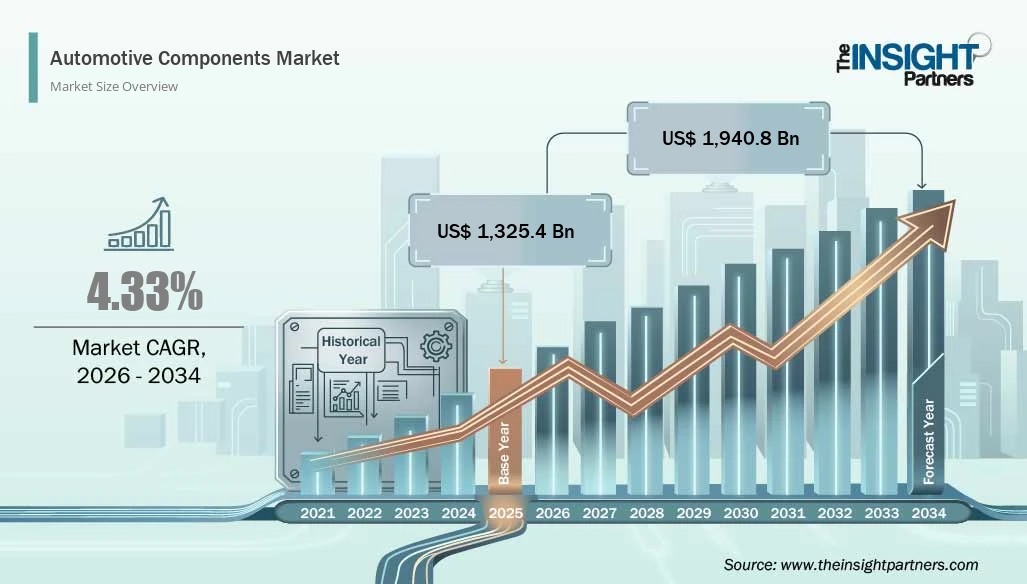
Automotive Component Market reached US$ 1325.45 Billion in 2025 and is projected to reach US$ 1940.81 Billion by 2034, registering a CAGR of 4.33% during 2026–2034. The expansion reflects continuing vehicle output, a rising electronics content per vehicle, stricter safety requirements, and simultaneous investment in combustion, electric, and hydrogen powertrains. Suppliers are therefore redesigning portfolios around integrated braking, sensing, thermal, drivetrain, and chassis platforms while preserving scale economics across regional production networks.
Within North America, the Automotive Component Market size is expected to expand at a 4.52% CAGR through 2034. Demand is anchored by the region’s high-value pickup and sport utility vehicle mix, substantial commercial-vehicle production, and localization of battery, semiconductor, and power-electronics capacity.
Automotive Component Market Assessment and Insights
- North America: The region represented 30.69% share in 2025 and is expected to record a 4.52% CAGR between 2026–2034, supported by premium vehicle content, pickup production, localized electrification investment, and a large replacement base.
- US: The US accounted for 67.78% of North American demand in 2025 and is projected to expand at a 4.43% CAGR between 2026–2034.
- Europe: Europe held 19.76% share in 2025 and is forecast to grow at a 4.38% CAGR between 2026–2034, led by Germany, France, Spain, Italy, and the UK.
- Asia Pacific: Asia Pacific captured 41.66% share in 2025 and is anticipated to register a 4.39% CAGR between 2026–2034, with China, Japan, South Korea, and India anchoring manufacturing and electrification.
- Largest Segment: Light Commercial Vehicle represented a 40.78% market share in 2025 and are expected to grow at a 4.33% CAGR during 2026–2034.
- High Growth Segment: Suspension System held a 1.58% market share in 2025 and are projected to post a 10.23% CAGR during 2026–2034.
- Key companies analyzed in detail: Cummins Inc., ZF Friedrichshafen AG, thyssenkrupp AG, Continental AG, DENSO CORPORATION, Valeo SE, MAHLE GmbH, Robert Bosch GmbH, Gentherm Incorporated, and Cebi International S.A.
Source: The Insight Partners' analysis based on proprietary research, government publications, company annual reports, investor presentations, industry databases, and expert interviews.
Hardware has transitioned from predominantly mechanical assemblies to networks of software addressable components. Electronically actuated brakes, active dampers, domain controllers, thermal loops, and sensor cleaning modules are increasingly networking within centralized architectures. Meanwhile, the trend towards modular manufacturing enables the same facilities to serve internal combustion, hybrid, battery electric, and fuel cell development programs. This represents an increase in engineering complexity and validation expense, but also in value per vehicle. Global production reached over 92 million units in 2024, with electric car sales surpassing 17 million units, further validating the need for dual-purpose component capacity.
Automotive Component Market Report Scope
| Report Attribute | Details |
|---|---|
| Market size in 2025 | US$ 1,325.4 Billion |
| Market Size by 2034 | US$ 1,940.8 Billion |
| Global CAGR (2026 - 2034) | 4.33% |
| Historical Data | 2021-2024 |
| Forecast period | 2026-2034 |
Automotive Component Market Analysis
The automotive component market growth is tied less to vehicle volume alone and more to content migration toward electrified, connected, and safety-critical systems. Requirements flow from automakers through tier-one integrators to semiconductor foundries, materials processors, precision manufacturers, software providers, and aftermarket distributors. Higher sensor counts and redundant actuation create new bill-of-material opportunities, while standardized platforms and long qualification cycles protect incumbents.
The automotive component market analysis indicates competition is shifting from standalone parts toward integrated hardware-software packages. Robert Bosch GmbH and ZF Friedrichshafen AG combine braking, steering, sensing, and control capabilities; DENSO CORPORATION, Valeo SE, and Continental AG emphasize electronics, thermal systems, and driver assistance. Cummins Inc. and MAHLE GmbH retain combustion expertise while redirecting engineering toward lower-carbon powertrains.
Investment priorities encompass the recruitment of software talent, electronics capabilities in regions, and test infrastructure for functional safety. Gentherm Incorporated, Cebi International S.A., and thyssenkrupp AG represent uniquely positioned companies in the areas of thermal comfort, electromechanical devices, and material-centric systems. Competitive advantage is becoming more dependent on securing platform designations early and calibrating through the air without any issues in terms of hardware reliability and security.
● REPORT CUSTOMIZATION
Tailor This Report To Align With Your Specific Business Requirements
This report can be customized to align precisely with your business objectives, scope, and target markets. Customization options include tailored segmentation, geography, competitive analysis, and strategic insights to support informed decision-making.
Customize This Report →WHAT YOU CAN ADJUST
- ● Segmentations
- ● Geography
- ● Competitive Analysis
- ● Language Preferences
Automotive Component Market: Strategic Insights
Regional Insights
North America Automotive Component Market
North America held 30.69% of the automotive component market share in 2025 and is projected to expand at a 4.52% CAGR through 2034. High pickup and sport utility vehicle penetration raises demand for braking, damping, drivetrain, thermal, and towing-related components. A mature fleet also sustains replacement demand for wear items, sensors, pumps, and electronic modules.
Regional sourcing is deepening as vehicle manufacturers localize batteries, inverters, semiconductors, and electric drivetrains. Mexico offers export-oriented assembly scale, Canada supports vehicle and materials supply chains, and the US concentrates engineering and commercial-vehicle platforms.
U.S. Automotive Component Market
The US represented 67% of North American demand in 2025 and should register a 3.8–4.43% CAGR through 2034. Large volumes of pickups, crossovers, and commercial vehicles favor durable brakes, automatic drivetrains, thermal systems, and electronically controlled suspension. Fleet operators increasingly evaluate component life-cycle cost, uptime, diagnostics, and parts availability alongside purchase price.
The companies Robert Bosch GmbH, Cummins Inc., ZF Friedrichshafen AG, DENSO CORPORATION, Gentherm Incorporated, and Continental AG have engineering, manufacturing, and customer support operations in the entire nation. While passenger vehicles dominate in terms of units required, delivery vans and trucks have higher parts values due to the severe nature of their usage. Federal safety regulations and state zero emissions initiatives drive innovation.
Europe Automotive Component Market
Europe accounted for 19.76% share in 2025 and is forecast to grow at a 4.38% CAGR. Germany leads through premium vehicles, engineering depth, and a dense supplier network. The UK combines motorsport expertise with specialty and commercial programs, while France benefits from compact-car platforms, electrification, and established braking and thermal suppliers.
Spain and Italy provide scalable assembly and export capacity; France, Italy, and Spain increasingly attract battery, electronics, and e-drive investment tied to European industrial policy.
APAC Automotive Component Market
Asia Pacific held 41.66% of 2025 demand and is projected to achieve a 4.39% CAGR, the fastest regional pace. China leads through unmatched vehicle scale and electric-platform deployment; Japan and South Korea contribute precision electronics, sensors, and thermal expertise.
India adds rapidly expanding passenger and commercial production, while Australia contributes replacement and severe-duty demand. Industrial policy, localization incentives, export-oriented assembly, and dense battery supply chains attract component investment.
Rest of World Automotive Component Market
Rest of World is expected to expand at a 3.04% CAGR through 2034. Saudi Arabia and the UAE lead investment in mobility infrastructure, fleet modernization, and emerging vehicle assembly; South Africa remains the principal established production and export base.
Demand across the rest of MEA centers on replacement parts, commercial vehicles, buses, and heat-resilient thermal systems. Energy availability supports industrial diversification, although fragmented regulation and logistics raise distribution costs. Localization programs and infrastructure construction favor durable suspension, braking, cooling, and drivetrain components.
Segmentation Analysis
Component
The component segment is projected to expand at a 4.33% CAGR during 2026–2034. The automotive component market scope spans mechanical systems, electronic sensors, thermal hardware, engines, and automated-driving modules. Mature categories retain scale through replacement demand, while by-wire actuation, electrified propulsion, and sensor redundancy increase engineering content. Platform integration will shift supplier selection toward organizations capable of functional-safety validation, software calibration, and globally consistent manufacturing.
- Brakes: Safety regulation and electrification sustain demand for integrated actuation and regenerative coordination. ABS and EBS remain pivotal for stability, shorter stopping distances, diagnostics, and commercial-vehicle compliance.
- Suspension System: Comfort, load control, and battery protection support adoption across premium cars and commercial fleets. Air, hydraulic, and mechanic architectures balance adjustability, durability, packaging, and cost.
- Drive Train: Automatic systems gain from urban driving and hybridization, while manual configurations retain cost-sensitive regional demand. Both require efficiency, durability, and compatibility with evolving engine architectures.
- Camera and Sensor Cleaning: Reliable perception under rain, dust, snow, and road spray makes cleaning essential for advanced driver assistance. Compact fluid, air, and heated solutions protect sensor availability.
- Thermal Management: Electrified platforms require precise conditioning of batteries, cabins, motors, and power electronics. Integrated heat pumps, valves, pumps, and controls improve range, charging consistency, and component life.
- Autonomous or Semi-Autonomous Driving: Redundant sensing, actuation, and domain computing support rapid content growth. Its 4–6% share in 2025 is expected to rise at a 9.0–10.5% CAGR.
- Pressure Sensor: Tire, braking, fuel, refrigerant, and manifold applications sustain broad demand. Miniaturization, wireless communication, and diagnostic accuracy strengthen regulatory compliance, safety, and predictive maintenance.
- Speed Sensor: Wheel, motor, and transmission monitoring underpins braking, traction, powertrain control, and automation. Suppliers differentiate through signal integrity, temperature resilience, compact packaging, and redundancy.
- Engine: ICE volumes remain substantial as electric and hydrogen designs scale. Suppliers are modularizing combustion, electric, and fuel-cell systems to serve varied infrastructure, duty-cycle, and emissions requirements.
- Damping System: Pneumatic, hydraulic, and mechanic damping manages ride, handling, and payload stability. Electronic control adds value in premium passenger cars, buses, trucks, and automated platforms.
Application
The application segment is forecast to grow at a 4.33% CAGR during 2026–2034. Passenger cars dominate unit demand, while commercial vehicles deliver higher component intensity through payload, uptime, braking, and thermal requirements. Electrified delivery fleets support faster adoption in light vehicles, whereas medium and heavy platforms require duty-cycle-specific solutions. Service coverage and total cost of ownership shape purchasing more strongly as vehicle mass and utilization increase.
- Passenger Car: Passenger held 39.59% share in 2025 and should grow at a 5.22% CAGR, supported by safety content, electrification, comfort features, and scale.
- Light Commercial Vehicle: E-commerce and urban logistics sustain pickups, small vans, minibuses, trucks, and passenger vans. Electrification advances where predictable routes make charging and operating savings measurable.
- Medium Commercial Vehicle: Delivery vans, medium buses, and medium trucks require robust brakes, thermal systems, and drivetrains. Municipal fleets and regional distribution favor telematics-enabled maintenance and lower-emission platforms.
- Heavy Commercial Vehicle: Heavy trucks, large buses, tractors, special-purpose vehicles, and trailers prioritize uptime, payload, braking redundancy, cooling capacity, and long service intervals across severe duty cycles.
Opportunity Snapshot
| Application | Revenue Contribution | Trend Tag | Adoption Stage |
| Passenger Car | High | Software Chassis | Mature |
| Light Commercial Vehicle | Medium | Last-Mile EVs | Scaling |
| Medium Commercial Vehicle | Medium | Fleet Telematics | Scaling |
| Heavy Commercial Vehicle | High | Zero-Emission Freight | Emerging |
Automotive Component Market Growth Drivers and Impact Analysis
Electrification Raises Component Value Per Vehicle
In the 2024 report, electric car sales across the globe exceeded the 17 million level, which means that electric cars now account for more than a fifth of all sales of new passenger cars. The electric cars have done away with the parts that were used in internal combustion engine and substituted them with parts like battery cooling plates, electric compressors, pumps, valves, inverters, electric driveshafts, high voltage connectors, and masking systems. The hybrid models, on the other hand, make the process more complex because they combine fuel combustion engines and electric engines. For the parts manufacturers, the greatest benefit comes from their ability to produce and supply one module that operates at a variety of battery voltages as well as vehicle sizes. Even as Plainly China's industrial hubs seem to be leading the charge, the impact is also significant in Europe and North America; However, new markets are driving the demand for cheaper localized designs. For this reason, engineers are paying increasing attention to thermal efficiency, weight savings, power density and high voltage safety.
Safety Regulation Expands Sensor and Actuation Content
Due to the increased adoption of TPMSs, electronic stability systems, AEBs, and other driver assistance systems, it can be said that pressure and speed sensors, camera and radar support, braking electronics, and cleaning systems will be required consistently. These kinds of regulations will ultimately turn such items into mandatory parts of a platform rather than additional options and therefore will provide higher volumes and validation barriers, which would normally be only a minor part of the total market. Additionally, due to redundant design, it becomes necessary to have another source of power, communication, and actuator routes. Those suppliers who have the integrated solution for brakes, steering, sensing, and control software can increase their portion of the total vehicle cost without making things complicated for the manufacturer. Practical benefits include reduced stopping distance, better prevention of loss of control, and higher system availability, which is why reliability and contamination protection become significant purchasing factors..
Fleet Uptime Prioritizes Durable, Connected Components
For the commercial players, it becomes more important to consider total cost of ownership rather than focus just on the cheapest components available. By using the connected technologies, it is possible to not only perform condition-based maintenance and scheduling of intervention but also minimize roadside failures as much as possible. This leads to the fact that component requirements become changing into higher service intervals, diagnostics capabilities, remanufacturing capabilities and software compatibility. The light commercial vehicle fleets can benefit from the synergy between the predictability of urban routes and electrification, while the medium and heavy trucks need cooling, suspension and braking systems which are electronically coordinated in order to handle heavy load. Manufacturers which are capable to combine hardware with lifecycle data will have a chance to retain their aftersales market and earn money from services. Changes also affect distributors and workshops which can provide training, diagnostics and parts availability, and thus it is becoming easier for them to deal with ever-growing electronic fleet of cars.
Automotive Component Market Future Trends
By-Wire Chassis Becomes Production-Scale
The automotive component market trends increasingly point toward electronically commanded braking, steering, and damping coordinated by vehicle motion software. Production programs are expected to progressively integrate more by-wire systems in premium models into mass-market platforms with the development of redundancy in power and communication structures. The absence of mechanical parts offers more flexibility in design, allows for change of driving characteristics and can be easily implemented in automated features. Suppliers will Mainly distinguish themselves by actuator response, fallback strategies, cybersecurity, and calibration libraries rather than the use of hardware alone. As it often does with new technology, the implementation will start in segments which either require premium features or have autonomous capability enough to make the investment worthwhile from the cost side. After that platforms will get more usage and the feature spread will get broader. Still, one can't forget that in the world of safety-critical systems a single error can cause multiple safety functions to fail. As a result, it will still be the case that validation evidence and competence across domains will be the main decision factors..
Thermal Systems Consolidate Around Intelligent Loops
In the future, cars will have one thermal system to handle heating and cooling of different sections of the car. The system will provide the coolant to the batteries, the power electronic motor, cabin and the charging stations at the same time. Thermal energy platforms will be the technology, including heat pump, multi-port valves, small pumps, foresight control, and exhaust heat recovery. This allows maximum energy efficiency in both hot and dry and cold and wet conditions as well as ensuring fast charging while minimizing hardware. Suppliers who can integrate components, software control and refrigerant knowledge have the potential of gaining more system deals. There will be the need for architectural flexibility due to local refrigerant regulations and climatic profiles. Thermal management will become a unique selling point for commercial fleets since lost productivity and battery aging are economically important factors.
Automotive Component Market Opportunities
Localize Electronics in Fast-Growing Production Hubs
The automotive component market forecasts favor investment near expanding vehicle clusters in India, Mexico, Southeast Asia, and North Africa. There would be certain reduction in tariffs, logistics volatility and launch lead times possible with a combination of regional assembly approach with standard designs globally. Pressure and speed sensors, electronic braking modules, thermal controllers, and small pumps that can be used in both combustion and electric platforms are the good component choices here. It is recommended for the investors to concentrate their attention on plants that are equipped with flexible automation, traceability and local testing capabilities rather than on single program capacity plants. Joint development with domestic car manufacturers can help with nomination process, while supplier development programs are one of the tools to help improve machineries, plastics and electronics infrastructure at the grass-root level. As it is expected that different regions would implement new technologies with different intensity, monetary discipline and stepwise expansion of capacity would be very important. Also, it is expected that supply chains would not be totally replaced by imports, hence it is necessary for the investors to keep some production capacity in suppliers' locations and to avoid moving all production to low wage countries.
Build Lifecycle Services for Connected Commercial Fleets
Commercial vehicles offer huge possibilities in terms of integration of diagnostics, calibration, remanufacturing, and uptime support through durable components. Fleets customers are going to buy premium systems with credible data which proves that they are reliable enough in terms of fewer failures, lower consumption of energy, longer life of the brake systems and tyres. As for the parts producers, they may consider the design of interchangeable interfaces, workshop equipment for diagnostics and services using pressure sensors, braking electronics in combination with thermal systems, suspension and drivetrains. The cooperation with the suppliers of telematics services and distribution networks may fasten the process of installation of base products without the need for selling directly to fleets in every market. .
Recent Developments
- March 2026: SAF-HOLLAND, a leading global manufacturer of heavy-duty commercial vehicle components, is pleased to be introducing the UltraLite40 Slider for the ULX40 Mechanical Sliding Suspension and Axle System, a next-generation solution engineered to deliver exceptional durability while significantly reducing weight for today’s on-highway trailers. Designed using years of real-world operating data and validated through a newly developed, more demanding test cycle, the UltraLite40 slider addresses two of the most pressing challenges facing OEMs and fleets today: extending trailer life and maximizing payload efficiency without increasing cost.
- February 2026: Hendrickson, a global leader in suspension technology and complete ride systems for commercial vehicles, exhibited at CONEXPO-CON/AGG 2026, held March 3–7 at the Las Vegas Convention Center. At Booth #S63910, Hendrickson featured advanced suspension solutions engineered for the demanding needs of vocational fleets, including its HAULMAAX EX heavy-duty rubber suspension system and PRIMAAX EX severe-duty air suspension system for rear drive axles in vocational trucks. Hendrickson’s HAULMAAX EX and PRIMAAX EX offerings built on a century of innovation in vocational suspensions, including the company’s first tandem walking-beam suspension introduced 100 years ago. That breakthrough equalizing-beam design set a benchmark for durability, traction, and load equalization in severe-duty applications, and its core principles carried forward in Hendrickson’s modern suspension portfolio for today’s demanding on- and off-highway environments.
- October 2025: As cities modernize their public transit fleets, the demand for vehicles offering better efficiency, comfort, and long-term reliability continues to grow. This is why Cummins introduced the first Meritor independent front suspension purpose-built for the bus and coach markets across Europe and Asia. Drawing on decades of proven expertise in suspension technology in defense and commercial applications, this new solution brings best-in-class steering, ride quality, and reduced maintenance requirements to a highly competitive segment.
Frequently Asked Questions

- Comprehensive Market Sizing and Forecast Analysis
- Detailed Segmentation Analysis
- In-Depth Market Dynamics Assessment
- Regional and Country-Level Insights
- Competitive Landscape and Company Benchmarking
- Strategic Business Intelligence
Recent Reports
Testimonials

The Insight Partners provided valuable market intelligence that supported our global go-to-market strategy. Their team was professional, responsive, and attentive to our feedback, providing thoughtful analysis and helpful methodological clarifications throughout the project.
Junmo Kim Chief Financial Officer (CFO), Enertech Co., Ltd.
The Insight Partners' SCADA System Market report is comprehensive, with valuable insights on current trends and future forecasts. The team was highly professional, responsive, and supportive throughout. We are very satisfied and highly recommend their services.
RAN KEDEM Partner, Reali Technologies LTDs
I requested a report on a very specific software market and the team produced the report in a few days. The information was very relevant and well presented. I then requested some changes and additions to the report. The team was again very responsive and I got the final report in less than a week.
JEAN-HERVE JENN Chairman, Future Analytica
We worked with The Insight Partners for an important market study and forecast. They gave us clear insights into opportunities and risks, which helped shape our plans. Their research was easy to use and based on solid data. It helped us make smart, confident decisions. We highly recommend them.
PIYUSH NAGPAL Sr. Vice President, High Beam Global
The Insight Partners delivered insightful, well-structured market research with strong domain expertise. Their team was professional and responsive throughout. The user-friendly website made accessing industry reports seamless. We highly recommend them for reliable, high-quality research services
YUKIHIKO ADACHI CEO, Deep Blue, LLC.
This is the first time I have purchased a market report from The Insight Partners.While I was unsure at first, I visited their web site and felt more comfortable to take the risk and purchase a market report.I am completely satisfied with the quality of the report and customer service. I had several questions and comments with the initial report, but after a couple of dialogs over email with their analyst I believe I have a report that I can use as input to our strategic planning process.Thank you so much for taking the extra time and making this a positive experience.I will definitely recommend your service to others and you will be my first call when we need further market data.
JOHN SUZUKI President and Chief Executive Officer, Board Director, BK Technologies
I wish to appreciate your support and the professionalism you displayed in the course of attending to my request for information regarding to infectious disease IVD market in Nigeria. I appreciate your patience, your guidance, and the fact that you were willing to offer a discount, which eventually made it possible for us to close a deal. I look forward to engaging The Insight Partners in the future, all thanks to the impression you have created in me as a result of this first encounter.
DR CHIJIOKE ONYIA MANAGING DIRECTOR, PineCrest Healthcare Ltd.Reason to Buy
- Informed Decision-Making
- Understanding Market Dynamics
- Competitive Analysis
- Identifying Emerging Markets
- Customer Insights
- Market Forecasts
- Risk Mitigation
- Boosting Operational Efficiency
- Strategic Planning
- Investment Justification
- Tracking Industry Innovations
- Aligning with Regulatory Trends





 Get Free Sample for