
Ultramax Vessel Market Share, Demand & Growth by 2034
Coverage: By Ownership (Ship Operators, Leasing Companies, and Others), Propulsion Type (Diesel and Dual Fuel), Application (Coal, Grain, Ores, Fertilizers, and Others), and Geography
- Status : Published
- Report Code : TIPRE00043821
- Category : Automotive and Transportation
- No. of Pages : 227
- Available Report Formats :


- Last update date : September 01, 2026


2025 Market Size
US$ 12.26 Bn
Base year value
2034 Forecast
US$ 20.21 Bn
Projected by 2034
CAGR 2026-2034
5.71 %
Growth rate
Addressable Market
US$ 147.15 Bn
(2026-2034)
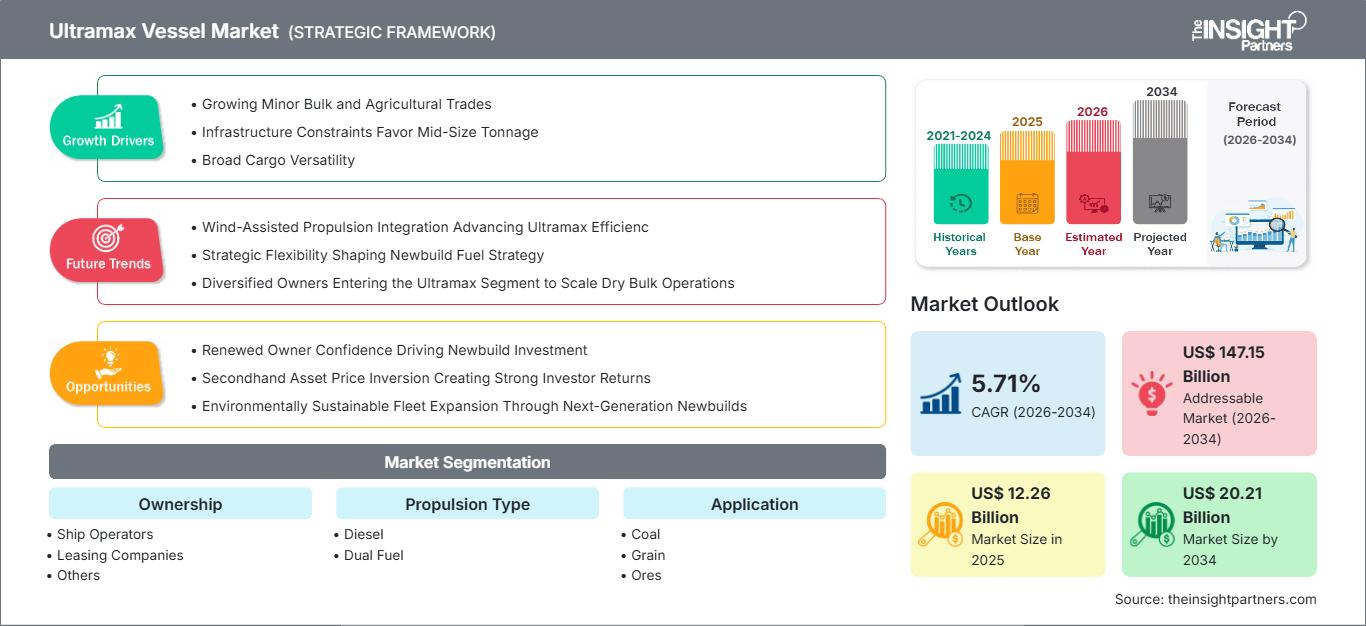
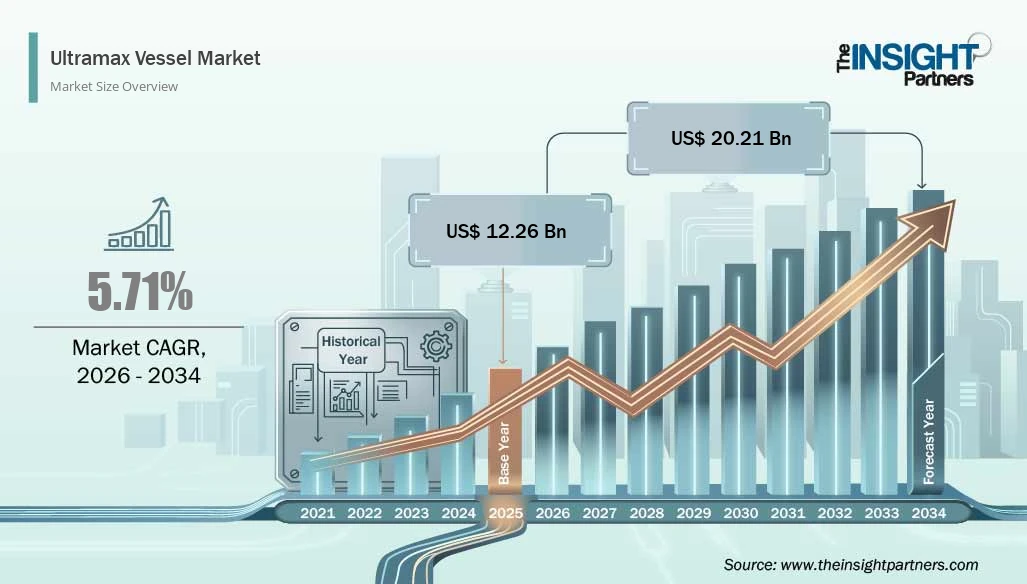
The Ultramax Vessel Market was valued at US$ 12.26 billion in 2025 and is projected to reach US$ 20.21 billion by 2034, registering a CAGR of 5.71% from 2026 to 2034. The market encompasses dry bulk carriers ranging from 60,000 to 65,000 deadweight tons, representing a critical segment within the global shipping industry. These vessels are valued for their optimal balance of cargo capacity and port accessibility. The market's growth trajectory is underpinned by robust global seaborne trade and a modernizing fleet.
The North American Ultramax Vessel Market is estimated to account for a significant share of global revenues, growing at a CAGR of approximately 5.40% during the forecast period. Growth is supported by the region's substantial agricultural exports, particularly grains and oilseeds, which are primary cargoes for Ultramax vessels. Additionally, infrastructure investments in the U.S. and Canada are driving demand for steel and construction materials, many of which are transported via dry bulk carriers, further bolstering the market.
Ultramax Vessel Market Assessment and Insights
- North America: The North American market holds an estimated 7.24% share in 2025, growing at a CAGR of 5.40% from 2026-2034. The region's extensive agricultural exports and modernization of port infrastructure drive vessel demand and operational efficiency.
- U.S.: The U.S. is the dominant market in North America, accounting for approximately 94.55% of the region's share in 2025. Growing at a CAGR of 5.46%, its grain exports and strategic Gulf Coast location fuel Ultramax vessel utilization.
- Europe: Europe holds approximately 33.62% of the global market share in 2025, growing at a CAGR of 5.64% from 2026-2034. Leading countries include Germany and the Netherlands, driven by intra-European trade, major port complexes, and established shipowners.
- Asia Pacific: The Asia Pacific region commands the largest share, estimated at 55.99% in 2025, with a CAGR of 5.85% from 2026-2034. Dominated by China and Japan, growth is fueled by massive commodity imports, manufacturing output, and aggressive fleet expansion.
- Largest Segment: The Application segment of Ores is estimated to hold the largest market share of 27.86% in 2025, with a CAGR of 5.46% from 2026-2034, driven by iron ore and bauxite trade from major exporting nations to industrial centers.
- High Growth Segment: The Application segment of Fertilizers is estimated as the high-growth segment with a 6.09% market share in 2025, growing at a CAGR of 7.26% from 2026-2034, driven by global food demand and agricultural expansion.
- Key companies analyzed in detail: Oshima Shipbuilding Co., Ltd.; TSUNEISHI SHIPBUILDING Co., Ltd.; IMABARI SHIPBUILDING CO., LTD.; Jiangsu Hantong Shipbuilding Heavy Industry Co., Ltd.; Wuhu Shipyard Co., Ltd.; COSCO SHIPPING HEAVY INDUSTRY CO., LTD.; Shin Kurushima Dockyard CO., LTD.; Oldendorff Carriers GmbH & Co. KG; SUMEC Group Corporation; and Yangzijiang Shipbuilding (Holdings) Ltd.
Source: The Insight Partners' analysis based on proprietary research, government publications, company annual reports, investor presentations, industry databases, and expert interviews.
The Ultramax Vessel Market is currently undergoing a significant transformation driven by technological innovation and shifting production dynamics. A notable trend is the age profile of the global fleet, with the average Ultramax being just 6.71 years old, making it the youngest among dry bulk carrier segments and facilitating faster adoption of eco-friendly designs . This youthfulness, coupled with a 20% fleet growth over the past decade, indicates a modern, efficient vessel base. Furthermore, a historic valuation reversal is occurring, with five-year-old Ultramax vessels commanding a premium over newbuilds, driven by robust spot earnings and limited newbuilding slot availability at shipyards until at least 2029.
The forward-looking outlook for the Ultramax Vessel Market is characterized by significant investments and emerging geographies. The order book composition remains heavily concentrated in the geared, mid-sized segment, with Ultramax vessels leading with 505 units on order, indicating strong owner confidence in this vessel class . Greek shipowners are particularly active, having taken delivery of 18 Ultramax vessels in the first half of 2026, showcasing a strategic push to renew and expand their fleets . Regulatory tailwinds favoring energy-efficient vessels and a supply-side constraint on shipyard capacity are expected to sustain the market's positive momentum and support asset values through the forecast period.
Ultramax Vessel Market Report Scope
| Report Attribute | Details |
|---|---|
| Market size in 2025 | US$ 12.26 Billion |
| Market Size by 2034 | US$ 20.21 Billion |
| Global CAGR (2026 - 2034) | 5.71% |
| Historical Data | 2021-2024 |
| Forecast period | 2026-2034 |
Ultramax Vessel Market Analysis
The primary demand drivers for the Ultramax Vessel Market are anchored in global commodity flows and fleet replacement cycles. The seaborne trade of major bulk commodities such as coal, grain, and ores remains resilient. Ultramax vessels are increasingly preferred for their versatility; they are large enough to benefit from economies of scale yet small enough to access a wider range of ports compared to larger Capesize vessels. Ship owners are actively seeking to modernize their fleets, replacing older, less efficient Supramax and Handysize vessels with modern Ultramax designs that offer superior fuel economy and operational flexibility.
The value chain for the Ultramax Vessel Market is multifaceted, encompassing ship design, steel production, component manufacturing, shipbuilding, and ship operation. Shipyards in Asia, particularly in Japan, China, and South Korea, are the primary production hubs. The supply dynamics are currently characterized by a significant bottleneck. Major shipyards are prioritizing high-value orders, such as tankers and specialized vessels, and have limited available delivery slots for Ultramax newbuildings until at least 2029 . This supply constraint is a critical factor reshaping the market, directly inflating secondhand asset values and prompting owners to explore different acquisition strategies.
The competitive landscape in the Ultramax Vessel Market is defined by a mix of major shipbuilders and global shipping operators. Key players include Oshima Shipbuilding, TSUNEISHI SHIPBUILDING, and IMABARI SHIPBUILDING, who are leading innovators in fuel-efficient designs. Major shipowners like Oldendorff Carriers are actively managing their fleets, recently selling six-year-old Ultramax vessels at prices near 93% of newbuild cost, indicating a strategic focus on capitalizing on current high asset values . Investment trends are skewed towards acquiring modern, secondhand tonnage. The strategic positioning of players hinges on securing cost-effective newbuilding slots, investing in high-performance vessels, and forming long-term charter agreements to ensure steady cash flows in a volatile freight market.
● REPORT CUSTOMIZATION
Tailor This Report To Align With Your Specific Business Requirements
This report can be customized to align precisely with your business objectives, scope, and target markets. Customization options include tailored segmentation, geography, competitive analysis, and strategic insights to support informed decision-making.
Customize This Report →WHAT YOU CAN ADJUST
- ● Segmentations
- ● Geography
- ● Competitive Analysis
- ● Language Preferences
Ultramax Vessel Market: Strategic Insights
Regional Insights
North America Ultramax Vessel Market
The North American Ultramax Vessel Market represents a key region, supported by its status as a major exporter of agricultural commodities. The market is growing at a CAGR of 5.40%, driven by the U.S.'s leading role in global grain and oilseed exports. These products are a primary cargo for Ultramax vessels, ensuring a consistent demand base. Furthermore, the region's strategic location with access to both the Atlantic and Pacific oceans facilitates efficient trade routes to major importers in Asia, Europe, and South America.
Port infrastructure and inland logistics, particularly along the Mississippi River and Gulf Coast, are critical growth drivers for the U.S. market. Investments in modernizing grain terminals and improving navigational channels enhance the operational efficiency of Ultramax vessels. The market is also influenced by U.S. trade policies and agricultural production levels. Although the region is a significant demand center for shipping services, its fleet ownership is smaller compared to major shipping nations like Greece and China, relying heavily on foreign-flagged vessels to transport its exports.
U.S. Ultramax Vessel Market
The U.S. Ultramax Vessel Market is estimated to account for approximately 94.55% of the North American market share in 2025. It is growing at a robust CAGR of 5.46%. Demand is heavily concentrated around the Gulf Coast and East Coast ports, facilitating the export of agricultural goods and the import of fertilizers and ores. The U.S. market is a crucial source of cargo for global shipping routes, with major chartering companies and commodity traders driving fixture activity.
Company presence in the U.S. market is more focused on commercial operations, chartering, and logistics rather than shipbuilding. The market's growth is intertwined with application trends, particularly the export of feed grains and soybeans to Asia and fertilizers from the U.S. to Latin America. The U.S. also plays a role in the secondhand market as a buyer of tonnage for its trading routes, often seeking fuel-efficient, modern Ultramax vessels to maintain competitiveness in long-haul voyages.
Europe Ultramax Vessel Market
The European Ultramax Vessel Market holds an estimated 33.62% share of the global market in 2025, growing at a CAGR of approximately 5.64% from 2026-2034. The United Kingdom is a major hub for shipping finance and management, with London being the center of the global freight market. Germany is a key importer of raw materials and a significant player in ship finance. France, Italy, and Spain are pivotal due to their major port gateways for Mediterranean trade and shipbuilding activities. The leading country is often Germany, due to its strategic commercial role and deep-sea port access.
Europe's market is structurally driven by high environmental standards and a strong emphasis on fleet modernization, placing it at the forefront of adopting eco-friendly vessel designs. The region's numerous trading partners within the EU and globally ensure a steady flow of bulk commodities such as coal, grain, and steel products. The European market also exhibits strong secondhand vessel trading activity, with Greek shipowners being notably active in expanding their Ultramax fleets, leveraging their established presence in global shipping.
APAC Ultramax Vessel Market
The Asia Pacific Ultramax Vessel Market commands the largest global share, estimated at 55.99% in 2025, growing at a robust CAGR of 5.85% from 2026-2034. Led by China and Japan, the region is the epicenter of both shipbuilding and commodity demand. Key countries like China, Japan, South Korea, India, and Australia drive growth through massive imports of iron ore, coal, and bauxite, as well as being major exporters of grain. The region's industrialization, urban expansion, and port development are primary industrial drivers. Policy drivers include national strategies to secure supply chains and maintain a strong maritime presence. Japan, as a leading shipbuilder, plays a crucial role in supplying modern tonnage, with yards like Oshima, TSUNEISHI, and IMABARI at the forefront.
Middle East & Africa Ultramax Vessel Market
The Middle East & Africa Ultramax Vessel Market is projected to grow at a CAGR of 4.37% from 2026-2034. This region's market is growing due to its energy and infrastructure context, with key countries such as Saudi Arabia and the UAE driving demand. Saudi Arabia's infrastructure megaprojects necessitate substantial imports of cement, aggregates, and steel, supporting dry bulk activity. The UAE serves as a major transshipment and trading hub, with ports like Dubai and Abu Dhabi facilitating cargo movement between Asia, Europe, and Africa. South Africa is a significant exporter of coal and manganese, contributing to outbound cargo volumes. The Rest of MEA includes key importers of grain and construction materials, with expanding port infrastructure. The leading country is often South Africa due to its established mineral export sector.
Segmentation Analysis
Ownership
The Ownership segment of the Ultramax Vessel Market is delineated into Ship Operators, Leasing Companies, and Others. Ship operators segment is projected to grow at a CAGR of 5.84% from 2026-2034. Ship operators are the dominant force, owning and operating vessels to transport cargo and generate freight revenue. The market dynamics are heavily influenced by operator strategies, including fleet renewal, vessel acquisition, and sale-and-leaseback arrangements. Leasing companies are gaining prominence as a financing mechanism, providing capital for newbuildings and enabling operators to maintain liquidity. This segment's outlook is tied to the financial health of the shipping industry and investor appetite for maritime assets.
- Ship Operators: This sub-segment forms the backbone of the Ultramax Vessel Market, with companies like Oldendorff Carriers leading in fleet management and operational logistics. Their investment decisions directly influence newbuilding orders and secondhand vessel demand.
- Leasing Companies: Leasing companies are crucial financial actors, providing capital for vessel acquisitions and enabling operators to manage balance sheets. The rise of leasing is a key trend in the market, providing alternative financing avenues.
- Others: This sub-segment includes individuals, private investors, and non-shipping entities that own vessels for capital appreciation or chartering. Their presence adds liquidity and dynamism to the secondhand vessel market.
Propulsion Type
The Propulsion Type segment is categorized into Diesel and Dual Fuel. Diesel segment is projected to grow at a CAGR of 3.80% from 2026-2034. Diesel propulsion remains the standard technology for the majority of the global fleet, offering reliability and extensive refueling infrastructure. However, the dual fuel segment is experiencing significant momentum due to tightening environmental regulations. Shipowners are increasingly ordering dual-fuel vessels capable of operating on liquefied natural gas (LNG) to reduce sulfur oxide and carbon emissions, ensuring long-term operational compliance and efficiency.
- Diesel: Diesel engines are the conventional and most widely used propulsion system in the Ultramax fleet. Their reliability and global availability of bunker fuel make them a standard choice.
- Dual Fuel: Dual-fuel engines represent a high-growth sub-segment, offering flexibility to operate on LNG or conventional fuel. Their adoption is driven by the need to comply with stringent emission regulations, positioning them as a forward-looking technology in the market.
Application
The Application segment includes Coal, Grain, Ores, Fertilizers, and Others. Ores segment is projected to grow at a CAGR of 5.46% from 2026-2034. Ores account for the largest share, driven by seaborne iron ore and bauxite trades from Australia and Brazil to China and other industrial centers. Coal remains a significant cargo, although its long-term outlook is tempered by decarbonization policies. Grain is a consistently high-volume cargo, benefiting from global food demand. Fertilizers are a high-growth application, driven by the need to enhance agricultural productivity in food-importing regions, with countries like the U.S. being a major exporter.
- Coal: Seaborne coal trade is a mainstay for the Ultramax segment, with major export routes from Australia, Indonesia, and South Africa to emerging Asian economies. Demand remains substantial, although growth is tempered by a gradual shift to renewable energy sources.
- Grain: The grain trade is a major driver, particularly for vessels operating routes from the Americas and Black Sea region to Asia and Africa. This application provides stable, non-seasonal demand in many regions.
- Ores: Ores are the single largest cargo type for Ultramax vessels, dominated by iron ore and bauxite exports. Trade flows are highly concentrated between major producers and industrial consumers, influencing global freight rates.
- Fertilizers: The fertilizer trade is a significant and growing application, supporting global agriculture. This cargo type often sees seasonal peaks and is a key driver for vessels operating from production hubs like the U.S. to agricultural importers.
Opportunity Snapshot
| Application | Revenue Contribution | Trend Tag | Adoption Stage |
|---|---|---|---|
| Coal | High | Energy Transition | Mature |
| Grain | High | Food Security | Mature |
| Ores | High | Industrial Input | Mature |
| Fertilizers | Medium | Agri-Productivity | Scaling |
Ultramax Vessel Market Growth Drivers and Impact Analysis
Growing Global Seaborne Commodity Trade
Global seaborne trade of dry bulk commodities is the fundamental growth driver for the Ultramax Vessel Market. The ongoing industrialization and urbanization in developing economies, particularly in Asia, continue to fuel demand for raw materials such as iron ore, coal, and bauxite. Ultramax vessels are extensively utilized for these trades, benefiting from their optimal size for both major and minor bulk routes. For instance, the robust demand for grain from the U.S. and Brazil, and iron ore from Australia, creates a continuous and high-volume stream of cargo, ensuring consistent vessel utilization and supporting freight rate stability. This foundational demand is projected to remain resilient throughout the forecast period.
Fleet Renewal and Age Profile Dynamics
The demand for modernizing the global bulker fleet is a powerful driver for the Ultramax segment. With an average age of just 6.71 years, the Ultramax fleet is the youngest among dry bulk carrier types, a result of significant investment in newbuildings over the past decade. A total of 20% fleet growth occurred in the last decade. This trend of fleet renewal is set to continue as owners replace older, less efficient Supramax and Handysize vessels. The focus is on acquiring fuel-efficient, high-performance vessels to comply with environmental regulations and achieve lower operational costs. The delivery of 98 Ultramax vessels in the first half of 2026 demonstrates the ongoing commitment to fleet modernization.
Supply-Side Constraint from Shipyard Capacity
A significant and unprecedented growth driver is the supply-side constraint created by limited shipyard capacity. Major shipbuilders are prioritizing high-value tanker and specialized vessel orders, leading to a severe shortage of available newbuilding slots for Ultramax vessels, with capacity booked until at least 2029. This has created a unique market dynamic where five-year-old Ultramax vessels command a premium over newbuilds, a rare phenomenon last seen in 2010. This supply tightness directly inflates both newbuilding and secondhand asset values, encouraging investment and shifting owner focus towards the secondhand market, and is expected to sustain high vessel valuations for the foreseeable future.
Ultramax Vessel Market Future Trends
Technological Advancements in Vessel Design
The Ultramax Vessel Market is on the cusp of a technological evolution, with a strong emphasis on advanced hull designs and alternative propulsion systems. The push for decarbonization will accelerate the adoption of energy-saving devices, optimized hull forms, and the integration of dual-fuel engines capable of operating on LNG, methanol, or ammonia. Japanese shipbuilders are leading innovations in vessel efficiency, significantly impacting market share by offering designs that promise lower fuel consumption and emissions. These advancements will become a key differentiator for shipowners seeking to maintain operational profitability and regulatory compliance, making 'eco-ships' the new industry standard.
Increasing Consolidation and Strategic Alliances
A trend of consolidation and strategic alliances among shipowners, charters, and commodity traders is likely to shape the future competitive landscape. To secure economies of scale and ensure cargo availability, larger operators may merge or form long-term partnerships. The trend is particularly evident with the aggressive expansion of Greek and Chinese owners. Such consolidation leads to more stable market dynamics, with major players coordinating fleet utilization and newbuilding orders. This strategic behavior reduces market fragmentation and can lead to more rational pricing in both the freight and secondhand asset markets, providing a counterbalance to the cyclicality of the shipping industry.
Ultramax Vessel Market Opportunities
Investment in Secondhand Vessel Acquisitions
The current market presents a significant opportunity for investment in secondhand Ultramax vessels. With newbuilding delivery slots being unavailable until at least 2029, the secondhand market has become highly liquid, with transaction volumes surging. Owners can capitalize on high freight rates by acquiring vessels for immediate deployment. This is validated by the 72% increase in secondhand sales in early 2026.
Focus on High-Growth Fertilizer Trade
There is a distinct investment opportunity in capitalizing on the high-growth segment of fertilizer application. As global food security concerns intensify and agricultural practices intensify, the seaborne trade of fertilizers is expected to grow at a robust pace, outpacing other commodities. This presents an opportunity for owners to secure long-term contracts with key producers and importers, ensuring stable revenue streams and high vessel utilization rates.
Recent Developments
- July 2026: China Zhejiang Shipping has signed contracts with SUMEC Marine for two 64,000-dwt bulk carriers, further strengthening its core Ultramax fleet.The deal comes as Zhejiang Shipping continues to broaden its fleet structure. While 50,000-64,000-dwt bulkers remain central to its flexible dry bulk operations, the Chinese state-owned shipping group has also expanded into Panamax, Capesize and Newcastlemax tonnage, while building a presence in the MR product and chemical tanker market.
- July 2026: Hong Kong-listed Seacon Shipping has returned to Tsuneishi Group’s Chinese shipyard for two bulk carrier newbuildings worth $66m. Seacon also ordered at the yard in April 2025, paying $38.34m for a 63,300 dwt ultramax scheduled for delivery in April 2027. The group has been active across several vessel segments over the year. It recently acquired two chemical tanker newbuildings for $39.2m, took over four multipurpose ship contracts in a $44.4m deal, added six ultramax resales worth $198.6m and moved into newcastlemax newbuildings with a pair at Qingdao Beihai.
- May 2026: COSCO SHIPPING Development Co., Ltd. issued an announcement stating that two of its wholly-owned subsidiaries intend to acquire eight 210,000-DWT bulk carriers and two 64,000-DWT bulk carriers—all currently under construction—from COSCO SHIPPING Bulk Co., Ltd. (COSCO SHIPPING Bulk). This move aims to continuously advance the Company’s strategic layout of integrating shipping leasing with financial services, thereby further expanding the scale of its high-quality vessel assets.
Frequently Asked Questions

- Comprehensive Market Sizing and Forecast Analysis
- Detailed Segmentation Analysis
- In-Depth Market Dynamics Assessment
- Regional and Country-Level Insights
- Competitive Landscape and Company Benchmarking
- Strategic Business Intelligence
Recent Reports
Testimonials

The Insight Partners provided valuable market intelligence that supported our global go-to-market strategy. Their team was professional, responsive, and attentive to our feedback, providing thoughtful analysis and helpful methodological clarifications throughout the project.
Junmo Kim Chief Financial Officer (CFO), Enertech Co., Ltd.
The Insight Partners' SCADA System Market report is comprehensive, with valuable insights on current trends and future forecasts. The team was highly professional, responsive, and supportive throughout. We are very satisfied and highly recommend their services.
RAN KEDEM Partner, Reali Technologies LTDs
I requested a report on a very specific software market and the team produced the report in a few days. The information was very relevant and well presented. I then requested some changes and additions to the report. The team was again very responsive and I got the final report in less than a week.
JEAN-HERVE JENN Chairman, Future Analytica
We worked with The Insight Partners for an important market study and forecast. They gave us clear insights into opportunities and risks, which helped shape our plans. Their research was easy to use and based on solid data. It helped us make smart, confident decisions. We highly recommend them.
PIYUSH NAGPAL Sr. Vice President, High Beam Global
The Insight Partners delivered insightful, well-structured market research with strong domain expertise. Their team was professional and responsive throughout. The user-friendly website made accessing industry reports seamless. We highly recommend them for reliable, high-quality research services
YUKIHIKO ADACHI CEO, Deep Blue, LLC.
This is the first time I have purchased a market report from The Insight Partners.While I was unsure at first, I visited their web site and felt more comfortable to take the risk and purchase a market report.I am completely satisfied with the quality of the report and customer service. I had several questions and comments with the initial report, but after a couple of dialogs over email with their analyst I believe I have a report that I can use as input to our strategic planning process.Thank you so much for taking the extra time and making this a positive experience.I will definitely recommend your service to others and you will be my first call when we need further market data.
JOHN SUZUKI President and Chief Executive Officer, Board Director, BK Technologies
I wish to appreciate your support and the professionalism you displayed in the course of attending to my request for information regarding to infectious disease IVD market in Nigeria. I appreciate your patience, your guidance, and the fact that you were willing to offer a discount, which eventually made it possible for us to close a deal. I look forward to engaging The Insight Partners in the future, all thanks to the impression you have created in me as a result of this first encounter.
DR CHIJIOKE ONYIA MANAGING DIRECTOR, PineCrest Healthcare Ltd.Reason to Buy
- Informed Decision-Making
- Understanding Market Dynamics
- Competitive Analysis
- Identifying Emerging Markets
- Customer Insights
- Market Forecasts
- Risk Mitigation
- Boosting Operational Efficiency
- Strategic Planning
- Investment Justification
- Tracking Industry Innovations
- Aligning with Regulatory Trends





 Get Free Sample for