
Automotive Head Up Display Market Growth and Forecast by 2034
Coverage: By Type (Combiner HUD and Windshield HUD), Technology (Conventional HUD and Augmented reality HUD), Vehicle Type (Passenger Cars, Light Commercial Vehicles, and Heavy Commercial Vehicles), and Geography
- Status : Data Released
- Report Code : TIPTE100000500
- Category : Automotive and Transportation
- No. of Pages : 150
- Available Report Formats :


- Last update date : August 05, 2026


2024 Market Size
US$ 1.95 Bn
Base year value
2034 Forecast
US$ 16.61 Bn
Projected by 2034
CAGR 2026-2034
26.9 %
Growth rate
Addressable Market
US$ 90.42 Bn
(2026-2034)
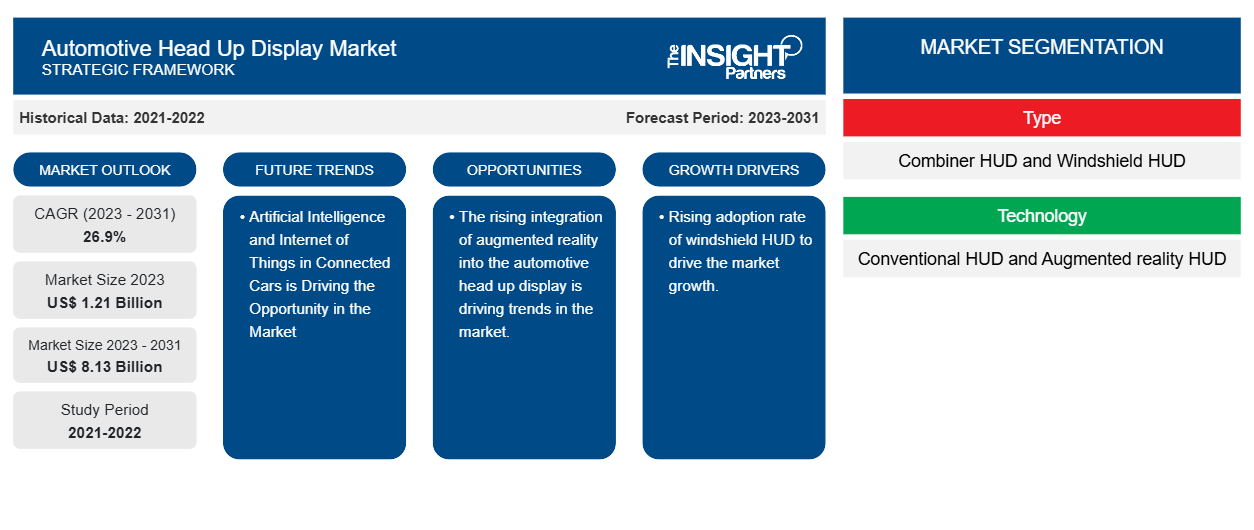
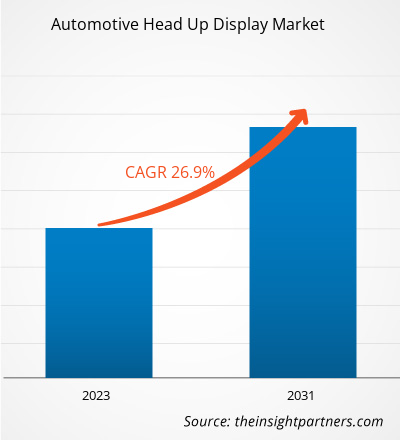
The Automotive Head Up Display Market is projected to grow from US$ 1.95 Billion in 2025 to US$ 16.61 Billion by 2034, registering a CAGR of 26.9% during 2026–2034. Demand is rising as automakers integrate navigation, speed, ADAS alerts, lane guidance, and vehicle status information into the driver’s forward field of view.
North America is a high-adoption region, with the Automotive Head Up Display Market size supported by premium vehicle penetration, safety-focused digital cockpits, and fast rollout of ADAS-enabled SUVs and electric vehicles. The region is expected to grow at a CAGR of 25.8–27.2% during 2026–2034 as windshield HUD and augmented reality HUD features move into broader vehicle trims.
Automotive Head Up Display Market Assessment and Insights
- North America: North America held 32–36% share in 2025 and is projected to grow at a CAGR of 25.8–27.2% during 2026–2034, supported by premium SUVs, EVs, and ADAS integration.
- US: The US accounted for 80–84% of North American demand in 2025 and is expected to grow at a CAGR of 25.6–27.0% through 2034.
- Europe: Europe represented 27–31% share in 2025 and is forecast to grow at a CAGR of 24.9–26.4%, led by Germany, the UK, France, Italy, and Spain.
- Asia Pacific: Asia Pacific accounted for 28–32% share in 2025 and is expected to grow at a CAGR of 27.6–29.2%, led by China, Japan, South Korea, and India.
- Largest Segment: Windshield HUD held 70–74% market share in 2025 and is projected to grow at a CAGR of 25.2–26.8% during 2026–2034.
- High Growth Segment: Augmented reality HUD held 19–23% market share in 2025 and is projected to grow at a CAGR of 30.5–33.0% during 2026–2034.
- Key companies analyzed in detail: Continental AG, DENSO CORPORATION, Robert Bosch GmbH, Harman International Industries, Incorporated, Yazaki Corporation, Valeo SE, Nippon Seiki Co., Ltd., Panasonic Automotive Systems Europe GmbH, HUDWAY, LLC, and Japan Display Inc.
Source: The Insight Partners' analysis based on proprietary research, government publications, company annual reports, investor presentations, industry databases, and expert interviews.
Vehicle display architecture is shifting from dashboard-centered information panels toward driver-focused projection systems that reduce glance time and support safer interaction with connected mobility functions. The Automotive Head Up Display Market is evolving through brighter projection units, larger virtual image distances, thinner optical packages, and integration with camera, radar, navigation, and cockpit domain controllers.
Forward demand will be shaped by EV cockpit differentiation, regulatory attention on distraction reduction, and increasing consumer expectation for premium digital interfaces. Suppliers are investing in augmented overlays, higher luminance, compact projectors, and software calibration. Asia Pacific is likely to accelerate adoption as China and Japan expand HUD localization, while North America and Europe remain strong value markets.
Automotive Head Up Display Market Report Scope
| Report Attribute | Details |
|---|---|
| Market size in 2024 | US$ 1.95 Billion |
| Market Size by 2034 | US$ 16.61 Billion |
| Global CAGR (2026 - 2034) | 26.9% |
| Historical Data | 2021-2024 |
| Forecast period | 2026-2034 |
Automotive Head Up Display Market Analysis
Demand is being driven by ADAS penetration, premium interior upgrades, and the need to reduce driver distraction. Automotive Head Up Display Market growth is also supported by navigation-rich infotainment, electric vehicle launches, and software-defined cockpit platforms that require intuitive visual interfaces. Windshield HUD remains the primary volume contributor because it offers a larger perceived image and stronger OEM integration.
The supply ecosystem includes optics providers, display panel makers, projector module suppliers, cockpit electronics firms, software developers, and tier-one integrators. Automotive Head Up Display Market analysis shows that performance depends on brightness, image stability, sunlight readability, windshield compatibility, packaging space, heat management, and calibration accuracy across vehicle platforms.
Competition is led by suppliers with optical engineering, display electronics, and OEM validation capability. Continental AG, DENSO CORPORATION, Robert Bosch GmbH, Nippon Seiki Co., Ltd., Valeo SE, and Panasonic Automotive Systems Europe GmbH compete through integrated cockpit systems, while Yazaki Corporation, Harman International Industries, Incorporated, Japan Display Inc., and HUDWAY, LLC support display, interface, and aftermarket innovation.
Investment trends favor augmented reality HUD, holographic projection, microLED light engines, and software-linked graphics. Strategic positioning depends on multi-platform awards, vehicle safety compliance, and integration with ADAS sensors. Suppliers that can reduce unit cost while improving field-of-view, depth perception, and image clarity are positioned to benefit as adoption shifts beyond luxury vehicles.
● REPORT CUSTOMIZATION
Tailor This Report To Align With Your Specific Business Requirements
This report can be customized to align precisely with your business objectives, scope, and target markets. Customization options include tailored segmentation, geography, competitive analysis, and strategic insights to support informed decision-making.
Customize This Report →WHAT YOU CAN ADJUST
- ● Segmentations
- ● Geography
- ● Competitive Analysis
- ● Language Preferences
Automotive Head Up Display Market: Strategic Insights
Regional Insights
North America Automotive Head Up Display Market
North America accounted for 32–36% Automotive Head Up Display Market share in 2025 and is projected to grow at a CAGR of 25.8–27.2% during 2026–2034. Adoption is strongest in premium SUVs, electric vehicles, pickups, and safety-oriented trims where ADAS alerts, speed, navigation, and blind-spot cues are increasingly presented in the driver’s sightline.
Regional demand is reinforced by higher willingness to pay for digital cockpit features, strong OEM technology packaging, and increasing use of windshield projection systems. Suppliers benefit from engineering proximity to automakers and from the expansion of connected vehicle software. Augmented reality HUD remains early but is gaining attention for lane-level navigation and hazard visualization.
U.S. Automotive Head Up Display Market
The US represented 80–84% of North American demand in 2025 and is expected to grow at a CAGR of 25.6–27.0% through 2034. Demand is concentrated in large SUVs, luxury sedans, EVs, and advanced pickup platforms where consumer acceptance of driver-assistance displays is comparatively strong.
Company presence is supported by Continental AG, DENSO CORPORATION, Robert Bosch GmbH, Harman International Industries, Incorporated, Valeo SE, Panasonic Automotive Systems Europe GmbH, and HUDWAY, LLC. Application trends favor windshield HUD, larger projection areas, and AR overlays that support adaptive cruise control, navigation, and safety warnings without increasing dashboard complexity.
Europe Automotive Head Up Display Market
Europe held 27–31% share in 2025 and is forecast to grow at a CAGR of 24.9–26.4% during 2026–2034. Germany leads regional adoption because premium OEMs use HUDs to differentiate safety, performance, and digital cockpit experiences. The UK supports premium and specialist vehicle demand, while France emphasizes compact EVs and driver-assistance integration.
Italy and Spain add demand through mass-market vehicle production and supplier programs linked to regional assembly. European regulation around vehicle safety, driver monitoring, and distraction reduction supports continued HUD adoption. Suppliers with expertise in optics, windshield compatibility, and cockpit software are positioned for platform wins as AR systems become more practical.
APAC Automotive Head Up Display Market
APAC accounted for 28–32% share in 2025 and is projected to grow at 27.6–29.2% during 2026–2034. China leads regional growth through EV brands, smart cockpit adoption, and localized display supply. Japan and South Korea support high-quality projection systems through established electronics and automotive supplier bases.
India is emerging as premiumization expands in passenger cars, while Australia supports import-led demand. Policy support for safer vehicles, connected mobility, and domestic electronics manufacturing strengthens regional supply. APAC is expected to gain share as HUDs move from luxury models into mid-priced EV and hybrid vehicles.
Middle East & Africa Automotive Head Up Display Market
The Middle East & Africa market is expected to grow at a CAGR of 21.8–23.6% during 2026–2034. Saudi Arabia and the UAE lead through premium vehicle imports, luxury SUVs, and technology-rich mobility preferences, while South Africa supports regional assembly and replacement channels.
Rest of MEA demand remains smaller because HUD adoption depends on premium vehicle penetration and OEM package availability. However, harsh sunlight conditions increase the need for high-brightness, glare-resistant systems. Fleet modernization and smart mobility investment can support gradual use in advanced passenger and commercial vehicles.
Segmentation Analysis
Type
Type defines Automotive Head Up Display Market scope because combiner and windshield architectures differ in cost, packaging, image size, and OEM integration. The segment is expected to grow at a CAGR of 26.1–27.6% during 2026–2034 as automakers balance mass-market affordability with larger, premium windshield projection systems.
- Combiner HUD: Combiner HUD systems remain relevant for compact vehicles and aftermarket-like applications because they use a separate transparent screen, reduce windshield dependency, and offer lower-cost deployment.
- Windshield HUD: Windshield HUD dominates OEM installations because it delivers larger virtual images, stronger premium perception, and easier integration with navigation, speed, ADAS alerts, and future AR overlays.
Technology
Technology is expected to grow at a CAGR of 26.8–28.4% during 2026–2034 as conventional HUD systems scale across premium and mid-segment vehicles while augmented reality HUD accelerates in EVs and safety-led platforms. Software calibration, sensor fusion, and graphics rendering are becoming decisive technical differentiators.
- Conventional HUD: Conventional HUD systems lead current demand by projecting speed, navigation, driver-assistance alerts, and vehicle data with proven optics, stable cost structures, and established OEM validation.
- Augmented reality HUD: Augmented reality HUD is strategically important because it anchors graphics to real-world lanes, hazards, and navigation cues, improving contextual awareness in advanced cockpit systems.
Vehicle Type
Vehicle Type is expected to grow at a CAGR of 25.9–27.5% during 2026–2034 as passenger cars dominate unit demand and commercial platforms gradually adopt driver-assistance displays for safety and route guidance. Premiumization, electrification, and fleet safety expectations influence penetration across vehicle classes.
- Passenger Cars: Passenger cars generate the largest demand because premium sedans, SUVs, EVs, and upper-mid models increasingly use HUDs to enhance safety, convenience, and cockpit differentiation.
- Light Commercial Vehicles: Light commercial vehicles offer scaling potential as delivery fleets seek navigation, speed, and safety alerts that reduce driver workload during urban and regional operations.
- Heavy Commercial Vehicles: Heavy commercial vehicles remain early-stage users, but long-haul trucking and buses can benefit from route guidance, speed alerts, and collision warnings in forward sightlines.
Opportunity Snapshot
| Vehicle Type | Revenue Contribution | Trend Tag | Adoption Stage |
| Passenger Cars | High | Smart Cockpit | Mature |
| Light Commercial Vehicles | Medium | Fleet Safety | Scaling |
| Heavy Commercial Vehicles | Low | Route Vision | Emerging |
Automotive Head Up Display Market Growth Drivers and Impact Analysis
ADAS Expansion and Driver Distraction Reduction
Advanced driver-assistance systems are increasing the amount of real-time information that must be communicated without distracting the driver. The HUD can bring lane departure warnings, collision warnings, adaptive cruise control indications, and speed limit information into proximity with the image of the roadway, as opposed to being displayed on a completely different screen on the instrument panel. This benefits the driver's reaction behavior and OEM's case for incorporating an HUD package either as a standard or an option. This has been observed to work best in premium SUVs and electric vehicles.
Electric Vehicle Cockpit Differentiation
Electric vehicle manufacturers are using digital cockpit technology to differentiate models in competitive segments. HUDs help achieve this vision through integration of range information, charging advice, navigation, energy flow information, and ADAS warnings in a visual interface. This is key since EV vehicles have minimal dashboards in their interiors, making information projection key to usability. As EV platforms become more widespread in China, North America, and Europe, providers of HUD systems with high brightness and software customization will be able to win platform deals.
Falling Display Costs and Optical Miniaturization
HUD adoption is widening as display panels, projection units, optical mirrors, and processing electronics become smaller and more cost-efficient. With reduced bill-of-material pressures, it is possible to fit the HUD in the upper-mid passenger cars instead of just in luxurious cars. The miniaturization aspect will help overcome packaging problems behind the dashboard. This driver will facilitate both the HUD and combiner HUD installations, and at the same time, lay a cost foundation for AR HUD installation in the future.
Automotive Head Up Display Market Future Trends
Augmented Reality Navigation Overlays
Automotive Head Up Display Market trends will increasingly focus on augmented reality overlays that place navigation arrows, lane guidance, pedestrian alerts, and hazard markers into the driver’s real-world view. Such solutions need reliable sensor fusion, low latency rendering and optical stabilization. With growing computing capabilities of vehicles, AR HUD will move from the flagships to the high-end mass-market EVs. This shift will change the supplier’s value proposition from pure hardware projection to software and calibration expertise.
Holographic and Wide-Field Displays
Future HUD systems are expected to use holographic optics, wider fields of view, and deeper virtual image distances to improve readability and reduce eye refocusing. These design options may enable projected images to become better integrated into the environment of the roadway. Future development will require high-brightness light engines, small-form-factor optics, and affordable optical films. Optical suppliers who address the issues of sunlight readability, heat stability, and windshield variation will be well-positioned for future digital cockpits.
Automotive Head Up Display Market Opportunities
Platform-Level AR HUD Supply Programs
Automotive Head Up Display Market Forecasts indicate strong opportunity in platform-level AR HUD supply, especially for EVs, premium SUVs, and software-defined vehicles. The suppliers can collaborate with OEMs at an early stage on optical design, ADAS data, cockpit software, and windscreen design. A platform win can cover more models and variants, increasing visibility for revenues. The companies that have projection hardware, graphics software, and calibration know-how can generate more content per car as AR guidance becomes a luxury safety feature.
Localized Production for Smart Cockpit Ecosystems
Localized HUD manufacturing and engineering support can improve competitiveness in China, Japan, South Korea, Mexico, and Eastern Europe. Suppliers of display devices should be located close to the location where cockpit electronics, windshields, and even the vehicle are made to minimize the risk involved in the process of launching. Regional manufacturers who meet global quality standards will be eligible for projects as more HUD is applied to electric and hybrid cars.
Frequently Asked Questions

- Comprehensive Market Sizing and Forecast Analysis
- Detailed Segmentation Analysis
- In-Depth Market Dynamics Assessment
- Regional and Country-Level Insights
- Competitive Landscape and Company Benchmarking
- Strategic Business Intelligence
Recent Reports
Testimonials

The Insight Partners' SCADA System Market report is comprehensive, with valuable insights on current trends and future forecasts. The team was highly professional, responsive, and supportive throughout. We are very satisfied and highly recommend their services.
RAN KEDEM Partner, Reali Technologies LTDs
I requested a report on a very specific software market and the team produced the report in a few days. The information was very relevant and well presented. I then requested some changes and additions to the report. The team was again very responsive and I got the final report in less than a week.
JEAN-HERVE JENN Chairman, Future Analytica
We worked with The Insight Partners for an important market study and forecast. They gave us clear insights into opportunities and risks, which helped shape our plans. Their research was easy to use and based on solid data. It helped us make smart, confident decisions. We highly recommend them.
PIYUSH NAGPAL Sr. Vice President, High Beam Global
The Insight Partners delivered insightful, well-structured market research with strong domain expertise. Their team was professional and responsive throughout. The user-friendly website made accessing industry reports seamless. We highly recommend them for reliable, high-quality research services
YUKIHIKO ADACHI CEO, Deep Blue, LLC.
This is the first time I have purchased a market report from The Insight Partners.While I was unsure at first, I visited their web site and felt more comfortable to take the risk and purchase a market report.I am completely satisfied with the quality of the report and customer service. I had several questions and comments with the initial report, but after a couple of dialogs over email with their analyst I believe I have a report that I can use as input to our strategic planning process.Thank you so much for taking the extra time and making this a positive experience.I will definitely recommend your service to others and you will be my first call when we need further market data.
JOHN SUZUKI President and Chief Executive Officer, Board Director, BK Technologies
I wish to appreciate your support and the professionalism you displayed in the course of attending to my request for information regarding to infectious disease IVD market in Nigeria. I appreciate your patience, your guidance, and the fact that you were willing to offer a discount, which eventually made it possible for us to close a deal. I look forward to engaging The Insight Partners in the future, all thanks to the impression you have created in me as a result of this first encounter.
DR CHIJIOKE ONYIA MANAGING DIRECTOR, PineCrest Healthcare Ltd.Reason to Buy
- Informed Decision-Making
- Understanding Market Dynamics
- Competitive Analysis
- Identifying Emerging Markets
- Customer Insights
- Market Forecasts
- Risk Mitigation
- Boosting Operational Efficiency
- Strategic Planning
- Investment Justification
- Tracking Industry Innovations
- Aligning with Regulatory Trends





 Get Free Sample for