
Automotive Intelligent Battery Sensor Market Overview, Growth, Trends, Analysis, Research Report (2025-2034)
Coverage: By Technology (Controller Area Network, Local Interconnect Network); Voltage (12v, 24v, 48v); Vehicle Type (Passenger Vehicle, Light Commercial Vehicle, Heavy Commercial Vehicle); Electric Vehicle (Plug-In Hybrid Electric Vehicle, Hybrid Electric Vehicle) , and Geography (North America, Europe, Asia Pacific, and South and Central America)
- Status : Data Released
- Report Code : TIPAT00002415
- Category : Electronics and Semiconductor
- No. of Pages : 150
- Available Report Formats :


- Last update date : July 20, 2026


2025 Market Size
US$ 3.91 Bn
Base year value
2034 Forecast
US$ 8.93 Bn
Projected by 2034
CAGR 2026-2034
9.6 %
Growth rate
Addressable Market
US$ 57.22 Bn
(2026-2034)
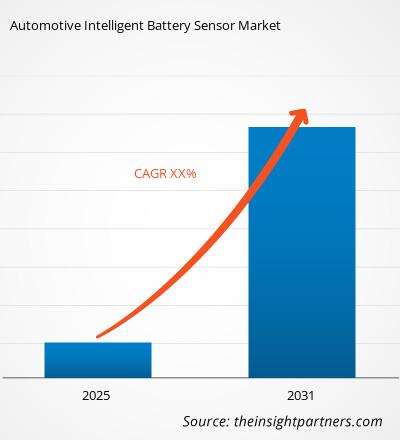
The Automotive Intelligent Battery Sensor Market size held a value of US$ 3.91 Billion in 2025 and will be worth US$ 8.93 Billion by 2034, at a CAGR of 9.6%. Growth drivers include battery state monitoring, start/stop, 48V, hybrid powertrains, and higher reliability demands in passenger cars, light commercial vehicles, and heavy commercial vehicles.
The North American market remains challenging technologically due to the integration of low-voltage energy management along with connected diagnostics and electrified accessories into cars. The market in North America is estimated to grow at 8.4%-9.4% during 2026-2034 driven by the electrification of pickups and SUVs, better warranty management, and increased CAN-based sensor use in premium vehicles.
Automotive Intelligent Battery Sensor Market Assessment and Insights
- North America held 26%–30% Automotive Intelligent Battery Sensor Market share in 2025 and is expected to grow at a CAGR of 8.4%–9.4% between 2026–2034, driven by connected diagnostics and 48v adoption.
- US represented 79%–84% of North America in 2025 and is projected to grow at a CAGR of 8.5%–9.5% between 2026–2034.
- Europe accounted for 27%–31% share in 2025 and is forecast to grow at a CAGR of 8.0%–9.0% between 2026–2034, led by Germany, France, the UK, Italy, and Spain.
- Asia Pacific held 34%–38% share in 2025 and is projected to grow at a CAGR of 10.2%–11.2% between 2026–2034, supported by China, Japan, South Korea, India, and Australia.
- Largest Segment 12v held a market share of 55%–59% in 2025, with CAGR range of 8.3%–9.3% between 2026–2034.
- High Growth Segment 48v held a market share of 11%–15% in 2025, with CAGR range of 11.4%–12.4% between 2026–2034.
- Key companies analyzed in detail: Continental AG, Furukawa Electric Co., Ltd., FORVIA HELLA, Inomatic GmbH, MTA S.p.A., NXP Semiconductors N.V., Qinuo Electronics Co., Ltd., Robert Bosch GmbH, Texas Instruments Incorporated, and Vishay Intertechnology, Inc.
Source: The Insight Partners' analysis based on proprietary research, government publications, company annual reports, investor presentations, industry databases, and expert interviews.
The development of battery sensors has progressed from simply measuring the terminals to more intelligent modules with features such as current, voltage, temperature, state-of-charge, and state-of-health determination. Manufacturing has become reliant on shunt precision, microcontroller embedding, LIN, and CAN communications, low quiescent current consumption, and suitability for lead acid, lithium ion, and mixed low voltage systems. The Automotive Intelligent Battery Sensor Market has been driven by start-stop, mild hybridization, and software defined diagnostics.
Future demand will grow the fastest at the intersection of electrification, fleet availability, and predictive maintenance. Asian manufacturing economies, European emissions regulations, and North American vehicle localization efforts have created a need for battery monitoring systems. Manufacturers need to find the balance between precision, cost, automotive certification, cybersecurity, and durable connectors to satisfy the demand for accurate energy management.
Automotive Intelligent Battery Sensor Market Report Scope
| Report Attribute | Details |
|---|---|
| Market size in 2025 | US$ 3.91 Billion |
| Market Size by 2034 | US$ 8.93 Billion |
| Global CAGR (2025 - 2034) | 9.6% |
| Historical Data | 2021-2024 |
| Forecast period | 2026-2034 |
Automotive Intelligent Battery Sensor Market Analysis
Demand is triggered by increase in electrical load, start/stop usage, mild hybrid system, battery warranty management, and avoiding unintended low-voltage failure. Growth in Automotive Intelligent Battery Sensor Market depends on the efforts of the OEMs to monitor current, voltage, and temperature levels and then derive charge level and battery life through processing of these measurements.
Supply factors tend to benefit players with automobile qualified sensors, longevity of the product, and presence of regional engineering teams. The supply chain for Automotive Intelligent Battery Sensor Market includes sensing IC vendors, shunt makers, connectors suppliers, harness suppliers, tier 1 electronics vendors, and OEMs. NXP Semiconductors N.V. offers battery sensor ICs with voltage, current, and temperature monitoring along with CAN and LIN interfaces.
The competitive environment consists of suppliers possessing automotive qualification capabilities and having relationships with OEM companies. The main competitors within the field are Continental AG, FORVIA HELLA, Robert Bosch GmbH, NXP Semiconductors N.V., Texas Instruments Incorporated, Vishay Intertechnology, Inc., Furukawa Electric Co., Ltd., MTA S.p.A., Inomatic GmbH, and Qinuo Electronics Co., Ltd.
The main investment drivers include development in areas such as 48V monitoring, low power ASICs, diagnostic capabilities, temperature tolerance, and secure data communication to body control and battery management systems. An automotive intelligent battery sensor market is now analyzed according to supplier robustness, performance of connectors, validation, and software calibration. A proper positioning strategy includes servicing both mass-production 12v platforms and growing hybrid architectures.
● REPORT CUSTOMIZATION
Tailor This Report To Align With Your Specific Business Requirements
This report can be customized to align precisely with your business objectives, scope, and target markets. Customization options include tailored segmentation, geography, competitive analysis, and strategic insights to support informed decision-making.
Customize This Report →WHAT YOU CAN ADJUST
- ● Segmentations
- ● Geography
- ● Competitive Analysis
- ● Language Preferences
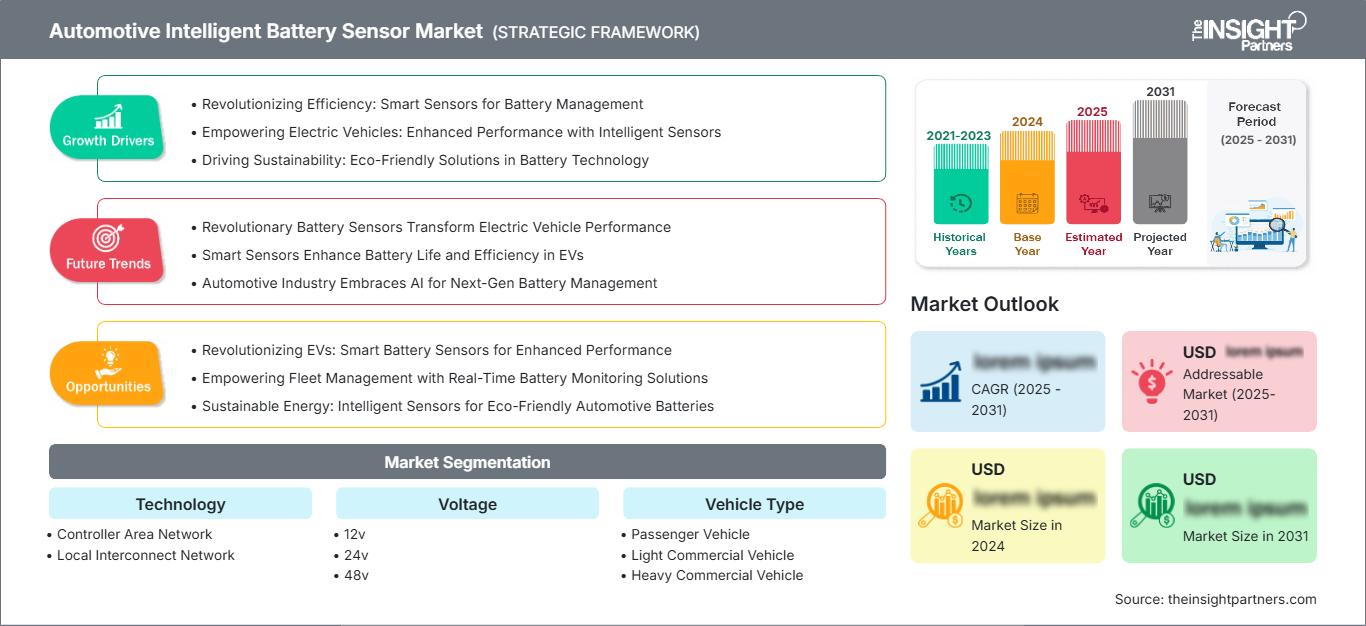
Automotive Intelligent Battery Sensor Market: Strategic Insights
Regional Insights
North America Automotive Intelligent Battery Sensor Market
North America had a market share of 26%-30% in 2025 and is projected to expand at 8.4%-9.4% till 2034. North American market share for Automotive Intelligent Battery Sensor Market has been driven by the high demand for battery sensor solutions in high-content vehicles, light trucks, hybrid cars, and connected car fleets.
Customers from the region require good CAN connectivity, validated sensor algorithms, and availability for long periods of time. Leading market players such as NXP Semiconductors N.V., Texas Instruments Incorporated, Robert Bosch GmbH, Continental AG, and FORVIA HELLA provide solutions for both low voltage networks and hybrid vehicles. Telematics, roadside reliability, and increased load on accessories in passenger and commercial vehicles are further driving demand.
U.S. Automotive Intelligent Battery Sensor Market
In 2025, the U.S. accounted for 79%-84% of North American demand with growth rates of 8.5%-9.5%. The application areas are 12V battery sensing, 48V mild-hybrid system, hybrid energy management, and fleet diagnostics. The high demand from pickups, SUVs, and commercial vehicles will favor the development of powerful sensor modules with dependable data output.
Companies’ presence comprises suppliers of semiconductors, sensors, and systems to OEM platforms. The companies NXP Semiconductors N.V., Texas Instruments Incorporated have CAN and LIN battery sensing solution and analog and power management systems respectively. Robert Bosch GmbH, Continental AG, FORVIA HELLA cover the area of integrated vehicle electronics, aftermarket replacement, and OEM energy management.
Europe Automotive Intelligent Battery Sensor Market
Share held by Europe was 27% to 31% in 2025 and expected to register growth of 8.0% to 9.0%. Germany is ahead with premium car production, 48v system and Tier 1 engineering, whereas UK has an advantage in speciality electrification and fleet application. France has alignment of battery monitoring with carbon emission reduction and hybrid platform production.
Italy and Spain have their contribution from vehicle assembly, components manufacturing and commercial vehicle platform which need reliable low-voltage monitoring system. Some of the players who fulfill European OEM needs include FORVIA HELLA, Continental AG, Robert Bosch GmbH, NXP Semiconductors N.V. and Vishay Intertechnology, Inc.
APAC Automotive Intelligent Battery Sensor Market
APAC had a market share between 34%–38% in 2025 and is expected to expand at a rate of 10.2%–11.2%. China dominates the region due to the volume of EV production, use of hybrid vehicles, and rapid localization of suppliers. Japan and South Korea gain strength in terms of electronic systems integration. Meanwhile, India and Australia are boosting the need to upgrade passenger vehicles and fleets.
Industrial policies, battery supply chains, and vehicle production drive regional growth. Furukawa Electric Co., Ltd., Qinuo Electronics Co., Ltd., NXP Semiconductors N.V., Continental AG, and FORVIA HELLA cater to the needs of 12v, 24v, and 48v monitoring. The most prevalent use cases occur in countries where the OEMs practice cost management and diagnostics.
Middle East & Africa Automotive Intelligent Battery Sensor Market
Middle East & Africa is forecast to experience 6.8%–7.8% growth, with the UAE leading the charge in the near term due to premium car imports, connected mobility and fleet tracking. Saudi Arabia is pursuing manufacturing capabilities in the automotive space, whereas South Africa is the key location for assembly of vehicles.
Demand in the Rest of MEA will be driven by commercial fleets, battery replacement schedules, telematics requirements and harsh climate conditions. Energy and infrastructure investments will aid in steady electrification, but adoption is irregular since each country’s level of component manufacturing capability and vehicle volume production varies. Suppliers concentrate on ruggedized sensor designs and after-sales market access.
Segmentation Analysis
Technology
Technology is projected to grow at 9.1%–10.1% during 2026–2034. Automotive Intelligent Battery Sensor Market scope spans Controller Area Network and Local Interconnect Network designs, with adoption shaped by data bandwidth, cost, diagnostics, and integration depth. CAN gains relevance in higher-value platforms, while LIN remains important for cost-efficient low-voltage sensing.
- Controller Area Network supports richer diagnostics and higher integration with body control, gateway, and battery management systems, making it strategically important for hybrid, premium, and commercial platforms.
- Local Interconnect Network remains widely used where cost efficiency, proven communication, and low-complexity battery monitoring are priorities across high-volume passenger vehicles and entry-level applications.
Voltage
Voltage is forecast to grow at 9.4%–10.4% during 2026–2034. The segment reflects continued dominance of 12v systems, steady use of 24v platforms in commercial vehicles, and faster adoption of 48v architectures for mild hybridization. The Automotive Intelligent Battery Sensor Market benefits as multiple voltage layers require precise monitoring and controlled energy distribution.
- 12v represents the largest installed base because conventional electrical systems, start-stop functions, lighting, infotainment, and body electronics depend on reliable low-voltage battery status monitoring.
- 24v retains importance in buses, trucks, and specialized commercial vehicles where higher accessory loads, durability expectations, and fleet uptime requirements support robust battery sensing.
- 48v is the high-growth voltage layer as mild hybrids, electric compressors, active chassis systems, and recuperation functions require accurate monitoring across higher-power low-voltage networks.
Vehicle Type
Vehicle Type is expected to grow at 8.8%–9.8% during 2026–2034. Passenger vehicles dominate demand because comfort electronics, start-stop systems, and hybrid options are spreading across trim levels. Commercial vehicles add value through telematics, battery uptime, auxiliary loads, and maintenance analytics that rely on accurate sensor feedback.
- Passenger Vehicle drives the largest demand base as OEMs integrate start-stop functions, infotainment loads, hybrid options, and diagnostic alerts across mass-market and premium vehicles.
- Light Commercial Vehicle adoption rises with last-mile fleets, telematics, idle management, and battery health monitoring that reduce downtime and improve service planning.
- Heavy Commercial Vehicle demand is linked to 24v systems, auxiliary power needs, cold-start reliability, fleet uptime, and preventive maintenance in logistics and vocational operations.
Electric Vehicle
Electric Vehicle is projected to grow at 10.6%–11.6% during 2026–2034. Hybrid and plug-in hybrid vehicles need dependable low-voltage monitoring because control units, pumps, safety systems, and auxiliary electronics remain active even when traction batteries dominate propulsion. This makes intelligent battery sensing essential for energy coordination and diagnostic reliability.
- Plug-In Hybrid Electric Vehicle requires accurate auxiliary battery monitoring because charging events, electric driving, and engine-off accessory loads create variable low-voltage duty cycles.
- Hybrid Electric Vehicle remains strategically important as regenerative braking, engine restart, stop-start operation, and control electronics depend on dependable battery condition data.
Opportunity Snapshot
| Vehicle Type | Revenue Contribution | Trend Tag | Adoption Stage |
| Passenger Vehicle | High | Start Stop | Mature |
| Light Commercial Vehicle | Medium | Fleet Uptime | Scaling |
| Heavy Commercial Vehicle | Medium | 24v Reliability | Scaling |
Automotive Intelligent Battery Sensor Market Growth Drivers and Impact Analysis
Start-Stop and Low-Voltage Reliability Requirements
Start-stop systems need to have real-time data on charge acceptance, cranking ability, temperature, and aging status of the battery before the engine can be shut down and restarted again. Smart sensors decrease the risk of failed restarting by supplying control modules with real-time information about the battery. The most noticeable commercial effect can be seen for passenger cars in mass production where efficiency increases should not harm the vehicle's reliability. Original Equipment Manufacturers also use sensor data to reduce battery warranty claims and detect parasitic drain in the vehicle.
48v Mild Hybrid Architectures Increase Sensor Value
In addition to offering recuperation, torque assistance, electrical compressors, and increased accessory power, 48V systems retain the low-voltage architecture, which should be precisely controlled. In such a case, the importance of using battery sensors grows, as there is an increase in the dynamics of the current compared to the 12V systems. Companies supporting a greater voltage range, shunt measurements, and connectivity with battery or body management systems would be able to provide more value per vehicle. Such an effect would be visible in premium and mass-market cars, as OEMs employ mild hybrids for achieving efficiency goals without battery-electric costs.
Connected Diagnostics and Predictive Maintenance
Fleet operators, dealers, and automakers increasingly value battery data because low-voltage failure can immobilize vehicles even when major mechanical systems remain functional. Intelligent battery sensors enable state-of-health tracking, remote alerts, and service planning through connected vehicle platforms. This creates measurable impact in light commercial and heavy commercial fleets where downtime affects delivery schedules and maintenance cost. Sensor suppliers benefit when their modules provide stable data over vehicle life, support diagnostics standards, and withstand vibration, temperature swings, and corrosion. The Automotive Intelligent Battery Sensor Market therefore gains from both factory installation and service ecosystem integration.
Automotive Intelligent Battery Sensor Market Future Trends
Sensor Data Becomes Part of Vehicle Energy Software
Automotive Intelligent Battery Sensor Market trends will increasingly center on the use of battery data inside vehicle energy software. Future platforms will not treat the sensor as a passive measurement device; instead, state-of-charge, state-of-health, current flow, and temperature inputs will support load shedding, predictive service, over-the-air diagnostics, and hybrid operating decisions. This trend favors suppliers that combine accurate hardware with calibration support and software-ready outputs. As electrical architectures consolidate, battery sensing data will become a trusted input for body controllers, gateways, telematics units, and battery management systems across multiple vehicle classes.
Higher Integration in Battery Terminal Modules
Future designs will integrate sensing, protection, communication, and diagnostic functions into compact terminal modules that reduce assembly complexity and improve data integrity. This direction is especially relevant for OEMs seeking simplified harnessing, fewer connectors, and better resistance to vibration and corrosion. Integrated modules can also support faster installation and more consistent factory calibration. The trend will reward suppliers with mechanical design expertise, automotive electronics capability, and close collaboration with battery and harness partners. Adoption will be gradual because automakers must validate durability, serviceability, and cost across long production cycles.
Automotive Intelligent Battery Sensor Market Opportunities
Platform Supply for 48v and Hybrid Programs
Automakers developing 48v and hybrid programs need battery sensing suppliers that can support wide voltage tolerance, precise current measurement, thermal monitoring, and validated communication with vehicle controllers. Automotive Intelligent Battery Sensor Market Forecasts support investment in platform-ready sensor families that can be adapted across passenger vehicles, light commercial vehicles, and regional trim strategies. Suppliers can differentiate through co-development, second-source planning, calibration assistance, and lifecycle support. The opportunity is strongest where a sensor design can serve multiple vehicle programs while meeting cost, safety, and durability requirements. Long-term supply agreements may also reduce launch risk for OEMs.
Aftermarket Diagnostics and Fleet Battery Health Services
Battery-related breakdowns create service opportunities beyond original equipment installation, particularly for commercial fleets and aging passenger vehicles. Suppliers and distributors can package intelligent battery sensors with diagnostic tools, telematics alerts, and maintenance workflows that identify weak batteries before failure. This opportunity requires compatibility with common vehicle networks, clear service procedures, and reliable replacement availability. Fleet operators can use sensor data to schedule maintenance during planned downtime, reducing roadside incidents and vehicle substitution costs. Aftermarket growth will depend on installer training, pricing discipline, and the ability to prove operational savings rather than simply selling another electronic component.
Recent Developments
- January 2026: FORVIA HELLA introduced its next-generation intelligent battery sensor in China, targeting more accurate battery condition monitoring and stronger support for local vehicle electrification programs. The launch highlights rising regional demand for compact sensors that combine measurement precision, communication capability, and OEM-ready integration.
- October 2025: NXP Semiconductors N.V. (NASDAQ: NXPI) announced its industry-first Electrochemical Impedance Spectroscopy (EIS) battery management chipset with hardware-based nanosecond-level synchronization of all devices. The new system solution is designed to enhance safety, longevity, and performance in electric vehicles and energy storage systems. It integrates EIS measurement directly into three battery management system (BMS) chipset units, enabling carmakers to gain deeper insights into battery health and behavior.
- December 2025: Littelfuse, Inc. (NASDAQ: LFUS), a diversified industrial technology manufacturing company empowering a sustainable, connected, and safer world, announced the release of six new automotive current sensors designed to enhance electric and hybrid vehicle performance, efficiency, and functional safety. (View the video in English, Chinese, and Japanese).
Frequently Asked Questions

- Comprehensive Market Sizing and Forecast Analysis
- Detailed Segmentation Analysis
- In-Depth Market Dynamics Assessment
- Regional and Country-Level Insights
- Competitive Landscape and Company Benchmarking
- Strategic Business Intelligence
Recent Reports
Testimonials

The Insight Partners' SCADA System Market report is comprehensive, with valuable insights on current trends and future forecasts. The team was highly professional, responsive, and supportive throughout. We are very satisfied and highly recommend their services.
RAN KEDEM Partner, Reali Technologies LTDs
I requested a report on a very specific software market and the team produced the report in a few days. The information was very relevant and well presented. I then requested some changes and additions to the report. The team was again very responsive and I got the final report in less than a week.
JEAN-HERVE JENN Chairman, Future Analytica
We worked with The Insight Partners for an important market study and forecast. They gave us clear insights into opportunities and risks, which helped shape our plans. Their research was easy to use and based on solid data. It helped us make smart, confident decisions. We highly recommend them.
PIYUSH NAGPAL Sr. Vice President, High Beam Global
The Insight Partners delivered insightful, well-structured market research with strong domain expertise. Their team was professional and responsive throughout. The user-friendly website made accessing industry reports seamless. We highly recommend them for reliable, high-quality research services
YUKIHIKO ADACHI CEO, Deep Blue, LLC.
This is the first time I have purchased a market report from The Insight Partners.While I was unsure at first, I visited their web site and felt more comfortable to take the risk and purchase a market report.I am completely satisfied with the quality of the report and customer service. I had several questions and comments with the initial report, but after a couple of dialogs over email with their analyst I believe I have a report that I can use as input to our strategic planning process.Thank you so much for taking the extra time and making this a positive experience.I will definitely recommend your service to others and you will be my first call when we need further market data.
JOHN SUZUKI President and Chief Executive Officer, Board Director, BK Technologies
I wish to appreciate your support and the professionalism you displayed in the course of attending to my request for information regarding to infectious disease IVD market in Nigeria. I appreciate your patience, your guidance, and the fact that you were willing to offer a discount, which eventually made it possible for us to close a deal. I look forward to engaging The Insight Partners in the future, all thanks to the impression you have created in me as a result of this first encounter.
DR CHIJIOKE ONYIA MANAGING DIRECTOR, PineCrest Healthcare Ltd.Reason to Buy
- Informed Decision-Making
- Understanding Market Dynamics
- Competitive Analysis
- Identifying Emerging Markets
- Customer Insights
- Market Forecasts
- Risk Mitigation
- Boosting Operational Efficiency
- Strategic Planning
- Investment Justification
- Tracking Industry Innovations
- Aligning with Regulatory Trends





 Get Free Sample for