
Automotive Battery Sensor Market Size, Share & Demand by 2034
Coverage: by Communication Technology (Local Interconnect Network (LIN), Controller Area Network (CAN)); Voltage (12v, 24v, 48v); Vehicle Type (Passenger Car, Light Commercial Vehicle, Heavy Commercial Vehicle); Hybrid Vehicle Type (Hybrid Electric Vehicle, Plug-In Hybrid Electric Vehicle) , and Geography (North America, Europe, Asia Pacific, and South and Central America)
- Status : Data Released
- Report Code : TIPRE00004118
- Category : Automotive and Transportation
- No. of Pages : 150
- Available Report Formats :


- Last update date : August 12, 2026


2025 Market Size
US$ 1.76 Bn
Base year value
2034 Forecast
US$ 4.57 Bn
Projected by 2034
CAGR 2026-2034
11.16 %
Growth rate
Addressable Market
US$ 27.90 Bn
(2026-2034)
The automotive battery sensor market was valued at US$ 1.76 Billion in 2025 and is projected to reach US$ 4.57 Billion by 2034, registering a CAGR of 11.16% during 2026–2034. Growth is driven by rising vehicle electrification, start-stop system penetration, 48v electrical architectures, and higher demand for real-time battery health diagnostics across passenger and commercial vehicle platforms.
North America remains a high-value adoption region as advanced electronics, hybrid vehicles, premium models, and fleet electrification increase battery monitoring requirements. The automotive battery sensor market size in the region is supported by strong OEM integration, regulatory focus on emissions reduction, and connected vehicle diagnostics, with regional growth expected to track a CAGR range of 10.2–11.6% during 2026–2034.
Automotive Battery Sensor Market Assessment and Insights
- North America: Held 24–27% share in 2025 and is expected to grow at a CAGR between 10.2–11.6% during 2026–2034, supported by hybrid vehicles, start-stop systems, and connected diagnostics.
- US: Accounted for 78–82% of North America in 2025 and is forecast to grow at a CAGR between 10.4–11.8% during 2026–2034, led by passenger cars, SUVs, and fleet electrification.
- Europe: Represented 23–26% share in 2025 and is projected to grow at a CAGR between 10.0–11.4% during 2026–2034, with Germany, the UK, France, Italy, and Spain leading adoption.
- Asia Pacific: Captured 39–43% share in 2025 and is expected to grow at a CAGR between 11.8–13.2% during 2026–2034, led by China, Japan, South Korea, India, and Australia.
- Largest Segment: Local Interconnect Network held 58–62% market share in 2025 and is projected to grow at a CAGR between 10.7–12.0% during 2026–2034 due to cost-efficient battery monitoring.
- High Growth Segment: 48v held 18–22% share in 2025 and is expected to grow at a CAGR between 13.2–14.8% during 2026–2034 as mild-hybrid architectures expand.
- Key companies analyzed in detail: ams-OSRAM AG, Bosch Limited, FURUKAWA ELECTRIC CO., LTD., HELLA GmbH & Co. KGaA, Inomatic GmbH, MTA S.p.A., NXP Semiconductors N.V., TE Connectivity Ltd., Texas Instruments Incorporated, Vishay Intertechnology, Inc.
Source: The Insight Partners' analysis based on proprietary research, government publications, company annual reports, investor presentations, industry databases, and expert interviews.
Battery sensing has moved from basic voltage checks toward intelligent modules that measure current, temperature, state of charge, state of health, and state of function. The automotive battery sensor market is evolving with mixed-signal semiconductors, shunt-based measurement, LIN communication, and CAN-enabled diagnostics. These shifts improve energy management in vehicles carrying more electronic loads, ADAS features, and electrified auxiliary systems.
Future demand will be shaped by hybrid adoption, 48v systems, connected diagnostics, and tighter emissions rules. Asia Pacific will add scale through vehicle production and EV supply chains, while Europe will emphasize CO2 compliance and battery reliability. Suppliers investing in compact sensing, software calibration, and cybersecurity-ready communication interfaces will be better placed for next-generation vehicle electrical platforms.
Automotive Battery Sensor Market Report Scope
| Report Attribute | Details |
|---|---|
| Market size in 2025 | US$ 1.76 Billion |
| Market Size by 2034 | US$ 4.57 Billion |
| Global CAGR (2026 - 2034) | 11.16% |
| Historical Data | 2021-2024 |
| Forecast period | 2026-2034 |
Automotive Battery Sensor Market Analysis
The automotive battery sensor market growth is driven by the need to prevent battery failure, optimize alternator control, and support start-stop functions. Modern vehicles rely on stable low-voltage networks for safety, infotainment, telematics, and driver assistance. Sensors help control charging strategy, reduce unnecessary engine load, and provide diagnostic data that supports predictive maintenance in private vehicles and fleets.
The automotive battery sensor market analysis shows that value is concentrated around sensor accuracy, communication protocol compatibility, semiconductor reliability, and integration with vehicle energy management systems. LIN technology still has its place in cost-sensitive battery monitoring applications, whereas CAN is becoming increasingly relevant when more diagnostic capabilities and better data transmission performance are needed. OEMs prefer sensors capable of tolerating thermal cycling, vibrations, and prolonged service intervals.
The rivalry covers electronics manufacturers, semiconductor manufacturers, connectivity, and wiring specialists, as well as companies specializing in battery management solutions. ams-OSRAM AG, Bosch Limited, HELLA GmbH & Co. KGaA, NXP Semiconductors N.V., Texas Instruments Incorporated, TE Connectivity Ltd., Vishay Intertechnology, Inc., FURUKAWA ELECTRIC CO., LTD., MTA S.p.A., and Inomatic GmbH offer solutions for various sensing, connectivity, and vehicle integration layers.
The investments are flowing into 48V battery monitoring, hybrid battery management, shunt measurement precision, and edge computing. Strategic alignment will depend on OEM certification, software capabilities, production near OEM location, and the capability to provide support to both 12V traditional and electrified vehicle platforms. Those who integrate sensing hardware with communication intelligence have better chances.
● REPORT CUSTOMIZATION
Tailor This Report To Align With Your Specific Business Requirements
This report can be customized to align precisely with your business objectives, scope, and target markets. Customization options include tailored segmentation, geography, competitive analysis, and strategic insights to support informed decision-making.
Customize This Report →WHAT YOU CAN ADJUST
- ● Segmentations
- ● Geography
- ● Competitive Analysis
- ● Language Preferences
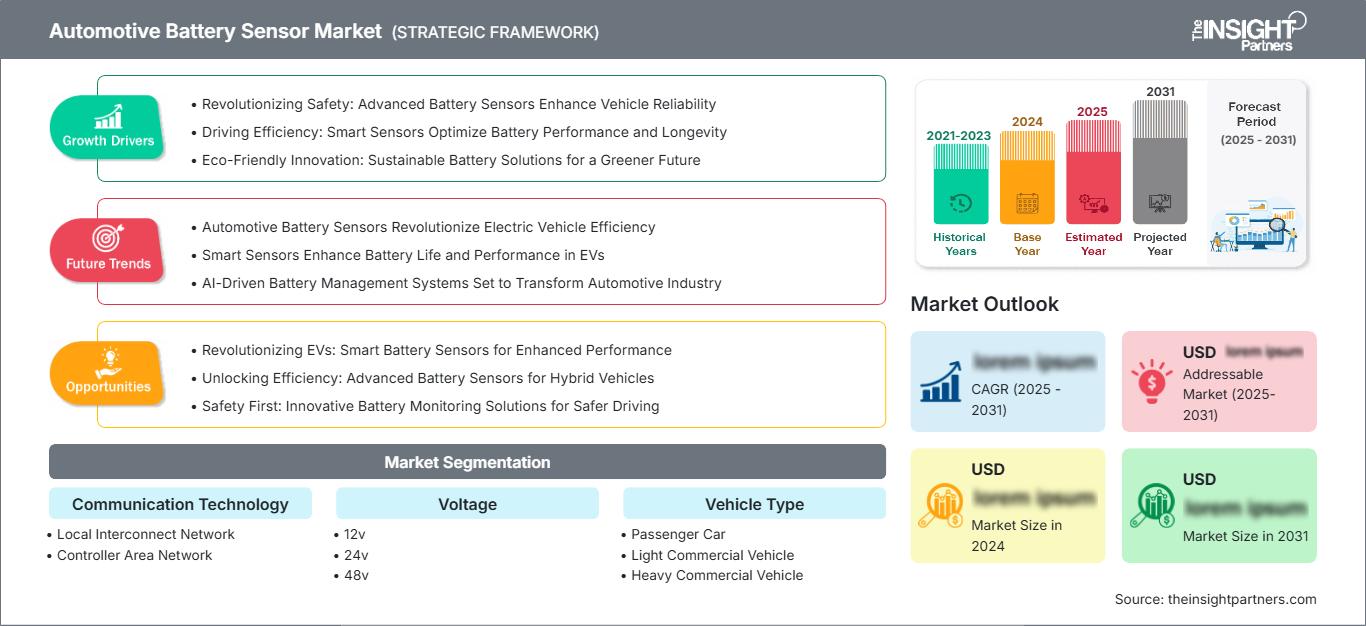
Automotive Battery Sensor Market: Strategic Insights
Regional Insights
North America automotive battery sensor market
North America held 24–27% automotive battery sensor market share in 2025 and is expected to grow at a CAGR of 10.2–11.6% during 2026–2034. These regions have access to high-quality automotive content, electric SUVs, diagnostics, and the use of battery health monitoring by fleets. An increased number of electronic devices in vehicles leads to a periodic necessity to use sensors that control voltage, current, temperature, and battery condition.
Automakers and fleet managers utilize battery information in order to decrease failures, facilitate start-stop functionality, and to manage warranty claims. Hybrid pickups, vans, and driver assistance technologies require more low-voltage energy management capabilities. The largest growth comes from OEMs utilizing battery sensors in terminals, body electronics, and predictive maintenance systems.
U.S. automotive battery sensor Market
The US accounted for 78–82% of North America in 2025 and is forecast to grow at a CAGR of 10.4–11.8% during 2026–2034. Demand is concentrated in passenger cars, SUVs, light trucks, and commercial fleets, where electronic content and battery reliability requirements are rising.
TE Connectivity Ltd., Texas Instruments Incorporated, NXP Semiconductors N.V., Vishay Intertechnology, Inc., and Bosch Limited strengthen the ecosystem through connectivity, analog chips, power management, and automotive electronics capabilities. Fleet electrification and connected diagnostics are encouraging OEMs to specify sensors with accurate state-of-charge and state-of-health reporting.
Europe automotive battery sensor Market
Europe represented 23–26% share in 2025 and is projected to grow at a CAGR of 10.0–11.4% during 2026–2034. Germany leads through premium OEMs, hybrid platforms, and strong Tier-1 electronics suppliers, while the UK supports connected vehicle software and aftermarket diagnostics.
France, Italy, and Spain add demand through compact cars, light commercial vehicles, and emission-compliant powertrain programs. European CO2 rules, start-stop penetration, and 48v mild hybrids support intelligent sensing adoption. Suppliers with validated safety, electromagnetic compatibility, and low-power performance will remain preferred in regional sourcing decisions.
APAC automotive battery sensor Market
APAC held 39–43% share in 2025 and is expected to grow at a CAGR of 11.8–13.2% during 2026–2034. China leads through EV, hybrid, and passenger vehicle production scale, while Japan and South Korea contribute advanced electronics and battery management expertise.
India is expanding through urban passenger vehicles, start-stop adoption, and rising demand for fuel-efficient models. Australia adds demand through SUVs and fleet diagnostics. Regional growth is supported by localized electronics supply chains, lower-cost sensor production, and strong government support for electrified mobility.
Middle East & Africa automotive battery sensor Market
The Middle East and Africa market is expected to grow at a CAGR of 8.5–9.8% during 2026–2034. Saudi Arabia and the UAE lead demand through premium vehicles, fleet modernization, and harsh climate conditions that make battery monitoring more valuable.
South Africa supports adoption through vehicle assembly, aftermarket diagnostics, and commercial fleets. The rest of MEA demand remains uneven, but heat, long-distance driving, and rising electronic content create opportunities for robust 12v battery sensors and service-channel diagnostic tools.
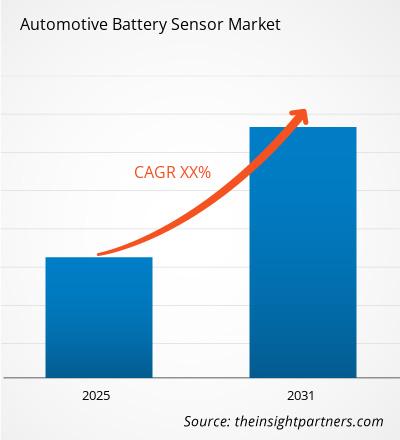
Segmentation Analysis
Communication Technology
Communication Technology is expected to grow at a CAGR of 10.9–12.3% during 2026–2034. The automotive battery sensor market scope is shaped by how battery data moves between sensors, battery management systems, and electronic control units. LIN supports cost-efficient sensing, while CAN supports richer diagnostics in complex platforms.
- Local Interconnect Network remains widely used because it offers low-cost communication for battery status data, start-stop control, and basic energy management across high-volume passenger vehicles.
- Controller Area Network is gaining importance where faster communication, fault diagnostics, and integration with vehicle domain controllers are required for hybrid, premium, and commercial platforms.
Voltage
Voltage is projected to grow at a CAGR of 11.2–12.8% during 2026–2034 as 12v systems remain foundational and 48v systems expand in mild hybrids. Voltage architecture influences sensor accuracy, packaging, current measurement range, and integration with alternators, converters, and energy recovery systems.
- 12v remains the largest installed base because most passenger cars and light vehicles still depend on low-voltage batteries for starting, lighting, infotainment, and body electronics.
- 24v supports commercial vehicles, buses, and heavy-duty applications where higher electrical loads require durable monitoring under vibration, temperature swings, and longer duty cycles.
- 48v is the fastest-expanding voltage class as mild-hybrid systems use higher electrical capacity for regenerative braking, torque assist, electric compressors, and improved fuel efficiency.
Vehicle Type
Vehicle Type is forecast to grow at a CAGR of 10.8–12.2% during 2026–2034 as battery reliability becomes important across passenger and commercial fleets. Vehicle size, electronic load, and duty cycle determine sensor complexity and replacement demand.
- Passenger Car demand is highest because global production scale, infotainment growth, ADAS content, and start-stop penetration require continuous battery condition monitoring.
- Light Commercial Vehicle adoption is supported by delivery fleets, telematics, electric auxiliaries, and downtime reduction goals that make battery health diagnostics financially valuable.
- Heavy Commercial Vehicle applications need rugged sensors that tolerate high vibration, long operating hours, accessory loads, and harsh thermal conditions in logistics and construction fleets.
Hybrid Vehicle Type
Hybrid Vehicle Type is expected to grow at a CAGR of 12.0–13.6% during 2026–2034 as electrified powertrains require precise low-voltage and auxiliary battery monitoring. Hybrid platforms increase sensor importance because engine restarts, regenerative braking, and electric support functions depend on reliable battery state data.
- Hybrid Electric Vehicle platforms use battery sensors to manage frequent engine stop-start events, accessory loads, and energy recovery while maintaining smooth operation.
- Plug-In Hybrid Electric Vehicle platforms require more advanced monitoring because charging behavior, electric driving range, and auxiliary battery reliability directly affect user experience.
Opportunity Snapshot
| Vehicle Type | Revenue Contribution | Trend Tag | Adoption Stage |
| Passenger Car | High | Start Stop | Mature |
| Light Commercial Vehicle | Medium | Fleet Uptime | Scaling |
| Heavy Commercial Vehicle | Medium | Rugged Power | Scaling |
Automotive Battery Sensor Market Growth Drivers and Impact Analysis
Expansion of Start-Stop and Energy Management Systems
The start-stop system requires accurate information about the battery condition since continuous engine stop cycles may reveal low-quality batteries and undermine the customer's trust. Battery sensors can be used to determine the state of charge, state of health, and cranking ability prior to allowing the engine to stop. It will reinforce OEM's need for inexpensive, reliable sensors in 12-volt systems and aftermarket diagnostics possibilities. The strongest influence will be seen in passenger cars and urban vehicles, where emissions and fuel savings take priority. The suppliers will gain from sensor integration into the alternator and body electronics control.
Growth of 48v Mild-Hybrid Architectures
Systems using 48-volt technology are becoming more popular since they make regenerative braking, torque assist, electric boost, and higher auxiliary loads possible without having to pay for high-voltage electrification. They need to have accurate sensing of current, voltage, and temperature so as to ensure the safety of the batteries as well as the coordination of energy transfer among the converters, the motors, and the controllers. It adds more value to the components and gives preference to suppliers who can provide accurate measurements, good communication, and automotive-grade semiconductors.
Rising Fleet Need for Predictive Battery Diagnostics
Unplanned battery failures lead to loss of productivity in commercial vehicle fleets, particularly in delivery vans, service vehicles, and trucks traveling long distances. Batteries have sensors that give predictive data, making it possible for maintenance teams to change or charge batteries without experiencing battery failures. Fleet technologies can take sensor data and turn it into information using telematics. This is a driving factor for the use of CAN-compatible sensors, robust housing, and software analysis. The suppliers can benefit from partnerships with fleet technology companies and OEMs.
Automotive Battery Sensor Market Future Trends
Edge Intelligence in Battery Monitoring
Automotive battery sensor market trends are moving toward sensors that process data locally instead of only transmitting raw measurements. Microcontrollers embedded inside will provide battery age estimation, charge acceptance capability, thermal stresses and probability of battery failure near the battery connector. This will ease the burden on electronics control units and will make maintenance decisions easier. With the growth in the number of software-defined vehicles, sensors that can be updated easily, along with cybersecurity and algorithms, will get more value.
Integration with Connected Vehicle Service Platforms
Increasingly, sensor data from batteries will be used to connect service platforms that offer remote monitoring of vehicle conditions. Car manufacturers and fleet managers could make use of the information from sensors to forecast warranties, schedule maintenance, and minimize no-start occurrences. In the long run, this will give rise to the need for standard data models, secure communication systems, and cloud-based diagnostics. Furthermore, the trend is also favorable for the after-sales services sector since the workshops will have access to the condition history of the batteries before making repairs.
Automotive Battery Sensor Market Opportunities
Localized Sensor Production for APAC Vehicle Platforms
Asia Pacific offers strong opportunity because high-volume vehicle production, EV supply chains, and hybrid adoption create scale for sensor suppliers. automotive battery sensor market Forecasts point to demand for cost-effective LIN sensors in mass-market cars and higher-value CAN-enabled sensors in hybrids and commercial vehicles. Localized production can reduce cost, shorten lead times, and improve OEM engineering support. Suppliers should invest in regional testing, electronics assembly, and partnerships with battery system integrators to win platform-level contracts in China, India, Japan, and South Korea.
48v and PHEV Battery Diagnostic Modules
Modules for 48V and PHEV systems present opportunities as such platforms demand much more sophisticated energy management than regular 12V cars. There are possibilities for differentiating suppliers based on high current measuring capabilities, temperature management, diagnostic software and adherence to automotive safety standards. There is an actionable opportunity due to the fact that auto makers continue to build up their range of hybrids while charging station infrastructure remains regional in nature. Vendors who prove their sensors in charging, regenerative braking and high load environments can win designs.
Frequently Asked Questions

- Comprehensive Market Sizing and Forecast Analysis
- Detailed Segmentation Analysis
- In-Depth Market Dynamics Assessment
- Regional and Country-Level Insights
- Competitive Landscape and Company Benchmarking
- Strategic Business Intelligence
Recent Reports
Testimonials

The Insight Partners' SCADA System Market report is comprehensive, with valuable insights on current trends and future forecasts. The team was highly professional, responsive, and supportive throughout. We are very satisfied and highly recommend their services.
RAN KEDEM Partner, Reali Technologies LTDs
I requested a report on a very specific software market and the team produced the report in a few days. The information was very relevant and well presented. I then requested some changes and additions to the report. The team was again very responsive and I got the final report in less than a week.
JEAN-HERVE JENN Chairman, Future Analytica
We worked with The Insight Partners for an important market study and forecast. They gave us clear insights into opportunities and risks, which helped shape our plans. Their research was easy to use and based on solid data. It helped us make smart, confident decisions. We highly recommend them.
PIYUSH NAGPAL Sr. Vice President, High Beam Global
The Insight Partners delivered insightful, well-structured market research with strong domain expertise. Their team was professional and responsive throughout. The user-friendly website made accessing industry reports seamless. We highly recommend them for reliable, high-quality research services
YUKIHIKO ADACHI CEO, Deep Blue, LLC.
This is the first time I have purchased a market report from The Insight Partners.While I was unsure at first, I visited their web site and felt more comfortable to take the risk and purchase a market report.I am completely satisfied with the quality of the report and customer service. I had several questions and comments with the initial report, but after a couple of dialogs over email with their analyst I believe I have a report that I can use as input to our strategic planning process.Thank you so much for taking the extra time and making this a positive experience.I will definitely recommend your service to others and you will be my first call when we need further market data.
JOHN SUZUKI President and Chief Executive Officer, Board Director, BK Technologies
I wish to appreciate your support and the professionalism you displayed in the course of attending to my request for information regarding to infectious disease IVD market in Nigeria. I appreciate your patience, your guidance, and the fact that you were willing to offer a discount, which eventually made it possible for us to close a deal. I look forward to engaging The Insight Partners in the future, all thanks to the impression you have created in me as a result of this first encounter.
DR CHIJIOKE ONYIA MANAGING DIRECTOR, PineCrest Healthcare Ltd.Reason to Buy
- Informed Decision-Making
- Understanding Market Dynamics
- Competitive Analysis
- Identifying Emerging Markets
- Customer Insights
- Market Forecasts
- Risk Mitigation
- Boosting Operational Efficiency
- Strategic Planning
- Investment Justification
- Tracking Industry Innovations
- Aligning with Regulatory Trends





 Get Free Sample for