
Autonomous Farm Equipment Market Share, Growth & Demand by 2034
Coverage: By Product Type (Tractors, Harvesters, UAVs, Others); Operation Type (Fully Autonomous, Partially Autonomous) , and Geography (North America, Europe, Asia Pacific, and South and Central America)
- Status : Data Released
- Report Code : TIPRE00020887
- Category : Manufacturing and Construction
- No. of Pages : 150
- Available Report Formats :


- Last update date : August 28, 2026


2025 Market Size
US$ 74.45 Bn
Base year value
2034 Forecast
US$ 136.57 Bn
Projected by 2034
CAGR 2026-2034
6.97 %
Growth rate
Addressable Market
US$ 952.73 Bn
(2026-2034)
The Autonomous Farm Equipment market is projected to expand from US$ 74.45 Billion in 2025 to US$ 136.57 Billion by 2034, registering a CAGR of 6.97% during 2026–2034. Expansion reflects the movement of autonomous tractors, harvesters, and unmanned aerial vehicles from controlled demonstrations into repeatable commercial workflows, as growers seek equipment that can sustain field productivity, improve operating precision, and reduce dependence on scarce seasonal labor.
North America remains the principal commercialization center, with a modelled CAGR of 6.6–7.2% through 2034. The autonomous farm equipment market size is supported by extensive broadacre operations, established dealer service infrastructure, and automated guidance already used on well over half of planted acreage for major US crops. Retrofit autonomy and remote fleet supervision should widen addressable demand without requiring complete equipment replacement.
Autonomous Farm Equipment Market Assessment and Insights
- North America accounted for 34–38% Autonomous Farm Equipment Market share in 2025 and is growing at a CAGR of 6.6–7.2% during 2026–2034, supported by broadacre economics, mature guidance infrastructure, and retrofit availability.
- US represented 78–82% of North American revenue in 2025 and is advancing at a 6.7–7.3% CAGR, with tillage, grain handling, and orchard spraying leading deployment.
- Europe held 26–30% share in 2025 and is expanding at a 6.4–7.0% CAGR through 2034; Germany leads, while France, the UK, Italy, and Spain underpin diversified adoption.
- Asia Pacific captured 22–26% share in 2025 and is growing at a 7.5–8.1% CAGR, with China leading and Japan, South Korea, India, and Australia broadening commercialization.
- Largest Segment Tractors held a 48–52% market share in 2025 and are expected to record a 6.5–7.1% CAGR during 2026–2034.
- High Growth Segment Fully Autonomous equipment represented 31–35% market share in 2025 and is projected to deliver a 8.0–8.6% CAGR during 2026–2034.
- Key companies analyzed in detail: Deere & Company, AGCO Corporation, CNH Industrial N.V., Yanmar Holdings Co., Ltd., Mahindra & Mahindra Limited, Rowbot Systems LLC, Kubota Corporation, AgXeed B.V., Naïo Technologies SAS, and FarmDroid ApS.
Source: The Insight Partners' analysis based on proprietary research, government publications, company annual reports, investor presentations, industry databases, and expert interviews.
The commercial development of the technology has moved away from guidance-assisted operation to remote-supervised field systems which rely on perception. Camera systems, RTK positioning, LiDAR sensors, edge computing, and digital field boundaries are now commonly combined into an operational stack. Ready-for-factory tractors are used side by side with retrofit kits and lightweight robots, enabling the producers to adjust the level of autonomy to the age of equipment, crop system, and capital investment cycle.
During the forecast period, the adoption of the technology will progress from North American grain farmers and European specialty crops to large Asian farms and selected projects from the Middle East. Leasing and financing services and the robotics-as-a-service model will lower the barriers for adopting the technology, while public demonstrations and digital agriculture incentives will improve trust. ISO 18497 safety standards and clear definitions of operational zones will facilitate the comparison during procurement processes.
Autonomous Farm Equipment Market Report Scope
| Report Attribute | Details |
|---|---|
| Market size in 2025 | US$ 74.45 Billion |
| Market Size by 2034 | US$ 136.57 Billion |
| Global CAGR (2026 - 2034) | 6.97% |
| Historical Data | 2021-2024 |
| Forecast period | 2026-2034 |
Autonomous Farm Equipment Market Analysis
The Autonomous Farm Equipment Market growth is based on the economic gain of completing time-sensitive operations with less human effort. The need for automation emerges in regions where bad weather forces farmers to perform tillage, seeding, spraying, or harvesting operations in limited time windows. Autonomous guidance systems are already implemented in more than 50% of areas planted with some of the most popular US crops, offering digital infrastructure.
The ecosystem is comprised of manufacturers of equipment, perception technologies, satellite navigation systems, software providers, implement manufacturers, dealers, insurance companies, and agronomy specialists. The availability of technology is constrained not by vehicle manufacturing but by the development of durable sensors, system verification, and customer support in different environments. Retrofit approaches contribute to higher efficiency of the equipment fleet, while specialized robotics solve problems related to low soil compaction and repetition of operations.
The autonomous farm equipment market forecasts reveals that competitive dynamics are splitting along scaled original equipment manufacturers and dedicated robotics companies. Deere & Company focuses on factory-integrated and retrofit perception systems; AGCO Corporation has progressed in mixed fleet OutRun autonomy; CNH Industrial N.V. differentiates automation from guidance to full autonomy. Kubota Corporation and Yanmar Holdings Co., Ltd. leverage their experience in miniaturized equipment along with their paths to Japanese smart agriculture adoption.
The strategic positioning is also based on crops' specifics. AgXeed B.V. is focused on broadacre autonomous power, whereas Naïo Technologies SAS, FarmDroid ApS, and Rowbot Systems LLC concentrate on field robotics, precision weeding, seeding, or nutrient decision-making. Mahindra & Mahindra Limited provides scale through value-based tractors and automation-ready platforms. The capital flows towards commercial validation, retrofit capability, dealer network, and recurring software or services income streams.
● REPORT CUSTOMIZATION
Tailor This Report To Align With Your Specific Business Requirements
This report can be customized to align precisely with your business objectives, scope, and target markets. Customization options include tailored segmentation, geography, competitive analysis, and strategic insights to support informed decision-making.
Customize This Report →WHAT YOU CAN ADJUST
- ● Segmentations
- ● Geography
- ● Competitive Analysis
- ● Language Preferences
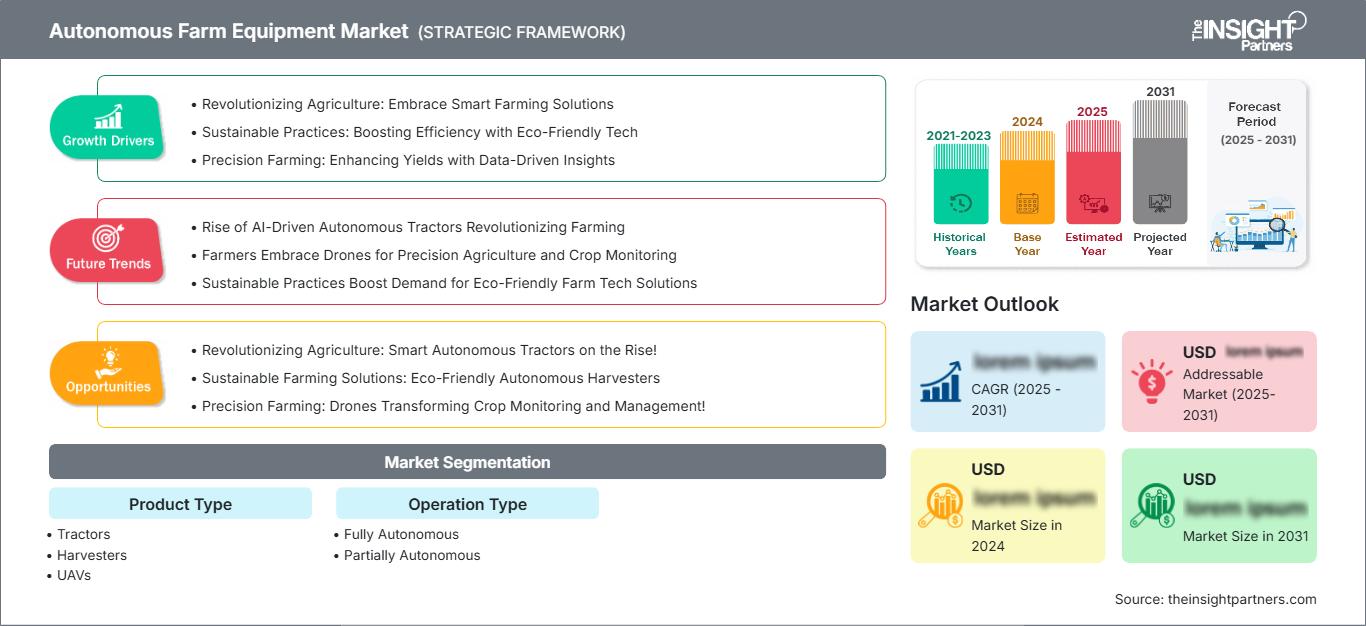
Autonomous Farm Equipment Market: Strategic Insights
Regional Insights
North America Autonomous Farm Equipment Market
North America is projected to expand at a 6.6–7.2% CAGR through 2034, underpinned by large contiguous fields, high machinery intensity, and persistent seasonal labor constraints. RTK coverage, digital field records, and dealer installation capabilities allow the autonomous farm equipment share of the region to gain an advantage. There is fast payback through broad-acre tillage and harvesting operations, where each hour lost due to operational delay impacts acreage that could be covered within a narrow weather window.
Autonomous technology is getting flexible with factory-fitted tractors being available for replacement purposes, and retrofitted autonomy solutions fitting existing equipment fleet. Canadian demand comes from the grain and oilseed farmers, while USA farmers are interested in row crops, orchards, and specialty farming. Purchasers increasingly consider remote intervention capabilities, equipment compatibility, uptime guarantees, and data transferability. It remains to be seen how safety and technician availability will impact successful pilot projects.
U.S. Autonomous Farm Equipment Market
The US accounted for 78–82% of North American Autonomous Farm Equipment Market in 2025 and is forecast to grow at a 6.7–7.3% CAGR. Deere & Company, AGCO Corporation, CNH Industrial N.V., Rowbot Systems LLC, and their dedicated technology partners form a solid competitive and service platform. Tasks such as tillage, grain cart movement, and orchard spray will see the fastest development initially since these are repetitive, confined, and quantifiable actions. Growers can evaluate labor input, fuel consumption, area covered, and the frequency of interventions compared to the supervised mode.
Adoption is uneven. Large-scale corn, soybean, wheat, and cotton growers can take advantage of automatic guidance systems already available across vast expanses, whereas specialty crop farmers need smaller-sized machines and selective interventions. According to the US Government Accountability Office, in 2023, 27% of farms or ranches were using precision agriculture approaches, demonstrating both an existing base for adoption and room for expansion. Significant upfront costs, data integration, liability sharing, and lack of qualified personnel pose crucial procurement challenges.
Europe Autonomous Farm Equipment Market
Europe represented 26–30% of global revenue in 2025 and is expected to grow at a 6.4–7.0% CAGR, with Germany leading. Engineering sophistication, environmental objectives, and high agricultural labor costs promote robotics, whereas fragmentation and operating complexity favor smaller, more precise machines. EU debates increasingly focus on uniform safety, interoperability, and safe communication of agricultural data, making it easier for buyers to assess proven technologies and setting development standards for suppliers.
The UK possesses large-scale arable farms, autonomous field tests, and contractor purchasing. Germany is well-endowed with important machinery distribution channels, engineering expertise, and demand for demonstrations. Scale is present in France for cereals, vines, and vegetables, with Italy and Spain having orchards, vines, and valuable horticultural production. In all of these areas, mechanical weed control, low compaction, and remote monitoring are technologies that could help reduce inputs, but successful commercialization would need financing, dealer education, and robust performance in varied conditions.
APAC Autonomous Farm Equipment Market
Asia Pacific held 22–26% share in 2025 and is projected to advance at a 7.5–8.1% CAGR, the fastest regional pace, with China leading through manufacturing scale and expanding digital agriculture. Japan combines acute workforce aging with supportive smart-agriculture legislation and 217 demonstration districts, favoring compact autonomous tractors, rice machinery, and coordinated fleets.
South Korea emphasizes controlled-environment and high-technology farming, India offers long-term volume but requires affordable service models, and Australia suits high-capacity broadacre autonomy. Regional growth depends on localizing implements, financing, connectivity, and safety procedures for plot size, crop mix, and climate.
Middle East & Africa Autonomous Farm Equipment Market
The Middle East & Africa is forecast to register a 6.0–6.6% CAGR through 2034, led by South Africa, where commercial grain and horticulture operations provide the clearest equipment economics. Saudi Arabia and the UAE create focused demand around controlled production, water efficiency, and technology-backed food-security investment.
Across the Rest of MEA, adoption remains project-led because farm fragmentation, financing, connectivity, and service coverage constrain scale. Equipment suppliers must align autonomy with irrigation infrastructure, heat resilience, dust protection, remote diagnostics, and locally available technical support.
Segmentation Analysis
Product Type
Product Type is projected to expand at a 6.6–7.2% CAGR during 2026–2034. The autonomous farm equipment market scope spans high-horsepower machines that carry multiple implements, automated harvest systems that optimize throughput, and UAVs that improve sensing or targeted application. Adoption depends on matching field task, payload, endurance, regulation, and serviceability. Tractors remain the primary value pool, while UAVs accelerate access to lower-cost, data-rich automation.
- Tractors lead demand because their year-round implement compatibility supports tillage, seeding, and crop care, while factory-ready units and retrofit kits provide flexible adoption paths.
- Harvesters occupy a strategically important position where automated speed, unloading coordination, and machine settings protect throughput and crop quality during narrow seasonal windows.
- UAVs address scouting, mapping, and targeted application with lower capital intensity, creating an accessible automation layer and feeding machine-readable crop data into ground-equipment workflows.
Operation Type
Operation Type is expected to record a 7.0–7.6% CAGR during 2026–2034. Partially autonomous systems currently benefit from lower behavioral and liability barriers, combining automated steering or implement control with an onboard operator. Fully autonomous equipment grows faster as perception reliability, geofencing, remote supervision, and emergency-stop protocols mature. The commercial transition will be staged, with growers expanding from bounded repetitive tasks into coordinated crop-cycle operations.
- Fully Autonomous equipment has strong strategic importance for unattended, repeatable fieldwork, but purchasing depends on validated operating zones, remote intervention, liability clarity, and dependable perception performance.
- Partially Autonomous systems retain broad demand because they raise operator consistency, reduce fatigue, and integrate with existing equipment practices without requiring immediate transition to unattended field operation.
Opportunity Snapshot
| Product Type | Revenue Contribution | Trend Tag | Adoption Stage |
| Tractor | High | Remote & Autonomous Operations | Scaling |
| Harvesters | High | Autonomous Harvesting & Fleet Coordination | Scaling |
| UAVs | Medium | AI-Enabled Monitoring & Precision Application | Emerging |
Autonomous Farm Equipment Market Growth Drivers and Impact Analysis
Labor scarcity raises the value of unattended field hours
The shortage of farm workers is a structural limitation, not a temporary phase. According to Deere & Company, there will be about 2.4 million US farm positions that need to be filled every year, and the figure in Japan is that core farmers would go down from 1.16 million to 300,000 in the next twenty years. Automation enables more productive machine hours without having to use a single person for each machine especially when planting, tilling, spraying, and harvesting seasons peak. It is not just the labor substitution effect that makes it important in the marketplace; timely completion of tasks can help minimize adverse effects of the weather, maximize asset efficiency, and enable skilled personnel to work on agronomy and maintenance.
Precision systems create an installed pathway to autonomy
Adoption is hastened in environments that employ guidance, digital boundary marking, corrective information, and telematics. Guidance automation has been observed to exist in more than half of the acres devoted to certain major agricultural crops in the USA, and the percentage of American farms or ranches applying practices of precision agriculture was 27% in 2023 according to USDA data. These solutions offer maps, connectivity, operator expertise, and processes that reduce the risks associated with adoption. Therefore, perception and control kits will increase the lifespan of compatible tractors instead of obliging their replacement. The commercial benefits of adoption include a shortened commissioning period, observable overlap reduction, and easy interfacing with management systems.
Input efficiency converts environmental pressure into investment logic
Autonomous machines can contribute to improving the accuracy and timeliness of fertilization, crop protection, and mechanical weed elimination. AGCO Corporation notes that there could be up to 70% reduction in the use of chemicals during its demonstration of vision-based targeted spraying, whereas Case IH mentions up to 60% reduction in the use of herbicides with selective spraying. Lightweight robots also lessen the risk of soil compaction due to repeated passes compared to the more cumbersome traditional processes. Such effects make the case for investment even stronger for regulations, costs, and resistance management which value accuracy of treatment application. This is because the commercial implication involves a change in the focus of selling machine capacity to verifying agronomic results.
Autonomous Farm Equipment Market Future Trends
Coordinated fleets will replace single-machine autonomy
Autonomous farm equipment market trends point towards the orchestration of tractors, robots, UAVs, implements, and logistical resources within one operation layer. Future platforms will assign tasks based on field boundaries, machine condition, weather, and crop prescriptions, while tracking the intervention automatically. This shifts the competitive landscape from an individual vehicle’s ability to fleet productivity and data flow. Standards for interoperability, secure application programming interfaces, and implementation controls will influence buying decisions. The farms will start off with a single proven workflow and purchase equipment that is able to use the same maps, supervisory resources, and services infrastructure. The vendors that do not have capabilities to manage multiple resources will be stuck in niche markets despite having top-quality equipment.
Perception and support software will become recurring services
In addition to margins earned from hardware sales, revenues in the Autonomous Farm Equipment Market will become more prevalent from subscriptions for software, monitoring services, model upgrades, and digital support. Perceptual systems benefit from learning new conditions in the field, whereas knowledge resources may reduce diagnostic times and operator training needs. The company FarmDroid ApS has already incorporated an assistant based on information from manuals provided officially, showing that service intelligence can be included into machine platforms. In the course of time, commercial agreements will incorporate autonomy, connectivity, safety, and seasonal support. It is necessary for generating recurring revenue but it creates customer concerns about data, offline usage, cybersecurity, and continuity of product support.
Autonomous Farm Equipment Market Opportunities
Retrofit autonomy for mixed and aging fleets
A potential solution for entering the farms that are unwilling to invest in new vehicles is to retrofit compatible tractors. Funding must focus on approved vehicle-attachment pairing, standardization of installation, certification of installation technicians, and remote monitoring of the system. The OutRun approach of AGCO Corporation and Deere & Company's perception upgrade are two different ways of leveraging the concept of autonomy in existing farm equipment. According to the autonomous farm equipment forecast, there will be an increase in both hardware and software purchases, as well as service agreements by season. This success will require clear compatibility lists and demonstrated return on investment per application.
Localized robotics for specialty crops and fragmented farms
Specialty crops create an investable niche where labor intensity, chemical constraints, and crop value can support smaller autonomous platforms. Suppliers should develop localized toolsets for vineyards, orchards, vegetables, sugar beet, and rice rather than treating autonomy as a universal tractor replacement. Yanmar Holdings Co., Ltd., Naïo Technologies SAS, and FarmDroid ApS illustrate application-led designs spanning spraying, weeding, and seeding. Market entry should combine agronomic partnerships, demonstration farms, dealer training, and crop-specific financing. Lightweight machines also fit fragmented plots where full-size autonomy is uneconomic. The strongest offerings will prove plant-level accuracy, soil protection, seasonal reliability, and straightforward transport between fields.
Recent Developments
- March 2026: AGCO Corporation – Its PTx Trimble OutRun Tillage retrofit solution won the 2026 Davidson Prize after extending driverless capability from grain-cart operations into spring and fall tillage. The platform enables users to plan, monitor, and manage fieldwork remotely on existing compatible tractors, supporting AGCO's stated objective of autonomous capability across the crop cycle by 2030
- September 2025: Kubota Corporation – Kubota unveiled an autonomous hydrogen fuel-cell tractor concept for Expo 2025 Osaka, Kansai. The machine combines fuel-cell system control, autonomous driving, and remote operation, with field demonstrations planned in Japan to evaluate unmanned operation, hydrogen supply methods, and suitability for agricultural tasks
Frequently Asked Questions

- Comprehensive Market Sizing and Forecast Analysis
- Detailed Segmentation Analysis
- In-Depth Market Dynamics Assessment
- Regional and Country-Level Insights
- Competitive Landscape and Company Benchmarking
- Strategic Business Intelligence
Recent Reports
Testimonials

The Insight Partners' SCADA System Market report is comprehensive, with valuable insights on current trends and future forecasts. The team was highly professional, responsive, and supportive throughout. We are very satisfied and highly recommend their services.
RAN KEDEM Partner, Reali Technologies LTDs
I requested a report on a very specific software market and the team produced the report in a few days. The information was very relevant and well presented. I then requested some changes and additions to the report. The team was again very responsive and I got the final report in less than a week.
JEAN-HERVE JENN Chairman, Future Analytica
We worked with The Insight Partners for an important market study and forecast. They gave us clear insights into opportunities and risks, which helped shape our plans. Their research was easy to use and based on solid data. It helped us make smart, confident decisions. We highly recommend them.
PIYUSH NAGPAL Sr. Vice President, High Beam Global
The Insight Partners delivered insightful, well-structured market research with strong domain expertise. Their team was professional and responsive throughout. The user-friendly website made accessing industry reports seamless. We highly recommend them for reliable, high-quality research services
YUKIHIKO ADACHI CEO, Deep Blue, LLC.
This is the first time I have purchased a market report from The Insight Partners.While I was unsure at first, I visited their web site and felt more comfortable to take the risk and purchase a market report.I am completely satisfied with the quality of the report and customer service. I had several questions and comments with the initial report, but after a couple of dialogs over email with their analyst I believe I have a report that I can use as input to our strategic planning process.Thank you so much for taking the extra time and making this a positive experience.I will definitely recommend your service to others and you will be my first call when we need further market data.
JOHN SUZUKI President and Chief Executive Officer, Board Director, BK Technologies
I wish to appreciate your support and the professionalism you displayed in the course of attending to my request for information regarding to infectious disease IVD market in Nigeria. I appreciate your patience, your guidance, and the fact that you were willing to offer a discount, which eventually made it possible for us to close a deal. I look forward to engaging The Insight Partners in the future, all thanks to the impression you have created in me as a result of this first encounter.
DR CHIJIOKE ONYIA MANAGING DIRECTOR, PineCrest Healthcare Ltd.Reason to Buy
- Informed Decision-Making
- Understanding Market Dynamics
- Competitive Analysis
- Identifying Emerging Markets
- Customer Insights
- Market Forecasts
- Risk Mitigation
- Boosting Operational Efficiency
- Strategic Planning
- Investment Justification
- Tracking Industry Innovations
- Aligning with Regulatory Trends





 Get Free Sample for