
Autonomous Tractor Market Size, Trends & Demand by 2034
Coverage: By Technology (GPS Guidance, Sensor-based, Remote Control), Automation (Fully Autonomous, Semi-autonomous), Application (Harvesting, Tillage, Planting & Seeding, Others), and Geography
- Status : Data Released
- Report Code : TIPRE00003853
- Category : Automotive and Transportation
- No. of Pages : 150
- Available Report Formats :


- Last update date : May 22, 2026


2025 Market Size
US$ 2.31 Bn
Base year value
2034 Forecast
US$ 7.36 Bn
Projected by 2034
CAGR 2026-2034
13.73 %
Growth rate
Addressable Market
US$ 41.78 Bn
(2026-2034)
The global autonomous tractor market size is projected to reach US$ 7.36 billion by 2034 from US$ 2.31 billion in 2025. The market is anticipated to register a CAGR of 13.73% during the forecast period 2026–2034.
Key market dynamics include an acute and persistent farm labor scarcity, rising operational costs, and an urgent global need to increase agricultural productivity on limited cultivable land. Additionally, the market is expected to benefit from rapid advancements in AI-driven precision planting, the integration of real-time IoT soil monitoring, and the growing trend of electrification and alternative fuel adoption in heavy machinery.
Autonomous Tractor Market Analysis
The autonomous tractor market analysis shows a significant shift toward full-scale automation as growers transition from semi-autonomous driver-assist features to fully driverless operations. The market trends indicate a bifurcation into large-scale broad-acre farms in North America that are investing in high-horsepower autonomous units for heavy tillage, while specialized horticultural farms in Europe and Asia-Pacific are adopting smaller, more agile autonomous robots for orchards and vineyards. Strategic opportunities are emerging in Autonomy-as-a-Service (AaaS) models and retrofit kits, allowing farmers to modernize existing fleets without massive capital expenditure on entirely new machinery. The analysis also notes that market expansion currently depends on regulatory clarity regarding safety protocols and liability in the event of hardware or software failure. Competitive differentiation is increasingly defined by open-API ecosystems that allow autonomous hardware to seamlessly integrate with diverse farm management software platforms.
Autonomous Tractor Market Overview
Autonomous tractors have evolved from experimental prototypes to mainstream solutions for modern agriculture. The autonomous tractors include fully autonomous platforms, semi-autonomous guidance systems, and specialized robotic units for high-value crops. Both global agricultural OEMs and AgTech startups compete in this market, using sensor fusion such as LiDAR, Radar, and RTK-GPS. Growing demand for 24/7 operational capability among health-conscious and productivity-focused producers in North America and Europe has increased the popularity of autonomous tractors as a portable wellness solution for farm labor issues. North America leads in revenue due to its established large-scale farming culture, while Asia-Pacific is advancing in ingredient innovation and retail adoption of farming. The US autonomous tractor market is a highly developed one, driven by a sophisticated agricultural infrastructure and the rapid adoption of precision farming. Large-scale commercial growers increasingly utilize autonomous-ready platforms to mitigate persistent labor shortages and rising operational costs, enhancing overall productivity and sustainability through data-driven land management.
Market Research Highlights
- Global market for Autonomous Tractor was valued at US$ 2.31 Billion in 2025
- Annual market size is expected to reach US$ 7.36 Billion by 2034
- Total addressable market (TAM) during 2026-2034 is projected to reach approximately US$ 41.78 Billion
- Market is anticipated to register a CAGR of 13.73% during the forecast period
- The United States represents a key market, supported by An increase in government investment in the agriculture sector across the globe drives market growth., as well as evolving industry dynamics
- Market analysis covers North America, Europe, Asia-Pacific, South and Central America, Middle East and Africa, with growth evaluated across the forecast period
- Market opportunities such as The rising advancement of remote control-based tractors is the key future trend in the global market in the coming years. are expected to influence market dynamics and addressable market
- Report profiles industry participants, including AGCO Corporation, CNH Industrial N.V., Mahindra & Mahindra Ltd., Deere & Company, Kubota Corporation, Yanmar Holdings Co., Ltd., AB Volvo, PACCAR Inc., Navistar, Inc., Embark Carss, Inc., PlusAI, Inc., Kodiak Robotics, others., while analyzing competitive strategies and innovation developments
-
Source: The Insight Partners' analysis based on proprietary research, government publications, company annual reports, investor presentations, industry databases, and expert interviews.
● REPORT CUSTOMIZATION
Tailor This Report To Align With Your Specific Business Requirements
This report can be customized to align precisely with your business objectives, scope, and target markets. Customization options include tailored segmentation, geography, competitive analysis, and strategic insights to support informed decision-making.
Customize This Report →WHAT YOU CAN ADJUST
- ● Segmentations
- ● Geography
- ● Competitive Analysis
- ● Language Preferences
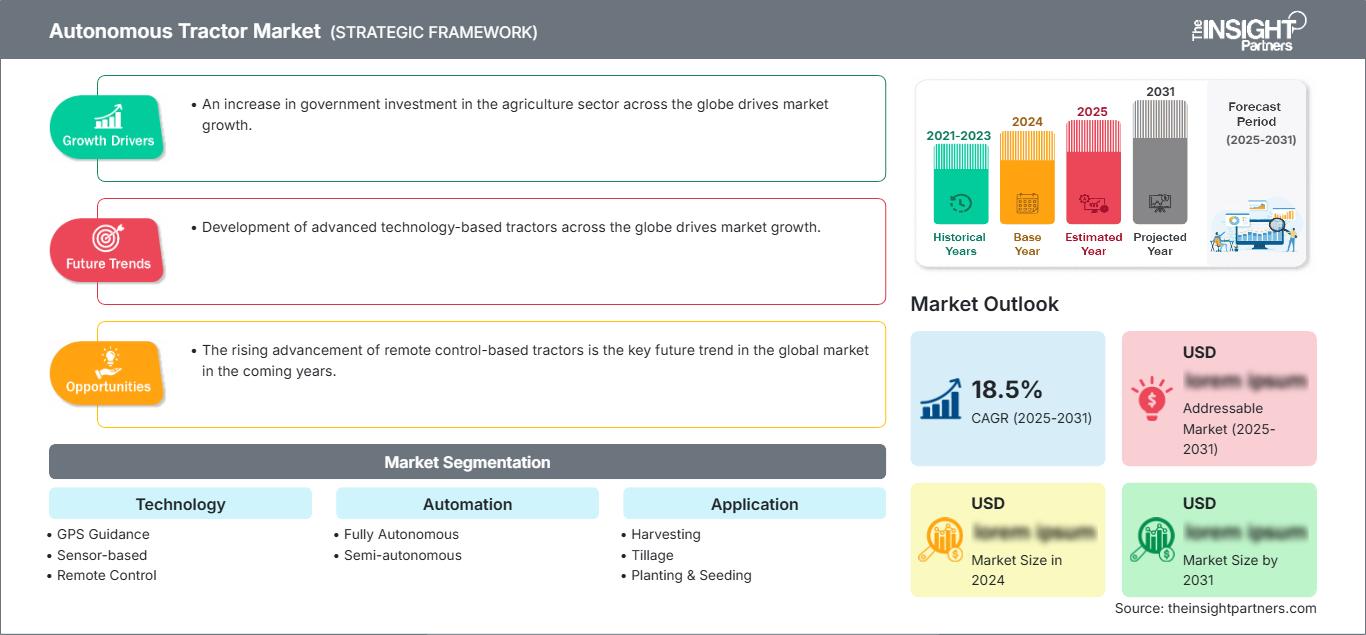
Autonomous Tractor Market: Strategic Insights
-
Get Top Key Market Trends of this report.This FREE sample will include data analysis, ranging from market trends to estimates and forecasts.
Autonomous Tractor Market Drivers and Opportunities
Market Drivers:
- Persistent Global Labor Shortages: An aging farmer population and the migration of rural workforces to urban centers have created a structural labor gap. Autonomous tractors address this by allowing a single operator to manage multiple machines simultaneously, reducing dependency on seasonal manual labor.
- Demand for Precision and Efficiency: Autonomous systems minimize overlaps and skips during tillage and seeding, leading to significant fuel savings and optimized input usage. The integration of AI allows for sub-inch accuracy that surpasses human capability.
- Favorable Government Policies and Subsidies: Many governments are providing financial incentives for agriculture to ensure food security. Programs supporting carbon-credit monetization for electric autonomous units are also gaining traction in Europe and North America.
Market Opportunities:
- Growth in the Retrofit Market: Developing hardware-agnostic autonomy kits presents a massive opportunity to upgrade millions of conventional tractors currently in use, particularly in emerging economies where new equipment costs are prohibitive.
- Expansion into Specialty Crop Automation: While broad-acre crops have been the early focus, there is a surging opportunity for narrow-row autonomous tractors designed specifically for high-value vineyards, nut orchards, and citrus groves.
- Integration of Generative AI for Predictive Tasks: Using advanced AI to predict soil health and crop yields in real-time allows autonomous tractors to function as mobile data hubs, creating new revenue streams for data-driven consulting services.
Autonomous Tractor Market Report Segmentation Analysis
The Autonomous Tractor Market share is analyzed across various segments to provide a clearer understanding of its structure, growth potential, and emerging trends. Below is the standard segmentation approach used in most industry reports:
By Technology:
- GPS Guidance: The dominant technology segment. It provides the essential foundation for precision navigation and auto-steering.
- Sensor-based: A rapidly growing segment utilizing LiDAR, Radar, and ultrasonic sensors to enable obstacle detection and environmental awareness for safer operations.
- Remote Control: Primarily used in hazardous environments or specialized tasks, allowing human operators to manage machines from a safe distance.
By Automation:
- Semi-autonomous: Held a significant market share. These systems assist operators with steering and task optimization, but still require a human in the cab or nearby for supervision.
- Fully Autonomous: The fastest-growing segment, as technology matures and regulatory barriers decrease. These units operate entirely without human intervention on-site.
By Application:
- Harvesting: The largest application segment by volume, due to the high labor demands and narrow time windows of the harvest season.
- Tillage: A mature segment for autonomous guidance, as straight-line draft work is easily automated with high precision.
- Planting & Seeding: As farmers prioritize sub-inch accuracy for seed placement to maximize germination rates and yield.
- Others: Includes autonomous spraying, fertilizer application, and specialized vineyard or orchard operations.
By Geography:
- North America
- Europe
- Asia Pacific
- South & Central America
- Middle East & Africa
Autonomous Tractor Market Report Scope
| Report Attribute | Details |
|---|---|
| Market size in 2025 | US$ 2.31 Billion |
| Market Size by 2034 | US$ 7.36 Billion |
| Global CAGR (2026 - 2034) | 13.73% |
| Historical Data | 2021-2024 |
| Forecast period | 2026-2034 |
| Segments Covered |
By Technology
|
| Regions and Countries Covered |
North America
|
| Market leaders and key company profiles |
|
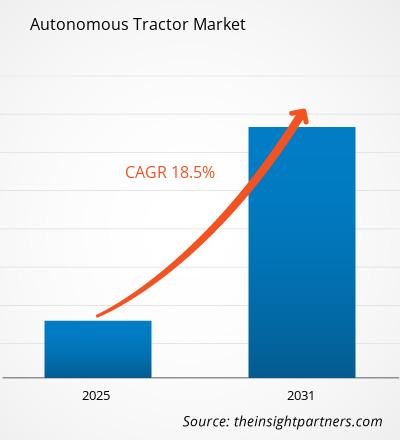
Autonomous Tractor Market Players Density: Understanding Its Impact on Business Dynamics
The Autonomous Tractor Market is growing rapidly, driven by increasing end-user demand due to factors such as evolving consumer preferences, technological advancements, and greater awareness of the product's benefits. As demand rises, businesses are expanding their offerings, innovating to meet consumer needs, and capitalizing on emerging trends, which further fuels market growth.
Autonomous Tractor Market Share Analysis by Geography
Asia-Pacific is expected to grow fastest in the coming years. Emerging markets in South & Central America, the Middle East, and Africa also have many untapped opportunities for premium machinery producers and farming service providers to expand.
The autonomous tractor market is undergoing a significant transformation, moving from traditional mechanical machinery to a global high-value digital ecosystem. Growth is driven by the rising scarcity of farm labor, a surge in demand for precision agriculture, and the expansion of large-scale commercial farming. Below is a summary of market share and trends by region:
North America
- Market Share: Holds the largest share globally, and is driven by large-scale broad-acre farming in the US and Canada.
- Key Drivers:
- Acute skilled labor shortages are forcing high-volume producers to adopt 24/7 autonomous operations
- Rapid integration of RTK-GPS and AI-driven precision methodologies in the grain and oilseed
- Robust infrastructure for high-speed data and cloud-based farm management systems
- Trends: Scaling of fully autonomous tillage systems and the successful adoption of retrofit kits to modernize existing high-horsepower fleets.
Europe
- Market Share: A significant and steady segment focused on high-precision and specialty crop automation, particularly in France, Germany, and Italy.
- Key Drivers:
Stringent environmental regulations and European Commission funding for emission-reducing smart machinery
-
- High demand for specialized narrow-row autonomous tractors for the premium vineyard and orchard
Established presence of leading European OEMs investing in electrification and alternative fuels
- Trends: A strategic shift toward autonomous platforms that prioritize soil health and reduce chemical usage through precision application.
Asia-Pacific
- Market Share: The fastest-growing region, with major players in Japan, China, and India advancing farming technologies.
- Key Drivers:
- Massive population growth and rising food demand necessitate rapid agricultural mechanization
- Government-supported subsidies for agriculture to combat aging rural workforces in Japan and South Korea
- Rapid urbanization in India and China is leading to increased labor costs and a transition to mechanized solutions
- Trends: Heavy reliance on compact autonomous units for small-to-mid-sized landholdings and the rise of autonomous rice transplanters and sugarcane harvesters.
South and Central America
- Market Share: Emerging market with a high density of autonomous adoption in the massive soy and corn belts of Brazil and Argentina.
- Key Drivers:
- Increasing awareness of the operational cost savings provided by autonomous grain carts and tillage systems
- Modernization of large commercial estates to improve export competitiveness in global commodity markets
- Strategic partnerships between global OEMs and local distributors to facilitate high-margin equipment leases
- Trends: Growth of large-scale autonomous fleet management where a single operator supervises multiple machines across thousands of hectares.
Middle East and Africa
- Market Share: Developing market with significant growth in commercial farming hubs and strategic government-led food security projects.
- Key Drivers:
- High demand for rugged, high-uptime autonomous machinery capable of operating in harsh arid climates
- Strategic investments in agriculture technology to reduce reliance on food imports
- Implementation of modern irrigation and planting technologies to formalize local agricultural production
- Trends: Adoption of shelf-stable autonomous units and a focus on high-efficiency soil preparation to maximize limited water resources.
High Market Density and Competition
Competition is intensifying due to the presence of established leaders such as Deere & Company, CNH Industrial, and AGCO Corporation. Regional specialists and niche players like Kubota (Japan) and Mahindra & Mahindra (India), alongside North American innovators such as Trimble and Raven Industries, also contribute to a diverse and rapidly expanding market landscape.
This competitive environment pushes vendors to differentiate through:
- Premiumization and functional branding: Position autonomous tractors as superior alternatives by emphasizing higher efficiency, sub-inch precision, and 24/7 operational capability for health-conscious farm budgets.
- Diverse Product Portfolios: Autonomous solutions now include more than just tractors. Companies offer robotic harvesters, probiotic soil-monitoring drones, and high-end AI software.
- Supply Chain Transparency: Producers manage the entire value chain from hardware design to local service support, ensuring quality and meeting ethical clean-label standards for farm data.
- Advanced Processing Technologies: New technologies like sensor fusion and machine learning help create high-quality autonomous routines used in nutraceutical and food security projects worldwide.
Opportunities and Strategic Moves
- Partner with high-end retail channels and e-commerce platforms to tap into the surging demand for farming technologies in Asia-Pacific and North American markets.
- Incorporate sustainable farming practices and regenerative agriculture certifications to appeal to environmentally conscious millennials and Gen Z farm owners.
Major Companies operating in the Autonomous Tractor Market are:
- AGCO Corporation
- CNH Industrial N.V.
- Mahindra & Mahindra Ltd.
- Deere & Company
- Kubota Corporation
- Yanmar Holdings Co., Ltd.
- AB Volvo
- PACCAR Inc.
- Navistar, Inc.
- Embark Carss, Inc.
- PlusAI, Inc.
- Kodiak Robotics
Disclaimer: The companies listed above are not ranked in any particular order.
Autonomous Tractor Market News and Recent Developments
- In February 2026, AGCO announced to showcase its Fendt®, Massey Ferguson®, and PTx™ brands at the 2026 Commodity Classic in San Antonio, Texas, on February 25-27. More than 24,000 square feet of combined exhibits will highlight the brands' latest precision ag equipment, retrofit innovations, and advanced autonomy solutions, along with opportunities for attendees to connect with experts and learn how AGCO's farmer–focused solutions can drive productivity, efficiency, and profitability across their entire operation.
- In January 2026, Kubota announced the commercialization of a smart, integrated autonomous solution developed in partnership with Agtonomy for the specialty crop market, fully built into the 105.7-horsepower diesel Kubota M5 Narrow tractor with advanced sensing and artificial intelligence. Designed for reliability and versatility, this innovation helps customers work more efficiently.
Autonomous Tractor Market Report Coverage and Deliverables
The Autonomous Tractor Market Size and Forecast (2021–2034) report provides a detailed analysis of the market covering below areas:
- Autonomous Tractor Market size and forecast at global, regional, and country levels for all the key market segments covered under the scope
- Autonomous Tractor Market trends, as well as market dynamics such as drivers, restraints, and key opportunities
- Detailed PEST and SWOT analysis
- Autonomous Tractor Market analysis covering key market trends, global and regional framework, major players, regulations, and recent market developments
- Industry landscape and competition analysis covering market concentration, heat map analysis, prominent players, and recent developments in the Autonomous Tractor Market.
- Detailed company profiles
Frequently Asked Questions

- Comprehensive Market Sizing and Forecast Analysis
- Detailed Segmentation Analysis
- In-Depth Market Dynamics Assessment
- Regional and Country-Level Insights
- Competitive Landscape and Company Benchmarking
- Strategic Business Intelligence
Recent Reports
Testimonials

The Insight Partners' SCADA System Market report is comprehensive, with valuable insights on current trends and future forecasts. The team was highly professional, responsive, and supportive throughout. We are very satisfied and highly recommend their services.
RAN KEDEM Partner, Reali Technologies LTDs
I requested a report on a very specific software market and the team produced the report in a few days. The information was very relevant and well presented. I then requested some changes and additions to the report. The team was again very responsive and I got the final report in less than a week.
JEAN-HERVE JENN Chairman, Future Analytica
We worked with The Insight Partners for an important market study and forecast. They gave us clear insights into opportunities and risks, which helped shape our plans. Their research was easy to use and based on solid data. It helped us make smart, confident decisions. We highly recommend them.
PIYUSH NAGPAL Sr. Vice President, High Beam Global
The Insight Partners delivered insightful, well-structured market research with strong domain expertise. Their team was professional and responsive throughout. The user-friendly website made accessing industry reports seamless. We highly recommend them for reliable, high-quality research services
YUKIHIKO ADACHI CEO, Deep Blue, LLC.
This is the first time I have purchased a market report from The Insight Partners.While I was unsure at first, I visited their web site and felt more comfortable to take the risk and purchase a market report.I am completely satisfied with the quality of the report and customer service. I had several questions and comments with the initial report, but after a couple of dialogs over email with their analyst I believe I have a report that I can use as input to our strategic planning process.Thank you so much for taking the extra time and making this a positive experience.I will definitely recommend your service to others and you will be my first call when we need further market data.
JOHN SUZUKI President and Chief Executive Officer, Board Director, BK Technologies
I wish to appreciate your support and the professionalism you displayed in the course of attending to my request for information regarding to infectious disease IVD market in Nigeria. I appreciate your patience, your guidance, and the fact that you were willing to offer a discount, which eventually made it possible for us to close a deal. I look forward to engaging The Insight Partners in the future, all thanks to the impression you have created in me as a result of this first encounter.
DR CHIJIOKE ONYIA MANAGING DIRECTOR, PineCrest Healthcare Ltd.Reason to Buy
- Informed Decision-Making
- Understanding Market Dynamics
- Competitive Analysis
- Identifying Emerging Markets
- Customer Insights
- Market Forecasts
- Risk Mitigation
- Boosting Operational Efficiency
- Strategic Planning
- Investment Justification
- Tracking Industry Innovations
- Aligning with Regulatory Trends





 Get Free Sample for