
Avalanche Photodiode (APD) Market Trends, Size & Forecast by 2034
Coverage: By Material (Silicon Based, Indium Gallium Arsenide (InGaAs), Germanium Materials, Others); Vertical (Industrial, Medical, Mobility, Others) , and Geography (North America, Europe, Asia Pacific, and South and Central America)
- Status : Data Released
- Report Code : TIPTE100000900
- Category : Electronics and Semiconductor
- No. of Pages : 150
- Available Report Formats :


- Last update date : August 10, 2026


2025 Market Size
US$ 143.5 Mn
Base year value
2034 Forecast
US$ 181.52 Mn
Projected by 2034
CAGR 2026-2034
2.65 %
Growth rate
Addressable Market
US$ 1,475.30 Mn
(2026-2034)
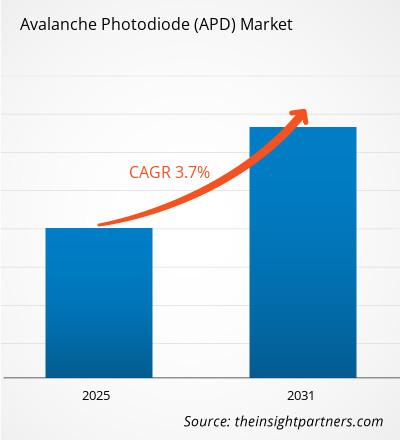
The Avalanche Photodiode Market size stood at US$ 143.5 Million in 2025 and is forecast to rise up to US$ 181.52 Million in 2034 with a CAGR of 2.65%. This market includes high-sensitivity semiconductor photodetectors operating under reverse bias voltage that allows achieving an internal gain by means of avalanche effect, which makes possible detecting low-light signals in optical fiber communication, LiDARs, medical imaging, and industry sensing applications. These components offer excellent signal-to-noise ratio and fast response time necessary for advanced photon-counting and ranging applications.
North America will grow at CAGR 2.2–2.9% in 2026–2034 due to modernization of telecommunications networks, deployment of LiDAR technology in autonomous vehicles, and aerospace and defense sector requirements for high-sensitivity detectors. Drivers of the demand include investments in optical sensing technologies and R&D expenses in semiconductor photonics.
Avalanche Photodiode (APD) Market Assessment and Insights
- North America held 28–31% Avalanche Photodiode Market share in 2025 and is growing at a CAGR of 2.2–2.9% during 2026–2034, led by telecom upgrade, LiDAR development, and defense applications across the US and Canada.
- US represented 82–85% of North American revenue in 2025 and is growing at a CAGR of 2.4–3.1% during 2026–2034.
- Europe accounted for 22–25% share in 2025 and is growing at a CAGR of 2.0–2.7% during 2026–2034, led by Germany, the UK, France, Italy, and Spain.
- Asia Pacific held 38–41% share in 2025 and is growing at a CAGR of 3.0–3.7% during 2026–2034, led by China, India, Japan, South Korea, and Australia.
- Largest Segment Silicon Based held 45–48% market share in 2025 and is growing at a CAGR of 2.4–3.1% during 2026–2034.
- High Growth Segment Telecommunications represented 35–38% market share in 2025 and is growing at a CAGR of 2.8–3.5% during 2026–2034.
- Key companies analyzed in detail: Edmund Optics Inc.; Excelitas Technologies Corp.; First Sensor AG; Global Communication Semiconductors, LLC; Hamamatsu Photonics K.K.; Kyosemi Corporation; Laser Components GmbH; Luna AB; OSI Optoelectronics Inc.; SiFotonics Technologies Co., Ltd.; Thorlabs Inc.; Analog Devices, Inc.
Source: The Insight Partners' analysis based on proprietary research, government publications, company annual reports, investor presentations, industry databases, and expert interviews.
The technology of avalanche photodiodes has progressed from rudimentary silicon-based devices to sophisticated multi-layer III-V semiconductors utilizing Indium Gallium Arsenide, and Germanium material for longer wavelengths and higher sensitivities. The manufacturing process focuses on accurate epitaxy process, reduction of dark current, multiplicative gain tuning and factory calibration at various operating temperatures and biases. In addition to this, the Avalanche Photodiode Market is driven by integrators who integrate the APD detectors into receivers, transimpedance amplifiers and signal processing systems in optical communication and sensing equipment.
Capital investment focus is changing towards the Asia Pacific, North America and Europe as the optical networks expand, autonomous sensors develop and medical imaging evolves with requirements of higher gain bandwidth product and lower excess noise. Compliance with telecommunication regulations, medical device norms and aerospace approvals facilitates the component certifications. Buyers are increasingly preferring manufacturers who have wafer fabrication, packaging and testing capabilities together with technical support and supply chain efficiency.
Avalanche Photodiode (APD) Market Report Scope
| Report Attribute | Details |
|---|---|
| Market size in 2025 | US$ 143.5 Million |
| Market Size by 2034 | US$ 181.52 Million |
| Global CAGR (2026 - 2034) | 2.65% |
| Historical Data | 2021-2024 |
| Forecast period | 2026-2034 |
Avalanche Photodiode (APD) Market Analysis
The Avalanche Photodiode Market drivers include the advancement in optical fiber communications, LiDAR technology, medical imaging, and industrial sensing. The industry players of this value chain are epitaxial wafers providers, semiconductor foundry firms, device manufacturers, packaging companies, and optical system integration firms. The supply drivers are availability of materials, precision in manufacturing and the application qualification cycles. The market report reveals that silicon-based APDs are preferred for visible and near-infrared applications whereas InGaAs APDs are preferred for telecommunication wavelengths. Service capability is very important since the device characterization, packaging, and reliability tests influence the performance of the system.
There is competition from photonics firms and semiconductor firms. The main competitors are Hamamatsu Photonics K.K., Excelitas Technologies Corp., First Sensor AG, OSI Optoelectronics Inc., Edmund Optics Inc., Laser Components GmbH, SiFotonics Technologies Co., Ltd., Global Communication Semiconductors, LLC, Kyosemi Corporation, and Luna AB. Investment opportunities include integrated detectors, array detectors and customized designs. The leaders in this market are Hamamatsu Photonics K.K. and Excelitas Technologies Corp. due to wide range of APD products and worldwide technical support. First Sensor AG and OSI Optoelectronics have advantages due to application specific design capability.
● REPORT CUSTOMIZATION
Tailor This Report To Align With Your Specific Business Requirements
This report can be customized to align precisely with your business objectives, scope, and target markets. Customization options include tailored segmentation, geography, competitive analysis, and strategic insights to support informed decision-making.
Customize This Report →WHAT YOU CAN ADJUST
- ● Segmentations
- ● Geography
- ● Competitive Analysis
- ● Language Preferences
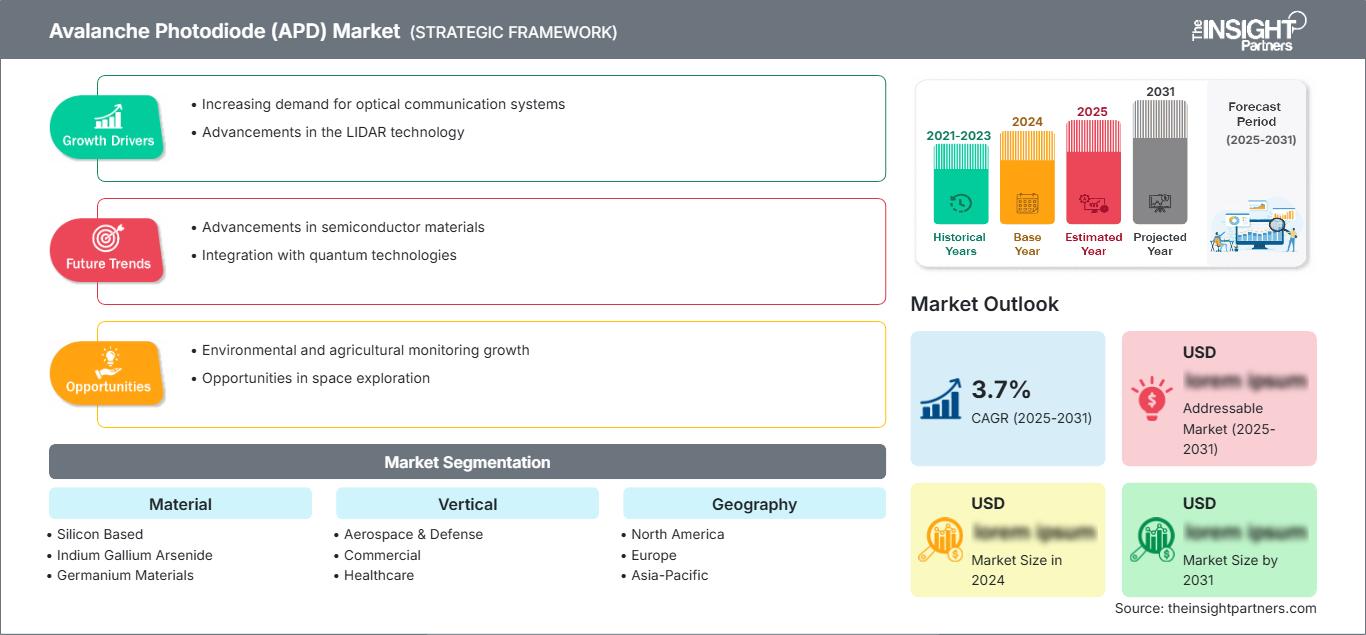
Avalanche Photodiode (APD) Market: Strategic Insights
Regional Insights
North America Avalanche Photodiode Market
The market share of North America was estimated to be 28–31% in 2025 and is expected to grow at a CAGR of 2.2–2.9% from 2026 to 2034. Some key drivers include upgrading of telecoms networks, implementation of LiDAR in developing autonomous vehicles, sensors in the aerospace & defense sector, and investment in research and development for photonic and quantum technologies. The technology environment and defense spending of the region generate steady demand for APDs. Key players Hamamatsu Photonics K.K., Excelitas Technologies Corp., OSI Optoelectronics Inc., Edmund Optics Inc., and Thorlabs Inc. have installed bases in laboratories and telecoms companies in North America.
U.S. Avalanche Photodiode Market
The U.S. represented 82–85% of North American revenue in 2025 and is forecast to grow at a CAGR of 2.4–3.1% during 2026–2034. Application demand is concentrated in optical communications, LiDAR development, defense sensor systems, and medical imaging equipment. Company presence is reinforced by Hamamatsu Photonics K.K., Excelitas Technologies Corp., OSI Optoelectronics Inc., Edmund Optics Inc., and Analog Devices, Inc. Buyers prioritize sensitivity, gain bandwidth product, dark current specifications, and reliability qualifications, plus application support that reduces design cycles and improves confidence in high-performance photodetection systems.
Europe Avalanche Photodiode Market
According to the Avalanche Photodiode Market report, Europe held 22–25% share in 2025 and is expected to grow at a CAGR of 2.0–2.7% during 2026–2034. Germany leads through industrial sensing, automotive LiDAR development, and photonics R&D, while the UK supports demand from telecommunications, defense, and scientific instrumentation. France, Italy, and Spain add demand through telecommunications infrastructure and research applications. Photonics industry investments and research funding favor suppliers with documented performance certifications. Hamamatsu Photonics K.K., First Sensor AG, Excelitas Technologies Corp., Laser Components GmbH, and Thorlabs Inc. remain visible across commercial and research projects.
APAC Avalanche Photodiode Market
Asia Pacific accounted for 38–41% share in 2025 and is projected to grow at a CAGR of 3.0–3.7% during 2026–2034. China leads through telecommunications expansion and semiconductor manufacturing, while India expands through optical network development and research infrastructure. Japan and South Korea prioritize high-reliability devices for telecommunications and industrial applications, while Australia adds sensing and research applications. Policy support for photonics R&D and telecommunications infrastructure strengthen adoption where optical network performance carries significant economic value.
Middle East & Africa Avalanche Photodiode Market
The Middle East & Africa market is projected to grow at a CAGR of 1.8–2.5% during 2026–2034. Saudi Arabia leads through telecommunications infrastructure and technology investment programs, while the UAE adds optical network development and research applications. South Africa and Rest of MEA rely on telecommunications expansion and research infrastructure. Digital infrastructure and photonics research investments create demand for reliable photodetection solutions. Suppliers succeed when they combine product quality, technical support, and supply chain consistency for diverse applications.
Segmentation Analysis
Material
Material is projected to grow at a CAGR of 2.4–3.1% during 2026–2034. Avalanche Photodiode Market scope covers Silicon Based, Indium Gallium Arsenide, Germanium Materials, and Others. Selection depends on wavelength requirements, gain characteristics, and application constraints. Silicon Based leads through mature manufacturing and established performance across visible and near-infrared wavelengths.
- Silicon Based APDs serve visible and near-infrared applications offering proven reliability, cost-effective manufacturing, and established performance across industrial sensing and medical applications.
- Indium Gallium Arsenide APDs provide superior performance at telecommunications wavelengths, offering high sensitivity and low dark current essential for optical communications applications.
- Germanium Materials APDs offer cost-effective performance for selected infrared applications where lower cost requirements outweigh sensitivity considerations.
Vertical
Vertical is forecast to grow at a CAGR of 2.5–3.2% during 2026–2034. Aerospace and Defense, Commercial, Healthcare, Industrial, Telecommunications, and Others applications are becoming more strategic as optical sensing technologies expand across industries. Vertical adoption intensifies when application requirements drive performance specifications.
- Aerospace and Defense applications require ruggedized, high-reliability APDs for LiDAR, range-finding, and sensing systems operating across demanding environments.
- Commercial applications include optical communications and sensing where cost-effective performance balanced with reliability drives component selection.
- Healthcare applications encompass medical imaging, flow cytometry, and diagnostic systems requiring high sensitivity and low-noise detection capabilities.
- Industrial applications use APDs for metrology, inspection, and sensing where precision optical detection supports quality control and automation.
- Telecommunications remains the largest vertical, with optical receivers requiring high-sensitivity APDs for long-haul and metropolitan network applications.
Opportunity Snapshot
| Vertical | Revenue Contribution | Trend Tag | Adoption Stage |
|---|---|---|---|
| Aerospace and Defense | Medium | Sensor Systems | Mature |
| Commercial | Medium | Optical Sensing | Scaling |
| Healthcare | Low | Medical Imaging | Emerging |
| Industrial | Medium | Precision Metrology | Scaling |
| Telecommunications | High | Network Performance | Mature |
Avalanche Photodiode (APD) Market Growth Drivers and Impact Analysis
Optical Fiber Communications Expansion Drives APD Demand
Global telecommunications networks continue expanding bandwidth and reach, requiring high-performance optical receivers capable of detecting weak signals after transmission over long distances. APDs provide the sensitivity advantage needed for 100G and 400G coherent optical systems, with emerging 800G and 1.6T systems requiring even higher performance. Network operators and equipment manufacturers increasingly rely on APDs for receiver applications where conventional PIN photodiodes lack sufficient sensitivity. The practical impact is continued demand for high-gain, low-noise APDs supporting telecommunications infrastructure investment across all regions.
LiDAR and Autonomous Sensing Enable New Applications
LiDAR deployment in autonomous vehicles, robotics, and industrial automation is creating significant demand for high-sensitivity APDs capable of detecting reflected laser pulses under varying environmental conditions. Automotive LiDAR applications require cost-effective, reliable APD arrays with consistent performance across temperature extremes. The expansion of autonomous systems across transportation, logistics, and industrial environments increases APD content per sensing system. This driver benefits suppliers that can deliver automotive-qualified devices with reliability and manufacturing scale supporting volume production.
Medical Imaging and Scientific Instrumentation Demand High Sensitivity
Medical diagnostics and scientific research increasingly rely on low-light detection techniques including fluorescence microscopy, flow cytometry, and photon-counting applications requiring APD sensitivity advantages. Research and clinical instrumentation demand high-gain, low-noise devices with consistent performance across operating conditions. The growing application of optical techniques in diagnostics and fundamental research creates consistent demand for specialized APD devices. The market impact is demand for specialized APD configurations supporting demanding detection requirements across medical and research applications.
Avalanche Photodiode (APD) Market Future Trends
Integrated APD Arrays Enable Advanced Sensing Architectures
Avalanche Photodiode Market trends point toward integrated APD arrays and linear arrays enabling advanced sensing architectures for LiDAR, ranging, and imaging applications. The next product cycle will combine multiple APD elements with integrated electronics for compact, high-performance detection systems. This shift matters because system designers increasingly value integration and component count reduction. Vendors with array design expertise and packaging capabilities will be better positioned as sensing systems become more sophisticated.
Silicon Photonics Integration Reshapes APD Platforms
Silicon photonics integration is emerging as a direction for APD development, enabling on-chip optical detection combined with electronic processing. The next generation of APDs will incorporate more functionality within photonic integrated circuits, reducing system complexity and improving performance. This evolution enables smaller, more efficient optical receiver systems. Suppliers that can deliver photonic integration capabilities with established APD performance will gain credibility with telecommunications and sensing system developers.
Avalanche Photodiode (APD) Market Opportunities
Automotive LiDAR Qualification for Volume Applications
Avalanche Photodiode Market Forecasts support investment in automotive-qualified APD devices for LiDAR applications requiring reliability, consistency, and cost-effectiveness for volume production. Manufacturers need devices meeting automotive specifications with documented reliability and manufacturing readiness. Providers can create opportunities by developing and qualifying devices for automotive applications. The opportunity is strongest where autonomous driving development creates demand for cost-effective APD solutions.
Quantum Technology Applications for High-Sensitivity Detection
Emerging quantum technology applications including quantum key distribution, quantum computing, and quantum sensing require high-performance photon detection capabilities. Suppliers with APD expertise can capture opportunities in quantum technology infrastructure by developing specialized devices for these demanding applications. This opportunity rewards companies that anticipate quantum technology requirements and develop detection capabilities for emerging applications.
Recent Developments
- February 2026: Hamamatsu Photonics introduces the S17268 Series, a new silicon avalanche photodiode series (Si APD) designed for high-precision optical detection in the UV to VIS regions for industrial, research, and environmental applications. The compact device delivers superior sensitivity, enabling easy integration and reliable performance.
- June 2025: Phlux Technology, a manufacturer of avalanche photodiode (APD) infrared sensors, announces a 30 µm optical window version of the Aura family of 1550 nm Noiseless InGaAs APDs. The sensors, which are also available in 80 µm and 200 µm versions, are 12X more sensitive than traditional InGaAs APDs and have inherently fast impulse response and short diffusion tails. The new 30 µm version features lower capacitance at 0.15 to 0.4 pF, which increases the cut-off frequency to 3.5 GHz, compared with the 80 µm version at 1.8 GHz and 200 µm at 0.7 GHz. This makes it ideal for high-speed, time-critical applications, such as those found in gigabit speed optical communications, including free space applications, and optical time domain reflectometry (OTDR) test equipment.
- January 2024: CMC Electronics, a pioneering leader in advanced sensing solutions, is proud to announce the debut of its revolutionary InGaAs Avalanche Photodiode (APD). Expertly designed to elevate sensing and ranging capabilities, our latest APD is tailor-made for eye-safe laser range finding and scanning LiDAR applications. The InGaAs APD represents a true revolution in sensing technology, distinguishing itself by enabling laser range finders to perform at greater distances with an unparalleled fusion of speed, accuracy, and consistency, thus setting a new industry standard. Our new InGaAs Avalanche Photodiode (APD) acts like a high-powered lens for laser range finders, enabling them to see farther and with greater precision, upgrading their vision for more accurate measurements. This breakthrough technology is not only ideal for scanning LiDAR but also finds applications in high-speed low-light level detection, industrial, analytical, aerospace, and defense sectors. Moreover, it is a preferred choice for high-volume applications where customized transimpedance amplifier (TIA) circuits are integral.
Frequently Asked Questions

- Comprehensive Market Sizing and Forecast Analysis
- Detailed Segmentation Analysis
- In-Depth Market Dynamics Assessment
- Regional and Country-Level Insights
- Competitive Landscape and Company Benchmarking
- Strategic Business Intelligence
Recent Reports
Testimonials

The Insight Partners' SCADA System Market report is comprehensive, with valuable insights on current trends and future forecasts. The team was highly professional, responsive, and supportive throughout. We are very satisfied and highly recommend their services.
RAN KEDEM Partner, Reali Technologies LTDs
I requested a report on a very specific software market and the team produced the report in a few days. The information was very relevant and well presented. I then requested some changes and additions to the report. The team was again very responsive and I got the final report in less than a week.
JEAN-HERVE JENN Chairman, Future Analytica
We worked with The Insight Partners for an important market study and forecast. They gave us clear insights into opportunities and risks, which helped shape our plans. Their research was easy to use and based on solid data. It helped us make smart, confident decisions. We highly recommend them.
PIYUSH NAGPAL Sr. Vice President, High Beam Global
The Insight Partners delivered insightful, well-structured market research with strong domain expertise. Their team was professional and responsive throughout. The user-friendly website made accessing industry reports seamless. We highly recommend them for reliable, high-quality research services
YUKIHIKO ADACHI CEO, Deep Blue, LLC.
This is the first time I have purchased a market report from The Insight Partners.While I was unsure at first, I visited their web site and felt more comfortable to take the risk and purchase a market report.I am completely satisfied with the quality of the report and customer service. I had several questions and comments with the initial report, but after a couple of dialogs over email with their analyst I believe I have a report that I can use as input to our strategic planning process.Thank you so much for taking the extra time and making this a positive experience.I will definitely recommend your service to others and you will be my first call when we need further market data.
JOHN SUZUKI President and Chief Executive Officer, Board Director, BK Technologies
I wish to appreciate your support and the professionalism you displayed in the course of attending to my request for information regarding to infectious disease IVD market in Nigeria. I appreciate your patience, your guidance, and the fact that you were willing to offer a discount, which eventually made it possible for us to close a deal. I look forward to engaging The Insight Partners in the future, all thanks to the impression you have created in me as a result of this first encounter.
DR CHIJIOKE ONYIA MANAGING DIRECTOR, PineCrest Healthcare Ltd.Reason to Buy
- Informed Decision-Making
- Understanding Market Dynamics
- Competitive Analysis
- Identifying Emerging Markets
- Customer Insights
- Market Forecasts
- Risk Mitigation
- Boosting Operational Efficiency
- Strategic Planning
- Investment Justification
- Tracking Industry Innovations
- Aligning with Regulatory Trends





 Get Free Sample for