
Aviation Annunciators Market Size, Share & Demand by 2034
Coverage: By Components (Control Panel, Switches, Lights); Light Source (Incandescent, LED); Aircraft Type (Commercial Aviation, Military Aviation, General Aviation) , and Geography (North America, Europe, Asia Pacific, and South and Central America)
- Status : Data Released
- Report Code : TIPRE00027421
- Category : Aerospace and Defense
- No. of Pages : 150
- Available Report Formats :


- Last update date : November 11, 2026


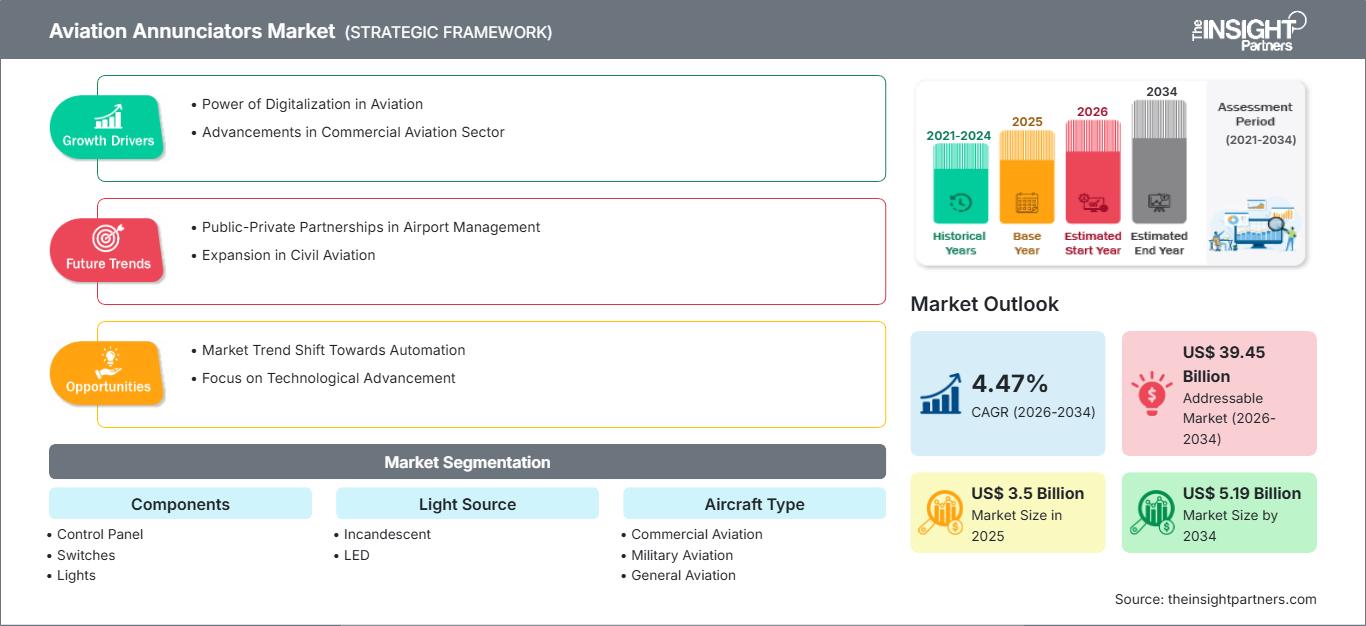
2025 Market Size
US$ 3.5 Bn
Base year value
2034 Forecast
US$ 5.19 Bn
Projected by 2034
CAGR 2026-2034
4.47 %
Growth rate
Addressable Market
US$ 39.45 Bn
(2026-2034)
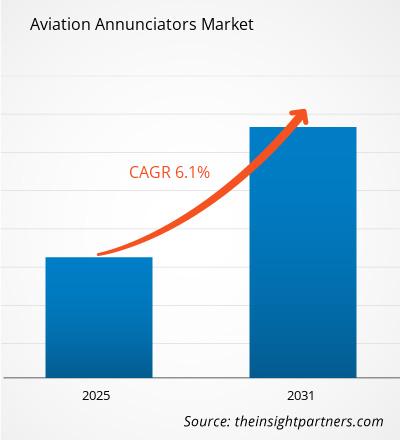
The aviation annunciators market size was valued at US$ 3.5 Billion in 2025 and is projected to reach US$ 5.19 Billion by 2034, registering a CAGR of 4.47% from 2026 to 2034. Growth is supported by aircraft fleet expansion, replacement of legacy cockpit indicators, increasing use of LED illumination, and demand for reliable pilot alerting across commercial, military, and general aviation platforms.
North America remains a structurally important market, supported by a large installed aircraft base, extensive MRO activity, and continued avionics modernization. The regional aviation annunciators market is modeled to expand at ~3% CAGR through 2034 as operators balance new-aircraft procurement with retrofit programs that improve readability, reliability, and maintainability without requiring wholesale cockpit redesigns.
Aviation Annunciators Market Assessment and Insights
Regional Outlook
- North America: ~34% of the global aviation annunciators market share in 2025 | ~3% CAGR through 2034. Market position: North America holds the largest regional position, supported by its extensive installed fleet, mature aerospace manufacturing base, military procurement, and strong aftermarket demand for cockpit lighting, switches, indicators, and annunciator replacements.
- US: ~80% of North American market revenue in 2025 | ~3% CAGR through 2034. Market position: The US dominates North American demand because of its commercial airline fleet, military aircraft programs, business aviation activity, and concentration of avionics suppliers. Retrofit and replacement requirements reinforce recurring demand.
- Europe: ~27% of the global market in 2025 | ~4% CAGR through 2034. Market position: Europe represents a mature aerospace manufacturing and MRO center, with Germany leading the regional market, supported by aircraft production, defense modernization, airline fleet renewal, and established avionics supply chains across the UK, France, Italy, and Spain.
- Asia Pacific: ~24% of the global market in 2025 | ~6% CAGR through 2034. Market position: Asia Pacific is the fastest-growing region as China, Japan, South Korea, India, and Australia expand fleets and aviation infrastructure. China is the leading country in Asia Pacific, while India provides particularly strong incremental fleet growth.
Segment Outlook
- Commercial Aviation: ~48% Share in 2025 | ~5% CAGR through 2034. Market position: Commercial aviation leads demand because every aircraft requires multiple visual indication and control interfaces across flight decks and cabin systems. Fleet expansion, aircraft deliveries, and retrofit activity create a broad recurring replacement base.
- LED: ~58% Share in 2025 | ~6% CAGR through 2034. Market position: LED adoption is accelerating as operators favor lower power consumption, longer operating life, improved sunlight readability, reduced heat generation, and greater flexibility in color and dimming characteristics.
Competitive Coverage
Aero Safety Systems, Mid-Continent Instrument Co., Inc. (dba Mid-Continent Instruments and Avionics), Applied Avionics, Inc., DPI Labs, Inc., Flight Data Systems, Korry Electronics Co., Microtechna Praha a.s., Radiant Power Corp., a HEICO company, Collins Aerospace, Astronics Corporation
Methodology
The Insight Partners follows Data Collection & Secondary Research, Primary Research, Data Analysis, and Data Triangulation & Final Review to validate market estimates and insights.
Source: The Insight Partners' analysis based on proprietary research, government publications, company annual reports, investor presentations, industry databases, and expert interviews.
Aviation Annunciators have moved away from being separate warning lights and have advanced to being integrated solid-state, digital and LED Human-Machine Interfaces. Older planes utilized removable lamps and fixed warning panels as opposed to the contemporary aircrafts that incorporate aviation annunciators within electronic flight information, navigation, aircraft monitoring and warning systems. It increases visibility, reduces maintenance requirements and provides the manufacturers an option of incorporating custom legends, dimming capability, built-in tests and night vision configurations.
The future of aviation annunciators lies in the demand for fleet modernization and not the production of new planes alone. While emerging aviation markets are expanding their fleet sizes, the existing airline companies are replacing old airplanes by updating them to prolong their usable life spans. Regulatory concerns for cockpit visibility, reliability and human factors ensure continued investments into robust annunciator systems. The aviation annunciators market can hence benefit from both new and retrofitting needs.
Aviation Annunciators Market Report Scope
| Report Attribute | Details |
|---|---|
| Market size in 2025 | US$ 3.5 Billion |
| Market Size by 2034 | US$ 5.19 Billion |
| Global CAGR (2026 - 2034) | 4.47% |
| Historical Data | 2021-2024 |
| Forecast period | 2026-2034 |
Aviation Annunciators Market Analysis
Demand is heavily influenced by aircraft manufacturing, installed fleet size, aircraft cockpit set-up, and replacement cycle times. Annunciation systems are not large components but their critical nature calls for proper illumination, legends, electrical compatibility, environmental resistance, and dimming performance. Value chain includes LED/incandescent light sources, electronics components, switches, control electronics, bezel/panels, aircraft integrator, original equipment manufacturers, maintenance repair operations, and distributors. Suppliers with aircraft qualifications experience and existing aircraft platforms can take advantage of long lifecycle product lines.
Supply characteristics depend on the certification process, low volume engineering needs, platform customization, and availability of long-lasting replacement parts. LED technology is changing purchase behavior into solid state architecture while incandescent technologies have application in legacy aircraft fleets and some replacement applications. Aircraft operators appreciate replacement components which offer similar mounting interface and wiring while ensuring reliability.
Aviation annunciators industry competes through segmented suppliers of specialized cockpit interfaces, avionics, aircraft components, and after market products. Korry Electronics is positioned broadly in the area of illuminated switches and annunciators for commercial and military aircrafts, Applied Avionics provides a combination of VIVISUN illuminated interfaces and NEXSYS avionics interface technology, Radiant Power provides incandescent and LED annunciator panels, and Aero Safety Systems produces warning and visual alert systems for experimental and light-sport aircrafts.
The positioning strategies rely heavily on platform qualifications, customizing capabilities, quick replacement availability, and integration with digital avionics. Collins Aerospace incorporates annunciator functions into avionics and retrofit services, Astronics competes across both aircraft lighting and cockpit systems, and DPI Labs emphasizes solid state cockpit annunciators and aircraft cabin electronics. The rest of the competitors, such as Mid-Continent Instruments and Avionics and Flight Data Systems, produce specialized aviation products, resulting in highly competitive environment where reliability, certifications, installed base services, and availability of the product throughout its lifecycle are the key factors to success.
● REPORT CUSTOMIZATION
Tailor This Report To Align With Your Specific Business Requirements
This report can be customized to align precisely with your business objectives, scope, and target markets. Customization options include tailored segmentation, geography, competitive analysis, and strategic insights to support informed decision-making.
Customize This Report →WHAT YOU CAN ADJUST
- ● Segmentations
- ● Geography
- ● Competitive Analysis
- ● Language Preferences
Aviation Annunciators Market: Strategic Insights
Regional Insights
North America Aviation Annunciators Market
North America accounted for ~34% of the aviation annunciators market in 2025 and is expected to expand at ~3% CAGR through 2034. There are already many airplanes installed in the region along with advanced aerospace production capability and matured MRO infrastructure. There are continuous efforts in fleet modernization on part of commercial airlines while military and business aviation demand robust cockpit systems that could sustain tough operating conditions. The US is the key demand center for the market, driven by aircraft OEMs, avionics system integration providers, defense procurements, and specialized aftermarket players.
The replacement demand is vital as there are many aircraft in operation for years now and their upgradation is required without redesigning of entire cockpit systems. The LED lighting, sunlight readability, night vision capability, and modular designs generate the demand incrementally. Manufacturers can target small GA aircraft with their programmable warning systems and indicator panels. There are plenty of prospects for manufacturers to build a product line for many years of usage in the region.
U.S. Aviation Annunciators Market
The US represented ~80% of North American aviation annunciators market revenue in 2025, with demand modeled to increase at ~3% CAGR through 2034. The positioning of this product is based on the size and variety of the national fleet of planes from such areas as commercial transport, military, business aviation, rotorcrafts, and general aviation. There are many avionics and components manufacturers situated in the country. The trends related to the applications include the increasing use of LED lights, modular switchlights, programmable warning system, and interfaces for modern avionics buses.
Applied Avionics manufactures VIVISUN annunciators and illuminated switches, and Korry Electronics produces illuminated human machine interfaces for commercial and military planes. Radiant Power Corporation also offers their flight deck annunciator services. The target customers are those who look for higher reliability and maintenance of their systems, while replacement market is also very active.
Europe Aviation Annunciators Market
The aviation annunciators market forecast shows that Europe held ~27% of the market in 2025 and is projected to grow at ~4% CAGR through 2034. Germany is the dominant country in Europe owing to its strength in aerospace manufacturing, defense initiatives, engineering, and being involved in the commercial aircraft value chain. The UK is also a dominant force in aerospace engineering and MRO services, while France has its advantage in aircraft and avionics manufacturing. Meanwhile, Italy and Spain have their influence through aircraft manufacturing, military aviation, component manufacturing, and modernization of airline fleet.
More and more European operators are balancing between introducing new aircraft and upgrading their existing fleets. It contributes to the demand for replacement annunciators, LEDs, illuminated switches, and integrated warning interfaces. Certification regulations and the importance of aircraft safety create the demand for durable and certified components. The suppliers of European platforms also gain the advantage of an extensive aerospace supply chain in Europe.
Manufacturing environment in Germany allows specializing in electronics and aircraft systems, while France and the UK contribute through OEM and MRO activities. Italy and Spain are important for regional aviation, military aircraft, and components integration. As European operators modernize their aircraft fleets, they are expected to prefer components which offer better visibility, lower maintenance burden, and fit existing cockpit architecture rather than change the structure.
APAC Aviation Annunciators Market
Asia Pacific represented ~24% of the aviation annunciators market in 2025 and is forecast to grow at ~6% CAGR through 2034, making it the fastest-growing regional market. China is the leading country in Asia Pacific, supported by expanding commercial aviation capacity, domestic aircraft production, and investment in aviation infrastructure. Japan and South Korea contribute through mature airline fleets and aerospace manufacturing, while India is expanding its installed fleet rapidly. Australia adds stable demand from commercial, defense, and general aviation operators.
Fleet expansion is the central regional driver, complemented by airport development, increasing passenger traffic, and aircraft localization initiatives. New aircraft require modern LED-based cockpit and aircraft indication systems, while growing installed fleets create a future replacement base. Regional suppliers and global avionics companies can capture opportunities through local support, certification expertise, and platform-specific configurations.
Middle East & Africa Aviation Annunciators Market
The Middle East and Africa aviation annunciators market is modeled to expand at ~5% CAGR through 2034. Saudi Arabia and the UAE represent major demand centers in the Middle East because of fleet investment, aviation hub development, defense procurement, and airport infrastructure programs. South Africa provides an established aerospace and MRO base, while the rest of the region is supported by airline fleet renewal and growing connectivity.
The Middle East benefits from large airline fleets and ambitious aviation infrastructure investment, creating demand for new aircraft and associated cockpit components. African demand is more uneven but can increase as carriers modernize fleets and MRO capabilities. Suppliers with adaptable products, strong aftermarket channels, and certification support can address both new-build and replacement requirements across diverse aircraft types and operating environments.
Segmentation Analysis
Components
The Components segment represents the hardware interface layer through which aircraft status, warnings, and operational information are presented to flight crews. Demand depends on cockpit architecture, aircraft platform requirements, switch functionality, illumination quality, and maintenance practices. Buyers prioritize compact construction, reliability, serviceability, and compatibility with existing electrical systems. Control Panel is modeled to achieve ~5% CAGR through 2034 within this component category as integrated cockpit architectures require increasingly configurable interfaces.
- Control Panel: Control panels provide the physical framework for arranging visual indications and associated controls. Their value is linked to cockpit ergonomics, available panel space, aircraft-specific integration requirements, and the need to consolidate multiple warning and status functions.
- Switches: Switches combine control and indication functions, supporting direct crew interaction with aircraft systems. Demand is reinforced by illuminated pushbutton designs that reduce component count while maintaining clear visual feedback during normal, abnormal, and emergency operating conditions.
- Lights: Dedicated lights remain relevant for aircraft status, warning, and identification functions. Their selection depends on brightness, color stability, dimming behavior, environmental durability, and compatibility with cockpit illumination standards across different aircraft generations.
Light Source
The Light Source segment is undergoing a technology transition as aircraft operators and manufacturers favor solid-state illumination for longer service life, lower power consumption, reduced heat, and improved visibility. The segment also reflects the coexistence of modern LED products with incandescent replacement demand in legacy aircraft. LED is modeled to achieve ~6% CAGR through 2034 within this category as new-build and retrofit programs progressively replace conventional illumination.
- Incandescent: Incandescent technology continues to serve installed legacy equipment where replacement compatibility and existing certification outweigh the benefits of conversion. Demand is concentrated in maintenance and replacement programs requiring equivalent form, fit, and electrical characteristics.
- LED: LED technology provides longer operating life, lower heat generation, efficient power use, and greater flexibility in color and brightness. These characteristics support adoption in new aircraft and retrofit applications where operators seek lower maintenance requirements and improved readability.
Aircraft Type
Aircraft Type determines annunciator configuration, certification requirements, environmental qualification, operating intensity, and replacement frequency. Commercial fleets generate broad unit demand because each aircraft incorporates numerous flight-deck and aircraft-system indications, while military platforms require ruggedized and specialized interfaces. General aviation adds a diverse aftermarket covering smaller aircraft and retrofit avionics. Commercial Aviation is modeled to expand at ~5% CAGR through 2034 as fleet expansion and modernization reinforce demand.
- Commercial Aviation: Commercial aircraft use annunciators across flight decks and aircraft systems where clear status and warning information is essential. New deliveries create original-equipment demand, while aging fleets generate continuing retrofit, repair, and replacement requirements.
- Military Aviation: Military aircraft require robust annunciators capable of operating under demanding environmental and mission conditions. Procurement emphasizes reliability, night-vision compatibility, customization, electromagnetic performance, and long-term availability for specialized platforms.
- General Aviation: General aviation demand is diverse because aircraft range from legacy piston platforms to sophisticated business and experimental aircraft. Programmable annunciators and compact LED panels are relevant where operators modernize older instrumentation without extensive cockpit restructuring.
Opportunity Snapshot
| Aircraft Type | Revenue Contribution | Trend Tag | Adoption Stage |
| Commercial Aviation | High | Fleet Renewal | Mature |
| Military Aviation | Medium | Mission Displays | Mature |
| General Aviation | Low | Avionics Retrofit | Scaling |
Aviation Annunciators Market Growth Drivers and Impact Analysis
Aircraft Fleet Expansion and Replacement Cycles
Expansion of the worldwide aircraft fleet directly increases the installed base of cockpit indicators, illuminated switches, and warning interfaces. Boeing's 2026 outlook projects nearly 44,000 new commercial aircraft deliveries through 2045, while Airbus reported 793 commercial aircraft deliveries in 2025 and a year-end backlog of 8,754 aircraft. These trends create a sustained equipment demand pipeline for aircraft interface suppliers. The impact extends beyond original equipment because aircraft remain in service for many years and require component replacement, upgrades, and repairs. Operators therefore create two overlapping demand streams: newly installed annunciation systems and aftermarket replacement requirements. This combination provides greater resilience than dependence on aircraft production alone.
Migration from Incandescent to Solid-State Illumination
LED technology is changing the specification criteria for aircraft annunciators by improving service life, reducing heat, lowering power consumption, and supporting consistent brightness and color characteristics. Korry Electronics describes its latest generation of high-brightness LED illuminated interfaces as supporting commercial and military aircraft, while Applied Avionics offers VIVISUN annunciator configurations incorporating LED technology and avionics interface functions. The migration also creates retrofit opportunities because operators can replace incandescent units while retaining established panel architectures. Suppliers that provide compatible LED replacements can therefore address fleets that are not yet ready for broader cockpit modernization. Over time, replacement economics and maintenance savings are expected to make LED conversion an increasingly important contributor to market expansion.
Growth of Integrated Cockpit Warning Architectures
Modern aircraft increasingly connect warning and indication functions with avionics data, sensors, electronic flight information systems, and aircraft health information. This development shifts annunciators from simple lamps toward configurable human-machine interfaces capable of communicating multiple aircraft conditions. Aero Safety Systems, for example, offers programmable annunciators that combine flight, engine, and aircraft configuration data to generate visual and voice alerts. The market impact is a gradual increase in demand for products combining display, control, processing, and interface functions. Such products can command higher engineering content and require closer integration with aircraft systems. Suppliers with avionics integration capabilities can therefore compete beyond conventional panel illumination by addressing warning logic, data interfaces, customization, and lifecycle support.
Aviation Annunciators Market Future Trends
Programmable and Data-Connected Annunciation
Future annunciator architectures are likely to become more programmable as aircraft systems generate larger volumes of digital status information. Instead of dedicating individual indicators to narrowly defined conditions, aircraft designers can increasingly use configurable interfaces that interpret system states and present prioritized warnings. Programmability can reduce wiring complexity, facilitate aircraft-specific configurations, and simplify changes during modernization programs. The trend is particularly relevant to general aviation and retrofit applications, where operators need adaptable systems without redesigning the entire cockpit. Commercial and military aircraft will continue emphasizing certification, redundancy, environmental qualification, and predictable human-machine interaction. The resulting product opportunity is not simply a brighter indicator, but a more configurable interface that connects aircraft data with visual and, where appropriate, audible crew alerts.
Human-Centric LED and Adaptive Visibility
The aviation annunciators market trends show that future designs are expected to place greater emphasis on visibility across changing cockpit lighting conditions. High-brightness LEDs, automatic dimming, sunlight-readable legends, night-vision compatibility, and improved optical uniformity can help maintain recognition during transitions between bright daylight and dark cockpit environments. Korry's current product portfolio already highlights brightness control, dimming, sunlight readability, and NVIS configurations, illustrating the direction of technology development. Over the forecast period, these capabilities can become increasingly integrated into compact switch and indicator assemblies. The commercial implication is a shift toward human-centric cockpit interfaces that combine optical performance with lower maintenance requirements, rather than treating illumination as an isolated component characteristic.
Aviation Annunciators Market Opportunities
Retrofit LED Conversion Programs
Retrofit programs provide an actionable opportunity because operators can modernize legacy annunciators without replacing complete cockpit assemblies. Suppliers can develop form-fit-function LED alternatives that retain mounting arrangements, electrical compatibility, connector interfaces, and established legend dimensions while delivering improved service life and visibility. The installed base is particularly important in North America and Europe, where mature aircraft fleets support continuing maintenance activity. Opportunity also exists in Asia Pacific as fleet growth creates a larger future aftermarket. Companies able to provide qualification documentation, installation support, and dependable spare availability can reduce operator conversion risk. The strongest commercial propositions will combine component replacement with engineering support, certification assistance, and lifecycle supply commitments, allowing customers to treat LED conversion as a controlled maintenance investment rather than a full cockpit redesign.
Localized Supply and Platform-Specific Solutions in Asia Pacific
Asia Pacific provides an attractive opportunity for suppliers able to combine global certification experience with regional engineering and support. The region's fleet expansion is increasing demand for new aircraft, while growing local aerospace capabilities create opportunities for partnerships with aircraft manufacturers, MRO providers, and avionics integrators. China, India, Japan, South Korea, and Australia have different fleet profiles and procurement structures, making standardized global products less effective when certification or aircraft-specific integration requirements differ. Suppliers can improve market access through regional technical support, localized configuration, spare-parts availability, and platform-specific engineering. Partnerships with MRO organizations can further establish replacement channels as aircraft utilization increases. This approach allows manufacturers to capture both new-build content and future aftermarket demand.
Frequently Asked Questions

- Comprehensive Market Sizing and Forecast Analysis
- Detailed Segmentation Analysis
- In-Depth Market Dynamics Assessment
- Regional and Country-Level Insights
- Competitive Landscape and Company Benchmarking
- Strategic Business Intelligence
Recent Reports
Testimonials

The Insight Partners provided valuable market intelligence that supported our global go-to-market strategy. Their team was professional, responsive, and attentive to our feedback, providing thoughtful analysis and helpful methodological clarifications throughout the project.
Junmo Kim Chief Financial Officer (CFO), Enertech Co., Ltd.
The Insight Partners' SCADA System Market report is comprehensive, with valuable insights on current trends and future forecasts. The team was highly professional, responsive, and supportive throughout. We are very satisfied and highly recommend their services.
RAN KEDEM Partner, Reali Technologies LTDs
I requested a report on a very specific software market and the team produced the report in a few days. The information was very relevant and well presented. I then requested some changes and additions to the report. The team was again very responsive and I got the final report in less than a week.
JEAN-HERVE JENN Chairman, Future Analytica
We worked with The Insight Partners for an important market study and forecast. They gave us clear insights into opportunities and risks, which helped shape our plans. Their research was easy to use and based on solid data. It helped us make smart, confident decisions. We highly recommend them.
PIYUSH NAGPAL Sr. Vice President, High Beam Global
The Insight Partners delivered insightful, well-structured market research with strong domain expertise. Their team was professional and responsive throughout. The user-friendly website made accessing industry reports seamless. We highly recommend them for reliable, high-quality research services
YUKIHIKO ADACHI CEO, Deep Blue, LLC.
This is the first time I have purchased a market report from The Insight Partners.While I was unsure at first, I visited their web site and felt more comfortable to take the risk and purchase a market report.I am completely satisfied with the quality of the report and customer service. I had several questions and comments with the initial report, but after a couple of dialogs over email with their analyst I believe I have a report that I can use as input to our strategic planning process.Thank you so much for taking the extra time and making this a positive experience.I will definitely recommend your service to others and you will be my first call when we need further market data.
JOHN SUZUKI President and Chief Executive Officer, Board Director, BK Technologies
I wish to appreciate your support and the professionalism you displayed in the course of attending to my request for information regarding to infectious disease IVD market in Nigeria. I appreciate your patience, your guidance, and the fact that you were willing to offer a discount, which eventually made it possible for us to close a deal. I look forward to engaging The Insight Partners in the future, all thanks to the impression you have created in me as a result of this first encounter.
DR CHIJIOKE ONYIA MANAGING DIRECTOR, PineCrest Healthcare Ltd.Reason to Buy
- Informed Decision-Making
- Understanding Market Dynamics
- Competitive Analysis
- Identifying Emerging Markets
- Customer Insights
- Market Forecasts
- Risk Mitigation
- Boosting Operational Efficiency
- Strategic Planning
- Investment Justification
- Tracking Industry Innovations
- Aligning with Regulatory Trends





 Get Free Sample for