
Aviation Warning Lights Market Growth, Demand & Size by 2034
Coverage: By Product Type (Low-Intensity Warning Lights, Medium-Intensity Warning Lights, High-Intensity Warning Lights); Lamp Type (LED, Xenon, Incandescent); Application (Towers, Chimneys, Building Infrastructure, Cranes, Airports, Others), and Geography (North America, Europe, Asia Pacific, and South and Central America)
- Status : Data Released
- Report Code : TIPRE00015697
- Category : Aerospace and Defense
- No. of Pages : 150
- Available Report Formats :


- Last update date : November 03, 2026


2025 Market Size
US$ 1,102.38 Mn
Base year value
2034 Forecast
US$ 1,893.65 Mn
Projected by 2034
CAGR 2026-2034
6.20 %
Growth rate
Addressable Market
US$ 13,565.06 Mn
(2026-2034)
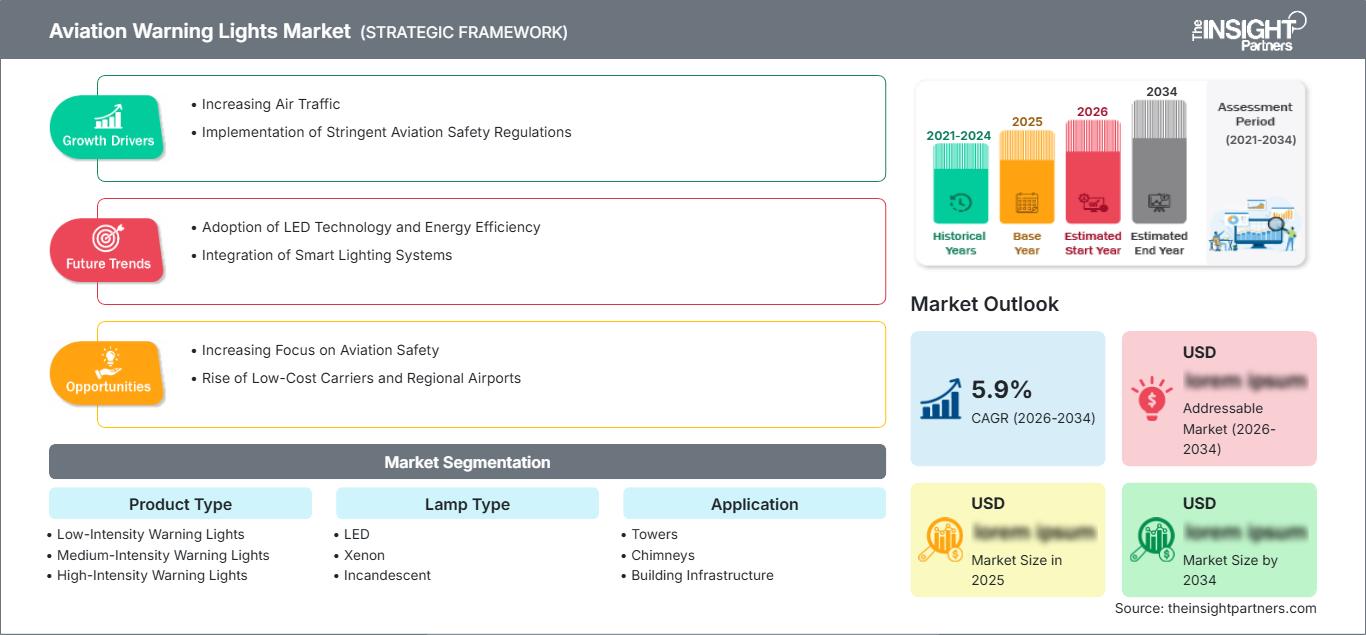
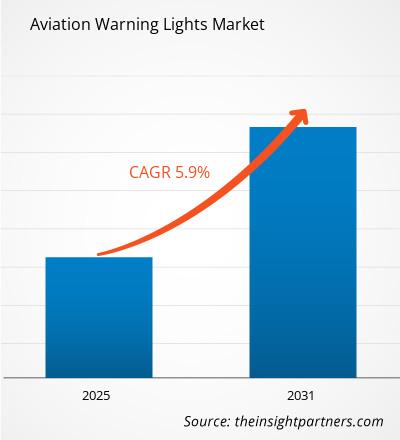
The aviation warning lights market size was valued at US$ 1,102.38 Million in 2025 and is projected to reach US$ 1,893.65 Million by 2034, registering a CAGR of 6.20% during 2026–2034. Expansion is supported by stricter obstacle-marking requirements, replacement of legacy lighting, growth of tall infrastructure, renewable-energy installations, and wider adoption of efficient monitored lighting. Demand is also shifting toward systems that combine compliant optical performance with lower maintenance, remote diagnostics, and adaptable power configurations.
North America is expected to advance at a modeled ~5% CAGR through 2034, supported by a large installed base of communication towers, utility structures, airports, and industrial facilities requiring periodic replacement and compliance upgrades. The region also benefits from established engineering practices and mature procurement channels, while conversion from legacy lamps to LED systems supports recurring retrofit demand. The aviation warning lights market in North America therefore remains comparatively mature, with replacement and modernization contributing more than first-time infrastructure deployment.
Aviation Warning Lights Market Assessment and Insights
Regional Outlook
- North America: ~34% of the global aviation warning lights market share in 2025 | ~5% CAGR through 2034. Market position: North America maintains the leading regional position because of its extensive installed base of communication and utility towers, mature airport infrastructure, established compliance processes, and continuing replacement of aging obstruction lighting systems.
- US: ~82% of North American market revenue in 2025 | ~5% CAGR through 2034. Market position: The US is the leading country in North America, supported by extensive tower networks, airports, utilities, industrial facilities, and established aviation safety requirements that sustain both replacement and new-installation demand.
- Europe: ~27% of the global market in 2025 | ~5% CAGR through 2034. Market position: Europe represents a mature regional market, with Germany, the UK, France, Italy, and Spain supported by dense infrastructure, renewable-energy installations, aviation safety requirements, and continuing modernization of legacy lighting systems.
- Asia Pacific: ~25% of the global market in 2025 | ~8% CAGR through 2034. Market position: Asia Pacific is the fastest-growing region, supported by rapid infrastructure development, expanding airports, telecommunications networks, high-rise construction, wind installations, and increasing adoption of compliant LED-based systems.
Segment Outlook
- Medium-Intensity Warning Lights: ~49% Share in 2025 | ~6% CAGR through 2034. Market position: Medium-intensity systems lead because they address a broad installed base of towers, buildings, cranes, and other elevated structures while balancing conspicuity, energy consumption, visual impact, and regulatory requirements.
- LED: ~70% Share in 2025 | ~7% CAGR through 2034. Market position: LED leads the lamp technology mix as operators prioritize long service life, lower power consumption, simplified maintenance, improved monitoring, and compatibility with solar-powered installations and increasingly connected control architectures.
Competitive Coverage
Astronics Corporation, Avlite Systems, Delta Obstruction Lighting Ltd., DeWiTec GmbH, Dialight plc, Technostrobe, Eaton Corporation plc, Abacus Lighting Limited, Hughey & Phillips, LLC, Obelux Oy
Methodology
The Insight Partners follows Data Collection & Secondary Research, Primary Research, Data Analysis, and Data Triangulation & Final Review to validate market estimates and insights.
Source: The Insight Partners' analysis based on proprietary research, government publications, company annual reports, investor presentations, industry databases, and expert interviews.
The aviation warning lights market is developing from traditional incandescent and xenon devices into solid state LED solutions incorporating control, diagnostic, infrared, synchronicity, and remote monitoring capabilities. This affects the economics of the business because more emphasis is being placed on the total cost of maintaining the equipment instead of simply the upfront cost of the device itself. LED technology also allows for smaller optics and more flexible power management schemes for towers, buildings, cranes, utility structures, and remote installations. In addition, there are ongoing developments in aviation regulations related to obstruction visibility, intensity, flash patterns, and night-vision operation.
The forecast to 2034 includes expansion of customer needs from merely replacement of a single lamp towards installation of the whole system of monitored aviation warning lights. There are emerging markets in Asia Pacific and the Middle East where the demand is expected to be fueled by growth in airport capacity, telecommunication installations, urban construction, renewable energy, and industrial construction. Solar energy solutions can be used at locations with prohibitive electrical connectivity, while controllers help minimize the need for inspection and maintenance. Alignment of local regulations with those of the aviation industry can help to establish uniform product architectures.
Aviation Warning Lights Market Report Scope
| Report Attribute | Details |
|---|---|
| Market size in 2025 | US$ 1,102.38 Million |
| Market Size by 2034 | US$ 1,893.65 Million |
| Global CAGR (2026 - 2034) | 6.20% |
| Historical Data | 2021-2024 |
| Forecast period | 2026-2034 |
Aviation Warning Lights Market Analysis
The aviation warning lights market report mentions both regulation and infrastructure growth. The market is driven by end users who are the owners and operators of potential obstruction sites which could pose threats to airplanes, such as communication masts, utilities installations, tall buildings, cranes, chimneys, airfields, and many more. Engineers and specialists will interpret the height of the structure, its location, the nature of the obstruction, visibility needs, and aviation regulations into light specifications. Suppliers provide light fittings, controllers, sensors, monitoring systems, mountings, and power systems. It is critical in replacement markets because installed lighting is subjected to exposure.
Market forces increasingly prefer suppliers who have the capability of providing integrated systems, as opposed to just lights. The client might need the lights in conjunction with flashheads, photocells, fault alarms, infrared light sources, surge protection features, anti-corrosion materials, solar energy source, and communication interface in a single project. This favors suppliers who have the engineering and certification capabilities, a good distribution channel, and services in place. Availability of the component, semiconductors, optics design, power electronics, and environmental qualification are factors that affect manufacturing costs. Local suppliers will perform well in places where they are familiar with local certifications and installations.
The competition in the aviation warning lights market revolves more around system reliability, compliance with documents, energy efficiency, monitoring capabilities, ease of installation, and maintenance of life cycles. Astronics Corporation holds the know-how of aviation systems, whereas Avlite Systems is known for certified obstruction and solar aviation warning lights. Delta Obstruction Lighting Ltd. and DeWiTec GmbH are specialized in obstruction and aviation-lighting needs, while Dialight plc is known to hold the know-how of LEDs in combination with obstruction lighting solutions.
Eaton Corporation plc differentiates itself through integrated obstruction lighting and control solutions for tough conditions, whereas Abacus Lighting Limited offers solutions to the lighting needs of aviation and infrastructure. The portfolio of Hughey & Phillips, LLC comprises low, medium, and high-intensity systems along with controls and monitoring facilities, whereas Obelux Oy concentrates on LED aviation obstruction lighting with synchronization and diagnostic options. Therefore, strategic investment is moving from mere improvement in luminosity to connected controls, energy-efficient optics, sustainable power, environmental toughness, and retrofitting.
● REPORT CUSTOMIZATION
Tailor This Report To Align With Your Specific Business Requirements
This report can be customized to align precisely with your business objectives, scope, and target markets. Customization options include tailored segmentation, geography, competitive analysis, and strategic insights to support informed decision-making.
Customize This Report →WHAT YOU CAN ADJUST
- ● Segmentations
- ● Geography
- ● Competitive Analysis
- ● Language Preferences
Aviation Warning Lights Market: Strategic Insights
Regional Insights
North America aviation warning lights market
The aviation warning lights market report shows that North America accounted for approximately ~34% of global revenue in 2025 and is expected to expand at a ~5% CAGR through 2034. The region benefits from a large installed base of telecommunications towers, broadcast structures, utility assets, industrial facilities, airports, and elevated buildings. Mature aviation safety procedures create a recurring requirement for compliant equipment, inspections, replacements, and system upgrades. Demand is therefore supported by both infrastructure maintenance and modernization rather than depending solely on new construction.
The local market is affected by the trend towards LED lights that have monitoring and reliability systems as well. The companies controlling tower and utilities across geographic regions have an interest in reducing the maintenance costs, energy usage, and risks of power outages. Companies like Astronics Corporation, Dialight plc, Eaton Corporation plc, and Hughey & Phillips, LLC already have expertise in this field that is suitable for North American markets. There are other potential opportunities related to wind farms and improvements in existing structures.
U.S. aviation warning lights market
The US represented approximately ~82% of North American market revenue in 2025 and is projected to grow at a ~5% CAGR through 2034. The positioning is determined by the magnitude of the telecommunications infrastructure, utility transmission infrastructure, broadcast towers, airport installations, commercial constructions, and other installations where aviation obstruction is considered. The replacement requirement is very crucial in that the operators have to provide adequate lighting for the operational life of their elevated constructions.
Growing demand is characterized by an inclination towards LED solutions, remote monitoring and control, surge protection, and ease of maintenance. Astronics Corporation, Dialight plc, Eaton Corporation plc, and Hughey & Phillips, LLC are players in the wider domestic lighting industry market, whereas tower and infrastructure-specific suppliers provide lighting solutions for this niche. The use of the products can be in communication towers, utility infrastructures, wind turbines, cranes, and industrial installations.
Europe aviation warning lights market
Europe represented approximately ~27% of the global aviation warning lights market in 2025 and is expected to register a ~5% CAGR through 2034. The region has a mature installed base and a strong emphasis on aviation safety, environmental performance, energy efficiency, and integration with renewable-energy infrastructure. Germany is the leading country in Europe, supported by industrial infrastructure, wind-energy development, engineering capabilities, and demand for technically advanced obstruction-lighting systems. The UK remains important because of its telecommunications, airport, construction, and energy infrastructure, while France combines major airports, utilities, industrial facilities, and large-scale infrastructure projects.
Germany's market also benefits from the increasing use of controllable lighting technologies for wind-energy projects, where reducing unnecessary nighttime illumination can help address community and environmental concerns without compromising aviation safety. France and Italy provide demand through airports, industrial sites, high-rise structures, and infrastructure modernization. Spain adds exposure to wind and solar-energy infrastructure as well as airports and elevated structures. Across the region, buyers increasingly favor LED systems with monitoring, synchronization, adaptive intensity, and low-maintenance characteristics. Abacus Lighting Limited, DeWiTec GmbH, Technostrobe, and Obelux Oy are relevant to the European competitive environment.
APAC aviation warning lights market
Asia Pacific accounted for approximately ~25% of global revenue in 2025 and is forecast to expand at a ~8% CAGR through 2034, making it the fastest-growing region. China is the leading country in Asia Pacific, supported by extensive infrastructure construction, industrial development, telecommunications networks, airports, and renewable-energy deployment. Japan and South Korea contribute through advanced airport and industrial infrastructure, while India benefits from airport expansion, telecommunications development, urban construction, and utility investment.
Australia provides demand from aviation infrastructure, mining, utilities, telecommunications, and remote installations where self-contained or solar-powered systems can reduce electrical infrastructure requirements. Across APAC, buyers increasingly consider LED efficiency, corrosion resistance, remote monitoring, and simplified installation when selecting warning systems. The combination of infrastructure expansion and modernization creates opportunities for suppliers that can provide certified products adapted to local regulatory requirements and challenging environmental conditions.
Middle East & Africa aviation warning lights market
The Middle East and Africa region is expected to grow at approximately ~6% CAGR through 2034. Saudi Arabia and the UAE are the leading countries in the Middle East and Africa, supported by airport development, high-rise construction, utility infrastructure, tourism projects, industrial investment, and large-scale urban development. Elevated structures associated with transportation, communications, energy, and commercial development create recurring demand for compliant aviation warning systems.
South Africa contributes through airports, telecommunications infrastructure, utilities, mining, and industrial installations, while the rest of the region presents opportunities where new infrastructure is being developed around major cities, airports, energy projects, and industrial corridors. Harsh heat, dust, coastal exposure, and limited grid access can increase the value of ruggedized and solar-powered equipment. Suppliers that combine durable LED fixtures with monitoring, efficient power systems, and simplified maintenance can address the operational constraints of remote or environmentally demanding sites.
Segmentation Analysis
Product Type
Product Type represents a fundamental purchasing dimension because light intensity determines how an elevated structure is identified under different operating conditions. Buyer decisions depend on structure height, location, surrounding visual environment, aviation authority requirements, and the required balance between visibility and community impact. Medium-intensity systems account for the largest portion of demand, with approximately ~6% CAGR for the leading Medium-Intensity Warning Lights sub-segment through 2034.
- Low-Intensity Warning Lights: These systems serve smaller or lower-profile structures where regulatory and site conditions permit lower optical output. Their compact design, low power requirement, and retrofit suitability support use on buildings, smaller towers, and localized infrastructure.
- Medium-Intensity Warning Lights: Medium-intensity products provide a practical balance between conspicuity and operating efficiency. They are widely relevant to telecommunications towers, industrial structures, buildings, cranes, and other installations requiring visible warning without the power requirements of the highest-output systems.
- High-Intensity Warning Lights: High-intensity systems address structures requiring greater visibility over long distances or under demanding daytime conditions. Their role is particularly important for tall towers, chimneys, large infrastructure, and selected airport-related applications where higher optical output is specified.
Lamp Type
Lamp Type influences lifecycle economics, maintenance requirements, power consumption, optical performance, and system integration. LED technology has become the principal technology direction because solid-state construction supports longer service intervals and flexible control. LED systems are expected to register approximately ~7% CAGR through 2034 as new installations and replacement projects progressively favor energy-efficient architectures.
- LED: LED fixtures provide high efficiency, long operating life, compact form factors, and compatibility with monitoring and solar power. Their ability to integrate infrared outputs, synchronization, diagnostics, and adaptive control strengthens their suitability for modern obstruction-lighting systems.
- Xenon: Xenon remains relevant in installations where existing system architecture, optical requirements, or replacement economics favor established discharge technology. Its installed base creates aftermarket demand for replacement components, maintenance, and selective system refurbishment.
- Incandescent: Incandescent technology represents a mature legacy category. Its declining strategic position reflects higher maintenance requirements and lower energy efficiency, although replacement demand persists where installed systems remain operational and operators transition gradually to newer technologies.
- Others: Other lamp configurations cover specialized or application-specific technologies that do not fit the principal categories. Demand is influenced by project specifications, regulatory acceptance, environmental conditions, and the availability of compatible replacement equipment.
Application
Application determines the physical and operational requirements of aviation warning systems, with demand closely linked to the height, location, structural design, and surrounding airspace of each asset. Towers remain a central demand category and are expected to achieve approximately ~6% CAGR through 2034 as telecommunications, utility, broadcast, and renewable-energy infrastructure expands.
- Towers: Communication, broadcast, utility, and other elevated towers require dependable visibility and often incorporate multiple light levels, synchronized flash patterns, and monitoring systems. Retrofit opportunities remain significant across aging tower inventories.
- Chimneys: Industrial chimneys and stacks require lighting solutions capable of operating reliably in hot, corrosive, or polluted environments. Robust housings, suitable mounting systems, and dependable fault detection are important procurement considerations.
- Building Infrastructure: High-rise and commercial structures use warning lights where their height or location creates an aviation obstacle. Low-profile fixtures, architectural integration, reduced light spill, and reliable rooftop operation influence purchasing decisions.
- Cranes: Construction cranes can create temporary aviation obstacles and therefore require flexible systems that can be installed, monitored, relocated, and removed as projects progress. Lightweight and rapidly deployable solutions are particularly relevant.
- Airports: Airport environments require carefully coordinated obstruction lighting around elevated structures, approach areas, and supporting infrastructure. Reliability, certification, synchronization, and integration with existing airfield systems are major buyer requirements.
- Others: Other applications include bridges, transmission structures, cable systems, industrial facilities, renewable-energy assets, and specialized elevated installations. Requirements vary according to site geometry, aviation exposure, and applicable national standards.
Opportunity Snapshot
| Application | Revenue Contribution | Trend Tag | Adoption Stage |
| Towers | High | Tower Retrofits | Mature |
| Chimneys | Low | Stack Compliance | Mature |
| Building Infrastructure | Medium | Rooftop Safety | Scaling |
| Cranes | Low | Temporary Marking | Scaling |
| Airports | Medium | Airfield Integration | Mature |
| Others | Low | Specialty Structures | Emerging |
Aviation Warning Lights Market Growth Drivers and Impact Analysis
Replacement of Legacy Lighting with Efficient LED Systems
The replacement cycle for incandescent and xenon systems is a major structural driver because operators increasingly evaluate energy consumption, service life, maintenance access, and system reliability together. LED fixtures can reduce the frequency of lamp replacement and enable integrated diagnostics, while their compact architecture supports retrofit installation in constrained locations. For remote towers and dispersed infrastructure, reduced maintenance visits can materially influence lifecycle economics because access often requires specialized crews, lifting equipment, or traffic and site coordination. The shift also creates demand for controllers, monitoring interfaces, infrared functionality, and compatible power supplies rather than only replacement lightheads. Consequently, suppliers with broad retrofit portfolios and certification capabilities can capture value from both fixture replacement and associated control-system upgrades.
Expansion of Tall Infrastructure and Renewable-Energy Assets
Growth in telecommunications infrastructure, high-rise construction, utility networks, wind installations, industrial facilities, and transportation projects expands the addressable installed base for aviation warning systems. Each new elevated asset creates potential requirements for obstruction marking based on its height, location, surrounding terrain, and aviation exposure. Wind-energy development is particularly relevant because turbines are geographically dispersed and frequently located in areas where reliable visibility and low-maintenance operation are important. The resulting demand extends beyond initial equipment procurement into replacement, inspection, monitoring, and service activities. Infrastructure owners increasingly favor standardized systems that can be deployed across multiple sites, enabling centralized monitoring and consistent maintenance procedures. This favors suppliers capable of scaling production while maintaining certification and environmental performance across diverse project environments.
Stronger Focus on Aviation Safety Compliance and System Reliability
Aviation authorities and infrastructure owners place increasing emphasis on maintaining effective obstacle visibility throughout the operating life of elevated assets. Compliance considerations influence fixture intensity, flash behavior, synchronization, monitoring, infrared performance, and installation configuration. A lighting failure can create operational, regulatory, and safety consequences, making fault detection and reliable power management increasingly important. This supports demand for controllers with alarm functions, remote communications, automatic day-night switching, and diagnostic capabilities. Buyers also increasingly evaluate environmental durability because corrosion, temperature extremes, lightning, and electrical disturbances can affect equipment availability. The resulting procurement shift favors complete systems with documented performance and service support. Manufacturers that can combine compliant optics with monitoring and robust electrical protection are therefore positioned to compete for higher-value projects.
Aviation Warning Lights Market Future Trends
Connected Obstruction Lighting and Remote Asset Management
The aviation warning lights market trends indicate that the next stage of the market is likely to involve greater integration between light fixtures, controllers, communication networks, and asset-management platforms. Instead of relying primarily on physical inspections, operators can increasingly use remote alarms and system-status information to identify failures and prioritize maintenance. Connected architecture can also support centralized management of geographically dispersed towers, wind installations, utility assets, and airport structures. As network capabilities improve, manufacturers may differentiate through interoperability, data availability, cybersecurity, and ease of integration with existing infrastructure-management systems. The commercial implication is a gradual shift from selling individual lightheads toward complete monitored systems. Vendors that provide open interfaces, reliable communications, and straightforward commissioning can strengthen relationships with infrastructure operators and engineering contractors.
Adaptive Intensity and Low-Impact Lighting Architectures
Future installations are likely to place greater emphasis on achieving required aviation visibility while limiting unnecessary nighttime illumination. Adaptive intensity systems can adjust output according to ambient visibility or operating conditions, helping reduce energy consumption and visual impact where regulations permit such operation. This approach is particularly relevant to wind farms, densely populated areas, high-rise developments, and infrastructure located near communities. Advanced optical control may also improve light distribution by directing output toward required viewing angles while limiting unwanted ground scatter. Such developments can encourage closer coordination between lighting manufacturers, aviation authorities, renewable-energy developers, municipalities, and project engineers. The competitive advantage will increasingly depend on demonstrating that safety, regulatory compliance, energy performance, and community considerations can be addressed within a single system architecture.
Aviation Warning Lights Market Opportunities
Integrated Solar and Low-Power Systems for Remote Infrastructure
The aviation warning lights market forecast shows that remote towers, utility structures, renewable-energy assets, and infrastructure outside reliable electrical networks create opportunities for self-contained aviation warning systems. Solar-powered configurations can reduce cabling requirements and simplify deployment where trenching or grid connection would add substantial project cost. Advances in LED efficiency, battery management, remote diagnostics, and power electronics can improve the viability of these systems across a wider range of climates. Suppliers can strengthen their position by offering complete packages combining lightheads, photovoltaic modules, batteries, controllers, communications, and mounting equipment. Standardized modular platforms can also simplify installation and replacement across geographically dispersed assets. The opportunity is particularly relevant in emerging infrastructure markets where new structures are being built away from established electrical networks and where operators prioritize predictable maintenance requirements.
Retrofit Packages Combining Lighting, Controls, and Monitoring
A substantial commercial opportunity exists in upgrading installed obstruction-lighting systems rather than replacing entire infrastructure assets. Retrofit projects can combine LED lightheads with new controllers, photocells, synchronization equipment, remote monitoring, surge protection, and compatible power supplies. This approach allows operators to improve reliability and operating efficiency while retaining existing mounting structures and cabling where practical. Suppliers can develop application-specific retrofit kits for tower inventories, industrial structures, airports, utilities, and renewable-energy facilities, reducing engineering time and simplifying procurement. Service organizations can complement equipment sales through inspection, commissioning, maintenance, and compliance support. As infrastructure owners increasingly seek measurable lifecycle savings, vendors that demonstrate lower maintenance exposure and straightforward installation can compete beyond initial equipment price and build recurring aftermarket relationships.
Frequently Asked Questions

- Comprehensive Market Sizing and Forecast Analysis
- Detailed Segmentation Analysis
- In-Depth Market Dynamics Assessment
- Regional and Country-Level Insights
- Competitive Landscape and Company Benchmarking
- Strategic Business Intelligence
Recent Reports
Testimonials

The Insight Partners provided valuable market intelligence that supported our global go-to-market strategy. Their team was professional, responsive, and attentive to our feedback, providing thoughtful analysis and helpful methodological clarifications throughout the project.
Junmo Kim Chief Financial Officer (CFO), Enertech Co., Ltd.
The Insight Partners' SCADA System Market report is comprehensive, with valuable insights on current trends and future forecasts. The team was highly professional, responsive, and supportive throughout. We are very satisfied and highly recommend their services.
RAN KEDEM Partner, Reali Technologies LTDs
I requested a report on a very specific software market and the team produced the report in a few days. The information was very relevant and well presented. I then requested some changes and additions to the report. The team was again very responsive and I got the final report in less than a week.
JEAN-HERVE JENN Chairman, Future Analytica
We worked with The Insight Partners for an important market study and forecast. They gave us clear insights into opportunities and risks, which helped shape our plans. Their research was easy to use and based on solid data. It helped us make smart, confident decisions. We highly recommend them.
PIYUSH NAGPAL Sr. Vice President, High Beam Global
The Insight Partners delivered insightful, well-structured market research with strong domain expertise. Their team was professional and responsive throughout. The user-friendly website made accessing industry reports seamless. We highly recommend them for reliable, high-quality research services
YUKIHIKO ADACHI CEO, Deep Blue, LLC.
This is the first time I have purchased a market report from The Insight Partners.While I was unsure at first, I visited their web site and felt more comfortable to take the risk and purchase a market report.I am completely satisfied with the quality of the report and customer service. I had several questions and comments with the initial report, but after a couple of dialogs over email with their analyst I believe I have a report that I can use as input to our strategic planning process.Thank you so much for taking the extra time and making this a positive experience.I will definitely recommend your service to others and you will be my first call when we need further market data.
JOHN SUZUKI President and Chief Executive Officer, Board Director, BK Technologies
I wish to appreciate your support and the professionalism you displayed in the course of attending to my request for information regarding to infectious disease IVD market in Nigeria. I appreciate your patience, your guidance, and the fact that you were willing to offer a discount, which eventually made it possible for us to close a deal. I look forward to engaging The Insight Partners in the future, all thanks to the impression you have created in me as a result of this first encounter.
DR CHIJIOKE ONYIA MANAGING DIRECTOR, PineCrest Healthcare Ltd.Reason to Buy
- Informed Decision-Making
- Understanding Market Dynamics
- Competitive Analysis
- Identifying Emerging Markets
- Customer Insights
- Market Forecasts
- Risk Mitigation
- Boosting Operational Efficiency
- Strategic Planning
- Investment Justification
- Tracking Industry Innovations
- Aligning with Regulatory Trends





 Get Free Sample for